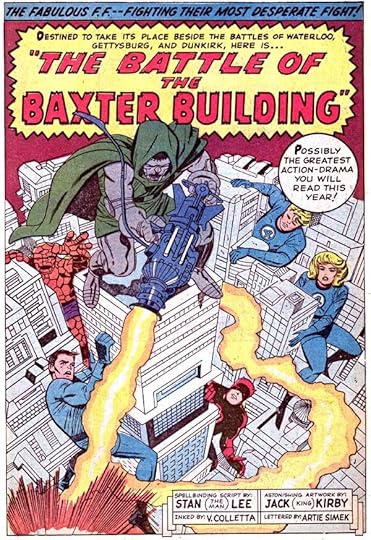
Stan and Jack are back with another classic FANTASTIC FOUR collection, earning the title "World's Greatest Comic Magazine" and throwing in a little extra to boot! It all starts off with the origin of that epitome of evil, Dr. Doom. Find out how Doom's face was scarred and how Reed Richards is connected with that fateful day. Witness the birth of an evil quartet to rival the FF-the Frightful Four! Join the Battle of the Baxter Building as a de-powered FF teams with Daredevil against Dr. Doom in a fight to the finish that'll loosen your fillings! There's also monster menaces galore from the Mole Man to Dragon Man and out-of-this-world villains from the shape shifting Skrulls to the undersea warlord Attuma! But it's not just the panel-bursting action that makes FF great, it's the personal drama. How will Johnny and Sue respond when the father they thought dead returns? When Reed pops the question will the Invisible Girl say, "Yes," or do visions of Namor dance in her head? They're not just classics, one and all, they're Masterworks!
Stan Lee (born Stanley Martin Lieber) was an American writer, editor, creator of comic book superheroes, and the former president and chairman of Marvel Comics.
With several artist co-creators, most notably Jack Kirby and Steve Ditko, he co-created Spider-Man, the Fantastic Four, Thor as a superhero, the X-Men, Iron Man, the Hulk, Daredevil, the Silver Surfer, Dr. Strange, Ant-Man and the Wasp, Scarlet Witch, The Inhumans, and many other characters, introducing complex, naturalistic characters and a thoroughly shared universe into superhero comic books. He subsequently led the expansion of Marvel Comics from a small division of a publishing house to a large multimedia corporation.
Annual 2 -Origin of Doctor Doom. Super iconic, especially for fans of MF DOOM who've heard the Stan Lee narration hundreds of times sampled in his songs. Includes a battle with FF where Doom meets up with that Pharaoh guy in space and decide rather quickly that they are in fact the same person. It's a bit odd that they'd jump to that conclusion... just because Doom built a time machine.
The Fantastic Four 31 - Mole Man Battle with the Mole Man. We also meet Susan Storm's father who is a highly talented sergeant in jail for murder. He breaks out and helps Susan.
The Fantastic Four 32 - The Invincible Man A skrull takes over Susan's fathers body. The dad ends up saving the day and sacrificing himself. It turns out his murder charge was a bit trumped up - he's actually a great person.
The Fantastic Four 33 - Sub-Mariner Sub-Mariner's love interest asks the FF to help - his kingdom is being challenged by a warlord named Attuma. It's a pretty cool underwater battle scene with some iconic Jack Kirby action. It hints that perhaps FF and Sub-Mariner can be allies.
The Fantastic Four 34 - Mr. Gideon A super rich guy (not a masked villain!) decides the next step is world domination... and of course needs to defeat the FF first. He turns each member against each other but eventually they defeat him and he decides being a loving husband and father is a worthier cause.
The Fantastic Four 35 - Dragon Man / Diablo FF visit a college and there's a weird science experiment that gets taken over by Diablo and a killer humanoid Dragon is unleashed.
The Fantastic Four 36 - Frightful Four Susan and Reed announce their engagement and are getting lots of publicity. That's one thing that's cool about FF comics, these guys actually get treated like celebrities which I think is quite realistic. They also constantly get complaints of property damage! The Frightful Four are Sandman, Paste-Pot Pete (Perhaps the greatest super villain ever created, he has a bucket of paste and a spray gun), The Wizard, and Medussa.
The Fantastic Four 37 "Behold! A Distant Star" - Skrulls FF go to outerspace to go to the Skrull galaxy. There they find themselves in a scrap with a wealthy Skrull the Evil Morrat. After his defeat the Skrulls make peace with Earth.
The Fantastic Four 38 - Frightful Four (Again) The FF almost die at the end but Susan's forcefield protect them from a huge "Q-Bomb" blast, but they appear to have lost their powers in the final panel.
The Fantastic Four 39/40 "A Blind Man Shall Lead Them!" - Doctor Doom and Daredevil The FF have no powers, they are rescued by a submarine crew. Back in NYC Doctor Doom is after them but Daredevil assists. In the end the FF get their powers back with a ray gun. Unfortunately, in order to defeat Doom, Reed has to use the gun on Ben Grimm turning Ben back into the Thing. It's interesting that Grimm doesn't seem to willingly want to sacrifice being normal to defeat Doom - Reed makes the decision for him. Stan Lee avoids the cliche heroics.
I admit that should one really read the stories, they become fairly tedious before very long. Jack "the King" Kirby's artwork, however, never does! The stories are dated, sure, but they provide a hit of sweet nostalgia that hits the spot.
This strikes me as the first place in the FF's history that the book is remotely readable: the writing and dialogue is somewhat less corny than earlier issues, and Jack Kirby's art is beginning the take on the blockly, dynamic style for which he'd be remembered.
I keep expecting to get to the point where Marvel's flagship series hits its stride, and I continue to be disappointed. The first volume works as an introduction and proof of concept, the second and third volumes show growing pains with glimpses of greatness--and here we are in volume four, not far from the apotheosis of Silver Age splendor in the form of the Galactus trilogy, and we're still dealing with silliness and forgettable adventures and preposterous resolutions.
I'm not sure I needed as much Frightful Four as we get in this volume. At least Paste-Pot Pete gets an upgrade as the Trapster (though, still mostly glue-based? The concept of being an expert...trapster...is rife with thus-far wasted potential.) Medusa is an interesting addition, and I'm wondering how Stan will handle her turn to not-villainy coming up. But the Wizard's a bore and Sandman is unconvincingly ineffective. The loss of the FF's powers was also a moment of great opportunity that was wasted with poor Silver Age characterization (Reed's frenzy to invent their way out of it is good, but I'd expect more interest on Ben's part to get back to a normal life), and it was all undone with a MacGuffin. "Behold a Distant Star" was a neat little sci-fi tale, but the sudden shift of depiction of Skrull society was jarring (from indistinguishable arch-scientists to another pseudo-medieval monarchy a la the Atlanteans). Dr. Doom's origin is effective and affecting, for all that it introduces some continuity perplexity relative to his past relations with Reed and Ben, and I have to laugh at the madcap nonsensicalness of this head of state engaging in various terroristic acts on foreign soil. Has no one heard of UN sanctions? Ah, well.
This book collects issues 31-40 of the Fantastic Four, along with the second annual, originally released in 1964-65. While the third Masterworks collection threw out a bunch of new (and occasionally crazy) ideas seemingly every issue, during this run Stan and Jack slow things down a bit and revisit some of the themes raised earlier in the series. Reed and Sue get engaged, Namor’s character is fleshed out, and Doctor Doom takes center stage; first in an extended look at his backstory, and later in an epic battle for the Fantastic Four’s headquarters:
Overall, this is probable the strongest of the first four Fantastic Four Masterworks collections, and this series was definitely one of Marvel’s best during the Silver Age. However, the real fireworks are yet to come. Stan & Jack are rounding into top form by the time this collection wraps up, and all the groundwork pays big dividends over the next few years when the Fantastic Four reaches new heights. But even if the best of this series is still ahead, this is a fun read for those who enjoy the Stan Lee Silver Age style. 3 stars, recommended.
Still reading FF in chronological order, for some reason! My favorites in here were #33 (great underwater pastel colors and I love it when Kirby does freaky warrior armor), #35 (kooky college lingo, fun plot, sweet ending) and #37 (Bloodthirsty Susan Storm, space opera, far-out collages, freaky warrior armor again).
#36 ("The Frightful Four") is the first Fantastic Four story in which the reader has to have some prior knowledge of another comic Marvel puts out (those Strange Tales with the Human Torch) to make any sense of what's happening, as Mr. Fantastic has already somehow encountered Paste-Pot Pete, the Winged Wizard and the Sandman before, even though they've never appeared previously in any FF comic book. Likewise, in #39 Daredevil makes reference of helping the FF take on Electro in #2 of his own comic book.
I'm not a fan of these "gotta buy 'em all!" incursions but I realize it's only going to get worse. The M.M.M.S. is becoming a real institution now and one of its casualties is standalone issues, or even comic books.
This book ends just before Kirby and Lee's run comes to its high point, but the stories contained herein are good samples of the Lee/Kirby magic that laid the foundations of the Marvel Universe. Most of the stories are still single issue, although they begin to float into each other more frequently here, which would become a trademark for Kirby's storytelling later on.
The highlight of the book is definitely FF Annual #2 which contains Doctor Doom's first origin story. Never before had a comic book villain been infused with so much humanism and complexity, and to this days it stands as one of the best Doctor Doom stories.
Chic Stone's solid inks over Kirby's pencils is a match made in heaven. The visual storytelling here is superb, and Kirby's action packed style is realized (almost) to its fullest.
The historical significance of Silver Age Marvel can never be stated enough. Stan Lee, Jack Kirby, and a few others revolutionized the comic book world. They ushered in true character development, conflicted heroes, and, dare I say it, “realism” in a completely unrealistic world. I prefer the term believability to realism because there is nothing realistic about this stuff. Stan Lee puts enough pseudo-science and five dollar words into his scripts to make me buy the whole enchilada hook, line, and sinker.
These issues are not the cream of the crop, at least in terms of Lee and Kirby's collaboration on the title. They are excellent, but there isn't anything as groundbreaking as what was coming up within the next year on the title. Annual 2 features another rematch with Doctor Doom. No one draws Doom as good as Kirby did. No one. Anyone who thinks that they can outdo Kirby's Doom is fooling only themselves. Issue 31 features another rematch, this one being in the form of the Mole Man. Issue 32 features the Invincible Man who is in reality (50 year old S P O I L E R!!) the Super Skrull, one of my favorite villains.
Issue 33 features some new blood in the form of Attuma, who would go on to be a major player. Issue 35 introduces Dragon Man, a robotic research construct brought to life by Diablo. Kirby's Diablo is also incredible, although John Byrne did a highly respectable take on the character during his run on this title.
Issue 36 features the introduction of another personal favorite, the Frightful Four. The original incarnation included the Wizard (billed here as the Wingless Wizard), the Sandman, Paste-Pot Pete (who would be renamed the Trapster in issue 38), and Medusa (later of the Inhumans, billed here as Madame Medusa). The FF would have a rematch with them in issue 38. Issue 37 features the Fantastic Four attacking the Skrulls home world in a tale that is silly. The Skrulls as we know them now are a savage, warrior race without a shred of the nobility shown here.
Issues 39 and 40 round out the book in a two-parter where Daredevil assists a temporarily powerless Fantastic Four against Doctor Doom. I'll say it again: Kirby's Doom rules.
Stan Lee was in churn mode here, with a few grammatical errors making it to the finished product. I dunno, you might be able to blame it on letterer Sam Rosen. This group of issues is excellent but is not as groundbreaking as the earlier issues, or the ones coming up. The Silver Surfer, Galactus, and the Black Panther await us in Volumes 5 and 6.
This volume of Marvel Masterworks: The Fantastic Four Vol. 4 collects a fascinating stretch of early Marvel Comics history, covering Fantastic Four #31–40, and it really shows why the series was the company’s flagship title in the mid-1960s. As expected, the action never stops. These stories come from an era when superheroes seemed contractually obligated to fight world-conquering maniacs every other week — and honestly, that’s part of the charm. The introduction of the Frightful Four gives the FF one of their first truly dangerous recurring enemy teams, and the aftermath of that battle — especially the loss of the Fantastic Four’s powers — adds genuine tension to the run. The highlight is undoubtedly the massive confrontation with Doctor Doom, still one of the best Doom stories up to that point. Seeing the FF battle him while powerless raises the stakes considerably, and the guest appearance by Daredevil is both entertaining and historically interesting. It’s obvious Marvel was using its bestselling title to help promote the “Man Without Fear,” but the crossover works surprisingly well. There’s also a stronger emotional undercurrent than one might expect from comics of this period. Ben Grimm’s despair after reverting permanently to the Thing — and his desire to leave the team because he no longer sees himself as human — may feel melodramatic today, but in context it gives the series real heart. The Thing was always the tragic soul of the book, and these issues lean heavily into that aspect. Of course, everything is delivered in the unmistakable style of Stan Lee: endlessly bombastic, overloaded with exclamation marks, and often hilariously over-the-top by modern standards. Still, the sheer energy is infectious. Meanwhile, Jack Kirby’s artwork, while not yet at the cosmic peak he would later reach, already bursts with dynamism and imagination on nearly every page. Not every issue is equally memorable, and some Silver Age storytelling habits can feel repetitive today, but overall this is a very enjoyable and historically important collection from the formative years of Marvel’s first family.
This set of 10 issues (and one annual) is definitely a step up from the previous 10, with fewer self-contained storylines and more subplots that bleed from issue to issue. I am not a fan of super-decompressed storytelling in comics, and Stan and Jack manage to keep things moving here while still letting events from previous issues impact the next one. The three-part storyline from issues #38-40 are a great example of this, with two different villains/villain groups, a guest star, and the introduction of yet another subplot that will carry the characters into #41. (The pages on which Ben turns back into the Thing are really something to behold. What pathos!)
Plus, we have Reed and Sue FINALLY getting together at the end of issue #35. It's interesting that, for a couple that is rightly considered Marvel's first couple, they really don't act like they're together at all for 33 issues (I'm not counting issue #1, when Sue reminds Reed she's his fiance). Sue's force field powers have made her an essential member of the team now, as well. Despite still being relegated to more "womanly" roles and being portrayed as physically weak on a fairly regular basis, she has saved the day on multiple occasions, which, as a female reader, I find to be a positive change.
*Fun fact: My father has an original copy of issue #32 ("Death of a Hero"), which I read when I was 6 or 7 years old. I distinctly remember being alone in my room and reading the page on which Johnny and Sue's dad dies repeatedly until I cried. Then I came out of my room a sobbing wreck, and my mother wondered what was wrong with me.
**I actually read these issues with my four-year-olds as part of the second Omnibus volume that collects issues #31-60 and Annuals #2-4, but I'm reviewing them as though we were reading Masterworks to keep track of when we finish each set of 10 issues.
***My four-year-olds LOVE Paste Pot Pete. We were all bummed when he became the Trapster.
We have here the second Fantastic Four annual, and the ten issues from #31 to #40 of their series. The first few of these are more or less the same as they have been, fun little tales with only the oddity of introducing Sue and Johnny Storm's father just to kill him off the next issue as pushing the envelope. Well, that and the fact that Sue and Reed finally decide to get married.
But starting in issue 36, things changed in this book. The Frightful Four were introduced, providing an effective counter-foil to the Fantastic Four that would be used in five of the next eight issues. There is a strange device utilized in issue 37 that would come back again to solve a plot conundrum in issue 40. Then the Frightful Four actually defeat the Fantastic Four and our heroes lose their powers. Daredevil guest stars for two issues to help them battle Doctor Doom. When Reed turns a now-human Ben Grimm back into the Thing, Grimm comes close to killing Doctor Doom before he is sent back to Latveria. Then the Thing announces he's leaving the FF. The stories start to integrate, and events don't just happen for one month only to return to normal by the end of the issue.
I should also point out that Annual #2 has the original of Doctor Doom which establishes the state of Latveria where he is the ruler, and thus possessor of diplomatic immunity in the U.S. And I love the way Reed convinces Doom through hypnosis that he has beaten the FF so he doesn't have to attack them again. Also, number 39 has a nifty way of undoing this.
The second half of this volume is where the Lee/Kirby FF starts to move up its gears, and (surprisingly) the catalyst is the book’s on-paper weakest concept yet, the introduction of the Frightful Four. Stan Lee even apologises for making such an obvious move on one of the covers! And it’s true that the Frightful Four themselves aren’t any great shakes - it’s simply that their arrival gives the book a throughline and a reason to start bringing in issue-to-issue continuity. And without the need to round off every plot within an issue, the creators can breathe a little: Stan gets to write more ridiculous banter, Jack gets more crazy collages and splash pages, and there’s more time to give events a sense of scale and raised stakes.
There’s still something missing - Lee and Kirby are still shuffling existing pieces around; the conceptual hot streak hasn’t quite begun (the only new ideas this volume are an unrecognisable Medusa and Dragon Man, maybe the last of Kirby’s great monster designs). So there are return bouts with the likes of Namor and the Super Skrull which slow things down initially. But by the end of this collection there’s a new momentum to the Fantastic Four, a feeling that each fresh issue might top the last - or at least try.
Here’s where everything really gets rolling. The characters and world are known and Lee and Kirby can really expand.
We begin with an annual focused on Doom wherein we learn his origin and Latveria more legitimately grounds him.
Then Mole Man, the Storms’ father shows up, the Super Skrull returns, Namor and the first appearance of Attuma, a one-off villain Gideon, Diablo returns with the introduction of Dragon Man(!), the Frightful Four (the Wizard and Paste-Pot Pete come over from Johnny’s solo adventures in Strange Tales, Sandman slides over from Spidey, and Medusa appears for the first time) first team up, more Skrulls, more Frightful Four, then Doom vs the F.F. (Plus a blind lawyer from Hell’s Kitchen).
This is the start of my happiest stretch of the Lee/Kirby years. While the next two volumes are the purest gold, this really showcases their evolving form.
Al ya tener la dinámica del equipo definida, este volumen no aporta mucho en ese sentido. Me encantó en Annual #2, y fue interesante leer sobre el pasado de los Storm en los primeros issues de esta colección, ya que aunque se explica bastante por encima, al menos ahora sabemos un poco más de ellos.
Reed y Sue al fin están comprometidos, algo que estoy amando porque al fin siento que están actuando más como una pareja. Lo que más me molestaba de los primeros issues era el triángulo amoroso Reed-Sue-Namor, pero por suerte resolvieron eso bastante rápido y no veo la hora de leer su casamiento.
Otra cosa que me gusta es como las historias empiezan a sentirse menos autoconclusivas, y cosas que pasaron en un issue pueden seguir afectando en los siguientes.
Y TAMBIÉN ESTÁ LA PRIMERA APARICIÓN DE MEDUSA!!!
(No puedo creer que le cambiaron el nombre a Paste Pot Pete)
Not much has improved since the last series of issues. The family dynamic is still there, the characters all have their distinguished voices, the dialogue is unnecessarily descriptive, the stories are equally contrived and occasionally hamfisted.
A bit of a shame since the opening issue was the best so far. Surprisingly moody opening that leads into what's essentially a Doctor DOOM story and it's only better for it. It is also pretty funny in how dated it is, although the humour of the entire series has aged perfectly fine.
Best: Annual #2 (the aforementioned story) Worst: 33, 34, 36 (couldn't quite choose; they were all either unimaginative or dull)
There are a couple of really fun stories in this graphic collection. A couple. The rest are marred by the obnoxious arguing between members of the FF that sometimes is so intense it nearly gets somebody killed. There are too many issues with front to back battles, too many impossible weapons, and even places where artist Jack Kirby forgets to draw something, so Lee has to explain it away in a caption or dialog. Marvel built its reputation on this?
Continuing my survey of the early days of Stan Lee, Jack Kirby, and the other creative contributors from Marvel comics covered so marvelously and comprehensively in the Marvel Masterworks series. This volume bookends two stories featuring arch nemesis Dr. Doom including his origin. I found it entertaining if not necessarily the most sophisticated examples of storytelling.
Doom's backstory in the annual and the Frightful Four were highlights. Medusa in patricular. This volume is more a 3.5 but you can't give half points as far as I can see on Goodreads. My first 2 comics with Daredevil. He was good. His cane can do almost anything. I look forward to other issues where he guest stars.
Now having read more Silver Age comics, it's easy to see why The Fantastic Four is the premier magazine of the era. It has the best characters. It has iconic and memorable villains. I have the most fun while reading it. I'm excited to finally read the intro for the Inhumans and Galactus in the next collection.
Like the previous volume, the Annual is amazing. Doctor Doom has finally come into his own as the best Marvel villain. The final two issues are also really good, the Fantastic Four losing their powers is a great setup and the fight between The Thing and Doom is super satisfying. The Fearsome Four or whatever they’re called are so boring I had to skip their issues.
The best part was Ben Grimm finally lashing out at the team for beings completely inconsiderate. Reed turns him back into something he hates without even considering what he wants. That was surprising and gave these comics a better end. Overall, enjoyable silver age goofiness.
Gems include Doom’s origin, Rama-Tut’s rescue of Doom, FF’s 1st team-up w/ Namor, Diablo’s creation of Dragon Man, &, most importantly, the Frightful Four’s formation & defeat of the FF & Daredevil & a depowered FF sieging Doom in the Baxter Bldg
First foray into the FF. Started strong with the intro to Dr. Doom which was cool but then fell off in the middle. Really? A guy with a glue gun? I'm glad he got an upgrade a few issues later.
Also, WTF Mr. Fantastic, just changing Ben back into the Thing against his will.
Half of this book is the Fantastic Four fighting the Frightful Four. Kirby's art looks great because Chic Stone did most of the inking. The only thing of note here is Paste Pot Pete for possibly the greatest villian name in all of Marvel Comics.