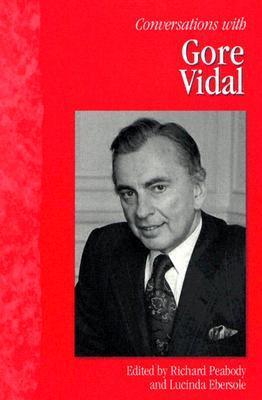
Almost sixty years ago, Gore Vidal burst onto the literary landscape with his World War II novel Williwaw . He never looked back. To date he has published twenty-nine novels, one short story collection, six theatrical plays, and numerous books of nonfiction. His novel The City and the Pillar was a groundbreaking work in the history of homosexual literature. In Myra Breckinridge Vidal created a ribald parody of sexual morality and identity. In 1967 Vidal published Washington, D.C. It would be the first of seven novels that have come to be known as the American Chronicles , a sprawling history of the empire filled with a cast of the most significant social, literary, and political figures of the United States.
Conversations with Gore Vidal features provocative and intriguing interviews with one of America's most prolific authors. Vidal was an enfant terrible in the 1940s and a marginalized homosexual in the 1950s. As Edgar Box he wrote mysteries, and as a screenwriter he penned the script for Ben-Hur . In 1960 he ran for Congress. In the 1990s, he appeared in films such as Gattaca , Bob Roberts , and Shadow Conspiracy . His essay collection United Essays 1952-1992 , which features 114 pieces on everything from Howard Hughes to French literature, won the National Book Award.
Vidal proves himself here to be a witty, acerbic, cantankerous conversationalist, one who is willing to-and often eager to-defy conventional wisdom and lacerate the tired clichés inherent in both politics and literature. A defiant political insider who is related to both the Gores and the Kennedys, he is a proud Leftist who nevertheless does not hesitate to slash at party orthodoxy when he deems it necessary.
In reading this book --- made up largely of a series of interviews from 1960 to 2003 of the great writer, wit, playwright, scriptwriter, thinker, social critic and essayist, GORE VIDAL --- I was once again reminded of the value of such a prodigious and versatile talent whom his many critics and detractors strove mightily to, at first destroy --- and failing that, to marginalize. Whatever one might think of Vidal, he was NOT dull. He has left us a vast body of work, spanning from the publication of his first novel, "Williwaw", in 1946, to his 3 critical analyzes a decade ago of the state of our political system, the invention of our nation from the perspective of the Founding Fathers, and his "Imperial America: Reflections on the United States of Amnesia."
This was a book I thoroughly relished reading. It made me think, laugh, reflect, and re-examine much of what we understand of ourselves as Americans and our relationship with the world, as well as prevailing perspectives on the arts, literature, history, politics, and religion.
GORE VIDAL was a courageous man. And for me, as one who was privileged to meet him in person at a public event in Washington in September 2000, he was the one writer who could always challenge, excite, and stir up my thinking. So, even if I was not always in agreement with some of Gore Vidal's views, I grew much in understanding of power and how it is (and has been, throughout history) exercised throughout the world --- as well as of people of power and influence --- because of his contributions. Vidal's passing is a loss for us all.
What a brilliant series of interviews with a brilliant man. So few people seem to be awake and aware these days. Vidal knew this before the dumbing down of America. His historical novels should be required reading in high schools but that probably won't happen. Too many people are terrified of actually....gasp! ...using their brains.