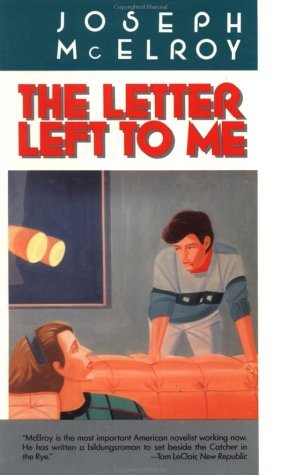
It's interesting to read a novel by an experimental writer tackling subject matter that seems more suited for a writer with earnestly romantic sensibilities. Why is it so damn difficult to avoid mentioning the background of a writer such as Joseph McElroy? His prose; its elliptical opacity, its tendency to grasp everything at once, its introspective inquisitiveness, just seems to demand an explanation of sorts. This stuff clearly isn't normal. Stories do not read this way, even if it's a first-person narrative. McElroy assumes that myriad explanations are required for the smallest occurrences, or the most trivial day-to-day routines, more importantly, that there is something darker, more profound, and ultimately more complex to the most plebeian troubles of our everyday lives. Yet, when McElroy analytically gropes at the banal, he tends to overwrite simplicity with abstraction. Then again, this could be McElroy merely trying something new after the massive critical failure of his magnum opus, Women and Men. The Letter Left to Me is his attempt as a writer to grapple with one of the most troublesome inevitabilities of adult life; dealing with the death of a parent, especially the subsequent questions that a son or daughter might have that were forever left unanswered in the wake of a loved one’s passing.
The title is fairly straightforward. The son of a recently deceased academic has discovered a letter left to him by his father. His father studied chemistry at Harvard, and was a fairly successful man. Yet, from what the narrator only really alludes to about the content of the letter, it was a sort of speech about the destructive force of failure, and it was largely comprised of the father urging his son to avoid the mistakes that he made as a middle-aged man. The letter is disseminated widely; to the immediate family as well as throughout the school that the son is attending. The son struggles (inside of his head mainly) with the reality of the exposure of the letter, and what his father wanted to convey to him.
As is the case with many shorter, avant-garde fiction pieces such as this one, all of the essential details are deliberately omitted. By removing plot details that should normally concern the linear-minded reader, the bulk of the book itself is composed of artistically reflective descriptions. In McElroy's case, they are mainly physical ones. The make and year of the antique desk that the letter is first found in is described in meticulous detail. The young man's thoughts race around and around; from familial digressions, to the Autumnal east coast milieu that the story is set in, and on to his present academic life and a few fragmented bits of information about his father. Keep in mind, the story is really just one long digression of the central character's remembrances of his father.
McElroy is almost always this ponderous. It’s likely that if one were to crack open any one of his books at random, they are bound to catch a character reflecting on physical locations imbued with mystery and clues to even further reflections and endless daydreaming digressions. This might be what makes Women and Men so daunting, or so boring for that matter. Within the context of this short novel, the emphasis is placed on a semantically-driven comprehension of written words and thoughts; what the character thought of his father, what he thinks about what his relatives thought about his father, certain passages of the letter, and most importantly, what the father's notion of failure entailed, and how that might apply to his thoughts about the way in which his son is capable of disappointing his wishes.
One of the problems so central to the execution of this typically high-concept novel of McElroy's, is that his prose is far too lifeless to really foster any of the reader's interest in the emotional underpinnings of the family surrounding these two men, as well the poignant dynamic of their relationship in particular. McElroy's prose reads like the musical phrases of a Steve Reich composition. The minimal repetitions are nuanced enough to sound varied, but the dullness of what is being conveyed seems to drone on monotonously. This in turn, has a devastating effect on the momentum of story, or on the son's thoughts and how they flow. If this isn’t bad enough, there just isn't a cohesive enough theme to the specific concerns of any of the minor characters who happen upon the letter. It's occasionally curious enough to wonder at some of the dialogue between the son and a few of his fellow students, even members of the family who knew the father, but there is never anything intentionally revealing about any of their exchanges.
If this all sounds more or less like a long-winded way of asking what the point of all this is, it's because on the surface The Letter Left to Me intermittently hazards further analysis. It's obvious that the son's concern with the weightiness of something such as a posthumous letter from his father isn't supposed to be summarized or concluded in any way. The beauty to this story, it might seem, is to be found in the connections; physical and otherwise that tie families and friends together. Of course, this showed up a lot in A Smuggler's Bible, McElroy's first novel. One detected a similar obsession with physical objects that were imbued with memory; their power as metaphysical clues to the psychological yearnings and inclinations that the mind occasionally has. Unfortunately, all of the pieces, mainly the eponymous piece, carries so much psychological weight, weight that is explained away with complete indifference to any sort of effort at artistic concentration. Basically, a young man finds a letter that his father wrote to him before he died, it was well written, said some profound things about academic ambition, and the son thought about it for a while. These thoughts connect to other people, and as cycles of thoughts about terribly difficult problems in life tend to be, they're digressive to the point of inconclusiveness, as McElroy's book essentially is.