Hoo boy, this was unpleasant.
What I expected: An account of how the author and her husband lived in Alaska for a while to film the wild fauna there for a documentary.
What I did not expect: A painful amount of abuse and mistreatment of animals robbed from the wild (and thus a normal life), shoved onto chains or into a pen so the Lois' husband could film them for documentary purposes.
Yes, this book is old. I get it. Different standards regarding the use of animals for media back then and all that. But that does not make this okay. That does not mean that this isn't animal mistreatment.
Also, I really gotta question the credibility of Lois and her husband as documentary makers (or, camera people for a documentary, I guess). I know Disney (who they were filming this for) already has come under scrutiny for their White Wilderness (which I presume is the documentary this was filmed for, though the documentary is never mentioned by name) for their mistreatment of the lemmings and inaccurate depictions of lemming migrations and a staged scene of a polar bear falling down a hill.
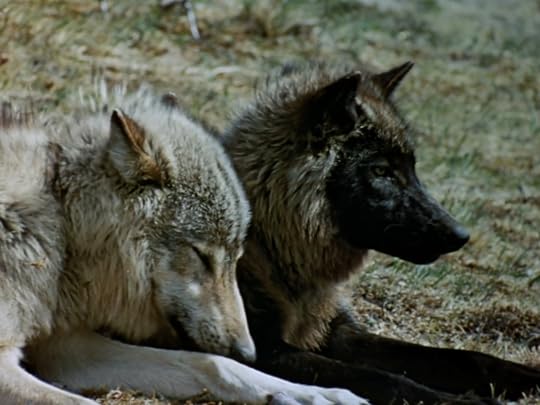
But like, I feel that the stuff with these wolf pups belongs on that list of Disney documentary scrutiny as well. Lois and her husband adopted two wolf pups which were forcefully taken from the wild (their parents killed, their three siblings not surviving) and raised them as pets, keeping them in small pens or even just chaining them up. The pups, Lady and Trigger, never even got the chance at a normal life as wolves and died as young adults, all because Crisler and her husband couldn't be bothered to film actual wild wolves doing wild wolf things. How are we supposed to see the documentary they were filming for as reputable if they just blatantly stage shit with captive animals?
They later on end up adopting two wolverines, an abused sled dog and yet another litter of five wolf pups taken from the wild (and again most of which end up dying except for one. Not mentioned within this book itself, but you can do the background check by googling a few things).
The appalling treatment of the animals and the lack of reputability of the Crislers as documentary makers aside, I also found Lois' writing voice to be dull and slow. Instead of being transported to Alaska and feeling like I was experiencing these events with her, it felt like it was being narrated to me in boring and slow prose.
If there's anything I can give this book credit for (and the reason for two stars rather than one), it's that this book, for the time when it came out, was a very rare positive portrayal of wolves. Remember, they were still widely hated around this time, so book like this and Farley Mowat's Never Cry Wolf at least did some good by not portraying them as monstrous killing machines. As badly as the wolf pups are treated in this book, at least Crisler never portrays them very negatively and I can imagine that for someone reading this at the time this could've been an eye-opener as to wolves not being murderous monsters like was a common misconception at the time.
I don't think what the Crislers did with the wolves was a good thing, of course, keeping wild-caught pups as pets, especially under these bad and unnatural conditions, but at least they wrote about the animals positively which was a bit of a novelty around this time.
But again, that doesn't negate the dull writing voice, the painful-to-read treatment of the animals who were forcefully taken from the wild, and of course the fact that this book made me absolutely disrespect the Crislers as documentary makes because it just ruins their own reputability. If you want to get your ass out there in Alaska to film wolves and caribou, by all means, do that. But film the real deal. Real, wild wolves. Real, wild caribou. Not whatever the fuck they were doing here.