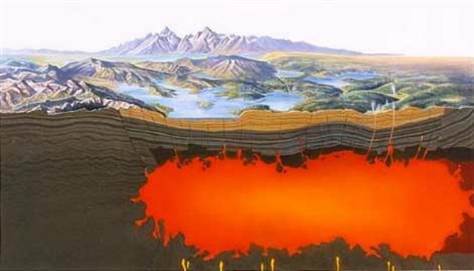
Despite growing evidence of geothermic activity under America's first and foremost national park, it took geologists a long time to realize that there was actually a volcano beneath Yellowstone. And then, why couldn't they find the caldera or crater? Because, as an aerial photograph finally revealed, the caldera is 45 miles wide, encompassing all of Yellowstone. What will happen, in human terms, when it erupts?
Greg Breining explores the shocking answer to this question and others in a scientific yet accessible look at the enormous natural disaster brewing beneath the surface of the United States. Yellowstone is one of the world's five "super volcanoes." When it erupts, much of the nation will be hit hard.
Though historically Yellowstone has erupted about every 600,000 years, it has not done so for 630,000, meaning it is 30,000 years overdue. Starting with a scenario of what will happen when Yellowstone blows, this fascinating study describes how volcanoes function and includes a timeline of famous volcanic eruptions throughout history.
Why did I read this book? Well I'm blaming Mike Mullin because every since I read Ashfall I've had an unhealthy obsession with this super Volcano. I have the next two books in his series coming up so I wanted to be ready. Or I'm just a dumbass.(it could really be that one)
I'm not going to re-hash what the book contained because it's a short one and you can read up on this stuff yourself. (be warned) So I love the "pictures" so I'm going there. (shut up you image haters)
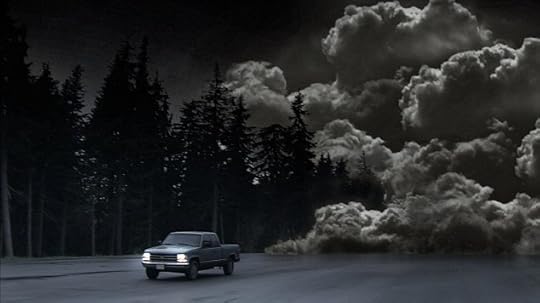
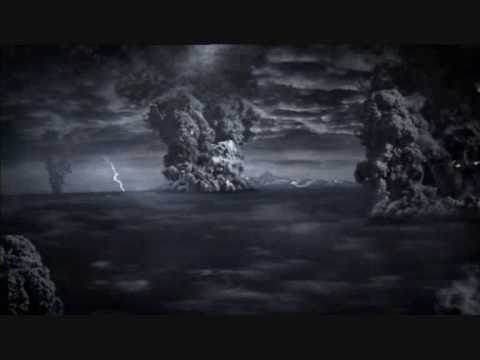
Scared yet? Come on with me and we will either go to these guys houses... or more than likely do this..
I like old mountains, really old mountains. Today (July 24) is my wife’s birthday and we decided to go to Leesburg, Virginia to a restaurant that we both like to celebrate that birthday. When we had gotten about 15 miles, reaching Centreville, Virginia, we could see the foothills of the Blue Ridge Mountains in the distance. Some of these mountains used to be volcanoes hundreds of millions of years ago.
Greg Breining, in his book Super Volcano: The Ticking Time Bomb Beneath Yellowstone Naitonal Park,, has written a book that will or should scare you if you live close to certain volcanoes. There are actually some volcanoes that are just magnificent but not scary. Mauna Loa, the largest volcano on earth also has the greatest lava flow, but that flow is smooth and predictable and really isn’t very scary at all. And then there are volcanoes which aren’t super volcanoes, but which are very dangerous. The most dangerous volcano is probably Mt.Vesuvius. Vesuvius has a million people living within four miles of the crater. About 3 million could die in the first two hours of a major eruption. Put simply, and Breining says this, people haven't learned the lesson of Pompeii. But Breining wants us to understand the so-called super volcanoes are ones that are nothing like Mauna Loa or Vesuvius.
There are super volcanoes in Indonesia like Krakatoa (which killed 36,000 people in 1883) or Tambora which exploded in April 1815 and filled the upper atmosphere with gases and ash so that North America and Europe experienced “The Year without a Summer” in 1816. And then there is Yellowstone, the volcano that is a sleeping giant underneath Yellowstone National Park. When it goes off the next time, it could kill tens or even hundreds of millions of people.
Here are a few facts about this particular super volcano. The last time it went off, with a huge explosion of ash and lava, was 70,000 years ago. So maybe we shouldn't worry about it. But it is an active volcano and the magma is known to be building under the surface of Yellowstone, slowly pushing upwards.
The timing of the eruptions actually may be of more concern. The last three were 2.1 million years, 1.3 million years, and 640,000 years ago. That eruption 70,000 years was only a major eruption and not a super eruption. And the frequency between super eruptions seems to be shrinking. We may be overdue for a super eruption.
Why does Yellowstone volcano explode as it does? Breining does a good job of explaining this. It is because the earth's crust where it Yellowstone is located—in the middle of the North Ameircan plate--does not flow as it does in Hawaii. It is rhyolite, filled with silica. Unlike in Hawaii, where molten basaltic magma easily flows up as lava, in Yellowstone, the rhyolite traps the magma … and the pressure grows and grows. And then it blows. A volume of magma expands 670 times as it rises from the mantle through the crust. And so you get the explosion.
The hot spot under Yellowstone first led to a caldera-causing eruption about 17 million years ago in what is now northwestern Nevada. Over 16.5 million years, the hot spot has moved 350 miles to the northeast and has caused at least 142 Yellowstone-scale eruptions. There were many more eruptions at first, more than 30 every million years at first and they have slowed to about three every million years. As the North American tectonic plate slowly moves, the location of the eruptions from this hot spot has changed. It has left a long track of calderas, some of which are 30 miles wide across the whole Snake River basin. The one 2.1 million years ago had a caldera that was 30 miles by 50 miles and ejected 600 cubic miles of magma.
Volcanoes tend to be where oceanic plates subduct beneath continental plates. Hence you get the famous Ring of Fire, the volcanoes around the Pacific Rim and the hot spots that give rise to volcanoes. There are more than 100 hot spots like the one under Yellowstone that power volcanoes and also move the tectonic plates around the surface of the earth. There are different theories about why a hot spot like the one under Yellowstone occurs in the middle of a continental plate and not at the edge. Most of the super volcanoes are located in Western North America, western South America, and Indonesia. But they have appeared elsewhere as well like Texas ... and in Wyoming.
The last major super volcano on earth occurred 26,000 years in New Zealand creating Lake Taupo. New Zealand at the time was uninhabited. An eruption today there would kill more than 200,000 people. This is minor compared to what would happen if a super eruption from the Yellowstone volcano occurred.
If Yellowstone had a super eruption, all of Wyoming would be gone. The Great Plains wheat fields and much of the Corn Belt would be buried under ash for one or more growing seasons, and field reclamation might take decades or even generations. Rivers will be filled with sediment. Machines will have major problems because of the ashes. Put simply, a billion people could die, and nations will fall.
When will a Yellowstone super eruption occur? We simply don’t know. It could be in a hundred years or in 10,000 years. But it is coming.
Am I worried? Well, I would visit Yellowstone National Park as a tourist. I think that the risks to you are greater from an angry grizzly bear or stumbling into a hot pool than dying from a super eruption. But it does bother me that a super eruption does seem to be overdue and we know that that the next eruption is definitely coming whether it is in ten years or 10,000 years. So yes, I would visit Yellowstone as a tourist, but I wouldn’t live next to Mt. Vesuvius.
The book itself is well written and the science of volcanoes and super volcanoes are well explained. I do think it could have used some better editing. There is some repetition of facts, but maybe that was intentional to drive these facts home. I’m glad that I read it.
Like I said at the beginning, I like old mountains. The Blue Ridge mountains are part of the Appalachians and, at one billion years of age, are the oldest mountain range on earth. When they were young they were the tallest mountains on earth and had a number of very active volcanoes. The mountains now are worn down and the volcanoes are all extinct. I like it like that. Extinct volcanoes are a lot safer to live close to.
I never knew until recently that Yellowstone was such a large volcano. This book discusses what scientists have learned about past super eruptions there have been and the devastation that occurred as well as how it compares against other volcanic eruptions throughout history as well as what could be expected from another. A very interesting book but sometimes I got a bit lost in the terminology but nonetheless very informative and not at all dry. You have to walk away with a greater respect for nature and its power
I would have given this fascinating book five stars, but for the fact that like too many books these days, this one was proofread via spell-checker, i.e., not really. It was filled with so many missing particles and whole phrases and so many other types of bad grammar that it was very hard to read -- and yet I couldn't put it down. Like Paul Gallico's Poseidon Adventure, which set the type for books-I-couldn't-put-down-until-I-had-finished-them-in-spite-of-awful-writing-and-proofreading, the information it presented on its already fascinating subject kept me going right to the end. For that alone it deserves at least 4 stars.
Super Volcano discusses, well, super volcanoes, especially one of the most dangerous in the world today, that of Yellowstone National Park, whose calderas -- yes, you read that right, numerous calderas spread across four US states, from Oregon on the West, through Nevada and Idaho, to the northwestern corner of Wyoming on the east, the result of 142 separate eruptions -- testify to the vast power of this 16.5 million-plus year old volcanic system. Its eruptions have at times left Nebraska, a thousand miles away, covered in layers of fine ash two to ten feet deep. As the crust of the Earth moved over the hot spot welling up from the Earth's upper mantle that created this huge volcanic system, the result of plate tectonics, it bulged up in a dome 300 miles wide and 1,700 feet high; today, the Yellowstone Plateau rises to an average of 7,900 feet above sea level, thanks to the activity of that system.
The author looks at the way in which geologists and paleontologists have put together models of the Yellowstone super volcano, the devastation it has caused, how it compares to other prehistoric super-eruptions somewhat below the vast flood-basalt episodes that helped close out the Permian and Cretaceous, but above many others), how it compares with deadly eruptions throughout human history (beside its eruptions, these others pale into insignificance), what will happen the next time it erupts -- and when that eruption is likely to take place.
The Yellowstone super volcano is still active, and could erupt at any time. The size of that eruption could, at the smallest, devastate surrounding states and wreak global havoc in the form of a 7-year-long winter that causes global crop failures, mass extinctions of many plant and animal species, cover nearby areas in ash layers many feet thick, pollute the air with particulates that could lead to respiratory failure for countless survivors, human and otherwise, and poison America's waterways with sulfur and other potentially deadly chemicals. At the high end of the scale, it could initiate a Great Mass Extinction, rendering most complex life on Earth extinct, and bringing about a sustained Ice Age.
Unfortunately, this is not sensationalistic tabloid journalism. Rather, it's a serious discussion of what scientists have learned about the Yellowstone volcanic system and other super volcanoes, ancient and modern, found everywhere on Earth. I really wish it had been proofread more carefully, because it deserves far better than what it got, and readers have a right to expect something like this book to communicate what it has to offer a great deal better than it actually succeeds in doing.
The Yellowstone super volcano is real, and, yes, it really could erupt again the way it has in the past, with devastating consequences for the whole world. While volcanoes can't be controlled, they can be avoided, and prepared against. Every American should have the knowledge given in this book.
We've all heard about the super-volcano simmering beneath Yellowstone National Park. There have even been movies and novels using the proposed disaster as a plot. But how much do we really know?
Greg Breining has done the research - not only into the history of the hot spot but the science behind plate tectonics - but also the rating system of volcanic eruptions (Volcanic Explosivity Index) from the slow oozing lava characteristic of Kilauea to the explosive venting of magma, ash, hot rocks and more characterized by Yellowstone, Toba, and Taupo. Eruptions that devastated the planet and nearly caused the exinction of hundreds of species. Yellowstone is not the only volcano that has the super volcano classification since there have been at least 40 eruptions classified as a VEI of 8 (the highest) in the last 132 million years.
There is a brief overview of the Siberian and Deccan traps - both among the largest volcanic features on the planet. 'Traps' refers to the stair step-like formations created by thousands of years of lava flows. More impacts on the environment and atmosphere that nearly wiped life from the planet.
Then there short highlights on the most dangerous volcanic eruptions in history - Mr. Breining's opinion - from Toba to Vesuvius to Santorini. He also speculates on what might happen when Yellowstone does eventually erupt - not only in the U.S. but across the world as the American Plains are unable to grow crops for years. The mighty Mississippi would definitely become the Big Muddy. Water would be absorbed by ashfalls. Livestock would suffocate or starve. The fine particles of ash would lift into the high atmosphere and block sunlight, dropping the temperatures across the planet.
At the end of the book, Breining relays the story of a series of documentaries about the Yellowstone supervolcano and the possibility, however remote, of an eruption and the devastating results. Some people contacted the head geologist at Yellowstone with questions and panic along with ideas how to create controlled eruptions at Yellowstone. Even contacting their government representatives demanding that they do something about the situation. The geologists reply: "So I just tried to assure them that it's probably not going to happen, And there's not a damn thing we can do about it if it does."
Seriously? If the government could control volcanic eruptions, the state governments right at the front of that knowledge would be Hawaii, Alaska, Washington, Oregon and California along with the states bordering Yellowstone.
The only negative I could say is the jarring of his use of the Sunda 'Straight' instead of the actual name of the Sunda Strait. A misspelling that should have been caught.
Now this was a thoughtful read while exploring Yellowstone over the past two weeks! This kind of read like a script for a Discovery Channel TV program - facts mixed in with fantastic/fatalistic suppositions about super volcanos and how we will die.
And it isn't just about Yellowstone. There are full chapters related to the "new" geology (be thinking plate tectonics), defining super volcanos (this only happened recently), other super volcanos, the most deadly volcanos. So the sub-title seems like a ploy to get Americans to read the book.
I enjoyed it nonetheless. Another fellow traveler borrowed it from me while on the same trip. He enjoyed it too.
Straightforward, short but still somewhat overlong and contrived investigation into the volcano that is Yellowstone. It will erupt one day and be devastating - a super volcano basically has the power to obiliterate huge areas with massive loss of life. It's probably about due in geologic terms which means withing several hundred years thousand years or so.
The author doesn't seen to know how to end it and pads the book out with brief accounts of similar disasters in historic times (although all are smaller). Interesting, not very in depth but nothing special.
Despite its sensational title, this book is a straightforward introduction to geological processes that formed the Yellowstone caldera and a discussion of volcanism there and around the world. Written in an engaging style accessible for the layperson, it explains what MIGHT happen if/when Yellowstone ever blows. Very enjoyable read while vacationing in and around the national park.
A fun read for those interested in geology, Yellowstone and/or volcanoes. It's a little thin, but it's well written and the style is enjoyable. Much of it will be old news to serious armchair volcanologists, but I still learned a lot from it and found it to be an enjoyable reading experience.
This book was an easy one to enjoy, but honestly, there was one aspect of the book that I found highly tiresome, and that was the way that the author felt it necessary to engage in gratuitous attacks on religious beliefs even as he admits that something like that explosion in the Yellowstone Caldera could be apocalyptic for contemporary society and that there is really nothing that can be done to prevent it given our lack of knowledge about the timing and our lack of ability to cope with the intense volcanism of hot spots. This is not a book that gives a fair amount of cheer to the reader, but it is one of those books that reminds the reader of the dangers that we ignore about in our existence because we can do nothing about them and would rather not think about horrible things. But for those who are willing to read about horrible things, this is an easy book to appreciate, and as someone who likes reading about horrible things I appreciated that this book not only talked about Yellowstone but also the context of volcanism in general.
The book begins with a discussion of the big blast in Yellowstone that took place about 2.1 million years ago (along with the two others that have happened since then (1). After that the author looks at Yellowstone today and how it was shaped by the influence of the magma that lies so close beneath the surface (2), as well as the natural wonders that can be found in Yellowstone, of which there are quite a few (3). The author then spends a chapter engaging in evolutionary just so stories as a way of trying to bolster the legitimacy of geology (4) as well as looking at the puzzle of Yellowstone and the different opinions that exist concerning shallow or deep magma plumes (5). The author looks at a site in Nebraska to show the distant death that took place because of Yellowstone's eruptions (6), and then looks at the biggest super volcanoes that have apparently ever existed (7). After this the author discusses the deadliest volcanoes and what made them so deadly (8) as well as what will likely occur during the next big blast in Yellowstone (9), which is a truly harrowing scenario of around a billion deaths or so and a threat to civilization in the eyes of the author, after which the book concludes with a glossary, references, index, and some information about the author.
Aside from the author's seeming insecurity about the view of geology in the world and his (all too common desire) to make fun of creationism, this book is an easy one to enjoy and it is one that soberly and seriously discusses the reasons why so many people are vulnerable when it comes to volcanoes, namely that volcanoes tend to be where human beings are concentrated and because volcanic soil is so easy to grow crops on, and because their eruptions are irregular and often with long periods of time, which tends to make people complacent. In fact, that complacency is really what this book seems to be designed to counteract, which is definitely something that I can appreciate and understand the value of. I will definitely have to keep my eyes open if there are any other books that discuss the existence of calderas and how they can form and the sort of supervolcanoes that may exist around the world. Admittedly, this is not a subject that many people are going to be interested in but it is definitely something that I can see the importance of.
Yellowstone has been one of the largest volcanoes in history. Yellowstone sits over a geologic hotspot, an area of the Earth's mantle from which hot plumes of magma rise upward, forming volcanoes on the overlying crust. It is the only major hotspot beneath a continental plate. As the the North American plate travels south west this hotspot has thrown up huge "super volcanoes" resulting in massive calderas along the Snake River valley. The magma chamber in this hotspot is mostly rholyte which contains a lot of silica. It does not flow even when molten so the magma chamber doesn't ooze lava but builds pressure until the force is uncontainable. Rholyte containing 5% water by weight expands almost 700 times as it is raised from the high-pressure depths of the earth to the surface creating massive explosions when released.
Yellowstone has had three three major eruptions, 1.3 million years ago, 2.1 million years ago and 640,000 years ago. The great plains of Nebraska and Kansas were buried as much as 9 meters of volcanic ash in the biggest one, 1.3 million years ago. The entire area around route Yellowstone is rising. Measurements in 1920 and 1950 showed that it had risen 2 feet. This is the magma chamber pushing the area up.
The author goes on to explain the massive volcanic eruption around the world throughout history and effects if the Yellowstone a super volcano were to explode again. Not good. Loss of the worlds bread basket on the Great Plains, global drop in temperature, mass starvation, extinctions. etc. It's happened before and will again.
Geneticists have noticed in mitochondrial DNA evidence of a massive constriction occurring about 74,000 years ago. A super volcano Toba in Indonesia erupted at that time and it is thought to have reduced the human population to about 15,000. in 1816 Tambora in Indonesia erupted and is thought to have lowered the world temperature by 5 degrees. The summer in Europe was dark, dreary and overcast with the ash of Tambora. Days of rain confined vacationing poets on Lake Geneva to stay inside. Lord Byron wrote "Darkness" and the future Mary Shelly wrote Frankenstein.
Misc: Yellowstone is the first national park designated by Ulysses S Grant in 1872. More than half the geysers in the world are found in Yellowstone park.
There are microbes that live in the high temperatures of Yellowstone bubbling pools. In 1983 one of these bacteria was used in a polymerase chain reaction that lead to the sequencing of DNA. Who knew?
Ben Franklin was the first to note in print that volcanoes might be responsible for global climate change.
Gravity is weaker where the ocean is deep.
Over the millennia the earths polarity has reversed many times. These reversal are recorded in the molten lava flowing from the sea floor along the borders of tectonic plates. 1961 a researcher name Mason measured the magnetic field on the sea floor off the coast of California and found that it reversed polarity in stripes indicating that the tectonic plates are indeed moving.
The core of the earth is solid because the pressure is so great. The enormous heat of the core is maintained by nuclear reactions.
There have been two “super volcano” eruptions during the existence of the human species. Underneath Yellowstone National Park is a hot spot, a liquid rock filled chamber, that warms the waters of the Old Faithful Geyser and is the heat engine driving the next potential volcanic cataclysm that will have global consequences. The book defines a “super volcano” as an event the erupts 1000 cubic kilometers (km) of magma; for reference, the 1980 Mount St. Helens disaster generated 1 cubic km. The earlier super volcano eruptions may have caused climate change by casting large amounts of dust into the atmosphere, blocking sunlight, and cooling the planet—a volcanic winter or ice age. The Lake Toba event 72,000 years ago almost caused the extinction of Homo sapiens.
There is less discussion about Yellowstone than might be expected from the subtitle. Other sub-super volcano eruptions, e.g. Santorini, Vesuvius, and Krakatau, are described along with their impacts on the planetary climate and human civilization. The last chapter is saved for a description of the “apocalypse” that will come from a Yellowstone super volcano eruption, which is considered inevitable but not soon.
This is well-written popular science book about geology, volcanic eruptions, and the Yellowstone hot spot which is the source of volcanic eruptions along the Snake River basin over the last 17 million years. The most recent super volcano eruptions were 2.1 and 1.3 million years ago, and the last one was 640,000 years ago. A calculation of the frequency volcano eruptions related to the Yellowstone hot spot is once every 100,000 years. This feeds the belief that an eruption is over due.
This is good layman's explanation of volcanos in general, the history of geology and the eventual development of the theory of plate tectonics, which explains volcanos and the effects of volcanos on the earth. The realization that Yellowstone National Park is one large volcano is a recent discovery. Other super volcanos exist, but none have erupted during recorded history. By way of explaining what the effects of a super volcano might be, Breining discusses the recently developed volcano rating system and the effects of the most disastrous volcanos of recorded history all rating at a 6 or below. Super volcanos begin at 8 and are 1000 times more destructive than a level 6. I found this an interesting read, but am a little concerned about the currency of the information. The book is now ten years old; our geological knowledge has been changing rapidly
... and well-researched. An exciting read. My first reaction was to become a "prepper"!!! Then I became a big fan of the Geological Service. Monitoring may be our only action possible. This book also made me re-think human-created global warming. It seems to me that all our industrial polluting over hundreds of years is a blip geologically, compared to one volcano. I don't mean to advocate for LESS human responsibility here - we should do all we can - it only makes sense. But what one volcano can do - and HAS done - is bigger than we are. And the planet recovers... Just saying...
A most interesting book if you are interested in volcanoes. Thru research and dating soil samples science has found many old super volcanoes and how they were formed over the last 12 to 60 million years, yes I said million. A prime example of Yellowstones influence over our environment can be found in Nebraska at the Ashfall Fossil Beds State Historical Park. Does the author have a time that Yellowstone might erupt? No, it could happen in a year it could happen in a 1000 years. How will we know, that part is somewhat predictable as there would be a major rise at the center of the caldera, and a great increase in number and intensity of earthquakes around Yellowstone.
Terrifying and informative at the same time. I'm not a fast reader by anyone's standards and I finished this book in a day because I just couldn't put it down. Definitely a great read for anyone who's been to the park to really help put things in perspective. Just how ancient, dangerous, ever changing, and still very active Yellowstone is, and how it compares to volcanos around the globe and throughout time. An amazing read for those with a love of geology and/or Yellowstone. An incredible book about an incredible place.
This is an excellent starter book on Yellowstone park - its history and also about geography. It also reviews the other super volcanoes that have happened on Earth. It's definitely not for the specialist - as a novice coming into the topic of super volcanoes, this was an eye-opener to the complexity of geology.
Interesting look at the history of the super volcano that is Yellowstone National Park. Also tells the history of other volcanic eruptions around the world, and compares them to what Yellowstone has been and what it could be, which is a end of the world as we know it event. It likely won't happen in my lifetime though.
Super Volcano starts off as a story which is fine but that's not what I was expecting. The scientific information is there and it is a great book that discusses supervolcanoes and previous disastrous volcanoes. Definitely an interesting read and you might learn a little bit about the supervolcano in the middle of the United States.
A very good read on a fascinating truth concerning Yellowstone National Park. The truth is the geological forces currently at play beneath the park are the same as those that preceded the 8.4 blast 640,000 years ago.
I really enjoyed the first half of the book. The later chapters got into details about various volcanoes and eruptions around the world, and I wasn’t as interested in a lot of those details. Overall it was interesting though.
I bought this while at Yellowstone to get more of an idea of the history around me and I loved it. It gave a good overview of the supervolcano as well as overview of the park. Highly suggest!
This was okay! I enjoyed parts of it, but I felt like it got too much into generic worldwide volcano history more than the history of Yellowstone. It was good, but not great.
The history part of how Yellowstone was formed was a must-read before a visit. I thought the book got off topic at the end; Yellowstone is in the title but it was no longer about Yellowstone.