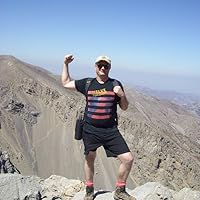
Robert Twigger is a British author who has been described as, 'a 19th Century adventurer trapped in the body of a 21st Century writer'. He attended Oxford University and later spent a year training at Martial Arts with the Tokyo Riot Police. He has won the Newdigate prize for poetry, the Somerset Maugham award for literature and the William Hill Sports Book of the Year award.
In 1997, whilst on an expedition in Northern Borneo, he discovered a line of menhirs crossing into Kalimantan. In 1998 He was part of the team that caught the world's longest snake- documented in the Channel 4/National Geographic film and book Big Snake; later he was the leader of the expedition that was the first to cross Western Canada in a birchbark canoe since 1793. Most recently, in 2009-2010, he led an expedition that was the first to cross the 700 km Great Sand Sea of the Egyptian Sahara solely on foot.
He has also written for newspapers and magazines such as The Daily Telegraph, Maxim and Esquire, and has published several poetry collections, including one in 2003, with Nobel Prize winner Doris Lessing.
Robert has published Real Men Eat Puffer Fish (2008), a humorous but comprehensive guide to frequently overlooked but not exclusively masculine pastimes, while his latest novel Dr. Ragab's Universal Language, was published to acclaim in July 2009. Robert now lives in Cairo, a move chronicled in his book Lost Oasis. He has lead several desert expeditions with 'The Explorer School'.
Robert has given lectures on the topic of 'Lifeshifting', an approach which emphasises the need to centre one's life around meaning-driven motivation. Drawing on experiences working with indigenous peoples from around the world, he has spoken on 'work tribes' and polymathy. He has also spoken on leadership. Some of these talks have been to companies such as Procter and Gamble, Maersk Shipping, SAB Miller and Oracle computing.
I loved this book the first time I read it, which was shortly after this particular edition was first published. I loved it when I read it again last week. It remains one of the most entertaining travel/exploration of modern times I have had the pleasure of reviewing. Robert Twigger has a great sense of self-effacing fun and has a wry eye on the world and its inhabitants that surround him. When he and his family relocate to Cairo (his wife is Egyptian) to save money, he is determined to follow in the wake of famous desert explorers like Almasy and Bagnold and look for the 'lost oasis' of Zerzura. His first quest is to find the perfect vehicle, which eventually leads him to constructing a hand-pulled trolley! But there's lots of fun and some group adventures to be undertaken before he gets to test his trolley on the sand dunes of the Sahara. This is one to tuck away for a rainy day when you want to conjure up vast seas of sand and desert caves adorned with ancient art.
I have previously read a couple of Robert Twigger books-Angry White Pajamas and Big Snake-so I knew what I was getting into with Lost Oasis (2007). It's part memoir and part a travel adventure story-that ends somewhat anti-climatically. It makes you wonder what the point of the book was-there is not lost oasis and I think he knew that to begin with, but he needed a goal or frame of reference to get him into the desert to create experiences that he could write about. He moved to Egypt with his Egyptian wife mainly to cut his cost of living and the desert was there to explore. Honestly, I found the parts about life in Cairo much more interesting than the episodes in the desert. Perhaps, the desert is something one must experience for oneself, and I haven't properly explored any deserts and have not yet ventured to Egypt or Africa-all things that long to do in the future.
Not nearly as good as the excellent 'Angry White Pyjamas'. Some interest for the account of life in modern Egypt, for a bit of background about the history of exploration of parts of the western desert of Egypt (by non-Egyptians, that is), and for some rather sporadic worthwhile insights about travelling and visiting the desert.
On the whole, though, this reads rather too much like 'I write for a living, and this is all I have to write about at the moment', or 'I've done a bit of local exploration for my own interest and I think I can work it up into a book.' Rather puts me off reading his other later books.
Some parts of this book were fascinating and others bored me...the pacing was really inconsistent. But maybe that was intentional on the author's part, as a way to reflect what it's like to live in Egypt. I'm not sure I'd recommend this one to anyone.
Entertaining. Description of life in Cairo was really funny. After having been into the desert myself a few times I can relate to the authors love of it. Had some really interesting, but easily digested facts about what you find in the desert and some of its explorers.