

What do you think?

Woodcuts #1-6
Six Novels in Woodcuts
From the eve of the Great Depression to the start of World War II, Lynd Ward (1905 1985) observed the troubled American scene through the double lens of a politically committed storyteller and a visionary graphic artist. His medium—the wordless "novel in woodcuts"—was his alone, and he quickly brought it from bold iconographic infancy to subtle and still unrivalled mastery.
Gods' Man (1929), the audaciously ambitious work that made Ward's reputation, is a modern morality play, an allegory of the deadly bargain a striving young artist often makes with life. Madman's Drum (1930), a multigenerational saga worthy of Faulkner, traces the legacy of violence haunting a family whose stock in trade is human souls. Wild Pilgrimage (1932), perhaps the most accomplished of these early books, is a study in the brutalization of an American factory worker whose heart can still respond to beauty but whose mind is twisted in rage against the system and its shackles.
Prelude to a Million Years (1933) is a dark meditation on art, inspiration, and the disparity between the ideal and the real. Song Without Words (1936), a protest against the rise of European fascism, asks if ours is a world still fit for the human soul. Vertigo (1937), Ward's undisputed masterpiece, is an epic novel on the theme of the individual caught in the downward spiral of a sinking American economy. Its characters include a young violinist, her luckless fianc
1408 pages, Hardcover
First published October 14, 2010
About the author
Lynd Ward
206 books67 followersLYND WARD (1905-1985) illustrated more than two hundred books for children and adults throughout his prolific career. Winner of the Caldecott Medal for his watercolors in The Biggest Bear, Mr. Ward was also famous for his wood engravings, which are featured in museum collections throughout the United States and abroad.
Married to May Yonge McNeer, several of whose works he illustrated. https://www.goodreads.com/author/show...
Married to May Yonge McNeer, several of whose works he illustrated. https://www.goodreads.com/author/show...
Ratings & Reviews
Friends & Following
Create a free account to discover what your friends think of this book!
Community Reviews
Displaying 1 - 29 of 29 reviews

March 2, 2017
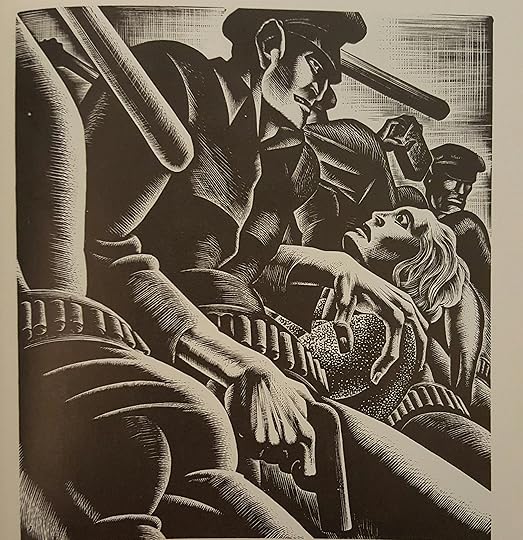
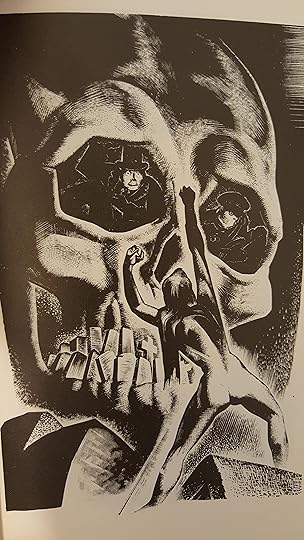
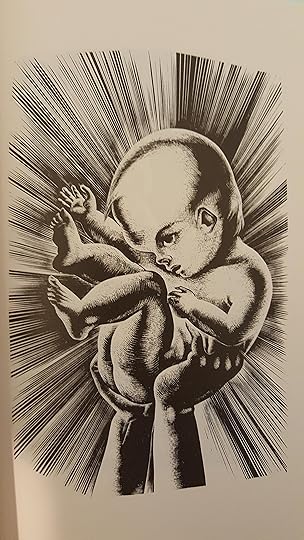
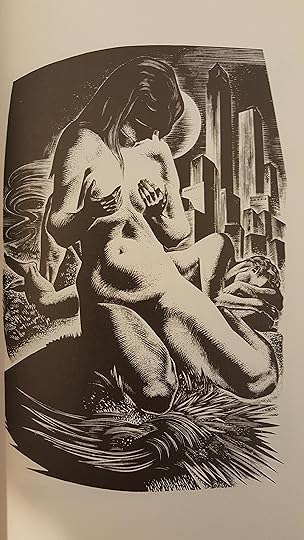
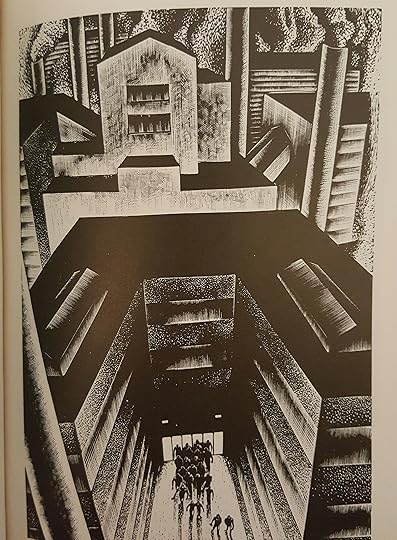
Books I feel absolutely blessed to own. The cradle and swaddling of the American comic--undeniably a genesis, wordless and contained. Lynd Ward took his training under master German woodcut printers and turned them into sequential art, or comics, whichever you'll have. This is hard to find, but so worth finding and devouring if you can.
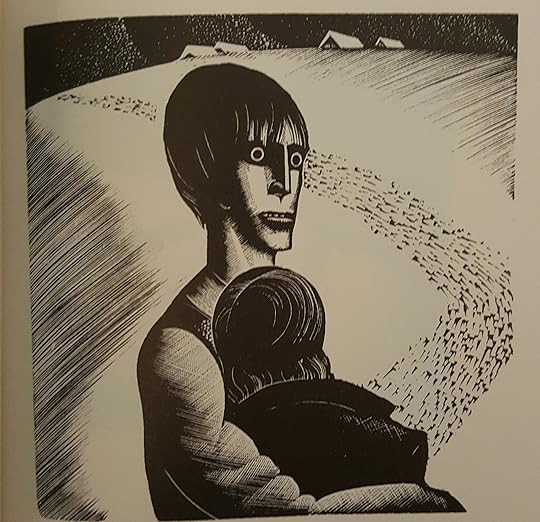
The essays that come with this give some great scaffolding to the work. But the work doesn't need it--there is more than enough in one, two, three panels, a world in several hundred.
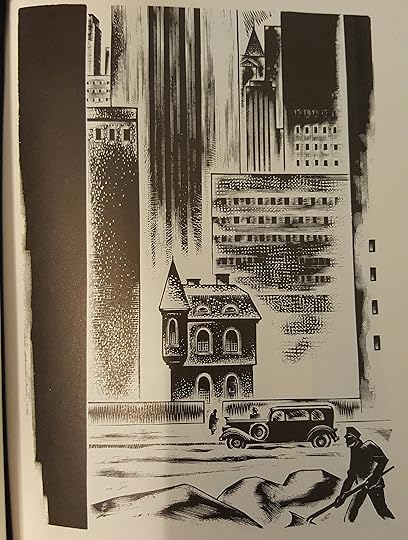
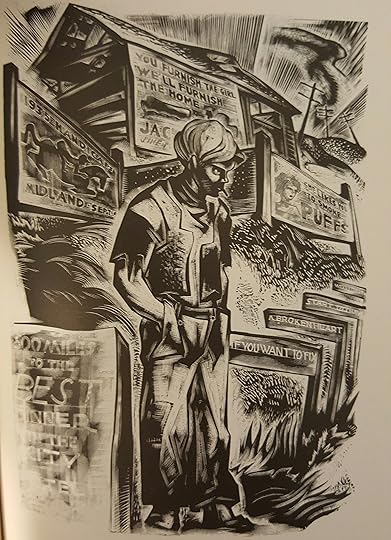
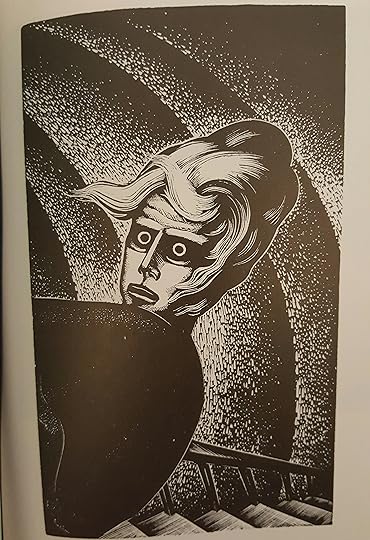
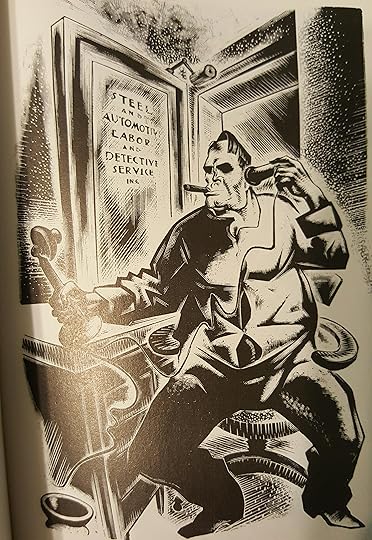
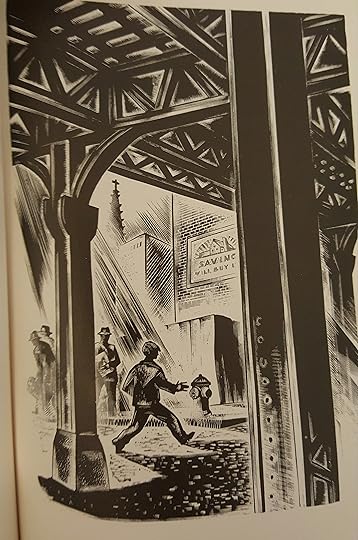
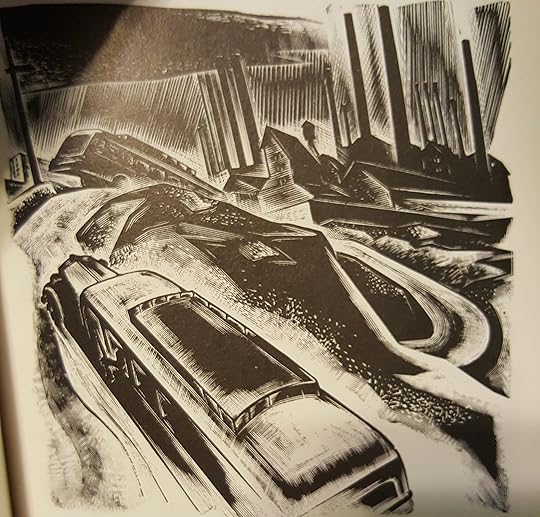
Ward's work is also a great reminder of the political nature of so much American art in the early 20th century, and political in wholly accessible manners. This is high stuff, but it's also understandable stuff with almost no barrier to entry. I tend to buy into the "those puritan, compromising, complacent olden days" notion in my lazier moments. These books challenge that. The examples, and the rest of the review, is below in the quoting of Ward's own work (taken by my camera phone under a bedroom light, so apologies for quality issues) (don't you wish pictures were just less white and blue and sharp these days? the headache of the digital screen, miss that burning orange tint).
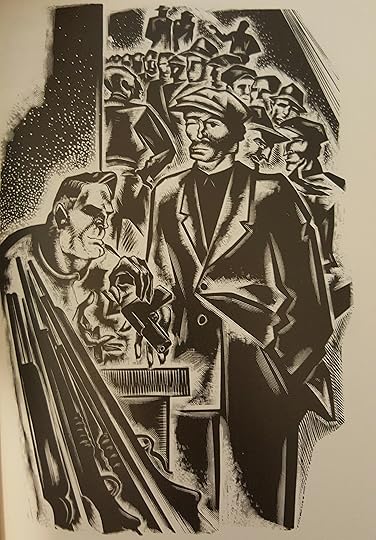
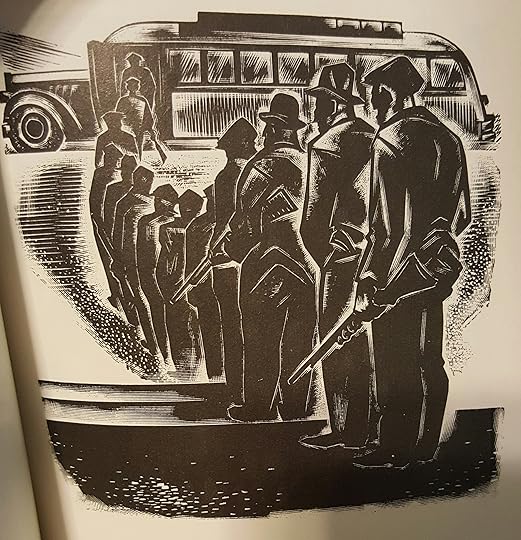
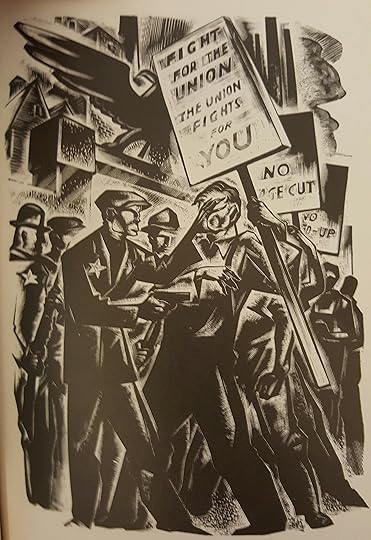

August 5, 2012
I highly recommend this to anyone who's into the history of comics as a medium or fans of German Expressionist film. This Library of America edition is really high quality and the introduction by Art Spiegelman and the essays by Ward are fantastic.
The best here is definitely Vertigo which is Lynd's last and longest work. It succeeds wonderfully in fulfilling the ambitious depth of story first attempted in Madman's Drum (which was overly complicated and failed in conveying story and character development clearly) and a more nuanced characterization.
Reading a story through Ward's wood blocks can be a surprisingly deep and moving experience. I'm eager to hunt down his children's books and other authors' works that he illustrated.
Some quotes from Ward's essays:
"Some day, I fear, scientists will successfully demonstrate that life had its origin in an ancient accident in which several previously isolate basic substances were merged into one by a flash of lightning, with the complexity of all human experience the unforeseen result.
"But until that day arrives, we have implicit permission to look back on whatever portion of that complexity we can remember, collectively or individually...There is nothing more exhilarating than the discovery of an overall purpose behind the seemingly unrelated events that comprise the part of either a nation or a citizen."
On qualifying works as true pictorial narrative: "If understanding is dependent on the words, the narrative is probably more properly described as a work of illustration, one in which the verbal element is primary and the pictorial element - no matter how impressive in draftsmanship or how much of the available space it occupies - is secondary."
On the Great Depression (eerily applicable to our present times):
"It seemed that only the morally crippled or the socially irresponsible could fail to react to the obvious effect that the vast, complicated, and impersonal social forces were having on the substance of so many individual lives."
"...it might even be possible to suggest that an impersonal social force is the accumulation of individual actions for which individuals are finally responsible."
The best here is definitely Vertigo which is Lynd's last and longest work. It succeeds wonderfully in fulfilling the ambitious depth of story first attempted in Madman's Drum (which was overly complicated and failed in conveying story and character development clearly) and a more nuanced characterization.
Reading a story through Ward's wood blocks can be a surprisingly deep and moving experience. I'm eager to hunt down his children's books and other authors' works that he illustrated.
Some quotes from Ward's essays:
"Some day, I fear, scientists will successfully demonstrate that life had its origin in an ancient accident in which several previously isolate basic substances were merged into one by a flash of lightning, with the complexity of all human experience the unforeseen result.
"But until that day arrives, we have implicit permission to look back on whatever portion of that complexity we can remember, collectively or individually...There is nothing more exhilarating than the discovery of an overall purpose behind the seemingly unrelated events that comprise the part of either a nation or a citizen."
On qualifying works as true pictorial narrative: "If understanding is dependent on the words, the narrative is probably more properly described as a work of illustration, one in which the verbal element is primary and the pictorial element - no matter how impressive in draftsmanship or how much of the available space it occupies - is secondary."
On the Great Depression (eerily applicable to our present times):
"It seemed that only the morally crippled or the socially irresponsible could fail to react to the obvious effect that the vast, complicated, and impersonal social forces were having on the substance of so many individual lives."
"...it might even be possible to suggest that an impersonal social force is the accumulation of individual actions for which individuals are finally responsible."

January 16, 2023
I was familiar with work of Flemish artist Frans Masereel (1889-1972), but somehow his American counterpart Lynd Ward (1905-1985) had escaped my attention. Until now! Both artists made wordless novels told in woodcuts, and this two volume box set contains all six by the American master. Needless to say these account for a fascinating "read". Ward views his homeland through socialist glasses, and heavily criticizes American society, ruthlessly showing the falsehood of the American dream, the hardships of the Great Depression, and the class struggle, in which the few get a lot, and the masses hardly anything.
Yet, his six novels are highly different from each other, both in length and in style. The first, 'God's Man' is the most straight-forward with its classic devilish tale. In 'Madman's Drum' the sins of the protagonist's father puts a curse on his own life. 'Wild Pilgrimage' is about a restless factory worker, the short but hard to decipher 'Prelude to a Million Years' about a struggling sculptor, the even shorter 'Song Without Words' some sort of nightmare, and the very long 'Vertigo' a complex tale starring three protagonists whose lives intertwine.
Ward's artwork is fascinating throughout. He mixes art deco with expressionism, and experiments with different formats and edge-less prints. His style is sculptural, very attractive, and communicative, even if some parts are puzzling.
I liked this book a lot. Highly recommended for novel readers, graphic novel fans, and art lovers alike.
Yet, his six novels are highly different from each other, both in length and in style. The first, 'God's Man' is the most straight-forward with its classic devilish tale. In 'Madman's Drum' the sins of the protagonist's father puts a curse on his own life. 'Wild Pilgrimage' is about a restless factory worker, the short but hard to decipher 'Prelude to a Million Years' about a struggling sculptor, the even shorter 'Song Without Words' some sort of nightmare, and the very long 'Vertigo' a complex tale starring three protagonists whose lives intertwine.
Ward's artwork is fascinating throughout. He mixes art deco with expressionism, and experiments with different formats and edge-less prints. His style is sculptural, very attractive, and communicative, even if some parts are puzzling.
I liked this book a lot. Highly recommended for novel readers, graphic novel fans, and art lovers alike.
December 8, 2010
A great treasure. Work of extraordinary narrative richness and unflagging social conscience. I just wish I could afford to actually own it.

Read
January 4, 20266.5 our of 10.
I’m not sure where I came across Lynd Ward’s work but the idea of a novel without words, expressed entirely through woodcut images, intrigued me so I put this edition on my wish list and this Christmas some friends granted my desire. Collected here are Gods’ Man, Madman’s Drum, Wild Pilgrimage, Prelude to a Million Years, Song Without Words and Vertigo, created over the course of the 1930s.
Gods’ Man, Ward’s first effort, is a straightforward retelling of the Faust story – a man makes a deal with the devil but ends up with an empty life and a damned soul. He returns to this theme several years later in Prelude but with a more assured style both in story telling and artwork. Madman’s Drum is Ward’s first attempt at a more complex story. It’s about a family that initially acquires its wealth in the slave trade and explores the effect that it has on the children. The story is a bit hard to follow but the art is amazing. Vertigo is Ward’s second attempt at a complex story weaving together the lives of several characters and as with Prelude versus Gods’ Man, it’s far more successful as it brings together the lives of three people during the Depression – a young woman whose fiancé disappears and whose father tries to commit suicide when he loses his job; a wealthy old man, owner of the factory where the father had worked (I think – one of the qualities of these stories is that a fair amount of what is going on depends upon a person’s interpretation); and a young boy who’s struggling to survive.
Wild Pilgrimage is the story of a laborer who dreams of a better life but is constantly thwarted. It’s unique in the collection in that the protagonist’s dreams are set apart from the black-white reality by the use of a washed-out red color. And Song Without Words, written in the mid-‘30s when Fascism was on the rise worldwide, depicts a woman who refuses to submit.
The collection is an interesting form of storytelling that I’d like to see more of. In addition to the novels, essays Ward wrote later in his life reflecting on the works and his motivations in using this medium are also worth looking at.
Recommended.
Postscript: While I was composing this review, it struck me that I had briefly flirted – all unknowing – with this way of telling a story back in sixth grade. In that year I first read Lloyd Alexander’s The Chronicles of Prydain and my teacher, Mrs. Graber, let me work on a special project where I retold the final book in a filmstrip. (The “filmstrip” is a technology long since superseded by other media but I’m sure you can find explanations of it on YouTube or Wikipedia – look it up.) Because of the limitations of the strip of plastic I was using to illustrate the story, I couldn’t include text; I was forced to convey what was going on solely with the pictures.
I’m not sure where I came across Lynd Ward’s work but the idea of a novel without words, expressed entirely through woodcut images, intrigued me so I put this edition on my wish list and this Christmas some friends granted my desire. Collected here are Gods’ Man, Madman’s Drum, Wild Pilgrimage, Prelude to a Million Years, Song Without Words and Vertigo, created over the course of the 1930s.
Gods’ Man, Ward’s first effort, is a straightforward retelling of the Faust story – a man makes a deal with the devil but ends up with an empty life and a damned soul. He returns to this theme several years later in Prelude but with a more assured style both in story telling and artwork. Madman’s Drum is Ward’s first attempt at a more complex story. It’s about a family that initially acquires its wealth in the slave trade and explores the effect that it has on the children. The story is a bit hard to follow but the art is amazing. Vertigo is Ward’s second attempt at a complex story weaving together the lives of several characters and as with Prelude versus Gods’ Man, it’s far more successful as it brings together the lives of three people during the Depression – a young woman whose fiancé disappears and whose father tries to commit suicide when he loses his job; a wealthy old man, owner of the factory where the father had worked (I think – one of the qualities of these stories is that a fair amount of what is going on depends upon a person’s interpretation); and a young boy who’s struggling to survive.
Wild Pilgrimage is the story of a laborer who dreams of a better life but is constantly thwarted. It’s unique in the collection in that the protagonist’s dreams are set apart from the black-white reality by the use of a washed-out red color. And Song Without Words, written in the mid-‘30s when Fascism was on the rise worldwide, depicts a woman who refuses to submit.
The collection is an interesting form of storytelling that I’d like to see more of. In addition to the novels, essays Ward wrote later in his life reflecting on the works and his motivations in using this medium are also worth looking at.
Recommended.
Postscript: While I was composing this review, it struck me that I had briefly flirted – all unknowing – with this way of telling a story back in sixth grade. In that year I first read Lloyd Alexander’s The Chronicles of Prydain and my teacher, Mrs. Graber, let me work on a special project where I retold the final book in a filmstrip. (The “filmstrip” is a technology long since superseded by other media but I’m sure you can find explanations of it on YouTube or Wikipedia – look it up.) Because of the limitations of the strip of plastic I was using to illustrate the story, I couldn’t include text; I was forced to convey what was going on solely with the pictures.

December 30, 2010
I tried to portion these out, because it doesn't take very long to read each one. But the work that went into them! I think woodcuts are my favorite art, next to wooden sculpture. I'm glad that this was a very thoughtful holiday gift to me, because now I can go back again and again.

October 17, 2017
Lynd Ward wasn’t the first graphic novelist. There were a couple who preceded him, though they’re not what we'd call graphic novels nowadays. They’re more like narrative printmaking, not cartoonists. Ward knew nothing of the comic vernacular, having grown up in a progressive religious family where the only illustrations he saw were from the Bible. They must have been some pretty wild Bible illustrations, because his work in the SIX NOVELS IN WOODCUT are beautiful designed stark images that reflect German Expressionism. That’s not surprising, as a young artist he bypassed the expected stay in Paris for German in the creative fervent of the turn of the last century. Every painstakingly detailed woodcut is a work of art, each page in his socially progressive stories, which are as melodramatic as the art. The narratives have less of a hold on me than the art, but that’s okay. Mastering one thing is more than enough.

February 26, 2018
The introduction was good as were all of the essays. I hadn't heard of Lynd Ward before, so I learned a great deal, but I wish this set had been broken into three volumes instead of two because they were a bit unwieldy for someone with small hands that would like to lay them flat and stare at the art in detail. (It also prevents making copies, which may be the reason they're so tightly bound. It's just ironic because the publisher claims their books can be laid flat.)
I liked Vertigo and God's Man the best out of the six novels. A Song Without Words was also good, but the other three were easy to forget because they were more internal and less straight-forward. It was great to review them though because Ward was one of the founders of the graphic novel concept long before it became popular for adults in the western world.
I liked Vertigo and God's Man the best out of the six novels. A Song Without Words was also good, but the other three were easy to forget because they were more internal and less straight-forward. It was great to review them though because Ward was one of the founders of the graphic novel concept long before it became popular for adults in the western world.

January 18, 2018
I stumbled upon this little gem at the library. I wanted to pick up something that I could finish in one sitting and this was absolutely prefect choice. I was totally unfamiliar with Lynd Ward’s work but in seeing Art Spiegelman’s name on the cover I snatched it up and settled in to a comfy seat by a window. A truly unique collection of wordless woodcut prints used to tell timeless stories in the backdrop of the 1930’s plus essays for each story that reveal the artist’s process and intention.

December 8, 2019
Wow, this was the quintessential lucky buy at Stories - and used but in perfect condition no less, a steal. Loved digging into Lynd Ward and his father's life a bit more afterward too. Compelling depression era, anti-capitalist, anti-fascist woodcuts that are riveting. Devoting half an hour in my corner chair to reading each of these occasionally the last few weeks was like watching a beautiful silent film.

January 4, 2018
To call Lynd Ward the OG graphic novelist would not be an overstatement. His aggressively modern compositions and darkly moralistic tales rendered without any dialogue in painfully exquisite woodcuts are a masterpiece of visual storytelling. This beautiful edition is one I return to again and again; a constant source of inspiration.

June 4, 2019
So darn impressive

June 21, 2022
4.5 for everything from wild pilgrimmage on, 3.0 for the first two
February 14, 2024
Thoughts on each novel can be found in my reviews of the two volumes.
Overall rating for both volumes: 6.75/10
Overall rating for both volumes: 6.75/10

July 14, 2021
Incredible collection of every Ward novel in woodcut. I love his mix of social commentary, fatalism, symbolism, and unions made during the Great Depression. Still timely today:) Ward’s essays on woodcutting and his novels are included in the back of each book.

July 5, 2011
By general consensus, Lynd Ward (1903-1985) is the American godfather of the graphic novel, and one of the few whose work lives up to the title. He worked without a net, creating six “novels without words” told entirely through stark, black-and-white woodcut images.
They are novels of gut-punch populism; Depression-era stories etched in bold strokes, where people fight for survival in a restless society dominated by labor strikes, bread lines and the threat of war. Ward’s people are caught in the gears of capitalism, torn between resistance on the one hand and selling out on the other. The novels combine the socially conscious realism of Steinbeck and Dos Passos with the expressionistic terror of the silent films of F.W. Murnau and G.W. Pabst. There’s a grim, noirish fatalism to them, as well as a deep tenderness and pity.
Ward, in his essays, spoke of an “inner movie machine” that would spark the idea for a new novel, and all these books are fired by a deeply cinematic imagination.
Gods’ Man, Ward’s debut, is a Faustian tale of a struggling young artist who sells his soul for a magic paintbrush, which briefly transforms him into a very successful, and very commercial, painter, who finds there’s still hell to pay even after he regains his conscience. Written when Ward was 25, and published on the very day of the 1929 Wall Street crash, the book went on to sell 20,000 copies in hardcover. It remains his most popular book, as well as his most conventional.
He took greater risks in Madman’s Drum (1930), but they didn’t fully pay off. Ward hadn’t yet fully mastered the art of cutting from one scene to the next, and this multi-generational saga of a story of a wealthy slave trader whose descendants pay for his sins becomes an incoherent mess about midway through.
Ward’s next three novels aren’t so much full-fledged stories as they are extended, highly dramatic tone poems, whose protagonists are set loose across a broken landscape. In Wild Pilgrimage (1932), a disaffected factory worker is tormented between his dream of what life could be and the harsh reality of what it is. A similar theme dominates Prelude to a Million Years (1933), a short work (only 30 plates) where a sculptor realizes the disconnection between his own idealized art and the violence, unrest and wasted lives outside his door. Song Without Words (1936), also short, is the nightmare vision of a pregnant woman imagining her child’s future in a world that always preys on the defenseless.
The final novel, Vertigo, is Ward’s masterpiece. The story of a young couple and an aging financier who plays havoc with their fate, it’s an ambitious and fully realized story about the vampiric relationship between wealth and poverty, and its three parts, detailing the lives of the main characters, dovetail seamlessly in the end.
Ward’s images recall political posters, as well as other great artists. His heroes are brawny, muscular young men, and beautiful busty women; anguished and defiant, ready to take on the elements, like those mythical figures in the work of another master engraver, William Blake. His villains — fat, slick, craggy-teethed businessmen — are Breughelian grotesques. Stereotypes they may be, but they give his work a striking, elemental power.
Ward’s means of expression, no less than his stories, was all about struggle — a “struggle between antagonists,” as he called it, where “every movement of the tool involves overcoming resistance and demands the use of a certain amount of sheer physical force.”
You can feel that tension throughout these two gorgeous volumes from the Library of America. Presented the way he intended — blank space on the left page, image on the right — they preserve the spare, stabbing urgency of his art, and serve as a powerful reminder of his legacy.
They are novels of gut-punch populism; Depression-era stories etched in bold strokes, where people fight for survival in a restless society dominated by labor strikes, bread lines and the threat of war. Ward’s people are caught in the gears of capitalism, torn between resistance on the one hand and selling out on the other. The novels combine the socially conscious realism of Steinbeck and Dos Passos with the expressionistic terror of the silent films of F.W. Murnau and G.W. Pabst. There’s a grim, noirish fatalism to them, as well as a deep tenderness and pity.
Ward, in his essays, spoke of an “inner movie machine” that would spark the idea for a new novel, and all these books are fired by a deeply cinematic imagination.
Gods’ Man, Ward’s debut, is a Faustian tale of a struggling young artist who sells his soul for a magic paintbrush, which briefly transforms him into a very successful, and very commercial, painter, who finds there’s still hell to pay even after he regains his conscience. Written when Ward was 25, and published on the very day of the 1929 Wall Street crash, the book went on to sell 20,000 copies in hardcover. It remains his most popular book, as well as his most conventional.
He took greater risks in Madman’s Drum (1930), but they didn’t fully pay off. Ward hadn’t yet fully mastered the art of cutting from one scene to the next, and this multi-generational saga of a story of a wealthy slave trader whose descendants pay for his sins becomes an incoherent mess about midway through.
Ward’s next three novels aren’t so much full-fledged stories as they are extended, highly dramatic tone poems, whose protagonists are set loose across a broken landscape. In Wild Pilgrimage (1932), a disaffected factory worker is tormented between his dream of what life could be and the harsh reality of what it is. A similar theme dominates Prelude to a Million Years (1933), a short work (only 30 plates) where a sculptor realizes the disconnection between his own idealized art and the violence, unrest and wasted lives outside his door. Song Without Words (1936), also short, is the nightmare vision of a pregnant woman imagining her child’s future in a world that always preys on the defenseless.
The final novel, Vertigo, is Ward’s masterpiece. The story of a young couple and an aging financier who plays havoc with their fate, it’s an ambitious and fully realized story about the vampiric relationship between wealth and poverty, and its three parts, detailing the lives of the main characters, dovetail seamlessly in the end.
Ward’s images recall political posters, as well as other great artists. His heroes are brawny, muscular young men, and beautiful busty women; anguished and defiant, ready to take on the elements, like those mythical figures in the work of another master engraver, William Blake. His villains — fat, slick, craggy-teethed businessmen — are Breughelian grotesques. Stereotypes they may be, but they give his work a striking, elemental power.
Ward’s means of expression, no less than his stories, was all about struggle — a “struggle between antagonists,” as he called it, where “every movement of the tool involves overcoming resistance and demands the use of a certain amount of sheer physical force.”
You can feel that tension throughout these two gorgeous volumes from the Library of America. Presented the way he intended — blank space on the left page, image on the right — they preserve the spare, stabbing urgency of his art, and serve as a powerful reminder of his legacy.

October 20, 2010
"Reading" these wordless novels is a surprisingly fulfilling experience to the dedicated reader. You might consider them a paper version of an intertitleless silent movie: a graphic novel with no dialogue. Still, quite powerful. Characters, interestingly enough nameless and regularly placeless without any expository elements to explain, develop and grow and change and betray and are betrayed. They have complex emotional responses to their situation. If anything, the storylines kind of let down the characters. Ward puts a lot of emotions into their faces and their reactions, but then most of their story is the same old basic "man lost in the world" or "man gives in to lust and/or violence" kind of short-story material. An interesting theme that shows up here or there is the concept of Communist (specifically Soviet) propaganda played off as both extreme and also appealing to the hard working men overshadowed by fate in the novels. While those whose woodcut teeth were cut (pun intended?) on Dore or Durer might find the stark, simpler woodcuts to be less fulfilling; there are plenty that will appreciate the solid force of the woodcuts, as well. They are not lacking detail, so much as focusing on a few key symbols and details. My biggest issue is that there are gaps where narrative breaks down, but admittedly quite complex events and emotions *do* make it through. My favorite of the six is probably Mad Man's Drum. The elements there, inner insanity and the mistakes made across generations flow well from the page.

August 17, 2011
This set is a beautifully bound collection of six graphic novels by Lynn Ward. All of them were written (or carved to me more precise -- they're wordless woodcuts) between 1929 and 1937. The artwork is stark, beautiful and verges on socialist realism -- except instead of the heroic workers and artists triumphing, they are typically depicted as being crushed by what Ward portrays as soulless capitalism, authoritarian police states, and simply fate. Although I didn't recognize any particular image, collectively they seemed like iconic representations of a certain age and worldview, to some degree dated and off-base, but also an interesting historical document and work of art.
The first novel in the collection, God's Man, is also one of the best. It retells Faust in a relatively simple, easy to follow series of images that works well without words. The last novel, Vertigo, is another one of the best, a considerably more complex story divided into three parts and multiple sub-parts, it is nevertheless relatively straightforward to follow and covers a vast panorama of Depression-era America. Only one novel, Madman's Drum, is a failure because it is largely incomprehensible without words, although even this one has interesting images.
The first novel in the collection, God's Man, is also one of the best. It retells Faust in a relatively simple, easy to follow series of images that works well without words. The last novel, Vertigo, is another one of the best, a considerably more complex story divided into three parts and multiple sub-parts, it is nevertheless relatively straightforward to follow and covers a vast panorama of Depression-era America. Only one novel, Madman's Drum, is a failure because it is largely incomprehensible without words, although even this one has interesting images.

May 22, 2011
This two-volume LOA edition of Lynd Ward's six evocative woodcut novels also contains helpful short essays by Ward on each work, the excellent chronology section found in all single-author LOA publications, and a snarky and somewhat unhelpful preface by Art Spiegelman that rehashes material that is treated better in Ward's own essays. Susan Sontag was right to include Ward's Gods' Man among her "random" list of camp objects, as the artist's earnest approach and grand guignol effects lead him, at times, into unintentional self-parody. The only transcendent piece among the bunch is the fantastic Prelude to a Million Years, although Madman's Drum and Vertigo are--by virtue of length alone--considerable accomplishments.

October 11, 2010
I came away from this collection with a greater appreciation for the woodblock form and for wordless storytelling for an adult audience. Some of the transitions from print to print are masterful in moving the story along and others are clunky or cheesy. The last story is the best, though it is the one that uses section headings to indicate the rate of time’s passing (though Ward uses the technique to interesting effect). (A side note: this collection would have been easier to handle if divided into three volumes instead of two.)

March 18, 2013
Ward writes in the closing essays of these volumes, "The individual who "reads" a pictorial narrative should feel completely free to develop jos own interpretation and end up with something that is right for him." Yet the zeitgeist that Ward does capture, if not the intricacies of the plot, are spectacular. The drawings are simply beautiful and a real work of art.

October 5, 2013
There's nothing that can be said about these novels that doesn't sound like hyperbole. There's no reason to NOT read these 6 novels, strong emotive and affective art, story that seems all the more complex and beautiful when under analysis. Lynd Ward's achievements will stand up as some of the strongest artistic statements of the 20th century.

August 1, 2014
Beautiful. Amazing. Innovative. Enthralling.
-1 star because:
IMAGES WAY TOO SMALL YOU IDIOTS I DON'T CARE IF THAT'S HOW WARD PUBLISHED THEM IT WAS THE @@$%#@^$% GREAT DEPRESSION AND WE HAVE COMPUTERS NOW
-1 star because:
IMAGES WAY TOO SMALL YOU IDIOTS I DON'T CARE IF THAT'S HOW WARD PUBLISHED THEM IT WAS THE @@$%#@^$% GREAT DEPRESSION AND WE HAVE COMPUTERS NOW

November 4, 2010
Masterpieces, all.

Want to Read
December 25, 2010Santa was good to me. :)

December 29, 2010
This is a spectacular presentation of Ward's novels, scholarly apparatus and all. The highest recommendations.
April 23, 2013
Pop rocks in a mud bath for the eyeballs.

November 29, 2010
Finished with my first read-through, but I'm sure I'll be coming back to it for years to come.

June 14, 2013
A nice collection of the masterful work of Waard
Displaying 1 - 29 of 29 reviews