

What do you think?

Volver a cuándo
PREMIO DE NOVELA CAFÉ GIJÓN 2022
La gran novela sobre la Venezuela del poschavismo y sus migrantes. Una nueva voz que vale la pena leer.
La vida en la revolución fue bonita mientras fue promesa. Luego vinieron los fracasos, los del país y los propios. Cuando Nina pidió el divorcio, Camilo no solo se separó de ella, sino también de su hija o eran los tres o no eran. En 2018, mientras Camilo ve pasar la crisis por la ventana, Nina es atropellada por ella. Su padre, el país y la revolución parecen haber muerto al mismo tiempo. Después de que Nina se va para Brasil, dejando a Elisa con la abuela, Camilo reaparece con una propuesta para la niña. Lo que para él es un intento desesperado de recuperar a su familia, para Nina es apenas una réplica íntima del autoritarismo nacional, ese que él maneja tan bien.
Mediante un excelente dominio de los tiempos, la acción y la estructura del relato por medio de las diversas voces narrativas, la novela se ciñe a la narrativa moderna inaugurada por Flaubert en La educación sentimental , donde por primera vez se integró la Historia en el conflicto personal del protagonista. Con una escritura coloquial de gran musicalidad y hallazgos expresivos muy sugerentes, Volver a cuándo habla, a través del drama de una familia afectada por las consecuencias sociales del poschavismo, de cómo sobreviven —y en qué condiciones— los ideales y las esperanzas de la gente en el campo de minas de la realidad.
«Con su prosa rica y desparpajada, que no da pausa, que es como un río o una maratón, Morán le da vida al caos. Una novela para sentir en carne propia la tragedia de Venezuela y sus migrantes. Una nueva voz que vale la pena leer».
Pilar Quintana
«Una novela de enorme envergadura literaria sobre la inmigración venezolana».
Diego Gándara, La Razón
«Volver a cuándo te arrastra, te zarandea, te ilusiona, te agota y te emociona. Como vivir otra vida, más difícil que la tuya, más intensa. Como llorar por lo que nunca será».
Ahora qué leo, La Sexta
La gran novela sobre la Venezuela del poschavismo y sus migrantes. Una nueva voz que vale la pena leer.
La vida en la revolución fue bonita mientras fue promesa. Luego vinieron los fracasos, los del país y los propios. Cuando Nina pidió el divorcio, Camilo no solo se separó de ella, sino también de su hija o eran los tres o no eran. En 2018, mientras Camilo ve pasar la crisis por la ventana, Nina es atropellada por ella. Su padre, el país y la revolución parecen haber muerto al mismo tiempo. Después de que Nina se va para Brasil, dejando a Elisa con la abuela, Camilo reaparece con una propuesta para la niña. Lo que para él es un intento desesperado de recuperar a su familia, para Nina es apenas una réplica íntima del autoritarismo nacional, ese que él maneja tan bien.
Mediante un excelente dominio de los tiempos, la acción y la estructura del relato por medio de las diversas voces narrativas, la novela se ciñe a la narrativa moderna inaugurada por Flaubert en La educación sentimental , donde por primera vez se integró la Historia en el conflicto personal del protagonista. Con una escritura coloquial de gran musicalidad y hallazgos expresivos muy sugerentes, Volver a cuándo habla, a través del drama de una familia afectada por las consecuencias sociales del poschavismo, de cómo sobreviven —y en qué condiciones— los ideales y las esperanzas de la gente en el campo de minas de la realidad.
«Con su prosa rica y desparpajada, que no da pausa, que es como un río o una maratón, Morán le da vida al caos. Una novela para sentir en carne propia la tragedia de Venezuela y sus migrantes. Una nueva voz que vale la pena leer».
Pilar Quintana
«Una novela de enorme envergadura literaria sobre la inmigración venezolana».
Diego Gándara, La Razón
«Volver a cuándo te arrastra, te zarandea, te ilusiona, te agota y te emociona. Como vivir otra vida, más difícil que la tuya, más intensa. Como llorar por lo que nunca será».
Ahora qué leo, La Sexta
182 pages, Kindle Edition
Published January 25, 2023
About the author
María Elena Morán
11 books72 followersMaría Elena Morán nasceu em Maracaibo, Venezuela, em 1985. Escritora e roteirista, é formada em Comunicação Social na Universidad del Zulia e em Roteiro na EICTV, Cuba. Fez mestrado e Doutorado em Escrita Criativa na PUCRS. Tem poemas e contos publicados em revistas e antologias. Os Continentes de Dentro é sua estreia como romancista.
Ratings & Reviews
Friends & Following
Create a free account to discover what your friends think of this book!
Community Reviews
Displaying 1 - 30 of 142 reviews

September 5, 2026
Set in 2018, THE WINDS OF MARACAIBO by María Elena Morán, translated by Madeline Jones, is the first novel I’ve read that takes readers directly into Venezuela’s devastating economic and social crisis. What Morán does exceptionally well is illuminate the human cost of mass migration: Where do you go when your country is collapsing, yet the countries surrounding you regard Venezuelan refugees not as desperate people seeking safety and work, but as unwanted intruders?
Nina Gutiérrez is a Venezuelan socialist who finds herself in increasingly dire circumstances as hyperinflation renders even basic necessities virtually unaffordable. Unable to support her family, she makes the agonizing decision to leave her thirteen-year-old daughter in the care of her mother while she travels to Brazil in search of work.
Nina’s journey is heart-wrenching. She encounters the particular cruelty of displacement, the loss not only of home and financial security, but of dignity and belonging. Morán captures what it means to become a refugee in a region where neighboring countries are themselves struggling and where Venezuelan migrants are frequently met with suspicion and contempt. Her prose leaves the reader feeling almost bereft.
Meanwhile, Nina’s ex-husband has prospered as a politically connected figure and has family living in Houston, Texas. He secretly takes their daughter from Nina’s mother and brings her to the United States without Nina’s knowledge or permission. When his Houston relatives are horrified by what he has done, he is forced to confront the consequences of his actions and eventually hires a smuggler in an attempt to reunite mother and daughter.
The contrast is striking: while Nina is crossing borders simply to survive, her ex-husband’s money, connections, and status give him choices unavailable to her. Through their very different journeys, Morán explores not only migration but also privilege, political disillusionment, family separation, and the terrible decisions people make when ordinary life has become impossible.
I borrowed the audiobook from my library. Alma Cuervo narrates this roughly six-and-a-half-hour novel, and listening to it is akin to experiencing a fever dream—frantic, disorienting, painful, and strangely beautiful.
What stayed with me most is how much I learned. Morán takes an enormous geopolitical and economic crisis and makes it intimate by showing us what happens to individual families caught inside it. Statistics about inflation and migration can be difficult to comprehend; Nina’s desperation to feed her family, find work, and get back to her daughter is not.
THE WINDS OF MARACAIBO is beautiful, unsettling, and deeply humane. I highly recommend it, particularly to readers interested in understanding more about Venezuela and the human consequences of a country in crisis.
Nina Gutiérrez is a Venezuelan socialist who finds herself in increasingly dire circumstances as hyperinflation renders even basic necessities virtually unaffordable. Unable to support her family, she makes the agonizing decision to leave her thirteen-year-old daughter in the care of her mother while she travels to Brazil in search of work.
Nina’s journey is heart-wrenching. She encounters the particular cruelty of displacement, the loss not only of home and financial security, but of dignity and belonging. Morán captures what it means to become a refugee in a region where neighboring countries are themselves struggling and where Venezuelan migrants are frequently met with suspicion and contempt. Her prose leaves the reader feeling almost bereft.
Meanwhile, Nina’s ex-husband has prospered as a politically connected figure and has family living in Houston, Texas. He secretly takes their daughter from Nina’s mother and brings her to the United States without Nina’s knowledge or permission. When his Houston relatives are horrified by what he has done, he is forced to confront the consequences of his actions and eventually hires a smuggler in an attempt to reunite mother and daughter.
The contrast is striking: while Nina is crossing borders simply to survive, her ex-husband’s money, connections, and status give him choices unavailable to her. Through their very different journeys, Morán explores not only migration but also privilege, political disillusionment, family separation, and the terrible decisions people make when ordinary life has become impossible.
I borrowed the audiobook from my library. Alma Cuervo narrates this roughly six-and-a-half-hour novel, and listening to it is akin to experiencing a fever dream—frantic, disorienting, painful, and strangely beautiful.
What stayed with me most is how much I learned. Morán takes an enormous geopolitical and economic crisis and makes it intimate by showing us what happens to individual families caught inside it. Statistics about inflation and migration can be difficult to comprehend; Nina’s desperation to feed her family, find work, and get back to her daughter is not.
THE WINDS OF MARACAIBO is beautiful, unsettling, and deeply humane. I highly recommend it, particularly to readers interested in understanding more about Venezuela and the human consequences of a country in crisis.

July 28, 2026
Real Rating: 4.25* of five
The Publisher Says: A propulsive family drama, the story of a woman determined to recover her kidnapped daughter in the ruins of Chávez’s social revolution—the fast-paced English-language debut of an award-winning and bestselling author that brings the Venezuelan migrant crisis to life in lyrical, seething prose, for readers of Elizabeth Acevedo, Jesmyn Ward, and Gabriela Garcia
It was too late, y la ternura no basta—now that she’d tasted the gunpowder, and the gunpowder was bolivariano, revolutionary. And that unthinkable traitor Camilo was using it to blow up her life.
“Elisa left with Camilo.” “Camilo took her out of the country.”
These are the text messages Nina receives while living in the storage room of a university in Porto Alegre, Brazil, where she’s cleaning houses to make money to send back home.
Home is 4,500 miles away, in Maracaibo, Venezuela, where the water never runs on Mondays and there’s yet another blackout. Where a trip to the grocery store costs 220 times the minimum wage.
Home is Elisa, her thirteen-year-old daughter, who loves to run around the house and belt out Queen’s “Don’t Stop Me Now.” Who should be growing, when instead her waist is shrinking. Home is Graciela, Nina's mother, who lately stays shut up in her room all day talking with her dead, most urgently her beloved husband, Raúl (who’s just as eager to talk back from the grave).
And what the hell does Camilo think he’s doing now, stealing off with their daughter to the United States of America—the one place Nina most assuredly never wants to call home?
Narrated through the voices of Nina and her family, and through the voice of her treacherous ex, Camilo, The Winds of Maracaibo is the heart-racing tale of a mother fighting to get her daughter back across the border, at any cost—a brave and furious reversal of the American Dream and an ode to the Venezuelan women who gave their blood, sweat, and tears to a nation dismantled by the egos of men.
I RECEIVED A DRC FROM THE PUBLISHER VIA NETGALLEY. THANK YOU.
My Review: I wonder how many people in the US will make it past the brutal evocation of what our government's calculated-to-immiserate destruction of Venezuela's civil society resulted in. It's almost a third, more than a quarter, of the beginning of the book. This is a country our regime hates enough to have kidnapped its sitting president and first lady because they wouldn't pay the vig that was demanded of them.
The living and the dead speak to us. It's a narrative structure that will take some time to settle into, though I think it's less off-putting than the rage they all feel, the terrible emotional toll they've paid and keep paying in this manufactured chaos, and the terrible decisions they make under its duress. I was so deeply offended by the intended-yet-impersonal misery and chaos they all, in their different ways, endure. My human fellow feeling circuits overheated multiple times.
The awful truth of people living under occupation and under economic sanctions is that they are not capable of...do not have the capacity to think...any thinking beyond the shortest of horizons. That's what survival mode does to a human being. It makes the people in its toils easily manipulable, its real intent, but it also causes their moral capacities to...short circuit, is my best approximation.
Camilo, lookin' right at you, miserable "enchufado" bastard. (Really worth looking up, Anglophones.)
The recent history, the past thirty years or so, of Venezuela has been dominated by Hugo Chávez and his disrupted revolution. One guess who did the disrupting...the results of that reformist binge collapsing have been horrendous for average Venezuelans like Nina. She's forced to leave her young daughter Elisa with her own mother Graciela, recently widowed by Raúl's death and struggling emotionally, financially, and practically. Elisa is thus parentified much to her resentful fury, which means when Nina's father Camilo shows back up with the idea of moving to the US so as to earn their money there, Elisa jumps at the chance to be a kid again.
Nina finds out when Graciela thinks to tell her Camilo's got Elisa now and they went to the US. Tank goodness, right? No! Nina's carrying a load of fury towards the US for its wanton destruction of her country, a thing that seems not to bother Camilo and exists in the same nebulous faraway as the rest of reality to Graciela. None of this happens as neatly as I'm presenting it to you. All those PoVs are following each other but not linearly, rather in twining braids of recursion. It's not direct but it felt more like I was in the natural process of getting to know the characters.
Given that I related most powerfully to the highly principled Elisa, who rejected Camilo and all he represented because he should only rot under the pile of money he's stolen from worthier needier people, you might feel surprise when I say Raúl's PoV, anguished for the unhappy present of the family he loves and annoyed he can't make them see sense, was the one that often moved me to tears. Graciela is overmatched by reality and Elisa is warping under the strain of growing up too fast. Nina is rigidly refusing to budge an inch; great for a single person but not for a mom.
It's a moving, enlightening family saga of mess, real-feeling people, and a very lovely story to read.
Until you think about what it means.
Sleep tight GOP voters.
The Publisher Says: A propulsive family drama, the story of a woman determined to recover her kidnapped daughter in the ruins of Chávez’s social revolution—the fast-paced English-language debut of an award-winning and bestselling author that brings the Venezuelan migrant crisis to life in lyrical, seething prose, for readers of Elizabeth Acevedo, Jesmyn Ward, and Gabriela Garcia
It was too late, y la ternura no basta—now that she’d tasted the gunpowder, and the gunpowder was bolivariano, revolutionary. And that unthinkable traitor Camilo was using it to blow up her life.
“Elisa left with Camilo.” “Camilo took her out of the country.”
These are the text messages Nina receives while living in the storage room of a university in Porto Alegre, Brazil, where she’s cleaning houses to make money to send back home.
Home is 4,500 miles away, in Maracaibo, Venezuela, where the water never runs on Mondays and there’s yet another blackout. Where a trip to the grocery store costs 220 times the minimum wage.
Home is Elisa, her thirteen-year-old daughter, who loves to run around the house and belt out Queen’s “Don’t Stop Me Now.” Who should be growing, when instead her waist is shrinking. Home is Graciela, Nina's mother, who lately stays shut up in her room all day talking with her dead, most urgently her beloved husband, Raúl (who’s just as eager to talk back from the grave).
And what the hell does Camilo think he’s doing now, stealing off with their daughter to the United States of America—the one place Nina most assuredly never wants to call home?
Narrated through the voices of Nina and her family, and through the voice of her treacherous ex, Camilo, The Winds of Maracaibo is the heart-racing tale of a mother fighting to get her daughter back across the border, at any cost—a brave and furious reversal of the American Dream and an ode to the Venezuelan women who gave their blood, sweat, and tears to a nation dismantled by the egos of men.
I RECEIVED A DRC FROM THE PUBLISHER VIA NETGALLEY. THANK YOU.
My Review: I wonder how many people in the US will make it past the brutal evocation of what our government's calculated-to-immiserate destruction of Venezuela's civil society resulted in. It's almost a third, more than a quarter, of the beginning of the book. This is a country our regime hates enough to have kidnapped its sitting president and first lady because they wouldn't pay the vig that was demanded of them.
The living and the dead speak to us. It's a narrative structure that will take some time to settle into, though I think it's less off-putting than the rage they all feel, the terrible emotional toll they've paid and keep paying in this manufactured chaos, and the terrible decisions they make under its duress. I was so deeply offended by the intended-yet-impersonal misery and chaos they all, in their different ways, endure. My human fellow feeling circuits overheated multiple times.
The awful truth of people living under occupation and under economic sanctions is that they are not capable of...do not have the capacity to think...any thinking beyond the shortest of horizons. That's what survival mode does to a human being. It makes the people in its toils easily manipulable, its real intent, but it also causes their moral capacities to...short circuit, is my best approximation.
Camilo, lookin' right at you, miserable "enchufado" bastard. (Really worth looking up, Anglophones.)
The recent history, the past thirty years or so, of Venezuela has been dominated by Hugo Chávez and his disrupted revolution. One guess who did the disrupting...the results of that reformist binge collapsing have been horrendous for average Venezuelans like Nina. She's forced to leave her young daughter Elisa with her own mother Graciela, recently widowed by Raúl's death and struggling emotionally, financially, and practically. Elisa is thus parentified much to her resentful fury, which means when Nina's father Camilo shows back up with the idea of moving to the US so as to earn their money there, Elisa jumps at the chance to be a kid again.
Nina finds out when Graciela thinks to tell her Camilo's got Elisa now and they went to the US. Tank goodness, right? No! Nina's carrying a load of fury towards the US for its wanton destruction of her country, a thing that seems not to bother Camilo and exists in the same nebulous faraway as the rest of reality to Graciela. None of this happens as neatly as I'm presenting it to you. All those PoVs are following each other but not linearly, rather in twining braids of recursion. It's not direct but it felt more like I was in the natural process of getting to know the characters.
Given that I related most powerfully to the highly principled Elisa, who rejected Camilo and all he represented because he should only rot under the pile of money he's stolen from worthier needier people, you might feel surprise when I say Raúl's PoV, anguished for the unhappy present of the family he loves and annoyed he can't make them see sense, was the one that often moved me to tears. Graciela is overmatched by reality and Elisa is warping under the strain of growing up too fast. Nina is rigidly refusing to budge an inch; great for a single person but not for a mom.
It's a moving, enlightening family saga of mess, real-feeling people, and a very lovely story to read.
Until you think about what it means.
Sleep tight GOP voters.

June 24, 2023
Como venezolana que vive en Venezuela, en la proliferación de novelas sobre la situación de Venezuela bajo el chavismo, escrita por escritores venezolanos, que exageran hasta la distorsión, por no decir la caricatura, es un alivio conseguir un libro más ponderado, inteligente y actual.
Enfocado en las vivencias del venezolano que emigró, que pasa por las miserias y discriminación de casi todas las emigraciones masivas del mundo contemporáneo, con brochazos a la realidad que originó esa discriminación. Además, presentando la visión del "interior del país" (Maracaibo), que ha sufrido mucho más fuertemente los embates del chavismo y la destrucción sistemática de la economía, los servicios y la democracia, porque, mal que bien, Caracas (la capital) con todo el deterioro, sigue siendo una especie de "vitrina". Y su protagonista no escoge uno de los países tradicionales para la emigración, - Colombia, España, Perú -, emigra a Brasil, buscando oportunidades que le permita obtener un piso económico, para sostener a la familia que deja en Venezuela, con la ilusión de trasplantarlos luego a Brasil e iniciar, conjuntamente, una nueva vida.
Excelente retrato del rechazo que recibimos los venezolanos fuera de Venezuela, a consecuencia de un migración masiva que pone en aprietos a más de un gobierno foráneo, doblemente duro cuando antes nos recibían con los brazos abiertos, tanto como turistas (con mucho dinero), como trabajadores dedicados y preparados:
Las razones para abandonar, no solo el país, si no a la familia (hija y madre):
Con pequeños guiños de humor:
Mi única crítica, el final de thriller, como guión de película.
Y dos citas finales del libro, como colofón:
Enfocado en las vivencias del venezolano que emigró, que pasa por las miserias y discriminación de casi todas las emigraciones masivas del mundo contemporáneo, con brochazos a la realidad que originó esa discriminación. Además, presentando la visión del "interior del país" (Maracaibo), que ha sufrido mucho más fuertemente los embates del chavismo y la destrucción sistemática de la economía, los servicios y la democracia, porque, mal que bien, Caracas (la capital) con todo el deterioro, sigue siendo una especie de "vitrina". Y su protagonista no escoge uno de los países tradicionales para la emigración, - Colombia, España, Perú -, emigra a Brasil, buscando oportunidades que le permita obtener un piso económico, para sostener a la familia que deja en Venezuela, con la ilusión de trasplantarlos luego a Brasil e iniciar, conjuntamente, una nueva vida.
Excelente retrato del rechazo que recibimos los venezolanos fuera de Venezuela, a consecuencia de un migración masiva que pone en aprietos a más de un gobierno foráneo, doblemente duro cuando antes nos recibían con los brazos abiertos, tanto como turistas (con mucho dinero), como trabajadores dedicados y preparados:
"... una viajante cuyo acento era bonito, hasta el momento de enseñar el pasaporte y verificarse como parte de la plaga."
Las razones para abandonar, no solo el país, si no a la familia (hija y madre):
crisis de los servicios, donde destacan las fallas en el suministro eléctrico "... salvada de esa cosa horripilante que es una ciudad completamente a oscuras donde la miseria no se ve y por eso asusta más."
la pérdida del poder adquisitivo, incluso en segmentos profesionalmente preparados y que garantizarían el desarrollo futuro del país "... y ni siquiera los profesores [universitarios] tenían cómo darse el lujo de comprar semejantes superfluidades, porque los escombros no respetaban ya escalafones ni glamures ni niveles académicos y, aunque algunos ganaran casi tres veces el salario mínimo, eso no significaba nada más que un grado levemente menor de pobreza en el que un profesor universitario del más alto escalón necesitaba más de setenta salarios mínimos para comprar lo básico de lo básico."
un sistema de salud deficiente en inicio, pero absolutamente desarticulado: "... es más fácil lidiar con la diabetes que con el desgano."
la represión del gobierno, que afectó particularmente a los jóvenes: "Se cambia la camiseta manchada de violencia y baja corriendo a ser adolescente ..."
la depresión y resignación ante un panorama cada vez más deteriorado: "... no había cómo esperar la mirada de un hombre que había perdido no un ojo, sino las ganas de ver."
Con pequeños guiños de humor:
"... no hay nada como chistes de argentinos para fortalecer la unidad latinoamericana."
"... su look de joven pasante en empresa de administración"
Mi única crítica, el final de thriller, como guión de película.
Y dos citas finales del libro, como colofón:
"Dictadura parece ser algo que los revolucionarios combaten, no algo que ellos mismos construyen.", aunque todas las revoluciones latinoamericanas del siglo XX han terminado en dictaduras.
Y, como reflexión final, el epígrafe: "Un hombre libre, cuando fracasa, no culpa a nadie. JOSEPH BRODSKY"

July 8, 2026
3.5 ⭐️ rounded up to 4
The first part of this book was a bit slow. I considered not finishing but stuck with it. It really picked up in the last half, and I’m glad I kept reading.
Taking place in Maracaibo, Venezuela, it alternates chapters with Nina, her teenage daughter Elisa, her mother Graciela (and the ghost of her husband Raul) and ex husband Camilo. The family are victims of the turmoil in their country, living with very little food or commodities and rolling blackouts.
When Nina decides to move to Brazil in search of work, Camilo takes Elisa to the US. This is where the plot thickens as Nina plans to reunite with her daughter.
The lyrical writing is quite beautiful and the story draws attention to the plight of Venezuela and the migrant crisis. The ending was perfect.
Thanks to NetGalley and Knopf publishers in exchange for my honest review
The first part of this book was a bit slow. I considered not finishing but stuck with it. It really picked up in the last half, and I’m glad I kept reading.
Taking place in Maracaibo, Venezuela, it alternates chapters with Nina, her teenage daughter Elisa, her mother Graciela (and the ghost of her husband Raul) and ex husband Camilo. The family are victims of the turmoil in their country, living with very little food or commodities and rolling blackouts.
When Nina decides to move to Brazil in search of work, Camilo takes Elisa to the US. This is where the plot thickens as Nina plans to reunite with her daughter.
The lyrical writing is quite beautiful and the story draws attention to the plight of Venezuela and the migrant crisis. The ending was perfect.
Thanks to NetGalley and Knopf publishers in exchange for my honest review

November 13, 2024
4,5
“Lo que pasa es que tu hija no quiere hablar con vos y punto, chica, le dijo por último Graciela, ya sin ganas, sin anestesia y sin vergüenzas, siendo que minutos antes la excusa había sido que la niña no venía porque estaba jugando en la computadora, y era mentira porque antes ya le había dicho que no había luz y antes de esa mentira ya le había dicho otra y que era que la niña se había metido a bañar porque mira, estaba saliendo agua de la regadera, una improbabilidad gigantesca porque era lunes, y los lunes no llegaba agua , la verdad hacía ya dos meses que ningún día llegaba agua…es que Elisa está rebelde y si no quiere hablar con vos tampoco la voy a obligar, y ella insistió en que la niña tenía que tomar el teléfono , yo soy su madre y ella no se manda sola, y Graciela rebatió con un desgano tajante, yo ya no sé qué decirle porque las madres no abandonan a sus hijas y que hago si eso es verdad, y en esa retahíla estaban cuando del lado de del teléfono, en esa esquinita de Brasil llamada Pacaraíma, empezó a oler a chamuscado y Nina oyó ¡Nos están quemando! ….”
La novela de Venezuela, con todos sus matices de idealismo revolucionario, consignas que se van vaciando de sentido, decepción, oportunismo, obcecación ideológica, ceguera; la nueva clase alta, la de los privilegios, y lo demás son simplemente grados de pobreza y escasez, que cada uno enfrenta a su manera; la decadente resignación, la adaptación práctica, la negación, el delito, la búsqueda del acomodo, la emigración.
Y en el centro, Nina que ha ido a buscar mejores horizontes para todo en Brasil, y deja a la preadolescente Elisa con la abuela Graciela, que desde la muerte de su Raúl, de tan sola e incompleta sólo quiere acostarse a esperar la muerte; mientras Camilo, el ex de Nina y padre de Elisa con la inocencia arrogante que da la crianza en la riqueza, sigue jugando como un adolescente a ser funcionario al servicio de la Revolución.
La narración, como puede verse, es farragosa, al estilo hispanoamericano (un estilo narrativo en el me siento muy cómodo, y del soy muy respetuoso), y mezcla escenas de realidad con subjetividades individuales, vivos que parecen muertos, acompañados de las voces de los muertos-muertos.
A pesar de un desenlace un poco hollywoodense, con un dejo agridulce, una novela excelente , como no podía ser de otra manera con estos fascinantes personajes. Y que, me parece, pinta muy bien esta historia dolorosa que vive Venezuela y sus personas, de manera mucho, muchísimo mejor que otras que he leído.
Una novela maravillosa.
“Lo que pasa es que tu hija no quiere hablar con vos y punto, chica, le dijo por último Graciela, ya sin ganas, sin anestesia y sin vergüenzas, siendo que minutos antes la excusa había sido que la niña no venía porque estaba jugando en la computadora, y era mentira porque antes ya le había dicho que no había luz y antes de esa mentira ya le había dicho otra y que era que la niña se había metido a bañar porque mira, estaba saliendo agua de la regadera, una improbabilidad gigantesca porque era lunes, y los lunes no llegaba agua , la verdad hacía ya dos meses que ningún día llegaba agua…es que Elisa está rebelde y si no quiere hablar con vos tampoco la voy a obligar, y ella insistió en que la niña tenía que tomar el teléfono , yo soy su madre y ella no se manda sola, y Graciela rebatió con un desgano tajante, yo ya no sé qué decirle porque las madres no abandonan a sus hijas y que hago si eso es verdad, y en esa retahíla estaban cuando del lado de del teléfono, en esa esquinita de Brasil llamada Pacaraíma, empezó a oler a chamuscado y Nina oyó ¡Nos están quemando! ….”
La novela de Venezuela, con todos sus matices de idealismo revolucionario, consignas que se van vaciando de sentido, decepción, oportunismo, obcecación ideológica, ceguera; la nueva clase alta, la de los privilegios, y lo demás son simplemente grados de pobreza y escasez, que cada uno enfrenta a su manera; la decadente resignación, la adaptación práctica, la negación, el delito, la búsqueda del acomodo, la emigración.
Y en el centro, Nina que ha ido a buscar mejores horizontes para todo en Brasil, y deja a la preadolescente Elisa con la abuela Graciela, que desde la muerte de su Raúl, de tan sola e incompleta sólo quiere acostarse a esperar la muerte; mientras Camilo, el ex de Nina y padre de Elisa con la inocencia arrogante que da la crianza en la riqueza, sigue jugando como un adolescente a ser funcionario al servicio de la Revolución.
La narración, como puede verse, es farragosa, al estilo hispanoamericano (un estilo narrativo en el me siento muy cómodo, y del soy muy respetuoso), y mezcla escenas de realidad con subjetividades individuales, vivos que parecen muertos, acompañados de las voces de los muertos-muertos.
A pesar de un desenlace un poco hollywoodense, con un dejo agridulce, una novela excelente , como no podía ser de otra manera con estos fascinantes personajes. Y que, me parece, pinta muy bien esta historia dolorosa que vive Venezuela y sus personas, de manera mucho, muchísimo mejor que otras que he leído.
Una novela maravillosa.

July 28, 2026
Thank you to Knopf and NetGalley for this ARC in exchange for my honest review.
I did not directly request this ARC, but I am so glad that I received it. Beyond being completely taken in by the story, I learned so much about Venezuela over the past three decades. This is a book that inspired more hours on extraneous research than the actual reading time. I’m grateful for that experience.
I am partial to multiple narrators. With five storytellers, spanning age, gender, and corporeal form, ‘The Winds of Maracaibo’ did not disappoint. The chapters were short and an action-packed , which made it a fast read. This format supported the sense of urgency that often pervaded the plot.
Grandmother Graciela, Grandfather Raúl, Mother Nina, Father Camilo, and Daughter Elisa. They were all victims and villains in their own ways. They also revealed the fluidity of age, as caregiving, fury, and wisdom were not owned according to generation or role. The characters were engaging and relatable.
A wonderful work of fiction grounded in the all-to-real world.
I did not directly request this ARC, but I am so glad that I received it. Beyond being completely taken in by the story, I learned so much about Venezuela over the past three decades. This is a book that inspired more hours on extraneous research than the actual reading time. I’m grateful for that experience.
I am partial to multiple narrators. With five storytellers, spanning age, gender, and corporeal form, ‘The Winds of Maracaibo’ did not disappoint. The chapters were short and an action-packed , which made it a fast read. This format supported the sense of urgency that often pervaded the plot.
Grandmother Graciela, Grandfather Raúl, Mother Nina, Father Camilo, and Daughter Elisa. They were all victims and villains in their own ways. They also revealed the fluidity of age, as caregiving, fury, and wisdom were not owned according to generation or role. The characters were engaging and relatable.
A wonderful work of fiction grounded in the all-to-real world.
September 18, 2026
The beginning of the book was very slow. The story didn’t initially start until part three.The first two parts were so long for us to just get the back story. Like it does makes sense to understand Nina journey to Brazil to find a better life for her daughter Eliza and her mother but it just drags on. I stopped caring at one point. Then in part two we get introduced to Camilo which is Eliza dad. Then we get his whole backstory with Nina which is fair enough. But at the same I just wanted the story to get to the point.
This is a well written story. It’s a heartfelt story knowing that this does happen in real life and it can go either wrong or right. It focused on immigration and basically kidnapping of a child to a different country without the other parent’s permission.
The book also jumps in narration which tends to get confusing at times and it has resulted me sometimes having to read a whole page before figuring whose narrative it was.
Thanks to NetGalley and the publisher for this arc in exchange for an honest review.
This is a well written story. It’s a heartfelt story knowing that this does happen in real life and it can go either wrong or right. It focused on immigration and basically kidnapping of a child to a different country without the other parent’s permission.
The book also jumps in narration which tends to get confusing at times and it has resulted me sometimes having to read a whole page before figuring whose narrative it was.
Thanks to NetGalley and the publisher for this arc in exchange for an honest review.

March 12, 2023
Increíblemente bien escrita, bien hilada, natural. Fluye contando la tragedia de todo un país en una sola historia que engloba todas las historias. Muy maracucha. Cada personaje tiene una voz definida, distinta en cada caso. Alternando la primera, segunda y tercera personas según el personaje, al principio puede confundir un poco, pero luego es la seña de cada uno. Bien merecido ese premio.
September 19, 2026
3,5
I found it interesting to learn more about life in Venezuela for regular people in these last few years. We hear too little about it in the news (apart from Maduro's capture) and I didn't even know Maracaibo, a city of two million people. It felt post-apocalyptic.
It's about a mother, Nina, leaving Venezuela for Brazil to earn money and send back to her daughter and mother in Maracaibo. Some Brazilians treat her well, others see her as a poor migrant and benefit from her vulnerability. Nina is separated from her husband, who profits from her absence to reconnect with his daughter with a plan to leave for the US.
I found the story jumping a bit too often between the different characters (including dead ones) and I would have liked it to be more focused. It prevented me from fully engaging as I was regularly confused. But there were occasional observations - on family, betrayal - that really jumped out and showed the amount thought gone into this.
I found it interesting to learn more about life in Venezuela for regular people in these last few years. We hear too little about it in the news (apart from Maduro's capture) and I didn't even know Maracaibo, a city of two million people. It felt post-apocalyptic.
It's about a mother, Nina, leaving Venezuela for Brazil to earn money and send back to her daughter and mother in Maracaibo. Some Brazilians treat her well, others see her as a poor migrant and benefit from her vulnerability. Nina is separated from her husband, who profits from her absence to reconnect with his daughter with a plan to leave for the US.
I found the story jumping a bit too often between the different characters (including dead ones) and I would have liked it to be more focused. It prevented me from fully engaging as I was regularly confused. But there were occasional observations - on family, betrayal - that really jumped out and showed the amount thought gone into this.

September 21, 2026
(4.25) A haunting, lyrical novel that resonates especially deep with those who understand or are affected by the modern diaspora of Venezuelans.
The novel embraces the use of multiple voices which, at first, seems challenging but becomes fairly straightforward and ultimately works in its favor. It is uniquely told in its structure and the myriad voices, and it all adds a level of depth to create a more broadly painted picture as to how the political climate of Venezuela has devolved to affect multiple generations, regardless of age or party affiliation.
As someone who has witnessed the decline of this once prosperous country in real time, and whose family has been forced to scatter the globe while losing everything, this is a moving novel that lays bare the trouble that has crippled this country and has forcibly, irrevocably affected its people for the remainder of all of our lives and likely beyond.
The novel embraces the use of multiple voices which, at first, seems challenging but becomes fairly straightforward and ultimately works in its favor. It is uniquely told in its structure and the myriad voices, and it all adds a level of depth to create a more broadly painted picture as to how the political climate of Venezuela has devolved to affect multiple generations, regardless of age or party affiliation.
As someone who has witnessed the decline of this once prosperous country in real time, and whose family has been forced to scatter the globe while losing everything, this is a moving novel that lays bare the trouble that has crippled this country and has forcibly, irrevocably affected its people for the remainder of all of our lives and likely beyond.

July 29, 2026
Hauntingly crafted, María Elena Morán brings to life the plight of ordinary people of Venezuela and their attempts to carve out an existence. Told in their own voices and beautifully translated, the story of one family's dissolution and the flight from the country lends a human face to the headlines of a country ravished by upheaval.

June 3, 2026
Thank you Knopf for the gifted early copy!!
Nina flees her country in search of work, hoping to send money back home while navigating the hardships of immigration, homelessness, job hunting, and the daunting reality of starting over from nothing. She leaves her daughter, Elisa, in the care of her mother, Graciela, who is struggling with the recent loss of her husband and has beguun communicating with the dead. While Graciela remains trapped in her grief, Elisa is left to care for both her grandmother and herself as best she can. When Camilo, Nina's ex, suddenly reappears and offers to take Elisa to the United States, she is faced with a difficult decision. Tired of fending for herself and resentful of the mother she feels abandoned her, Elisa agrees to go with him. However, beneath her anger lies a simple wish: for Nina to drop everything and come back to her.
This was an incredibly difficult book for me to read because I saw so much of myself in Nina's story. As a Venezuelan, as an immigrant, and as someone trying to build a life in a country that doesn't always welcome you, this novel brought back painful memories. I remember seeing fellow Venezuelans have their belongings thrown into the streets and burned before their eyes, treated as though they were less than human. Reading this reopened old wounds I thought had healed.
With impeccable prose, this novel captures the realities faced by millions of Venezuelans. It lays bare both the cruelty and hardship experienced by those who leave and the devastating realities endured by those who remain. I felt deeply connected to Nina and related to her on so many levels.
I also loved the novel's rotating perspectives. Each chapter immerses you in a different character's life, allowing their emotions and struggles to feel immediate and authentic. What impressed me most was how accurately Morán captured the voices of our people: the mother who immigrates in search of a better future and works tirelessly to bring her daughter and mother to join her, the grandmother who stays behind and assumes the responsibility of raising her grandchild, and the despicable, irresponsible father, who despite having all the money in the world, was never present for his daughter and whose wealth comes directly from his connections to the government. (We call people like him “enchufados”, hate them.) Those details made these characters feel incredibly real to me.
Morán's storytelling shines brightest as the novel reaches its climax. The suspense is beautifully executed because it is built upon situations that, to Venezuelans, feel painfully ordinary like a kidnapping (Express kidnappings were something I feared throughout my childhood). Even so, the tension is built so effectively and the twists unfold so naturally that I was constantly on edge, wondering where the story would take me next.
This novel moved me in ways I wasn't prepared for. It felt deeply personal, not only because I saw parts of my own experience in its pages, but also because it captures the realities of so many Venezuelan families, and it does not shy away from highlighting the reality of the community and system. It's a moving, suspenseful, and beautifully written story that will stay with me for a long time. I'm so proud to see it translated and shared with a wider audience, and I'm grateful for the early copy. 😭🤧
Nina flees her country in search of work, hoping to send money back home while navigating the hardships of immigration, homelessness, job hunting, and the daunting reality of starting over from nothing. She leaves her daughter, Elisa, in the care of her mother, Graciela, who is struggling with the recent loss of her husband and has beguun communicating with the dead. While Graciela remains trapped in her grief, Elisa is left to care for both her grandmother and herself as best she can. When Camilo, Nina's ex, suddenly reappears and offers to take Elisa to the United States, she is faced with a difficult decision. Tired of fending for herself and resentful of the mother she feels abandoned her, Elisa agrees to go with him. However, beneath her anger lies a simple wish: for Nina to drop everything and come back to her.
This was an incredibly difficult book for me to read because I saw so much of myself in Nina's story. As a Venezuelan, as an immigrant, and as someone trying to build a life in a country that doesn't always welcome you, this novel brought back painful memories. I remember seeing fellow Venezuelans have their belongings thrown into the streets and burned before their eyes, treated as though they were less than human. Reading this reopened old wounds I thought had healed.
With impeccable prose, this novel captures the realities faced by millions of Venezuelans. It lays bare both the cruelty and hardship experienced by those who leave and the devastating realities endured by those who remain. I felt deeply connected to Nina and related to her on so many levels.
I also loved the novel's rotating perspectives. Each chapter immerses you in a different character's life, allowing their emotions and struggles to feel immediate and authentic. What impressed me most was how accurately Morán captured the voices of our people: the mother who immigrates in search of a better future and works tirelessly to bring her daughter and mother to join her, the grandmother who stays behind and assumes the responsibility of raising her grandchild, and the despicable, irresponsible father, who despite having all the money in the world, was never present for his daughter and whose wealth comes directly from his connections to the government. (We call people like him “enchufados”, hate them.) Those details made these characters feel incredibly real to me.
Morán's storytelling shines brightest as the novel reaches its climax. The suspense is beautifully executed because it is built upon situations that, to Venezuelans, feel painfully ordinary like a kidnapping (Express kidnappings were something I feared throughout my childhood). Even so, the tension is built so effectively and the twists unfold so naturally that I was constantly on edge, wondering where the story would take me next.
This novel moved me in ways I wasn't prepared for. It felt deeply personal, not only because I saw parts of my own experience in its pages, but also because it captures the realities of so many Venezuelan families, and it does not shy away from highlighting the reality of the community and system. It's a moving, suspenseful, and beautifully written story that will stay with me for a long time. I'm so proud to see it translated and shared with a wider audience, and I'm grateful for the early copy. 😭🤧

May 17, 2026
Review of advance copy received from NetGalley.
I almost gave up on this book, but I’m really glad I stuck with it. By the end, everything clicked into place in a way that made the emotional weight of the story hit much harder.
The Winds of Maracaibo is a brutal, deeply human look at the Venezuelan migrant crisis and the toll political collapse takes on families, identity, and survival. The novel blends the voices of the living and the dead, which initially left me feeling disoriented. But as the story unfolded, I began to understand what María Elena Morán was doing with that structure.
The story centers on Nina, her daughter Elisa, and her mother Graciela. When Nina’s ex, Camillo, kidnaps Elisa and takes her to the United States, the novel shifts into a gripping, suspenseful narrative that becomes hard to put down.
I do think this is a book that benefits from some familiarity with Venezuelan political history, particularly the Chávez era. I went in knowing very little, and there were moments where I felt like I was missing important context. Even so, the emotional core of the novel still came through clearly, especially Nina’s love for her daughter, and the lengths she’ll go to get her back.
Ultimately, the suspense pulled me in, and I found myself needing to see how it would all come together.
I almost gave up on this book, but I’m really glad I stuck with it. By the end, everything clicked into place in a way that made the emotional weight of the story hit much harder.
The Winds of Maracaibo is a brutal, deeply human look at the Venezuelan migrant crisis and the toll political collapse takes on families, identity, and survival. The novel blends the voices of the living and the dead, which initially left me feeling disoriented. But as the story unfolded, I began to understand what María Elena Morán was doing with that structure.
The story centers on Nina, her daughter Elisa, and her mother Graciela. When Nina’s ex, Camillo, kidnaps Elisa and takes her to the United States, the novel shifts into a gripping, suspenseful narrative that becomes hard to put down.
I do think this is a book that benefits from some familiarity with Venezuelan political history, particularly the Chávez era. I went in knowing very little, and there were moments where I felt like I was missing important context. Even so, the emotional core of the novel still came through clearly, especially Nina’s love for her daughter, and the lengths she’ll go to get her back.
Ultimately, the suspense pulled me in, and I found myself needing to see how it would all come together.

May 30, 2025
Me gustó muchísimo. Como venezolana viviendo en Venezuela, aún puedo ver las consecuencias de la crisis (la más fuerte, a partir de 2016) en el pensamiento, el sentir y el comportamiento de muchos (yo incluida). Siento que esta novela muestra el momento de quiebre de muchos venezolanos que dijeron "hasta aquí" y decidieron migrar para huir de la pobreza, la violencia, el hambre, la carencia de servicios, el sin futuro.
Ahora, en cuanto a la historia de "Volver a cuándo", me encantó que los personajes no son santos ni perfectos. Tienen un montón de defectos y errores que solo afectan a Elisa, esa niña de 12-13 años que está en la peor época para estar sola en una ciudad (y país) muerta. Me daba muchísima compasión. También me gustó la forma en que está escrita, con diferentes perspectivas y realidades: la escasez, la depresión, la inflación, la migración, la corrupción, las diferencias sociales (hasta hoy). Además, la prosa es muy bella.
Este es un libro escrito para venezolanos. Un poco de memoria histórica para siempre recordar lo que vivimos. Supongo que recordar duele, pero es necesario.
Ahora, en cuanto a la historia de "Volver a cuándo", me encantó que los personajes no son santos ni perfectos. Tienen un montón de defectos y errores que solo afectan a Elisa, esa niña de 12-13 años que está en la peor época para estar sola en una ciudad (y país) muerta. Me daba muchísima compasión. También me gustó la forma en que está escrita, con diferentes perspectivas y realidades: la escasez, la depresión, la inflación, la migración, la corrupción, las diferencias sociales (hasta hoy). Además, la prosa es muy bella.
Este es un libro escrito para venezolanos. Un poco de memoria histórica para siempre recordar lo que vivimos. Supongo que recordar duele, pero es necesario.

June 27, 2026
This book completely surprised me.
I expected a kidnapping story—a mother trying to get her daughter back. Instead, I found a beautifully written multigenerational family saga about home, grief, migration, and the bonds that survive even death.
The writing is lyrical without being difficult, and every sentence matters. This is one of those novels that rewards close reading. More than once I found myself going back because a single line changed how I understood an entire scene. The author doesn’t over-explain; she trusts the reader to connect the pieces.
The ghostly elements are handled with remarkable tenderness. Raúl became one of my favorite characters, not because he dominated the story, but because of the quiet way he loved his family. Some of the most memorable moments are also the gentlest.
Don’t go into this expecting a thriller. The kidnapping sets the story in motion, but this is really a family drama about what we inherit from those who came before us—love, grief, memory, hope, and even home itself.
A novel that stayed with me long after I turned the last page.
Thank you to NetGalley and Knopf Publishing for the ARC
I expected a kidnapping story—a mother trying to get her daughter back. Instead, I found a beautifully written multigenerational family saga about home, grief, migration, and the bonds that survive even death.
The writing is lyrical without being difficult, and every sentence matters. This is one of those novels that rewards close reading. More than once I found myself going back because a single line changed how I understood an entire scene. The author doesn’t over-explain; she trusts the reader to connect the pieces.
The ghostly elements are handled with remarkable tenderness. Raúl became one of my favorite characters, not because he dominated the story, but because of the quiet way he loved his family. Some of the most memorable moments are also the gentlest.
Don’t go into this expecting a thriller. The kidnapping sets the story in motion, but this is really a family drama about what we inherit from those who came before us—love, grief, memory, hope, and even home itself.
A novel that stayed with me long after I turned the last page.
Thank you to NetGalley and Knopf Publishing for the ARC

September 3, 2026
This is the first English translation by acclaimed author María Elena Morán, and I would love to read more from her. While this has elements of magical realism, it is very grounded in the economic and political turmoil of modern Venezuela. Through the different viewpoints of family members, we see how revolutionary idealism turns into disillusionment, how scarcity and starvation lead to desperate decisions, and the different ways people cope under these circumstances.


August 21, 2026
Beautifully written! Captivating. I really loved this story!

July 28, 2026
A Promise with a Lock on It
In “The Winds of Maracaibo,” fathers perform rescue, mothers carry guilt, ghosts prove useful, and one daughter learns that being saved is not the same as being claimed.
By Demetris Papadimitropoulos | July 28th, 2026
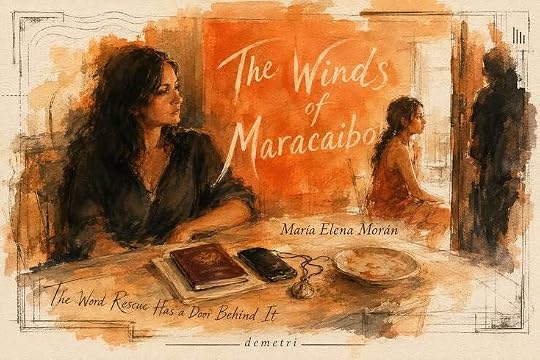
The Word Rescue Has a Door Behind It – A threshold-room watercolor painted in a cover-derived palette of coral heat, sepia shadow, cream paper, and dark accents to hold the novel’s uneasy question of rescue, custody, and care.
Do not trust the word rescue too quickly in “The Winds of Maracaibo.” María Elena Morán’s English-language debut, translated by Madeline Jones, has the visible outline of a cross-border recovery plot: a mother learns that her treacherous ex has taken their daughter out of Venezuela, and she has to get the girl back. But the novel’s sharpest suspicion is aimed at the word that makes such a plot sound clean. Rescue, here, is what people reach for when panic wants a halo. A mother rescues by leaving. A father rescues by abducting. A grandmother rescues a house while a child goes hungry inside it. The dead father, unable to command anyone, becomes the book’s most persuasive guardian precisely because he cannot own what he loves.
Every major adult in the novel has a way of dressing damage as love. Nina, living in Brazil after leaving Maracaibo, has crossed into a life of errands sharpened into peril with an impossible plan: earn money, establish a foothold, send remittances, then bring her thirteen-year-old daughter Elisa and her mother Graciela out of a country of failed taps, blackouts, empty shelves, and shrinking bodies. Elisa, left behind, receives this arithmetic with a child’s merciless accuracy. Mothers do not abandon their children, she tells herself, or nearly tells herself, and no migration logic can make that sentence stop hurting.
Maracaibo keeps pressing on the novel even after the plot has crossed borders. It is a place of expensive food, dead phones, rooms full of heat, and revolutionary language gone stale in the mouth. Morán is not stapling a lesson to the scenery. She is writing about what happens when a country’s ruin gets into the pantry, the wiring, the remittance, the phone battery, the body. Politics shows up as electricity, groceries, visas, gasoline, gossip, a father’s speeches, a daughter’s shrinking waist. The book is strongest when it lets history reach the kitchen before it reaches explanation.
Elisa’s hunger is one of the book’s smallest, sharpest gauges. She is lonely, furious, and more perceptive than the adults around her find convenient. When Camilo, her long-absent father, returns with food, money, air-conditioning, music, family glamour, and the lush nuisance of paternal attention, she is not simply fooled. She is available to being chosen. A child may reach for rescue not because she is foolish, the novel knows, but because she has counted the adults and found the pantry empty. Before Elisa becomes a girl to be recovered, she is already a girl making calculations in a house where the grown-ups keep giving absence better names.
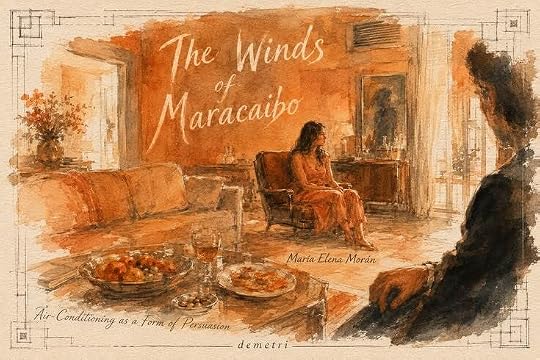
Air-Conditioning as a Form of Persuasion – A cool room, a quiet table, and a child’s watchful posture turn comfort into argument.
The clean summary is this: Camilo takes Elisa out of Venezuela and toward the United States, trying to force Nina into his script for the family. Nina, helped by friends, teachers, strangers, and improvised saints of logistics, tries to reach her. The messier account cuts closer: Camilo’s theft of Elisa is a private act performed in the style of a podium brought indoors. A former revolutionary functionary, one-eyed from an attack that helped turn him into a martyr of the cause, he has learned how to convert injury into mandate. His missing eye is credential, costume, accusation, alibi. He is one of those men who discovers that history has handed him a mirror and mistakes the reflection for permission.
Raúl, Nina’s dead father, gives the book its least possessive tenderness. He is not a lantern hung for atmosphere, not a shimmer applied to realism. He cannot fix hunger, unkidnap Elisa, repair Graciela, or forgive Camilo on anyone’s behalf. He can attend. He can focus. He can find his daughter through the amulet she wears, a small wearable archive made from his handwriting. In a novel full of people who confuse love with command, Raúl’s helplessness becomes a discipline of not taking. He is useful because he cannot make himself central.
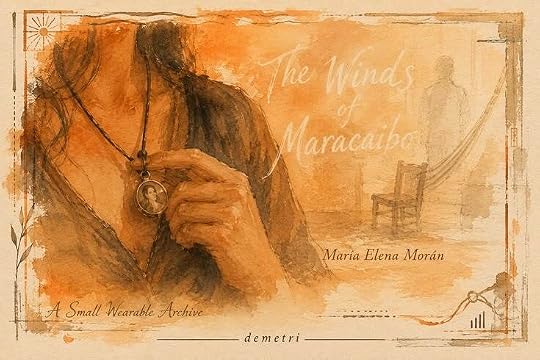
A Small Wearable Archive – The pendant becomes a private vessel for handwriting, absence, and watchful love.
In Camilo’s sections, Morán sets him under the bare bulb of second person, turning him into both defendant and prosecutor. You had two eyes, the narration tells him, before power, mythology, and humiliation began their slow revisions. These passages are often brilliant because they show a man narrating himself into excuses even as the prose strips those excuses away. They are also where the book comes closest to over-explanation. Camilo’s private authoritarianism is already scrawled across his behavior toward Nina and Elisa; the novel does not always need to keep tightening the courtroom lights.
Part of the force of “The Winds of Maracaibo” comes from the way Morán refuses to keep motherhood in flattering light. Nina is brave, loving, and frequently right, but she is not exempt from the damage her choices cause. She left because staying had become another form of failure; Elisa suffers the leaving anyway. Graciela’s grief is real, but so is her negligence. Even Elisa, the child at the center, is not buffed into sacred victimhood. She can be vain, cruel, funny, frightened, hungry, and devastatingly young. The novel’s compassion is sturdy because it has no interest in polishing anyone for display.
As prose, the book is hot-blooded, crowded, and boldly allergic to tidiness. Morán’s sentences tend to surge rather than step. They gather smells, errands, insults, documents, political phrases, old songs, underwear, bus stations, smoke, jokes, and family accusations until a paragraph begins to feel like a room into which too many lives have been forced. Then a shorter sentence hits. After the migrant camp in Pacaraima is set on fire, Nina’s inventory of her half-burned backpack becomes more than a list of possessions. It is a biography singed at the edges, a ledger of personhood rescued from contempt.
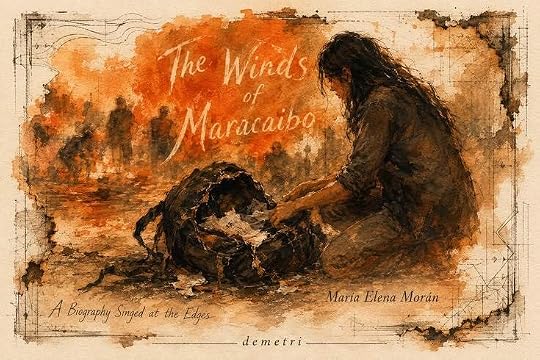
A Biography Singed at the Edges – A half-burned backpack holds the private inventory of a life pulled from public violence.
Placed beside a sparer novel, this one can look excessive; placed beside the lives it imagines, spareness might look like a lie. The style is not ornament. It turns scarcity into syntax. Every clause seems to know that no action has only one cause. Migration is hunger and paperwork, accent and class, grief and the body’s smell after travel. Fatherhood is absence and money, performance and tenderness, a promise with a lock on it. Jones’s translation keeps the multilingual pressure alive; Spanish and Portuguese arrive as intimacy, insult, power, and misrecognition, not decorative confetti.
A less assured novelist might have built the book as a straight hallway of a chase: good mother, bad father, endangered child, finish line. Morán’s structure is more interesting because it keeps reopening the case. The novel is divided into four parts and moves through a braid of voices: Nina, Elisa, Graciela, Raúl, and Camilo. Each voice revises the family record left by the previous one. Nina’s absence becomes ambition, sacrifice, and wound. Elisa’s anger becomes evidence. Graciela’s fidelity to the house and the dead becomes both love and abandonment. Camilo’s rescue story collapses into confinement. Raúl’s watchfulness becomes the least coercive form of protection.
Decisions about form are decisions about blame here. The rotating sections do not just distribute information; they change the verdict. No single character is allowed to own the story of what happened, because ownership itself is one of the book’s dangers. Camilo wants to author everyone else’s fate. Nina wants, more understandably, to correct the story before it kills her daughter. Elisa must stop being the proof in someone else’s case. The book creates momentum not only by asking what happens next, but by asking who has the power to describe what just happened.
If the abduction plot promises speed, the middle of the book keeps refusing the clean sprint. It swerves through memory, ideology, labor exploitation, ghostly instruction, route mechanics, and the grim social comedy of people trying to survive catastrophe without losing their talent for insult. Readers wanting a lean border thriller may grow impatient with the crowding. But the crowding is the point, most of the time. Morán is writing a chase in which the pursuer is also being chased by every earlier version of herself: young socialist, daughter, orphan, mother, migrant, cleaner, liar, survivor.
Morán is at her best when she lets objects alter power. Burned shoes, borrowed eggs, a student ID, a passport, a confiscated phone, a hammock, a pendant, an air-conditioned room, a truck compartment beneath a seat: these things carry more force than any speech about ruin could. Hunger makes Camilo more plausible. Dollars make Graciela more permissive. A phone becomes a custody instrument. A bed becomes a wage. A border becomes a parental threat. The material world is not symbolic first. It is useful, dangerous, and only then radiant.

The Phone Becomes Custody – A dark phone, a withheld line of contact, and a tense hand turn communication into confinement.
If the novel has a central limitation, it is the cost of its own heat. Morán’s fury is usually earned, but the book can remain so near crisis pitch that one occasionally longs for a colder passage, a plainer surface, a silence not already vibrating with history. The argument about revolutionary masculinity, public myth, and private coercion is persuasive, but at moments the prose circles back to underline what the scenes have already proved, especially in Camilo’s self-accusing sections. This is not a thin book pretending to be rich. It is a rich book that sometimes keeps adding seasoning after the pot has already begun to sing.
That caveat matters because the novel’s best scenes already know how to prosecute. When Camilo’s own family names his act as kidnapping, the glamour drains from his rescue narrative. When he keeps Elisa’s phone from her, the fatherly mask slips without fanfare. When Elisa realizes she is not being saved from adult failure but relocated inside another version of it, the book reaches one of its sharpest turns. She has been treated as daughter, witness, prize, reproach, and hostage. Her escape matters. It restores not innocence, but agency.
Real-world pressure enters by way of rooms and routes, not announcement. “The Winds of Maracaibo” speaks to Venezuelan displacement, host-country resentment, hunger, infrastructure failure, and the exhaustion of any easy northward dream. Yet Morán’s most durable subject is not policy. It is misnaming. People call flight abandonment, kidnapping rescue, pride duty, grief fidelity, possession love, survival ingratitude. The book is diagnostic rather than reactive: it shows how public ruin trains private language to lie.
Other novels cast useful neighboring light, though none sits in the same chair. “Sing, Unburied, Sing” by Jesmyn Ward offers a kinship of ghosts, road movement, and family grief; “Of Women and Salt” by Gabriela Garcia shares an interest in women carrying political betrayal across generations and borders; “Infinite Country” by Patricia Engel is a helpful companion for family fracture under migration pressure. Morán, though, is more volcanic, more crowded, more willing to let the dead help with directions.
Perhaps the book’s least showy strength is that the United States is not the place where meaning settles. Camilo imagines it as leverage. Nina distrusts it. Elisa is carried through it as through someone else’s bad idea. The novel’s ending turns southward, toward Mexico, toward possible soil rather than promised land. That geographical refusal loosens the old magnet. Arrival is not salvation. Return is not possible. Home will have to be made from stranger materials.
On balance, I would place “The Winds of Maracaibo” at 87/100, or 4/5 stars: high praise for a book whose heat is both its glory and its cost. It moves, but entertainment is not the chief measure of its success; it feels urgent, but urgency is not its only claim. Its excellence lies in voice, pressure, and the weather it builds around rescue. It remains just below the highest tier because of sustained overpressure, a few over-explained insights, and a plot engine that braids more than it bolts.
Underneath the family drama is a question that grows more unsettling the longer the novel sits with it: what remains of love after it has been made to carry too many excuses? Nina loves Elisa, but love does not erase absence. Camilo loves Elisa, but love does not excuse captivity. Graciela loves her family, but love does not cook dinner by itself. Raúl loves from the dead, and perhaps that is why his love feels least easy to misuse: it cannot demand, only accompany. Morán’s vision is stern without turning punishing. She believes in tenderness, just not in its moral immunity.
Late in the book, Elisa’s escape from Camilo transforms the novel from maternal recovery into self-rescue. Hidden beneath the backseat of a truck, instructed to be still, frightened into the body’s most helpless betrayals, she crosses not toward fantasy but toward her mother. Raúl’s presence around her is the book’s boldest gambit, and it works because by then the living have proved so limited that help from the dead feels almost practical. The scene is frightening, tender, and slightly mad in the way family stories often are when told by those who survived them.
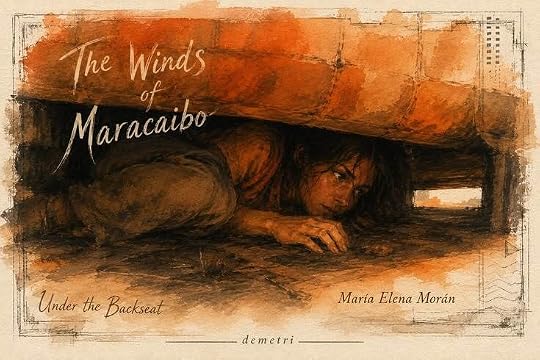
Under the Backseat – Elisa’s hidden crossing becomes cramped, bodily, and breath-held.
Of all the novel’s phrases, the one that finally gathers its scattered force is “patria portátil,” portable homeland. The idea is prepared from the dedication onward, but it earns its weight only at the end, when Nina and Elisa’s reunion expands beyond mother and child. It holds Raúl’s memory, Graciela’s future arrival, the afterburn of Camilo’s rage, the helpers who appear and vanish, the songs carried across borders, the ruined country that cannot simply be left behind. Homeland is no longer a place one returns to or reaches. It is what can be carried without becoming another cage.
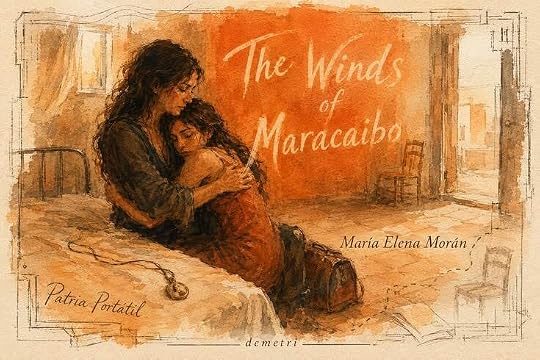
Patria Portátil – Nina and Elisa’s reunion turns home into something carried, unfinished, and alive.
Still, the ending is not triumph so much as revised custody. Nina does not recover the old life. Elisa does not recover the mother who never left. Venezuela is not returned to working order, Camilo is not neatly punished, Graciela is not healed, and the dead do not go politely back to being dead. What remains is an embrace under thin shelter, full of heat, memory, debt, fear, and stubborn breath. “The Winds of Maracaibo” understands that being saved is not the same as being claimed. Sometimes the person you save is not brought home at all. Sometimes she is the home, arriving filthy, terrified, alive, and small enough again to be held.

A literary watercolor portrait of María Elena Morán, shaped by the novel’s cover palette and its visual language of thresholds, documents, absence, and portable homeland.

Cover-Palette Swatch Study
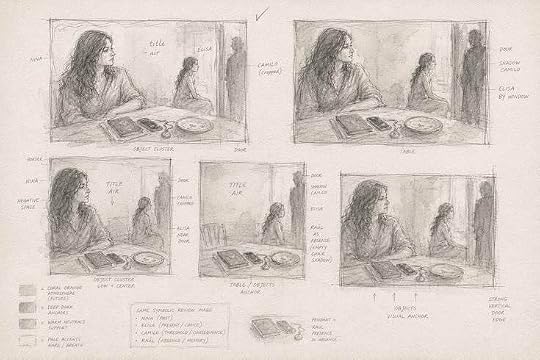
Composition Thumbnails
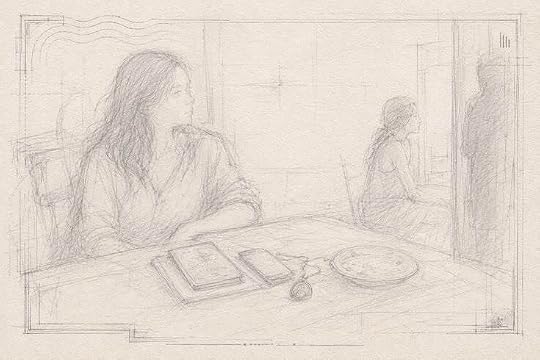
Pencil Underdrawing for “The Word Rescue Has a Door Behind It”
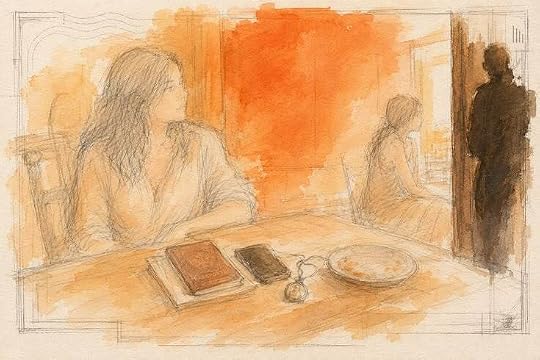
First Wash Study for “The Word Rescue Has a Door Behind It”
Border Study for “The Word Rescue Has a Door Behind It”
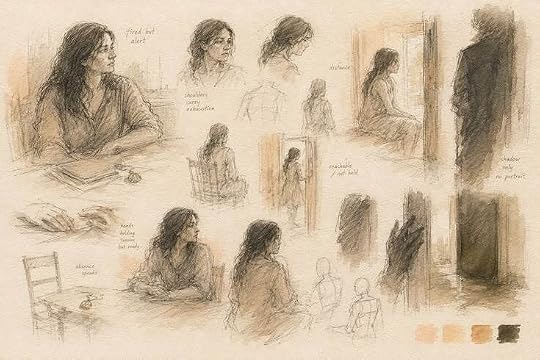
Nina, Elisa, and Shadow – Figure Study
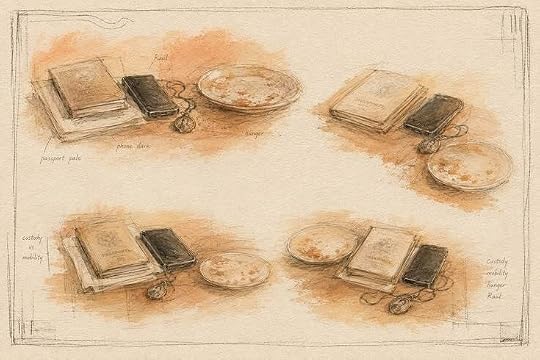
Passport, Phone, Pendant, Plate – Object Study
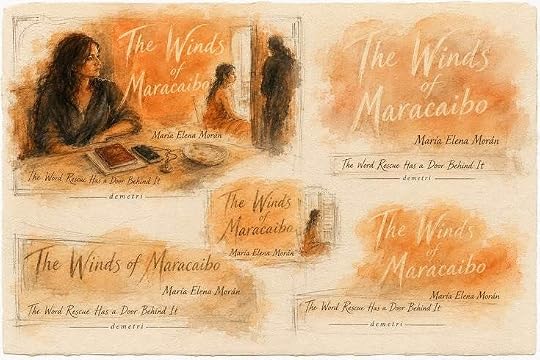
Hand-Lettering Study
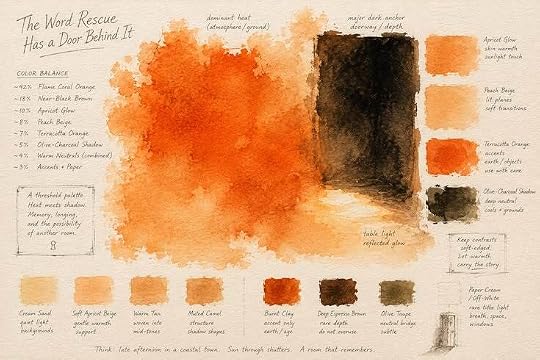
Pigment Ledger
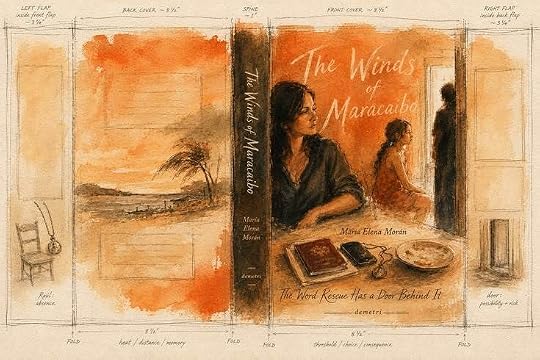
Alternative Dust Jacket Study
All watercolor illustrations by Demetris Papadimitropoulos.
Watercolors are done on 140lb vellum and then scanned into the computer using an Epson scanner. From there, they are finalized in Procreate. All art and opinions are my own.
In “The Winds of Maracaibo,” fathers perform rescue, mothers carry guilt, ghosts prove useful, and one daughter learns that being saved is not the same as being claimed.
By Demetris Papadimitropoulos | July 28th, 2026
The Word Rescue Has a Door Behind It – A threshold-room watercolor painted in a cover-derived palette of coral heat, sepia shadow, cream paper, and dark accents to hold the novel’s uneasy question of rescue, custody, and care.
Do not trust the word rescue too quickly in “The Winds of Maracaibo.” María Elena Morán’s English-language debut, translated by Madeline Jones, has the visible outline of a cross-border recovery plot: a mother learns that her treacherous ex has taken their daughter out of Venezuela, and she has to get the girl back. But the novel’s sharpest suspicion is aimed at the word that makes such a plot sound clean. Rescue, here, is what people reach for when panic wants a halo. A mother rescues by leaving. A father rescues by abducting. A grandmother rescues a house while a child goes hungry inside it. The dead father, unable to command anyone, becomes the book’s most persuasive guardian precisely because he cannot own what he loves.
Every major adult in the novel has a way of dressing damage as love. Nina, living in Brazil after leaving Maracaibo, has crossed into a life of errands sharpened into peril with an impossible plan: earn money, establish a foothold, send remittances, then bring her thirteen-year-old daughter Elisa and her mother Graciela out of a country of failed taps, blackouts, empty shelves, and shrinking bodies. Elisa, left behind, receives this arithmetic with a child’s merciless accuracy. Mothers do not abandon their children, she tells herself, or nearly tells herself, and no migration logic can make that sentence stop hurting.
Maracaibo keeps pressing on the novel even after the plot has crossed borders. It is a place of expensive food, dead phones, rooms full of heat, and revolutionary language gone stale in the mouth. Morán is not stapling a lesson to the scenery. She is writing about what happens when a country’s ruin gets into the pantry, the wiring, the remittance, the phone battery, the body. Politics shows up as electricity, groceries, visas, gasoline, gossip, a father’s speeches, a daughter’s shrinking waist. The book is strongest when it lets history reach the kitchen before it reaches explanation.
Elisa’s hunger is one of the book’s smallest, sharpest gauges. She is lonely, furious, and more perceptive than the adults around her find convenient. When Camilo, her long-absent father, returns with food, money, air-conditioning, music, family glamour, and the lush nuisance of paternal attention, she is not simply fooled. She is available to being chosen. A child may reach for rescue not because she is foolish, the novel knows, but because she has counted the adults and found the pantry empty. Before Elisa becomes a girl to be recovered, she is already a girl making calculations in a house where the grown-ups keep giving absence better names.
Air-Conditioning as a Form of Persuasion – A cool room, a quiet table, and a child’s watchful posture turn comfort into argument.
The clean summary is this: Camilo takes Elisa out of Venezuela and toward the United States, trying to force Nina into his script for the family. Nina, helped by friends, teachers, strangers, and improvised saints of logistics, tries to reach her. The messier account cuts closer: Camilo’s theft of Elisa is a private act performed in the style of a podium brought indoors. A former revolutionary functionary, one-eyed from an attack that helped turn him into a martyr of the cause, he has learned how to convert injury into mandate. His missing eye is credential, costume, accusation, alibi. He is one of those men who discovers that history has handed him a mirror and mistakes the reflection for permission.
Raúl, Nina’s dead father, gives the book its least possessive tenderness. He is not a lantern hung for atmosphere, not a shimmer applied to realism. He cannot fix hunger, unkidnap Elisa, repair Graciela, or forgive Camilo on anyone’s behalf. He can attend. He can focus. He can find his daughter through the amulet she wears, a small wearable archive made from his handwriting. In a novel full of people who confuse love with command, Raúl’s helplessness becomes a discipline of not taking. He is useful because he cannot make himself central.
A Small Wearable Archive – The pendant becomes a private vessel for handwriting, absence, and watchful love.
In Camilo’s sections, Morán sets him under the bare bulb of second person, turning him into both defendant and prosecutor. You had two eyes, the narration tells him, before power, mythology, and humiliation began their slow revisions. These passages are often brilliant because they show a man narrating himself into excuses even as the prose strips those excuses away. They are also where the book comes closest to over-explanation. Camilo’s private authoritarianism is already scrawled across his behavior toward Nina and Elisa; the novel does not always need to keep tightening the courtroom lights.
Part of the force of “The Winds of Maracaibo” comes from the way Morán refuses to keep motherhood in flattering light. Nina is brave, loving, and frequently right, but she is not exempt from the damage her choices cause. She left because staying had become another form of failure; Elisa suffers the leaving anyway. Graciela’s grief is real, but so is her negligence. Even Elisa, the child at the center, is not buffed into sacred victimhood. She can be vain, cruel, funny, frightened, hungry, and devastatingly young. The novel’s compassion is sturdy because it has no interest in polishing anyone for display.
As prose, the book is hot-blooded, crowded, and boldly allergic to tidiness. Morán’s sentences tend to surge rather than step. They gather smells, errands, insults, documents, political phrases, old songs, underwear, bus stations, smoke, jokes, and family accusations until a paragraph begins to feel like a room into which too many lives have been forced. Then a shorter sentence hits. After the migrant camp in Pacaraima is set on fire, Nina’s inventory of her half-burned backpack becomes more than a list of possessions. It is a biography singed at the edges, a ledger of personhood rescued from contempt.
A Biography Singed at the Edges – A half-burned backpack holds the private inventory of a life pulled from public violence.
Placed beside a sparer novel, this one can look excessive; placed beside the lives it imagines, spareness might look like a lie. The style is not ornament. It turns scarcity into syntax. Every clause seems to know that no action has only one cause. Migration is hunger and paperwork, accent and class, grief and the body’s smell after travel. Fatherhood is absence and money, performance and tenderness, a promise with a lock on it. Jones’s translation keeps the multilingual pressure alive; Spanish and Portuguese arrive as intimacy, insult, power, and misrecognition, not decorative confetti.
A less assured novelist might have built the book as a straight hallway of a chase: good mother, bad father, endangered child, finish line. Morán’s structure is more interesting because it keeps reopening the case. The novel is divided into four parts and moves through a braid of voices: Nina, Elisa, Graciela, Raúl, and Camilo. Each voice revises the family record left by the previous one. Nina’s absence becomes ambition, sacrifice, and wound. Elisa’s anger becomes evidence. Graciela’s fidelity to the house and the dead becomes both love and abandonment. Camilo’s rescue story collapses into confinement. Raúl’s watchfulness becomes the least coercive form of protection.
Decisions about form are decisions about blame here. The rotating sections do not just distribute information; they change the verdict. No single character is allowed to own the story of what happened, because ownership itself is one of the book’s dangers. Camilo wants to author everyone else’s fate. Nina wants, more understandably, to correct the story before it kills her daughter. Elisa must stop being the proof in someone else’s case. The book creates momentum not only by asking what happens next, but by asking who has the power to describe what just happened.
If the abduction plot promises speed, the middle of the book keeps refusing the clean sprint. It swerves through memory, ideology, labor exploitation, ghostly instruction, route mechanics, and the grim social comedy of people trying to survive catastrophe without losing their talent for insult. Readers wanting a lean border thriller may grow impatient with the crowding. But the crowding is the point, most of the time. Morán is writing a chase in which the pursuer is also being chased by every earlier version of herself: young socialist, daughter, orphan, mother, migrant, cleaner, liar, survivor.
Morán is at her best when she lets objects alter power. Burned shoes, borrowed eggs, a student ID, a passport, a confiscated phone, a hammock, a pendant, an air-conditioned room, a truck compartment beneath a seat: these things carry more force than any speech about ruin could. Hunger makes Camilo more plausible. Dollars make Graciela more permissive. A phone becomes a custody instrument. A bed becomes a wage. A border becomes a parental threat. The material world is not symbolic first. It is useful, dangerous, and only then radiant.
The Phone Becomes Custody – A dark phone, a withheld line of contact, and a tense hand turn communication into confinement.
If the novel has a central limitation, it is the cost of its own heat. Morán’s fury is usually earned, but the book can remain so near crisis pitch that one occasionally longs for a colder passage, a plainer surface, a silence not already vibrating with history. The argument about revolutionary masculinity, public myth, and private coercion is persuasive, but at moments the prose circles back to underline what the scenes have already proved, especially in Camilo’s self-accusing sections. This is not a thin book pretending to be rich. It is a rich book that sometimes keeps adding seasoning after the pot has already begun to sing.
That caveat matters because the novel’s best scenes already know how to prosecute. When Camilo’s own family names his act as kidnapping, the glamour drains from his rescue narrative. When he keeps Elisa’s phone from her, the fatherly mask slips without fanfare. When Elisa realizes she is not being saved from adult failure but relocated inside another version of it, the book reaches one of its sharpest turns. She has been treated as daughter, witness, prize, reproach, and hostage. Her escape matters. It restores not innocence, but agency.
Real-world pressure enters by way of rooms and routes, not announcement. “The Winds of Maracaibo” speaks to Venezuelan displacement, host-country resentment, hunger, infrastructure failure, and the exhaustion of any easy northward dream. Yet Morán’s most durable subject is not policy. It is misnaming. People call flight abandonment, kidnapping rescue, pride duty, grief fidelity, possession love, survival ingratitude. The book is diagnostic rather than reactive: it shows how public ruin trains private language to lie.
Other novels cast useful neighboring light, though none sits in the same chair. “Sing, Unburied, Sing” by Jesmyn Ward offers a kinship of ghosts, road movement, and family grief; “Of Women and Salt” by Gabriela Garcia shares an interest in women carrying political betrayal across generations and borders; “Infinite Country” by Patricia Engel is a helpful companion for family fracture under migration pressure. Morán, though, is more volcanic, more crowded, more willing to let the dead help with directions.
Perhaps the book’s least showy strength is that the United States is not the place where meaning settles. Camilo imagines it as leverage. Nina distrusts it. Elisa is carried through it as through someone else’s bad idea. The novel’s ending turns southward, toward Mexico, toward possible soil rather than promised land. That geographical refusal loosens the old magnet. Arrival is not salvation. Return is not possible. Home will have to be made from stranger materials.
On balance, I would place “The Winds of Maracaibo” at 87/100, or 4/5 stars: high praise for a book whose heat is both its glory and its cost. It moves, but entertainment is not the chief measure of its success; it feels urgent, but urgency is not its only claim. Its excellence lies in voice, pressure, and the weather it builds around rescue. It remains just below the highest tier because of sustained overpressure, a few over-explained insights, and a plot engine that braids more than it bolts.
Underneath the family drama is a question that grows more unsettling the longer the novel sits with it: what remains of love after it has been made to carry too many excuses? Nina loves Elisa, but love does not erase absence. Camilo loves Elisa, but love does not excuse captivity. Graciela loves her family, but love does not cook dinner by itself. Raúl loves from the dead, and perhaps that is why his love feels least easy to misuse: it cannot demand, only accompany. Morán’s vision is stern without turning punishing. She believes in tenderness, just not in its moral immunity.
Late in the book, Elisa’s escape from Camilo transforms the novel from maternal recovery into self-rescue. Hidden beneath the backseat of a truck, instructed to be still, frightened into the body’s most helpless betrayals, she crosses not toward fantasy but toward her mother. Raúl’s presence around her is the book’s boldest gambit, and it works because by then the living have proved so limited that help from the dead feels almost practical. The scene is frightening, tender, and slightly mad in the way family stories often are when told by those who survived them.
Under the Backseat – Elisa’s hidden crossing becomes cramped, bodily, and breath-held.
Of all the novel’s phrases, the one that finally gathers its scattered force is “patria portátil,” portable homeland. The idea is prepared from the dedication onward, but it earns its weight only at the end, when Nina and Elisa’s reunion expands beyond mother and child. It holds Raúl’s memory, Graciela’s future arrival, the afterburn of Camilo’s rage, the helpers who appear and vanish, the songs carried across borders, the ruined country that cannot simply be left behind. Homeland is no longer a place one returns to or reaches. It is what can be carried without becoming another cage.
Patria Portátil – Nina and Elisa’s reunion turns home into something carried, unfinished, and alive.
Still, the ending is not triumph so much as revised custody. Nina does not recover the old life. Elisa does not recover the mother who never left. Venezuela is not returned to working order, Camilo is not neatly punished, Graciela is not healed, and the dead do not go politely back to being dead. What remains is an embrace under thin shelter, full of heat, memory, debt, fear, and stubborn breath. “The Winds of Maracaibo” understands that being saved is not the same as being claimed. Sometimes the person you save is not brought home at all. Sometimes she is the home, arriving filthy, terrified, alive, and small enough again to be held.
A literary watercolor portrait of María Elena Morán, shaped by the novel’s cover palette and its visual language of thresholds, documents, absence, and portable homeland.
Cover-Palette Swatch Study
Composition Thumbnails
Pencil Underdrawing for “The Word Rescue Has a Door Behind It”
First Wash Study for “The Word Rescue Has a Door Behind It”
Border Study for “The Word Rescue Has a Door Behind It”
Nina, Elisa, and Shadow – Figure Study
Passport, Phone, Pendant, Plate – Object Study
Hand-Lettering Study
Pigment Ledger
Alternative Dust Jacket Study
All watercolor illustrations by Demetris Papadimitropoulos.
Watercolors are done on 140lb vellum and then scanned into the computer using an Epson scanner. From there, they are finalized in Procreate. All art and opinions are my own.

August 14, 2023
Me encantó este libro en especial por la prosa: mucho nivel de poesía, metáforas fuertes y hermosas, avanza como una corriente de pensamientos en muchas partes. Las voces de los personajes y los personajes en sí son muy interesantes: los machos de izquierda, la mujer que se quiere ir, la que no quiere irse. Le sumo puntos extras por tener en su concepción una estructura bien planeada y aún así ser sumamente armónico por la manera en la que fluye la narración.
El tema es muy importante, controversial y honesto, el desencanto de la izquierda, creo que se abordó desde todas las aristas y que solamente una persona que estuvo militando puede escribir de esa manera.
Recomendado para todos, un libro que me rompió bastante por lo político que es y lo cercano que se sienten sus personajes. Lo político que es el telón donde suceden la vida de los personajes nunca deja de ser un protagonista.
El tema es muy importante, controversial y honesto, el desencanto de la izquierda, creo que se abordó desde todas las aristas y que solamente una persona que estuvo militando puede escribir de esa manera.
Recomendado para todos, un libro que me rompió bastante por lo político que es y lo cercano que se sienten sus personajes. Lo político que es el telón donde suceden la vida de los personajes nunca deja de ser un protagonista.

August 8, 2026
“For so many years now her life was just putting useless patches over potholes that never stopped expanding.”
Thank you to NetGalley, the author and publisher for an advanced reader ebook copy of The Winds of Maracaibo by María Elena Morán in exchange for an honest review. I admit I almost put this one down, but I’m glad I stuck with it. It was actually a note from another review that pushed me to give it a try. Because I clearly didn’t read the book jacket description well enough, I didn’t initially realize that chapters were told from different character’s point of view, and the writing style changes depending on the character, so it was jarring at first and I was confused about what was going on. Once I got the hang of it though, this novel definitely grew on me and I think a lot of other readers will find immense value here. I think the book cover designer did a great job conveying how reading this story made me feel!
Title: The Winds of Maracaibo
Author: María Elena Morán
Translator: Madeline Jones
Genre: Literary Fiction
Setting: Maracaibo, Venezuela; United States
Publish Date: July 28, 2026
Publisher: Knopf, Pantheon, Vintage, and Anchor
Book Cover Designer: Janet Hansen
Pages: 208
POV: Multiple Narrators, First, Second and Third Person POV
Read this if you enjoyed: Septology by Jon Hosse, stream of consciousness writing
My rating: ⭐⭐⭐ 3 stars
I consumed the: Ebook (advanced reader copy)
The Winds of Maracaibo is a family drama told in first, second, and third person POV in various writing styles from various narrators including Nina (the mother), Elisa (the daughter), Graciela (the grandmother, Raúl (the dead grandfather), and Camilo (the absent father figure who takes his daughter to the U.S. while Nina is abroad searching for work). All that one it’s own is a lot! Then bring in all the background conflict of Chávez’s social revolution and you’ve got a really chaotic atmosphere for a lot of things to happen in…
There is a lot to unpack about this English-language debut. The writing style took me a while to get used to, especially during Nina’s chapters where the sentences are very long and meandering, filled with interjections, dialogue without quotations where one sentence becomes a whole paragraph. It’s like stream of consciousness, but it’s more journalistic. The characters documenting what’s happening in front of Nine and providing her commentary on the happenings at the same time, while also speaking to people about what’s happening. It’s all a bit much right up front. You have to settle into it. This is one of my favorite passages from early on in the novel when the refugee camp Nina is staying in catches on fire:
“Everything, cherished or not, important or not, citizen or not, ended up transformed into bits of carbon and soot, and she wondered how it could be that this contempt has the same smell as the burning lots back home in Maracaibo, those abandoned private lands surrounded by ever-diminishing cinder-block fences, because there was always someone around to steal cinder blocks to build a little house so their family wouldn’t have to put up with the same smell. The smell of garbage that people would toss over the failing walls, to burn it on rich people’s lots when the trash collection stopped. But soggy or burnt, in the end garbage all smelled the same, whether is came form poor people or rich people or the corner restaurant or the party headquarters or the PSUV or the bathroom of the university Humanities Department–garbage is garbage, Nina thought, and like the stinking lots back in Maracaibo, the Roraima camp was up in flames now, but Roraima wasn’t garbage and they weren’t garbage, they weren’t garbage, they weren’t garbage. Yet even as she thought this, for a few seconds she let herself be carried away by the horrible idea that the charred, foul-smelling air was simply their own wake…”
Now, I don’t want to read too much into it, but I can imagine the author might want to simulate the idea of being displaced, like Nina is. It leaves the reader feel a bit like floating. Quite literally, without a period marking the end of a sentence, I found my eyes just scanning down the page and I had to reread things multiple times. I didn’t find it particularly enjoyable, but I image the feeling of being displaced is not enjoyable either.
I particularly enjoyed the grandmother, Graciela’s, chapters as she falls into despair over the death of her husband who she clearly has so much affection for. This passage was especialy heartbreaking:
“There are people who don’t feel pain. They burn themselves, cut themselves, crush themselves without realizing. Only afterwards there’s the blood, the bruise, the blister, and the news. The day you died, Raúl, the only thing I felt was rage. My hands praying over your coffin were like a photograph of my hands praying over your coffin, my husbands coffin. My tears were cheap, theatrical even, and the words that came out of my mouth were like a script from some telenovela. About two weeks later, the news hit me. That’s when I began to see the blood, the bruise, the blister. Then I couldn’t see anything else.”
This is one of the most unique books I’ve read so far this year, and it’s definitely not the easiest to read. Be ready to sit and spend some time with this one if you really want to get everything you can out of it. I can tell the author poured so much of her heart into telling this story. I ultimately had a hard time connecting with it due to the multiple narrators, POV shifts, and writing style, but if you’re a reader who loves more experimental narrative styles without a heavy plot, you might really enjoy this one.
“He’s felt lost since the first second he set foot in this strange land that is death, but he knows that’s how all journey’s like this are–untimely and with no return ticket.”
I think this book succeeded with the lush and philosophical prose. I highlighted so many quotes that stood out to me. Morán has a really clear and distinct voice. For such a short novel, it felt really dense at times sifting through there sheer amount of thoughts connected on one page. Thought this book didn’t ultimately land for me, I think I would try future works of hers if others are translated into English in the future. What I appreciate most about this story is the anti-American dream aspect, and the fact the Nina didn’t want to leave home, she just wanted her home to be better than the chaos it had devolved into.
“I honestly don’t know when or how I got back to the house. It’s like I leave myself, from one second to the next, without warning or signs, and someone steals a few pieces of me. When I come back, I never really come back, some pieces are still missing.”
While this is translated from Spanish, I appreciate that the translator left in some Spanish phrases and quotes throughout. They seem mostly to be phrases that an English speaker/reader could decide using context clues, but you might have to look up a few. It will be easier if you’ve taken at least a few Spanish classes ins school, but by no means necessary, you just might get more depth out of the reading experience.
I think this novel will stick with me, but I don’t think I got everything out of the reading experience that the author intended. I wouldn’t mind coming back to this novel and trying again in the future. It’s definitely unique.
Thank you to NetGalley, the author and publisher for an advanced reader ebook copy of The Winds of Maracaibo by María Elena Morán in exchange for an honest review. I admit I almost put this one down, but I’m glad I stuck with it. It was actually a note from another review that pushed me to give it a try. Because I clearly didn’t read the book jacket description well enough, I didn’t initially realize that chapters were told from different character’s point of view, and the writing style changes depending on the character, so it was jarring at first and I was confused about what was going on. Once I got the hang of it though, this novel definitely grew on me and I think a lot of other readers will find immense value here. I think the book cover designer did a great job conveying how reading this story made me feel!
Title: The Winds of Maracaibo
Author: María Elena Morán
Translator: Madeline Jones
Genre: Literary Fiction
Setting: Maracaibo, Venezuela; United States
Publish Date: July 28, 2026
Publisher: Knopf, Pantheon, Vintage, and Anchor
Book Cover Designer: Janet Hansen
Pages: 208
POV: Multiple Narrators, First, Second and Third Person POV
Read this if you enjoyed: Septology by Jon Hosse, stream of consciousness writing
My rating: ⭐⭐⭐ 3 stars
I consumed the: Ebook (advanced reader copy)
The Winds of Maracaibo is a family drama told in first, second, and third person POV in various writing styles from various narrators including Nina (the mother), Elisa (the daughter), Graciela (the grandmother, Raúl (the dead grandfather), and Camilo (the absent father figure who takes his daughter to the U.S. while Nina is abroad searching for work). All that one it’s own is a lot! Then bring in all the background conflict of Chávez’s social revolution and you’ve got a really chaotic atmosphere for a lot of things to happen in…
There is a lot to unpack about this English-language debut. The writing style took me a while to get used to, especially during Nina’s chapters where the sentences are very long and meandering, filled with interjections, dialogue without quotations where one sentence becomes a whole paragraph. It’s like stream of consciousness, but it’s more journalistic. The characters documenting what’s happening in front of Nine and providing her commentary on the happenings at the same time, while also speaking to people about what’s happening. It’s all a bit much right up front. You have to settle into it. This is one of my favorite passages from early on in the novel when the refugee camp Nina is staying in catches on fire:
“Everything, cherished or not, important or not, citizen or not, ended up transformed into bits of carbon and soot, and she wondered how it could be that this contempt has the same smell as the burning lots back home in Maracaibo, those abandoned private lands surrounded by ever-diminishing cinder-block fences, because there was always someone around to steal cinder blocks to build a little house so their family wouldn’t have to put up with the same smell. The smell of garbage that people would toss over the failing walls, to burn it on rich people’s lots when the trash collection stopped. But soggy or burnt, in the end garbage all smelled the same, whether is came form poor people or rich people or the corner restaurant or the party headquarters or the PSUV or the bathroom of the university Humanities Department–garbage is garbage, Nina thought, and like the stinking lots back in Maracaibo, the Roraima camp was up in flames now, but Roraima wasn’t garbage and they weren’t garbage, they weren’t garbage, they weren’t garbage. Yet even as she thought this, for a few seconds she let herself be carried away by the horrible idea that the charred, foul-smelling air was simply their own wake…”
Now, I don’t want to read too much into it, but I can imagine the author might want to simulate the idea of being displaced, like Nina is. It leaves the reader feel a bit like floating. Quite literally, without a period marking the end of a sentence, I found my eyes just scanning down the page and I had to reread things multiple times. I didn’t find it particularly enjoyable, but I image the feeling of being displaced is not enjoyable either.
I particularly enjoyed the grandmother, Graciela’s, chapters as she falls into despair over the death of her husband who she clearly has so much affection for. This passage was especialy heartbreaking:
“There are people who don’t feel pain. They burn themselves, cut themselves, crush themselves without realizing. Only afterwards there’s the blood, the bruise, the blister, and the news. The day you died, Raúl, the only thing I felt was rage. My hands praying over your coffin were like a photograph of my hands praying over your coffin, my husbands coffin. My tears were cheap, theatrical even, and the words that came out of my mouth were like a script from some telenovela. About two weeks later, the news hit me. That’s when I began to see the blood, the bruise, the blister. Then I couldn’t see anything else.”
This is one of the most unique books I’ve read so far this year, and it’s definitely not the easiest to read. Be ready to sit and spend some time with this one if you really want to get everything you can out of it. I can tell the author poured so much of her heart into telling this story. I ultimately had a hard time connecting with it due to the multiple narrators, POV shifts, and writing style, but if you’re a reader who loves more experimental narrative styles without a heavy plot, you might really enjoy this one.
“He’s felt lost since the first second he set foot in this strange land that is death, but he knows that’s how all journey’s like this are–untimely and with no return ticket.”
I think this book succeeded with the lush and philosophical prose. I highlighted so many quotes that stood out to me. Morán has a really clear and distinct voice. For such a short novel, it felt really dense at times sifting through there sheer amount of thoughts connected on one page. Thought this book didn’t ultimately land for me, I think I would try future works of hers if others are translated into English in the future. What I appreciate most about this story is the anti-American dream aspect, and the fact the Nina didn’t want to leave home, she just wanted her home to be better than the chaos it had devolved into.
“I honestly don’t know when or how I got back to the house. It’s like I leave myself, from one second to the next, without warning or signs, and someone steals a few pieces of me. When I come back, I never really come back, some pieces are still missing.”
While this is translated from Spanish, I appreciate that the translator left in some Spanish phrases and quotes throughout. They seem mostly to be phrases that an English speaker/reader could decide using context clues, but you might have to look up a few. It will be easier if you’ve taken at least a few Spanish classes ins school, but by no means necessary, you just might get more depth out of the reading experience.
I think this novel will stick with me, but I don’t think I got everything out of the reading experience that the author intended. I wouldn’t mind coming back to this novel and trying again in the future. It’s definitely unique.

February 21, 2023
Historia íntima y punzante, que lo mete a uno en el corazón de la Venezuela de hoy y la Latinoamérica de siempre, narrada frenéticamente por personajes vivos que respiran hasta cuando no están, y saben robarse de la atención de una historia que de otra forma caería en lo predecible y general.
María Elena Morán usa una variedad de perspectivas y recursos narrativos para distinguir a sus personajes, resistiendo en cada oportunidad el uso de una prosa tradicional de ficción, lo que a veces complica seguir los eventos, pero funciona bien para esta novela corta, tan sentida y tan humana.
Si eso no fuera suficiente, superada la barrera de su prosa particular, salta a la vista la musicalidad que le da las palabras, que ya sería motivo suficiente para recomendar este libro.
María Elena Morán usa una variedad de perspectivas y recursos narrativos para distinguir a sus personajes, resistiendo en cada oportunidad el uso de una prosa tradicional de ficción, lo que a veces complica seguir los eventos, pero funciona bien para esta novela corta, tan sentida y tan humana.
Si eso no fuera suficiente, superada la barrera de su prosa particular, salta a la vista la musicalidad que le da las palabras, que ya sería motivo suficiente para recomendar este libro.

March 29, 2023
Retrato interior de una Venezuela miserable y nostálgica de la revolución. Una novela sobre la migración contada desde las disputas y resentimientos de una expareja de revolucionarios: una mujer de clase media y un hombre de clase alta. Y los conflictos de la familia de la mujer.
Uno de los valores característicos de la literatura latinoamericana es permitirnos una reflexión extensa sobre nuestra realidad política e histórica. «Volver a cuándo» si bien triunfa en el preciso entramado psicológico de sus personajes, descuida el contexto histórico en el que habitan. Con menciones vagas y esquivas de la política, el lector no llega a comprender el problema fundamental de fondo, que es, justamente, el motor de la historia.
Uno de los valores característicos de la literatura latinoamericana es permitirnos una reflexión extensa sobre nuestra realidad política e histórica. «Volver a cuándo» si bien triunfa en el preciso entramado psicológico de sus personajes, descuida el contexto histórico en el que habitan. Con menciones vagas y esquivas de la política, el lector no llega a comprender el problema fundamental de fondo, que es, justamente, el motor de la historia.

August 26, 2026
Thank you to NetGalley and Knopf for providing me with an ARC of this ebook in exchange for an honest review.
Reading translated literature is endlessly fascinating to me, but what always stands out to me is the way different cultures tell their stories. I’ve learned a lot in my ‘read around the world’ self-challenge, and this book took me to both Venezuela and Brazil on this multilayered family saga.
The book started on a bit of a rocky note for me, as it took me a few chapters to acclimate to the various POVs. Chapters switch back and forth between Graciela, Nina, Elisa, and Camilo, and each is a distinct voice from the others. I also had to acclimate to being in the heads of characters I didn’t necessarily like at first. Elisa was easier for me to empathize with, since she was so young and didn’t have the life experience (or guidance) to fully understand the world around her and the consequences of decisions, both for choices that she made and those that were made for her.
As for the setting, the story is split between Nina’s time in Porto Alegre, Brazil and Graciela, Elisa, and Camilo in Maracaibo, Venezuela; and ventures into the United States. The read is a short one at just over 200 pages and it delves into some really heavy subject matter, so character development is prioritized over a focus on the geopolitical situation in South America. Having a basic understanding of the politics and current events in South America is good to have since there isn’t as much exploration of the situation.
Making the choice to prioritize character development was a smart one. Morán crafts characters who are complex and have a rich internal world, and even manages to include Raúl, the deceased husband of Graciela, and all of the characters are so vastly different that it was easy to follow the perspective jumps without feeling jagged. We see some of the situation in Venezuela that occurred after decades of dictatorship, and how it affects the characters. Electricity cuts, poverty, and limited opportunities all play a role in the story, and it leads to Nina’s stay in Brazil to try and earn money to send back to her family. However, she isn’t having an easy time of it, and seems to be digging herself further into a hole the longer she stays in Brazil. I did get a sense of irony from how miserable she is in a city named Happy Port.
Nina leaves her daughter Elisa in the care of her mother, Graciela. But since the death of Graciela’s husband Raúl, she spends all her time shut in her room conversing with him from beyond the grave, giving the story a taste of the magical realism that South American literature has come to be known for, at least for me. It worked really well in this story, compared to the realism brought to the story with the situation in Venezuela, life under an authoritarian regime, and the lengths people take to try and improve their situation when very few doors are open to them.
Meanwhile, Camilo is Elisa’s father, and he wants to take her away with him to America. Camilo cut ties with both Nina and Elisa when they got divorced, and has been estranged from his daughter for years. There was a turbulent relationship between Camilo and Nina, and she fought against his controlling, abusive nature. Initially, these two were socialist activists, but as Camilo became a politician and gained some power and financial security as Nina and Elisa slide into poverty and are heavily affected by their lack of financial security or opportunities.
The relationship dynamics are outstanding. As Nina is trying to get by and provide more for her family than she was able to in Maracaibo, Elisa at 13 is becoming more resentful of her mother’s absence, clearing the way for Camilo to swoop into her life where he takes Elisa out of the country and brings her to stay with his family members in Texas. He treats Elisa more like a bargaining chip when he manipulates Nina into coming to see him by keeping Elisa away from her, and his relationship with Nina mirrors his political career by controlling her, even after a divorce.
Ultimately, this story winds up centering the relationship dynamics between these different members of a family and does it extremely well. I was impressed with how richly the characters were developed in such a short book, and although some parts of the story felt a little rushed, I found that I much preferred how layered the characters are, and how realistically they were portrayed. The pacing wasn’t as much of a problem for me since I really enjoyed how well-done the rest of the book was. It left me with more of an understanding of Venezuelans and the factors that contribute to their migration away from their country. And while I didn’t always like the adult characters who are central to Elisa’s life, I was able to appreciate the impact they had on each other and watch Elisa learn from these unhealthy situations she is placed in. Her character growth and the bond between Elisa and Nina changes over the course of the book, at least how Elisa views her parents. But overall, this was a really good story and I’ll be keeping an eye out for more of Morán’s writing.
Bottom line: A fascinating look at the complex relationships within one family, this is a fast read and portrays the family dynamics in a multilayered manner, but it helps to have a basic understanding of the recent history and political situation in Venezuela before starting the read.
Reading translated literature is endlessly fascinating to me, but what always stands out to me is the way different cultures tell their stories. I’ve learned a lot in my ‘read around the world’ self-challenge, and this book took me to both Venezuela and Brazil on this multilayered family saga.
The book started on a bit of a rocky note for me, as it took me a few chapters to acclimate to the various POVs. Chapters switch back and forth between Graciela, Nina, Elisa, and Camilo, and each is a distinct voice from the others. I also had to acclimate to being in the heads of characters I didn’t necessarily like at first. Elisa was easier for me to empathize with, since she was so young and didn’t have the life experience (or guidance) to fully understand the world around her and the consequences of decisions, both for choices that she made and those that were made for her.
As for the setting, the story is split between Nina’s time in Porto Alegre, Brazil and Graciela, Elisa, and Camilo in Maracaibo, Venezuela; and ventures into the United States. The read is a short one at just over 200 pages and it delves into some really heavy subject matter, so character development is prioritized over a focus on the geopolitical situation in South America. Having a basic understanding of the politics and current events in South America is good to have since there isn’t as much exploration of the situation.
Making the choice to prioritize character development was a smart one. Morán crafts characters who are complex and have a rich internal world, and even manages to include Raúl, the deceased husband of Graciela, and all of the characters are so vastly different that it was easy to follow the perspective jumps without feeling jagged. We see some of the situation in Venezuela that occurred after decades of dictatorship, and how it affects the characters. Electricity cuts, poverty, and limited opportunities all play a role in the story, and it leads to Nina’s stay in Brazil to try and earn money to send back to her family. However, she isn’t having an easy time of it, and seems to be digging herself further into a hole the longer she stays in Brazil. I did get a sense of irony from how miserable she is in a city named Happy Port.
Nina leaves her daughter Elisa in the care of her mother, Graciela. But since the death of Graciela’s husband Raúl, she spends all her time shut in her room conversing with him from beyond the grave, giving the story a taste of the magical realism that South American literature has come to be known for, at least for me. It worked really well in this story, compared to the realism brought to the story with the situation in Venezuela, life under an authoritarian regime, and the lengths people take to try and improve their situation when very few doors are open to them.
Meanwhile, Camilo is Elisa’s father, and he wants to take her away with him to America. Camilo cut ties with both Nina and Elisa when they got divorced, and has been estranged from his daughter for years. There was a turbulent relationship between Camilo and Nina, and she fought against his controlling, abusive nature. Initially, these two were socialist activists, but as Camilo became a politician and gained some power and financial security as Nina and Elisa slide into poverty and are heavily affected by their lack of financial security or opportunities.
The relationship dynamics are outstanding. As Nina is trying to get by and provide more for her family than she was able to in Maracaibo, Elisa at 13 is becoming more resentful of her mother’s absence, clearing the way for Camilo to swoop into her life where he takes Elisa out of the country and brings her to stay with his family members in Texas. He treats Elisa more like a bargaining chip when he manipulates Nina into coming to see him by keeping Elisa away from her, and his relationship with Nina mirrors his political career by controlling her, even after a divorce.
Ultimately, this story winds up centering the relationship dynamics between these different members of a family and does it extremely well. I was impressed with how richly the characters were developed in such a short book, and although some parts of the story felt a little rushed, I found that I much preferred how layered the characters are, and how realistically they were portrayed. The pacing wasn’t as much of a problem for me since I really enjoyed how well-done the rest of the book was. It left me with more of an understanding of Venezuelans and the factors that contribute to their migration away from their country. And while I didn’t always like the adult characters who are central to Elisa’s life, I was able to appreciate the impact they had on each other and watch Elisa learn from these unhealthy situations she is placed in. Her character growth and the bond between Elisa and Nina changes over the course of the book, at least how Elisa views her parents. But overall, this was a really good story and I’ll be keeping an eye out for more of Morán’s writing.
Bottom line: A fascinating look at the complex relationships within one family, this is a fast read and portrays the family dynamics in a multilayered manner, but it helps to have a basic understanding of the recent history and political situation in Venezuela before starting the read.

July 11, 2023
Muy cerquita del corazón.

August 25, 2026
This is a beautifully written book, it is a work of fiction set in Venezuela after Hugo Chavez's death. At the wake of the country's economic collapse following Chavez's demise, Nina, the protagonist, emigrates to neighboring Brazil in search of work, leaving her 12 year old daughter, Elisa, in the care of her depressed and distant mother, Graciela, who is herself mourning the recent death of her beloved husband Raul. Meanwhile, Nina's relatively well off and estranged ex-husband, Camilo, returns, to kidnap his own daughter across borders to the USA, in the hope of later coercing Nina to join them. This timeline is juxtaposed with snippets of the roles the characters played in Chavez's Bolivarian Revolution, before the events in this book, and possibly alludes to how this broken family might come to represent the broken nation they'd once agitated for.
Originally published in Spanish, the first time translator of this novel does a phenomenal job in keeping the narrative latina, leaving several Spanish phrases, idioms, and expletives as is, untranslated and unexplained, forcing the English reader to reckon with the characters' own agency without westernizing or reducing their story. The prose seemed to employ literary devices I haven't come across often (and couldn't possibly name), some being Third Person Limited (perspectives from one character at a time, thanks Kara!), symbolism (national crisis-migrant crisis-broken family), dialogues without quotation marks, mixed narratives, run on sentences, lyrical prose, etc. which makes for a rich tapestry without being obtuse or annoying. I tabbed and underlined several sentences for their sheer poetry and beauty!
The book also digs at revolutions, dictatorships, and the political unrest everywhere in history and today, warning us of patterns, while keeping it very tight to Venezuela and it's fraught relationship with the US. And somehow achieves to do all of the above in under 200 pages! Quite the quiet masterpiece!
Originally published in Spanish, the first time translator of this novel does a phenomenal job in keeping the narrative latina, leaving several Spanish phrases, idioms, and expletives as is, untranslated and unexplained, forcing the English reader to reckon with the characters' own agency without westernizing or reducing their story. The prose seemed to employ literary devices I haven't come across often (and couldn't possibly name), some being Third Person Limited (perspectives from one character at a time, thanks Kara!), symbolism (national crisis-migrant crisis-broken family), dialogues without quotation marks, mixed narratives, run on sentences, lyrical prose, etc. which makes for a rich tapestry without being obtuse or annoying. I tabbed and underlined several sentences for their sheer poetry and beauty!
The book also digs at revolutions, dictatorships, and the political unrest everywhere in history and today, warning us of patterns, while keeping it very tight to Venezuela and it's fraught relationship with the US. And somehow achieves to do all of the above in under 200 pages! Quite the quiet masterpiece!

September 1, 2026
A story about what it was like to emigrate from Venezuela during its worst moment (2017/2018), the desperation for people to find ways to put food on the table and find life outside of the country, and the sacrifices you must make for your family to survive.
Sadly, it’s hard to understand that this must have been the story of thousands of people in Venezuela who made the impossible decision to leave. Nina leaves Venezuela to help find a better option for her family abroad. Venezuela is dealing with constant blackouts, scarce resources, no food, no water. Impossible living conditions.
She leaves her daughter Elisa with her grandmother, but grandma can’t carry the grief from losing her husband, the rock of the family, and starts to become negligent under her depressive state. Her estranged father, Camilo, sneaks back in while Nina is away and secretly takes their daughter across the border as a ploy to get Nina back so they can “be a family again.”
It’s a short novel about a country in crisis, a mass migration, and the lengths a mother’s love will take her to make sure her family survives and is okay.
Sadly, it’s hard to understand that this must have been the story of thousands of people in Venezuela who made the impossible decision to leave. Nina leaves Venezuela to help find a better option for her family abroad. Venezuela is dealing with constant blackouts, scarce resources, no food, no water. Impossible living conditions.
She leaves her daughter Elisa with her grandmother, but grandma can’t carry the grief from losing her husband, the rock of the family, and starts to become negligent under her depressive state. Her estranged father, Camilo, sneaks back in while Nina is away and secretly takes their daughter across the border as a ploy to get Nina back so they can “be a family again.”
It’s a short novel about a country in crisis, a mass migration, and the lengths a mother’s love will take her to make sure her family survives and is okay.

October 8, 2024
Me encantó el estilo y sus voces dispersas, esas patrias portátiles” que dan cuenta de la diáspora venezolana. La persistencia de la memoria que encarna Raúl, el sudor de Nina, la soledad de Camilo, el entendimiento de Elisa. Hay un par de detalles que no me convencieron, pero en general me ha parecido una buena novela. Merecido premio Café Gijón. Ojalá se lea más en España.

April 18, 2026
Achei super interessante a maneira como a crise da Venezuela pós Chávez acompanha a crise da família, tanto pela própria situação do país quanto pelos conflitos que elas estão vivendo internamente.
Acho que o final me desprendeu um pouco porque pra mim fugiu da linha que o livro estava seguindo, mas ainda assim gostei bastante.
Acho que o final me desprendeu um pouco porque pra mim fugiu da linha que o livro estava seguindo, mas ainda assim gostei bastante.

August 8, 2023
La Venezuela real, la que vivimos todos es el epicentro de esta historia. Con acento maracucho los personajes se van adentrando a una serie de hechos que dejan al descubierto nuestros más oscuros pensamientos. Culpa, migración, xenofobia son algunos de los temas que toca está impecable novela de la narrativa latinoamericana.
Displaying 1 - 30 of 142 reviews