Jump to ratings and reviews
Rate this book

Plague of Angels #1

A Plague of Angels

Rate this book
Atop a twisting,  canyon-climbing road, a witch lurks in a fortress  built strong to keep out dragons and ogres. In  another part of the countryside, a young orphan is  maturing into a beautiful woman in the enchanted  village that is her home. Somewhere nearby, a young man  is seeking adventure after running away from his  family's small farm. Suddenly a strange and  terrible prophecy sets off a chain of events that will  bring these three together in the heroic, romantic,  and thrilling tale of an age-old battle.

588 pages, Paperback

First published September 1, 1993

65 people are currently reading
1199 people want to read

About the author

Sheri S. Tepper

74 books1,081 followers
Sheri Stewart Tepper was a prolific American author of science fiction, horror and mystery novels; she was particularly known as a feminist science fiction writer, often with an ecofeminist slant.

Born near Littleton, Colorado, for most of her career (1962-1986) she worked for Rocky Mountain Planned Parenthood, where she eventually became Executive Director. She has two children and is married to Gene Tepper. She operated a guest ranch in Santa Fe, New Mexico.

She wrote under several pseudonyms, including A.J. Orde, E.E. Horlak, and B.J. Oliphant. Her early work was published under the name Sheri S. Eberhart.

Ratings & Reviews

What do you think?
Rate this book

Friends & Following

Create a free account to discover what your friends think of this book!

Community Reviews

5 stars
611 (25%)
4 stars
939 (39%)
3 stars
629 (26%)
2 stars
141 (5%)
1 star
35 (1%)
Displaying 1 - 30 of 120 reviews
Profile Image for Blodeuedd Finland.
3,669 reviews310 followers
October 31, 2011
It is hard to describe this book, honestly it is just one of those books you have to read to understand. I have read a Tepper book before, and she does have a way to build a story.

This starts as fantasy, but nothing is as it seems. No it is this strange mix of fantasy and sci-fi and Tepper does it so well. She mixes things up and little by little I get to understand this world. Is it Earth? Is it a new planet? Well, I will not tell you that, read and see. What I can tell you is that it is a world that got destroyed by war, by stupidity, by humans, what else. Some left for another planet and those left behind struggled to get by. In the countryside there are villages and farmers. In the cities gangs rule with weapons. In Archetypal villages archetypes live; oracles, prophets, heroes, princesses, witches. Why? To save the rest from those who might cause trouble. There is also Edgers who live behinds walls and have technology, and the place of power where Families rule and use androids. But there are also ogres and dragons in the forest. Like I said, nothing is what it seems.

There you go, a world so strange, but still very real. There are reasons for everything and we get to know why things are like they are. Books are burned if they are older than 50 years, because if you can’t read about the past, you can’t remember it and you can’t go to war over silly things. There are people out there trying to save nature. And while I read I kept wondering what, and how. The clues are there and it was so fun finding out more. I love a well created world and that it sure is.

About the story then. Well a young man leaves for the city and becomes a ganger. And orphan is taken to an archetypal village and at the place of power a woman wants just that, power, and to go to the stars. These stories are all connected. I liked Abasio, the boy who leaves for the city. He knows the cities are bad, his own mum had been a gangers concubine and fled. But still he leaves. Orphan is a mystery, and someone is out after her. But she is just a sweet girl. And then there are others that they meet, good people, and bad people.

I liked it, it was a freaky book, in a good way. I love fantasy so of course I was all over that angle, and sci-fi is fun too. This mix here, more fantasy than sci-fi is another great mix. There is technology, just not much, or used that much. Therefore it makes it the more interesting. She also has a way to keep you interested, because you can’t see anything coming.

What to call this book then? Post-apocalyptic, dystopia, fantasy, sci-fi, your call. Whatever suits you. And that is also its strong side, it can be something for everyone.

I do recommend it if you want to try something different. Tepper is a master storyteller and she will keep on surprising you.
Profile Image for Shelly Van Allen.
5 reviews
December 3, 2012
I read this book almost 20 years ago, so I don't remember every detail. What I do remember is hating the ending so much that every time something reminds me of this story, I still get a little bit upset.

But maybe that's the mark of effective story-telling. To be honest, A Plague of Angels takes a lot of my favorite tropes, such as post-apocalyptic life, acknowledged archetypes, and questionable technologies, and mixes them in with pretty compelling characters. I remember being especially fond of Abasio, the boy who runs away to join a gang.

The female protagonist was something of a cipher, as I think she was meant to be. However, her mysterious nature made it difficult to really feel for her character. Any time she was in danger, I found myself worried--not for her, though, but for the characters who would be upset if anything happened to her.

And then...there was that ending. It was such a bleak, unnecessary left turn that I distinctly remember hurling the book across the room to crash into the wall. But maybe it's been enough time that I should go back and give A Plague of Angels another try. As an adult, I might see and understand things I missed as a kid.
Profile Image for Ideath.
32 reviews4 followers
October 21, 2009
Can i choose somewhere between "it was OK" and "i liked it"? Another embarrassing book to carry (couple on a horse, wind blowing their hair), the back cover blurb playing up the fantasy cliches...

Honestly, can i tell the lady who asks me (as i walk down the sidewalk reading) "it's fantasy, but it's *self-conscious* fantasy, with feminist and ecological themes and a hidden framework of post-apocalyptic sci-fi?"

Anyway, looks like sci-fi/fantasy with an ideological axe to grind w/r/t gender or ecology is my preferred literary junk food. This cements it. Pretty much anything that casts heroes as a set of self-important buffoons gets my giggle.

I kept finding myself disappointed with the writing, though, in that obviously she has to illuminate the (complex) world somehow, but the exposition moments aren't that believable as dialog. That's probably a major marker between the books that i gobble up because i enjoy the way they play with ideas, and the ones i luxuriate in because of their craft in making worlds that help the reader play with ideas.
Profile Image for Metaphorosis.
977 reviews63 followers
March 20, 2015

reviews.metaphorosis.com

4 stars

Abasio is a bored farm boy who runs off to adventures in the city his mother escaped from and warned him against. Orphan is an archetype from an archetypical village. Separate urgencies cause them to flee together toward the mysterious Place of Power.

My first exposure to Sheri Tepper was The Gate to Women's Country, many years ago. I'd never seriously considered that men and women should live separately (outside monasteries and convents). I didn't agree with the idea, but it was provocative and fascinating, the writing excellent. I was a Tepper fan thenceforth, picking up each new book as it emerged. I've seldom been disappointed, and A Plague of Angels follows the model.

Tepper does have and apply a consistent model - solid SFF writing with a philosophical basis in feminism and environmental protection. I agree with most of her ideas, though it's a strange brand of feminism - one with a sizable dollop of sexism, and a suspicion of sex. Tepper focuses less on equality and more on what she sees as innate gender differences. To oversimplify, men are shallow and violent, women nurturing and strategic. Happily, those are general characteristics; Tepper's characters are individuals, good or bad regardless of gender.

Tepper brings archetypes more clearly to the fore in this book, creating villages literally filled with archetypes: Orphan, Artist, Hero, Fool, etc. As often with Tepper, the philosophy is on the heavy-handed side. As usual, the writing is so good that you don't mind.

A Plague of Angels presents a post-apocalyptic world with risen oceans, genetically engineered creatures, and a mix of social structures. There are ogres and griffins, but also trickster Coyote, gang wars, and nuclear fusion. As the characters pursue their flight and eventual quest, the truth behind much of the world structure slowly emerges. Most of it is interesting and credible, and the emotional balance is handled with Tepper's usual skill (and dry, if limited, humor).

I decided to re-read Plague largely because I'd recently bought the third book (Fish Tails) in the loosely connected Plague world, and I simply didn't recall how it all fit together. The re-read didn't provide many answers. Unusually for Tepper, much of the book's final revelation raises more questions than it answers, leaving the reader relatively unfulfilled. Great powers emerge, but what they are and where they come from is never clear. The book's ending also seems to undercut the Fish Tails book's purported link to the True Game universe - though perhaps that comes clear later in the third book.

All in all, a strong book as per Tepper's usual. Less effective than most due to its unsatisfying ending, but still very much worth reading.
Profile Image for Jenny (Reading Envy).
3,876 reviews3,709 followers
December 26, 2010
This has to be the most bizarre book I have ever read. A fantasy type novel, with fantastical creatures, talking animals, quests to foreign lands. Add in self-aware characters from Archetypal Villages, like Orphan, Oracle, Hero, and Martyr. But then it is set in post-apocalyptic war that was ravaged by war, stds, and famine, although the characters don't know much about that because book burners take out anything older than 50 years. Oh yeah and an evil witch is trying to put a spaceship back together, with the help of nuclear-human engineered beings that remind me of dementors. And who could forget the guardian angel with a beak and an uncanny sense of direction, if not being the best protector.

It is as if Sheri Tepper set out to write a sci-fi/fantasy novel containing all the sub genres of speculative fiction. The only thing she really left out - time travel. It was crazy, I was laughing for the wrong reasons, but I've definitely read 400 page books where much less happens. Call me crazy, but I'm still going to read the sequel that just came out 17 years later - The Waters Rising.

There are some Tepper books I have loved - The Gate to Women's Country probably is the best. This was just weird compared to that.
Profile Image for J. Boo.
769 reviews29 followers
February 9, 2017
Read many years ago. Interesting start, featuring a Village of Archetypes, after which it heads into Weird Dystopialand and slides off the rails. Tepper's understanding of people seemed oddly limited. Was actually surprised to find out she'd had more than one child; those little bundles of needs and desires usually force an understanding of the basics on even the most blinkered of caretakers, but maybe she's the exception that proves the rule.
Profile Image for Julie.
1,064 reviews25 followers
October 3, 2019
It probably doesn’t help that I had surgery in the middle of reading this, but this book is loopy as hell. It starts and seems a bit like a fairytale fantasy then meanders into a post-apocalyptic society, and only really ramps in plot in the last 25%. I dragged my way through the finish line because it hinted at a great reveal but it was pretty meh!
Profile Image for Kathy Davie.
4,876 reviews738 followers
April 26, 2016
First in the Plague of Angels dystopian fantasy series set in a possible future Earth.

My Take
Damn, now I'm gonna have to go back and re-read The Waters Rising , 2, as I need to understand how Abasio fits in with what I learned in A Plague of Angels.

It's the restless youth who runs off for adventure to the big city trope, only Tepper gives this a twist with the culture and world she creates and combines with the fairy tale character archetypes. In some ways, it reminds me of a kid's version of Peter V. Brett's The Warded Man , Demon Cycle 1, with its assortment of little kingdoms and the magic/technology of its inhabitants. Only Tepper's underlying theme is one of our polluted world and lack of concern for its ability to sustain our depredations on it. Not to worry though, as there is little tension and the drama is primarily surface. Even the sad parts are glossed over.

It's a study of human nature: the individual as well as the collective. It's also a look at how being kind to others results in good things for people — and Griffins. And kindness is not often found in the city as the gangers' treatment of women and what happens to Elrick-Ann can attest. Some of the past and current events in here are explained while others are better explained in The Waters Rising . The Artemisian approach to human nature certainly has a different approach to sex and relationships. Part of me has to wonder if they don't have a good idea, if a bit too socialist for me.

Part of a deep laid plan, Orphan receives a good education in her village, preparing her for the realities of people and the world.

There are a couple of names that will give you a giggle, and it's annoying. I know, why on earth would this annoy me when I enjoy laughing so much? What's pissed me off was that I kept looking for more names Tepper could have played with, and she never came through. It was distracting. Of course, it's always *eye roll* possible that I didn't pick up on them…

In some ways, it's almost a dream come true of an ultimate power that will cleanse the evil from our world.
"Men will not solve a problem unless they can find an 'acceptable' solution, and there are no acceptable solutions for some problems."

Man believes what man wants to believe, and he always wants to believe the next time will be different.

If children are taught to ignore their minds and merely believe, grown men will never do otherwise."
The Story
Life is calling and Abasio is eager to answer when he slips off the farm one early dawn, and the adventures begin almost immediately with travelers, truckers, orphans, and walkers.

It starts then, the walkers asking after toddlers with black hair. Then, as the years pass, a child, then a teen, then asking after a woman, for The Ellel wants to conquer the world and needs the Gaddir child.

Meanwhile, it's meant to be as Abasio encounters the black-haired Orphan again and again.

They'll need five champions…

The Characters
Orpn, er, I mean Orphan, is the archetype intended for one of the villages. When she leaves, she becomes Olly Longaster, honorary kin to Farmwife Suttle.

Abasio Cermit, a.k.a., Basio the Cat, a.k.a., Sonny Longaster, is a restless youth with a hunger for adventure that seems too easily satisfied. Thank god for his upbringing. Grandpa. Ma, Elisa, had her own adventure which she fled for home. Big Blue is Grandpa's horse.

The city of Fantis
Whistler deals drugs and Sudden Stop has a weaponry store. The city is divided up into gangers; to survive, you must belong to Purple Star, Blue Shadows, Green Knives, or Renegades. Wally Skins is the chief of the Green. Nelda had been concubine to Big Chief Purple years ago, and now she manages a songhouse. Masher, Thrasher, and Crusher are Survivors, mercenaries available to whoever wishes to hire them.

Whisper-High, Dreamland, and Starlight are drugs.

Purple Star House
The purpose of women is to bear tots, to keep the House numbers up. Old Chief Purple has retired to a house on the Edge and has delegated his power to Soniff, a warlord, a regent for Old Chief Purple's sole surviving son, Kerf, a.k.a., Young Purple Chief. Elrick-Ann was bought from the Cranked-Up gang for Young Kerf. TeClar and CummyNup Chingero are brothers become friends with Abasio, and they watch out for each other. Mama Chingero has told them to take care of him, to avoid the drugs and the songhouses. Crunch and Billibee are their younger brothers. Sybbis is the new concubine to Young Purple Chief; Posnia is her sister. They are of the Bloodrun Clan.

Wise Rocks Farm
Farmwife Originee Suttle runs the farm as her husband travels most of the time. She's a neighbor of Abasio's grandfather. Seelie is one of her children. Widow Upton and her son, Simile, are related but bad news. Wilfer Ponde is the dyer in Whiterby who takes Olly on as an apprentice.

The archetypal villages hold…
…people who don't fit are placed in isolated villages: Heros, Bastards, Princesses, Oracles, Poets, Fools, Orphans, Drowned Women, Princes, Virgins, Milkmaids, Misers, Martyrs, Gluttons, Painters, Spinster Sisters, Conspirators, Sycophants, Idiots, Peddlers, Babies, Students, Young Lovers, Brides, Ingenues, Pirates, Suicides, Heroines, Authors, Artist's Mistresses, Wet Nurses, Huntsmen, and Mysterious Strangers.

In our Orphan's village, there was a Drowned Woman, an Oracle, a Bastard, a Fool, a Hero, and a Burned Man. Herkimer-Lurkimer is the old man who brought Orphan to the village.

Artemisia, the Land of the Sages, is…
…where Wide Mountain Mother rules over a conglomeration of different Indian tribes including the Diné. Their purpose is to keep people and nature in balance while respecting the land and its creatures. Black Owl is an emissary. Arakny is the librarian in Wide Mountain Mother's confidence. Abasio spends some time with Tall Elk and Night Raven. The Mankind Management Group decides "where and how many". Lithel is a gate guard.
In the Place of Power…
…there is the original family, the Gaddi, and four families who arrived later: Ellel, Ander, Mitty, and Berkli. The four have been compiling information about the world. The people who live here who are not of the families are called Domers and are servants to the families. Dever is the chief engineer on the space shuttle project. Bossik Finch is Qualary's brother.

The Gaddi, Throne House
Hungagor (why does Hungagor call Abasio great-grandson while elsewhere Grandpa recalls her as his wife, Honey?) and Werra were two of the Gaddi branches. Now only old Seoca, a.k.a., Your Wisdom, is left. Nimwes is Seoca's favorite helper. Tom Fuelry is a scientist, but a layman.

The Ander
Fashimir is conspiring with Quince. The Ander are way too concerned with aesthetics. Forsmooth appears to The Ander. There's also Aunt Bivina.

The Berkli
Jobo Berkli is the head of his house, the thinkers.

The Mitty
Osvald Mitty is The Mitty. His house is fascinated by technology.

Organizations dedicated to salvation include…
…the Sisters to Trees are an organization intent on reforesting the world. Farmwife Chyne plans to join them. The Animal Masters are concerned with the fauna. Guardians of Earth stop erosion and clean up pollutants. The Northern Lights run ozone plants. The Sea Shepherds govern fisheries. And I've already mentioned the Artemisians.

Think of the Ellel as…
…the Wicked Witch archetype: Quince Ellel, a.k.a., Madame Domer, who took over after her father, Jark III, disappeared on his travels. Qualary Finch is her primary, unwilling, servant.

Seems the old stories are true when Coyote and Bear appear. I love how they mess with the Wide Mountain people, lol. Barefoot Golly is one of the truckers with some good advice for a young man. The Edge is the only part of this world where any vestiges of our world still survive. It's walled and their high tech protects it from the rest. Walkers are shiny figures who burn nuclear, leaving destruction in their wake, and fear in the minds they come near. IDDI are immune deficiency diseases.

The Cover and Title
The cover is a pastel collage of the landscapes in Tepper's world with a misty valley, an arched bridge, a stone castle, and a dragon flying overhead in the sunset of this world. A vertical column down the center third forms a red-violet banner to hold the author's name and the title on either side of a framed graphic of Abasio and Ol on Big Blue as they flee the ogres.

The title is what others believe, that A Plague of Angels may hold the ultimate sway over this world while the virus these “angels" have unleashed is a plague.
Profile Image for Melody.
2,668 reviews308 followers
April 28, 2008
There was way too much going on in this book for my taste. And I found it to be overlong. It was a vaguely dystopian fable with a huge cast of characters and some creaky plot devices. I finished it, but it was a slog. It was cluttered up with so much extra stuff that there were two, maybe three novels worth of stories, and I'm of the opinion that they would have been better teased apart.
Profile Image for Michael Battaglia.
531 reviews64 followers
July 24, 2014
Whoa hey, what's this? A world in crisis? If there only was a way for the book to painstakingly link it as a blatant metaphor for the ills in our current civilization and proceed to show us how the world should be run. You know, in harmony. Seems easy. But first, let's cue ourselves up some trolls!

Tepper's novel is somewhat positioned as a fantasy tale at first, with its "farmboy destined for greater things" trappings and hints of blackclad enforcers stalking the landscape looking for a certain child orphan. But all that goes out the window when trucks start appearing and before long it becomes clear that we're in a future version of our world, presumably after some disaster leveled the playing field somewhat (it's not a Tepper novel if civilization isn't reeling from a plague in its past or bracing themselves for one to come), and all of this is before the villain starts to plan how to get to an old space station. So it's the future but all the cool people left. Got it.

Our story centers around Abasio, a farmboy who lusts for adventure like my classmates in middle-school lusted after the swimsuit edition of the latest sports magazine, and goes off to seek it. But there's little adventure to be found around here, so instead he does the logical thing and joins a gang, a bunch of purple people, who teach him that life is more than stabbing people and sleeping with their women, but being open to stabbing those people, too. Meanwhile we have an Orphan growing up in an archetypical village that is literally inhabited by archetypes, a Hero and a Burning Man and a Seeress and so on. As the story goes on it becomes fairly clear that she's the young lady in question that the more nefarious elements are looking for, embodied in the form of the Witch, who keeps a small group of families in line by basically being entirely crazy and unpredictable. She's looking to get up to that space station, you see, and the only thing they're missing is someone with the right genetic code to plug into the navigator seat. A genetic code that is not unlike the poor dear Orphan's.

If what I'm describing sounds like the ingredients for a mess, part of the fault lies with me for not being able to describe it correctly, but there's a very real chance at several points for this to go completely off the rails and it's basically only because Tepper's a veteran at this that it doesn't. The setting has echoes of several better novels, unfortunately, with the idea of archetypes hanging out in the wake of all the cool toys that the majority of mankind left behind when they got the heck out of Dodge bringing to mind both Delany's "Einstein Intersection" (an alien race evokes Jungian archetypes on an Earth abandoned my mankind) and Crowley's "Engine Summer", both of which had ideas and style to spare. That isn't quite the case here, although she tries very hard.

Part of the problem is that it's very hard to immerse yourself in this world as any sort of real construct. Half the trick of creating a fantasy world, or any fictional world really, is to make the reader invest not only in the characters but the landscape they inhabit. And the landscape that we get here is such a hodgepodge that half of it seems to be a deadly serious didactic examination of the trends of the current world we live in and the rest is a winkingly meta version of a fantasy world convinced that it's not at all like other fantasy worlds. Which is true, it isn't. But it isn't like any other world I recognize, either. We get all the pieces here but it's hard to imagine them fitting in any coherent way and the far future setting allows her to throw in elements without having to explain them at all. Why are there archetypical villages at all, with some of the lesser inhabitants only existing as robots? Why is the world flush with monsters of old stories? What is the Edge like that everyone keeps referring to? I can get behind inserting mysteries in your novel without having any intention to explain them, it adds a little allure and color to the proceedings. But if the world doesn't feel fully realized to begin with then we're going to need all the details we can get.

Fortunately the characters do save it. Tepper has a good grasp of social dynamics and even if I rarely agree with her conclusions that those dynamics inevitably lead to, she can make the interactions compelling enough that it hardly matters in the short run. From the clumsy machinations of the gangs to the burgeoning romance between Abasio and Orphan, to the political maneuvering of the remaining families around the increasing nuttiness of the witch (the mystery shrouded sections of the novel are deployed best here and watching everyone trying to enact desperate plans before the crazy woman notices and unleashes hordes of killer androids upon them is probably the most exciting part of the book), there's plenty of material here to keep the book moving even when the plot seems to be meandering out of reach.

Which is just fine because when Tepper's usual stylistic tics appear, it starts to put the story in fairly standard territory. The Witch remains another in a long line of irrationally frothing Tepper antagonists, though I will give her credit for making the villain a woman this time and upending expectations, not crazy enough to be excitingly unpredictable but so nuts that you know she has no chance of succeeding because she's way too over the top. We take a detour into a land that seems inhabited by the descendents of Native Americans so she can have the characters give us a lecture on yet another variation of her Perfect Civilization that lives in harmony with the land, where men and woman are completely equal and candy is available for all. Still, the battles that take up the back chunks of the novel are exciting (but not as visceral as "Grass", which probably remains the high point for her entry into the SF Action Hall of Fame) and watching all the plans come together is glorious in itself, even if the land they live in still doesn't make much sense.

If you're reading any of this and thinking, "Wow, I can't see she can pull together a satisfying ending out of that", you are apparently thinking along the lines of the author, who upon finding that it would be difficult to tie it all together . . . didn't. In what is a daring use of both anti-climax and deus ex machina, the ending pretty much gets handed to the characters and by "handed" I mean nobody at all gets what they want. But Tepper gets to indulge in yet another plague so that itch is scratched. We're treated to yet another discourse about men and women and her somewhat disturbing tendency to have her characters insist that there's too many people in the world so its perfectly okay for nature to knock off a bunch of them. I'm no stranger to ambiguous or downbeat endings but here it feels more like she couldn't think of an organic way to do it so she let the plot shove itself sideways in an attempt to elicit some kind of ending. Needless to say after five hundred pages it doesn't make for the most satisfying reading experience, bordering on the frustrating. Yet there's enough moments lingering inside to make you wonder what she could do with a concept like this if she wasn't constantly indulging her need to the plot be dragged toward her standard topics, like a magnet trapped inside its own field and assuming that's what attraction really is.
Profile Image for Malou.
307 reviews15 followers
August 12, 2019
Flipp me, did Sheri S Tepper manage to write maybe the craziest book I've ever read. We got fantasy and sci-fi and feminism and ecology all potato mashed together, and boy did it get lumpy! The first 250 pages when the story was primarily fantasy and there was a budding love story between 2 interesting characters, I was game! It wasn't until the sci-fi bit got thrown in to the mix and all the underlying equality issues arised that I started to scratch my head. Then it just got confusing and the author had to explain the massive, mad worldbuilding rather than me understanding it organically and my head started to hurt from all my scratching. One thing is for sure, I will never ever forget it! And I will attempt the sequel.. nervously. I mean ANYTHING could happen.
Profile Image for Penn Hackney.
240 reviews30 followers
February 23, 2025
1993. Borrowed from CLP on 2/26/24 to read for discussion with the Second Foundation on 3/17/24. A strong feminist and ecological philosophy / ideology underlies the whole. Great writing.

Amalgam of fantasy, science-fiction, dystopia, plague and STD virology, romance, quest, a stab at a utopia in Artemisia,

World-building props (praise):
Goblins, trolls, dragon, giant, Walkers, Edgers, ghosts, Wicked Witch, ogres, gnomes, minotaurs, manticore,
Weapons, science, batteries (power), see sci-fi below

Pacing erratic, plot and character strands are complex but absorbing if the reader stays with it.
E.g., the switch from Basio to the witch, p. 13, was vertiginous and would benefit from a chapter break.

Surrealism, dream-like, e.g. throne vision in h. 10/

My Goodreads review:
https://www.goodreads.com/review/show...

My Facebook snippets:
https://www.facebook.com/penn.hackney...

https://www.facebook.com/penn.hackney...

https://www.facebook.com/penn.hackney...

https://www.facebook.com/penn.hackney...


Sexually conservative - wisdom and misandry, e.g., even Abasio has one-sided (if not rape) intercourse with a virgin concubine.

“tally groups in Fantis who started out drinking and yelling war cries, working themselves up into a howling mob that ended up pursuing some hapless songhouse woman with such mindless violence, she ended up dead, or worse.” p. 290

The need for adventure with safety.

ARCHETYPAL VILLAGE, pp. 31-32 and passim - e.g., Drowned Woman, orphan, oracle, hero, poet, bastard, guardian angel, miser (he’s also a hoarder, p. 38), fool, Ingenue, wicked witch, wicked step-mother, Burned Man / Martyr, glutton, painter, conspirator, sycophant, gossip, the idiot, Wizards, Fairy Godmothers? Preachers, Princesses Private Eyes, Milkmaid, Virgin, Demagogue,

Orphan takes lessons in fighting (p. 34) and survival tactics (e.g., 113) from Hero

“Orphan is a temporary role, like Baby or Student, or Young Lover, or Bride. One outgrows those archetypes. One should, at any rate.” p.

CITIES v. Villages

IDDIs immune deficiency disease p. 25

Cities run by Gangs (“gangers” in colors, and Survivors), drugs (“Starlight”), brothels (“song-house”),
Everything else run by the Four Families: the Ellels and Anders and Berklis and Mittys,
Ethics of (some) bangers: Don’t abuse old folks or babies. Don’t kill people just tryin’ to live. Don’t you ever force a woman says no. If you got to fight, fight people as strong as you, otherwise it’s just hateful.

Place of Power: clans, dome, Gaddi House (inhabited? by ‘Gaddirs’), laboratory (Mitty), Earth’s remaining ‘scientific’ community?

Chilling moments

Wisdom:
“You’re young still,” said the Widow with a sniff. “Your time for regret is yet to come.” p. 167
“though intelligence is a continuum that does not begin and end with man, most men have traditionally believed themselves to be the only intelligent living things.” p. 294

Sci-fi:
Men went to the stars 150 years ago, p. 20 et passim; to escape? Ethics and politics of who goes and who stays; the science and technology left behind (what are the ethics of using it now?);
Moon mines, moon settlements / bases; shuttle ship being built on Earth; space station; guidance system (a human brain of a particular genetic type that was uniquely specialized to guide the ship anywhere at all);

Today: fear mongers p. 91,
Dystopian cities
Social criticism: pp. 162-4, 178,
Fighting over territory etc. p. 332,
Library of linked machines p. 334

Artemisia - environmentalists p. 95, and Native American p. 332; sex is strictly controlled, pp. 285-88, but “they are trying to structure a society that includes nature rather than destroys it,” p. 293.

Ellel talks with her dead father, p. 109, very creepy.

Ecofeminism:
Sister of Trees p. 114 (“green-gowned women bearing canvas sacks at their belts and iron-tipped staffs in their hands. They were working their way systematically from crack to crack, from dirt alley to dirt alley, making holes with their staffs and dropping seeds into the holes” 322);

guardians (“sent to see to the destruction of weapons and the long-term storage of chemicals so the water and soil don’t get poisoned,”) 324

Animal Masters (“Fence cutters, cage destroyers, pen wreckers.”)

Word questions:
conks?
tots
Herkimer-Lurkimer?
burdock
forbs


Oaths and imprecations:
By the wind’s knees; for ancestors’ sake; please Creation; Lord of all trees;

A talking coyote, very smart - and funny - p. 291 et seq.

A plague-like illness, with refugees, ch. 10

Library and Librarians, Arakny, ch. 10

Ethical dilemma, ch. 11 p. 364;
Profile Image for Vanessa.
960 reviews1,213 followers
June 18, 2013
2.5 stars.

A Plague of Angels is not the type of novel I would normally think to pick up. However, I was recommended this book as part of a Goodreads book group, and it's always good to try something a little bit different once in a while. Life would just get boring otherwise, right?

And my oh my, A Plague of Angels might be one of the most interesting books I've ever encountered, in terms of plot. It has it all; fantasy elements mixed with futuristic dystopia set in a partly pastoral environment, with talking animals, villages of archetypal characters such as Martyrs, Oracles, Heroes, Princesses, etc., and a disfigured Witch bent on travelling into space. Yes, you heard right - SPACE. Sheri S. Tepper has one hell of an imagination!

From looking at the cover of this book and its blurb, I expected just an everyday fantasy novel, fantasy not being my first choice of genre at all. However, it was much more than that, and this was what really hooked my interest. Some of my favourite parts of the book were the depictions of the cities, where sex, drugs, and violence are rife, and the population is being whittled away due to poor choices and sexually transmitted infections. The jolt of realism Tepper gave this novel at moments made it seem that little bit more believable, and I liked how there were issues present in the book that are still relevant today.

Some of the characters were really entertaining, particularly Oracle, Tom Fuelry (haha), Coyote, and Bear. Unfortunately I didn't really warm to the main characters Olly and Abasio as much. I felt that I was more interested in them when they weren't on their quest together, but when they were seperate entitities - the Orphan and the Mysterious Stranger. I found Abasio to be especially tiresome, having hissy fits throughout, and Olly at times could be infuriating with her prophecy and her journey of self-discovery that made her act over-important in the end.

The book took a little while to get into, and although there were some sections that really hooked me, particularly nearer the end, I found that there was just a bit too much going on most of the time. The jumping between characters was at times hard to keep up with, and especially at the start there were so many names flying about that it took me a while to work out who was who.

Overall I'm glad I read this book, as it was a refreshing and different read from what I normally pick up. I'm sure that lovers of fantasy and dystopia will really enjoy this, and if you are a fan of either genre I would suggest giving this a go. However, I don't think I will be picking up the sequel.
Profile Image for Emily.
514 reviews15 followers
November 12, 2014
There are all kinds of interesting spec fic things going on in this book. The archetypal villages are brilliant, the Mad-Max gangers work surprisingly well in all their glorious horror, and Tepper's deconstruction of one of Tolkien's climactic battles is worth the journey.

The book features a new-weird-lite world built around bare assertions of female supremacy the way that contemporary best-selling genre works openly espouse dueling culture. There is, and should be, room in the market for this content.

<--pomo jargon-->
Unfortunately I'm afraid I'm looking at a work of intersectionality fail, resting on gender essentialism, cultural appropriation, and banal primitivism. As a critique of patriarchal values in genre, the execution of [spoiler] at Baelor's Sept ends up being more effective and rightly more influential.
< / --pomo jargon-->

Valuable as a snapshot of feminism's influence on the genre market, even if the experiment isn't all that successful in the long term.
Profile Image for V. Briceland.
Author 5 books80 followers
November 6, 2014
Sheri S. Tepper's 1993 outing is a bit of an oddity. Fairytale villages complete with creatures from fable mingle freely in its pages with gang-ruled dystopian post-apocalyptic cities seemingly straight out of a nineteen-eighties Pat Benatar music video extravaganza. The author takes the then-current topical hot buttons of sexually-transmitted diseases, women as sexual commodities, and the dangers of technological development gone wild, mixes in some of her favorite eco-feminist concerns, and finally throws in some talking animals and saintly former Native Americans with a what-the-hell authorial vim.

The recipe sounds like a bit of a mess. Although A Plague of Angels is one of Tepper's most sprawling novels—almost sometimes to the point of seeming unfocused—two decades on it still holds together quite well, thanks to its vigorous storytelling. As science fiction, it's nothing like anything anyone else has written. As always, however, Tepper's oracular urgency comes through loud and clear.
Profile Image for Jeanne.
74 reviews50 followers
Read
November 3, 2009
Sheri S. Tepper never ceases to amaze me with the vast variety of stories she creates. Each and every book is so completely different from the last one I read by her, it's almost like having several dozen favorite authors with the same name. Her stories are always thought provoking, intelligent, and creative. They take me completely away from this world to another world that I would never have thought of were it not for Sheri.

A Plague of Angels is one of those worlds and although I didn't particularly like the way it ended, I felt Tepper was true to herself as a writer by not copping out to the happily ever after ending.
Profile Image for Kristi.
314 reviews
October 13, 2015
Every book by Sheri S. Tepper that I read further cements her at the top of my list of favorite authors. A Plague of Angels is no exception to that statment. A perfect blend of sci fi and fantasy with some surprises thrown in for good measure. Her writing perfectly captured the world and characters in this story. The only reason I couldn't give five stars is because I didn't care for the ending, which seemed to come on too suddenly and too metaphysically.
Profile Image for Micha.
88 reviews1 follower
June 24, 2022
I tried; gave up a third of the way thru. I gave Grass and Gate to Woman’s Country both 5 stars years ago; absolutely loved them.
There are just too many good books out there that I want to read and limited time.
Profile Image for Andrew Leon.
Author 60 books47 followers
August 16, 2019
I'm going to lead with the fact that I haven't quite finished this book; however, I'm within 20 pages of the end, and I'm fairly certain that nothing can redeem it at this point, so I feel pretty safe in all that follows.

But let me remind you that I like Tepper and think of The Gate to Women's Country as a must read. Or, at least, a should read.

And I love A Plague of Angels as a title. However, it seems to have no connection to the book other than as a title, which is more than a little disappointing.

As is common with Tepper, this is a post-apocalyptic style novel. It's not quite post-apocalyptic because there doesn't seem to have been what we would think of as an apocalypse-level event, but the effect is the same. Man, after having used the Earth harshly, takes off for the stars in hopes of finding a better place to live than what they're leaving behind. Of course, not everyone goes, and this is a story about those left behind and putting together the pieces of the world into something livable. Except this story takes place so far after the exodus that it's a legendary event to most people. A story passed down and passed down and passed down.

So far so good, right?
That's what I thought, too.

The first bit of oddness is the Archetypal Villages that are scattered around the land and populated by Archetypal Characters. These people have no names, only titles: Orphan, Oracle, Hero. There can be only one character of any given type in a village. Now, these villages seem to have some relevance or importance early on in the book, and maybe they did when Tepper started the writing, but the whole thing about them gets shrugged off later on when one of the apparent masterminds of the world states that they are only places for misfits to live who have no other place in society. Not only that, but some of them are largely populated by androids.

So, you know, in a world where civilization and society have collapsed, some group of people decided to go around gathering up all of the orphans and creating a whole village for each of them, because it does seem that each village must have an orphan. But only one at any given time. And, when the village could't be supported by enough other misfits, this group of people supplied androids to fill the roles.

No, this whole premise is in no way supported by the text, especially the fact that this group of people supplies these android play-actors to these villages but seems to make no other use of them. For anything.

And then there's the part where mythological monsters spring back into being after the exodus. Why? No reason is given, though there's an implication that they were called forth so that the Heroes would have things to fight. Called forth from...? Yeah... No idea.

And talking animals show up, oh, somewhere a bit after halfway through the book. Why? Because some guy started teaching them to talk.

But all of this is supposed to be coming out of the ruins of our own world so, well, I think if animals could learn to talk, it would have already happened since there are plenty of people who spend a lot of time trying to learn to speak with animals.

Oh, plus, there's a very convenient "battle of five armies" at the end of the book that's so contrived that the author has one of the characters state that it feels contrived but decides that it's okay because he was not the one that contrived it.

And I haven't even mentioned the "walkers," because, as it works out, they're too stupid to bother to mention.

This whole book, by the time I got to the end, felt like some kind of sweep-the-kitchen pizza. But, you know, not in a pizza kind of way. Unless that pizza was literally made from the sweepings of the actual kitchen floor, including dog and cat hair, stray coffee beans that bounced into corners, and bits of dry cat food that cat sticks into odd places probably to see if the dog will find them.
Not something you'd ever actually want to eat, is my point.

And this is the first book of a trilogy!
One that I will not finish, because I'm not going onto anything built off of this story.
In fact, this one is so bad that it's put me off of Tepper for a while.
To say that it was a disappointment isn't saying enough.
Profile Image for C.C. Yager.
Author 1 book159 followers
April 21, 2019
This novel defied my expectations. I had thought I would be reading a traditional fantasy novel, and it sort of begins that way with a young man ready to start a quest. But then it veers off into territory I've never been in before, which was not a bad thing, actually. It just took me a while to get used to this different world that combined elements of fantasy with futuristic sci fi. Tepper's imagination knows no bounds, that's certain. Her prose continues to mesmerize me -- I could have finished this novel much faster than I did, but I slowed down to simply enjoy the prose and Tepper's creation.

Abasio wants to leave the farm he's grown up on, make his way to the city, and make something of himself. As he leaves the farm, he runs into an old man leading a donkey that carries a precious cargo -- a little girl who instantly takes to Abasio. She is Orphan, on her way to one of the archetypal villages to live. She and Abasio are destined to meet again. Abasio also spies two men on the road, Whistler and Sudden Stop, that he'll discover are business owners in the city of Fantis where he eventually ends up. What he finds in Fantis dismays him, but he manages to attach himself to one of several gangs, the Purples, then work to keep himself safe, healthy, and away from battle despite being a ganger. He grows up, as does the Orphan. They will fulfill roles in a power struggle playing out in the Place of Power among four families who want to rule the world and the stars.

There are a lot of characters in this story but Tepper masterfully distinguishes them so well that they become well known "friends" to the reader rather than part of a struggle to remember who they are and what their roles in the story are. Tepper combines elements of fable, fantasy, and sci fi to create a future world, the specific location of the story probably in the Southwest of the US. She doesn't set up this world as post-apocalyptic, although there is the sense that something did happen that damaged the environment and created a rift among farmers, city dwellers, "Edgers," and the people in Artemisia who work to restore the environment. And there are monsters: ogres, trolls, griffins, giants, wiverns but no dragons. And talking animals.

About a third of the way through, I stopped trying to figure out what kind of a story this was and just enjoyed it for what it is: a suspenseful tale of humans struggling against each other for power and survival. As with many Tepper stories, there is a subtle spiritual element too, and an interesting frisson between what words conventionally mean and how Tepper uses them, e.g. "angels." So, although I missed enjoying a traditional fantasy, Tepper gave much to savor and enjoy, and certainly to ponder.

Are you an adventurous reader who loves the challenge of reading stories that blend genres? This novel is for you. If you're a fan of Tepper, this novel will not disappoint. Her worlds are very different and marvelous. This novel is the first in a trilogy and I plan to continue reading to find out what happens to this particular world that Tepper has created.
Profile Image for Midu Hadi.
Author 3 books180 followers
August 9, 2017

My second Tepper read was succulently good! I wanted to savor the book, so I took my time with it. I am sharing my favorite parts of the book here like I do in most reviews. However, this time, I have chosen 6 quotes that sum up how I felt about the book.

Quote # 1
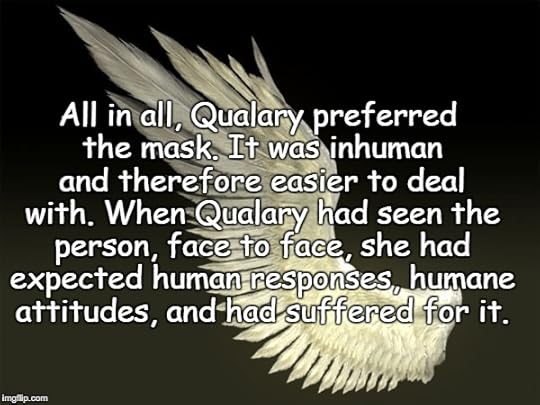
Sometimes, it was the way the author described an emotion, such as the horror that a character felt when the Witch took her mask off.

description

Quote # 2

Other times, it was how a character expressed a philosophical thought about gangers simplifying language to such an extreme that they started looking down at poetry and literature. The quote below reminded me of the restrictions being placed on characters in the novel 1984.

If you take out the different words that describe completely different things that are also the same, what are you left with? For instance, I think love when I read the word, red. I don’t think that when I come across scarlet because I associate it with scandal. Then there is crimson, which reminds me of blood.

description

Quote # 3 & 4

Then there were times when a character stated the truth in the simplest manner. The line is easy to miss with so much else that is going on. Yet, if you stop and think about it, there is depth in those words. Two particular examples that made me shudder are mentioned below:

description
description

Quote # 5

As were the times when a character who is still young and inexperienced said something profound. I went back and read this quote multiple times because it resonated with me. If you find it touching your heart too, you might want to check out my review of The Handmaid’s Tale.

description

Quote # 6

Finally, there were some parts that sparked something in me. While reading them, I thought I could base my next story on these lines. I find that the books that end up on my favorites’ shelf have that in common. I think that each line in those books could be hiding a story in itself.

description

I would very much love to read the second book in the series even though it would be lacking one of my favorite characters from this one. Care to join me for a buddy read?

Image

Also reviewed at:
BL
BS
WP
LI
ME
BO
This entire review has been hidden because of spoilers.
Profile Image for Deb Omnivorous Reader.
1,991 reviews177 followers
June 14, 2023
I actually finished this book a while back, I enjoyed it so much I needed to let my thoughts and feelings marinade a little bit before writing about it.

So, the author; I know I read a bit of Sheri Tepper, back in the day, but it has been a while and though I know I liked her books this is the first I have read for a while and I am certain I have never read this one before.

It blew me away!

The writing, close to flawless, full of vivid descriptions that make you SEE the scenes and the landscape inside your head. I swear I could set eyes on and recognise so many places from this book instantly... if they existed.

So, the scenario is a semi dystopian far future but the book initially fools you into thinking that you are reading pure fantasy, with One of our main characters, Abasio, leaving his home village (very classic fantasy) to go to the city. On the way he meets an old man taking a toddler to an Archetypical village (where archetypes like 'the Orphan' 'the Hero' ect are preserved for.... reasons?). Abasio gets a ride on a truck, which confuses the reader into thinking 'Steampunk?!?' and continues on to the city.

We also cut to a city far away, where a crazy mad woman is building a space shuttle to got a salvage materials from a semi completed space station and from the moon... and by now one should give up trying to classify the book into a genera and just enjoy the hell out of ne of the best, most satisfying stories I have read for ages.

The finale had me staying up until one, two in the morning, because I could NOT stop reading and the finale is not short. This is not a book where having slogged through the resolution happens in half a page. Not at all! The finale is as rich, textured and exciting as the end to such a brilliant book should be.

Also, I burbled about how much I enjoyed it on youtube https://www.youtube.com/watch?v=iXhPU...
671 reviews5 followers
November 7, 2025
I might be a little harsh on this book, but the more I think about it, the less satisfying I find it.

It's a book that definitely is very impressed with itself, and is trying very hard to Teach Us All Something, which winds up being rather heavy-handed. It gets spelled out pretty clearly at the end, which doesn't leave much for the reader to do for themselves. So that's not so great, nor is how clever the book thinks it is.

I think there's also a real pacing problem here; the first 2/3 are establishing the world and the main characters, but it really drags, which isn't helped by focusing around characters that are clearly set up to be Important, but don't spend much time doing much of anything that's terribly interesting other than trying to introduce you to the world through something other than massive exposition dumps. And that helps, but at the same time, the world Tepper has set up is fairly strange and she does very little to explain how it got there and why any of it matters.

There's also a bit of bait & switch with genre here that I think many people will find unsatisfying. It's framed up as a fantasy novel (including the cover art, back cover copy, etc) but in reality it's much more of a post-apocalyptic sci-fi book using some of the trapping of fantasy novels (monsters and so forth) in its web of metaphors. Now, that's not entirely on the author, but in a book that's already frustrating through poor pacing, unimpressive characters, and a consistent sense that there's a lot more going on than being revealed this isn't helping.

The final third does move faster (though some of the characters become less sympathetic) and once things finally come to a head a lot of the manipulation going on behind the scenes starts to get cleared up, though there's also much less fury about how people have been used I think is realistic.

At the end of the day, i think this is a big swing...that mostly missed.
Profile Image for Stuart.
Author 1 book22 followers
May 13, 2021
Another daring oddball of a book from Sheri Tepper. Much like The Gate to Women's Country, this is a post-apocalyptic novel with a distinctly 2nd wave feminist worldview--personality traits and characteristics inherent in men have caused the cataclysm and only a deep green ecology can produce a civilization that won't destroy the earth.

The shortcomings of second wave feminism are evident here--essentialism and heteronormativity exist. even if electricity largely doesn't, and gender roles are still largely enforced and complied with. It's interesting to have such a unique and vivid imagination (there are talking animals that are very well written, a doomed space station, a remarkably interesting economy, archetypal villages, radioactive death robots, ogres, trolls, extraplanar thrones, a bunch of other stuff I am forgetting) be blinkered by social norms prevalent in the 80s.

Basically a long form fable, the book is intricately plotted to the extent that every character, no matter how fleeting, is given connections to many other characters in the book, and Ms. Tepper can write an excellent male character, one bound up in the net of toxic masculinity whose process of unlearning will take a lifetime, potentially several lifetimes.

Worth a read just to explore how the second wave worldview operates when given a blank canvas, also worth a read as a well-written and unique post-apocalyptic novel, if a little heavy handed at times.
Profile Image for Kate.
31 reviews
May 31, 2023
I really enjoyed A Plague of Angels! While I am biased because I adore fantasy books (having been raised on a healthy dose of The Chronicles of Narnia and The Lord of The Rings lol), I thought the world-building of this book was fantastic and enthralling. While it could be considered a post-apocalyptic novel, Tepper's idea on how the world would look after humanity left for the stars is really unique.
That being said, some of the ideas are definitely a product of the time in regards to gender roles, and the age gap between the two main characters/love interests was a bit creepy to me since Olly is 19-20 when she meets Abasio as a romantic partner and he is in is early to mid-30's. I still recommend the book of course, especially if you like speculative fiction!

xoxo
Profile Image for Vicki Cline.
779 reviews45 followers
February 7, 2018
This was a very interesting sci-fi/fantasy book. It takes place many, many years after mankind has left Earth for the stars. The people that remain have separated into different societies. Cities are ruled by competing gangs, there are archetypal villages which contain collections of archetypes like Oracle, Hero, Bastard, or Orphan, and formerly mythical creatures like griffens, trolls and dragons are roaming the land. One of these Orphans sets off on a quest to fulfill a prophesy her Oracle told her, joined by a member of one of the gangs from a nearby city. There are many, many fascinating characters, and I couldn't wait to see what happened next.
Profile Image for Jake.
37 reviews
January 30, 2021
This rereading did not stand up to my memory of this book, and maybe it's only 4 stars for Tepper, but it's still 5 stars for me as a novel. As usual, wildly creative and full of profound truths -- as long as you're somewhere in the green / feminist / anarchist realm ideologically; if not, you might fight with the undergirding philosophies more than I did; indeed, I found them a little less compelling at age 45 than I did at 23. But the characters are compelling in precisely the ways they need to be, and the slow unwinding of historical and cosmological revelations is just as satisfying.
Displaying 1 - 30 of 120 reviews

Can't find what you're looking for?

Get help and learn more about the design.