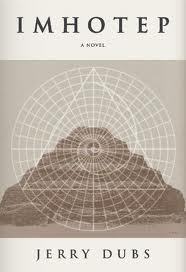
"Imhotep" is the first book in a four-novel series about the ancient Egyptian architect. Stumbling in the dark of an unfinished tomb beneath the sands of Saqqara, American tourist Tim Hope unknowingly passes through a time portal that leads to ancient Egypt — a time before the Sphinx, before the great pyramids of Giza, and long before the loss of his beloved Addy. When he discovers that two other Americans preceded him through the time portal, Tim immerses himself in the ancient world to search for them. As he becomes more comfortable with the simpler, more immediate land, he finds himself irresistibly attracted to the delicate Meryt, a wbt-priestess for the god Re. Learning that a seven-year famine has led to a plot to overthrow King Djoser, Tim discovers that his fate, the lives of the two Americans and the future of Egypt rest in the hands of the legendary Imhotep, master architect of the Step Pyramid, renowned physician and intimate adviser to King Djoser. Downloaded by more than 100,000 readers, “Imhotep" is the first book in an acclaimed four-book series about the ancient Egyptian architect Imhotep. The second book in the series is "The Buried Pyramid." The third book is "The Forest of Myrrh." The fourth book is "The Field of Reeds."
I've always been drawn to science fiction. The seed for "Imhotep," my first novel, was an incident that happened in 1980, when my wife and I were in Egypt. In the Imhotep series I explore the information divide in modern America. In a new series of books, I'm planning to explore the development of personal identity. Of course, this is all wrapped in a gripping story with fleshed-out characters. I'm also starting an exciting experiment on crowd sourcing creativity. For more on that, take a look at my Patreon page Married since 1980, Deb and I have three children. Back in 2012 we became vagabonds (an experience we wrote about in Vagabond Retirement). So far, its been a blast. Cheers! Jerry
I have a degree in Egyptology, have visited Egypt many times, and have often wished I could go back in time and see what it was really like - so obviously I was drawn to this book. My verdict - it was okay, I finished it, but the historical inaccuracies drove me mad. If someone is going to write an historical novel, then the least that they can do is research it properly! I suppose to someone who doesn't know much about ancient Egypt, the inaccuracies wouldn't be spotted, but they did matter to me, enough to write a review, something I do rarely. The book was set in the Old Kingdom, but many of the names were New Kingdom names, dating from over 1200 years later - a bit like setting a book in Anglo-Saxon England and having characters called Kylie or Jamie! The view of religion was also distorted, coming again from a much later period of history - there were several mentions of the Book of the Dead, which again, is from the New Kingdom, and they wouldn't have even called it that anyway,(the mortuary spells decorating tombs were called by the Egyptians "the Chapters of Coming Forth By Day" for anyone who's wondering). Finally, and the most glaring error, were people riding about on camels, which are not indigenous to Egypt, and were not introduced until, you guessed it, the New Kingdom. The story was fairly interesting, but this is just sloppy. I hope Mr Dubs researches his next novel a little better!
I'm giving up on this one... I tried... I really tried... The writing is not for me... I can't connect... I don't know if this one is proofread or the editor doesn't do the job right... I just don't know... It made my head ache... I like Egyptian lit, ancient pyramids, but for this one... Uggh... I guess I'll spend my time in another book... 👎🏾👎🏾👎🏾
American Tim Hope, a tourist in Egypt, is visiting Saqqara when he witnesses from afar a very odd exchange between a man, a woman, and the guard at the entrance to a Pyramid. He had been told that for the right money, a person can get into the tombs after they close and he assumes this is what is going on. Resting in the sand, and creating drawings of the area, Tim is greatly missing his Addy, the love of his life, whom he has lost. As dusk approaches, he realizes he has not seen the two come out of the tomb.
When their driver shows up looking for them, he asks Hope where they are. Hope says he saw them go on, but they never came out. The driver leaves. Hope approaches the guard, who won't give any answers. Hope decides to wait it out and see what happens.
After the guard finally leaves, and night falls, Hope finds a way into the tomb. He calls out but no one answers. He finds footprints in the sand far back in the tomb, and nearly falls into a sarcophagus himself. Not giving up, and in a panic, he walks through a door and finds himself in ancient Egypt, a time even before the Pyramids. He realizes the same must have happened to the other Americans and is determined to find them.
As time goes on, Hope finds he likes ancient Egypt with it's beliefs, mythology, and the life of an ancient Egyptian in general. Eventually he falls for Meyrt, a Priestess for the God Re.
Saying more would lead to spoilers, so I'll stop here and just say it's a great premise for a book. It's not all an easy read though - be prepared for customs that may be hard to read about.
This is the story of three misplaced travelers of the modern times who suddenly find themselves in ancient Egypt, 5000 years in the past after pushing on a false door of an ancient tomb. King Djoser rules and the step pyramid has not been built yet. Egypt is at the end of a harsh seven year famine and they find themselves at the center of a nefarious plot to kill the King who has proclaimed himself divine.
This book is long, 695 pages, but I found myself enthralled. The author does a great job of imagining how life would have been like back then with the food, customs, gods and daily living. The characters were well developed and I thought he did a wonderful job of weaving the modern travelers into the story so that they became part of history. The author seemed to have done his research on the information available about this king even if there are a couple of inconsistencies of the time that other reviewers have mentioned.
There are several instances of violence and cruelty and some sexual scenes, but I didn't find them offensive and the sexual stuff was done tastefully, (except for one rape scene, but it was more implied and not overly descriptive).
All in all, I enjoyed this one very much and I am looking forward to the other 3 books in the series. Recommended.
ugh, not sure I even want to finish this book, now that the main character (an adult man from the future/our time) is screwing a 13 year old girl. Call it my "cultural bias" if you want, author, but *you're* the one writing your pedophilic fantasies...gross. (Seriously, he brings it up just to downplay it: "He knew that thinking of her as a child was a cultural bias. In this time and place, a girl of thirteen was a woman, not a child." Really, dude? smh)
I didn't have a problem with the writers ability to write, though it's obvious that he didn't have the benefit of collaboration with a professional editor - the book ramble aimlessly at points. And I even enjoyed the time travel aspect. However, I could not get behind the pedophilia, or the explicit and graphic violence. The author does try to justify both, but his main characters are modern, and the justifications feel too convenient. What grown American man raised in today's society would not only willingly have sex with a 13-year-old, but go on and on waxing poetic all about it, and her budding body? Apparently, the hero of this novel. The male characters even talk about getting her pregnant like its a good thing. Which should not have come as a surprise, I guess, because there are no redeeming female characters in the book. They are either broken, weak, superficial people, or the subject of a sexual fantasy. Or both, strangely enough. Sorry, just not my cup of tea.
this book just took way too long to get going for me. I usually plow through even hooks I don't like in a week or less. this one took well over a month for me to even bother picking it up. the last 15% or so of the book was really good, and I didn't want it to end. so if the author had cut out like the first 30% worth of babbling and concentrated on the good part of the story a bit id have been more pleased.
I suspected this might be another mediocre self-published novel, and the first few chapters seemed to confirm that. The main character's behaviour didn't really make too much sense and seemed to drag on for much longer then necessary.
However, as soon as we hit 3rd Dynasty Egypt, everything changes. It turns into an epic adventure with proper baddies, heroes you can care about, and the writing improves massively. I suspect that Jerry Dubs was holding himself back until he got to the part of the story he really wanted to write. OK, some of the history is a bit dubious, and he should really use 'hieroglyphs' instead of 'hieroglyphics' in most cases, but who really cares when it's this much fun?
The closest comparison I can think of is Michael Crichton's Timeline, but Imhotep is much, much better than that.
I'm officially surprised. I downloaded this book as a free offer. It is long. It is self published. All of this should be a recipe, not just for disaster, but for a perfect storm of a disaster. But it isn't. This is the work of a talented writer. It's a good adventure ... modern guy slips into the past, does some stuff ... it's easy for that kind of a story to become a cliche, but this one doesn't. Nor does it become a dry history class on Ancient Egypt. The daily life of that time is woven into the story nicely, the land coming alive almost as another character rather than a mere landscape. This is not a perfect book, but it's a darn good one.
I love Ancient Egypt, I've read so much about it and when this came up in my Kindle deals I just had to buy it, the idea of being able to travel back to the Old Kingdom was just too tempting. Sadly while the story itself was really enjoyable and intriguing, there were a number of inaccuracies that kept niggling at the back of my mind (some of which only hit me after I was halfway through!), including the references to the Book of the Dead, which is what the tomb writings were called in the New Kingdom not the Old, and the prolific use of camels, which also didn't arrive until the New Kingdom (as an ecologist, I found this doubly annoying). Putting those and other inaccuracies aside, the story itself was enjoyable and I did like the descriptions of Egyptian life and the comparisons it made to modern living. I really like Tim/Imhotep as a character and did find him quite believable although my mind also got stuck on the issue of how the Saqqara was built to start with if a time-traveller did it based on what he saw when he visited it 5,000 years later...who built it first time round for him to see it? (Que brain explosion!). I think I will carry on with the series but I do hope there are fewer inaccuracies, or at least ones I don't notice!
Interesting story but very long in the middle. The story dragged and dragged but then finished with a bang. I may read more of this series but not right away.
Imhotep surprised me. I wasn't expecting this book to be so likable and easy to read. It's a terrific blend of science fiction and time travel along with a healthy dose of historical fiction and mythology.
In present day, Tim is an American tourist studying ancient Egyptian architecture. He has been studying the Tomb of Step and finds his way into the unfinished tomb in Saqqara after seeing a young American couple disappear into the tomb and never come out.
Tim enters with good intentions, believing that the couple has gotten lost or have been hurt, but he soon discovers that the tomb is a doorway in time that takes people back to ancient Egypt, before the great pyramids of Giza and the Sphinx are constructed.
Tim is able to track Brian and Diane into Ancient Egypt and the three of them are deemed Gods for suddenly appearing in the land.
Brian is perhaps the funniest and most intriguing of the three Americans. At the beginning of the novel, he is portrayed as a bit of a dumb jock, a shallow American tourist with no manners who doesn't care about others, but as we move further into the story, Brian's true personality is revealed and we learn he is not who he seems to be. There is honesty, bravery, and the willingness to help others coursing through his veins. Egypt brings out the best in Brian, and he ended up being my favorite character in the book despite the book being named after an Egyptian architect called Imhotep.
Tim is also a man with a mission. He enters Ancient Egypt to help the two lost Americans, but he quickly adjusts to the simple lifestyle and the surrounding land. He also meets a young Re priestess for the god Re.
With advance knowledge of what is to come, Tim is aware that a seven-year famine is approaching and his life along with the lives of Brian and Diane are inexplicably connected to a plot to overthrow King Djoser. The future of Egypt lies within the hands of the legendary Imhotep, who is King Djoser's trusted advisor, physician, and the architect behind the Step Pyramid.
Will Tim meet one of Egypt's most famous sons? Will he be able to rescue Brian and Diane? You'll have to read Imhotep to find out.
Egyptian mythology has always intrigued me and Wilbur Smith has always been the reigning king (for me) of historical fiction on Ancient Egypt, but Jerry Dubs took the first book in his Imhotep series to a new level. I'd almost classify this as young adult fiction for its easy reading style, but there are some really gruesome parts in the book that some people might not find appropriate.
This is a free book that has been self-published and I thought the author did a terrific job with his story. At 693 pages, it's a long committed read, but Dubs has grabbed my attention. I'm starting the second book in his series soon. I hope you enjoy this book as much as I did.
I’ve read my fair share of historical novels over the years, and a good number of these have been set in ancient Egypt. However, I hadn't yet ventured very far into the world of self-published novels, so when a friend recommended Jerry Dubs' Imhotep to me, I popped along to Amazon to check it out.
Of course, one of the risks you take when buying self-published work is that you don’t know what you’re going to get: will the book be littered with typos and poorly constructed prose? Will the characters be well developed and believable, or will you be slapped in the face with the ramblings of someone who just hasn’t got what it takes to spin a good yarn?
However, having been published in Kindle format, Imhotep was selling for a mere 77p (and considering the length of the book, that's an absolute bargain!), so I thought to myself, ‘Hey, why not?!’ After a brief prologue, the story begins with our main protagonist, the troubled and heavy-hearted Tim, on holiday in Egypt.
Having seen an American couple disappear into a tomb at the pyramid complex of Djoser and then fail to reappear, he follows them in and finds himself transported 5,000 years back to Old Kingdom Egypt.
The story then follows Tim and the American couple, Brian and Diane, as they come to terms with their new home and their attempt to integrate themselves into a vastly different society – each of them experiencing Egypt in a different way.
Tim, quiet, pensive and unable to recover from the loss of Addy, finds solace in the simpler lifestyle of ancient Egypt; Brian, at first glance a mindless college jock, makes the best he can of this bizarre situation with great gusto (and also became my favourite character in the book); and Diane, a fiery redhead, the least adaptive of the three, struggles to come to terms with her strange twist of fate.
The author seems to have had a lot of fun exploring how people from our time might fit into life 5,000 years ago. He compares the two dichotomous cultures and addresses issues such as the age at which a girl was considered to have reached maturity, attitudes towards sex and relationships, and how the Egyptians dealt with problems such as disease and violence.
I was a little unsure at first at how the author portrayed the ancient Egyptians; when Tim, Brian and Diane first appear out of the tomb, stepping into the distant the past, they're assumed them to be gods and the Egyptians were made to look a little primitive with what I can only describe as a rather 'colonial' attitude. This was, however, mercifully brief and the rest of the novel saw the Egyptians cast as intelligent, thoughtful people (or scheming and politically driven, in some cases).
There were a few issues I had with historical accuracy; for instance, Tim, Brian and Diane were put on camels when they first arrived in the past (camels were not used regularly until much later in pharaonic history; donkeys would've been a better choice) and the author used the ancient Egyptian word hwt – which he spelled 'hewet' – when the Egyptian characters were referring to their homes (hwt was a word used in relation to temple buildings; pr would've been the more appropriate term to use). But these were only minor quibbles.
I really enjoyed Imhotep; it was a lot of fun to read, and both the plot and the characters felt well-crafted and polished. I could identify with the protagonists – Tim and Brian in particular – and the author really brought ancient Egypt to life. His descriptions of the land, of festivals and of the people themselves really made me feel like I was there alongside the characters. The story flowed and developed well, I didn't find the few historical inaccuracies spoiled my enjoyment, and – importantly for me – my reading wasn't disrupted by annoying typos.
In my opinion, Jerry Dubs is a talented writer, and I would be pleased to see him get snapped up by a publisher. If you have a bank-breaking 77 pence spare to swap for a trip back in time to ancient Egypt, then I thoroughly recommend this book.
I expected well-researched ancient Egypt (Old Kingdom) plus the fun of modern people caught up in the alien dangers and wonders of the ancient world.
What I got was scanty research--just the barest bones of what everyone already knows about ancient Egypt--plus uninspired, cliche characters, including a few in the "too dumb to live" vein. I wasn't rooting for any of them.
The most sympathetic of the three, Tim, is the main character. However, there were reasons to lose respect for him along the way--including his amorous feelings for a barely pubescent teenage girl who worships him as a god, with no apparent self-awareness or self-reflection on his part.
The other main characters consist of a drunken, self-absorbed party girl, a stupid jock who loves baseball and can't read the room, an obese priest whom the author keeps describing in obscene detail and assuring us that he is empty in terms of soul, and various interchangeable gorgeous Egyptian women, all of whom have the same simpering personality. They really believe Tim and the other two Americans are gods.
I DNFed about halfway through.
Although this book was published sometime later than 2010, it has a 1980s pulp fiction vibe, with literary tropes which are considered mistakes nowadays. There is a lot of head hopping (POV shifts in mid-chapter or even mid-scene). There's classic cinema dialogue. There is a lot of focus on directions and mechanics of movement, with filter words (such as "shoulders shrugged", or "eyes looked"), which takes away focus from plot and character development.
It is hard for me to overlook the signs of an unseasoned writer. Even so, I love adventures, and I made it through 5 or 6 books of the "Outlander" series. Ancient Egypt is a really interesting setting. I would have kept reading this one, if it had had a gripping plot or engaging and likable characters. It did not.
January 23, 2015 A Review by Anthony T. Riggio of the novel “Imhotep” written by Jerry Dove
I recently purchased this book from Amazon Kindle as the summary squib sounded interesting. I had no idea about this book and knew nothing of the author Jerry Dove. I do love historically based stories and this book filled every interest I had: some fantasy, some history, differences in language and culture, political intrigue, religion and even sexual mores.
The main story starts out with a journey of three people through a time portal never before known to anyone, located in a closed to the public, pyramid in current day Egypt. The portal brings these Americans into the period of Egypt five thousand years in the past. They walk out of the pyramid they walked into but to a completely different setting from the one they came from. Many of the other pyramids they saw in the 21st century have not even been built five thousand years ago. The travelers include Brian and Diane followed three days later by Tim Hope. The book was so capturing that I hated putting it down to do other things. I have to say very few books have caught my interest like this book and I highly recommend it to all readers. It is a long book over 600 pages but it will keep your interest and attention often at the edge of your seat. The book is about survival and acceptance of the new environment they were fortuitously drawn into.
I gave this book five stars out of five and probably would have rated it higher if allowed. I am so thrilled that this book was part of a continuing story which is contained in two follow up books. I look forward to reading them in the not so distant future.
An excellent idea which doesn't quite work in the execution
While I generally enjoyed this well researched historical time-travel novel, I do have some reservations.
One, rather ironically, is the treatment of time-travel aspect, which somehow seems uncomfortably trivial compared with the historical theme.
The characterisation is also not strong. The Egyptians do have defined character traits, which are consistent, making them easily recognisable, if generally pretty one dimensional. In contrast, the modern day Americans are not so clearly portrayed. Although they undergo some character development and the male ones have distinct qualities which they put to use in the alien world in which they find themselves, I sometimes found myself double-checking whether I was reading about Brian or Tim.
Finally, after a good start, I found the remainder of the first half or even two thirds of the book quite slow for what the time travel seemed to have turned into an adventure story. (It was in this portion of the book that I found the time travel sitting particularly uncomfortably with the carefully researched historical novel.) The action then picked up, leading to an exciting, if largely predictable conclusion.
The jury is still out as to whether I continue with the series in due course. 3.5 stars.
I think this is one of those books that was OK, but probably could've been much better with the help of a good editor. Luckily, I don't now enough about ancient Egypt to get overly distracted by the historical inaccuracies, but there were things that even I, as a very amateur Egyptologist, quickly realized didn't belong.
That being said, the premise is good. There was some action and adventure, with a little steamy romance (although a little disturbing that the men kept hooking up with very young girls), and the storyline, although somewhat complicated at times, was well drawn out.
The role of the women in this book bothered me somewhat. Diane was pretty unlikeable, but even she didn't deserve what happened to her in the end. And the reader is sort of hit over the head with her one defining character trait, over and over again. We got it the first time it was said, she's never lived her own life, she's a follower, not a leader. Time to move on.
Something that might've made this just a bit more likeable for me is if there had been a little epilogue at the end about life back in modern time.
The premise behind the book was great. The characterization, the drama, Egyptian Gods, History, the growth of technology, etc. what killed this book for me was the authors desire to continually talk about sex. Specifically in relation to 14yr old girls. I read on thinking ok this is just for historical reference blah blah blah. But how the author continued to write about young children disgusted me so I put the book in the trash.
Had high hopes for this, but they weren't met. The historical research is excellent, but at times it reads more like a history lesson than a novel. Way too much focus on sexuality. I'm guessing this reflects the focus of the author. Some good philosophical thoughts, but the story gets bogged down way too often and some characters just get lost in the process. Good idea, but just wasn't executed well enough. I really love Egyptian history and was hoping for more than I got.
This book is an alternate history type of thriller. a third person single narrator with about 6 main characters and at least 8 minor characters the book takes about 30% to set up the story. It's well written with and falls well within the historical setting of the third dynasty in ancient Egypt. I enjoyed the book staying up late more than one night to finish
Hmmmm...I may reserve full judgement until I read the next in this series. My "suspension of disbelief" just didn't quite work here; I mean, the idea of a time-traveling Imhotep? I don't know...
The premise is the best thing about it. The writing could be worse, too.
I assumed someone who had the vision and nerve to write a series on Imhotep would have really delved into the period and thought hard about the implications of the inescapable realities of life and culture at that time. Not so much...
I'm too disturbed by the glossy view of institutionalized pederasty to be as tactful as usual towards another writer here. I grew up in Egypt and saw the damage too much. 13 year olds, even precocious ones, ARE STILL ONLY 13. Meryt acted 24, for reals. Not an age-appropriate level of mentation or attention structure at all. Thanks to life spans extended to 48 in the 1970's, it was far more normal to wait until the late teens or early twenties to marry, and that was considered preferable. 13 YR OLDS ARE STILL ONLY 13, and it is rarely exciting to be required to marry an adult who has the right to rape, brutalize, and control you; it's life threateningly frightening, for the kid and her parents alike. It's not ideal for the groom's family either, which has another needy, scared, demanding adolescent where it really needs another adult.
Also, I couldn't get over the fluffy rose-colored tint over life in that place and era: the pace of life is only laid back for uppermost priests & royals -- everyone else is working *every moment they're awake,* even when they're strolling to the next town. Their life expectancy was only 35 for good reason: they worked to death. No female over 3 and a half didn't have a distaff going, when she wasn't doing something else -- working is the default state of being. If a man took off to find work, he didn't drag 5 hungry mouths with him; they stayed behind to glean, beg, work, hunt, anything. If he had robbery in mind, he'd bring a Male relative or 2, but for haven's sake, leave the women at home, where they can access family and friends for support! He'd send for them once he was set up, but not before. (That was just daft.)
Plus, the Ancient Egyptians were intense necrophiliacs (never mentioned) and *very* looksist, to the point of eugenicism; strangers who didn't have that distinctive curve of nose and "normal" honey toned skin (especially anyone darker) would have been instantly enslaved, not deified. Here's how it would have started: - the fair woman would have gone straight into the nearest harem, or sent to the Pharoah as a gift with warm personal regards from anyone wanting to suck up to him (like a priest contemplating treason), there to be raped by her master and his friends and important guests (part of desert-culture hospitality.) It was also a mandatory-heterosexuality culture. Thus, handing the exotic woman over to an African woman (a minor priestess?) for safekeeping was just nuts. - the freakishly big guy would have gone as a slave either into a guard unit or into a heavy-labor squad. Repeat escapees get maybe one chance, not two, before they're executed. - the "dark-skinned with curly hair" guy would have been killed on sight as a spy or escaped slave. If he looked remotely African, dead; if northern Mediterranean, maybe an indoor slave, if not killed as a spy. He'd be too old to train, after all, and not strong enough to work well.
It's an intensely interlinked culture: if nobody knows where you came from, you can't survive, especially if you're dark and skinny.
That Ancient Egyptian look is distinctive. Coptic Christians, insular up until the last century, look exactly like those tomb paintings. They didn't look like modern Arabs, but like Ancient Egyptians, the result of marked genetic drift and a very specific idea of beauty. (A melting-pot American can't cut it, especially one with dark skin and curly hair. We're shaped all wrong.) He made the hero a joke.
There are ways to turn this harsh-sounding material into thrilling, sexy, even comical, stories. There are ways for them to escape these grim ends, but not by pretending the barriers didn't exist.
Additionally, characterization failed. The characters were neither distinct nor compelling past the first ~20% of the book -- their individual voices dissolved into protracted interior dialog (not keeping a voice, but hopping from one interior dialog to the next, like a bad cartoon) about whatever that individual was currently obsessed with, interspersed with cursory set pieces for a bit of action and sex.
Of course, there are philosophical and logical problems with feeding into the idea that ancients couldn't possibly be geniuses of a staggering kind, but had to be aided by people from another planet or another time.
Dubs may have done quite a bit of reading and may even have visited Egypt, but it would have been a far more engaging and successful effort if he'd made the effort to step outside of his own head. This book gave me the impression he got lost in his fantasy world without ever reaching for the larger reality that awaited him.
Excellent book overall, especially for being self-published. Other than the multiple pedophile diatribes and references, I mean. Here's the protagonist's internal monologue on the subject of a (maybe?) 13 year-old-girl. "She was... perhaps 13... A year is simply how long it takes the earth to swing around the sun... does it really matter how many times that has happened since Meryt's birth? Is the movement of the planets and stars a more relevant way of measuring her maturity than looking into her eyes? Is counting the number of days and nights that have passed since her birth more meaningful than her touch and her smile?"
In a word, yes. Maturity isn't determined solely by age, but neither is it determined by whether a girl touches you, or the "look in her eyes"... it actually does have a lot to do with physical development, which takes place over time. Right? Ok, maybe that was a one-off... but it wasn't.
Another excerpt: "Yes, he would sit upon the throne of the Two Lands and upon his lap would sit a young boy, a beautiful innocent thing. He would stroke the soft skin of the young boy... and the boy would nestle against him and touch him..."
There's another area where a priest finds that young boys "offer a new world of pleasure and pain to explore", after which the young boy is told to get a 5-year old girl to join in...
I mean, I'm no prude, but even I felt really uncomfortable with how descriptive the scenes involving children were. Not to mention the literary kiddy-porn-BDSM vibe.
I apparently got the latest, best edited edition. I found very few editorial gaffes.
I like the author's understated, conversational writing style. I don't like overblown prose, so this suited me.
I did get a little bored with the travelog style of story telling as he related the main characters' travels up & down the Nile River. It was almost as dry as Heroditus' version of his travels...
However, he did keep the storyline moving along at an acceptable pace. I liked how he portrayed both the good guys & the bad guys. He didn't make use of the stereotypical all bad, all powerful bad guys nor did he give the good guys syrupy perfection. He allowed his characters to be flawed & human, making mistakes just like anyone else can.
My one objection is that he gave the main protagonist a 'deus ex machina' in the form of a backpack filled with the most complete & amazing first aid kit... I mean really... Who would bring antibiotic meds on a vacation to Egypt? I can agree with the rest of the contents of the kit, but antibiotics? No. Antibiotics are prescribed for specific types of bacterial infections. You need to know which group of bacteria that you are treating before administering them... The same is true for broad spectrum antibiotics. So, no that part was totally unbelievable in my honest opinion.
Other than the above complaint, I enjoyed this book. I was even able to ignore the anachronistic camels... :)
"...the Egyptian sense of time. They lived at a slower tempo and if they were aware of time, it was in the sense that its passage formed a hazy backdrop to their life. It was a measure, not a master." p. 94
Tim Hope is in Saqqara, Egypt at the Step Pyramid, King Djoser's tomb, ruler of the 3rd dynasty during the Old Kingdom and the founder of this epoch. He follows two other Americans into the tomb to realize he has traveled 5000 years back in time. He inserts himself into a plot by Kanakht, the king's vizier to dethrone the king. As it turns out Djoser has declared himself a god and the Nile river has not risen for seven years, thus leading to the seven-year famine. Two other priests, Djefi, Priest of Sobek--crocodile, and Waja-Hur, High priest of Thoth are in the plot.
As the story progresses, Tim becomes Imhotep, the king's architect, counselor, and physician.
The premise is great, but the delivery is awful. The story is poorly narrated from the third person point of view. The author changes points of views sometimes within a paragraph. The prose is a mess, ramblings go on without end. The book is boring and the narrative is confusing. Mr. Dubbs should have hired a good editor to sort the mess out because the premise is great.