Anthropology originated as the study of 'primitive' cultures. But the notion of 'primitive' exposes presumptions of 'civilized' superiority and the right of the West to speak for 'less evolved' others. With the fall of Empire, anthropology became suspect and was torn by dissension from within. Did anthropology serve as a 'handmaiden to colonialism'? Is it a 'science' created by racism to prove racism? Can it aid communication between cultures, or does it reinforce our differences? "Introducing Anthropology" is a fascinating account of an uncertain human science seeking to transcend its unsavoury history. It traces the evolution of anthropology from its genesis in Ancient Greece to its varied forms in contemporary times. Anthropology's key concepts and methods are explained, and we are presented with such big-name anthropologists as Franz Boas, Bronislaw Malinowski, E.E. Evans-Pritchard, Margaret Mead and Claude Levi-Strauss. The new varieties of self-critical and postmodern anthropologies are examined, and the leading question - of the impact of anthropology on non-Western cultures - is given centre-stage. "Introducing Anthropology" is lucid in its arguments, its good humour supported by apt and witty illustrations. This book offers a highly accessible invitation into anthropology.
Legitimately, it is difficult to introduce anthropology without discussing its problematic history. However, I was expecting much more of an Anthro 101 type textbook in graphic novel format. I rarely review books based on thwarted expectation, but in flipping through this I for sure thought there'd be more about, say, kinship customs; and less dry discussion of, say, how differing schools of anthropological thought approach resource allocation. But when I started to read it... dry.
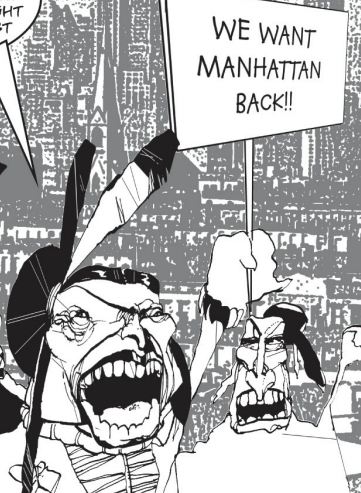
The illustrations occasionally made me wince, as well; while the text discusses some of anthropology's racist past, it is hard to figure out where that falls into the picture with stereotypical illustrations of different races. Was I supposed to read those illustrations as caricatures or were they just poorly thought out? Does it really matter?
All of that said, what the text examines, it examines well for an introductory graphic novel; however, knowing the subject of anthropology as well as I do (i.e., as well as your average anthropology major) and how much that informed my reading of this book, I might be wary of coming cold to other books in this series.
As readable as it is, I can't bring myself to give this book more than 3 stars. The first 90 pages or so may seem like your run-of-the-mill introduction to the history of the subject, but the farther you delve into this train wreck of a book, the more 'critical' it gets of the field as a whole, with the author somehow managing to sneak in disparaging comments about modern ethnography in almost every single paragraph.
Moreover, the book seems to assume the reader is, at the very least, somewhat familiar with philosophy and basic sociology: concepts like social forms, governmentality, post-modernity, and thick description are mentioned, but never explained.
I love introducing graphic guide books and hoped I could use this one to introduce friends and students to my beloved field of anthropology. Unfortunately, it does not provide a comprehensive review and can be outright mis-informative. I give it 2 starts because there were some topics presented well. I am, like the author, very critical of the discipline itself, however she does not explain her criticism to the un-informed reader nor present both sides of the coin. I believe that as anthropologists we are not doing enough to attract more people's interest to the discipline and introducing books should do just that.
Fantastic intro. Had no idea of how problematic Anthropology as a discipline is, and this book is a great eye opener: without over simplifying it gives many threads to follow while functioning as an overview.
Spent a Sunday afternoon taking notes, I skipped the last part as it was less interesting to me. Sorry the formatting on GR is so terrible
My notes on Introducing Anthropology: A Graphic Guide
What is anthropology? Founding fathers Major trends in Western thought (p. 19) Progressivism Primitivism Natural Law German Idealism 'Indianology' Derived minor trends Rationalism Positivism (as a label for Empiricism) Marxism or dialectical materialism Utilitarianism and Socialism Structuralism Nationalism Imperialism Theories of Evolutionism Western thought has always imagined stages like the ages of gold, bronze, and iron → savagery, barbarism, civilization Greeks: a schema of decadence Moderns: a schema of progress Integrating the biological and the social: Herbert Spencer Universal Evolution Theory: evolution doesn't just apply to biological systems (as Darwin believed), but to all systems, including social, economic, and cultural ones → Evolution is a process that moves from the simple to the complex, from undifferentiated to differentiated forms. Society as organism: society is similar to a living organism—it has functions, structures, interdependencies. But each individual/cell remains independent. “Social Darwinism”: He coined "survival of the fittest" But not in an eugenic sense: Spencer was anti-interventionist, individualist, and optimistic about progress. His social Darwinism was liberal, with strong 19th-century overtones, more libertarian than authoritarian. Natural law and morality: Societies become more “just” and “harmonious” over time, following natural laws → a providential and optimistic view of history that Nietzsche despised. Nietzsche (in On the Genealogy of Morals) associates Spencer with English moralists who reduce morality to social utility: “The English genealogists of morality, like Spencer, imagine that morality was born from social utility.” Nietzsche detested Spencer’s scientific optimism, seeing it as a way to mask moral weakness and bourgeois conformity with biology. Diffusionism The idea that ideas, culture, and society spread through contact (e.g. the Tower of Babel). Culture does not develop independently in every place but diffuses from original centers to peripheral zones. Some authors believed in a single origin (e.g. Egypt, Mesopotamia): the theory of hyperdiffusionism. It was an early reaction against classical evolutionism, which claimed all societies go through the same stages. Now considered outdated because: It underestimates cultural convergence: arriving at similar solutions in similar environments It risks epistemic racism: assuming some cultures are superior and original creators It fails to explain internal transformations within cultures It’s historically impossible to prove the original point of an idea But it paved the way for cultural globalization studies: it opened up the study of networks of exchange and inter-civilizational influence. Field studies They leave the armchair—but bring all their prior theories with them
Anthropology disciplines Physical or biological anthropology: In the 19th century: dividing humans into races and measuring skulls; studying the “primitive man” as a link between humans and animals (e.g. Broca, Lombroso) Today: studies the biological evolution of humans using scientific methods (DNA, fossils, comparison with other primates) Polygenesis theory: different races/species from different origins, often used to justify racism Monogenesis theory: single origin — biblical (Adam and Eve) or Darwinian (common evolutionary ancestor) Franz Boas (early 20th century): introduced cultural relativism, demonstrating that differences between human groups are cultural, not biological. This marks the beginning of modern, critical anthropology. The linear model of evolution (from Homo habilis to Homo sapiens) has been replaced by a network model. Homo sapiens interbred with Neanderthals and Denisovans, leaving genetic traces. These are collateral lines — not ancestors, but species we shared the world (and the bed) with. Sociobiology theory: Originated in the 1970s–80s Social behaviors have an evolutionary basis — seen as strategies to maximize reproductive success Controversial because: It tends to naturalize cultural/historical behavior (e.g. patriarchy, violence, religion) It leans toward biological determinism It can be used ideologically (sexist, racist, neoliberal) Gene-centered theory: Behavior determined by genes Models early human behavior based on animal behavior Focus on interbreeding and reproductive control in population dynamics Archaeology: material culture, production tools, and technology Anthropological linguistics: Language as a core part of culture, not neutral Language shapes identity, meaning, and worldview Societies seen as communicative systems Difference between society and culture: Society = organized relations (institutions, roles, norms): how people live together Culture = meanings and symbols that make those relations sensible: how people interpret living together American cultural anthropology (aka ethnology): Studies culture as a totality (language, rituals, food, norms, art) Culture is primary; society is seen as its expression Key figures: Franz Boas, Margaret Mead, Ruth Benedict Method: empirical, ethnographic, descriptive Idea: each group has an internally coherent culture; understanding requires relativism British social anthropology: Studies social relations and institutions (kinship, power, economy, gender) Society is primary; culture is a tool it uses to reproduce itself Focus on structure (roles, norms, institutions) More theoretical; seeks general models of how society works Key figures: Radcliffe-Brown, Evans-Pritchard, Malinowski Ethnography and economy: How people exploit environments via tech (ecological anthropology) Economic anthropology: Mauss (1925) → the gift implies 3 duties: to give, to receive, to reciprocate Formalist vs Substantivist debate: Formalist: economics is a science, universal laws apply Substantivist: economies are embedded in culture Marxist anthropology: Focuses on pre-capitalist societies via: Modes of production: foraging, feudal, capitalist Means of production: hunting, fishing, horticulture Relations of production: how activities are socially organized Sees social change as driven by contradiction Multiple modes of production coexist and interact with capitalism Reframes “the Other” in relation to colonialism Kinship and social organization Kinship is the study of how societies organize relations via family, descent, and marriage. A core field in British anthropology. Household unit and forms of family: nuclear, compound, joint, extended Marriage links: monogamy, polygamy, polyandry, ghost marriage, levirate (marrying a dead wife’s sister), woman marriage Marriage contracts: bridewealth, dowry Kinship theory: Kinship is to anthropology what logic is to philosophy: the foundational system Descent theory: vertical inheritance (status, goods, identity through bloodlines) Alliance theory (Lévi-Strauss): society formed through horizontal exchange (marriage), not descent. "It’s not about who you descend from, but whom you marry." Incest taboo is foundational: it creates the space for exchange and society Kinship types: symbolic, classificatory, fictive (e.g. godparents, compadrazgo) Descent systems: patrilineal, matrilineal, double descent, cognatic/bilateral Marriage and residence rules; rights, duties, and responsibilities Final note: anthropology doesn't impose a definition of kinship, but seeks to understand what kinship means to people in their own terms
Read for the 2015 Reading Challenge: A graphic novel.
Fácil lectura para aquellos que no tienen mucha idea de Antropología. Geniales las ilustraciones. En lo personal, me ayudó mucho a entender algunos conceptos que tenía medio flojos. Pienso que es importante que la autora no haya ignorado aquellos sucesos lamentables en los que la Antropología influyó (y mucho). Por otra parte, no llega a las 5 estrellas (incluso dudo en si darle 4 o no) porque solo se centra en la Antropología occidental hegemónica, ignorando el hecho de que no solo Europa y EE.UU son centros generadores de antropología.
A whistle stop tour that covers all the main points, but it is heavy with it in places. I’m familiar with some aspects of anthropology as we covered it in my ethnoarchaeology module - and whilst granted that was a decade ago now - so much went over my head! Not particularly beginner-friendly but also a bit too basic if you are familiar with topic.
This has an excellent resource list at the end and references throughout, the signposting for further material is top notch so I’ve added an extra second star to my rating
But why is this otherwise a 1-star book? Aside from the information being unwieldy at times, the illustrations are absolutely awful. I don’t mind that it’s not my aesthetic style, but the issue was the frequency my eyes didn’t actually recognise what I was looking at. If I need two minutes to puzzle out it’s a person, it’s not the quick information fix that I’ve come to the book for.
There’s also some very odd and uncomfortable choices made - family types are depicted with a basic man/woman/boy/girl representations. They’re introduced for nuclear family and apply across family types and marriage links, with the exception of compound families. For some unknown reason the ‘generic’ (read very ‘western’) female figures are now wearing burkhas purely for this representation of a compound family. Nowhere else, just here. On the one hand, that’s a great bit of additional information depicted as, yes, this family unit type is current, for example, in some Muslim African communities. But here’s the thing, the first part of this book discusses the racist imperialist origins of anthropology, othering and dangerous stereotypes. Burkhas are not exclusive to compound families nor are compound families exclusively wearing burkhas - just from my limited knowledge, the Hamar of Ethiopia (Channel 4’s The Tribe) immediately come to mind . I could do without being supplied with misinformation and stereotypes - particularly as you may not activity question an image as you flick through and so subconsciously absorb it. No thanks!
Tato knížka má být úvodem do kulturní antropologie, pro mne tedy byla osvěžením a doplněním základů. Jakožto antropologická skripta by tato kniha dostala čtyři hvězdičky, je to velmi dobrý reading list a přehled zajímavých momentů v antropologii, byť bez nějaké větší dramaturgické invence či pedagogických ambicí. Ale to nebyl důvod, proč jsem tuto knížku četl. Je to totiž obrázková, komiksová knížka, a já jsem doufal, že z ní ukradnu vtipné obrázky pro své budoucí studenty. Jakožto obrázková knížka se však vůbec nepovedla. Jednak obrázky postrádají jakoukoliv invenci, nijak obsahově neposouvají knihu a ač se tváří vtipně, vlastně… holt nejsou vtipné, no. Tato kniha pohořela jako koncept, odstraněním obrázků by o nic nepřišla. Možná mám už i já mozek sežraný červy wokeismu, ale prostě si nemyslím, že byl dobrý nápad volit k citlivému tématu antropologie styl karikaturních kreseb. Jistě, karikovaní jsou i bílí fousatí antropologové devatenáctého století, ale ti jsou karikováni jako jednotlivci, zatímco indiáni jsou karikováni jako… indiáni, a to je dost nešťastné. Navíc se mi ta estetika opravdu nelíbí. No posuďte sami. V české verzi je navíc mizerně přeložená (vtipně znějící výrazy jako „jaderná rodina“ jsou na každé druhé straně) a občas i vyložené chyby, třeba zaměnit polygamii a polygynii je fakt kumšt. Abych nebyl jen zlý, knížka vypráví dějiny antropologie dost jinak, než jsem zvyklý z jiných učebnic, takže člověk jenž jich pár četl se dozví něco nového, skoro vždy s odkazy na literaturu, vyvařil jsem z této knihy fakt hodně četby na příští roky.
PS. Teď jsem kontroloval originál, a ta chyba s polygamií je už v originále! Hanba Meryl Win Davies!!
Definitely one of the better books in this series. I’ve always found anthropology an interesting field but have not read widely. This gives a good flavour and a sketchy history of how the discipline has developed.
The profoundly ‘colonial’ nature of this field is not shied away from. A memorable part of the text says, quoting Deloria, that the problem with anthropology is that to survive as a discipline it has had to tell the world about cultures not by using the words and ideas of cultural “insiders” but through the lens of Anglos, who teach what has been found out to other Anglos.
I was reminded of the story i heard from a disabled academic that disability studies was not really a field they could be taken seriously in due to their inherent bias… being too close to the subject.
Although there are some good gems of information in here for the novice, there is also a great deal of black satire and almost 'rants' against anthropology especially the past and how it was practiced. The views are not overly balanced or objective which was a shame. Piero's cartoons were mostly dark humour with some information but I found them to be a tad negative. Not sure this is really the right book for a new comer to the topic, but might be worth reading, if your mind is totally open and not subjected to the bias.
It is a great book to read before start to anthropology or ethnomusicology to have some ideas to understand the field. It shows a short history of anthropology and also gives us the idea in a enjoyable way I like the book but I can not say it is a professional book in field. this book is for teenagers or for the people who is not in the field of anthropology.
Many of the other reviews here have already said what can be said. I feel that this book can be useful for some ready-to-go quotes, or as a ready summary/notes of names and theories for advanced stage students of Anthropology. For beginners and lay readers, this book's bibliography is very good and much more useful, so go through that, especially if you get hold of it for free on Kindle.
Concise info and history on/of Anthropology in a compact yet easy to read book. I learned more about Anthropology from reading this book, than I did in college courses!
A brief look at anthropology with black and white illustrations.
I read it and I understand anthropology less than when I started? I think anthropology is a confusing mess and every anthropologist is making it up as they go along?
Lo leí para mi diplomado de Gestión cultural. Pensé que me ayudaría a ordenar un poco mis ideas, pero la verdad es que me confundió más. De todos los libros que he leído de la colección "para principiantes", este es el que me ha parecido el más débil.
Seems to have been written by anthropologists for anthropologists. But anthropologists don't need this book. All in all its fine, but the tone is a bit light and condescending at times.
Felt like reading a borrowed note of the class topper..The book largely covers the evolution of anthropology and touches key concepts but they are not sufficient to evoke an interest in theuninitiated or further the interests of a beginner