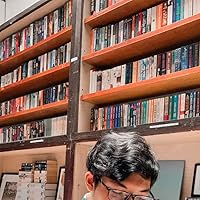
Jose Ando (Japanese name: 安堂 ホセ) was born and raised in Tokyo, and is of African-Asian heritage. His debut novel Jackson Alone was awarded the 59th Bungei Prize. It was also shortlisted for the Akutagawa Prize, as was his second novel, The Camouflaged Man. His third novel, Dtopia, won the 172nd Akutagawa Prize, solidifying his presence as one of Japan’s brightest young literary stars.
This novel is about four biracial Japanese gay men who team up to mess with those who’ve mistreated them, banking on the fact that people won’t be able to tell them apart. It’s a bit ironic then, that my biggest gripe with the novel is that telling the various characters apart was a bit confusing—they were constantly swapping identities, and the different characters didn’t feel distinct enough for me to have a firm grasp on their different personality traits.
Still, I really enjoyed the fresh perspective of this book. I’ve read a lot of Japanese lit over the years, and queer perspectives, especially those of gay men, are still relatively rare—and this is the first book I’ve read that depicts what it’s like to be half-Black in Japan. It was really eye-opening to see a portrayal of the everyday discrimination these groups face. The plot felt like a bit of a missed opportunity, because I feel like it could have been done better, but this book was still worth reading just to get a glimpse of Japan through the eyes of gay, biracial men. I would love to see more books like this!
This book is kind of a mess. It starts and aborts many ideas and several plots in a half-hearted way, all culminating in an act of violence that’s poorly described and only thematically related to the rest of the book. The premise as described is baaaaaaarely followed through on. I did enjoy the disaffected narration and some of the things it had to say about race and queerness (and often more so, racism and homophobia) in Japan. Still the whole thing was kind of like why are we here what’s the plan mouthing off and not writing a second draft. But the translation had some energy to it, and hey, it was quick!
2.5 pomysł na pewno nietypowy i zaczęło się dziwnie, ale dobrze. No ale niestety im dalej, tym gorzej, a końcówka to w ogóle było jedno wielkie wtf, i didn’t get it?
Books that jump out at me on a hunch are usually interesting. This book is no exception, and is by far the best novel I have read in recent months.
The main character is Jackson, a gay man who is a mix of African and Japanese. At work, he learns that a pornographic video of someone who looks like him is circulating. He has no memory of when he was filmed. No, he think he has a faint memory of it.
By chance, Jackson meets three mixed gay men. The four, who have similar facial features, band together to find the source of the video. At the same time, they impersonate each other and play a little prank on each other. They have similar skin color, eyes and noses. They take small revenge on those who judge them by their appearance.
While it's a scintillating read, we are also reminded that the Jacksons are perceived as "one person" rather than four. Four people with different personalities and personal lives. But the only thing that people remember about them is that they are mixed men.
The story draws you in. The writing is refined and clear. The descriptions are straightforward, the conversations are sharp, and the expressions of feelings and subtleties of the heart when exposed to the gaze of others are very good.
This book is the debut novel of Jose Ando, himself a mix. I look forward to following this promising newcomer in the future.
When I started this, I was hoping the low rating would be misplaced, but I very much get it.
Jackson Alone is about four queer Black Japanese men being blackmailed with a revenge porn video that looks like all of them (and it's of one of them).
The beginning had something reminiscent of Flesh by David Szalay, as it sort of follows Jackson going through stuff in a seemingly apathetic way. As the reader, you just see bad things happen to this guy here and there and lots of yapping about stuff, and it's all told in a detached way. I found, though, that the book was hard to follow as it keeps throwing you here and there without telling you where you are, and bringing up new stuff and opening new storylines, then immediately dropping them without closing anything. It feels like the author had an idea to start the book and a cool ending in mind, and they just kinda went from one point to the other in the most chaotic way.
I'd say the highlight was the way it addresses homophobia and minorities in Japan.
Thank you to NetGalley and Bonnier Books UK/Footnote Press for providing me with an ARC of this book in exchange for a review.
This novel was so promising to begin with. It opens with Jackson, a massage therapist for a sports company who, in his professional and personal life, experiences prejudice about his race and sexuality. He is shocked when his colleagues discover an explicit video featuring a man that looks very similar to him. In search of answers, he meets three other men of similar appearance, who are all also gay and mixed-race. Realising its exploitable potential, they plan to float between each other’s identities and thereby both find the culprit and seek revenge upon others that have wronged them.
At first, we are delivered exactly what we are promised, which is a biting commentary on being Black in modern Japan. Having the four perspectives meant getting an insight into their separate experiences and opinions, while their physical similarity parodies the racist assumption that ‘they all look the same’. Ando manages a level of distinct characterisation that is impressive for such a short novel. I also enjoyed the switching of points of view, which meant the reader got to see events and characters from both a personal and outsider’s perspective.
But, along the way, something went wrong. From around 75% through, I (and, judging from reviews, a lot of other readers) lost understanding of what was going on, or what it signified. What I felt was a novel rooted in reality descended into surrealism which failed to justify itself. As I finished reading, I was confused and unsure what I was meant to take from it. Had the pace of the beginning continued, though, this could be a near perfect novel—it’s just a shame that none of those ideas followed through.
This made no sense at all, I'm sorry to say. Which is a shame, as I requested it from Netgalley expecting something more along Yigit Karaahmet's Summerhouse (also published by Soho Crime). Thankfully, it was a rather quick read.
I appreciated how weird this was and the use of doppelgängers to explore racial prejudice, identity and sexual autonomy. Ultimately I don’t think it came together in a satisfying conclusion and the final chapter seemed like a separate short story.
le principe de l'histoire donnait grave envie mais l'écriture est trop fouillie, j'étais perdue tout le long du livre :/ on se perd dans les personnages et dans l'intérêt de l'histoire
I've been spending more time in the literary corners of international Blackness during the past few weeks than I would have thought myself capable of: first Giada Scodellaro, now Jose Ando. The scene vastly differs, the genre near opposite, and of course there's the languages to contend with, but if Scodellaro constructs, Ando dissects, and in society like Japan that took far too eagerly to European systems of fascism and colorism, there's a whole lot to flay open. I didn't understood everything and can't say I instinctively enjoyed most of it, but in the field of worldwide status quo and all of its antitheses, a little bit of subversion goes a long way.
The concept of race makes masters and slaves of us all. While the US has been one of the loudest in pointing this out to good effect, it can flatten the realities of Black folks that don't have some variation of "American" in their hyphenated balancing act. Jackson serves as one example of Blackness in Japan as Cassius "Cash" did as Blackness in the US in Sorry to Bother You, where the rabbit hole is as deep as the hierarchies of power and as wide as the human capacity for abuse. Considering Japan's joke of a legal system, I can well imagine how the "stop and search" grotesquely breeds with social systems of sex, tech, and consumption of all things Black without the risk of being "contaminated" so long as the humanization is kept in check. Ando cycles through a great deal to devastating effect, and while some scenes left me cold, I am more than invested in his long term literary career. If he's intersectionally gutting the white supremacist system in a queer way this early on, I can only imagine what he'll be capable of in the years to come.
It's been interesting looking back and realizing how much of my appreciation of this book is grounded in film. One can thank Jordan Peele for much of that, as well as the instances when my younger self was capable of having more sense than capitalism is willing to substantially reimburse. I've yet to watch something that captures the horror of queerhood in addition to Blackness, but my appetite for pursuing the most cutting edge of such in film pales (ha) in comparison to my efforts in text, so I can piece together what I've drawn from Baldwin and co. to have The Delectable Negro in my reading sights. It's a shame I can't rate this particular work any higher without leading out a lie, so I will say, this is far too short and too potent for folks to risk giving it a miss simply due to poor average rating. To draw a reasonable comparison, I acquired The Disappearers for my workplace based on my substantial past experiences long before anyone in the upper news echelons gave it a sniff, and just look at it now.
As for Jackson, when HR listened to what he had to say, he didn't come off as especially angry but rather like he was calmly pointing out some sort of clerical error.
So, you know how people talk about losing the plot? That's exactly what this book is.
I picked up Jackson Alone this afternoon and read it in one go. But, I didn't understand 90% of what I was reading. So, I re-read it this night and now I don't understand 60% of what I was reading. So, much better, but still not good...
The first time around, I couldn't figure out what was happening or why it was happening. The characters were incredibly confusing to me because they don't have distinctive individual voices. There are also a lot of strange (time) jumps that threw me off. I didn't understand anything.
The second time around, I started to get a better grip on the story. I was able to connect certain events to one another and it was easier to differentiate between the different characters. But by the gods, this book took a lot of brain juice to read!
This book was our book club pick. It's not something I would choose myself, but that's what's fun about being in a book club! Trying new things and expanding your point of view.
The concept of the book scared me, quite honestly. But I could see the potential of a thrilling and shocking story, so I was willing to give it a try. Unfortunately, I don't think this worked out that well. Just like other reviews on here say, there's a lot going on and it's like not everything fits together or makes sense. The blurb promised something different if you ask me.
I also couldn't connect to the characters, because they make the strangest choices. I didn't even feel bad for them when genuinely bad things happened to them?! That was a bizarre experience...
There are some hard-hitting quotes in here. Also quite a few honest paragraphs about racism and how it's basically everywhere. But once the book started getting somewhere with that, it got lost just as quickly.
I am glad that I reread it, but damn... What did I read? Curious to see what my book club thinks about this book.
This one unfortunately didn’t have the impact I was hoping for. I genuinely think it may be a case of being somewhat lost in translation, and I found myself wishing I could read Japanese to experience the source material as it was originally intended.
While I loved the premise, there was a lot of setup with very little payoff. The story never fully comes together and then ends rather abruptly, which left me feeling unsatisfied.
That said, the audiobook narration by Pun Bandhu was excellent. He was engaging throughout and did a great job differentiating the characters. The book itself is also very short—just over three hours at 1x speed—so I finished it in about an hour and a half.
In the end, I still think this is worth reading. There’s the beginning of a compelling story here, and it does offer a glimpse into the racism experienced by mixed-race individuals within Japanese culture, which was one of the more meaningful aspects of the book.
I was fortunate to receive a complimentary ALC from RB Media via NetGalley, which gave me the opportunity to share my voluntary thoughts.
Jackson Alone by Jose Ando is an intruiging queer neo-noir revenge novella. It hooked me with a strong start, then almost lost me with too many characters and side stories. In the end, I realized that this excess was the point, and that the turn is handled quite cleverly. I didn’t love every part and found it a bit uneven, but the finish earned my respect.
This entire review has been hidden because of spoilers.
I went into listening to Jackson alone, thinking that this was going to be a gruesome, revenge story and found it to be something little different.
Jackson is a massage therapist, but he doesn’t fit in with the rest of the office staff and clientele. He stands out for being mixed race, half Japanese and half African. This becomes a detriment when one of the clientele finds a violent pornographic film. It appears to be featuring Jackson…
Jackson has no memory of this occurring, but the person in the video looks exactly like him… But things start to turn around when he meets up with three other queer mixed race people who look eerily similar to him…
All four of them are not completely happy in their current life positions and decide to use this newfound found multiple identities to mix things up.
I found the idea and the premise to be quite unique, but I had hoped for a bit more resolution to the unsanctioned pornography and the fallout from Jackson’s office. Overall, I felt like I was left, feeling unsatisfied by the resolution of the story.
I listened to the audiobook narrated by Pun Bandhu and enjoyed their reading voice. I do think this book would have done well to have additional male narrators for the additional doppelgängers just to create more distinction between the characters. I think Pun does a relatively decent job differentiating them, but with four characters in play, as an audio it became difficult to tell which character was speaking in turn.
Très agréable surprise. Un roman sur le racisme que subissent les métis noirs/asiatiques au Japon. Si on rajoute à métis et à noir le fait d'être un homme gay, et on a la totale en terme d'oppressions systématiques. L'auteur lui-même métis et probablement gay connaît son sujet.
Une demi-étoile perdue parce que j'ai pas du tout compris ce qu'il essayait de dire avec la scène finale. Elle est beaucoup trop courte et il s'y passe beaucoup trop de trucs pour arriver à démêler tout ce que l'auteur y a empaqueté.
Le seul point vraiment négatif, c'est qu'il n'y pas un seul personnage féminin dans tout le livre. Même pas un tout petit.
I read a great review of this book and had my library buy it, because I am interested in Japan and Japanese literature. I have got to say, this is one weird book. Jackson is a biracial, half black Japanese man. The premise is there is a porn video, which I can not even describe because I could not understand, but people at his work accidentally viewed it, but it wasn't him but another biracial Japanese man. So, is the premise that there are 4 biracial gay guys who people can't tell apart?? Is that in itself racist?? I can honestly say I had difficulty following the story.
i liked this! v short novel with a lot to say on being black(/mixed race) and queer in japan and the narrative shifts so seamlessly between the foursome. but it’s such a short book so the conclusion felt a bit rushed!! an enjoyable reading experience though!
So many ideas. An interesting vibe. The pov shifts very fluidly mid paragraph leading to a dream like feel. Felt more like a snapshot of a larger narrative.
It has some of interesting commentary on the surveillance state, specifically for Black people in non-majority Black spaces, but I wish it touched on it MORE. This book is really short, and I think if the author just developed some ideas more thoroughly then this could be really cool.
This book is the definition of "what the fuck is going on????" This was a ride from start to finish. The synopsis goes as follows: four queer Black Japanese men team up to find and take revenge on the anonymous person who is threatening them with a gay porn of a Black man, whose real identity is one of them.
Psychedelic, critical, and unpredictable, Jackson Alone is a book I wouldn't recommend to anyone looking for realism. Colorism, racial discrimination, and homophobia were discussed in this novel, questioning the ways Japanese society deals with minorities. It's reminiscent of Hunchback in the way that they both loudly and directly criticize society, honest to the point of brutality. But sometimes being truly candid is necessary, and I think both Ando and Ichikawa commit to their truth in a way that's almost frightening (yet admirable).
Jose Ando's writing jumps from one character to the next, never coddling the readers — in fact, Ando doesn't care if the readers catch up with what he's saying. Despite of — and maybe because of — this neglect, there's power and punch to his writing. And I think that's also what made me enjoy Ando's writing: fast, quick prose with momentum that builds up rapidly. It could also be a double-edged sword, as a lot of reviewers I see here dislike that aspect of the book. But the thing is, Jackson Alone is camp. It's not meant to be liked by everyone, and it doesn't care about being liked. It's excessively theatrical and flamboyant, and it stands proud despite all that. Books rarely are camp, so this was such a unique and distinct experience for me.
However, the reason I couldn't give it 4 stars (or above) is because I personally think Ando almost seems like he doesn't know what the fuck is going on in the book either. I think an author should at the very least have control of their own book, and there are way too many things Ando tried to fit in inside this chaotic book, and that's exactly where the book fails. Of course, it is campy as it can be — but the lack of control made it gauche and inelegant. I know sometimes that's the point of camp, but I prefer elegant camp over chaotic camp. If you know what I mean.
I must applaud the last quarter of the book because wow, what a spectacular scene! The book is so ridiculous and outlandish, but it's anything but oblivious to it. In fact, it's so self-aware that it's almost meta. All in all, I'm all for Ando. I just need him to refine his control of his own prose.
3.5 stars!!! #JapanInJanuary
Thank you to Edelweiss and the publisher for the e-arc <33
I'm so confused! This book started strong and the beginning immediately caught my attention, but the story progressed so fast it was hard to keep up with everything that happened. The perspectives kept switching around rapidly and the story kept changing directions, or at least that's what it felt like. In the end I was majorly confused and absolutely lost. I have no idea what that last chapter was and how it was supposed to be connected to the beginning.
I don't know if this was the length it was supposed to be or if the editing process deleted a lot of additional text, but I feel like this story could have been so much better with a slower pacing and a clearer path.
There were so many important topics like racism, internalized homophobia (or heterosexism), SA of men, the question of consent,... but the story moved so fast, it almost brushed over all of it.
Also, I'm not sure where exactly this book was "darkly funny" but I definitely didn't catch that - dark, yes, funny?! Not so much.
At least the narrator was good, but even he couldn't save me from the overwhelming confusion this book dumped on me.
Thanks NetGalley for the free ALC in exchange for an honest review.
This was quite weird, and I have to admit the plot got away from me! It’s funny, my instinct was to think “I’d keep these characters straight better if I saw them in a movie” except, no, I wouldn’t. 😂
Having said that, I think part of the point of this book is to comment on how racism can come in the form of mistaking people of the same race for each other. So how similar did these guys *really* look?
It’s kinda surreal and bonkers and definitely escalates, which I appreciate. But what that escalation looked like didn’t quite work for me. It felt more and more disconnected from where the book started, and I was definitely muddled.
I appreciated reading the perspective of a mixed race person with dark skin in Japan. That’s not something I’ve come across before, and it sounds rather isolating and frustrating.
Thanks to NetGalley and the publisher for the ARC.
This is definitely a beguiling novella, that’s for sure. It managed to say a whole lot about racism, classism, cultural appropriation, the surveillance state, social power & status, celebrity, and queer identity in contemporary Japan, among other things. These sociological observations were abundant but subtle, presented as quotidian and the narrative didn’t remark on them. The whole concept of the story hinges on the interchangeability of Black men, even by those who lust for their bodies. Everything is presented to an almost exaggerated degree, and parts of this story are dark satire, but that is mixed with a detached naturalism that makes the whole thing hard to categorize. It certainly engendered reflection on the intersectionality of these issues and more, without ever once feeling didactic, self-righteous, or scolding. That made this is constantly intriguing and engaging read.
I say it is beguiling though because these observations are done in the midst of a threadbare narrative, which I suppose isn’t uncommon in farces or satires but contrasted with the detached, naturalistic tone much of the narrative adopted. We have an intimate third-person and yet there still feels like an observational distance, not because we don’t have access to the characters’ thoughts but because their emotional landscape is reserved and not as wildly expressive as parts of the story would imply they should be. There is some head-hopping, which is to say switching POV across characters within a single page without any clear narrative delineation, and it had an interesting effect here. Generally excessive head-hopping just feels like amateur writing, without the narrative clues to direct the reader to where they should be, but here it felt very intentional and it aligned with some of the themes of the story. These characters are individuals but they also are porous, confused for one another even by the narrator, seemingly, and it helped create a level of surreality and distance that set the tone for the story.
The nature of the story meant the characters didn’t feel particularly well-rounded, each had a distinct history but that was just kind of explained to the reader, we didn’t come to understand them through their emotional experiences, they didn’t have inner story arcs, and they almost felt disposable. This made sense for the story being told but it made it hard for me to care about any of them, much less try to follow the logic in the narrative action. It all lent to a detached, observational style that was more performative than inviting. The writing itself felt direct, with short, declarative sentences that almost felt clinical. This kept the story moving quickly and tended to highlight the absurdity of what was happening. It is smart for this to be novella length, because it can sustain its level of weirdness and ambiguity for that long without feeling stretched thin, but it does come at the expense of a meaningful or emotionally resonant plot. Instead it almost reads like a number of interconnected tableaus stitched together.
I definitely enjoyed reading this. It feels confident in its style and decisions, and does a great job of creating opportunity for reflection. I do wish there had been more substance to the characters, and I would have liked there to be either clearer inner journeys happening or a more robust narrative plot, something to hook my attention a little more concretely. It does read really quickly and will leave you scratching your head, if nothing else, as you think about race, identity, and power.
I want to thank the author, publisher, and NetGalley, who provided a complimentary eARC for review. I am leaving this review voluntarily.
i knew it was going to be weird going in and that's not usually my genre, but the synopsis caught my eye so i figured i'd give it a chance.
but really like.. why?
i thought that it had a lot of good bones, good things were being set up: talking about what it's liked to be mixed race and queer in a largely homogenous society, surveillance on Black lives, the experience- good and bad- of coalitions of social groups. But to what end? I felt a lot of these themes were left unresolved in favor of composing the revenge narrative.
Where I thought this book excelled was in atmosphere. Everything is so tense and off-kilter. There's an neasy blurring of lines between imagination and reality. At first, Jackson tells the reader in no uncertain terms that he is not the man in the video, but then throughout the novel he gets weird sense memories of the event, like the feeling of the music ripping through him, or the familiarity with the hotel carpet. Ando also set up characters who are all distinct in the basic facts of their life, but somehow also become porous in each others' presence, as if they want to escape into each other. The "head-hopping" between each man, so to speak, is so fluid it's blink and you miss it.
All four men come together and break apart in ways that should be alarming, but which are smoothed over by the apathy of the writing style, which makes it all the more unsettling. Even though the narration is third person limited, the reader is shut out from more meaningful thought process that would form the basis of motivations or explanations. Why do they care about each other? Why are they really helping each other? Why are they so eager to transgress social norms wearing another's identity?
The answers to some of these questions (I felt) were left intentionally vague to amp up the eerie atmosphere, but when you have no answers at all, everything feels cheap.
Even though the whole book is a series of bizzare interludes, the ending in particular felt like an abrupt departure from the rest of the book. I knew from the general bent of the story that we were never going to get a satisfying conclusion that neatly explained everything, but the nonsensical nature of the final pages really made me question what the whole point of the bok even was.
However, I am more than willing to entertain the idea that this is a me problem, that it's I who just didn't understand. Reading the audiobook defintely got me through this fast and helped me avoid getting snagged on thorny passages. I feel like if I read this physically, I'd keep trying to go back and reread to wring meaning where there was none. On the other hand, I do acknowlege that because the audiobook kept ushering me on, I wasn't reading as closely as I could have. It's a balancing act. Things could have also been lost in translation, but who's to say.
I do want to give props to the audiobook narrator- Pun Bandhu so good at portraying this tone of ceaseless, dizzying apathy and disaffection. that when moments of clarity rip through it feels like a bucket of cold water tossed on you.
Given I'm not so sure that I got everything out of this book I could have, I'm very interested to see what other people are saying about it. I feel bad giving this a midling rating considering that the average rating is quite low. I suspect perhaps that a lot of people don't get it, so they rate it lowly. But what're ya gonna do, that was my experience with this book.
To be a minority in any culture brings its own challenges. In a country such as Japan, as is sometimes parodied and in fact is here in one scene, known for both courtesy and priding itself in social unity as a tool of communal good, it causes a contradiction of interests for the majority. Four mixed-race black Japanese men have absorbed the subconscious to outright prejudices and awkward interactions their entire life differently. They're given a chance to see these variations and compare grievances after they're brought together by a shirt each mysteriously received. It's a key to a scandalous viral video featuring someone people believe to be each of them.
Hyped up with accumulated aggravation, chemical assistance, and comradery they devise a plan to strike back against those who have pushed their buttons for too long. In turns they take advantage of others' blindness and pretend to be each other to enact revenge on behalf of each other. The experience is cathartic if not a touch ironic given what brings them together. Looming in the background remains the disturbing video and its source of it.
I file “Jackson Alone” with a group of titles that are bursting with potential but absolutely fall apart for me. There are so many valid, important, points this book could be making. Is it a book about the dangers of AI, data collection, privacy, and the commodity that's made of black bodies and culture regardless of individuals? Is it a book about external, internalized, systematic, and even intraracism with its notes of colorism by some characters and regional prejudices? Is it about the evolution of social response to queer identities? Is it about discrimination and hypocrisy seen towards sex work? Is it about community and the assumed uniform opinions and reactions we expect a group to have? Is it about finding what defines you?
Yes and no to all of these. If the book's purpose was to bring this questions to the forefront of readers minds, yes this was a success. Because of how crucial these conversations are, I can't give it less than three stars.
However, as a contained narrative this was scrambling all over the place. While there was character evolution, I'm not sure I can call it progression or development, there was no follow through on any of these potential messages. I'm not even sure if it really handled the initial plot concerning the video. Combine that with a complete surrealist twist that just brings up its own set of questions and I ended this reading experience just baffled.
While I am incredibly grateful to NetGalley for the opportunity to explore this story, it's been a while since I've been so conflicted on evaluating a book. I want to engage people in all of these discussions. To have them all in one place is beneficial. I enjoy being challenged and books that compel you to think. But it's hard to recommend it when I feel I've seen them individually addressed in other places that was a more fulfilling reading experience.
If I were a more granular- if I believed in quarter stars, this might be a 3.75. I really enjoyed it.
This is one of the most unique, interesting premises I have encountered. I was gripped from the opener, it delivers on the premise. I felt like I was fully in it with the characters, I actively wanted to keep reading all the time. It's a quick read, while there is a clear narrative, there is a lot of somewhat disparate scenes that ultimately contribute to the same conversation. Some of these scenes, or ideas could have lingered more, or been more developed. They also don't need to be. They accomplish what they want to do.
One thing I really appreciate about the story, is how every moment is, sort of underscoring it's point. There's a big final set piece that seemingly comes out of nowhere, but it does very much play with the same themes. And despite being a serious conversation, devoted to exploring it's themes of fetichism and othering, it's also a playful novel. It's a little tongue in cheek, a little quirky. It has that thing I love where it feels like modern mythology. It's a story that makes me want to sit down with people and recount the plot, just to hear it again. It's ultra realist, and ridiculous in a way that only seems to lend more truth to it, and I liked that.
On the translation: I cannot attest to the accuracy of it. Prose wise, it was the type of writing that left me with the feeling that either there is some quality, a casualness or simplicity to the writing in it's original language that the translator is trying to preserve in English. Or, it's possible that during the translation process, the most obvious, typical English words were chosen to the detriment of style. I think it's most likely a combination of both, it's tempting to me to blame the translator. One example is that I kept noticing early on that the book is full of filler words like 'really' and 'so', like it might say, the walk through the park is really long, when 'really' could easily be removed from the sentence, or a different adjective could be chosen. It's not the language is simple, because again if there's a conversation quality to the original, I think it makes sense to preserve that, it's that (the translation) is simple in a way that felt unintentional, and inelegant.
It bothered me until it didn't (once I got into the story I was in it). It's a short book so it didn't bother me for very long. The characters are both unique and believable, I was rooting for them. If this had been a more plotty book, with an over-focus on the mystery, it may have overstayed it's welcome. But it doesn't and isn't, it does exactly everything it needs to do.