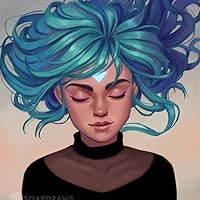
The Concept: Japan. A horribly scarred woman has a vision of the afterlife in which she is visited by her dead mother, and then returns to life with a new sense of purpose. A personal tale of love, duty, and self discovery, elegantly told through the masks and metaphors of the Japanese Ghost Story. The long-awaited second volume in David Mack's critically acclaimed series. This Collection: Now back in print! Collecting four fully painted Kabuki stories (including a completely new story!) in a brand new and improved prestige edition with extra pages! Much more than the previous out-of-print 48-page Dreams paperback, this 128-page volume presents all of the very first-painted Kabuki books (Kabuki Color Special & Kabuki: Dreams of the Dead), but also the fully painted Kabuki #1/2, and an entire Brand NewKabuki story written and painted by David Mack, just for this volume! Also included in Kabuki for the first time ever, a completely autobiographical comic book story, written and drawn by David Mack, an in-depth Kabuki Spotlight and David Mack interview from France's Ekllipse Magazine, a gallery of original covers, an introduction by Brian Michael Bendis, and brand new afterword by David Mack, a brand new front and back cover (and lots of new art pages), and printed on new and improved, thicker high grade, archival paper. Having been out of print for some time, fans are looking for these early painted Kabuki stories and this book delivers with loads of extras and a brand new painted story!
Beautiful and immersive - one of the best concepts in comics in the last 30 years. If you are not aware of Kabuki by David W. Mack do yourself a favor and look it up! In my opinion it is just a matter of time before there is a movie based on the characters; but before that happens you can still treat yourself to this amazing series!
Mack throws us a curveball after Circle of Blood. This is a surreal dream taking place as Kabuki is bleeding out on her mother's grave at the end of Circle of Blood. What story there is, is a bit of an incoherent mess. The text is often drawn into the art making it difficult to even find much less read. Everything about this is experimental. Mack switches to full color for this volume, using mixed media like photos on some pages and on others his first fully painted pages. Really the only reason to get this is to flip through the pretty pictures. There's not much else here.
(Non Spoiler) - We find ourselfs at the same place where the first book ended, and kind of stay there for a more detailed examination.
This shouldn't really be looked at as a continuation, Mack himself describes it as an epilogue to the first book in a very experimental way. Its very nice to read, with finally color added to the art. But in terms of moving the story this does little to nothing.
So I would even go as far to say you could skip this if you are in for the story and not for the art.
Kabuki is a series about transformation. Yes, it has beautiful art. Yes, it has great writing. And while the central theme of the narrative is transformation, what I found even more powerful is the way the art of the stories transforms from collection to collection, seeming to mirror the character’s evolution.
I have met David Mack a couple times at Comicon, and I’ve been meaning to ask him if he always intended from the beginning for the story to be about transformation and to move from standard comic style to collage. I like to think that it’s something he came up with as he went along, and the writing of the story transformed as he developed it. That the book evolved him as the story itself evolved.
On a plot level, the story begins in rather mainstream comic fashion. Kabuki is set slightly in the future, primarily in Japan. The main character, Kabuki, is one of a group of eight female assassins called The Noh who wear iconic masks and stylized costumes. They are a team managed by the government and sent out to instill fear and kill gangsters and various corporate criminals. However ... not all is as it appears. A multi-layered conspiracy ensues. Seven graphic novels complete the story.
Kabuki Circle of Blood. Mack wrote and drew. Black & white. Has a grim, raw style. The art seems a bit underdeveloped to my eye. Has a bit of Sin City tone but more surreal. With more emphasis on emotions. The story is overall, fairly straightforward to this point.
Kabuki Dreams. Mack wrote and drew. Takes a huge leap forward in style and has more of the Mack signature look. Collage style begins, color is introduced. Blends pencil sketching, ink drawings, painting and even photography. This is a book of interior monologue and, as the title would lead you to believe, is trippy.
Kabuki Masks of Noh. Mack writes and draws some scenes, but this is primarily guest drawn. The style returns to black & white, but overall more refined, precise and graphic than Circle of Blood. Rick Mays draws a pretty phenomenal Scarab. The various artists seem to be chosen to help represent the style of each of the assassins. This sequence consists of short stories introducing us further to the other members of the Noh.
Kabuki Skin Deep. Mack returns to both draw and write. In Skin Deep his incredible artistic skills beginning to shine. He can morph like a chameleon from cartoonish renderings to realist representational paintings to pencil sketches.
Kabuki Metamorphosis. Mack writes, draws, letters and designs. For the sheer brilliance on display, I think Metamorphosis is the most beautiful of the series and my favorite. The diversity of techniques is breathtaking.
Kabuki Scarab Lost in Translation. An action-packed side-step featuring everyone's favorite assassin, Scarab. Illustrated in graphic black & white by Rick Mays, the coolest artist from the Masks collection. Just as the art harkens to outstanding comic illustration style, it doesn't push the envelope in content or technique. A fun diversion.
Kabuki The Alchemy. Mack takes his signature collage style even further, using cut up items and diverse materials including envelopes and letters sent to him from fans of the series to tell the existentialist, inspirational conclusion of Kabuki's epic story. Although visually, I prefer Metamorphosis, I truly admire The Alchemy for showing the potential of comics. Yes, many artists like R. Crumb and Chris Ware have achieved fame for non-superhero stories. But Mack essentially demonstrates the potential before our eyes to move beyond the dictates of the superhero form. A series that begins with ultra-violent superhumans fighting battles for stereotypical reasons ends with artistic explorations of our inner potential as creative beings. Kabuki moves beyond standard comic book “hero” tropes into a story of heroic action as self-transformation, moving beyond the dictatorship of the system, the fear of change and the psychological control of the past. The hero is one who evolves not one who kills everything. And Mack says we each have the potential, regardless of what has come before, to evolve. Perhaps best of all, the transformation that takes place goes much further than within the narrative; it is a transformation of the form of graphic storytelling. Now that is truly inspirational.
It is really awesome to see Kabuki in full color and more of what I think is now considered Mack's trademark style. The story is sparse and poetic here, but does important work if Kabuki will appear in later volumes of the series. Besides the art, I loved the elements here about Japanese culture/religion. I think the more you like Mack's art, the more you will like this volume since. I'm glad I got to read this second volume right after the first and while I don't feel the urge to run out and get the rest of the volumes, I still have really enjoyed reading this series.
This is a stunning example of the unique power of the graphic novel form. This is not a comic book - it is muliple media literature, and its' stunning. The huge variety of artistic styles and techniques which Mack uses is astonishing. I wish I was half as talented. The story is also wonderful, even if this is a book which fills in, rather than is part of, the main arc of the series. Actually, it is less like a story and more like a poem.
Just when you thought the first Kabuki was awesome, this comes along and blows your mind. So many different mediums used, and effectively, to convey this story. A shining example of how Mack was ahead of his time. Plenty of people can tell stories in the comic book medium, but few can do that while also utilizing photography, water color and a host of other styles to make the pages come to life and add such texture and richness.
This one is not for readers who are looking for a story. Nothing is happening. Not much time passes. But it is much better than the first volume when one is willing to open the mind for its beauty.
The few words which are used are arranged to poetry. The panels are pure art.
It's one of the most beautiful graphic novels I ever saw. Honestly, breathetaking and inspiring.
It even works as a standalone due to its focus on the essence of life, death and identity.
David Mack produces beautiful artwork to go along with the appropriately-named “Dreams”. He uses a wonderful combination of collage, painting, photography, and many other mediums to show us the fall and rise of the titular Kabuki. The letters at the beginning and end of this volume made me appreciate Mack’s work even more. A good indie comic read, especially if you’re an artist, art enthusiast, art collector, or just appreciate art.
This entire review has been hidden because of spoilers.
In this volume, David Mack starts giving us real art - color, repeated imagery, text - words cannot describe. The character Kabuki dreams of her past life and her mother as she lies bleeding on the ground. Sounds mundane, but it's anything but.
A mysterious comic that pretty much retels the story from the first Kabuki volume "Circle of Blood" with a completely different visual style. It's still very essential to the series and an extremely powerful experience.
Beautiful art work!!! This book picks up where Vol. 1 left off, Kabuki is bleeding on her mother's grave. We are transported into the world of dreams/death. The book ends with her and her mother having a conversation and Kabuki is being called back to life in a hospital.
Wow, just wow. I went into this graphic novel knowing nothing and it was just so beautiful! I think its he most visually stunning and wonderfully poetic piece of art I have seen in a long time. Feeling very inspired for my next poetry class
A Coda to the Original Story, Not a Story Unto Itself.
The art here is incredible. As kabuki bleeds out on her mother's memorial stone, hallucinations flood her mind, painted in exquisite detail. This is for art lovers, not those who want to see a lot of shooting.
This is a super unconventional comic book. This artwork has inspired me for years, the "plot" if you can call it that is a meditation on the meaning of life. So, good stuff.
This has the best art out of any graphic novel I’ve read hands down. It feels less like a story and more like a portal to a trippy magical place of artistic expression. Very cool.
This whole series is pretty driven from the intellect. The whole time you are dealing with the character- Kabuki- who is a mask for expressing the author's ideas about his mother, and the author, who is an intellectual force of art and writing, and sometimes it gets in the way. Sometimes it is really powerful. I just kind of feel that in this volume, even though it is meant to be dreamy and the character is 'stuck' in terms of the narrative (healing from the wounds of the first arc) it was just a bit unsatisfying. It was probably also brave to do that, because having read other volumes since, this one sits a little better in the overall story now.
Maybe I’m having a bad day. Maybe I’ve just had enough for now of men drawing idealised female bodies (met brugkut uiteraard) in bloody fantasies. Yes, David Mack is a talented artist. Yes, the story of Kabuki is impressive. Yes, I need something else. Not rating this. Wouldn’t know how.
The first full-painted and color Kabuki work, and it’s glorious! The illustrations in this volume shows what is to come with Mack’s experimental visual story-telling in Skin Deep and Metamorphosis and onward.