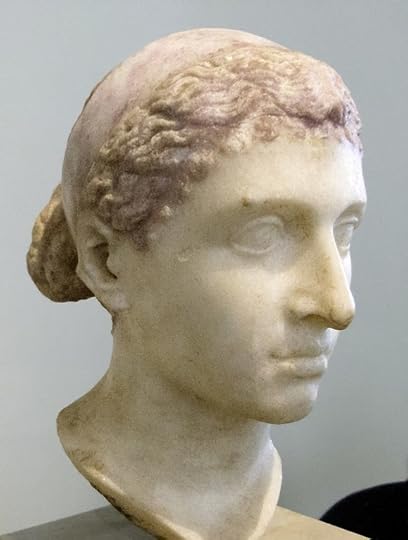
This review is for the 2026 edition.
To be honest, I’m not sure we needed a new edition of this book. When it first came out in 1990, it was a critical work in the field, and it still is today, but scholarship on Cleopatra’s cultural afterlife has increased significantly since then. The most recent monograph on the subject, The Reception of Cleopatra in the Age of Mass Media, isn’t even old enough to be in first grade, and Brill is currently compiling a Companion volume on her reception.
Apparently, Hughes-Hallett agrees with me, because while this was marketed as being a “revised” version, the most significant change, besides being available in epub format, is the cover (which, admittedly, I prefer to previous ones). The text itself is fundamentally unaltered, without even a new introduction reflecting on the influence the book's had in the almost forty years since its first release. The bibliography contains not a single work from the twenty-first century. It seems that it was re-released to introduce it to new readers– attention thus turns to how well it holds up.
Scholarship on Cleopatra as an individual has advanced since 1990, and so some of the historical details are outdated. The existence of Cleopatra’s same-named older sister has been largely debunked (and even early scholars like Mahaffy questioned it); even ignoring the recent studies on volcanic eruptions during it, calling Cleopatra’s reign a time of peace and prosperity is overstating the case; the woman on the Portland vase might not be Cleopatra at all; and Hughes-Hallett cannot resist the temptation that strikes so many Cleopatra writers to compare Roman women’s alleged subordination to Egyptian women’s alleged liberation, which would surprise both modern scholars of Roman women and women in Hellenistic Egypt, whose legal rights varied depending on their ethnicity. While they’re not quite errors, the positive citation of Bernal’s radioactively controversial (even in 1990) Black Athena raised my eyebrows, it is not quite clear why Berenice I is singled out as especially powerful, and Hughes-Hallett is surprisingly accepting of the snake bite story (without even adding mentions of the handful of people in the twenty-first century who have died this way). I do acknowledge, however, that a lot of these are nitpicks, and Hughes-Hallett’s handling of the historical Cleopatra is generally solid. While she clearly has some fondness for the queen, she does not delude herself into thinking that the more positive Arabic tradition was any more accurate than the Western one; she is also refreshingly skeptical of the generally accepted Plutarchian factoid of Cleopatra’s polyglotism. She is quick to emphasize the political motivations of all the major players, and does not denigrate either Caesar or Antony to make their mistress’ star shine brighter.
The meat of the book is, of course, the literary portion. Here, Hughes-Hallett is also solid, and the mostly thematic organization is unique. It is apparent how understandings of Cleopatra do not follow a consistent line, and many core parts of her legend were not actually from the ancient sources. Hughes-Hallett should be commended for incorporating a large amount of material, both well-known and obscure, and including non-Western material. She does, however, have a tendency to go into tangents that are not always directly relevant; does Antony’s negative portrayal really have that much in common with a rapist’s defense of their actions, or Cleopatra’s romanticized suicide with sati (to which several pages are then devoted to describing)? Certain works, Shakespeare’s Antony and Cleopatra notably, are given more attention than others, pages that could have, especially in a re-release, been devoted to something else. Hughes-Hallett’s opinionated writing will probably bother some readers.
But a person with some knowledge of Cleopatra reading this in 2026– and this is the intended audience, since Hughes-Hallett assumes that Fulvia and Gnaeus Pompeius are known parts of Cleopatra’s legend– will find it incomplete. The final chapter states that “a few voices have been raised on (Cleopatra’s) behalf”, but in the twenty-first century a paradigm shift has occurred, which might receive the chapter heading of “The Girlboss”, and these voices are becoming the new orthodoxy. Somebody seeking to learn about Cleopatra will probably go to Google instead of a library, where on the first page they will find no shortage of articles from websites like History Hit or Grunge saying that Cleopatra was actually a smart and capable leader whose motives were distorted by the legends Hughes-Hallett explores. The Internet itself is arguably a paradigm shifter in how information on Cleopatra is shared, and how new myths can be created (like the "golden mouth" story, which even has a counter-myth). Many fictional representations of the queen, mostly in non-film media, have increasingly sought to portray Cleopatra in a more nuanced, and often positive, light, with her political career receiving a renewed amount of attention. This is all pretty unprecedented in Cleopatra’s Western reception, yet there is no trace of it here, not even any HBO Rome.
Even if Hughes-Hallett didn’t want to write another chapter on Cleopatra-as-feminist-symbol, there were plenty of other things she could have added. One chapter talks about how in the nineteenth-century, Cleopatra was often perceived as black; this would be a great opportunity to examine how black women have appropriated her legend (this has occurred both at the time and later), but the thread is abandoned. Another possible avenue is characters based off of Cleopatra, at least one of which (Dinah Slade from Susan Howatch’s The Rich are Different) was created when Hughes-Hallett was first writing and would have some connection with the mention of the character named Cleopatra in the movie Freaks, but no interest in this is betrayed. Even the paucity of English Cleopatra movies and shows, despite many such projects being announced, could warrant a paragraph or two about whether this has anything to do with the historical personage of Cleopatra or the failure of the 1963 movie, but instead the extended analyses of long forgotten plays are unaltered. It makes it stand out other treatments of Cleopatra's reception in recent times, and not in a flattering way.
While Hughes-Hallett’s original study still has merit, the re-release is overall a missed opportunity.