

What do you think?

Black Titan: A.G. Gaston and the Making of a Black American Millionaire
The grandson of slaves, born into poverty in 1892 in the Deep South, A. G. Gaston died more than a century later with a fortune worth well over $130 million and a business empire spanning communications, real estate, and insurance. Gaston was, by any measure, a heroic figure whose wealth and influence bore comparison to J. P. Morgan and Andrew Carnegie. Here, for the first time, is the story of the life of this extraordinary pioneer, told by his niece and grandniece, the award-winning television journalist Carol Jenkins and her daughter Elizabeth Gardner Hines.Born at a time when the bitter legacy of slavery and Reconstruction still poisoned the lives of black Americans, Gaston was determined to make a difference for himself and his people. His first job, after serving in the celebrated all-black regiment during World War I, bound him to the near-slavery of an Alabama coal mine—but even here Gaston saw not only hope but opportunity. He launched a business selling lunches to fellow miners, soon established a rudimentary bank—and from then on there was no stopping him. A kind of black Horatio Alger, Gaston let a single, powerful question be his What do our people need now? His success flowed from an uncanny genius for knowing the answer. Combining rich family lore with a deep knowledge of American social and economic history, Carol Jenkins and Elizabeth Hines unfold Gaston’s success story against the backdrop of a century of crushing racial hatred and bigotry. Gaston not only survived the hardships of being black during the Depression, he flourished, and by the 1950s he was ruling a Birmingham-based business empire. When the movement for civil rights swept through the South in the late 1950s and early 1960s, Gaston provided critical financial support to many activists.At the time of his death in 1996, A. G. Gaston was one of the wealthiest black men in America, if not the wealthiest. But his legacy extended far beyond the monetary. He was a man who had proved it was possible to overcome staggering odds and make a place for himself as a leader, a captain of industry, and a far-sighted philanthropist. Writing with grace and power, Jenkins and Hines bring their distinguished ancestor fully to life in the pages of this book. Black Titan is the story of a man who created his own future—and in the process, blazed a future for all black businesspeople in America.
346 pages, Kindle Edition
First published December 30, 2003
Ratings & Reviews
Friends & Following
Create a free account to discover what your friends think of this book!
Community Reviews
Displaying 1 - 30 of 39 reviews
September 11, 2019
A. G. Gaston is a complicated figure worthy of remembrance. The book explored the development of a life during American Apartheid that succeeded but perhaps never separated from the system in which it was developed. My family is from Alabama. So in many ways, the books is an enlightening and scholarly exploration of the context of segregation, economics, and cultural dynamics. Though it occasionally made for a slow read. Before reading the book, I asked my grandmother, who Mr. Gaston was. Though we had never discussed him before, she recalled an important and deeply respected figure who insured, funeralized, and employed many Black people in Alabama. I approached the book with three essential questions: 1)Who was A. G. Gaston? 2)Why has Dr. Gaston been lost in African-American history? 2)What can I learn from his experience?
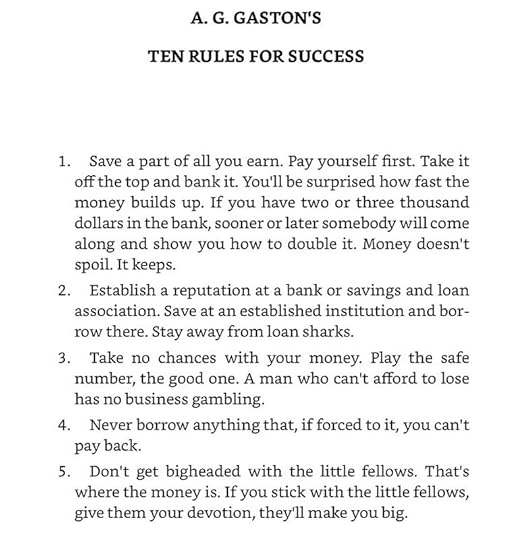
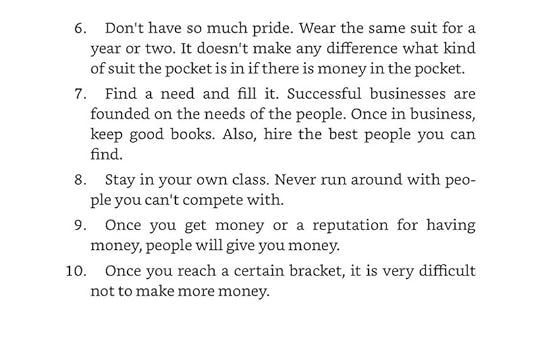
Dr. Gaston, as portrayed within the book, was an intentionally mysterious figure. I left the book with a sense of how he operated, what he valued, but not with a deep sense of who he was as a person. The book repeatedly examines him in terms of how he was viewed. Perhaps this is all any biography can offer. As to why his legacy is has been diminished over time, the fights with MLK and the Civil Rights leaders who have have received posthumous preference, explains why the more conservative approach of Dr. Gaston has fallen from favor. A similar though not as traumatic fate has also befallen his idol, Booker T. Washington. As to what I can learn, there is a valuable list of his rules at the end that aligns with the conservative wisdom of his generation. What stands out in my mind is his shift to activism when the children of Birmingham took to the streets. The lesson: no matter how successful, never loose sight of what is going on around you.
Dr. Gaston, as portrayed within the book, was an intentionally mysterious figure. I left the book with a sense of how he operated, what he valued, but not with a deep sense of who he was as a person. The book repeatedly examines him in terms of how he was viewed. Perhaps this is all any biography can offer. As to why his legacy is has been diminished over time, the fights with MLK and the Civil Rights leaders who have have received posthumous preference, explains why the more conservative approach of Dr. Gaston has fallen from favor. A similar though not as traumatic fate has also befallen his idol, Booker T. Washington. As to what I can learn, there is a valuable list of his rules at the end that aligns with the conservative wisdom of his generation. What stands out in my mind is his shift to activism when the children of Birmingham took to the streets. The lesson: no matter how successful, never loose sight of what is going on around you.

June 5, 2019
Very good read and interesting story. A bit embarrassed that I never heard of him (though I am a Northerner)

January 29, 2017
I had never heard of A.G. Gaston before this book showed up on Book Bub last year. I'm glad I found out about him. He had a remarkable life.
A.G. Gaston's grandparents were slaves. His grandfather worked with horses and his grandmother was an accomplished cook. These were considered "privileged" positions. When slavery ended they stayed on working for the family that previously owned them. His grandmother taught his mother to cook and she also earned a living working for wealthy white families as a live-in cook and as a sought after caterer. This put A.G. in contact with wealth at a young age.
When he was young there were two broad schools of thought about black advancement. Booker T. Washington believed that black people should stay where they were and work hard to advance economically before looking for social equality. W.E.B. DuBois believed in fighting for social equality and letting the "talented tenth" of black elites raise up the rest of the community. A.G. Gaston spent his life firmly in Booker T. Washington's camp.
After serving in WWI, he returned to Alabama and couldn't find a good job. He had to take work in the mines. He saw widows begging for money to pay for their miner husbands' funerals. He started a burial insurance business. From there he bought funeral homes. Eventually he started a bank for black people and a business training school.
He was in his seventies and wealthy when the civil rights movement game to Birmingham. He owned the only black hotel so Martin Luther King and the Southern Christian Leadership Conference set up shop there. I got the impression that he thought they were young radical whippersnappers. He argued for moderation. He wanted to negotiate instead of marching. But, he was the person that repeatedly bailed them out of jail - whether they wanted bailed out or not. He also argued vehemently against involving children in the marches and then secured the bond for the release of all the children jailed. People spoke of him as being too deferential to the white businessmen, especially if they didn't know that he was bankrolling a lot of the protests.
His hotel was bombed. His house was bombed. (He said he couldn't be sure if it was white or black people who wanted to bomb his house.) Bombs were set at other of his properties but were found before they went off. He let the marchers on the way to Selma camp on one of farms one night. He was even kidnapped.
After the protests moved away from Birmingham, he stayed and continued to serve the community. He was a philanthropist. Eventually he sold his business empire to his employees for a tenth of its worth to maintain local black control.
A.G. Gaston died at the age of 103. His story is amazing. He should definitely be better known.
 This review was originally posted on Based On A True Story
February 11, 2017
It was a very interesting read, but it's written by Gaston's niece so it was frustratingly biased. I would love to read more about this man and the tension of being a black millionaire and how that put him in conflict with the Civil Rights movement and there is a little in here to illuminate that struggle, but her main mission seems to be to defend Gaston against his critics.

February 19, 2022
“Athletes and musicians who have made millions in their industries deserve our respect, but it is critical that blacks understand that our history, and our (often neglected) successes, run deeper than that. All children need to be made familiar with images and stories of blacks who have found success in the boardroom and the classroom, along with those who have found it on the court and in the clubs. Every child should have the privilege of believing, as I did growing up, that skin color does not determine success—dedication does.”
I thought I would begin my latest review with a paragraph from the epilogue of Black Titan by Carol Jenkins and Elizabeth Gardner Hines. The niece and grandniece of Alabama Businessman A.G. Gaston told the story from his post Civil War impoverished childhood to becoming a multimillionaire and Birmingham’s most prominent African American entrepreneur.
Sadly, I had never heard of A.G. Gaston until a few months ago on a podcast where Professor Greg Carr of Howard University mentioned his name briefly and the overlooked contribution the entrepreneur made during the civil rights movement during the 1960s, mostly in Birmingham. Gaston became an entrepreneur upon accident and a deep need to get out of poverty. His empire began with a funeral company (since white-owned funeral homes would not bury black folks) and expanded into an insurance company, bank, motel (which was prominent during the civil rights movement), business college, and boys & girls’ club. They estimated that Mr. Gaston’s net worth reached 130 million at the time of his death in January 1996. He lived to 103 years old.
Gaston was a complicated figure that believed loyalty and dedication were keys to success. His business credo, “Find a need and fill it,” served him well in nearly every business venture he undertook. Of course, no one was perfect ,and the book chronicled his failed venture with Brown Belle Soda Pop Company and his tense but respectful relationship with Martin Luther King.
That relationship (along with his business principles) were the highlights for me in the book. They labeled Gaston as a black conservative and called him an Uncle Tom for continuing to accommodate Birmingham’s white power structure by those who followed King and his nonviolent approach in attempting to desegregate the city. The entrepreneur wanted the same outcome as King, but understood that economic power was just as important a factor for black progress as well as social justice. Gaston stung by being labeled an Uncle Tom but stood firm in his beliefs. As time has passed, Gaston’s viewpoint helped shape a post civil-rights Birmingham as much as King did.
I appreciated the book, highlighting the fact that two black men on the opposite side of the political and social spectrum could work together despite their differences. Gaston bailed King out of jail during his time in Birmingham. King deposited $1,000 (worth about 8,100 dollars today) into Gaston’s bank as a sign of support. The entrepreneur and the activist seemed to understand they needed each other and proved that when a bigger cause is at work, they could set aside differences to reach the goal.
February is Black History Month, and I have made it my mission to learn something about African American life I had not known about before. Black American life throughout our history in this country in multilayered and complex. Our contributions run deep and a rags-to-riches story like A.G. Gaston should be celebrated as an American success story by everyone.
I thought I would begin my latest review with a paragraph from the epilogue of Black Titan by Carol Jenkins and Elizabeth Gardner Hines. The niece and grandniece of Alabama Businessman A.G. Gaston told the story from his post Civil War impoverished childhood to becoming a multimillionaire and Birmingham’s most prominent African American entrepreneur.
Sadly, I had never heard of A.G. Gaston until a few months ago on a podcast where Professor Greg Carr of Howard University mentioned his name briefly and the overlooked contribution the entrepreneur made during the civil rights movement during the 1960s, mostly in Birmingham. Gaston became an entrepreneur upon accident and a deep need to get out of poverty. His empire began with a funeral company (since white-owned funeral homes would not bury black folks) and expanded into an insurance company, bank, motel (which was prominent during the civil rights movement), business college, and boys & girls’ club. They estimated that Mr. Gaston’s net worth reached 130 million at the time of his death in January 1996. He lived to 103 years old.
Gaston was a complicated figure that believed loyalty and dedication were keys to success. His business credo, “Find a need and fill it,” served him well in nearly every business venture he undertook. Of course, no one was perfect ,and the book chronicled his failed venture with Brown Belle Soda Pop Company and his tense but respectful relationship with Martin Luther King.
That relationship (along with his business principles) were the highlights for me in the book. They labeled Gaston as a black conservative and called him an Uncle Tom for continuing to accommodate Birmingham’s white power structure by those who followed King and his nonviolent approach in attempting to desegregate the city. The entrepreneur wanted the same outcome as King, but understood that economic power was just as important a factor for black progress as well as social justice. Gaston stung by being labeled an Uncle Tom but stood firm in his beliefs. As time has passed, Gaston’s viewpoint helped shape a post civil-rights Birmingham as much as King did.
I appreciated the book, highlighting the fact that two black men on the opposite side of the political and social spectrum could work together despite their differences. Gaston bailed King out of jail during his time in Birmingham. King deposited $1,000 (worth about 8,100 dollars today) into Gaston’s bank as a sign of support. The entrepreneur and the activist seemed to understand they needed each other and proved that when a bigger cause is at work, they could set aside differences to reach the goal.
February is Black History Month, and I have made it my mission to learn something about African American life I had not known about before. Black American life throughout our history in this country in multilayered and complex. Our contributions run deep and a rags-to-riches story like A.G. Gaston should be celebrated as an American success story by everyone.
October 4, 2020
I enjoyed this book greatly. My only real complaints have more to do with editing than the writing.
First the good. The subject Mr. A.G. Gaston was a fascinating man. For those who do not know about him this book is a good starting place. It covers about a century of time in Alabama, where Mr. Gaston by wit, will, and work went from poverty to wealth, and from Jim Crow and segregation to being a major force for change in Birmingham, even if he did not always agree with the methods of Shuttlesworth (or even King) he still was always trying to make the city he loved a better place.
Now the bad, which is really more annoying than bad and should not stop you from reading the book. It is written by his great niece and niece, so they were able to provide personal stories. At times however they, do seem to judge the past through a modern lense, and it rings a little off key.
The books tries to add historical background to help show how he fit into events happening around him. This was probably seen as necessary since Mr. Gaston did write an autobiography, Green Power (of course it is currently out of print and $400 on Amazon in Fall 2020, so likely most people will not be comparing the two). The history is not wrong it is just shallow and simplistic. However in their defense, it is a biography not a history text book.
Also, there are a couple of errors like using UAB and the University of Alabama interchangeably. Like I said, annoying, but not horrific. It does make you question some of the other details.
The last thing was that it rather felt like they got tired of writing the book. There is not much devoted to the time between the Civil Rights movement and his death. A great deal more happened besides the founding of his Boys Club, his kidnapping, and his death.
Still, minor complaints. Read this book if your interested in Civil Rights, Black businesses of the 20th Century and especially Martin Luther King Jr. He is definitely presented as a man who Mr. Gaston admired, but not an infallible saint, which makes him somehow even more noble.
First the good. The subject Mr. A.G. Gaston was a fascinating man. For those who do not know about him this book is a good starting place. It covers about a century of time in Alabama, where Mr. Gaston by wit, will, and work went from poverty to wealth, and from Jim Crow and segregation to being a major force for change in Birmingham, even if he did not always agree with the methods of Shuttlesworth (or even King) he still was always trying to make the city he loved a better place.
Now the bad, which is really more annoying than bad and should not stop you from reading the book. It is written by his great niece and niece, so they were able to provide personal stories. At times however they, do seem to judge the past through a modern lense, and it rings a little off key.
The books tries to add historical background to help show how he fit into events happening around him. This was probably seen as necessary since Mr. Gaston did write an autobiography, Green Power (of course it is currently out of print and $400 on Amazon in Fall 2020, so likely most people will not be comparing the two). The history is not wrong it is just shallow and simplistic. However in their defense, it is a biography not a history text book.
Also, there are a couple of errors like using UAB and the University of Alabama interchangeably. Like I said, annoying, but not horrific. It does make you question some of the other details.
The last thing was that it rather felt like they got tired of writing the book. There is not much devoted to the time between the Civil Rights movement and his death. A great deal more happened besides the founding of his Boys Club, his kidnapping, and his death.
Still, minor complaints. Read this book if your interested in Civil Rights, Black businesses of the 20th Century and especially Martin Luther King Jr. He is definitely presented as a man who Mr. Gaston admired, but not an infallible saint, which makes him somehow even more noble.

December 18, 2016
An interesting part of history for sure.

December 23, 2022
Her great uncle having already written his own autobiography, the author chose to chronicle A.G. Gaston's life against the national and global events that impacted and were impacted by him. In that regard, Black Titan is a true tale of American history that sort of reminds me of the movie Forrest Gump.
Remember how we were told how major events such as the Kennedy Assassination, the Vietnam War, and HIV/AIDS impacted Forrest? In Black Titan, you'll discover how serving in the military differed for Blacks even during war times, what happened to Gaston and the race overall during the Great Depression, how the New Deal was applied to Blacks, what Jim Crow was like for wealthy blacks, how the Civil Rights movement was funded, what happened when Jim Crow ended (Was racism suddenly over and blacks suddenly prosperous?), how people who had known Dr. Martin Luther King and President Kennedy experienced their assassinations.
Without spoiling the read for you, Gaston basically turned lemons into lemonade. Gaston was born in Alabama during Jim Crow. His family was dirt poor (sharecroppers, maids and whatnot) but they were loving. They taught Gaston how to avoid getting lynched. Gaston used that lesson to master how to get along with whites in general.
Jim Crow's separate but equal policy created an opportunity to provide for blacks what whites would not supply (e.g., banking services, motel accommodations, business education, funeral services, etc.). Seizing that opportunity, Gaston was able to build a fortune approaching centi-millionaire status before doing the cool thing before it became cool--giving a large portion of it to his employees rather than to the natural heirs of his bounty.
His great niece did a wonderful job of supplying the emotional side of this opportunistic businessman. I find it a very worthy read.
Remember how we were told how major events such as the Kennedy Assassination, the Vietnam War, and HIV/AIDS impacted Forrest? In Black Titan, you'll discover how serving in the military differed for Blacks even during war times, what happened to Gaston and the race overall during the Great Depression, how the New Deal was applied to Blacks, what Jim Crow was like for wealthy blacks, how the Civil Rights movement was funded, what happened when Jim Crow ended (Was racism suddenly over and blacks suddenly prosperous?), how people who had known Dr. Martin Luther King and President Kennedy experienced their assassinations.
Without spoiling the read for you, Gaston basically turned lemons into lemonade. Gaston was born in Alabama during Jim Crow. His family was dirt poor (sharecroppers, maids and whatnot) but they were loving. They taught Gaston how to avoid getting lynched. Gaston used that lesson to master how to get along with whites in general.
Jim Crow's separate but equal policy created an opportunity to provide for blacks what whites would not supply (e.g., banking services, motel accommodations, business education, funeral services, etc.). Seizing that opportunity, Gaston was able to build a fortune approaching centi-millionaire status before doing the cool thing before it became cool--giving a large portion of it to his employees rather than to the natural heirs of his bounty.
His great niece did a wonderful job of supplying the emotional side of this opportunistic businessman. I find it a very worthy read.

February 22, 2018
Black Titan is a strong if more than slightly biased retelling of Gaston's life by his niece and grandniece, Carol Jenkins and Elizabeth Gardner Hines.
I found it a bit slow to read what with its somewhat scholarly tone. However, I enjoyed the photos of Mr. and Mrs. Gaston sightseeing noted locations around the world and meeting renowned historical figures.
Until this book appeared on Bookbub I’d never heard of Gaston. I think it’s curious he isn't a bigger household name given his key role in the civil rights movement. His status as one of the US’ wealthiest Black men at his death in the late ‘90s should also have garnered greater media attention.
Gaston’s story isn’t without certain controversial aspects; I appreciated the care the authors took to include both the pro and con attitudes that prevailed toward him by other Black people. I imagine his relatively conservative politics have helped to keep his memory from receiving broader awareness and respect among African-Americans.
(Side note: it was dispiriting to learn in Black Titan that Booker T Washington advocated the trickle down theory. Ugh.)
I found it a bit slow to read what with its somewhat scholarly tone. However, I enjoyed the photos of Mr. and Mrs. Gaston sightseeing noted locations around the world and meeting renowned historical figures.
Until this book appeared on Bookbub I’d never heard of Gaston. I think it’s curious he isn't a bigger household name given his key role in the civil rights movement. His status as one of the US’ wealthiest Black men at his death in the late ‘90s should also have garnered greater media attention.
Gaston’s story isn’t without certain controversial aspects; I appreciated the care the authors took to include both the pro and con attitudes that prevailed toward him by other Black people. I imagine his relatively conservative politics have helped to keep his memory from receiving broader awareness and respect among African-Americans.
(Side note: it was dispiriting to learn in Black Titan that Booker T Washington advocated the trickle down theory. Ugh.)
May 21, 2023
Business Titan in a difficult place and time
A.G. Gaston led a prosperous life that he worked hard to attain but he had his detractors especially during the civil rights era. You can say he was this or that but make sure you remember all the people he helped throughout his life. The author's telling of his story was balanced giving different aspects of the man through research and through others that knew him. Reading this should inspire you because if he could accomplish so much in the place and time that he lived, ask yourself why can't you accomplish as much or even more.
A.G. Gaston led a prosperous life that he worked hard to attain but he had his detractors especially during the civil rights era. You can say he was this or that but make sure you remember all the people he helped throughout his life. The author's telling of his story was balanced giving different aspects of the man through research and through others that knew him. Reading this should inspire you because if he could accomplish so much in the place and time that he lived, ask yourself why can't you accomplish as much or even more.

August 30, 2017
Interesting story about a black man who was a major player in the business world in Alabama - pre-civil rights era no less. The entrepreneurship of A.G. Gaston was impressive. He had businesses in a number of sectors from funeral homes to a bottling company. Although the pace of the book is slow, the story was engaging, to me at least.
April 12, 2019
More people need to now about African Americans like A.G. Gaston. He was a giant at at time when few like him existed. A.G. Gaston is a role model for young African Americans trying to find their way today. His role in helping to shape the civil rights movement at a time when black people were not always in alignment with each other is relevant today.
November 27, 2019
Amazing story of the life of A.G. Gaston. Had not heard of him prior to this book, however, as a black Southerner his story inspires perpetually a sense of self-determinism no situation can extinguish. Just the sheer ability to see better as an option during a period where it would have been easy to "fall-in-line" speaks most saliently to me. Thoroughly enjoyed this book!!!!

November 1, 2025
This is my second book reading about Arthur George Gaston and his followings of Booker T. Washinton. A really good must-read black history book. Anything stolen (people, money, property) does not lead to ownership. My favorite part: "MLK - No lie can live forever...the arm of the moral universe is long, but it bends towards justice" P.225.

March 18, 2018
What an incredibly powerful and historically relevant book. Thoroughly enjoyed diving into the history of African-American's and their wealth creation post-slavery. Something not often spoken of or taught. We need more of these stories!

March 16, 2021
Listened to this audiobook. Excellent history and biography of A.G. Gaston and the Black community. I had heard of his name and association with Martin Luther King, Jr. but I didn’t know the details or how and why Gaston was so influential.

April 14, 2021
So much I didn't know until reading this book. So much I am happy to know now that I have read this book. It makes me want to 'find a gap and fill it'. What's a gap that I can fill? That question I will ponder until I find an answer. I highly recommend this book.

March 6, 2022
This is a meticulously researched biography about a great man. It's a truly inspiring book. The authors do a fantastic job capturing the difficulties of discrimination while telling A.G. Gaston's story. Excellent!

May 15, 2018
One of the greatest books, that I have ever read.
July 17, 2018
Unknown Titan to me before my friend introduced me to him. So many influential people work in the background of history and are historic!
March 8, 2019
Great Book
Great Book!!! I definitely recommend it to anyone interested in the success ful story of one of this country's most influential businessmen
Great Book!!! I definitely recommend it to anyone interested in the success ful story of one of this country's most influential businessmen

July 12, 2021
This book is fantastic. Just simply fantastic.
November 17, 2024
Powerful.

September 5, 2007
At one time labeled a "Super-Uncle Tom" by Fred Shuttlesworth, A.G. Gaston was the exemplar of the Booker T. Washington philosophy of black empowerment. Raised by a mother who used her inherited talents as a cook to escape the virtual slavery of share-cropping, Gaston capitalized on his tenth-grade education to build an empire of businesses valued at $120 million when he retired. This biography, written by his niece and grandniece, chronicles Gaston's use of thrift, native business acumen, and recognition of the opportunity created by Jim Crow to grow businesses catering to the African American clientèle ignored white-run financial institutions.
While Gaston took his life to be proof of the reality of the American Dream, it could just as easily be taken as the exception the proves the rule of the sociological damage caused by four centuries of racism. That the initial path Gaston used to escape from the perpetual debt of working in the Birmingham coal mines was becoming essentially a loan shark is indicative of how few economic opportunities there were. After Gaston established himself his success seemed to continually hang by a thread and he needed to risk his wealth in a series of all-or-nothing ventures to maintain his status.
Gaston earned Shuttlesworth's wrath during the time the Civil Rights Movement came to Birmingham, through his public opposition to the policies of 'outsiders' Martin Luther King Jr. and Ralph Abernathy. Part of the authors' aim seems to be to demonstrate that while Gaston did oppose certain aspects of the SCLC's approach, he proved invaluable to the movement during their time in Birmingham. His established contacts with white business owners created the possibilities of negotiations and his financial support at key moments helped maintain the movement. Gaston's commitment to the social betterment of the African American community around Birmingham is also detailed throughout the book, including his founding of a business college that allowed thousands to escape the system of sharecropping and mining company-towns.
The principles on which Gaston based his life, highlighted in an appendix by the authors, are treasure to anyone interested in business or even responsible financial investing and will certainly have a place in my thinking about my own finances.
The portrayal of his wife, Mimi, is no less fascinating. She ran the business college in Gaston's stead and became a leader in the effort to extend the federal student loan program to cover trade schools.
Part loving memorial, apology, and psychological study, Black Titan provides a window into an exceptional man and the world he inhabited.
While Gaston took his life to be proof of the reality of the American Dream, it could just as easily be taken as the exception the proves the rule of the sociological damage caused by four centuries of racism. That the initial path Gaston used to escape from the perpetual debt of working in the Birmingham coal mines was becoming essentially a loan shark is indicative of how few economic opportunities there were. After Gaston established himself his success seemed to continually hang by a thread and he needed to risk his wealth in a series of all-or-nothing ventures to maintain his status.
Gaston earned Shuttlesworth's wrath during the time the Civil Rights Movement came to Birmingham, through his public opposition to the policies of 'outsiders' Martin Luther King Jr. and Ralph Abernathy. Part of the authors' aim seems to be to demonstrate that while Gaston did oppose certain aspects of the SCLC's approach, he proved invaluable to the movement during their time in Birmingham. His established contacts with white business owners created the possibilities of negotiations and his financial support at key moments helped maintain the movement. Gaston's commitment to the social betterment of the African American community around Birmingham is also detailed throughout the book, including his founding of a business college that allowed thousands to escape the system of sharecropping and mining company-towns.
The principles on which Gaston based his life, highlighted in an appendix by the authors, are treasure to anyone interested in business or even responsible financial investing and will certainly have a place in my thinking about my own finances.
The portrayal of his wife, Mimi, is no less fascinating. She ran the business college in Gaston's stead and became a leader in the effort to extend the federal student loan program to cover trade schools.
Part loving memorial, apology, and psychological study, Black Titan provides a window into an exceptional man and the world he inhabited.

October 5, 2009
In this candid biography, written by his niece and great-niece, Gastons life is recounted alongside the story of a changing America. Born in 1896, Gaston lived until he was 103, his life spanning eras of incredible change in the country he deeply loved even though,despite his wealth and invitations to the White House, he had to use the doors marked "Niggers/Freight" for most of his life.
This book proved to be an exceptionally easy and rewarding read. set against the dramatic backdrop of virulent racism and the struggle for civil rights in the American south, this story appeals to history students and entrepreneurs alike.
A.G Gaston rose from exceptionally humble beginnings to create a life for himself in an incredibly racist and segregated society. Inspired by the story of the freed slave Booker T Washington, his role model, the young Gaston constantly strived to better himself through hard work and determination.
What is even more remarkable is the fact that he succeeded. Through his incredible work ethic, business sense and determination he amassed a fortune in the tens of millions of dollars, becoming one of the first black millionaires. One of the more striking aspects of his life and career is his dedication to the local community and the importance he placed on this work from a commercial and personal point of view.
The authors are exceptionally honest, highlighting Gaston's periods of intense loneliness and emotional diffidence as he focused on his business career at the expense of his personal relationships. They also tackle the charges of "Uncle Tomism" arising from the civil rights incidents in Birmiungham in the 1960's head on, exploring Gaston's reasoning while never providing excuses.
The only criticism I would have with the book is that it does not delve deeply enough into the mind and character of this incredible man himself. It is worth noting that the author remarks in the acknowledgements that many of the surviving family members refused to participate in the book, and I think this is significant.
Overall, well written and hugely readable. This is a must read for any business person with pearls of commercial wisdom everywhere in the text. It will also appeal to anyone interested in the struggle for equality and the American south of the times.
Highly recommended.
This book proved to be an exceptionally easy and rewarding read. set against the dramatic backdrop of virulent racism and the struggle for civil rights in the American south, this story appeals to history students and entrepreneurs alike.
A.G Gaston rose from exceptionally humble beginnings to create a life for himself in an incredibly racist and segregated society. Inspired by the story of the freed slave Booker T Washington, his role model, the young Gaston constantly strived to better himself through hard work and determination.
What is even more remarkable is the fact that he succeeded. Through his incredible work ethic, business sense and determination he amassed a fortune in the tens of millions of dollars, becoming one of the first black millionaires. One of the more striking aspects of his life and career is his dedication to the local community and the importance he placed on this work from a commercial and personal point of view.
The authors are exceptionally honest, highlighting Gaston's periods of intense loneliness and emotional diffidence as he focused on his business career at the expense of his personal relationships. They also tackle the charges of "Uncle Tomism" arising from the civil rights incidents in Birmiungham in the 1960's head on, exploring Gaston's reasoning while never providing excuses.
The only criticism I would have with the book is that it does not delve deeply enough into the mind and character of this incredible man himself. It is worth noting that the author remarks in the acknowledgements that many of the surviving family members refused to participate in the book, and I think this is significant.
Overall, well written and hugely readable. This is a must read for any business person with pearls of commercial wisdom everywhere in the text. It will also appeal to anyone interested in the struggle for equality and the American south of the times.
Highly recommended.

May 31, 2017
Great story about an often forgotten figure in the civil rights movement. A.G. Gaston is the definition of a spectacular and relentless businessman.
Favorite quote:
There's a story that A. G. Gaston liked to tell about his early life in Demopolis, something his mother taught him that he never forgot. He had been sitting at the kitchen table in his grandparents' log cabin, his cousin Gaston Stern seated just beside him. Rosie, Art's mother, had placed an apple on the table between the two boys and handed Art a knife to divide the fruit for sharing. Grasping the knife in his small hand, Arthur had proceeded to cut the apple “in such a way that I had about two thirds of the apple for myself.” He passed the smaller portion to his cousin and reached for his own, larger slice. Before his hand could close around his piece of fruit, Rosie intervened, silently taking Art's piece and placing it in front of Gaston Stern, and moving the smaller piece in front of her son. As Arthur remembered, she looked him hard in the eyes and offered him this piece of advice: “This is the way good people think. This is the way you're supposed to think … always. God first. Others second. Me third.”
Favorite quote:
There's a story that A. G. Gaston liked to tell about his early life in Demopolis, something his mother taught him that he never forgot. He had been sitting at the kitchen table in his grandparents' log cabin, his cousin Gaston Stern seated just beside him. Rosie, Art's mother, had placed an apple on the table between the two boys and handed Art a knife to divide the fruit for sharing. Grasping the knife in his small hand, Arthur had proceeded to cut the apple “in such a way that I had about two thirds of the apple for myself.” He passed the smaller portion to his cousin and reached for his own, larger slice. Before his hand could close around his piece of fruit, Rosie intervened, silently taking Art's piece and placing it in front of Gaston Stern, and moving the smaller piece in front of her son. As Arthur remembered, she looked him hard in the eyes and offered him this piece of advice: “This is the way good people think. This is the way you're supposed to think … always. God first. Others second. Me third.”

March 18, 2016
As a lover of biographies, auto-biographies, and memoirs, this book is one of the best biographies I have ever read. The authors’ writing simply flowed and they seamlessly intertwined U.S. History, during the Civil Rights Era, into the context while putting the story of A.G. Gaston's life on paper. I learned so much more about the Civil Rights era from reading this book, and that compelled me to appreciate the book even more. To see the relationship between Dr. MLK and A.G. Gaston was eye-opening, as one would not have that knowledge without reading this book. Also, we learn 'the why' behind A.G. Gaston’s decisions, in business and in his personal affairs, and that made the book a joy to read. This book resonated with me and I will forever remember the stories and inspiration that came as a result of learning A.G. Gaston's life story. "Black Titan" is a good read for sure!

November 6, 2010
What a great inspiration. This book should be required reading for everyone in the United States. This book is about A. G. Gaston's working life. The grandson of former slaves built an enormous empire through a time period when Negroes were on the bottom rung in America.

July 3, 2011
A business bio written by family members can have its pluses and minuses. On the one hand, the authors have access to oral histories and personal documents that can shed meaningful insight on the subject. Yet family alliances can weaken a biography in the form of self-censorship.

February 29, 2012
I read this because A G Gaston is from Demopolis and I have heard his name all my life, but knew little about him. He was a Titan - he had a 10th grade education and became a billionaire because of his 10 principles of business. A worthwhile read for anyone interested in the business profession.
Displaying 1 - 30 of 39 reviews