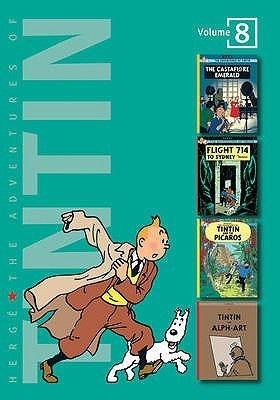
Same great Tintin volumes, same 3-in-1 format, with a classy new look!
Join traveling reporter Tintin and his faithful dog Snowy, along with well-known friends such as Captain Haddock, as they embark on extraordinary adventures spanning historical and political events, fantasy and science-fiction adventures and thrilling mysteries. These full-color graphic novels broke new ground when they were first released and became the inspiration for countless modern-day comic artists.
This repackaged hardcover volume contains 3 classic Tintin stories, including: The Castafiore Emerald, Flight 714 to Sydney, and Tintin and the Picaros.
Georges Prosper Remi (22 May 1907 – 3 March 1983), better known by the pen name Hergé, was a Belgian comics writer and artist. His best known and most substantial work is The Adventures of Tintin comic book series, which he wrote and illustrated from 1929 until his death in 1983, leaving the twenty-fourth Tintin adventure Tintin and Alph-Art unfinished. His work remains a strong influence on comics, particularly in Europe.
"Hergé" is the pseudonym of George Remí, making a game with the initials of his name inverted. Throughout the evolution of his star character, Tintin, we can see the progress of this author: from the first titles marked by the ultraconservative doctrine of the director of the newspaper Le Petit Vingtième, to the breaking of conventions embodied from The Blue Lotus , as well as the evolution of the society of his time. The research carried out by Hergé to historically contextualize his Adventures, as well as his implicit social criticism, have made Tintin a masterpiece of the 20th century.
My first impression was that all 3.x of these books were quite different from a typical Tintin adventure. Then I realised there isn't any such thing as a typical Tintin adventure.
Tintin brings me back memories of being in eighth grade, the Algebra or Arithmetic teacher screaming at me after they discovered a copy of his adventures hidden inside my exercise book. Life was much simpler back then, where every bullet missed its target, every expedition had a happy end and every villain was vanquished (but sometimes able to escape and appear in a later story.) The stories hold less magic today to my adult self, though the nostalgia is plentiful to keep me turning the pages. Depiction of some of the non-European characters is problematic but I didn't spot any of the offensive material which apparently exists in other stories. Interestingly, there are hardly any female characters in these stories - the plots centre exclusively on male friendships, companionship, adventure and battle. Tintin belongs to a long gone era - I'd be curious to know whether young boys today relate to him at all.
I’d probably substitute Tintin and the Picaros with King Ottokar’s Sceptre or The Black Island, but the two other titles in this volume definitely make my desert-island list. Reading aloud with friends and family from a Tintin book is one of the pleasures of the innocent life. I always voiced Captain Haddock, Bianca Castafiore, and one of the detective twins – Thomson, to be precise. Or was it Thompson … ?
The Tintin stories for anyone who has read them and understands their history can't be viewed as anything other than groundbreaking. The beginnings of these stories have been around as long as the Lord of the Rings, the illustration and environments in the Tintin books are accurate and extremely detailed. Anyone who has spent even a little time exploring Herge (Georges Remi) can see the painstaking research and adversity he worked through to compose the world around Tintin. His ideas were ahead of his time (Exploring the moon, Industrialization, South American political conflict, modern slave trade, extraterrestrial life) and he made certain every detail for every object would be realistic (after the third book at least). Herge's work can certainly be cited as an influence for any modern day graphic novel or comic book.
Merged review:
The Tintin stories for anyone who has read them and understands their history can't be viewed as anything other than groundbreaking. The beginnings of these stories have been around as long as the Lord of the Rings, the illustration and environments in the Tintin books are accurate and extremely detailed. Anyone who has spent even a little time exploring Herge (Georges Remi) can see the painstaking research and adversity he worked through to compose the world around Tintin. His ideas were ahead of his time (Exploring the moon, Industrialization, South American political conflict, modern slave trade, extraterrestrial life) and he made certain every detail for every object would be realistic (after the third book at least). Herge's work can certainly be cited as an influence for any modern day graphic novel or comic book.
I prefer reading Tintin in the standard A4 format as a rule, but these collected volumes are very handy. Thus far it's the only one I've bought, and I got it primarily as a handy way of combining getting a few portable Tintin adventures for holiday reading and finally adding Alph Art to my otherwise complete Tintin collection.
For some reason I can't bring myself to get Alph Art in the A4 format. It seems like a rip-off: a sketch passed off by publishers as a complete adventure. Getting it as part of this set seems to me, by comparison, better value and more satisfactory. Alph Art is tantalising, and looks like it was shaping up to be a great Tintin adventure.
In addition to the inclusion of this historical oddity, this volume includes the three final complete Tintin stories, of which Castafiore and Flight 714 are amongst the best from Studio Hergé, with Picaros being very good, if not perhaps among the best (I'm with the Tintin traditionalists who are unhappy to see Tintin lose his trademark plus fours!).
Good value - it's the sole small format collection from this series to include four adventures (all the other volumes have just three) - and highly recommended.
I've never read any of the Tintin comics, and this so happened to be the one I picked up at the library. After I began reading, it became obvious that many previous adventures laid the groundwork for the ones in this collection (i.e. characters re-introduced from previous stories, character developments that were mentioned in previous stories, etc). Nonetheless, I got to know the characters quickly and everything was explained (or implied) well enough that I wasn't confused. Herge is a great story-teller and I immediately felt myself drawn into Tintin's adventures.
I think my favorite part of all the stories was the mixture of adventure and humor. A "serious" plot is seamlessly intermingled with bouts of complete absurdity, and the dialogue is perfect.
I liked all three stories in this collection, but The Castafiore Emerald was my favorite...it was just so silly at times, but an interesting mystery.
Will definitely be reading more Tintin. Not sure why it took me so long in the first place!
The final volume of this great collection of Tintin books. Herge was certainly pushing his boundaries here - The Castafiore Emerald is a great example of a story where not much happens, but it's still entertaining; and 714 and the Picaros had the characters deviating from their usual behaviour, which made for another couple of great books.
Alph-Art is the really odd one here, though - it is just the rough sketches and notes for the first half or so of Herge's final unfinished book, but it was clear that he was really changing things around. Although a bit frustrating due to the lack of a conclusion, it's a fascinating insight into the way the author started to build his stories.
The Castafiore Emerald is my favourite - v. funny.
Castafiore crashes Marlinspike uninvited, claiming to be hiding from the press. As soon as one reporter calls on the phone though, she shows her true colours and invites them for an interview. The reporter sees her fighting with Capt. Haddock. The reporter misunderstands it as a lover's tiff, then tries to confirm with the Professor, who confirms they are in love (due to his extreme deafness and another misunderstanding).
Volume 7 of 7 volume series, each of these contain three Tintin books. I like these books because they're compact and don't take a lot of shelf space. The printing quality is very good: rich color ink on nice, smooth paper. The only complaint I have is with the physical dimensions of the books, which are 45% smaller than the traditional albums. That said, they are no substitute for the original albums if you are a serious Tintin fan or collector, as I am.
A solid ending to the series! My first of this bunch was easily "The Castafiore Emerald" if only for Haddock being so funny and genuine. I love the wheelchair scene, I love the "marriage" bit. I laughed so hard because I really just love Haddock's character. He's my favourite! I'm really happy to finally have finished reading the series and it's something I didn't appreciate back in school and learning it in French class. Wonderful ending, worth reading, recommended.
Except for the US, the world has loved Tintin for decades. These are the 2nd, 3rd, & 4th Tintins I've read. I thought I'd better catch up, since the young journalist resembles--in certain respects--my own young hero journalist, Johnny Graphic (Johnny Graphic and the Etheric Bomb). Tintin is a bit of a cipher--apart from being smart and stalwart and heroic. But it sure has worked out well for him.
The Castafiore Emerald: Bianca Castafiore's famous emerald is stolen during her stay at Marlinspike Hall.
Flight 714: Their flight to a convention in Sydney gets hyjacked.
Tintin and the Picaros: Tintin, Capt. Haddock and Prof. Haddock rush to San Theodoros to rescue friends who have been imprisoned by the reigning tyrant.
Every time I pick up a Tintin book, I expect it to be a lot less fun that it turns out to be. There's enough adventure to keep your younger side's attention and enough nuance to keep your adult brain involved. The perfect mix in my opinion.
oh my gosh!!! I LOOOOOOOOVED the last 2 stories!!! the first one, "The Castafiore Emerald" was funny, but not as good as "Flight 714 to Sydney" and "Tintin and the Picaros"! I'm hoping Spielberg makes another Tintin adventure!!! I looooooooooove these books!!!
After about a year and a half, I have finally finished my second re-read of all 8 volumes of The Adventures of Tintin!! This wasn't my favorite volume, but it was still such a treat to spend some time with my favorite characters.
I didn't read this particular book (the print and pictures are too tiny) but the larger-format books which feature 1 story apiece. The Catafiore Emerald is by far my most favorite Tin Tin of all, maybe b/c of my age: some commenters say "nothing really happens" but I liked the various plot lines and false leads, no one dies or is violence used to solve the problems (no guns), along with the social commentary vis-a-vis the Roma people, and, of course, the frequent laugh-out-loud episodes and dialogue. I've read it countless times to my kids and it still makes me laugh! Herge in these later books include references to or include previously introduced villains and allies/comic foils. The earlier books are a bit repetitive in their content - Tintin gets ensnared with a powerful gangster, gets locked up before an impending execution, escapes, and defeats the gangster - repeat. Herge is clearly breaking new ground with his ingeniously drawn action scenes and attention to details in his scenes. Although he depicts non-white characters in ways we now consider somewhat racist or stereotypical, he would have been considered "woke" in his time because Tintin the character regarded them with magnanimity and respect. These are classics all children (grown and not-quite-grown) should read for their entertainment value but also for understanding the period in which they were written where Civil Rights, the shadow of WW2 and the Cold War were all very real.
Ok, I had to give this last volume of Tintin a lower rating because it lacked the same sense of adventure as the earlier stories. In the end, the best tales were those which spanned multiple volumes. Add to that the fact that inevitably, the same cast of villains and characters always manage to show up. I was left feeling a little disappointed with how the last of the Tintin adventures turned out. I will not be reading Tintin and the Alph-art, as it was never completed and reads more like an homage to modern art than an actual adventure. I do still plan on reading Tintin in the Congo when I get a hold of a copy, even with the forewarning that it may be racist and promotes animal cruelty.
Overall, the Tintin adventures are a nice diversion, but they are not really life-altering and are ultimately somewhat forgettable.
These adventures are not my favorite in the series. My favorite of the set has to be Flight 714, which I don't think I ever read until this volume. I enjoyed the antics of the two truthful millionaires as they argued over who was the most evil. Also, what fun to bring in a UFO! The Castafiore Emerald annoys me probably because I don't like the Castafiore character and obviously the tale strongly features her. Tintin and the Picaros was okay for me since I am not usually excited to read about politics which was the theme of this adventure. It seemed like an anti-climatic end to the series. I wish there was a definitive end to the series that came after that adventure. It feels like the series lacks closure and that bothers me because I like to read the endings of things.
what fun! Herge is timeless. The Castafiore Emerald is crackerjack fun. This volume though, does not have the usual adventure and intrigue that other volumes carry.