

What do you think?
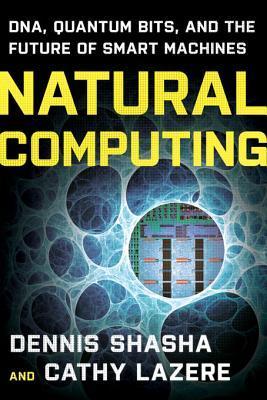
Natural Computing: DNA, Quantum Bits, and the Future of Smart Machines
Computers built from DNA, bacteria, or foam. Robots that fix themselves on Mars. Bridges that report when they are aging. This is the bizarre and fascinating world of Natural Computing. Computer scientist and Scientific American’s “Puzzling Adventures” columnist Dennis Shasha here teams up with journalist Cathy Lazere to explore the outer reaches of computing. Drawing on interviews with fifteen leading scientists, the authors present an unexpected the future of computing is a synthesis with nature. That vision will change not only computer science but also fields as disparate as finance, engineering, and medicine. Space engineers are at work designing machines that adapt to extreme weather and radiation. “Wetware” processing built on DNA or bacterial cells races closer to reality. One scientist’s “extended analog computer” measures answers instead of calculating them using ones and zeros. In lively, readable prose, Shasha and Lazere take readers on a tour of the future of smart machines.
320 pages, Kindle Edition
First published May 17, 2010
Ratings & Reviews
Friends & Following
Create a free account to discover what your friends think of this book!
Community Reviews
Displaying 1 - 19 of 19 reviews
Read
May 15, 2026Natural Computing: DNA, Quantum Bits, and the Future of Smart Machines is a sharp, lucid tour of where computation is going once we stop treating silicon as the only game in town and start treating nature itself—molecules, organisms, quantum systems—as information-processing substrates. It reads less like popular science and more like a set of curated research conversations that challenge how you think about algorithms, hardware, and even “intelligence” itself.
What the book is really about
At its core, the book argues that the future of computing is a synthesis with nature: we will increasingly either compute with natural materials (DNA, bacteria, quantum systems) or borrow organizational principles from biological and physical processes to design smarter machines. Shasha and Lazere structure this vision through interviews with fifteen leading scientists, so you encounter ideas in the wild, as they are deployed in spacecraft control, drug design, finance, and large‑scale engineering.
They position natural computing within three broad currents in the field: nature‑inspired algorithms, computing with natural substrates, and rethinking the physics of computation itself—an alignment with how natural computing is defined in the research literature.
Structure and style
The authors divide the book into three main parts that mirror those currents.
Part I explores how we can design machines that adapt and self‑organize, taking cues from biological evolution and complex systems.
Part II moves to wetware and biocomputing, showing how DNA, bacteria, and other biological substrates can literally act as computers.
Part III asks what happens when we push into quantum computing and other exotic physical models to attack problems that classical architectures cannot handle efficiently.
The prose is deliberately accessible—no heavy formalism—yet the conceptual load is high; for a technical reader this is ideal because you can map the narrative effortlessly onto the deeper mathematics and physics you already know.
Key theories and ideas
While the book is written for a general audience, it implicitly traverses most of the canonical theories in natural computing as defined in the academic literature. The main conceptual pillars are:
Nature‑inspired computation: evolutionary algorithms, neural‑style learning, and other bio‑inspired heuristics that exploit ideas like selection, self‑organization, and adaptation.
Computing with natural materials: DNA strands, bacterial colonies, and other molecular or cellular media used as the actual hardware of computation.
Physics‑level computation: quantum bits, analog and extended analog machines, and devices that exploit physical dynamics directly instead of abstracting everything into discrete 0/1 logic.
This tripartite view matches the standard classification of natural computing: methods inspired by nature, simulations of nature, and computations carried out in nature.
Part I – Learning from nature
In the first part, Shasha and Lazere showcase work where the architecture of computation is borrowed from biology and complex systems rather than from von Neumann machines. They highlight scientists who design systems that adapt to hostile environments—like spacecraft that must continue functioning under extreme radiation—by embedding robustness and redundancy reminiscent of biological organisms.
You see the conceptual kinship with neural networks, evolutionary algorithms, swarm intelligence, and other nature‑inspired paradigms that the formal field counts as central to natural computing. For an elite technical reader, this section is less about discovering specific algorithms and more about absorbing a design philosophy: robustness emerges from decentralization, variation, and selection, not from brittle top‑down control.
Part II – DNA, bacteria, and wetware
The second part presents what the title foregrounds: DNA computing and bacterial or cellular “wetware” devices. The researchers profiled show how DNA strands can be used to encode combinatorial problems so that massive parallelism is achieved through the sheer number of molecules reacting in solution.
A striking theme is cost and scale: bacteria and DNA offer essentially free replication and mind‑boggling concurrency, promising advantages over conventional silicon in certain classes of problems, even if they are ill‑suited to general‑purpose computing as we currently conceive it. The book doesn’t give you the formal models of, say, sticker systems or test‑tube programming, but it conveys the theoretical insight that “computation” is a physical process whose power is constrained—and sometimes liberated—by the medium carrying the information.
Part III – Quantum bits and new physics
The final part moves into quantum computing and other physically exotic architectures. Shasha and Lazere discuss work on quantum bits (qubits) that exploit superposition and entanglement to explore vast computational spaces in parallel, with the canonical motivation being problems like factoring and certain optimization tasks.
One concrete example they emphasize is protein folding: predicting the three‑dimensional shape of a protein given its amino acid sequence is such a combinatorially explosive problem that it naturally suggests specialized hardware and massive parallelism. Here the book connects the dots between the abstract theory of quantum and analog computing, and real‑world demands in pharmacology and drug design that push beyond classical architectures.
Central insights for elite readers
Several high‑level insights will resonate with graduate‑level and industry‑level readers:
Computation is substrate‑dependent.
The power, limitations, and elegance of an algorithm only make sense relative to the physical medium that implements it; DNA, bacteria, quantum systems, and silicon all carve the space of feasible computations differently.
Nature is not just an analogy; it is an oracle.
Evolutionary processes, immune responses, and neural dynamics are not metaphors but concrete algorithmic strategies that can be instantiated in software or hardware.
Interdisciplinarity is a necessity, not a flourish.
The scientists in the book fluidly traverse physics, biology, computer science, and engineering, suggesting that the next wave of breakthroughs will belong to people comfortable thinking across these boundaries.
The frontier is problem‑driven.
Applications like spacecraft autonomy and protein folding do not politely fit the assumptions of classical architectures; they demand architectures that look more like the natural phenomena they are modeling or controlling.
For someone working in high‑tech, these insights are a quiet challenge: the abstractions you rely on—Turing machines, big‑O, and digital logic—are historically contingent, not sacred.
Intellectual and inspirational value
Reviews note that the book is “very inspiring” in how it shows both how far natural‑inspired computing has come and how much room there is for future work. It gives a realistic sense that quantum and biological computers are still partly hypothetical, yet also points to concrete successes in evolutionary algorithms and high‑performance hardware that already shape real‑world systems.
The value of this book is not in technical depth but in agenda‑setting: it helps you locate your own research or product work within a broader shift from “computation as symbol manipulation” to “computation as physics and biology harnessed with intent.” For senior engineers and founders, it functions as a horizon‑expander, suggesting where the next generational platform shifts might originate and what kinds of interdisciplinary literacy they will require.
Critical assessment
From a critical standpoint, the book necessarily abstracts away many of the hard technical obstacles: error correction in quantum devices, noise and reliability in biochemical systems, and the engineering overhead of integrating exotic hardware with existing stacks. Some of the more speculative visions—fully general bacterial computers, for instance—remain far from deployable reality, a gap the book is optimistic about but does not fully interrogate.
Yet for an intellectually serious audience, these omissions are less a flaw than an invitation: you can read the book as a map of open problems rather than a catalog of finished technologies. In that sense, its greatest contribution is motivational—it reframes “smart machines” as systems that learn from, live within, and literally are made of the natural world.
What the book is really about
At its core, the book argues that the future of computing is a synthesis with nature: we will increasingly either compute with natural materials (DNA, bacteria, quantum systems) or borrow organizational principles from biological and physical processes to design smarter machines. Shasha and Lazere structure this vision through interviews with fifteen leading scientists, so you encounter ideas in the wild, as they are deployed in spacecraft control, drug design, finance, and large‑scale engineering.
They position natural computing within three broad currents in the field: nature‑inspired algorithms, computing with natural substrates, and rethinking the physics of computation itself—an alignment with how natural computing is defined in the research literature.
Structure and style
The authors divide the book into three main parts that mirror those currents.
Part I explores how we can design machines that adapt and self‑organize, taking cues from biological evolution and complex systems.
Part II moves to wetware and biocomputing, showing how DNA, bacteria, and other biological substrates can literally act as computers.
Part III asks what happens when we push into quantum computing and other exotic physical models to attack problems that classical architectures cannot handle efficiently.
The prose is deliberately accessible—no heavy formalism—yet the conceptual load is high; for a technical reader this is ideal because you can map the narrative effortlessly onto the deeper mathematics and physics you already know.
Key theories and ideas
While the book is written for a general audience, it implicitly traverses most of the canonical theories in natural computing as defined in the academic literature. The main conceptual pillars are:
Nature‑inspired computation: evolutionary algorithms, neural‑style learning, and other bio‑inspired heuristics that exploit ideas like selection, self‑organization, and adaptation.
Computing with natural materials: DNA strands, bacterial colonies, and other molecular or cellular media used as the actual hardware of computation.
Physics‑level computation: quantum bits, analog and extended analog machines, and devices that exploit physical dynamics directly instead of abstracting everything into discrete 0/1 logic.
This tripartite view matches the standard classification of natural computing: methods inspired by nature, simulations of nature, and computations carried out in nature.
Part I – Learning from nature
In the first part, Shasha and Lazere showcase work where the architecture of computation is borrowed from biology and complex systems rather than from von Neumann machines. They highlight scientists who design systems that adapt to hostile environments—like spacecraft that must continue functioning under extreme radiation—by embedding robustness and redundancy reminiscent of biological organisms.
You see the conceptual kinship with neural networks, evolutionary algorithms, swarm intelligence, and other nature‑inspired paradigms that the formal field counts as central to natural computing. For an elite technical reader, this section is less about discovering specific algorithms and more about absorbing a design philosophy: robustness emerges from decentralization, variation, and selection, not from brittle top‑down control.
Part II – DNA, bacteria, and wetware
The second part presents what the title foregrounds: DNA computing and bacterial or cellular “wetware” devices. The researchers profiled show how DNA strands can be used to encode combinatorial problems so that massive parallelism is achieved through the sheer number of molecules reacting in solution.
A striking theme is cost and scale: bacteria and DNA offer essentially free replication and mind‑boggling concurrency, promising advantages over conventional silicon in certain classes of problems, even if they are ill‑suited to general‑purpose computing as we currently conceive it. The book doesn’t give you the formal models of, say, sticker systems or test‑tube programming, but it conveys the theoretical insight that “computation” is a physical process whose power is constrained—and sometimes liberated—by the medium carrying the information.
Part III – Quantum bits and new physics
The final part moves into quantum computing and other physically exotic architectures. Shasha and Lazere discuss work on quantum bits (qubits) that exploit superposition and entanglement to explore vast computational spaces in parallel, with the canonical motivation being problems like factoring and certain optimization tasks.
One concrete example they emphasize is protein folding: predicting the three‑dimensional shape of a protein given its amino acid sequence is such a combinatorially explosive problem that it naturally suggests specialized hardware and massive parallelism. Here the book connects the dots between the abstract theory of quantum and analog computing, and real‑world demands in pharmacology and drug design that push beyond classical architectures.
Central insights for elite readers
Several high‑level insights will resonate with graduate‑level and industry‑level readers:
Computation is substrate‑dependent.
The power, limitations, and elegance of an algorithm only make sense relative to the physical medium that implements it; DNA, bacteria, quantum systems, and silicon all carve the space of feasible computations differently.
Nature is not just an analogy; it is an oracle.
Evolutionary processes, immune responses, and neural dynamics are not metaphors but concrete algorithmic strategies that can be instantiated in software or hardware.
Interdisciplinarity is a necessity, not a flourish.
The scientists in the book fluidly traverse physics, biology, computer science, and engineering, suggesting that the next wave of breakthroughs will belong to people comfortable thinking across these boundaries.
The frontier is problem‑driven.
Applications like spacecraft autonomy and protein folding do not politely fit the assumptions of classical architectures; they demand architectures that look more like the natural phenomena they are modeling or controlling.
For someone working in high‑tech, these insights are a quiet challenge: the abstractions you rely on—Turing machines, big‑O, and digital logic—are historically contingent, not sacred.
Intellectual and inspirational value
Reviews note that the book is “very inspiring” in how it shows both how far natural‑inspired computing has come and how much room there is for future work. It gives a realistic sense that quantum and biological computers are still partly hypothetical, yet also points to concrete successes in evolutionary algorithms and high‑performance hardware that already shape real‑world systems.
The value of this book is not in technical depth but in agenda‑setting: it helps you locate your own research or product work within a broader shift from “computation as symbol manipulation” to “computation as physics and biology harnessed with intent.” For senior engineers and founders, it functions as a horizon‑expander, suggesting where the next generational platform shifts might originate and what kinds of interdisciplinary literacy they will require.
Critical assessment
From a critical standpoint, the book necessarily abstracts away many of the hard technical obstacles: error correction in quantum devices, noise and reliability in biochemical systems, and the engineering overhead of integrating exotic hardware with existing stacks. Some of the more speculative visions—fully general bacterial computers, for instance—remain far from deployable reality, a gap the book is optimistic about but does not fully interrogate.
Yet for an intellectually serious audience, these omissions are less a flaw than an invitation: you can read the book as a map of open problems rather than a catalog of finished technologies. In that sense, its greatest contribution is motivational—it reframes “smart machines” as systems that learn from, live within, and literally are made of the natural world.

July 25, 2010
An online preview (first 26 pages) is found here
http://books.google.com/books?id=EFqY...
The researchers share the theme that the future of computing is a synthesis with nature .
The following three themes repeat themselves:
1) biological thinking has inspired new ways to do digital computing.
2) biological entities may replace silicon
3) new applications may require the rethinking of the physics of computation.
This collection has the story of 14 snapshots of researchers each with a background of how they got interested in their field, the problem they are trying to solve and their research. The info is directed to the layman and the reader looking for more rigorous details will need to research it later on the web.
I'm found it enjoyable as I am a sucker for this type of personal story. Leveson signed up for a computer class and forgot about it.She was reminded she signed up when she received a notice for the final exam. During her open book test (and first time reading it) she decided it was interesting and decided to study computer science. She failed the course. (I'm amazed my reoccurring dream has actually happened to someone )
Finished but need to reread at some point to better understand things like NP Completeness.
http://books.google.com/books?id=EFqY...
The researchers share the theme that the future of computing is a synthesis with nature .
The following three themes repeat themselves:
1) biological thinking has inspired new ways to do digital computing.
2) biological entities may replace silicon
3) new applications may require the rethinking of the physics of computation.
This collection has the story of 14 snapshots of researchers each with a background of how they got interested in their field, the problem they are trying to solve and their research. The info is directed to the layman and the reader looking for more rigorous details will need to research it later on the web.
I'm found it enjoyable as I am a sucker for this type of personal story. Leveson signed up for a computer class and forgot about it.She was reminded she signed up when she received a notice for the final exam. During her open book test (and first time reading it) she decided it was interesting and decided to study computer science. She failed the course. (I'm amazed my reoccurring dream has actually happened to someone )
Finished but need to reread at some point to better understand things like NP Completeness.
Read
September 13, 2016I was in Germany with my mom in the Deutsches Museum browsing the library there when the title of this book caught my eye. I decided to read the first few pages and I became quite interested in reading the rest of the book
Artificial intelligence is my favorite subject. I would like to understand AI’s current status more and how AI might develop in the future.
The content that I have read so far has been very fascinating. I also really like and believe in the general theme of the book which is that “the future of computing is a synthesis with nature.”
The book consists of 15 articles (each article being a single chapter), in which every article has its own protagonist. Several examples of the protagonists in the book are adaptive computing, DNA origami, and genetic algorithms.
The first chapter talks about adaptive computing (to put it more bluntly, AI). So far, adaptive computing is at a level where robots can adapt to environmental variations and perform various repetitive tasks.
Each chapter has its setting located in laboratories all over the United States in the present. In the 1st chapter, the setting is in a small lab behind Stanford university when researcher Brooks was getting his Ph.D. in 1979. The setting tells the reader that visions of robotics was in the early development phase in 1979.
Artificial intelligence is my favorite subject. I would like to understand AI’s current status more and how AI might develop in the future.
The content that I have read so far has been very fascinating. I also really like and believe in the general theme of the book which is that “the future of computing is a synthesis with nature.”
The book consists of 15 articles (each article being a single chapter), in which every article has its own protagonist. Several examples of the protagonists in the book are adaptive computing, DNA origami, and genetic algorithms.
The first chapter talks about adaptive computing (to put it more bluntly, AI). So far, adaptive computing is at a level where robots can adapt to environmental variations and perform various repetitive tasks.
Each chapter has its setting located in laboratories all over the United States in the present. In the 1st chapter, the setting is in a small lab behind Stanford university when researcher Brooks was getting his Ph.D. in 1979. The setting tells the reader that visions of robotics was in the early development phase in 1979.

February 27, 2012
Book about how bleeding edge computing is mimicking how Nature computes AND trying to co-opt Nature into carrying computations by natural means (replacing DNA pieces with a custom made code---then letting reproduction take place).
For the most part the field is very young, and extremely basic. There could be intriguing results in the next century, perhaps, provided we don't destroy ourselves in the process of making these experiments.
For the most part the field is very young, and extremely basic. There could be intriguing results in the next century, perhaps, provided we don't destroy ourselves in the process of making these experiments.

May 13, 2011
Got me! I fell for the Amazon reviews and didn't read what I was getting. This book is just a quick survey of 15 scientists and their computing projects. Everything is too quick and too shallow as each story is only 10-15 pages. The actual project descriptions are even shorter than that because the author does 2-3 pages of human interest on each guy.
No meat. Mostly filler. All dop.
No meat. Mostly filler. All dop.

July 17, 2017
Una simpatica panoramica, un po' datata ormai, della ricerca in campo informatico che prende ispirazione dal mondo biologico. Diviso in tre macro-sezioni, racconta storie di scienziati che lavorano a tali tematiche, nello stile abbastanza classico dell'intervista di stampo americano (ma con una attenzione discreta ai contenuti e alle problematiche scientifiche che i vari personaggi affrontano). Ben fatto e abbastanza godibile, nel complesso.

January 19, 2018
Great. Needs an update. (my copy was from 2010). Learned about biology-focused programming languages and the importance of investigating analog computing in a world where the advances in digital processing are starting to see diminishing returns with respect to computing power. Really drives home how limited digital computers are!
I also discovered a new favorite quote (by Charles de Gaulle) "The cemeteries of the world are filled with indispensable men."
I also discovered a new favorite quote (by Charles de Gaulle) "The cemeteries of the world are filled with indispensable men."

September 2, 2017
I enjoyed reading the book. I particularly liked reading about analog computers. I had never head of an analog computer.

December 18, 2018
Little content.
August 17, 2019
the most interesting thing is on Analog computing and how the programing of organic matter via DNA manipulation might replace some aspect of digital computing.

June 28, 2022
Short book is an eclectic mix of articles only tangentially involving computers. Really scattered.
February 8, 2025
Reads like a collection of high school essays - some good and some are bad.

February 28, 2017
Really interesting! I intend to get their previous book.

April 25, 2014
Good I started reading and put it down and then when I had time continued reading. Motivated me to be involved again with the computer science, mathematical, and natural science in our world. The book discusses technology that imparts a new dimension to the human experience with dedicated architectural computing processes. An advantage for both the innovator. The story about how simple the complex world really is lives on. Also the true identity of the digital versus the analog world paradigm helps to explain the reasons that new perspectives are very important. I wonder if the loss of perfection introduces the idea that programming and therefore programmers are really bargaining for the worse possible alignment with reality.

December 20, 2013
This book is more than it purports to be at first glance (lightweight woodfree paper, large typeface, typical popsci graphics), but it offers more than a cheap airplane read. Ironically, my favorite chapter was the one on system safety, which might be least related to compsci compared to the rest of the book.
Unfortunately, as noted by other readers, the content could be made more educational — the 'grey boxes' are still the most interesting parts of the book. All in all, it reads like the transcript to an interesting documentary (which is admittedly both an advantage and a shortcoming for a written volume), but I encourage you to have a look if you have a weekend to spare.
Unfortunately, as noted by other readers, the content could be made more educational — the 'grey boxes' are still the most interesting parts of the book. All in all, it reads like the transcript to an interesting documentary (which is admittedly both an advantage and a shortcoming for a written volume), but I encourage you to have a look if you have a weekend to spare.

October 27, 2010
An overall qucik survey of things. I really like genetic algorythms, and I was just wondering why you could do the same thing for producing theroms and proofs in mathmatics. Someone's trying that it ( automated therom proving ) Probably the only hope for bigtime problems like P/NP
September 29, 2011
"To the troublemakers -who take science in new directions" it summerises all!The journey through the book was inspiring and the complex subjects written and explained in simple language is something more fascinating.
September 20, 2015
This is a great book about using computing for things in the future. For example they can put something into a bridge and that something can tell when the bridge is needing work or is unsafe. This principle can be applied to so many things and save lives also.
May 17, 2013
A fascinating overview of what some very smart people are focusing on, in the realm of doing computing beyond the standard way it's currently done.
Displaying 1 - 19 of 19 reviews