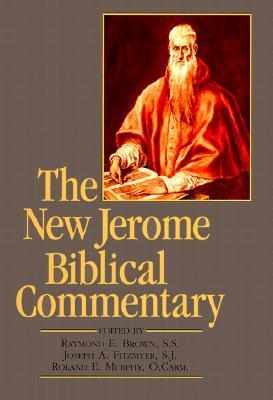
This reference book is a compact commentary on the entire Bible that readers can use to familiarize themselves with the methods and paths followed by biblical scholars. It features current theories on dating, historical reconstruction, and archaeological information. Contemporary perspectives and topical articles of an introductory nature include Hermeneutics, Canonicity, Old Testament themes, and coverage of biblical theology. Additional commentary includes articles on Jesus, the early Church, Gnosticism, and the subapostolic church. Especially for seminarians and clergy who require a commentary on the Scriptures both during their formal study of theology and for preaching in their ministry. Also, for those interested in religion and theology on all levels and feel the need for an adequate background in the Bible.
Roman Catholic priest, member of Society of Saint-Sulpice and a prominent biblical scholar, esteemed by not only his colleagues of the same confession. One of the first Roman Catholic scholars to apply historical-critical analysis to the Bible.
Excellent resource! I used it in seminary (ordained 1964), and look forward to accessing online. Not finished reading it, since the commentary is a resource book.
A scholarly and throughly researched commentary on the Bible that at once adheres to Church teaching and Sacred Tradition while taking into consideration modern cultural historicism and grammatology. A must-have for all armchair theologians and burgeoning Christian faithful.
It would take years to come to grips fully with this book, not only because it is so large (on a rough calculation, about 1.5 million words) but because it is not the most readable I've ever picked up (did someone say it's dry?...). Though the authors are all Catholics, this is not a faith-based commentary but an attempt at a scientific, 'objective' one. I say 'attempt' because I'm not sure that either of those things are possible in reference to scripture; but that is the aim, and I have no reason to doubt that the academic 'results' presented are the best available. Yet such things, mostly guesswork based on little hints of internal evidence and very exposed to the winds of fashion, at best tend towards tail-chasing. The book serves its purpose, you may find it useful at times to have obscure background details explained, you may find it interesting to know the best guesses as to how a given Bible book was produced; you are certainly not going to be inspired by it.
Already though, one passage makes me doubt whether there is consistent quality in the thinking behind the writing. This is in Adela Yarbro Collins' introduction to Revelation. Section 6 compares this book, rather improbably, to Greek tragedy. It begins by giving a not-very-accurate definition of Drama as a form; then it says, helpfully, that Revelation is not a Drama in this sense; nevertheless it is somewhat like Drama, particularly Tragedy, because it is serious; because it does include some speech and songs; and because, like tragedy, it may evoke pity and fear. The section concludes with the opinion that therefore the book 'may well have been' influenced by Greek tragedy, and the helpful information that Collins herself has written a whole book on this.
I mean, this is just shoddy thinking, or at best the author trying to bend the subject towards her area of special interest. The juxtaposition of narrative and commentary songs is not peculiar to the Greeks, it's a commonplace in folklore and epic. Tragedy evokes pity and fear but - as Collins herself notes - with the aim of purging these emotions. That is pretty much the opposite of the aim of Revelation. And what is supposed to be the mechanism by which this classical Attic art finds itself the model of a book by a C1st Levantine Jew?
Any similarity is so tenuous, its alleged Biblical influence so entirely without evidence, that I can't see the value in raising the comparison at all. What I can say is that, not only does no Biblical book as a whole feel at all close to a Greek tragedy in method or atmosphere (though there are a few individual scenes that might qualify), but to believe that any one of them ever could seems to involve a complete failure to understand the Bible's purpose, namely to present us with salvation history - something that is simply not consistent with the tragic view of life. And Revelation, especially, is not at all tragic: everyone gets what they deserve, according to the writer's viewpoint.
In short, it is a silly and irrelevant aside in a book where you'd think space would be at a premium. I'm not saying that this little bit is representative of the whole, but it raises grave doubts about the degree of quality control exercised by the editors.
Or, another example: the passage which in Isaiah that says he will feed on 'curds and honey' is explained as being 'the food available in a devastated landscape'. This intrinsically unlikely gloss - since when does honey mean a starvation diet, especially poetically? - is further undermined by a verse only a little further along in which the same phrase evidently signifies prosperity:
That day each man will raise one heifer and two sheep And because of the abundance of milk they give All who are left in the country Will feed on curds and honey (Is 7:21-2)
Parts of the book read like Wikipedia articles, as though they have been written by people adding a bit here and a bit there, and some articles would benefit very much from sub-headings. I don't know what translation they're using but it's not the one we have in Europe, which makes the commentary difficult to follow at times. And, physically, it is just a lot to manage; it is almost too big to have on your lap. Plus the print is pretty faint, I have to hold it as close to my face as possible!...
In short, though it is interesting in parts, if I hoped this could be a one-stop-shop for Catholic Bible studies I'm afraid that hope has not entirely been fulfilled.