No one thinks much of Black Gold because he is so small. But Jaydee sees something special in his eyes. He knows Black Gold would be great if he was his rider! Finally, Jaydee gets his wish. And Black Gold grows strong and fast under his careful hands. Soon it would be time for the most important race in America. Did they really have what it takes to win? Black Gold's inspirational story proves that the power of love and dedication can make any dream come true. Set against the thrilling and colorful world of Thoroughbred horses, Black Gold is the true story of this legendary horse and his determined young jockey.
Marguerite Henry (April 13, 1902–November 26, 1997) was an American writer. The author of fifty-nine books based on true stories of horses and other animals, her work has captivated entire generations of children and young adults and won several Newbery Awards and Honors. Among the more famous of her works was Misty of Chincoteague, which was the basis for the 1961 movie Misty, and several sequel books.
"It is exciting to me that no matter how much machinery replaces the horse, the work it can do is still measured in horsepower ... even in the new age. And although a riding horse often weighs half a ton and a big drafter a full ton, either can be led about by a piece of string if he has been wisely trained. This to me is a constant source of wonder and challenge." This quote was from an article about Henry published in the Washington Post on November 28, 1997, in response to a query about her drive to write about horses.
Marguerite Henry inspired children all over the world with her love of animals, especially horses. Author of over fifty children's stories, including the Misty of Chincoteague series, Henry's love of animals started during her childhood. Unfortunately, Henry was stricken with a rheumatic fever at the age of six, which kept her bedridden until the age of twelve. Born to Louis and Anna Breithaupt, the youngest of the five children, Henry was a native of Milwaukee, Wisconsin. Because of her illness, Henry wasn't allowed to go to school with other children because of her weak state and the fear of spreading the illness to others. While she was confined indoors, she discovered the joy of reading. Soon afterward, she also discovered a love for writing when her father, a publisher, presented her with a writing desk for Christmas. On the top of stacks of colored paper her father wrote, "Dear Last of the Mohicans: Not a penny for your thoughts, but a tablet. Merry Christmas! Pappa Louis XXXX."
Henry's first published work came at the age of eleven, a short story about a collie and a group of children, which she sold to a magazine for $12. Henry always wrote about animals, such as dogs, cats, birds, foxes, and even mules, but chiefly her stories focused on horses.
In 1923, she married Sidney Crocker Henry. During their sixty-four years of marriage they didn't have children, but instead had many pets that inspired some of Marguerite's stories. They lived in Wayne, Illinois.
In 1947, she published Misty of Chincoteague and it was an instant success. Later, this book—as well as Justin Morgan had a Horse and Brighty of the Grand Canyon—were made into movies.
She finished her last book, Brown Sunshine of Sawdust Valley, just before her death on November 26, 1997 at the age of 95.
So indeed, if were to consider Marguerite Henry's Black Gold as simply a horse story in and of itself, I would probably be rating it with a lower than average three star rating (actually two and a half stars). Yes, Black Gold is (truth be told) well written and engagingly enough recounted, but with a tragic (and for me likely also totally preventable) ending that really does majorly infuriate and frustrate me. Because it is (at least in my humble opinion) more than obvious that Black Gold should NOT have been raced or even trained again as a Thoroughbred (ever) once he developed his serious and recurring hoof problems (and with this statement I mean to imply that Black Gold might have been alright, might have been safe for less strenuous flatwork like dressage or easy going jogs on soft ground, but that racing was much too hard and straining on his already majorly damaged hoof).
However, even while the author, while Marguerite Henry does indeed at times portray Black Gold's trainer Hanley Webb rather critically, there simply is not enough of this within the text proper of Black Gold to in ANY way adequately satisfy me. For no matter how much Hanley Webb claims to have loved and appreciated his horse, it absolutely and for me stridently appears that he from the very onset both overtrained and over-raced Black Gold, and to then have Black Gold come out of retirement to race again (no matter for what perceived reason), considering that he still suffered from quarter crack (a serious split in the hoof that can not only cause extreme lameness but can also lead to considerably more serious problems) was simply and utterly wrong, and in my humble opinion, also seriously neglectful if not at least somewhat cruelly abusive. And indeed to then have the novel, to have Black Gold end with the same Hanley Webb, while blaming himself for what happened (Black Gold’s death) still insisting that he supposedly ran Black Gold in good faith, to me and for me, this basically signifies that Webb did not and still does not really consider his horse's recurring lameness as having been all that significant and that he is unable (or maybe also unwilling) to fathom that he had willfully and wrongly ignored Black Gold's serious hoof and leg issues and had refused to listen to Jaydee (the jockey) until it was too late (and yes, this does leave a rather nasty taste in my mouth, and tears of both sadness and anger in my eyes, especially because Marguerite Henry's own narrative and textual voice also seems to be both supportive and comisserative towards Hanley Webb, which he in my opinion certainly did not and does not really in any manner even remotely deserve).
But I guess what finally has convinced me to award only one star to Black Gold is twofold. For one, considering that Black Gold (while indeed regarded by many as a legendary steed) was in my humble opinion basically trained to death and raced to death, I (on a very personal level) really have to wonder and in all ways question why Marguerite Henry chose to even write about him (and then to write about Black Gold in such a way that was at least for me in no way critical enough of the entire concept of Thoroughbred racing, and the reality that Thoroughbreds are often trained and raced too young and too intensely, that so very many end up broken down or worse). And for two, and for me, even more importantly, I absolutely and massively chafe at all the glowing epitaphs which somehow portray the fact Black Gold did manage to complete his final race with a broken leg as somehow heroic and courageous (sorry, but there is NOTHING even remotely heroic or courageous about a severely, fatally injured Thoroughbred continuing to run its race, simply because that is what these horses have been trained to do). Black Gold is just too devastating and too uncritical a tale, and as someone who has always been rather against standard Thoroughbred racing as a sport out of principle, I simply cannot and will not ever recommend it.
Dec 21, 215pm ~~ I suppose I read this as a youngster but I couldn't remember anything about it even after a few chapters so maybe not. Who knows. Doesn't really matter, it's just that I read every horse book I could get my hands on back then more than once and it seems funny to not remember so many of this author's titles.
Well, anyway, I know I've read it now, and I can say I am appalled at what happened to Black Gold, who by the way was a real horse, which means that this book is a true story, making the whole thing more upsetting.
There is much of legend about Black Gold, but according to what I have read at a racing website the main story here follows the horse's life, although I would not swear to the reasons given for the trainer's obstinate behavior. That part was most likely imagined by Henry for dramatic impact (and to try and redeem him in the reader's eyes).
The book is described on the back cover this way: "Black Gold's inspirational story proves that the power of love and dedication can make any dream come true."
Maybe. But the story also proves the foolishness of expecting more from a horse than is healthy for him. Maybe I am more sensitive about this topic since I just read a book about Charlie Whittingham, who believed in training a race horse for that horse's future, in order to allow him to be healthy and strong throughout his career. CW also paid attention and when any horse let him know there was something wrong he did not ignore it, he tried to figure out what the problem was and how he could fix it. Black Gold's trainer came across as a selfish old man who did not truly think very much at all about the well-being of the horse in his care.
Black Gold's life story should have ended much differently. If it had, then I would accept the idea of this book being inspirational. The way things actually happened, though, the book is a sad example of human greed and ignorance. I spent the second half of the book wanting to horsewhip that stupid trainer.
All of Marguerite Henry's books are amazing, but this one has a special place in my heart. This is the first tragic animal tale I ever read. I cried for days. I couldn't believe the hero could have a unhappy ending. As an adolescent girl, it was delightful!!!
I haven't read this in years and even though I KNOW what happens at the end, that killer sentence still made me burst into tears: "He finished his race. On three legs and a heart, he finished it." I freaking love this book.
Another thing: the Osage are in this book!! The discovery of oil on Osage land is in this book. Wild crossover with Killers of the Flower Moon (this book is a true story, too).
This entire review has been hidden because of spoilers.
The illustrations through out the book were my favorite. I deeply related to Mooney on his decision to back away from Webb and Black Gold after he realized his voice wasn’t being heard.
Very weird and tragic "children's" story based on the life and death of the 1924 Kentucky Derby winner Black Gold. It's surprises me how many children;s books now thought of as classics had a lot of death and/or violence in them.
One of the murkier of Henry's books where it raises more questions in the reader than it answers. For example, that Black Gold was infertile was only hinted at, since you could talk about death but not sperm count in kids' books in 1957 (when Black Gold was first published.) The real history of Black Gold and his impact on American thoroughbred racing and the Kentucky Derby is more interesting than Henry's book.
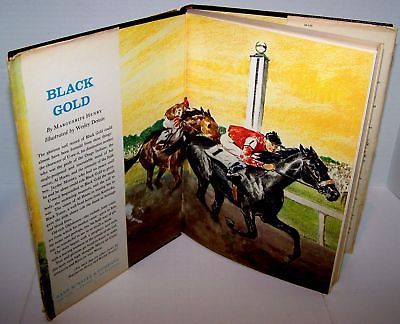
Try to get an edition with full-color illustrations, as they greatly add to the story as a whole. In this book, Wesley Dennis winds up telling a better story than Henry does. Usually the hardback editions have the full-color illustrations, but not always. I believe there was a paperback with all of the color illustrations published in the late 1980s but I may be wrong.
This book was NOT the basis for the Anthony Quinn film about Black Gold, since this book came out ten years after the movie Black Gold.
Inspired by a true story, Marguerite Henry continues her literary tradition of showcasing a love of horse (and mule) flesh for young adult readers. Unlike the homespun crises in MISTY OF CHINCOTEAGUE this story takes readers into the harsh world of professional horse racing, with its stark risks and grim realities.
Set in Okalahoma, then in Kentucky in the 1920's this story relates the birth and racing career of a thoroughbred whose smaller stature caused him almost to be overlooked for serious training. Fortunately for horse and owner Black Gold is loved by his young jockey, Jaydee--an Irish youth who recognizes the colt's potential and often argues with his adult trainer.
There is inevitable conflict over the horse's training and career among the men who admire him--a struggle of wills, knowledge and equine insight which result in Jadyee's psychological coming-of-age. This YA weepie provides a realistic lens on the various aspects of life around the Track--culminating with a running of the historic Kentucky Derby. Both horse and youth must demonstrate that it's the size of the heart in each one--working as a team--which ultimately matters in this highly competitive milieu. Even adults are advised to keep a hanky handy as Henry's tale unfolds.
(February 19, 2011. I welcome dialogue with teachers.)
This is a chapter book about a horse named Black Gold. The horse is seen by many as being too small to race. A young rider named Jaydee thinks the horse has what it takes to win horse races. The story ends with Black Gold breaking its leg during the final stretch of a race and has to be put to sleep. This book was written in 1957 for eight to twelve-year-old children. There are several small illustrations that appear to be done in pencil. I did not find the story very interesting. I think you would have to enjoy horse racing to have a chance at enjoying this story. I think children might be bored by this book and would struggle to finish it because it doesn't hold the readers attention.
This entire review has been hidden because of spoilers.
Henry is a masterclass author. Her talent in setting a scene was only mildly hindered by my personal dislike for switching between present and past tense. Also, to be completely honest, even she couldn't make Webb sympathetic here (at least not to me), but I'm not convinced that was her goal anyway. She simply laid out what happened in a compelling way and let you decide, and while that tactic isn't always my favorite, here it worked brilliantly.
Black Gold is the center of two dreams. The dream of Al Hoots, who risked much on a mare named U-see-it; then lost the chance to race her and set out to breed a Kentucky Derby champion. And the dream of Jaydee Mooney, a young boy destined to become a jockey and determined to ride one very special horse.
Black Gold is now one of my favorite Marguerite Henry books. The story seems more solidly based on fact than many of her other novels. And the horse is truly legendary.
This is probably my favorite of Marguerite Henry's books, partly because Black Gold was real, and at the time I read all her horse books, I was an elementary school girl who loved horses more than just about anything!
Agh, this was way sadder than expected... But I loved it all. I feel like everything ended up the way it should, even if it wasn't how I wanted it. I've always loved Marguerite Henry's books and this is no exception.
Dear reader, I advise you not to buy this book, for the reason that the horse, Black Gold, the Main character, is killed. I also think that the people should not have taken him away from his mother.
Dear Manybooks I do heartily agree with you. While I enjoyed the book, and the fierce persistent spirit of Black Gold, I too think that the either ending or the book was unnecessary. It is cruel to race a horse that much. I personally like horse racing, but it is too true that the sport can be highly corrupted by gambling and cruelty for horses. In the Bible it says: A righteous man regards the life of his animal, but the tender mercies of the wicked are cruel. I also will never reccomend it. Thank you for reopening my eyes regarding this book.
A proofread before adding it to my children’s bookshelf. It’s a great read for any child who loves horses. I didn’t appreciate several references to God/church/the Bible that lacked appropriate respect hence the 3-star rating.
Growing up, my California-dwelling family would visit my Philadelphia-residing grandparents every summer. While out there, we would usually venture on some excursion, Amish country, Niagara Falls, we would take a mini-vacation while on vacation. One summer we went to Chincoteague Island. My family had read Misty of Chincoteague by Marguerite Henry that year and were inspired to see the real life location of this story.
Now I'll be honest. Twenty plus years later I don't remember much of the trip (I do remember that I had a good time and that I thought the water very pretty) nor do I remember much of the book. I do know know however, that I liked he book enough for it to influence our mini-vacation. And even though I couldn't remember anything of the book, I do remember enjoying it. So when it came time to create my "To-Read List of 2025," I decided to include a couple of Marguerite Henry's books. The first Marguerite Henry book on my list was Black Gold. Unlike Misty of Chincoteague, I had never read Black Gold before. I was excited to revisit Marguerite Henry's works and I ended up finishing this book in one afternoon.
To be fair, it's not a long book, about 176 pages, but despite it's small size, it's still a great story about a racing horse name Black Gold. It starts off with the story of Black Gold's "dam" (or mother), U-See-It. Al Hoots, a rancher living in Oklahoma who already owned several thoroughbreds, spies U-See-It at a fairgrounds racetrack. he immediately sees something in this filly and trades 80 acres for her. It turns out to be a good bargain. U-See-It wins race after race. She travels around racing, making Al Hoots proud. But it takes a team to take care of such an important horse like U-See-It. Along with Hoots, there's his friend Hanley Webb. A former county sheriff with neither wife nor children, Webb is in charge of training U-See-It. Webb employs a man named Chief Johnson to exercise U-See-It. With this team, U-See-It is a star on the circuit.
While U-See-It is traveling the circuit, a boy named JayDee is growing up in New Orleans. He loves horses and every chance he gets, he is around these animals, riding them, taking care of them, watching them. His dream is to be a jockey and he is not going to let any obstacle deter him from this dream. Despite the death of this father at a young age and subsequently having to enter the work force, JayDee becomes a skilled horse-rider.
U-See-It, meanwhile, also comes into some trouble. After she wins 34 races, Al Hoots's wife, Rosa Hoots, want U-See-It to retire. She, like her husband, loves U-See-It and would like to see this little mare come home and rest. But Al Hoots thinks she has one last race in her. Unbeknownst to Rosa, he signs U-See-It up for another race. And this is no ordinary race. It is a claiming race. In a claiming race, all the entered horses are available for sale and that includes U-See-It. However, everyone knows of Al Hoots's love for U-See-It and how much she means to him. So Al Hoots enters her under a gentlemen's agreement that says the U-See-It is not actually for sale. Unfortunately an unscrupulous individual breaks this unspoken understanding and claims U-See-It. Hoots refuses to let his beloved horse go and brandishing a gun, he threatens the man who has come to claim her. The claimer backs off but it comes at a bitter cost. U-See-It can no longer race and all of her previous wins and times will be revoked. It will be like she has never existed. Hoots, although comforted by the fact he can keep U-See-It, is despondent at the fact that U-See-It will be stripped of her former glory. He returns home to tell Rosa the unhappy news. However he comes up with a plan. He will breed U-See-It and he will train her foal to not only race, but to win the Kentucky Derby, one of the most prestigious horse races. Rosa, Webb, and Chief Johnson are on board. All they need to do is raise the money to send U-See-It to be bred. Unfortunately Al Hoots dies before they can breed U-See-It. But his wife is determined to fulfill his dream. Because of an oil boon in Oklahoma, Rosa is able to afford to send U-See-It to be bred by Black Toney, an accomplished breeding stallion. Together they have a foal who Rosa names Black Gold in honor of his sire and and because of the oil that funded the money to breed U-See-It. When he's old enough, Black Gold is trained by Webb and Chief Johnson just like his mother. He starts his life on the circuit and is noticed by a new jockey named JayDee.
JayDee spots Black Gold in New Orleans and is instantly smitten by this horse. He promises himself that he will someday race Black Gold and not just in any race. He will race Black Gold in the Kentucky Derby and they will win. He approaches Webb to see if he can ride her. Webb initially rebuffs JayDee but over time, he agrees to let JayDee ride Black Gold. They train together and Black Gold starts winning races. Finally they are ready for the Kentucky Derby.
Although JayDee and Black Gold withstand tribulation during the race, they triumph and win the Kentucky Derby. Black Gold is thrust into stardom and Webbs decides to enter him into race after race after race, with no respite. JayDee protests, saying that Black Gold needs to rest. He notices that Black Gold has a crack in his hoof and insists that the winning horse has the surgery necessary to correct this issue. But Webb refuses. He doesn't want to stop Black Gold's wining streak. JayDee objects to racing Black Gold while the horse is in pain. He and Webb argue over the matter and JayDee leaves. However Webb does promise he will get Black Gold the surgery after a while. When JayDee returns to check on Black Gold, he learns that Webb lied and never got Black Gold his surgery. Disgusted, JayDee cuts ties with Webb.
Black Gold still races though and during one of his races his leg snaps. He carries on in the race and completes it on "three legs and a heart." Tragically however, there isn't anything anyone can do for him and Black Gold is euthanized that day.
When JayDee hears the news, he is angered at Webb and saddened by the death of the horse he had loved so much. Although he comes to forgive Webb, he never forgets the magnificent horse he felt such a connection to.
In the afterward, Marguerite Henry tells us there is now a race called Black Gold Stakes, named for this fearless horse and at the end of the race, the winner places flowers on Black Gold's grave. She also tells us that this books is based on real events and real people
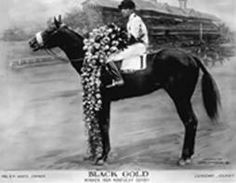
Black Gold was a real racehorse who won the Kentucky Derby in 1924. JayDee, John James Mooney, was a real jockey and he did race Black Gold in the 1924 Kentucky Derby. Rosa Hoots was a real woman, and was, in fact, the first woman who both owned and bred a Kentucky Derby winner. Al Hoots was a real man and he did trade acreage for U-See-It. He did enter U-See-It in a claiming race (although possibly unknowingly). He did refuse to give her up when claimed, although accounts differ on how exactly it all went down. However what is certain is that he and U-See-It were banned from ever racing again. Hanley Webb did train U-See-It and Black Gold. What happened to Black Gold in his final race really did happen and it was because of his split hoof. Overall, the story is fairly true to life.
This is why I really wanted to to revisit Marguerite Henry's works. Because she creates these emotional stories that are also accurate. I learned a lot about horse-racing and the Kentucky Derby. I learned about this valiant horse who won in 1924 and his determination until the very end. And I didn't just learn from this book. After reading Black Gold, I wanted to find out more about this horse so I did some research and discovered so much more information and history about his story (some of which is included in the previous paragraph).
It is a really good book and I would recommend it. It not only is a poignant glimpse into the world of horse training and the Kentucky Derby, but also into the relationship between man and beast. We see Webb push Black Gold to his detriment and ultimately his untimely death. Webb feels isolated with no wife and no children and tries to bury his loneliness by keeping himself preoccupied with Black Gold, even though he ignores Black Gold's needs. He fears dying with no legacy, nothing or nobody to remember his name. It's clear he knowledgable about training horse and he's determined and driven to keep winning but his fear and loneliness overrides any affection or love he has for Black Gold.
On the other side it's obvious that JayDee loves Black Gold (and horses in general). He refuses to ride Black Gold when the horse is in pain, even though it means JayDee misses out on making a lot of money. However, one could potentially argue that he abandons Black Gold when Black Gold needed someone to intervene on his behalf. What would have been Black Gold's fate if JayDee had stayed?
When all is said and done however, it was Webb who pushed Black Gold and ignored any and all appeals for his care. Webb was so intent on making his mark that he neglected the very thing that was going to help him achieve that goal. And in the end, it was Black Gold who paid the price.
Final Rating: ⭐⭐⭐
~~~~~~~~~~~~~~~~~~~~~~~~~~~~~~~~~~~~~~~~~
Here are some websites that go more into the story of Black Gold. I also recommend checking out the Wikipedia articles about Black Gold and JayDee.
I have to agree with another reviewer here who mentioned that Henry shouldn't have written about Black Gold at all. His life was an extremely short tragedy propelled by greed and mismanagement. His leg snapped at the ankle due to a long-term crack in the hoof his trainer knew about for years but refused to have mended, due to nothing but pride. A useless, selfish old man that Henry paints as lonely and victimized, and she grants him pardon in the end for running a 7 year old horse to death. For some reason she finds him a sympathetic character while the title character is literally sacrificed. Not the best example of a heartwarming tale, but certainly a look into the horrible world of thoroughbred racing.
This book was good in the beginning. I loved her characterization of Black Gold's jockey, and it was good to have even a fictionalized version of an otherwise forgotten Derby winner. I liked U-see-it, Rosa, and the boy. The trainer, though...he was all right at first, but got progressively more frustrating.
Black Gold's ultimate fate was . Despite being something of a downer, however, it's still a good, moving story. I think it still has relevance today in the treatment of Thoroughbreds, even if there are a few things today that weren't around then. Henry's point is still valid and of concern.
This story is the story of Seabiscuit and Ruffian. I think people like horse books so much because a horse symbolizes so many things from friendship to freedom. Those particular horses who can run so fast and jump so high on their own strength and without machine and who let us harness them teach us the power of synergy. Animals can teach us in a more direct and simpler way than just about anything else. Then we take those lessons and apply them to the most important relationships--those with our families and loved ones. The lessons a horse who runs until he breaks teaches us are about loyalty, dedication, and pure desire to do something just for the love and joy of it.
Henry was one of my favorite authors as a kid, but my rating of this book is based on my difficulty processing the heartbreak of the story when I first read it.
Emotional growth as well as simply growing up (in addition to the top reviews on Goodreads) have given me an entirely new perspective on the events of this book. As a kid I tried my best to admire Black Gold's "courage and heart" finishing his race with a broken leg. Henry's writing (as well as my own upbringing) went a long way toward making me believe I ought to see this story as somehow triumphant. Today I see the avoidable tragedy instead.
It was really well written. I think the tragedy at the end of the book was well put into words so much so that it brought tears of sympathy to my eyes. I really did enjoy this book... and I would recommend this book to horse lovers and young Jockeys that want to go to the track and be able to walk around in the winners circle. I read this book because its main basic story goes along about an race horse that made many wins and brought hope to the less fortunate. Black Gold was beautifully set and thought out. LOVE the bookLOVER.
A very uncomfortable read. Why didn't Jaydee stand up stronger to Webb, or get the Colonel to, or, better yet, the owner, Rosa Hoots? Why did the author try to give us reasons to think that Webb meant well?
There was quite a bit about the Osage Indians in here. A fair bit was educational. All was intended to be respectful. However, again, the author erred. Despite her research, she managed to use the insulting word 'squaw,' for example.
Ha ha ha, I saw this book and had to add it to my books. I have very good memories of hiding in my closet reading this book when I was supposed to be doing my chores. I think I was 8. I probably read it 5 or so times.