On a late September day in 480 B.C., Greek warships faced an invading Persian armada in the narrow Salamis Straits in the most important naval battle of the ancient world. Overwhelmingly outnumbered by the enemy, the Greeks triumphed through a combination of strategy and deception. More than two millennia after it occurred, the clash between the Greeks and Persians at Salamis remains one of the most tactically brilliant battles ever fought. The Greek victory changed the course of western history -- halting the advance of the Persian Empire and setting the stage for the Golden Age of Athens. In this dramatic new narrative account, historian and classicist Barry Strauss brings this landmark battle to life. He introduces us to the unforgettable characters whose decisions altered Themistocles, Athens' great leader (and admiral of its fleet), who devised the ingenious strategy that effectively destroyed the Persian navy in one day; Xerxes, the Persian king who fought bravely but who ultimately did not understand the sea; Aeschylus, the playwright who served in the battle and later wrote about it; and Artemisia, the only woman commander known from antiquity, who turned defeat into personal triumph. Filled with the sights, sounds, and scent of battle, The Battle of Salamis is a stirring work of history.
Barry Strauss, professor of history and classics at Cornell University, is a leading expert on ancient military history. He has written or edited several books, including The Battle of Salamis, The Trojan War, The Spartacus War, Masters of Command, The Death of Caesar, and Ten Caesars.
Description: On a late September day in 480 B.C., Greek warships faced an invading Persian armada in the narrow Salamis Straits in the most important naval battle of the ancient world. Overwhelmingly outnumbered by the enemy, the Greeks triumphed through a combination of strategy and deception. More than two millennia after it occurred, the clash between the Greeks and Persians at Salamis remains one of the most tactically brilliant battles ever fought. The Greek victory changed the course of western history -- halting the advance of the Persian Empire and setting the stage for the Golden Age of Athens. In this dramatic new narrative account, historian and classicist Barry Strauss brings this landmark battle to life. He introduces us to the unforgettable characters whose decisions altered history: Themistocles, Athens' great leader (and admiral of its fleet), who devised the ingenious strategy that effectively destroyed the Persian navy in one day; Xerxes, the Persian king who fought bravely but who ultimately did not understand the sea; Aeschylus, the playwright who served in the battle and later wrote about it; and Artemisia, the only woman commander known from antiquity, who turned defeat into personal triumph. Filled with the sights, sounds, and scent of battle, The Battle of Salamis is a stirring work of history.
Opening: He was the last Athenian. That is, if a box of bones may be considered an Athenian. Alive, he had been Themistocles, architect of the greatest sea battle ever fought. Now his remains were secretly reburied here in Athenian soil, perhaps, as rumored, along the shore outside the wall of Piraeus harbor. Themistocles’ family, they said, had dug up the bones from their first grave abroad under the noses of the authorities
If you have read the first few books in the scrumptious series by , then you will know that my reading of this produces a smile.
Artemisia
NONFIC NOVEMBER 2015:
R White Mughals 5* A History of England from the Tudors to the Stuarts 3* Rome and the Barbarians 4* Field Notes From A Hidden City 3* The King's Jews: Money, Massacre and Exodus in Medieval England 5* A History of Palestine 634-1099 3* Charlotte Brontë: A Life 3* The Alhambra 5* A Long Walk in the Himalaya: A Trek from the Ganges to Kashmir 3* Buddhist Warfare 4* A Gathering of Spoons AB A Brief History of Roman Britain - Conquest and Civilization 4* Victorian Glassworlds: Glass Culture and the Imagination, 1830-1880 3* Food Safari 4* She-Wolves by Castor 3* India: A Portrait 2* The Archaeology of Ancient Sicily 5* Classics of Russian Literature 3* The Battle of Salamis 4* The Age of Wonder 5* Lost Worlds of South Americas 3* Wind and Sand 2* Skeptics Guide to the Great Books 3* The Invention of France 3* Balthus CR Every Time a Friend Succeeds CR Unfaithful Music and Disapearing Ink AB She Wolves by Norton CR Aquinas CR Invisible Women
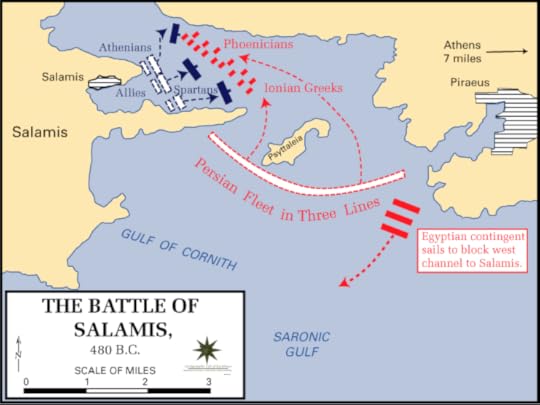
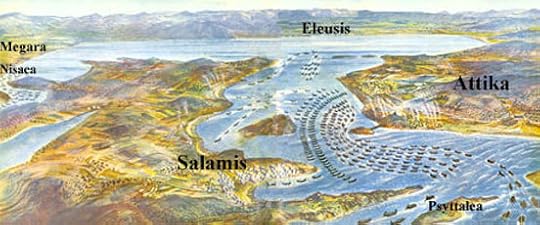
Barry Strauss has written a very accessible account of the second time the Greeks fought off the Persian Empire. He spends a good amount of time on the background: the Ionian revolt, the general configuration of the Persian court, etc. Along the way, we good descriptions of triremes, the geography, and the backgrounds of many of the important people. So it's was a little surprising that he spends so little time and descriptive power on Marathon and (while talking about the aftermath) Plataea. But, Strauss is fixated on the water; the fighting at Thermopylae gets decent coverage, but the naval fighting at Artemesium is where the early focus lies. This generally makes sense for a book mostly about a naval battle, but enough other things are thrown in that I found these omissions surprising. A nice touch is that every chapter has a small map near the beginning (at least in the Kindle version, they might be elsewhere in print).
The biggest enemy in any book looking back ~2500 years is the lack of sources. Strauss leans heavily on Thucidides (who I agree is more reliable than sometimes given credit for) and
Aeschylus
, but does leaven his text with a few other sources and modern reconstructions of triremes. He does not hesitate to speculate, but marks these off with 'we may assume', etc., so you know when he is doing so (which, as to be expected, is pretty often).
Generally, he does a good job with his analysis, but there are places I disagree. He compares the Spartan stand at Thermopylae to Persian confusion at Salamis saying "Leonidas served a transcendent cause, while the Phoenician king Tetramnestus merely calculated the odds." I'd think Leonidas saw delaying the Persian army as much as possible as his strategic goal, while Tetramnestus' only goal was the destruction of the Greek navy; if that wasn't going to happen, then the battle wasn't worth fighting. He also assumes that Artemesia must have fooled the Greeks into thinking hers was a Greek ship, and Xerxes into thinking she had just rammed a Greek ship during a famous incident when she rammed her ally Damasithymus' ship (this is the usual view). I wonder. Given that there are only a few angles at which ramming is truly effective, I wonder if she had just put her ship in position much more difficult to get at (by having to go through Damasithymus' ship to do so, for instance). Given normal courtly politics, Xerxes may also have been willing to celebrate the competence of someone who instantly saw and acted upon a chance to avoid defeat/capture and cut down a rival at the same time.
The subtitle is a bit mixed. 'Saving Greece' is hard to argue—except for the fact that 'Greece' was not a very cohesive concept, a fact pointed up, as Strauss does, by the fact that a lot of 'Greeks' fought for the Persians. But there was a cohesive Greek alliance, fairly untroubled by defections to Persia, and Salamis was the turning point in the campaign. As for 'Western Civilization'... Strauss notes that, perhaps, defeated Greeks would have fled to Italy and continued on, even retaken Greece. But there'd be no Delian League, what he calls the birth of 'imperial democracy'. "Defeat at Salamis would not have deprived the world of Greece's glory but of its guile and greed." From there he talks about the road to Western political philosophy. So it's not just hyperbole.
More like 3.5. Fascinating and well written summary of the Battle of Salamis, a crucial Greek naval win in the Greco-Persian War of the 400s B.C. The author has made this narrative interesting and not too scholarly for the general reader such as myself. We are informed as to the causes of the war, important battles up to that time {Artemesium--naval battle ending in a draw] and Thermopylae, the Spartans' "last stand" in spite of treachery and overwhelming odds. Then there are the factors leading up to the decision to face off against the Persians at sea from the Greek base on the island of Salamis. Eurybiades, the pragmatic Spartan, chief admiral of the Greek sea forces, defers to Themistocles in matters of strategy and planning. The author calls the Athenian "a latter-day Odysseus." By a ruse, the cunning Themistocles tricks the Persians into coming to Salamis to battle it out--just where Themistocles wants them to be. Themistocles knows the help he'll get from the geography and from the weather. Description of the one-day battle was fantastic; maps of each stage were invaluable. Then we follow the Great King's retreat. Salamis was not the last battle in the war, but a turning point; the author uses the analogy of a Gettysburg vs an Appomattox. I enjoyed reading about some of the unknown [to me] historical participants: Aeschylus the playwright as a participant and eyewitness; Artemesia, the wily woman admiral and queen of Halicarnassus; Aminias of Pallene, who may have started the battle, and others. I thought the last part of the subtitle a bit grandiose.
I thought easily the best parts were descriptions of a trireme and her crew with which Strauss opens the book and of ancient sea warfare both at Salamis and in general! I realize the author based his text heavily on primary sources: Herodotus, Aeschylus, Plutarch, and Timotheus, and on later writers' interpretations but I felt uneasy about so many "if"s, "maybe"s, "it could have happened this way" and other speculations including the [speculative] physical descriptions of the main players that opened nearly every chapter. Highly recommended.
An intensely detailed account of the sea battle between the quasi-united Greeks, officially under a Spartan commander but heavily influenced by the strategy of Athenian Themistocles, and Xerxes’ tremendously more numerous army. Strauss follows Herodotus and other sources, accepting them as reliable for the most part, but sweetening the account with hundreds of details from modern scholarship about the prevailing winds, manners of dress, the physical requirements of rowing a trireme, and so forth.
It’s really a masterwork of erudition, written with a very pleasing and dramatic style that emphasizes the daring stratagems of Themistocles (for example, his false treachery to the Persians, sending his slave Sicinnus to say the Greeks were fleeing and that Xerxes should strike immediately, when in reality the Greeks were waiting for them) and the remarkable nature of the Greek victory. The subtitle of the book is “The Naval Encounter That Saved Greece – And Western Civilization,” which is a bit of hyperbole, because in my view had the Greeks lost at Salamis they simply would have girded up and won a victory elsewhere. But to Strauss, while Salamis didn’t necessarily ensure classical civilization, which probably would have happened anyway, it did create a new kind of imperial democracy: “At home, Athens stood for freedom and equality. Abroad, Athens did not hesitate to use any means necessary in order to enforce the authority of the league that it led. After making a heroic stand against Xerxes in the name of freedom, Athens had discovered that in order to maintain its freedom, it would have to make difficult compromises ahead.” An analysis that may sound familiar to modern American ears.
One should approach the reading of this book with a drinking game. Every time Barry Strauss says the word "Herodotus" one should take a drink. I don't actually advise this as the reader is sure to die of alcohol poisoning given the fact that Herodotus is on almost every page of this wonderful book.
Strauss's book was simply incredible for the fact that every page felt dramatic, captivating, informative, and concerned with being accurate to the facts and records. Much like Roger Crowly's 1453, THe Battle of Salamis narrates one of the important battles in world history and attempts to contextualize it in what came before and ultimately what would come after. And while I didn't always follow every single detail of the narrative, any reader is sure to appreciate this book simply for the fact that Strauss is a gifted writer who makes even the details on the surface of trireme seemed captivating and entertaining.
Barry Strauss is a master of the “you are there” style of popular historical writing. His books are accessible and gripping narratives about discrete historical episodes, including Spartacus, the Trojan War, and the death of Caesar. I’m a fan, of course. I’ve read most of his books, and I’m working on finishing the rest. “The Battle of Salamis” was the first popular book written by Strauss, and it well deserves the praise often heaped on it.
Salamis (an island just southeast of Athens) was, of course, the site of an ancient naval battle in 480 BC, which is commonly and justifiably regarded as crucial in creating our world today. Here an alliance of Greek states, led by Athens, defeated the Persian Empire, after the Persians had sacked and burned Athens and all her people had been evacuated from the mainland.
Salamis immediately followed the defeat of the Greek alliance at Thermopylae, where the Spartans (and some other Greeks) fought to the last man. (“Go, tell the Spartans, thou who passest by, that here obedient to their laws, we lie.”) Thermopylae is better remembered today than Salamis. But the Greeks saw Salamis as more important, and embodying the same spirit. The Corinthians set up a cenotaph after the battle with the inscription, “When all Greece was balanced on the razor’s edge; We protected her with our souls and here we lie.” Failure at Salamis would have led to Persian domination of Greece and, almost certainly, the loss of that Greek inheritance which has informed and molded Western civilization, the civilization solely responsible for all the modern world’s freedom and glory.
The nature of “you are there” history is to paint vivid pictures of key individuals at specific moments, and then slot those moments into the larger narrative, compelling the reader with the former and informing him with the latter. It is like a movie about Troy: perhaps a tight focus on a muscular Achilles, sweating in Corinthian helmet, bronze breastplate and greaves, stabbing with a short, bronze sword—then pulling out to include his immediate opponent, then farther out to show knots of men in combat, then further still to show the ebb and flow of the forces and the city standing opposite beached ships. In the same way, Strauss picks individual characters, such as Aminias, captain of the first (or maybe second) Greek ship to attack during the battle, describing and profiling him, including his possible thoughts, then slotting him into his role in the battle, pulling back to describe the period of the battle in which Aminias played a key part. This authorial technique is not easy; it can quickly become melodrama, or too obviously fantasy. But Strauss pulls it off, and repeatedly—not just with Greeks, but with Persians and their allies (who included many Ionian Greeks), such as Artemnesia, the queen of Halicarnassus and one of the extremely few women in all history known to have led in battle, though she did not fight hand-to-hand, and Tetramnestus, king of Sidon, who captained a ship personally.
A second particular gift of Strauss is teasing out often-contradictory sources to create a coherent narrative that still continuously acknowledges its possible inaccuracies and variations. An author in such a case (which is always true for books about Classical times) has to steer between getting bogged down either in “on the one hand, on the other hand,” or in a false sense of certainty (or worse yet, the creation of a wholly fictional narrative to fill in gaps). Strauss deftly notes where the sources differ, why that matters, and what he thinks most likely happened, and why. The reader is not perturbed, but rather informed. This authorial technique is also difficult, and it is to Strauss’s credit that he pulls it off repeatedly.
While it’s hard to argue with the contributions of Classical Greece to the West, traditionally the Persians have fared poorly in the telling, cast as effete, despotic and hampered by their various vices and inferior ways of government. Popular culture to this day, such as the not-bad movie “300” (about Thermopylae) and its atrocious sequel (about Salamis, sort of), reinforce these stereotypes. Yes, there’s some truth to all that, as there is to all stereotypes, but as Strauss notes, “Persia was neither decadent nor dull but a formidable and innovative power from which the ancient Greeks—and the modern West—borrowed much.” Sure, the Great King, Xerxes, lost. He lost at Salamis, and he (or rather his main general, Mardonius—Xerxes had gone home) lost at the subsequent land battle of Platea. Xerxes’s father, Darius, had lost at Marathon. And so the Persians never returned (and eventually a Greek, Alexander, dealt them their fatal blow). But they weren’t stupid, and they weren’t incompetent, or evil. They ruled a massive empire competently for a long time, though their inflexible military system that failed to reward initiative often hampered them in dealing with the flexible Greeks (see also, for example, Xenophon’s “Anabasis,” a hundred years later, where an army of Greek mercenaries cut their way home out of the heart of the Persian Empire). We would not, probably, have as good a modern world if the Persians had won, but they don’t deserve the contempt with which they’re frequently showered.
The hero, if there is one, in Strauss’s story is the Athenian leader Themistocles. “Themistocles was that rare thing in a democracy, a leader. He had no fear of speaking truths to the people. By the same token, he knew that a straight line is not always the shortest distances between two points.” Reading Classical history, one is always struck (as one is struck reading the Old Testament) how little people have changed. The archetypes visible in the real people of thousands of years ago are visible in people today. Donald Trump is, perhaps, a second-rate Themistocles: a clever man, under-rated by others, whose flexibility of principles masks a will to power, and a will to succeed on behalf of his vision of national greatness. Now, I hesitate to suggest this, much less to fully endorse it. I thought, though I doubted, in November 2008, that Barack Obama might be the new Pericles, sent to unite us. Instead, he was a fifth-rate Cleon, a divisive demagogue who led the country into the toilet by turning people against each other. So Trump is not very likely to be the new Themistocles. Or, if he is, he may end his days as a satrap to Vladimir Putin, just as Themistocles ended his days as satrap to the Persian Emperor Artaxerxes, the son of the Xerxes defeated at Salamis. But it is just possible. Check back in four years!
Strauss ends with several pages of musings on the difference between liberty, the old Greek way and focus, and the “imperial democracy” of the Delian League, which succeeded the success of Athens in the Persian Wars and which, Strauss obliquely implies, is our modern way. In his view, it was the contradictions of imperial democracy, and its critics, that produced the Golden Age of Athens. This book was published in 2004, when America’s imperial democracy seemed at its height, though Strauss makes no reference to then-current events. Today, “imperial democracy” seems less attractive, and our own path nothing like that of Athens. We are spent and weak, exacerbated by years of execrable leadership that prized above all abasing America, not poised for expansion under new, great leaders. We are more like Athens after the Peloponnesian War, waiting to be plucked by Macedon. But such analogies can easily be overdone. All we can do is work our hardest—to make America great again, by searching for, exclusively rewarding, and ultimately achieving the excellence that the Greeks of Salamis, all of them, made their aim, to their everlasting credit and our everlasting admiration.
I read this in anticipation of 300: Rise of an Empire. I studied Classics in college, so I went into this book with a knowledge advantage.
An overview of the Battle of Salamis with appropriate framing (Ionian Revolt to Artemisium/Thermopylae through the Persian retreat). Strauss draws heavily upon Herodotus and Aeschylus. While his extensive notes and source discussion at the end of the book lists works discussing the accuracy of these accounts, there is little discussion in the actual book, suggesting that it is meant to be accessible to a wide audience. One wonders, however, why he did not just provide a translation of Herodotus and supplement it with Aeschylean addenda.
It is a quick read and his presents the battle clearly. At times, the tangents that take up one paragraph here and there are jarring and truly irrelevant. Strauss' prose has identifiable problems. Surely there is a more elegant way of framing speculation than repeating "so we might imagine" over and over again. The chapters begin with physical descriptions of various historical figures and their supposed inner monologs ("so we might imagine" them thinking), but there is no continuity. These figures occupy the first few pages at the most and then the action passes elsewhere. It felt forced, which is not a good thing. While I understand the impulse, Strauss should have either presented a fictionalized narrative with a factual breakdown of the narrative at the end of the book or stuck closer to a historical analysis. The larger question is what this adds to Herodotus' account. Strauss does add some geographic analysis absent in the historical sources, but this could be presented in footnotes to an edition of Herodotus. Strauss' analysis of the importance of the battle is actually quite good, but too brief.
I would not consider this a must read except for those who are interested in the Battle of Salamis but have no desire to read Herodotus.
Okay. This is not a great book, in my opinion, which is a shame since the subject matter is actually fascinating. The Ancient Greek city-states and their tenuous alliances, coupled with the nascent democracy in Athens, all at risk from Xerxes of Persia’s imperialist ambitions—this is clearly the stuff of epics and poetry, as evidenced by the fact that ancient dramatist Aeschylus wrote a play about this conflict (my favorite fact of the book is that Aeschylus was a combatant at Salamis, as well as having fought at Marathon a decade earlier). Where this falls into trouble in the aggregate is that it fails to deliver on its grandiose subtitle, and in the granular, the writing and structure are not good.
Let’s start with the writing. Each chapter begins with a zoomed-in focus on an unnamed personage, described in the present tense, who we must read about in confusion until Strauss decides to identify them to the reader. This could have been effective a couple of times, if done well, but it became tired quickly and I was annoyed with the beginning of each new chapter. The narrative is also excessively bogged down in detail and the Ancient Greek names and patronymics quickly become almost indistinguishable from each other. I think Strauss often gets in his own way when trying to convey the facts of Salamis and the Greek-Persian conflict, which is nowhere more evident than when I finished the section about the battle proper and found that I could not identify from the text whether or not the Persians had begun to retreat (they had, in fact). I was unable to deduce that from what I had read on the first pass and ended up having to take the author’s word for it after a second attempt.
The structure also doesn’t work, in my opinion. There is a lot of build-up to Salamis, none of which I dispute is useful and even essential background to the battle, but fully a third of the text is the lead-up and could have been condensed by at least fifty percent and been twice as effective. There are a lot of tangents, and this reads almost like someone’s very enthusiastic undergraduate thesis in terms of the desire to demonstrate deep source engagement and mastery of the subject area—everything must be included! There was a passage towards the end of the book where Strauss states, quite succinctly, three factors that led to the Greeks’ triumph over the Persians, and I would have preferred him to dig deep into these three elements and have that be the book, rather than a minute play-by-play account of the conflict from origins to aftermath.
Finally, I’ll echo a friend’s review in that the book does not deliver on the subtitle’s promise. I think he successfully demonstrates, or at least intimates, that Salamis was a turning point in the conflict with Persia and that Greek and thus Western (European) history would have been different in some regard, but he undercuts this by saying that if the Greeks had been displaced they would have flourished in exile and probably been more or less the same. So I don’t know how I should be convinced by this claim that he devotes very little actual word count to.
This will be fascinating to discuss in my book club, and I’ll be curious to see what others thought of the arguments and the ultimate impact of the volume.
This was an interesting period that I knew little about. But it was written as if in long form bullets telling moment by moment what happened in the lead up to, during and after the Battle of Salamis. There wasn’t enough storytelling. Just a laying out of the bare facts. Perhaps this was meant to be the definitive statement of what happened since the facts had to be gleaned from dozens of sources. In that sense, it was a success. But with a subtitle about saving “Western Civilization”, very little was done to advance that claim. The author mentioned the long-term ramifications very lightly in the epilogue - he really should have done more of that from the very beginning.
Interesting to read this right after reading Persians: The Age of the Great Kings. Obviously a much more pro-Western slant here, though the subtitle is overstated (most authors don't pick their own subtitles, by the way). The book provides a decent feel for the battle itself and also the backstory, without too many rabbit trails. Of course, much is conjecture because no one sat down immediately afterward to write down how the battle progressed. It wasn't like Herodotus, our main source, was observing from an overlooking hillside. However, Aeschylus was there, so his drama The Persians must be taken into account.
Great book about this integral battle. The author does a great job of bringing that classic naval conflict to life. Each chapter starts with a scene from one of the many personalities involved. The highlight, for me, are all the maps. Maps for each chapter, plus bigger maps at the beginning of the book. There's also a very short, but important intro to the different boats, which helps when you're reading about all those triremes.
One can tell the sort of subject matter that an author is expert in by what they see as "saving western civilization," and this author is clearly a classicist in viewing the Battle of Salamis in such a light. This is not to say that a reader should think the battle unimportant, only that this battle is one of the many battles that is viewed as a hinge of history. One can tell that the author is a classicist and not, say, a moralist by the way that this battle is viewed as being vitally important but not providential in nature. The author goes out of his way to look at various reasons why we should not look to divine providence as a reason for the survival of the Greeks, and the author is helped in this by his focus on the trickiness and general lack of moral fiber of the hero Themistocles and the author's view that religious feeling on the part of anyone is akin to superstition. The book therefore is an interesting read but there is clearly some distance between the author's view and my own.
This book of about 250 pages is divided into four parts. The author begins with some notes on spelling, a timetable, and notes about the ships. After that the author discusses the Persian advance (I) with chapters on Artemisium (1), the Greek stand at Thermopylae (2), the Persian sack of Athens (3), and the arrival of the Greek fleet at Salamis (4). After that the author discusses the Greek trap of the Persians (II), looking at what happened at Phaleron where the Persians had set up their base of operations (5), the trip of one of Themistocles' slaves from Salmais to Phaleron with some information about Greek disarray (6), the willingness of the Persians to accept the bait of that trap (7), and the arrival of the Persians at Salamis (8). The next part of the book is spent talking about the battle itself (III), dividing the battle into three phases, namely morning (9), afternoon (10), and evening (11), looking at what the sources say and what can be reconstructed from it. Finally, the author closes with a look at the retreat (IV) of the Persian fleet (12) and the response of the Athenians to it (13) with an epilogue about Themistocles' going to Persia after having to leave Athens in exile.
This book is very humanistic in its tone, and that is likely something that will appeal to a lot of writers. Yet it would not be too much to imagine that Greece could have survived the loss at Salamis. There is nothing to say that a Persian victory would have been permanent in light of the frequent revolts in Egypt and Ionia. Likewise, there is no reason why the Persian army would have necessarily been superior had there been a less decisive victory or a draw that allowed for a retreat to the area around Corinth. We are all a bit prone to view things as decisive because they happened to happen that way without thinking more about what it would have meant for things to work out differently. Often our imagination is not nearly as good as our interest in analyzing and enshrining the importance of what did happen. Even so, this is a good book about an important battle that was one of the battles between very different and alien cultures that demonstrated the boundaries of an empire and its eventual decadence and decay. The author's praise and heavy use of Herodotus is not a choice that everyone would agree with, but the author's view that ancient authorities should be respected is certainly in line with my own views on the matter, to be sure.
To the layman the Persian-Greek war consisted of only a few very important battles when in reality it consisted of many. One of the most underrated of these unknown encounters is the battle that took place in the Salamis straits between the island of that same name and the Attica coastline. Instead of focusing on the popular battles of Thermopylae or Marathon, Barry Strauss gives us an in depth snapshot of the days leading up to that late September day in 480 B.C. along with a detailed account of what went on during that fateful day and the days following. Strauss argues that this naval battleground was the main turning point in the Persian-Greek war and it, subsequently, saved the recently born idea of democracy from certain Persian ruin under the tyrannical Xerxes. Without retaking Athens the city would never have flourished as it did or become the hub for democratic thought through political philosophers such as Sophocles in later years. In turn, the Romans would not have adapted the Greek ways and democracy would never have spread to the shores of Italy, Britain, and then, eventually, the United States of America.
Each chapter is entitled with a place in or around Greece and the first paragraphs of each chapter starts with a perspective from one of the many figureheads of the battle. We are graced with the outlooks of war lords, slaves, poets, and politicians from both sides of the war. Though most of the battle includes guess work two (arguably three if you include Plutarch) very important sources still remain today. One is Aeschylus the playwright (who invokes more poetic leeway than should be taken seriously) and the more down to earth historian Herodotus. Combine these two (or three) works and there is an accurate representation of what occurred.
Though most history texts are rather droll, Strauss creates a brilliantly vibrant read that is borderline edge-of-one's-seat thriller. As said before, most of this is guess work, and a lot is assumptions, but that is what makes the idea so thrilling. He sticks with the facts as much as he can while engaging the reader in the sights, sounds, and actions of the battle. He even gives us emotions to go with the reading, such as sympathy and elation at the bravery of the oarsmen that sat in the three tiered triremes who could see little, but hear a lot of the commotions outside. Danger lurks around every corner and the stakes are high so the reading goes fast. What's even better about this book is that one does not need to know the war too well to just pick it up and start reading.
Barry Strauss' The Battle of Salamis provides a good rendering of this important sea battle that turned back the invasion of Greece, led by Persian King Xerxes. After breaking through the defensive position of the Spartans at Thermopylae, the Persian army then moved southward and sacked Athens. All that stood between Xerxes and the taking of Greece was the Greek fleet.
This book begins with a description of the basic ship, the trireme, to help provide the reader with some context. Also, the events leading up to Salamis are discussed. Some of the intriguing personalities, such as Queen Artemisia, who commanded part of the Persian fleet, are well described and add depth to the discussion.
Heavily outnumbered by the great fleet of Xerxes (which did not feature, ironically, Persian ships), the Greeks gathered their fleet at the island of Salamis. The Greeks faced internal disagreement, with the Athenian Themistocles contending with a not very cohesive alliance.
The battle itself began with the Persian fleet moving into position, rowing during the evening. On the one hand, this led to a modest surprise as they emerged at Salamis; the down side was that those rowing the ships were exhausted and, possibly, not in the best shape for a major battle. The next day, the Greek fleet attacked and, due to a variety of factors, smashed the Persian fleet and sent it in chaotic retreat. Greek ships picked off retreating ships easily, inflicting extremely heavy losses.
The book concludes with the telling of Xerxes' retreat, of the sad picture of the Athenian hero, Themistocles, ending up begging Xerxes' successor, Artaxerxes, for some position with the Persian Empire.
Overall, this is a valuable and readable book examining what is termed the Greek "Gettysburg" by the author. The aftereffects of the failure of the Persian attack could be better described. The reader might wish more detail on the context of the death of Xerxes. Nonetheless, a book worth reading for those interested in this period in history.
Mr. Strauss, in this book, describes the events and personalities that surround one of the greatest naval battles in the ancient world. And yet, this book is more than that. Despite it's short page count, this is perhaps one of the best summations of the Persian-Greek War of 480 B.C. Mr. Strauss builds up the tension in the first half of the book by describing both the Greek and Persian strategies and battles that led up to Salamis. He interweaves court and democratic politics, religion, and history to pull the reader into that world, a world that is far different from our present world as well as from the picturesque portrait given in too many Hollywood movies. Naval warfare in this time was not pretty or comfortable and Mr. Strauss does a fine job of describing nearly everything. And this is in spite of the fact that many of the ancient sources are vague, lost, or contradictory. But while he does a fabulous job of putting all of that together in the lead up to the battle and afterwards, but his big weakness is that he doesn't with the actual battle. He devotes three chapters to the battle itself, approximately 50 pages, and yet I'm not quite sure what exactly happened. This may be due to the sources he was working with, but his ability to weld it all together previously in the book makes me a little unsure. However, he more than makes up for it by starting each chapter with a short biography of key players in the battle like Themistocles or Xerxes. In short, this is a fine introduction to the Ancient Greek world as well as to the war that was a turning point for Western Civilization.
A rip roaring true tale of triumph in the face of adversity. Strauss does indulge in a bit of fantasy when he describes how certain historical figures felt at a given moment and on a given day. But this adds to the story rather than subtract ting from it. If you enjoy a quick read about ancient Greek history and want to learn more about a battle that changed the world? This is a book for you. It also appeals to those who know Greek history, but feel the traditional teaching is dry. Hence the authors fantastic journeys into the historical characters minds, sights, smells, physical pain, and emotional pain.
Amazingly well-written, it relies on historical and ancient cultural details/norms to help the characters and scenes come to life. It addresses the challenges of studying and writing ancient history, and explains the rivalries which led to different accounts of Salamis in Greek texts.
I wasn't sure if I'd like this book; it's been a while since I've read about ancient history and sometimes I struggle with the names of historical figures in ancient empires. However, I couldn't put it down!
Interesting stuff, and generally well written. Unfortunately, it should have been about a third of it's final length. Strauss repeats himself frequently, and his desire to get into deep, speculative detail ends up lessening credibility. This was a well written book than just had too much of itself.
This is an outstanding look at a critical battle in the history of western civilization. Very well researched and equally well-written it gives us a glimpse into the personalities who had a disproportionate influence on the development of western civilization.
Ho passato una settimana viaggiando con Barry Strauss per tutta la Grecia, quasi avvertendo nelle narici l'odore salmastro del mar Egeo e le grida dei persiani sconfitti alla ricerca di salvezza in una battaglia che ha rivoluzionato le sorti di Atene.
I loved it, but then I'm horribly partial to this stuff. Not particularly nuanced but an accurate and riveting account. It won't take you two months and a history PHD to finish it, either.
TL/DR: X-Posted review I wrote for Amazon a number of years ago. I liked the book.
"The Battle of Salamis" by Barry Strauss is an excellent source of information about an important naval encounter that occurred between the Persian Empire and the Greeks in 480 B.C. This review will discuss the content of the text, extrapolate the main themes that are offered to the reader, and finally shall critique the sources of information that the author employed throughout his study.
The naval battle that occurred at Salamis, according to Strauss, was a turning point in the development of western civilization. Had the Persian Navy prevailed, the lone Democracy that the world had known, Athens, would have perished from the Earth, and one can only speculate what would have happened next. The scope of the book covers not only the naval battle at Salamis, but the land invasion to include the two major battles that preceded it at Artemesium and Thermopylae. Further, it provides the reader with a very engaging epilogue of what happened to the great figures of the time in the years that followed the battle.
The book is written in a narrative style, which makes the content very easy to digest by even the casual reader. It stands in stark contrast to many of the more cumbersome and academic volumes that exist on the subject, but with the expected gratuitous use of (sometimes conflicting) primary sources, specifically Herodotus and Plutarch. As a result, the reader is provided with nothing less than an outstanding piece of scholarship.
Beginning with the Persian advance into Greece, the text explores the battle at Artemesium, a cape north of Euboa, Greece, in which the Persian Navy attempted to entrap the Greeks. Greek strategist and Athenian commander, Themostocles, dispatched several of his speedy Greek triremes to employ ramming tactics against the Persian triremes which, due to their overwhelming numbers, had not left themselves adequate room to maneuver about. The result was a capture of thirty Persian triremes, and initially a Persian retreat. Further compounding the troubles of the Persian Navy was a violent thunderstorm that destroyed an additional two-hundred ships. The conclusion of the battle resulted in a retreat by the Greek Navy. The text then goes on to discuss the land battle at Thermopylae, in which the Greek coalition, led by the Spartans, held off the Persian advance for a time, despite overwhelming odds. Thermopylae fell, opening up the road to Athens, and the rest of the account revolves around the Athenian retreat from Attica, an in-depth account of the Battle at Salamis, and an epilogue of what happened after the battle to many of the key figures.
Combining a chronology of the events with a study of the important figures, again, told in the narrative style, is what draws the reader into this story. Even the casual reader, after reading anecdotes about Xerxes "whipping the sea", the scheming of Artemesia the Queen of Halicarnassus, and Themostocles' coalition-building, will be enticed and ask themselves the question, "What will happen next?" The strength of the story, however, is in the details provided in the character studies of these great figures. The great figures given this extra attention in the book are, in order of their appearance in the book, Herodotus, Themistocles of Athens, Leonidas, the Spartan commander who fought the Persian Army to a near standstill at Thermopylae before falling, Xerxes, the Great King of Persia, Hermotimus, a Persian royal eunuch, Eurybiades the Spartan naval commander, Artemisia the warrior-queen of Halicarnassus, Tetramnestus the Phoenician naval commander, Aeschylus the Greek Poet, Ariabignes, a Persian Naval commander and half-brother of Xerxes, Aminias of Pallae, a Greek trireme commander, and finally Polycritus, an Aeginetan nobleman and another Greek trireme commander who becomes important to the story during the initial Persian retreat. The remaining chapters of the book covering the Persian retreat from Salamis explore these characters further and tell the reader what happened to them in the years that came to pass.
Perhaps one of the most interesting character studies is that of Artemisia, the queen of Halicarnassus, a Carian city that fell under the administration of the Persian Empire. Strauss relays, in explicit detail, her motivations behind fighting for Xerxes, but also examines gender roles in the conflict by discussing her uniqueness as a female naval commander, her importance as an advisor at court, and her ability to scheme her way out of trouble when it found her at Salamis. An anecdote relayed about how Artemisia, knowing that the battle was lost and attempting to save both her prestige and her life, rammed an allied trireme, (a tactic employed to confuse the Greeks), shows the reader just how important it was to maintain the appearance of competence and bravery, as well as the importance of putting an appropriate amount of spin on the actual events, in the eyes of the supreme commander. Doing anything less, according to Strauss, would result in one finding themselves decapitated, and in the case of Artemesia, found her winning the prize for bravery at the battle.
A final word with reference to the summarizing events must give credit to the ancillary material that is placed in the text that provides the reader with the appropriate background information they need to understand the little nuances of the story. First, the book opens with a discussion of the technology utilized by both sides...the trireme. Down to details of how it smelled, Strauss gives the reader a very specific understanding of it's capabilities and limitations. Also adding to the recounting of events are seventeen maps, interspersed throughout the text to give the reader a quick geographical context for the event about which they are reading. They are incredibly valuable to the reader who does not have anything more than a casual understanding of the region with it's many complicated place names and geographic features. Placing the maps in the text as they have been makes this story more readily available to an audience that may not have the background necessary to form an appropriate mental map of the places at which many of these rapid developments took place.
Three major themes are discussed in the book, and are explored through the telling of the story. First, Strauss informs the reader that a great deal of scholarship about Persia exists and that he believes, as Herodotus did, that the Persians were a power, "from which the ancient Greeks--and the modern West--borrowed much." We can see this throughout the book. Secondly, Strauss debunks the myth that the Greeks were, as he states it, "noble sons of liberty." Instead, a major theme of the book is to show that they were not a, "true" democracy, but an imperial democracy. Perhaps, an antecedent to several democracies that exist today. The final theme explored throughout the book is, as Strauss states it, a focus on, "...the experience of battle", as told through the vivid details and reconstructions of the major battles discussed in the book. Equally important, though not explicitly stated, is the attention Strauss gives to the issue of situational awareness among the commanders and great figures examined in the book. This is a theme that, in the past, historians painted with a broader stroke, as they were unwilling to take the leaps that historians such as Strauss have with his battle reconstructions and narrative retellings based upon the evidence. The result is a greater insight--albeit an assumed insight--into what specific people involved in the conflict were thinking at specific times, and the sometimes adverse consequences of those thoughts and subsequent decisions.
The sources from which Strauss draws his information and formulates his arguments are vast without being overbearing to the reader. He is careful throughout the text to insert little caveats after making grand statements as not to overreach the scope of those sources. For example, in Chapter Three Strauss describes the clothing of Hermotimus, the eunuch responsible for many matters of Xerxes royal household down to the smallest minutiae. After doing so, however, he is quick to state, "This description of his appearance is an educated guess, based on ancient evidence." The use of other operative phrases throughout the text, such as, "We might imagine the generals at Salamis...", or, "On a likely reconstruction", the reader is alerted to the fact that no concrete facts exist surrounding individual events. Instead, Strauss uses what sources are available to him and attempts to bridge the gaps without attempting to deceive the reader into thinking that the events as he relays them are absolute facts. Not only does this lend credibility to his arguments when written sources do exist, but it adds to the readability of the book and helps the flow of the account.
The only sources that Strauss really mentions by name in the text are those left behind by Herodotus. In fact, he uses Herodotus so gratuitously that he begins and ends the book with stories about Herodotus and the bases for his observations about Salamis fifty years after the actual events. At points throughout the text where the historical record disagrees with Herodotus though, or seem an impossibility, Strauss is openly critical of Herodotus' recounting of the events, and then speculates, based upon the amalgamated alternative sources on what Herodotus may have meant. Strauss also recognizes what later writers such as Plutarch had to say about the events, but again, is quick to insert the caveat that their writings took place several hundred years after the actual events and may have been derivative of the work that Herodotus had done some years before.
The last twenty-three pages of the book are devoted to shoring up the narrative with hard and fast facts in the form of primary sources that Strauss used to formulate his recounting of the events surrounding the Battle of Salamis, as well as additional resources for study. Again, the reader sees Herodotus nearly everywhere, but when Strauss strays from Herodotus he offers a veritable gold mine of secondary source work that is of invaluable assistance to anyone interested in further study of the issue. In fact, he even goes so far as to rank and offer criticism of his own sources, such as his critique of Modern Studies of Salamis where he surveys the work of his peers and predecessors, offering the reader invaluable insights such as, "The best book-length study, too often overlooked, is Constantin N. Rados, La Bataille de Salamaine." Further, he offers criticism under the headings of, "Ancient Sources", "Ancient Ships and Naval Battles", "Ancient Warfare", "People and Places" and some general criticism of reference texts such as the "Oxford Classical Dictionary". One of the most interesting sets of source criticism that he offers falls under the heading, "Miscellaneous", where Strauss tells the reader specifically what sources he used to formulate some his rich narrative details. Sources such as, "Ancient Greek Dress", "Perfumes and Cosmetics in the Ancient World", and "Eunuchs in Antiquity and Beyond" provide the reader valuable insight into where Strauss found data which provided the little but indispensable details for his miniature character studies of some of the important people in the story.
In conclusion, the narrative style of this book and the great details contained in the course of the story make it imminently readable not only to the student or scholar, but also to the general reader. One gets the sense that Strauss, with his narrative style, is trying to entice an entirely different audience than simply the brick-and-ivy set. Yet, to make his book a valuable reference for the latter audience, he includes all of these excellent sources as well as his own insights into their value to the scholar. This piece of work is an indispensable survey of the events that led up to, occurred during, and followed the Battle of Salamis, and is a work from which readers can take away more than just a simply chronological understanding of the events. Strauss places the reader in the context with his vivid depictions of people, places, events and motivations. As a result, perhaps the biggest challenge of this wonderful book is setting it down. Buy it. Share it with friends. (Specifically friends who think that Classical history is dull and boring.) Cheers! C.
In 480 BC, the mighty Persian army had conquered Athens, and its fleet vastly outnumbered the Greeks who had taken refuge on the island of Salamis. As the alliance of Greek cities decided that they should flee toward the isthmus of Corinth, the Athenian leader, Themistocles, demonstrated his skills by tricking the two sides in battling each other. As a result, a battle that should have seen the Persians triumph ended up with the outstanding victory of the Greeks. Almost 2500 years later, we are still fascinated by this battle, which fits right into the classical Greek mythology.
Barry Strauss is a historian I have seen in documentaries several times, and I was glad to pick up this book as an introduction to his work. Well written, it gives us a full picture of the events that les to the battle, the battle itself, and its aftermath. The fact that the author constantly writes that "we may guess", that someone "probably" did this or that, that this person's appearance as described is an educated guess, shows us that we have in essence not much information about the battle of Salamis and the people involved. Despite this uncertainty, Strauss paints a credible picture that gives the reader an idea of what has most likely happened, but he reminds us to acknowledge that much is not known.
For a long time, the narrative amongst historians was to describe one side as being radically different from the other. The civilized Greeks against the barbarians. The two opponents were indeed different. On one side, you had the Greeks made up of various groups who all spoke the same language and adored the same divinities. On the other side, a multi ethnic army made up of all the groups that inhabit the Persian empire, speaking different languages and adoring different gods. However, there were also similarities. First of all, the Persians were far from being uncivilized, and they had many Greeks in their ranks. There were perhaps more Greeks in the Persian army than there were in the Greek army. Yet, the most striking difference between the two sides was their leadership. The Greek army was headed by a Spartan who had been chosen by an assembly of the other Greek cities. Anyone was free to say his mind and criticize the leader. The Persian army was led by the Great King himself, Xerxes, and few dared tell him what they really thought. One army, the Greeks, was driven by the motivation to defend their civilization, while the other, the Persians, was driven by fear or the desire to receive a reward.
A fascinating aspect of the story is the character of Themistocles, who cleverly played his cards to force the Greeks who had initially chosen to retreat to battle the Persians. He also tricked the Persians into battling the Greeks by making the former believe that the latter was in full retreat. The most striking thing is perhaps the end when we are told that years later, Themistocles, who used to be the Persians' most fearsome enemy, was exiled by his home city of Athenes and ended up in Persia to serve the Great King.
After Salamis, the Persian fleet was not destroyed, but the shock of the defeat was so great that they retreated, and Persia was never able to gain the ascendant at sea. The army remained in Greece for some time but was eventually defeated. The battle itself crossed the ages as a legendary battle, and it retains this status itself. Strauss' book dispells many mysteries about this event, but it does not damage the legend. On the contrary, it elevates it.
"He was the last Athenian." "He sits on the quarterdeck of his trireme..." "Though tall and limbered, he has put on weight. " "A man sits in a small wooden book." "Stripped of its helmet, Leonidas's head is framed by its long hair." "She sits wrapped in a flowing linen tunic..." "He stands in the doorway of the throne room." And so on. Every one of the thirteen chapters plus the prologue and the epilogue open in such fashion. With the use of such novelistic affectations, one could be forgiven for thinking that Barry Strauss is an aspiring historical fiction writer, or perhaps a dabbler in screenplays. Just when one might think he has gone too far -- in the context of writing history -- he reels it back it with the equivalent of "... or so one might conjecture, based on the writings of Herodotus or the archeological evidence unearthed ..." I do understand what Strauss is doing: trying to bring alive the past, long dead some 2400-plus years ago. And, though the conceit of the biographical sketches wears a bit thin at times, generally he is successful in his efforts. The chapter openings act as a hook to snare you into the generally more important and consequential details that follow. Idle speculation is not Strauss' modus; though inspired conjecture does play a part. He references the ancient historians as often as needed: Herodotus and Plutarch mostly, Thucydides sometimes and only rarely the oft-suspect Diodorus Siculus. He also taps that other respected antiquity source for the Greco-Persian wars, the playwright Aeschylus. Strauss' notes and sources sections are appropriately documented and the many maps are well-drafted.
Dedicating a mere chapter each to the opening salvos of Artemisium and Thermopylae, the bulk of the book is spent on setting up the game board of Salamis and then moving the pieces about. Never does the book tend to drag; in each chapter the players maneuver closer and closer to the ultimate denouement that is Persian defeat. When it does come, the end seems almost anti-climatic, with Xerxes more or less abruptly packing up what was left of his fleet, sending them eastwards, whilst with much of his army, he marches back to Asia and the Greeks, shocked with their victory, once again settle-in to bickering amongst themselves. It would be a year later on the dales and hills of Plataea where Persia met her ultimate defeat with the death of their leader Mardonius and some 10,000+ of his troops.
This book is likely to remain the definitive one-volume account of the Battle of Salamis for some time and though it may appear at first glance to be too "popular" (read: a non-dry, even stirring read) to be considered "serious" by some, the scholarly research is clearly there. An enjoyable and informative historical read, and there is nothing inherently wrong with that combination.
The battle of Salamis covers the monumental clash between the Greek and Persian navies during the second Persian invasion of Greece in 480 BC, almost certainly the largest naval battle up to that point.
The book is a strange mix between informal and formal. Each chapter opens by looking through the eyes of a particular leader. Imagining what they may have looked like or what they were feeling at a given moment, such as Eurybiades at Salamis or Artemisia at Phaleron. This may grate on some readers, but I found this to be fine, especially as it usually only took up a page or two of each chapter. After this opening, Strauss branches out to the wider events that took place in a more formal and, for the most part, factual manner. However, he still tends to lean towards the more fantastical elements. For example, he will often include some of Herodotus's more unbelievable stories, such as that of Xerxes throwing his bodyguards off his ship to lighten the load. A story even Herodotus did not believe was true.
The book covers the main events leading to the battle, such as Thermopylae, Artemisium and the sacking of Athens, all while not losing focus of the main subject of the book. These previous events are necessary to understand the position the Greeks and, particularly, the Athenians, were in at the battle of Salamis.
The battle itself is split into three chapters covering the morning, afternoon and evening. Most areas of the battle are covered, such as ship sizes, the compositions of the two fleets and the tactics employed. With aspects of the battle which are unknown, Strauss uses fairly reasonable guesswork to fill the gaps in our knowledge.
One area of this book that could have been handled better is looking in greater detail at the Persian navy instead of taking an overwhelmingly Greek focus. He does briefly look at the various Ethnicities which served in the Persian fleet and the way it was structured, but this is glossed over quite quickly and could have been expanded more.
Overall, I found this to be an enjoyable read which covers the main events around the battle as well as its broader impact on the Persian invasion. I would recommend it for avid or casual history readers.




 If you have read the first few books in the scrumptious series by
 , then you will know that my reading of this produces a smile.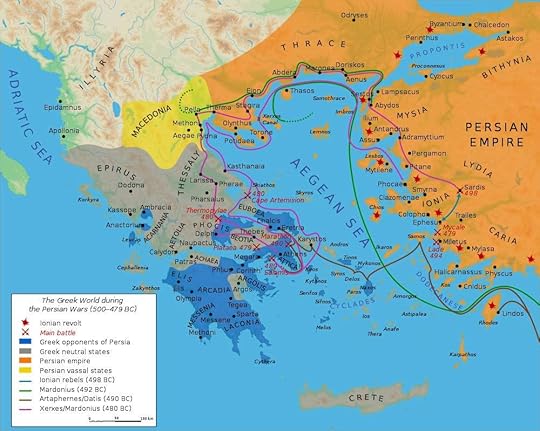
 Artemisia