The most influential work of architectural criticism and history of the twentieth century, now available in a handsomely designed new edition. Initially produced as the catalog to accompany a controversial and groundbreaking 1932 Museum of Modern Art show of the then new architecture emerging in Europe and America, The International Style quickly became the definitive statement of the principles underlying the work of such giants as Mies van der Rohe, Le Corbusier, Walter Gropius, and other pioneers. It might be said that Henry-Russell Hitchcock and Philip Johnson discovered as well as defined "the International Style," and over the decades their book has served as both a flashpoint for criticism and a frame for growth in the architectural profession. It has never been out of print in over sixty years.
This new edition has been completely redesigned and reset, and it features a new foreword by Philip Johnson, who reflects on the legacy of the International Style and examines the still-precarious power of architecture in our public life.
In 1931, MoMA, at the time only two years old, organised what was arguably the most important architectural exhibition since the Chicago world fair. Hitchcock and Philip Johnson (the latter didn't start his own practice until after the Seagram collaboration with Mies) invited what are now recognised as the biggest, most significant architects in the 20th century: Le Corbusier, Oud, Gropius, Mies van der Rohe, Hood, Newtra, and of course, Frank Lloyd Wright.
Wright's involvement with Modernism was vastly different to the rest of the International crew. For one thing, his organic style was in principle an opposition to the stark formalist aesthetic the rest of Europe and early American corporate culture strived for. Sometimes I wonder what Wright would have turned out like if he took up Daniel Burnham's offer to go to Paris's Beaux Arts, four years with paid accommodation. 'It's too late now, I'm afriad. Mr. Sullivan has spoiled me,' Wright replied. Perhaps that was another reason why Wright departed so much from his European modernist peers.
Let's talk about Mies van der Rohe, who was on the other side of the globe. He was one of the first to pioneer those extravagant skyscrapers we come to associate cityscape with, and went through a most dramatic change in style when compared to the rest of the Modernists.
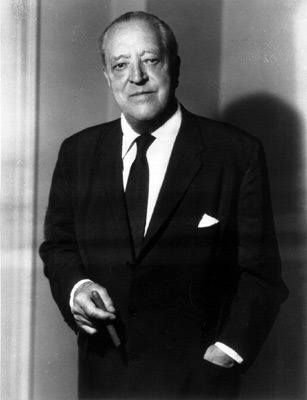
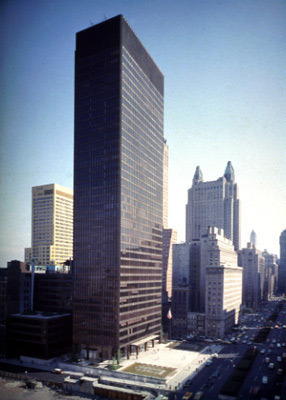
Isn't it fantastic how monochrome photography suited him? A little bit intimidating (he was tall, and built), authoritarian, well-dressed, black suit black tie - the prototype of modern architects. And everybody was oblivious to Mies's deep down insecurity. Born in a stonemason's home, Mies struggled with his professional credential, which was a combination of several internships and no formal education. He was talented, hard working, but still that did not predict his failure to enter Gropius's 1919 exhibition for the 'unknown' architect. Mies was rejected on the ground of 'lack of modernity', contributing to his later conscious make-over to be as Modern as possible. He grew experimental, joined the November Grounp, The avant-garde artist community. Then he went to America, disillusioned by the German nationalist mounumentality. After several Chicago projects, he received the Seagram commission by Phyllis Lambert.
Now, what does all of that have to do with the International Style?
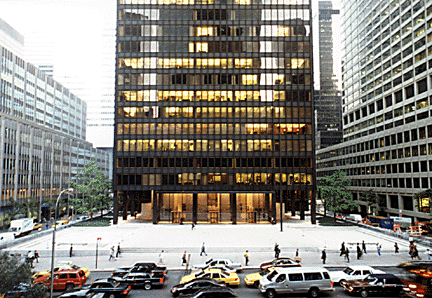
The history of the International Style is similar to Mies's life. At the start, both of them wanted something new, stylistic, grand, functionalist. The strict functionalists was even anti-aesthetic, it was a witch hunt of all things decorative and expressionist. But look at Seagram:
Mies never had the heart to severe all tie with classicism. There is his favourite 3-5 proportion, Hellenistic Bronze, and Le Corbusier's pilotis that have morphed with traditional Greek columns.
How ironic. I wonder what Wright thought about all of that.
And then there were other Wright followers:
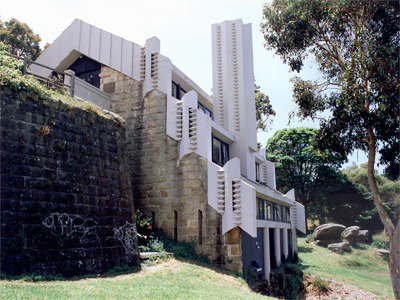
Marion and Walter Burley Griffin in Australia
Laurie Baker in India
[image error]
In a way, International Style was a failure because it could not, and did not survive. Even Seagram went over its budget, not to mention the rest of the Modernist's ignorance of energy efficiency or environmental sustainability. There is a strong sense of nostalgia in Hitchcock's plates, it was the absolute conviction of newness, of something that would be monumental without trying. While the academic Modernists were plotting, Wirght's organic, vernacular approach has seeped into every contemporary practice.
The International Style has often been criticised for being heartless. And yes it did start that way, much like how we view YBA and shock art today. It was another translation of commercial new for new's sake, a movement that attempted but failed to eliminate all context and individuality. Mies is a great example of this - even he betrayed his peers by consciously adding all the deco elements, and associating himself with de Stilj aesthetics.
Was it worth it? Modernism has spent several decades on a style that was never resolved and unsustainable, yet to this day we still look at the International Style as the sole truly 'architectural style'. It was the first to delineate from other fine art movements, it made an effort to be unique by making an universal box that is applicable to all. How Mies and the rest of his crew thought it was possible I would never know. And it is still tenaciously holding on.
It is a dying breed, forever immotalised in history text-books. But at least it made a name, and gave architecture a sense of dignity that it still holds.
Well, that is 261 pages of reading that I will never get back. I read this after a mention by Peter Gay in Modernism. It could have been said better and in a more concise manner. It describes the style, history, and purveyors and challenges the established model (the last, a major theme for inclusion in modernism). Perhaps the best writing in the book comes from Mr. Hitchcock in the Appendix. It is an article from him published in the August 1951 Architectural Record. He reflects on the book given the two decades that have passed and reads the way the entire book should have. I have saved my biggest complaint for last. Pages 107-238 are photographs of buildings and plans. I am using a 1995 paperback copy. I have not located a copy of the original edition, but I hope they did a better job than this. The plans are unreadable, the photos are marginal, and one must flip back and forth from the reading to the example. It is like the result of copying copies five or six times. In addition, some captions refer to color! If you have an abiding interest in architecture or modernism, have at it. Otherwise, run away.
This is considered an essential and groundbreaking book in architectural history. It details the rise of the international style and modernist architecture and accompanies the exhibit at MOMA around the same time.
The book is fairly short but goes some insight and analysis into modernist architecture just as it was becoming more mainstream. There are many photos, some from lesser known architects, but overall not the highest quality photos.
This is a good and short read for anyone interested in the history and origins of modernist architecture as written by critics of the era.
Very interesting book written in the 1930s which allows insight into the criticisms and beliefs of popular architecture at the time. Provides sound advice and predictions for the subject. Pictures and diagrams are useful / interesting too. Worth reading the 1950s follow up article for the authors perspectives on how architecture changed over the next 50 years
A must read, obviously, for those interested in the dissemination of European modern architecture within the US. There's little need to repeat the oft-observed aspect that Johnson and Hitchcock's book and MoMA exhibit essentially purged out all of the social determinants that many of these projects responded to (or at least those that their architects spoke/wrote about), so grab the book and spend a lovely afternoon at an airport or DMV waiting line near you.