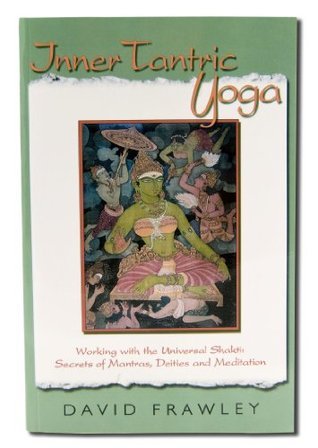
Inner Tantric Yoga presents the deeper tradition of Tantra, its multidimensional vision of the Divine and its transformative practices of mantra and meditation that take us far beyond the outer models of how Tantra is usually presented today. The book can expand your horizons about masculine and feminine energies, Self and world, universe and the Absolute into a living experience of the Infinite and Eternal both within and around you.
David Frawley (or Vāmadeva Śāstrī वामदेव शास्त्री), b. 1950, is an American Hindu teacher (acharya) and author, who has written more than thirty books on topics such as the Vedas, Hinduism, Yoga, Ayurveda and Vedic astrology, published both in India and in the United States. He is the founder and director of the American Institute of Vedic Studies in Santa Fe, New Mexico, which offers educational information on Yoga philosophy, Ayurveda, and Vedic astrology. He works closely with the magazine Hinduism Today, where he is a frequent contributor.[1] He is associated with a number of Vedic organizations in several countries. He is a Vedic teacher (Vedacharya), Vaidya (Ayurvedic doctor), and a Jyotishi (Vedic astrologer).
For anyone from the west interested in Tantra Yoga, this is a book to read. Frawley lays out the primary key "stones" of Tantra which is a never ending series, it seems, of anthropomorphic representations in Hinduism and Buddhism for basic and higher principles of man re-expressed in human expressions that are adorned, adapted, transformed, and wickedly so at times almost completely alienating the idea of their human form to a achive something higher and divine that is physically now expressing that higher conscious knowleldge. Frawley writes better than most does full spread on the important stuff I think, and he did it all while still meditating and studying whereever in the east. His instructions on Deity Meditation for instance have such a bold assertiveness to them, at least in my mind, one begins to appreciate the fact that this means of projecting higher principles of human thought and behavior into human form using creative license, and in incorporating those principles in the physical world of expression doesn't reveal the real power and beauty of the east but only the west's reductionistic method for handling information from outside our culture.
As a practitioner, Frawley knows nondual yoga philosophy, theory, and application. This is a comprehensive examination of Shiva/Shakti worship. I found logical inconsistencies inherent in the doctrine, but this book nonetheless details the tenets clearly.
*Except for a significant point*: Tantra isn't the sole possession of nondual theory. Tantra is a coherent spiritual system regardless of sectarian differences such as dualism vs nondualism. Dualistic systems have elaborate tantric texts.
Tantra requires (1) proper initiation into the path; (2) ritual worship; (3) higher and lower goals (spiritual and material); and (4) is given in divinely revealed texts.
As with most modern-day tantric proponents, Frawley asserts Tantra is a nondual path. Surprisingly, given Frawley's exposure to Eastern thought, this is inaccurate.
Expect a philosophical read. Those unfamiliar with Eastern thought may have difficulty navigating the nuances. As we might expect, the philosophy is complex. Well done.
It's a good exploration of the inner aspects of Tantra but also a bit redundant and inspecific. I think it would be best read in conjunction with other texts on Tantra that explore the philosophy more in depth. It would have been nice to have examples of Tantric use of yantra in meditation in addition to the focus on mantra. The focus on mantra, however, is appreciated and well executed. Frawley points out the ways to use the mantras and address possible pitfalls with doing so.
You can revel in the lush mythopoeic thought and imagery. You might find it interesting and exciting. In complete contradiction with modern physics and neurosciences so probably wise not to take all of the extremely imaginative and speculative ontological reifications too seriously. You might find the meditation advice useful - after carefully extracting the nonsense. There is a lot of detail. Some of it might be good. But for me just a gush of words of no particular value or meaning. But maybe that’s just me wallowing in my own ineptitude. Who knows.
Still the best book on the topic, because it gives the traditional considerations and also allows a Western audience, however poorly advised, to enter directly into practice without any new age obscuration.
The material is superbly organised and it would make an excellent workbook for a half semester.
Compared to the other books on the subject, it actually delivers and neither compromises for Hindu religion nor new age watering down.
This scholar/practitioner text was pretty dry and difficult to get through. I could only read a few pages at a time before putting it down. It may be more interesting to someone who wants a intellectual understanding of the yoga and doesn’t have Bhakti or devotion. There was some glimmer of hope near its end when Shiva and Shakti came into the picture but it was short lived