Knowledge Treasures of the Northwest Coast looks into seventeen of the numerous sites in the Pacific Northwest region with major collections of Northwest Coast Indigenous material culture, bringing attention to a wide range of approaches to caring for and exhibiting such treasures. Each chapter is written by one or more people who work or worked in the organization they write about. Each chapter takes a different approach to the invitation to reflect upon their some narrate a history of the institution, some focus on particular pieces in the collection, and some consider the significance of the work currently being done for the present and future. They do more than fill in the gaps and background of an already existing discussion. They show that these are places and moments in a much longer story, still ongoing, with many characters—individuals, institutions, communities, artworks, treasures—on different, although often parallel or intersecting, journeys.
A good book should leave something behind in your mind, little nuggets of treasure—a thought to ponder, a quote to repeat, an ending that will not end, a scene you see again and again, a relationship that deepens, a new insight to see with, an image that says so much. The book Knowledge Within leaves you with a selection of these gems. Knowledge Within: Treasures of the Northwest Coast It is an unusual book. The overarching concept is a book whose chapters each represent a museum or art gallery whose holdings include indigenous ‘works of art’. Each chapter is written by someone very familiar with the organization—a current or past staff member. While the concept of Northwest Coast First Nations material ties each chapter together, each chapter is unique and presents different offerings: a history of an institution, collection or of a people; the philosophical basis the organization is built on; an overview of important holdings or exhibits; or, an intention—to make things right.
An image that brilliantly reflects a central motif of the book, and an image I keep seeing in my mind, is Marianne Nicolson's exhibit Wanx'id: to hide, to be hidden', a series of eight dark glass boxes that resemble bentwood boxes, an installation discussed in the chapter on Museum of Anthropology at UBC. The outside of the boxes are smooth plain black glass with the inside walls being etched with designs typically seen carved on the outside of wood boxes. The floor of the boxes each containing a ghostly image transparency which requires a light beneath to illuminate the photo. It is not until the viewer makes an effort to peer over the edge and down into the box that the image is revealed and a lot more effort to think about what these boxes are trying to tell us.
Anthony Alan Shelton, former Director of the MOA and one of the curators of this book, when discussing Nicholson’s boxes, wrote “Each of these works helps us rethink the museum; they challenge us to amplify the sensual codes required to understand the original meanings of the things it holds…. and they entreat us to acknowledge the parameters, rights, and limitations to expressing different types of knowledge.”
Bentwood boxes were used on the coast to store food, clothing, utensils. Intricately carved ones, boxes of treasures, were for potlatch valuables—masks and regalia, only brought out to be used in dances. Drawing on the box of treasures metaphor, Franz Boas, ‘The Father of American Anthropology’, imagined his 1896 book (heavily contributed to by George Hunt), The Social Organization and the Secret Societies of the Kwakiutl Indians, as a storage box for “laws and stories”. The late Ira Jacknis in his book The Storage Box of Tradition: Kwakiutl Art, likened museums to storage boxes of tradition. Nicolson's bent glass boxes Wanx'id impels us to rethink museums, what they store, how it is cared for and who is presenting it. Each chapter in this book, talks about how a particular museum does that.
I mention Boas, as he is also the father of one of the earliest museum displays of Northwest Coast objects. The Smithsonian’s American Museum of Natural History’s Hall of Northwest Coast Indians opened in 1899 and never changed for over 120 years. That is until recently, when ten co-curators from ten Pacific Northwest First Nations came together and redesigned it. Haa’yuup, Ron Hamilton, was one of those curators and wrote the foreword of this book, which hopefully opens the minds of the reader to realities we need to acknowledge and address. He speaks of our ‘uncomfortable history of racism’, museums as having been repositories of colonial treasure of which many only saw the superficial object and not the deeper cultural knowledge and beliefs that created it.
Haa’yuup’s experience with many museums and the examples in this book shows us the possibilities of how these treasures can be respectfully cared for and shared.
Sharon Fortney, in her chapter on the Museum of Vancouver takes us on a fascinating journey looking for baskets made by her grandmother. One learns how objects reflect their maker through choices made in the process of creating—the type of root used, how the root is split, motifs used, style, and many other personal choices. Careful looking at an object like a basket, allows the ancestor to speak and “we see the genealogies of unknown basket makers written in the commonalities of their handiwork and that of their descendants.”
Traditional museums classifications can obscure information relating to memories, meanings and communities. Fortney explains that museums can be a two-sided coin: how we see ourselves vs. how others perceive us. “Until recently, museums were skewed towards the outside gaze… We have moved away from ‘experts’ telling stories about others, to people telling stories about themselves, enabling re-connections with traditional knowledge.”
Some of the institutions that stood out for me were those that had a philosophical underpinning, like the Sea Alaska Heritage Institute whose core value Haa shuká which is honouring ancestors and future generations. The Haida Gwaii Museum created with the intention of making things right. The Stó:lō Resource Centre who built a ‘house of respect’ that houses experiences, ancestors, languages and more.
These cultural foundations were guided by elders and their communities who oversaw the types of space that was created such as a traditional clan house to house exhibits, and the functions held within, not just exhibition space, but space for ceremonies with a fire pit, archives, a respectful place to house ancestral remains, language and learning rooms.
Some ‘museums’ go even further and place great importance on future generations, like the Squamish Lil’wat Cultural Centre with their training of cultural ambassadors to show visitors around, pairing elders with youth to transfer knowledge such as collecting, preparing, spinning fibres and weaving blankets, and teaching a business program through the lens of a museum.
Running throughout are stories: the story of the banned Potlatch (U’mista); Billy Assu’s house posts (Nuyumbalees Cultural Centre); the stories, territories, families totem poles represent; how YVR became the largest collection of NWC art; and the story of Bill Reid (Bill Reid Gallery) and origin stories.
Underlying a lot of the book are discussions of respect, cultural context, the importance of relationships between cultures but also our relationship with nature, and how that can be evidenced in a culture and in an institution.
An insight I am left with after reading this so aptly named book, is that the word museum or art gallery when conceived, built, governed and operated by First Nations, no longer works to convey what that institution does. They are more like boxes of treasures or houses of knowledge.
Together, all these chapters offering various perspectives, reflect a complexity that requires the reader to think deeply about the issues we face when on a reconciliation journey to understand different cultures. Indigenous cultures cannot be simply translated to western cultures using western/colonial ideas. There are layers upon layers that make a culture and we can only open our minds and learn to learn. It is not simple, especially in B.C. where there is not one nation. There are many nations, in many territories and many cultures. Many of the museums in this book are reflecting their territory, their people, their stories. Each chapter provides many ways to think about culture to help us on our journeys.
As Haa’yuups foretells, there is much of value to discover within this book of treasures.




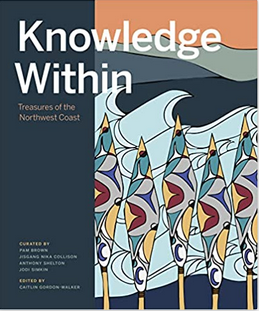 Knowledge Within: Treasures of the Northwest Coast