

What do you think?

Aubrey & Maturin #19
The Hundred Days
Patrick O'Brian's Aubrey-Maturin tales are widely acknowledged to be the greatest series of historical novels ever written. To commemorate the 40th anniversary of their beginning, with Master and Commander, these evocative stories are being re-issued in paperback with smart new livery. This is the nineteenth book in the series. Following the extraordinary success of The Yellow Admiral, this latest Aubrey-Maturin novel brings alive the sights and sounds of North Africa as well as the great naval battles in the days immediately following Napoleon's escape from Elba. Aubrey and Maturin are in the thick of the plots and counterplots to prevent his regaining power. Coloured by conspiracies in the Adriatic, in the Berber and Arab lands of the southern shores of the Mediterranean, by night actions, fierce pursuits, slave-trading and lion hunts, The Hundred Days is a masterpiece. 'O'Brian is far and away the best of the Napoleonic storytellers and The Hundred Days is one of the best of the series: a classic naval adventure, crammed with incident, superbly plotted and utterly gripping!This is O'Brian at his brilliant, entertaining best and when he is on this form the rest of us who write of the Napoleonic conflict might as well give up and try a new career. Fans of the series will need no encouragement to buy this book, but if you are new to Aubrey and Maturin then this is as splendid an introduction as you could wish for.' Bernard Cornwell
281 pages, Paperback
First published January 1, 1998
About the author
Patrick O'Brian
162 books2,515 followersPatrick O'Brian was an English novelist and translator whose reputation rests above all on the Aubrey-Maturin novels, a twenty-volume sequence set during the Napoleonic Wars. The books follow Captain Jack Aubrey of the Royal Navy and Stephen Maturin, his friend and ship's surgeon, whose Irish-Catalan background and scientific interests complement Aubrey's practical naval outlook. Beginning with Master and Commander, the series combines historical events with fictional adventures, preserving the outcome of real history while placing its protagonists within the action. O'Brian's command of period language, naval terminology, medical detail, and maritime practice gives the novels a convincing sense of nineteenth-century life, while their humor and the evolving relationship between Aubrey and Maturin provide their emotional center. The series became a long-form narrative in which professional duties and private lives develop continuously across successive voyages. O'Brian's literary career began remarkably early. Writing as Richard Patrick Russ, he published his first novel, Caesar: The Life Story of a Panda-Leopard, as a teenager, followed by animal stories collected in Beasts Royal. His novel Hussein: An Entertainment appeared in 1938 and received critical attention. After the Second World War, he adopted the name Patrick O'Brian and continued publishing fiction, including The Last Pool, Testimonies, and The Catalans. His early naval novels for younger readers, The Golden Ocean and The Unknown Shore, already contained elements that anticipated Aubrey and Maturin. He also became a translator from French, producing more than thirty English translations, including works by Simone de Beauvoir, Henri Charriere, and Jean Lacouture. His nonfiction included biographies of the naturalist Joseph Banks and the painter Pablo Picasso, whom he knew in Collioure, France. O'Brian lived in Wales after the war before moving with his wife Mary to Collioure in 1949. Their collaboration was important to his working life, with Mary assisting him in research and preparing his handwritten manuscripts for publication. O'Brian wrote by hand throughout his career and resisted modern writing technology. His literary breakthrough came unusually late. Although the Aubrey-Maturin books had a modest British following after their first appearance, their American revival in the early 1990s, led by W. W. Norton, brought sales and recognition. The novels eventually sold millions of copies and attracted devoted readers well beyond the age group normally associated with historical adventure fiction. O'Brian received the inaugural Heywood Hill Literary Prize in 1995, an honorary doctorate from Trinity College Dublin, and a CBE in 1997. His reputation was complicated when British media revealed details of his early identity and first marriage, matters he had kept private. Despite the controversy, his fiction remained central to his legacy. His unfinished twenty-first Aubrey-Maturin novel was published posthumously, preserving both handwritten pages and typescript. His manuscripts, notes, and research materials have since become part of major literary collections. His influence is also reflected in the continued readership of the novels and the 2003 film Master and Commander: The Far Side of the World, which drew primarily from The Far Side of the World while incorporating material from elsewhere in the series.
Ratings & Reviews
Friends & Following
Create a free account to discover what your friends think of this book!
Community Reviews
Displaying 1 - 30 of 322 reviews

May 4, 2017
"Patriotism, promotion, and prize-money have been described as the three masts of the Royal Navy."
- Patrick O'Brian, The Hundred Days

One more full novel to go in this series and two surprising deaths. This, the 19th novel was published in 1998, 29 years after the first book in the series (Master and Commander) came out (1969). This novel takes place largely in the Eastern Mediterranean, Gibraltar, and the Levant. There were many things about it to love and while this wasn't the best in the series, O'Brian still manages to reinvigorate the novel (which takes place during les Cent-Jours (hundred days) after Napoleon escapes imprisonment on the Isle of Elba; hence the title).
Things are wrapping up with the series (but you wouldn't know it from the writing). Some of the things from this book I loved: naval superstitions (involving narwhal tusks, hands of glory, etc.), Mediterranean piracy, Gibraltar, details regarding the splitting of prize money, nuances of the Ottoman Empire (specifically the Deys of Algiers), discussion of the Battle of Waterloo, etc. O'Brian constantly brings back common items like music, science, education of young midshipmen, order and discipline, wives, etc., but each book is spiced with some new tidbit or eddy that he folds into the plot with skill and precision. When Captain Aubrey and Dr. Maturin discuss prize money, it is relevant to the plot, but also interesting and detailed. It just WORKS.
- Patrick O'Brian, The Hundred Days
One more full novel to go in this series and two surprising deaths. This, the 19th novel was published in 1998, 29 years after the first book in the series (Master and Commander) came out (1969). This novel takes place largely in the Eastern Mediterranean, Gibraltar, and the Levant. There were many things about it to love and while this wasn't the best in the series, O'Brian still manages to reinvigorate the novel (which takes place during les Cent-Jours (hundred days) after Napoleon escapes imprisonment on the Isle of Elba; hence the title).
Things are wrapping up with the series (but you wouldn't know it from the writing). Some of the things from this book I loved: naval superstitions (involving narwhal tusks, hands of glory, etc.), Mediterranean piracy, Gibraltar, details regarding the splitting of prize money, nuances of the Ottoman Empire (specifically the Deys of Algiers), discussion of the Battle of Waterloo, etc. O'Brian constantly brings back common items like music, science, education of young midshipmen, order and discipline, wives, etc., but each book is spiced with some new tidbit or eddy that he folds into the plot with skill and precision. When Captain Aubrey and Dr. Maturin discuss prize money, it is relevant to the plot, but also interesting and detailed. It just WORKS.

April 7, 2014
4 1/2
Said Kent (a Whitehall gentleman), “You will recall that Buonaparte professed himself a Muslim at the time of the Egyptian campaign?”
This from the penultimate (#19 of 20) novel in O’Brian’s Aubrey-Maturin series of Napoleonic-era sailing/adventure novels. (For an overview and introduction to this series, see my review of Master and Commander.)

At the end of the previous novel (The Yellow Admiral) Aubrey receives a letter, dated Feb 28 [1815] - Napoleon has escaped from Elba. The reviewed novel begins, “The sudden rearmament that followed Napoleon’s escape from Elba had done little to thin the ranks of unemployed sea-officers by the early spring of 1815.“
Yes, the title of the book refers to the (later so-called) Hundred Days of Napoleon’s return to, and subsequent fall from, power in 1815.
Before continuing, but only after a disclaimer … DISCLAIMER … let’s indulge in an
Historical digression – a timeline of certain European events, 1812 – 1815.
What about that outrageous quote at the top of the mast?
Napoleon a Muslim? Surely not. Is this something entirely made up by the author? Well, it would be quite like Tolstoy having made up and written, re Borodino, “ … when the whole plain was covered in smoke, on the French side the two divisions of Desaix and Compans advanced on the right upon the fleches … The fleches were a verst from the Shevardino redoubt, where Napoleon, attired in women’s clothing, was standing, …”
Yes, one can make up stuff in historical fiction, but to make up something outrageous and pass it off without a hint of humor or sarcasm? No. A thousand (or at least a dozen) times no.
It turns out that in Egypt, Napoleon did engage in certain activities and did make certain statements that over the years attained an overblown reputation. Google “Muslim support for Napoleon” (or some such) and see what comes up. One site I found (https://chnm.gmu.edu/revolution/d/612/) shows a quote from Napoleon’s personal secretary, from Napoleon’s memoirs, which the site summarizes thus:
… just one more …
In this novel, Jack Aubrey once again becomes captain of HMS Surprise. This non-fictional ship, a vagabond character in the series, wends its way in and out of Jack Aubrey’s sailings on the high seas.
The Surprise was actually a ship built by the French builder Jean Fouache in Le Havre, named Unité and launched on January 16 1794. It was captured by the Royal Navy in April 1796, renamed the Surprise, and classified as a 28-gun sixth-rate frigate. The ship was sold out of the Royal Navy in 1802 and broken up. (See https://en.wikipedia.org/wiki/HMS_Sur...)
BUT … she was restored to her glory days, made even somewhat more glorious, 175 years later, when O’Brian chose to give her to Jack Aubrey, first in HMS Surpise (3rd in the Aubrey-Maturin series), and then with increasing inventiveness, in The Ionian Mission (8th), The Far Side of the World (10th), Clarissa Oakes (The Truelove in the U.S.) (15th), this novel, and Blue at the Mizzen (20th and last). To fans of the series, and to Jack Aubrey even more, Surprise remains the ship that lives on in memory.
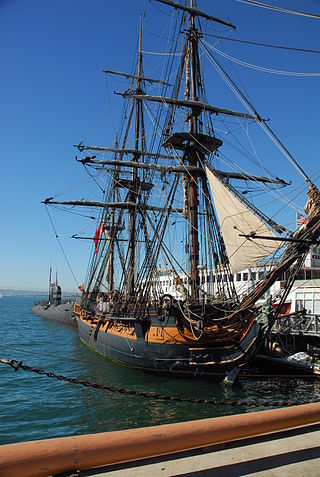
A replica of HMS Surprise at the San Diego Maritime Museum, based on HMS Rose and used in the Master and Commander film.
and back to
Napoleon the Muslim
Well, NOT! But what O’Brian writes is that Muslim potentates in North Africa are aflame with admiration for the deposed emperor, and, British intelligence reports, about to transport an immense fortune in gold across the Med, to be used in somehow delaying the assembly of the Seventh Coalition armies, thus buying time for Buonaparte.
This provides the background for Maturin’s mission in the book, which is to seek audiences with the Muslim leaders (engaged in simultaneous power struggles among themselves) and to thwart this shipment …
back to the review …
… while Jack Aubrey pursues, first, an assignment to provide escort for a fleet of Indiamen sailing up the NW coast of Africa, and then to begin actions in the Med. to assure that ship-builders in Italy do not provide craft to help reconstitute the French Navy.
Here’s a couple quotes from early in the book. First, as Aubrey’s ships sail from Gibraltar, and down the coast of Morocco, searching for the Indiamen. This illustrates O’Brian’s easy, pleasing narrative style.
Never mind such mundane happenings as numerous bird sightings, a Gibraltar court martial for sodomy, the rescue of a Muslim Dey from a lioness with a well-placed shot, a discussion of the possible reasons for impotency in men, Stephen Maturin’s purchase of two young Irish children in an Algerian slave market, discussions of diseases, medicines, mathematics, wildlife ... all described with O’Brian’s perfectly paced styling, and bristling every now and then with a challenging word or two.
and forward to the future
I plan to read the last of the series in 2016. Perhaps a review, if warranted. I would like to re-read the entire series over the next few years. If I do, I may write brief reviews for some of the best novels. But don’t worry that there will be twenty forthcoming long, boring reviews of slight historical novels. They aren’t slight.
. . . . . . . . . . . . . . . . . . . .
Previous review: Almost No Memory Lydia Davis, some "short fiction"
Next review: Anarchism a VSI
Older review: As You Like It
Previous library review: The Wine-Dark Sea
Next library review: Blue at the Mizzen
Said Kent (a Whitehall gentleman), “You will recall that Buonaparte professed himself a Muslim at the time of the Egyptian campaign?”
This from the penultimate (#19 of 20) novel in O’Brian’s Aubrey-Maturin series of Napoleonic-era sailing/adventure novels. (For an overview and introduction to this series, see my review of Master and Commander.)
At the end of the previous novel (The Yellow Admiral) Aubrey receives a letter, dated Feb 28 [1815] - Napoleon has escaped from Elba. The reviewed novel begins, “The sudden rearmament that followed Napoleon’s escape from Elba had done little to thin the ranks of unemployed sea-officers by the early spring of 1815.“
Yes, the title of the book refers to the (later so-called) Hundred Days of Napoleon’s return to, and subsequent fall from, power in 1815.
Before continuing, but only after a disclaimer … DISCLAIMER … let’s indulge in an
Historical digression – a timeline of certain European events, 1812 – 1815.
Very well, … but now, again before proceeding …
1812 – The tide of war in Europe begins to turn against Napoleon when his disastrous invasion of Russia results in the loss of a major portion of his army.
October 1813 – In the War of the Sixth Coalition, Coalition forces from Russia, Prussia, the Austrian Empire, and Sweden defeat Napoleon in the battle of Leipzig. The Coalition (including Britain, Spain, Portugal, Saxony, Bavaria and the Netherlands) vow to pursue Napoleon to Paris and depose him.
Late February 1814 – Prussian Field Marshall Blucher advances on Paris.
March 1814 – The battles of Laon and Reims are fought early in the month; followed by the battle of Montmartre, fought in the Paris suburbs on the 30th. On 31 March the French surrender.
6 April 1814 – Napoleon abdicates. This leads to the ascension of Louis XVIII to the throne of France, governing under a Constitutional Monarchy (the Bourbon Restoration).
11 April 1814 – Napoleon is banished to the island of Elba, off the coast of Tuscany, and is granted sovereignty over its 12,000 inhabitants.
Early May 1814 - Napoleon arrives on Elba.
September 1814 – The Congress of Vienna, one of the signal (and controversial) events of 19th century Europe, convenes. The countries of Europe attempt to form a balance of power that will lead to peace on the continent, following the Napoleonic Wars and the French Revolution. Aspects of the Congress were used in the next century when first the League of Nations, and later the United Nations, were formed.
26 February 1815 - As the Congress of Vienna drags into its sixth month, Napoleon seizes an opportunity and escapes from Elba.
1 March 1815 - Napoleon lands in France at Golfe-Juan.
March 1815 - As he makes his way to Paris, thousands of French veterans, and nominally Royalist troops, flock to his growing army.
13 March 1815 – The Congress of Vienna declares Napoleon an outlaw.
19-20 March 1815 - Napoleon arrives in Paris and assumes the Emperorship. The Hundred Days has begun.
25 March 1815 - Austria, Prussia, Russia and the United Kingdom, members of the Seventh Coalition, pledge themselves to put 150,000 men each into the field to end Napoleon’s rule.
15-16 June 1815 – Napoleon begins the “Waterloo campaign” (later so-called), attempting to defeat the armies of the Seventh Coalition in detail. The battles of Ligny (defeating Blucher’s Prussian army) and Quatre-Bras (stalemating Wellington’s British army) are fought.
18 June 1815 - The Battle of Waterloo, one of the most famous and significant in the history of Europe, is fought. Napoleon is defeated by Wellington’s British army, with help from a late charge by Prussian cavalry which sweep the French from the field. Napoleon returns to Paris.
8 July 1815. Prussian troops enter Paris. Louis XVIII is restored to the throne (again!). The Hundred Days (actually 111 days) ends, as does Napoleon’s influence on the course of European history.
15 July 1815 – Napoleon, on the lam and neither able to remain in France or escape from it, surrenders to Captain Frederick Maitland of HMS Bellerophon and is transported to England.
24 July 1815 – Napoleon is not allowed to land on British soil; instead he is placed on a third-rate ship of the line, HMS Northumberland, and transported to the remote island of St. Helena in the South Atlantic.
six years later, 5 May 1821 – Never having left St. Helena, Napoleon dies. Talleyrand says of his death, “It was not an event, only a news item.”
What about that outrageous quote at the top of the mast?
Napoleon a Muslim? Surely not. Is this something entirely made up by the author? Well, it would be quite like Tolstoy having made up and written, re Borodino, “ … when the whole plain was covered in smoke, on the French side the two divisions of Desaix and Compans advanced on the right upon the fleches … The fleches were a verst from the Shevardino redoubt, where Napoleon, attired in women’s clothing, was standing, …”
Yes, one can make up stuff in historical fiction, but to make up something outrageous and pass it off without a hint of humor or sarcasm? No. A thousand (or at least a dozen) times no.
It turns out that in Egypt, Napoleon did engage in certain activities and did make certain statements that over the years attained an overblown reputation. Google “Muslim support for Napoleon” (or some such) and see what comes up. One site I found (https://chnm.gmu.edu/revolution/d/612/) shows a quote from Napoleon’s personal secretary, from Napoleon’s memoirs, which the site summarizes thus:
Bonaparte’s secretary describes the religious practices, attitudes, and views of Bonaparte with regard to Islam. Accepting that the general curried favor with Muslims, he also hoped to deflect criticism of Bonaparte, claiming that what he did was good governance rather than bad Christianity, as his critics maintained.Now, before developing this further, just one more historical note.
… just one more …
In this novel, Jack Aubrey once again becomes captain of HMS Surprise. This non-fictional ship, a vagabond character in the series, wends its way in and out of Jack Aubrey’s sailings on the high seas.
The Surprise was actually a ship built by the French builder Jean Fouache in Le Havre, named Unité and launched on January 16 1794. It was captured by the Royal Navy in April 1796, renamed the Surprise, and classified as a 28-gun sixth-rate frigate. The ship was sold out of the Royal Navy in 1802 and broken up. (See https://en.wikipedia.org/wiki/HMS_Sur...)
BUT … she was restored to her glory days, made even somewhat more glorious, 175 years later, when O’Brian chose to give her to Jack Aubrey, first in HMS Surpise (3rd in the Aubrey-Maturin series), and then with increasing inventiveness, in The Ionian Mission (8th), The Far Side of the World (10th), Clarissa Oakes (The Truelove in the U.S.) (15th), this novel, and Blue at the Mizzen (20th and last). To fans of the series, and to Jack Aubrey even more, Surprise remains the ship that lives on in memory.
A replica of HMS Surprise at the San Diego Maritime Museum, based on HMS Rose and used in the Master and Commander film.
and back to
Napoleon the Muslim
Well, NOT! But what O’Brian writes is that Muslim potentates in North Africa are aflame with admiration for the deposed emperor, and, British intelligence reports, about to transport an immense fortune in gold across the Med, to be used in somehow delaying the assembly of the Seventh Coalition armies, thus buying time for Buonaparte.
This provides the background for Maturin’s mission in the book, which is to seek audiences with the Muslim leaders (engaged in simultaneous power struggles among themselves) and to thwart this shipment …
back to the review …
… while Jack Aubrey pursues, first, an assignment to provide escort for a fleet of Indiamen sailing up the NW coast of Africa, and then to begin actions in the Med. to assure that ship-builders in Italy do not provide craft to help reconstitute the French Navy.
Here’s a couple quotes from early in the book. First, as Aubrey’s ships sail from Gibraltar, and down the coast of Morocco, searching for the Indiamen. This illustrates O’Brian’s easy, pleasing narrative style.
They had scarcely cleared the Straits, leaving the glow of Tangier on the larboard quarter, before the rain stopped and the wind lessened, though it was still capable of a powerful gust from the same direction. ‘Mr Woodbine’, said Jack to the master, ‘I believe we may send up the topgallantmast and spread a little more canvas.’And then, a few hours later, having found the Indiamen under attack by a fleet of Moorish xebecs and galleys in a bay, barely holding their own with their lone escort, a sixteen gun brig-sloop …
This, with the help of a clearing sky over the main ocean, the light of a splendid moon and a more regular sea, was soon done; and the squadron, well in hand, at the proper cable’s length apart, ran down the Moroccan coast under courses and full topsails with an easier following sea and the wind on their larboard quarter …
This was pure sailing, with a fine regular heave and lift, an urgency of the water along the side, the sea-harping in the taut sheets and windward shrouds, the moon and stars making their even journey across the clearer sky from bow to quarter, pause and back again.
Jack made the signal for independent engagement, and launched the Surprise at what seemed to be the commanding xebec, the corsair’s leader: the Moors had no distinct line of battle, but this one wore some red and tawny pennants.But enough. No further quotes, no plot outlines.
… When each was five points on the other’s bow, Jack called, ‘On the downward roll: fire from forward as they bear.’
Some desultory musket fire, two or three well-directed round-shot from the xebec; the tingling sound of a gun hit full on the barrel; and immediately after the height of the wave Surprise fired a long rippling broadside from forty yards. The wind blew the smoke back, and when it cleared they saw a most shocking wreckage, half the xebec’s ports beaten in and her rudder shot away …
He took the Surprise right under the xebec’s stern. The frigate stayed beautifully and ran up the enemy’s side. The next slower, even more deliberate broadside shattered the Moor entirely. Xebecs were fine nimble fast-sailing craft, but they were not strongly built and she began to settle at once, her people crowding the deck and flinging everything that would float over the side.
… The bay resounded with the bellowing of guns. But already the issue was decided, the arrival of six brisk men-of-war made it absurd to stay. Those xebecs that could, spread their huge lateens on either side, in hare’s ears, and raced away at close on fifteen knots southward home to Sallee … while the uninjured galleys pulled straight into the wind’s eye, where no sailing ship could follow them.
Never mind such mundane happenings as numerous bird sightings, a Gibraltar court martial for sodomy, the rescue of a Muslim Dey from a lioness with a well-placed shot, a discussion of the possible reasons for impotency in men, Stephen Maturin’s purchase of two young Irish children in an Algerian slave market, discussions of diseases, medicines, mathematics, wildlife ... all described with O’Brian’s perfectly paced styling, and bristling every now and then with a challenging word or two.
and forward to the future
I plan to read the last of the series in 2016. Perhaps a review, if warranted. I would like to re-read the entire series over the next few years. If I do, I may write brief reviews for some of the best novels. But don’t worry that there will be twenty forthcoming long, boring reviews of slight historical novels. They aren’t slight.
. . . . . . . . . . . . . . . . . . . .
Previous review: Almost No Memory Lydia Davis, some "short fiction"
Next review: Anarchism a VSI
Older review: As You Like It
Previous library review: The Wine-Dark Sea
Next library review: Blue at the Mizzen

December 23, 2011
For the second time (I think) in the series, O'Brian has written an ordinarily entertaining novel rather than something that achieved a bit more. There are minor lapses here and there. Those who cavil at the leaps in plot and the lingering on what sometimes seem like insignificant details haven't been paying enough attention; O'Brian has done this from the beginning. In the past, the swift refocusing of the narrative on surprising events (or the glossing over of major ones--here, the death of a major character, in a clause, no less) always seemed to serve a larger narrative purpose, illustrating characters through contrast primarily. There is a bit of that here, but not nearly to the extent that the practice had governed the other novels. As ever, it is a cracking good yarn, with the expected mixture of naval suspense, botanizing (here, a lion hunt in the Atlas mountains), and music. But it does seem as if some of the wind has gone out of the sails here, the story merely existing to tell the story and not illustrate some larger sense of who these two main characters and their ever-changing constellation of hangers-on are (and thereby to say something about the human condition generally--for ultimately, that has been O'Brian's aim throughout). Like other readers, I was not fully convinced that Maturin sank his mourning for Diana so completely in pursuing his intelligence aims against Bonaparte. O'Brian, it seems, missed a trick by not having a single-minded Stephen overshoot the mark in his despair and sorrow. Instead, it feels little too much like business as usual. Again, a lesser O'Brian novel is still miles better than a lot of stuff out there and this delivers the basic goods even if it doesn't provide the richer treasures this series so often has brought.

May 16, 2019
The 19th and, unfortunately, the final book in O'Brien's Jack Aubrey and Stephen Maturin series. This one takes place during the Hundred Days of Napoleon's return to power ending at Waterloo. Not one of the better ones, it does involve an intriguing story of Commodore Aubrey seeking to intercept a
shipment of gold being sent to Napoleon from North Africa. Nobody writes about the sea and sailing ships like O'Brien, who passed away in 2000.
Correction: I understand there's a 20th book, so there's more Aubrey...good!
shipment of gold being sent to Napoleon from North Africa. Nobody writes about the sea and sailing ships like O'Brien, who passed away in 2000.
Correction: I understand there's a 20th book, so there's more Aubrey...good!

April 9, 2019
Loved it, as richly enjoyable as the 18 preceding novels, but oh! Only one left! (Don’t like reading unfinished works). Think I’m going to bite the bullet and go straight on to Blue at the Mizzen just in case the sky falls on my head before I’ve had that pleasure and joy! After all, one of these days I can reread ‘em all again!

February 21, 2009
In two ways, this might be the most tragic book in the series. There are two deaths which are shocking. And then there is the way in which O'Brian relays those deaths.
Series-long characters go kaput. Okay, it's a long series with a long war as the backdrop, so deaths are to be expected. At least one significant one happens in every book. I'm okay with that. What I'm not okay with is the nonchalance of these two deaths in particular. O'Brian's tone has always been stoic, but this is taking things too far.
It's still a very good book, but this threw me for such a loop, I'm having trouble moving past it. Alight, I'll try...
Captain Jack Aubrey and Dr Stephen Maturin are sent to the Adriatic to deal with Muslim mercenaries on the move in the Mediterranean. A shipment of gold will propel them up into Europe to hamper the Russian and Austrian westward thrust to help Wellington at Waterloo.
O'Brian generally kept the scenery fresh for each book, however, book #8 in the series, The Ionian Mission, tread upon a similar setting. I have a feeling that was because the historical timeline inevitably brought him to Waterloo. He couldn't very well pass that up, not in a series based upon the Napoleonic Wars! So, he needed his heroes to get in on the action. Since they're mostly water-bound, this probably seemed like the most natural option.
That's fine...but I'm still not fine about those deaths! I needed a little more closure.
My review of book #18, https://www.goodreads.com/review/show...
My review of book #20, https://www.goodreads.com/review/show...
Series-long characters go kaput. Okay, it's a long series with a long war as the backdrop, so deaths are to be expected. At least one significant one happens in every book. I'm okay with that. What I'm not okay with is the nonchalance of these two deaths in particular. O'Brian's tone has always been stoic, but this is taking things too far.
It's still a very good book, but this threw me for such a loop, I'm having trouble moving past it. Alight, I'll try...
Captain Jack Aubrey and Dr Stephen Maturin are sent to the Adriatic to deal with Muslim mercenaries on the move in the Mediterranean. A shipment of gold will propel them up into Europe to hamper the Russian and Austrian westward thrust to help Wellington at Waterloo.
O'Brian generally kept the scenery fresh for each book, however, book #8 in the series, The Ionian Mission, tread upon a similar setting. I have a feeling that was because the historical timeline inevitably brought him to Waterloo. He couldn't very well pass that up, not in a series based upon the Napoleonic Wars! So, he needed his heroes to get in on the action. Since they're mostly water-bound, this probably seemed like the most natural option.
That's fine...but I'm still not fine about those deaths! I needed a little more closure.
My review of book #18, https://www.goodreads.com/review/show...
My review of book #20, https://www.goodreads.com/review/show...

March 10, 2026
It was very like a home-coming ...
Commodore Jack Aubrey and Doctor Stephen Maturin are called back from Madeira, on their mission to South America, by the news that Napoleon has escaped from Elba and is leading a renewed French liberation army. The title is a reference to the hundred days conflict. While four grand armies converge on Waterloo, the lords of the Admiralty are worried about reports of unrest and re-arming of ships along the Adriatic Coast and about the recruiting of Muslim mercenaries for the French Emperor in the Balkan States.
But you most important task by far is to look into those Adriatic ports you know so well.
Commodere Aubrey receives orders to attack the shipyards and the frigates on the Adriatic Coast and to interdict the transport of gold treasure from the North African Coast to the mercenaries.
And so, the next to last outing for the old Surprise and its companion ships is underway, moving from Gibraltar to Port Mahon in the Balearic Islands, then to Malta, Kutali, Spalato, Tripoli, Algiers and even a secret, uninhabited volcanic crag in the Mediterranean. With pirate attacks, convoy escort, espionage, dirty sabotage campaigns, sudden storms, accidental collisions, diplomacy, cloak and dagger stuff, bribery, musical evenings, rich and convivial meals, letters from home, a lion hunt in the Atlas Mountains and the obligatory long chase and ship to ship broadsides – this indeed feels like coming home to those fans of the series who read the previous 18 books and wanted more.
While historical fact may take second place here to swashbuckling fiction, this episode is better glued together and faster paced than some of the previous ones.
This was pure sailing, with a fine regular heave and lift, an urgency of the water along the side, and sea-harping in the taut sheets and windward shrouds, the moon and the stars making their even journey across the clearer sky from bow to quarter, pause and back again.
The years have started to lay heavy on both Jack Aubrey and Stephen Maturin, but their enthusiasm is as bright and shining as on the first day they meet, aboard the Sophie . Loud, choleric Jack has grown large and florid, but he is still keen to climb into the rigging and to watch the horizon for enemy activity. The burden of command suits him, especially since his severity is tempered by kindness and understanding. Gender issues are more openly discussed in this episode than in previous books, in particular as Stephen needs to ask some questions about the presence of women in the Royal Navy and about punishments for sodomy between an officer and a sailor.
‘A loblolly-girl, for all love? I wonder at it.’
‘And is being towed ashore on a grating the set penalty for gross indecency?’
‘No. We call it the use and custom of the sea: that is the way it has always been.’
I think Jack’s answers could be considered very liberal for the period, within the context given in the story.
Stephen Maturin starts the journey with the heaviest of hearts . The routine of the ship, the demands of his medical role, the music he still shares with Jack, his secret war brief and a new assistant will help bring to the surface the old Maturin, with his unquenchable curiosity about the natural world, about the places and the cultures he visits, about science and mathematics.
All this puzzles me extremely, though I am something of a physiologist, devoted to comparative osteology ...
‘It is exceedingly impressive: there is a strange beauty here,’ said Stephen. ‘I long to be better acquainted with it.’
Patrick O’Brian is at his usual best, weaving together historical accuracy with political acumen, formal language and politeness with gross humour and subtle irony, pleasant routine and familiar faces with sudden gusts of violence and terrible, unavoidable loss. While Jack plays his violin and Maturin accompanies on his cello, O’Brian is writing symphonies to the wind on the blank page.
... the levanter came racing across the water with a low cloud of spray: it struck the Surprise from astern, a glancing blow that drove her foretops deep, so that she gave a sudden peck like a horse going over a hedge and finding the ground on the far side much lower than it had expected – a movement so violent that it flung Stephen and Jacob the length of the gun-room, together with their backgammon board, the dice and the men.
‘What is the difference between a sea and a land mile, tell?’
‘Oh, nothing much, except that the sea-mile is rather longer, and very, very much wetter, ha, ha ha! Lord, what a wag I am,’
Good humour is a charmingly infectious state anywhere, particularly aboard a ship that has recently had a very rough time of it and that is now in port, moored fore and aft.
The whole series is a celebration of nature, language, life-long friendship, sailing, science, music: of drinking deep from the cup of life and adventure.
I am already feeling mawkish in the knowledge that there is only one more story left to read about Aubrey and Maturin as they finally head towards South America aboard the Surprise, but I know I will remain forever grateful for the chance to be part of their journey.
Commodore Jack Aubrey and Doctor Stephen Maturin are called back from Madeira, on their mission to South America, by the news that Napoleon has escaped from Elba and is leading a renewed French liberation army. The title is a reference to the hundred days conflict. While four grand armies converge on Waterloo, the lords of the Admiralty are worried about reports of unrest and re-arming of ships along the Adriatic Coast and about the recruiting of Muslim mercenaries for the French Emperor in the Balkan States.
But you most important task by far is to look into those Adriatic ports you know so well.
Commodere Aubrey receives orders to attack the shipyards and the frigates on the Adriatic Coast and to interdict the transport of gold treasure from the North African Coast to the mercenaries.
And so, the next to last outing for the old Surprise and its companion ships is underway, moving from Gibraltar to Port Mahon in the Balearic Islands, then to Malta, Kutali, Spalato, Tripoli, Algiers and even a secret, uninhabited volcanic crag in the Mediterranean. With pirate attacks, convoy escort, espionage, dirty sabotage campaigns, sudden storms, accidental collisions, diplomacy, cloak and dagger stuff, bribery, musical evenings, rich and convivial meals, letters from home, a lion hunt in the Atlas Mountains and the obligatory long chase and ship to ship broadsides – this indeed feels like coming home to those fans of the series who read the previous 18 books and wanted more.
While historical fact may take second place here to swashbuckling fiction, this episode is better glued together and faster paced than some of the previous ones.
This was pure sailing, with a fine regular heave and lift, an urgency of the water along the side, and sea-harping in the taut sheets and windward shrouds, the moon and the stars making their even journey across the clearer sky from bow to quarter, pause and back again.
The years have started to lay heavy on both Jack Aubrey and Stephen Maturin, but their enthusiasm is as bright and shining as on the first day they meet, aboard the Sophie . Loud, choleric Jack has grown large and florid, but he is still keen to climb into the rigging and to watch the horizon for enemy activity. The burden of command suits him, especially since his severity is tempered by kindness and understanding. Gender issues are more openly discussed in this episode than in previous books, in particular as Stephen needs to ask some questions about the presence of women in the Royal Navy and about punishments for sodomy between an officer and a sailor.
‘A loblolly-girl, for all love? I wonder at it.’
‘And is being towed ashore on a grating the set penalty for gross indecency?’
‘No. We call it the use and custom of the sea: that is the way it has always been.’
I think Jack’s answers could be considered very liberal for the period, within the context given in the story.
Stephen Maturin starts the journey with the heaviest of hearts . The routine of the ship, the demands of his medical role, the music he still shares with Jack, his secret war brief and a new assistant will help bring to the surface the old Maturin, with his unquenchable curiosity about the natural world, about the places and the cultures he visits, about science and mathematics.
All this puzzles me extremely, though I am something of a physiologist, devoted to comparative osteology ...
‘It is exceedingly impressive: there is a strange beauty here,’ said Stephen. ‘I long to be better acquainted with it.’
Patrick O’Brian is at his usual best, weaving together historical accuracy with political acumen, formal language and politeness with gross humour and subtle irony, pleasant routine and familiar faces with sudden gusts of violence and terrible, unavoidable loss. While Jack plays his violin and Maturin accompanies on his cello, O’Brian is writing symphonies to the wind on the blank page.
... the levanter came racing across the water with a low cloud of spray: it struck the Surprise from astern, a glancing blow that drove her foretops deep, so that she gave a sudden peck like a horse going over a hedge and finding the ground on the far side much lower than it had expected – a movement so violent that it flung Stephen and Jacob the length of the gun-room, together with their backgammon board, the dice and the men.
‘What is the difference between a sea and a land mile, tell?’
‘Oh, nothing much, except that the sea-mile is rather longer, and very, very much wetter, ha, ha ha! Lord, what a wag I am,’
Good humour is a charmingly infectious state anywhere, particularly aboard a ship that has recently had a very rough time of it and that is now in port, moored fore and aft.
The whole series is a celebration of nature, language, life-long friendship, sailing, science, music: of drinking deep from the cup of life and adventure.
I am already feeling mawkish in the knowledge that there is only one more story left to read about Aubrey and Maturin as they finally head towards South America aboard the Surprise, but I know I will remain forever grateful for the chance to be part of their journey.

July 23, 2021
Sempre squisito e sempre rinfrancante, forse per la primissimissima volta mi è sembrato che abbia perso un qualcosina della sua consueta super-brillantezza: ma del resto, arrivati a questo punto (dicesi anche: diciannovesimo episodio su una serie di 20 episodi e mezzo), il puro affetto è perfettamente in grado di perdonare nonché sopperire (finanche negare ostinatamente) difetti ben più gravi della semplice perdita di lucentezza dello smalto. E in virtù di questo affetto, la mia opinione ha smesso di essere obiettiva e imparziale già da un bel pezzo.
Dunque, voglio infinitamente bene a O'Brian e a tutti i suoi personaggi anche se qui, pur ritrovando il pattern abituale, mi è mancato il consueto guizzo che sapesse rinnovarne la freschezza. E tuttavia, è stato pur bello passare qualche giorno a zonzo per la mediterranée. Bello anche il fatto che, all'interno della saga, ci sia uno specifico episodio che si apre con la fuga di Napoleone dall'Elba e che si conclude con l'arrivo delle notizie da Waterloo. E infine, bello nonostante due morti inaspettate, due personaggi presenti sin dall'inizio e che qui hanno bruscamente dovuto dire addio.
Dunque, voglio infinitamente bene a O'Brian e a tutti i suoi personaggi anche se qui, pur ritrovando il pattern abituale, mi è mancato il consueto guizzo che sapesse rinnovarne la freschezza. E tuttavia, è stato pur bello passare qualche giorno a zonzo per la mediterranée. Bello anche il fatto che, all'interno della saga, ci sia uno specifico episodio che si apre con la fuga di Napoleone dall'Elba e che si conclude con l'arrivo delle notizie da Waterloo. E infine, bello nonostante due morti inaspettate, due personaggi presenti sin dall'inizio e che qui hanno bruscamente dovuto dire addio.
August 1, 2024
This installment of the series involves stopping a plot by Shiite Muslims who are allied with Napoleon to send an army of mercenaries to split the Austrian and Russian armies. The plot involves funding this venture with gold smuggled in by Barbary corsairs and our heroes are the men to stop it. Stephen Maturin enlists the aid of a Jewish doctor with great linguistic skills and knowledge of this part of the world in this quest. The doctor Amos Jacob is able to track the movements of the ship full of gold captained by Murad Reis with his superior intelligence gathering skills. There is much to be said about how Patrick O' Brian recreates the past so vividly for the modern reader but he neglects to use the perspective of the common sailor. Many of his men were pressed into service against their will and are regarded as unimportant. I guess that was how the class system was back in the days of Aubrey and Maturin.

August 25, 2023
As others have noted here and elsewhere this was an...unusual entry in O'Brian's long-running saga, but still nothing quite like it as an audiobook experience. One more (complete) novel to go...

September 28, 2020
As we come nearer to the end of the Aubrey-Maturin cycle we also approach the final days of Napoleon’s ascendancy in Europe. In this volume, as evinced by the title, we see Jack and Stephen’s involvement in “the hundred days” when Napoleon escaped from his exile on Elba and attempted to re-take his empire. While peace is undoubtedly a good thing, one would be forced to admit that for career naval captains like Aubrey the reinstatement of hostilities is not an altogether bad thing…especially if his career and political position was precarious at the war’s end. Thus we have Aubrey very happy to forego his ostensible surveying trip to South America (whose real purpose was to aid in local rebellions against Spain) and instead be assigned once more as commodore of a squadron whose aim is to protect the shipping of Britain and her allies and disrupt French ship-building along the Adriatic. For his part, Stephen is assigned an important mission by the Ministry: attempt to uncover the details of a plot by a pro-Buonaparte coalition to fund a mercenary army whose aim is to disrupt the allies’ attempts to meet up and crush the French emperor before he can gain any more support on the continent.
We see that Napoleon’s position is perhaps not quite as certain as the initial surge of support he received would imply: many of the French captains in the Adriatic are wavering in their allegiance, either due to the fact that they truly stand against the emperor, or because they are waiting to see where the main chance lies before declaring their intentions. Aubrey manages to bring several of these captains over to the British side to support the naval endeavours of the allies in Mahon, and otherwise thoroughly disrupts the attempts of the pro-Buonaparte shipbuilders through a combination of naval action and sabotage of the shipyards (effected through the efforts of Maturin and his new assistant surgeon, and fellow intelligence operative, Dr. Amos Jacob). Maturin and Jacob also go to the mainland in order to meet with the local Muslim powers and dissuade them from participating in the aforementioned plot to fund mercenaries working for the French empire, as well as to gain any intelligence they can as to exactly where and when the cache of money earmarked for this can be found.
The main plot of the novel is, as usual, filled out with several side plots that add colour to the tale. In one of these we once again see evidence of Stephen’s kind heart as he finds himself yet again saving a pair of unlucky children: this time Irish twins captured by corsairs being sold in the slave market of Algiers. More significantly there is the fact that as the novel opens we are told in the first few pages, in quite an off-hand manner I might add, that To be fair there was some set up of at least the method involved if not the event itself in a few scenes in previous novels, but I was still taken totally off-guard. To add salt to the wound in the closing pages of the novel we and I was most definitely thrown by that one! These are just two of the larger examples of O’Brian’s penchant for having events, often quite major ones, occurring off-page, or in an eye-blink, and I have to say it can be somewhat vexing. That being said this was a satisfying novel in the sequence, though not, I must admit, my favourite.
We see that Napoleon’s position is perhaps not quite as certain as the initial surge of support he received would imply: many of the French captains in the Adriatic are wavering in their allegiance, either due to the fact that they truly stand against the emperor, or because they are waiting to see where the main chance lies before declaring their intentions. Aubrey manages to bring several of these captains over to the British side to support the naval endeavours of the allies in Mahon, and otherwise thoroughly disrupts the attempts of the pro-Buonaparte shipbuilders through a combination of naval action and sabotage of the shipyards (effected through the efforts of Maturin and his new assistant surgeon, and fellow intelligence operative, Dr. Amos Jacob). Maturin and Jacob also go to the mainland in order to meet with the local Muslim powers and dissuade them from participating in the aforementioned plot to fund mercenaries working for the French empire, as well as to gain any intelligence they can as to exactly where and when the cache of money earmarked for this can be found.
The main plot of the novel is, as usual, filled out with several side plots that add colour to the tale. In one of these we once again see evidence of Stephen’s kind heart as he finds himself yet again saving a pair of unlucky children: this time Irish twins captured by corsairs being sold in the slave market of Algiers. More significantly there is the fact that as the novel opens we are told in the first few pages, in quite an off-hand manner I might add, that To be fair there was some set up of at least the method involved if not the event itself in a few scenes in previous novels, but I was still taken totally off-guard. To add salt to the wound in the closing pages of the novel we and I was most definitely thrown by that one! These are just two of the larger examples of O’Brian’s penchant for having events, often quite major ones, occurring off-page, or in an eye-blink, and I have to say it can be somewhat vexing. That being said this was a satisfying novel in the sequence, though not, I must admit, my favourite.

June 3, 2022
I can hardly believe that I only have one and a half Aubrey and Maturin novels left unread. It's unheard of for me to stick with a series for so many books, yet twenty and a half feels like too few. Spending time at sea and on land with Jack and Stephen is a continual delight. The Hundred Days begins with both the dramatic threat of resurgent Napoleon and personal tragedy.
Despite this sadness hanging over subsequent events, there are some excellent moments of levity. These include the farcical incident with the narwhal horn leading to Killick's disgrace, varying reactions to Naval puddings ("Frankly, sir, I think that I may die"), Stephen leaving Jack's telescope in the maintop, and the wide-eyed ship's boy ("He is to carry the message to the Commodore, but this is the first time he has ever left Stow on the Wold - he sees wonders on every hand, and I fear he may utterly lose his way"). I must also mention Stephen supplying Jack with an argument to save an officer from execution after being accused of sodomy:
This is a particularly plotty episode in the adventures of Aubrey and Maturin, as both work to foil Napoleon. There are exciting sea battles, chases, and the ingenious hoisting of a cannon up a cliff to bombard a ship sheltering in an island cove. Equally exciting are political machinations aiming to cut Napoleon off from allies and resources. These require Stephen to spend some time ashore, where he sees wonderful wildlife. Two splendidly described lions are sadly killed in a hunting expedition undertaken for diplomatic purposes.
The theme of slavery's repugnance recurs at several points, as it periodically does in this series. At one point the Surprise crew observe with horror as chained galley slaves are thrown overboard to drown from the ship they pursue; at another Stephen comes across a pair of Irish children who have been enslaved. O' Brian is very skilled at showing cruelties in their historical context and making clear that they were deplored at the time. This is an exciting and eventful instalment in the series, with fewer quiet moments than some and a fascinating connection to historical events. I turned to The Hundred Days because the two books I'd started were proving hard going. Aubrey and Maturin novels can always be relied upon to immediately absorb, entertain, and delight.
Despite this sadness hanging over subsequent events, there are some excellent moments of levity. These include the farcical incident with the narwhal horn leading to Killick's disgrace, varying reactions to Naval puddings ("Frankly, sir, I think that I may die"), Stephen leaving Jack's telescope in the maintop, and the wide-eyed ship's boy ("He is to carry the message to the Commodore, but this is the first time he has ever left Stow on the Wold - he sees wonders on every hand, and I fear he may utterly lose his way"). I must also mention Stephen supplying Jack with an argument to save an officer from execution after being accused of sodomy:
"I repeated your 'No penetration, no sodomy', which floored one and all; although I must say that most of them were glad to be floored. I persuaded the others to find no more than gross indecency."
This is a particularly plotty episode in the adventures of Aubrey and Maturin, as both work to foil Napoleon. There are exciting sea battles, chases, and the ingenious hoisting of a cannon up a cliff to bombard a ship sheltering in an island cove. Equally exciting are political machinations aiming to cut Napoleon off from allies and resources. These require Stephen to spend some time ashore, where he sees wonderful wildlife. Two splendidly described lions are sadly killed in a hunting expedition undertaken for diplomatic purposes.
The theme of slavery's repugnance recurs at several points, as it periodically does in this series. At one point the Surprise crew observe with horror as chained galley slaves are thrown overboard to drown from the ship they pursue; at another Stephen comes across a pair of Irish children who have been enslaved. O' Brian is very skilled at showing cruelties in their historical context and making clear that they were deplored at the time. This is an exciting and eventful instalment in the series, with fewer quiet moments than some and a fascinating connection to historical events. I turned to The Hundred Days because the two books I'd started were proving hard going. Aubrey and Maturin novels can always be relied upon to immediately absorb, entertain, and delight.

December 21, 2021
Read this book in 2009, and its the 19th superb volume of the magnificent "Aubrey/ Maturin" series.
Its AD 1814, and after Napoleon has escaped from Elba he's gone on the rampage throughout Europe to win all, and settling it all will be at the Battle of Waterloo of AD 1815.
Before that will happen Napoleon has won some victories, making the Muslim community in the East alert in helping Napoleon militarily and financially.
On it way to Napoleon is a horde of gold ingots from Sheik Ibn Hazm, and that will arrive in North Africa, and for Jack Aubrey once more the chance to excel himself for the British Navy.
At all costs Aubrey and Maturin have to intercept that gold to help the rest of Europe in their struggles and battles against a ferocious Napoleon.
What is to follow is an amazing and delightful seafaring adventure, with Aubrey and Maturin in the ascendancy for the British Navy and thus rescuing Europe from further danger, and all this is brought to us by the author in his own authentic and entertaining way.
Highly recommended, for this is another splendid addition to this fabulous series, and that's why I like to call this episode: "A Marvellous Hundred Days"!
Its AD 1814, and after Napoleon has escaped from Elba he's gone on the rampage throughout Europe to win all, and settling it all will be at the Battle of Waterloo of AD 1815.
Before that will happen Napoleon has won some victories, making the Muslim community in the East alert in helping Napoleon militarily and financially.
On it way to Napoleon is a horde of gold ingots from Sheik Ibn Hazm, and that will arrive in North Africa, and for Jack Aubrey once more the chance to excel himself for the British Navy.
At all costs Aubrey and Maturin have to intercept that gold to help the rest of Europe in their struggles and battles against a ferocious Napoleon.
What is to follow is an amazing and delightful seafaring adventure, with Aubrey and Maturin in the ascendancy for the British Navy and thus rescuing Europe from further danger, and all this is brought to us by the author in his own authentic and entertaining way.
Highly recommended, for this is another splendid addition to this fabulous series, and that's why I like to call this episode: "A Marvellous Hundred Days"!

July 2, 2009
I have to say reading this novel resulted in a bit of a shock to me. Patrick O'Brian uses deus ex machina to address some apparent 'loose ends,' and I shan't say anything further to spoil it for the reader. Superbly plotted and deftly written, "The Hundred Days" refers to the period of time between Napoleon's escape from exile on Elba to his subsequent defeat on the battlefield of Waterloo in June 1815 by the Allies. In that same time frame, our intrepid Royal Navy Captain, Jack Aubrey, now made Commodore, is gallivanting about the Mediterranean Sea harassing French ships and ports; whilst Stephen Maturin is involved in some sensitive diplomatic and intelligence activities in Algiers, mixed in with his usual bit of bird-watching and 'botanizing.' There's even some lion-hunting; and, of course, lots of exciting naval action too. An excellent and most worthy addition to this sublime series.

February 8, 2020
It seems that O'Brian got tired of two old and important characters, and thus killed them here. Probably O'Brian is already contemplating some replacements. Napoleon and France are back in the war, a new friendly spy joins Stephen, some political intrigues are developing in Eastern Mediterranean, an old enemy dies and a new one appears, a fabulous treasure is captured, and Jack ends up in the arms of a new woman that promises more troubles for him ahead. The mood and the luck of the entire ship moves from neutral, to high, to low, and then finally to very high – as Stephen brings on board a “hand of glory” and a narwhal horn, as the hand is eaten by a dog and the horn broken by Killick, and as the two are somehow restored to their previous status.

November 6, 2020
Another great one.

October 16, 2014
Patrick O'Brian is close to the end of the series with this book. There are only one and a half books left and a little bit of the shine and luster have faded. Relatively important characters suddenly die off with very little explanation or impact on the story, Maturin has strangely come to understand the names of sails and the comparative values of different vessels, and much of the narrative involves espionage and the preparations for espionage instead of old fashioned cannon thumping and swashbuckling.
That said, by this point in the series, I am not coming to these stories for much plot. I read them because I enjoy the characters. The books could be filled with chapters of Aubrey and Maturin discussing their newly acquired sheets of music, or philosophizing or naturalizing, or simply bobbing on the sea discussing the merits of naval discipline, it doesn't matter much to me anymore. The friendship of the two lead characters is utterly enjoyable and comfortable that I don't really care what they do anymore, I'm game to sit back and listen.
A few things occurred to me as I read this book. The first is how myopic Americans tend to be when it comes to world history. As much of the Napoleonic wars don't involve the United States (other than the lucrative Louisiana Purchase) we don't dwell on them much, or appreciate how truly international they were in scope. In a very real way these were dress rehearsals for the World Wars. Secondly, even though much of the narrative involves Maturin on land, doing very little that involves the sea, it was still enjoyable. Maturin is such a cosmopolitan, a polyglot, a learned man, yet also such a self-effacing character, you can't help liking him, or even wanting to be like him.
All told this story has begun to wind the series down, but for the diehard fan it won't matter much, these guys are just nice to be around.
http://joshuarigsby.com
That said, by this point in the series, I am not coming to these stories for much plot. I read them because I enjoy the characters. The books could be filled with chapters of Aubrey and Maturin discussing their newly acquired sheets of music, or philosophizing or naturalizing, or simply bobbing on the sea discussing the merits of naval discipline, it doesn't matter much to me anymore. The friendship of the two lead characters is utterly enjoyable and comfortable that I don't really care what they do anymore, I'm game to sit back and listen.
A few things occurred to me as I read this book. The first is how myopic Americans tend to be when it comes to world history. As much of the Napoleonic wars don't involve the United States (other than the lucrative Louisiana Purchase) we don't dwell on them much, or appreciate how truly international they were in scope. In a very real way these were dress rehearsals for the World Wars. Secondly, even though much of the narrative involves Maturin on land, doing very little that involves the sea, it was still enjoyable. Maturin is such a cosmopolitan, a polyglot, a learned man, yet also such a self-effacing character, you can't help liking him, or even wanting to be like him.
All told this story has begun to wind the series down, but for the diehard fan it won't matter much, these guys are just nice to be around.
http://joshuarigsby.com

September 29, 2018
It's been a while and I'd forgotten about O'Brian's delicious prose. Delicious prose like ice-cream that's full of flavour and goes down smoothly. Prose that makes a statement. Makes a statement then repeats it, expanding upon it. Prose that really is way harder to imitiate than it looks...
It was a bit of a shock to find Aubrey and Maturin had not only escaped the magically extended 1812 (authors are the gods of their creations and can do anything) but had arrived in 1815 without any apparent intervening time. And they're off to North Africa for political shenanigans and anti-Napoleonic naval action.
There are some surprises here and new destinations, amazing for book 19 of a series that's circum-navigated the globe several times over - this is neither the best nor the worst entry and if you've got this far, surely you both know what to expect and are going to stick it out through the 20th and final book...
It was a bit of a shock to find Aubrey and Maturin had not only escaped the magically extended 1812 (authors are the gods of their creations and can do anything) but had arrived in 1815 without any apparent intervening time. And they're off to North Africa for political shenanigans and anti-Napoleonic naval action.
There are some surprises here and new destinations, amazing for book 19 of a series that's circum-navigated the globe several times over - this is neither the best nor the worst entry and if you've got this far, surely you both know what to expect and are going to stick it out through the 20th and final book...

January 16, 2008
What I wrote in my LJ while actually reading it:
Warning: heavy spoilers!
Do you know what the best remedy is for post-mooting depression? Preserved Killick. God, that man cracks me up. I'm about page 150 in The Hundred Days.
And have just reached Stephen's little adventure in the rigging trying to get Jack's telescope back. Oh, they crack me up sometimes.
The last thing that happened was us sailing past a whole lot of burning harbours, with the sailors kind of resenting their prize money being burnt, and Jack's wee speech about rather seeing an enemy ship burn than a midshipman getting killed. Like I could possibly love that man more. <3 Sigh.
________
Page 200 now and I'm ehr... I'm missing Jack. A lot. Is it bad I'm missing him after not having seen him for less than fifty pages? God, what am I going to do when I finish this series?
I'm liking both the Vizier and the Dey, though, so that's good. Jacob... meh. Kind of indifferent toward him. He needs to cheer up a bit and maybe I'll like him. Maybe. I'm not sure yet.
*sigh* I miss Martin, too. I wonder if he'll ever come back. And I want to know what happened to Pullings and Mowett and Babbs. I fret too much.
I'm also still wondering at Stephen's ability to get over Diana's death so smoothly; I'm sure it still hurts, but he's reverted back to being -- more or less -- a fully functional human being.
O'Brian doesn't seem to like to describe people's reactions to death. First he skipped a few years and avoided Jack's reaction to Nelson's death (and with such an emotional creature as Jack, I'm sure he must have suffered), and now he skipped Diana. Nothing on how Stephen found out, nothing on his decision to bury her with the Blue Peter, just "the sort of frigid indifference to virtually everything". I don't know. I just thought he'd suffer more. Insidian wrote in one of her SPAM posts, that it seemed as if Stephen was playing the part of Stephen, and I agree with that for the beginning of the book, but not anymore. He's mostly just himself again, now.
Of course, I've already my suspicions of him and Mrs Wood, because of something Rosamundeb said ages ago (which also made me keep a close eye on Mrs Wood the first time she popped up). I hope life will finally go the right way for Stephen Maturin now.
_____________
So. The Hundred Days. Um. I'm at the point where Jack's very slowly headed toward Gibraltar to meet with Lord Barmouth.
Stephen bought some kids. I just... Where are the days when he'd think children superfluous and annoying? Personally I have to admire the man for having five children now (if you include Emily and Sarah, which I do) and skipping the baby part with each of them. No stinky diapers for YOU, Dr Maturin.
Seriously I was so amused, and thank God for the diversion from political stuff.
And then to the Ringle to meet with Reade, back to JACKOMG, and then meeting up with Dundas. I couldn't be happier. Also Jacob pwned Stephen at one point. That made my day.
Oh, and Geoghegan is alive again. Geoghegan, the gorgeous little oboe player that you loved in the five pages that you knew him and then DIED. He's back. O'Brian may have a knack for killing off his midshipmen, but at least it's only temporarily. *snickers* Seriously, O'Brian, like we wouldn't notice a boy with a name like that popping back up. And this is the second one already! Also Wetherby from the last book is now Witherby. Why? I don't know.
So yes. Stephen bought kids. I hope he isn't going to try 'n dump them at Mrs Broad's again.
Oh, and one thing I didn't understand. Jack, Stephen and Bonden are all in the foretop watching Hen's ship sail toward them, and they set a fore-and-aft skyscraper sail that Jack thinks is a bit OTT. Jack asks Bonden has he ever seen such a thing. Bonden says no, but he has seen a square sail above the royal once and "it being square we called it a moonsail". What does a moon have to do with squares? O.O Bonden, you are not making sense!
Tomorrow we fight! Wheehoo! MONEYMONEYMONEY! Lots of it.
*sings The Proclaimers' "Follow The Money"*
__________
So I finished The Hundred Days. So many good things that happen in the end, money, flirting, naked man-handling, and you know? I never stopped crying during any of it. I still haven't stopped.
O'Brian, you bastard.
Warning: heavy spoilers!
Do you know what the best remedy is for post-mooting depression? Preserved Killick. God, that man cracks me up. I'm about page 150 in The Hundred Days.
And have just reached Stephen's little adventure in the rigging trying to get Jack's telescope back. Oh, they crack me up sometimes.
The last thing that happened was us sailing past a whole lot of burning harbours, with the sailors kind of resenting their prize money being burnt, and Jack's wee speech about rather seeing an enemy ship burn than a midshipman getting killed. Like I could possibly love that man more. <3 Sigh.
________
Page 200 now and I'm ehr... I'm missing Jack. A lot. Is it bad I'm missing him after not having seen him for less than fifty pages? God, what am I going to do when I finish this series?
I'm liking both the Vizier and the Dey, though, so that's good. Jacob... meh. Kind of indifferent toward him. He needs to cheer up a bit and maybe I'll like him. Maybe. I'm not sure yet.
*sigh* I miss Martin, too. I wonder if he'll ever come back. And I want to know what happened to Pullings and Mowett and Babbs. I fret too much.
I'm also still wondering at Stephen's ability to get over Diana's death so smoothly; I'm sure it still hurts, but he's reverted back to being -- more or less -- a fully functional human being.
O'Brian doesn't seem to like to describe people's reactions to death. First he skipped a few years and avoided Jack's reaction to Nelson's death (and with such an emotional creature as Jack, I'm sure he must have suffered), and now he skipped Diana. Nothing on how Stephen found out, nothing on his decision to bury her with the Blue Peter, just "the sort of frigid indifference to virtually everything". I don't know. I just thought he'd suffer more. Insidian wrote in one of her SPAM posts, that it seemed as if Stephen was playing the part of Stephen, and I agree with that for the beginning of the book, but not anymore. He's mostly just himself again, now.
Of course, I've already my suspicions of him and Mrs Wood, because of something Rosamundeb said ages ago (which also made me keep a close eye on Mrs Wood the first time she popped up). I hope life will finally go the right way for Stephen Maturin now.
_____________
So. The Hundred Days. Um. I'm at the point where Jack's very slowly headed toward Gibraltar to meet with Lord Barmouth.
Stephen bought some kids. I just... Where are the days when he'd think children superfluous and annoying? Personally I have to admire the man for having five children now (if you include Emily and Sarah, which I do) and skipping the baby part with each of them. No stinky diapers for YOU, Dr Maturin.
Seriously I was so amused, and thank God for the diversion from political stuff.
And then to the Ringle to meet with Reade, back to JACKOMG, and then meeting up with Dundas. I couldn't be happier. Also Jacob pwned Stephen at one point. That made my day.
Oh, and Geoghegan is alive again. Geoghegan, the gorgeous little oboe player that you loved in the five pages that you knew him and then DIED. He's back. O'Brian may have a knack for killing off his midshipmen, but at least it's only temporarily. *snickers* Seriously, O'Brian, like we wouldn't notice a boy with a name like that popping back up. And this is the second one already! Also Wetherby from the last book is now Witherby. Why? I don't know.
So yes. Stephen bought kids. I hope he isn't going to try 'n dump them at Mrs Broad's again.
Oh, and one thing I didn't understand. Jack, Stephen and Bonden are all in the foretop watching Hen's ship sail toward them, and they set a fore-and-aft skyscraper sail that Jack thinks is a bit OTT. Jack asks Bonden has he ever seen such a thing. Bonden says no, but he has seen a square sail above the royal once and "it being square we called it a moonsail". What does a moon have to do with squares? O.O Bonden, you are not making sense!
Tomorrow we fight! Wheehoo! MONEYMONEYMONEY! Lots of it.
*sings The Proclaimers' "Follow The Money"*
__________
So I finished The Hundred Days. So many good things that happen in the end, money, flirting, naked man-handling, and you know? I never stopped crying during any of it. I still haven't stopped.
O'Brian, you bastard.
This entire review has been hidden because of spoilers.

June 23, 2021
The cracks finally show here. It’s O’Brian’s own mourning book apparently. Still good, still fantastically subtle alongside its cannonfire (witness Lady Clifford’s reaction to children).
At one point it looks like it’ll be another genre entirely, what with the land crossings, the fearsome order of literal Assassins who must be deprived of their blood money and the triple-crossing of wily pashas.
Great fun with sailor superstitions:
At one point it looks like it’ll be another genre entirely, what with the land crossings, the fearsome order of literal Assassins who must be deprived of their blood money and the triple-crossing of wily pashas.
Great fun with sailor superstitions:
“There is the rope, of course. He can get half a crown an inch for a rope that hanged a right willain. And there are the clothes, bought by them that think a pair of pissed and shitten breeches …’
‘Now then, Killick,’ cried Poll, ‘this ain’t one of your Wapping ale-houses or knocking-kens, so clap a stopper over that kind of talk. “Soiled linen” is what you mean.’
‘… are worth a guinea, for the sake of the luck they bring. But most of all it is the Hand of Glory that makes the hangman so eager for the work. Because why? Because it too is worth its weight in gold … well, in silver.’
‘What’s a Hand of Glory?’ asked the nervous voice.
‘Which it is the hand that did the deed – ripped the young girl up or slit the old gentleman’s throat – and that the hangman cuts off and holds up. And our Doctor has one in a jar which he keeps secret in the cabin and looks at by night with his mate, talking very low.”
“Do not take me for a bloody-minded man, Stephen, a death-or-glory swashbuckling cove. Believe me, I had rather see a first-rate burnt to the waterline than a ship’s boy killed or mutilated.”
“The doctors are going ashore,’ said Joe Plaice to his old friend Barret Bonden.
‘I don’t blame them,’ said Bonden. ‘I should like to see the sights of Spalato myself. I dare say they are going to burn a candle to some saint.’
‘That’s a genteel way of putting it,’ said Plaice.
At six bells in the middle watch, when all the larboard and most of the starboard guns had been drawn and reloaded with powder that Jack kept for saluting, the doctors came back. They were kindly helped up the side by powerful seamen and they crept, weary and bowed, towards their beds.
‘Wholly shagged out,’ said the gunner’s mate. ‘Dear me, they can’t hardly walk.’
‘Well, we are all of us human,’ said the yeoman of the sheets.”

May 5, 2019
The one where Barrett Bonden breaks your heart.
Perhaps the most beautifully subtle of the series. The Hundred Days begins the task of spinning the series toward what I think would have been its inevitable close. We have the death of long-standing and beloved characters, and the retirement of others. This Jack and Stephen are older, more experienced, and more scarred by their lifetime of war, intrigue, and the experience of living as fully as they have. Given this glimpse, I grieve the truncation of this amazing series and how O’Brian might have brought it to a masterly close.
Perhaps the most beautifully subtle of the series. The Hundred Days begins the task of spinning the series toward what I think would have been its inevitable close. We have the death of long-standing and beloved characters, and the retirement of others. This Jack and Stephen are older, more experienced, and more scarred by their lifetime of war, intrigue, and the experience of living as fully as they have. Given this glimpse, I grieve the truncation of this amazing series and how O’Brian might have brought it to a masterly close.

March 30, 2018
I don't think this story was as good as the last, but brought back fond memories of previous battles and stories. I will miss Bonden.

December 15, 2023
Diana is dead.
Bonden is dead. Bonden should've gotten more attention, I feel, given that he's been here since book 1.
...and now I have given them both as much attention as O'Brian did (one and two sentences respectively). Even for a fellow as clipped and elliptical as O'Brian frequently is, it floors me that that's literally all we got. Diana was off-screen even -- on page 4 some no-name guy goes "did you hear that Stephen's wife died in a carriage accident?" That's all she gets. Bonden gets "The shot came over the waves and killed Bonden." and then a page or two later "Bonden's death upset Jack deeply, of course...[but he's gonna focus on other stuff and not even mention it again]". That's it. That's the sum total.
It was a good book, more of the usual told in its usual rollicking way, with opportunities for both to shine. I don't have the energy for a full review of this one but...
no malaporpoise. There had better be one in the finale or I will hang someone from a yardarm.
Bonden is dead. Bonden should've gotten more attention, I feel, given that he's been here since book 1.
...and now I have given them both as much attention as O'Brian did (one and two sentences respectively). Even for a fellow as clipped and elliptical as O'Brian frequently is, it floors me that that's literally all we got. Diana was off-screen even -- on page 4 some no-name guy goes "did you hear that Stephen's wife died in a carriage accident?" That's all she gets. Bonden gets "The shot came over the waves and killed Bonden." and then a page or two later "Bonden's death upset Jack deeply, of course...[but he's gonna focus on other stuff and not even mention it again]". That's it. That's the sum total.
It was a good book, more of the usual told in its usual rollicking way, with opportunities for both to shine. I don't have the energy for a full review of this one but...
no malaporpoise. There had better be one in the finale or I will hang someone from a yardarm.

August 17, 2026
Commodore Jack Aubrey sails up and down the Strait of Gibraltar doing his best to scupper the machinations of Napoleon Bonaparte's supporters after the erstwhile emperor's escape from exile. Meanwhile his beloved friend Stephen Maturin does the same in and around Tangier, while of course taking great delight in the flora and fauna to be found on the North African coast.
A joy, of course, but in this penultimate book in the series there -at last, after nineteen instalments- hints at formulaic plotting. But that's after NINETEEN books. Otherwise, The Hundred Days remains amongst the very best Historical Fiction there is - just like the rest of this series.
A joy, of course, but in this penultimate book in the series there -at last, after nineteen instalments- hints at formulaic plotting. But that's after NINETEEN books. Otherwise, The Hundred Days remains amongst the very best Historical Fiction there is - just like the rest of this series.
December 28, 2025
Man vet akkurat hva man får nesten hver eneste gang. Vemodig når man smått begynner å wrappe opp både krig og privatliv.

November 12, 2013
Definitely a disappointment--this one fell really flat. It felt disordered, improbable, and apathetic. Lots of conflicting and repeated details, not to mention very little action or real character development and virtually no humor. And then of course there are the deaths. I noticed long ago that O'Brian is possibly the worst author ever for handling death. He just doesn't know how to confront it and make it human. Diana's death (or, more specifically, Stephen's reaction to it) is the closest he comes in the entire series, but even that is deeply lacking. And then there's Bonden . . . Complete indifference from O'Brian, and a reaction from Jack that is entirely inconsistent with the character and the history of his relationship with Bonden (remember how worried he was after the boxing match?). Depending on the quality of Blue at the Mizzen, I think O'Brian should either have stopped with Yellow Admiral or gone straight from Yellow to Blue (and then we could still have Diana and Bonden into the bargain). Just poor writing all around.
This entire review has been hidden because of spoilers.

December 28, 2011
Patrick O'Brian, you Son of a B
How can you just kill off one of the most beloved characters in this series, and brush it aside like nothing happened?
I get that sudden death is a fact in the British Navy of the Napoleonic wars, but that was ludicrous. I can't believe that, and I'm trying not to spoil the "who" involved, Jack and Steven would have just moved on like he was a landsman.
Ok, I'm done venting. Maybe not...
Here's the problem. This story isn't the most succinct of the series. it's sort of meanders through the book. So, when a critical moment happens, like this unforeseen death, I found myself really in a daze, and not focused on the rest of the story.
It's the same thing I've complemented the author on in the past. But of all the 2nd tier characters in this series, a little more love should have been given here.
How can you just kill off one of the most beloved characters in this series, and brush it aside like nothing happened?
I get that sudden death is a fact in the British Navy of the Napoleonic wars, but that was ludicrous. I can't believe that, and I'm trying not to spoil the "who" involved, Jack and Steven would have just moved on like he was a landsman.
Ok, I'm done venting. Maybe not...
Here's the problem. This story isn't the most succinct of the series. it's sort of meanders through the book. So, when a critical moment happens, like this unforeseen death, I found myself really in a daze, and not focused on the rest of the story.
It's the same thing I've complemented the author on in the past. But of all the 2nd tier characters in this series, a little more love should have been given here.
November 18, 2009
I cannot tell you how much I love this series. I've been rationing it -- I saved two of the last four for my honeymoon. I'm debating when and how to consume the last two.
These books are awesome -- funny, with great characters. If you're just starting out ask someone who's read them before to give you a little primer on what to pay attention to...
These books are awesome -- funny, with great characters. If you're just starting out ask someone who's read them before to give you a little primer on what to pay attention to...

Read
July 23, 2019I've been putting this one off, partly because O'Brian's books seem too much like the sort of thing Brexiteers might like. Indeed, I sort of meant to read it while Rory Stewart was still a thing - one can easily picture him as a well-meaning but gawky midshipman under Aubrey. But I was listening to Al Murray's BBC take on Vanity Fair at the time, and after a rash of Second World Wars in my reading, I didn't want to be equally burned out by Waterloos. The other reason, though - as I was saying recently when a retired admiral asked what I liked to read, because sometimes it's very easy to guess at shared interests - is that here, time restarts. O'Brian is very accurate to his period in most respects, but there's not enough of it, so with a little legerdemain he had 1812-14 last for about a decade. But at the end of the previous book, the clock began ticking again with news of Napoleon's escape, and after this there's only a book and a fragment left (though given I started midway, I can of course go back to the start and round to where I came in). I suppose I was also a little worried that some strings might be pulled to get Jack and Stephen to the Low Countries so they could be in at the death, but I should really have trusted O'Brian more; that's the sort of bullshit other historical fiction writers pull. Instead, we follow a frankly unlikely - which is to say, quite possibly based directly on history, because that's how history rolls - side-quest to stop the Assassins disrupting the allied forces, while also engaging in a spot of sabotage en route (and yes, I am picturing a Beastie Boys video reenacted in full naval uniform right now). But O'Brian being O'Brian, this is often background to tense comedies of manners, chunks of just-about-plausible exposition on whatever takes his fantasy, and a surprisingly involved subplot about a narwhal tusk. Once again, he's bumped off a major character between books; once again, he introduces a character who is obviously on the autism spectrum, never mind the book taking place long before that was an identified thing, because so what? And if you've never read him, all of this makes it sound like the book should be an ungainly mess of a thing, yet somehow he's good enough that she sails as well as the Surprise.
I still find it bloody odd that he named himself after Plastic Man, though.
I still find it bloody odd that he named himself after Plastic Man, though.

August 23, 2018
This is now my third time reading through this brilliant series and I am reminded again how beautifully written and how wonderfully, addictively enjoyable they are.
Following the Peace and paying off of much of the Royal Navy, Napoleon has escaped from Elba and war is again upon Jack and Steven. They and the Surprise find themselves ordered to the Mediterranean again to harass and thwart Bonaparte’s plans to build more ships and reinforce his troops in Europe. There is plenty of action, plenty of political intrigue (perhaps in a tad too much detail at times) and, of course, Steven’s pursuit of natural philosophy wherever he finds himself. It’s another fine, absorbing instalment. It begins, too, with a masterstroke of storytelling as we learn of the death of a significant character which has taken place offstage, as it were, since the end of The Yellow Admiral. It is rather like a Greek Chorus and is remarkably effective and affecting.
Patrick O'Brian is steeped in the period of the early 19th Century and his knowledge of the language, manners, politics, social mores and naval matters of the time is deep and wide. Combined with a magnificent gift for both prose and storytelling, it makes something very special indeed. The books are so perfectly paced, with some calmer, quieter but still engrossing passages and some quite thrilling action sequences. O'Brian's handling of language is masterly, with the dialogue being especially brilliant, but also things like the way his sentences become shorter and more staccato in the action passages, making them heart-poundingly exciting. There are also laugh-out-loud moments and an overall sense of sheer involvement and pleasure in reading.
I cannot recommend these books too highly. They are that rare thing; fine literature which are also books which I can't wait to read more of. Wonderful stuff.
Following the Peace and paying off of much of the Royal Navy, Napoleon has escaped from Elba and war is again upon Jack and Steven. They and the Surprise find themselves ordered to the Mediterranean again to harass and thwart Bonaparte’s plans to build more ships and reinforce his troops in Europe. There is plenty of action, plenty of political intrigue (perhaps in a tad too much detail at times) and, of course, Steven’s pursuit of natural philosophy wherever he finds himself. It’s another fine, absorbing instalment. It begins, too, with a masterstroke of storytelling as we learn of the death of a significant character which has taken place offstage, as it were, since the end of The Yellow Admiral. It is rather like a Greek Chorus and is remarkably effective and affecting.
Patrick O'Brian is steeped in the period of the early 19th Century and his knowledge of the language, manners, politics, social mores and naval matters of the time is deep and wide. Combined with a magnificent gift for both prose and storytelling, it makes something very special indeed. The books are so perfectly paced, with some calmer, quieter but still engrossing passages and some quite thrilling action sequences. O'Brian's handling of language is masterly, with the dialogue being especially brilliant, but also things like the way his sentences become shorter and more staccato in the action passages, making them heart-poundingly exciting. There are also laugh-out-loud moments and an overall sense of sheer involvement and pleasure in reading.
I cannot recommend these books too highly. They are that rare thing; fine literature which are also books which I can't wait to read more of. Wonderful stuff.
Displaying 1 - 30 of 322 reviews