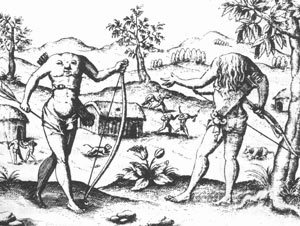
Sir Walter Ralegh's narrative of his expedition to South America is a fundamental source for the historical anthropology of the Americas. Yet readers must question how Ralegh, the quintessential Elizabethan, garnered his information, and how we should interpret it. In this new edition based on the first printing of the Discoverie in 1596, anthropologist Neil L. Whitehead addresses problems at the heart of current anthropological and literary criticism, and he challenges existing evaluations both of Ralegh and of early travel accounts generally. Whitehead has travelled where Ralegh led his expedition along the Orinoco in quest of an indigenous 'empire' in the highlands of Guiana. He draws on his own observations of the region as well as the available sources, including valuable Spanish and Venezuelan texts, to illuminate Ralegh's military engagements with the Spaniards, diplomacy with native 'kings', enigmatic encounters with monsters, and the search for gold (which continues today).
Sir Walter Raleigh or Ralegh (c.1552 - 1618), was a famed English writer, poet, soldier, courtier, and explorer.
Raleigh was born to a Protestant family in Devon, the son of Walter Raleigh and Catherine Champernowne. Little is known for certain of his early life, though he spent some time in Ireland, in Killua Castle, Clonmellon, County Westmeath, taking part in the suppression of rebellions and participating in two infamous massacres at Rathlin Island and Smerwick, later becoming a landlord of lands confiscated from the Irish. He rose rapidly in Queen Elizabeth I's favour, being knighted in 1585, and was involved in the early English colonisation of the New World in Virginia under a royal patent. In 1591 he secretly married Elizabeth Throckmorton, one of the Queen's ladies-in-waiting, without requesting the Queen's permission, for which he and his wife were sent to the Tower of London. After his release, they retired to his estate at Sherborne, Dorset.
In 1594 Raleigh heard of a "City of Gold" in South America and sailed to find it, publishing an exaggerated account of his experiences in a book that contributed to the legend of El Dorado. After Queen Elizabeth died in 1603, Raleigh was again imprisoned in the Tower, this time for allegedly being involved in the Main Plot against King James I, who was not favourably disposed toward him. In 1616, however, he was released in order to conduct a second expedition in search of El Dorado. This was unsuccessful and the Spanish outpost at San Thomé was ransacked by men under his command. After his return to England he was arrested and, after a show trial held mainly to appease the Spanish after Raleigh's attack of San Thomé, he was beheaded at Whitehall.
It's a mark by how bored I was while reading it that I only have the vaguest idea of what happened in this discourse(Note: it's not a story, there's no plot. Just endless 'I did this. Then I did that'.
It surpasses Master F.J in its dullness. Congratulations.
"Guiana is a country that hath yet her maidenhead, never sacked, turned, nor wrought; the face of the earth hath not been torn... The graves have not been opened for gold, the mines not broken with sledges, nor their images pulled down out of their temples."
Don't worry folks, Sir Walt is here to correct that horrible situation. Luckily he failed, unluckily there's nothing of interest in this short account of his failure. I was hoping at least for some craziness like in The Travels of Sir John Mandeville but there's only a passing mention of the Amazons and the headless Ewaipanoma. He doesn't even claim to have any first hand knowledge of them, Mandeville's outrageous lies where at least mildly entertaining.
This is basically magical realism historical pre-novel fiction & it spells beautiful as "bewtiful" and situate as "scituate" so really how can I give it a negative review? (Well, ignoring the blatant racism, sexism, colonization, pure molten evil, etc. etc.)
The book can be considered as a manifestation of failure of England's imperial project. Raleigh, as an English Courtier, is never able to discover Guiana, but rather lives with its dream.