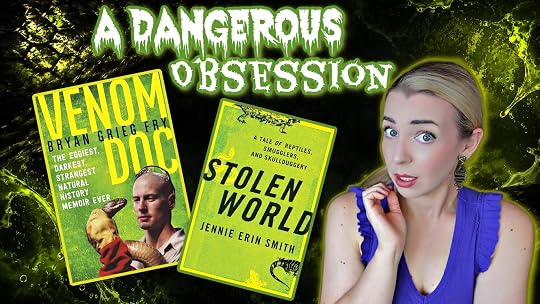
Tortoises disappear from a Madagascar reserve and reappear in the Bronx Zoo. A dead iguana floats in a jar, awaiting its unveiling in a Florida court. A viper causes mayhem from Ethiopia to Virginia. In Stolen World , Jennie Erin Smith takes the reader on an unforgettable journey, a dark adventure over five decades and six continents.
In 1965, Hank Molt, a young cheese salesman from Philadelphia, reinvented himself as a “specialist dealer in rare fauna,” traveling the world to collect exquisite reptiles for zoos and museums. By the end of the decade that followed, new endangered species laws had turned Molt into a convicted smuggler, and an unrepentant one, who went on to provide many of the same rare reptiles to many of the same institutions, covertly.
But Molt soon found a rival in Tommy Crutchfield, a Florida carpet salesman with every intention of usurping Molt as the most accomplished reptile smuggler in the country. Like Molt, Crutchfield had modeled himself after an earlier generation of natural-history collectors celebrated for their service to science, an ideal that, for Molt and Crutchfield, eclipsed the realities of the new wildlife-protection laws. Zoo curators, caught between a desire for rare animals and the conservation-minded focus of their institutions, became the smugglers’ antagonists in court but also their best customers, sometimes simultaneously.
Crutchfield forged ties with a criminally inclined Malaysian wildlife trader and emerged a millionaire, beloved by some of the finest zoos in the world. Molt, following a string of inventive but disastrous smuggling schemes in New Guinea, was reduced to hanging around Crutchfield’s Florida compound, plotting Crutchfield’s demise. The fallout from their feud would result in a major federal investigation with tentacles in Germany, Madagascar, Holland, and Malaysia. And yet even after prison, personal ruin, and the depredations of age, Molt and Crutchfield never stopped scheming, never stopped longing for the snake or lizard that would earn each his rightful place in a world that had forgotten them—or rather, had never recognized them to begin with.
I am a reporter, writer and reviewer specializing in science and natural history, with a longtime interest in zoos, museums, animals and conservation. For several years I worked as an environmental reporter in Florida, where I developed many of the contacts needed to write Stolen World; currently I live in Europe, where I write for the Times Literary Supplement and other publications. I am always happy to talk about my work, so please don’t hesitate to contact me if you have questions, or feedback, or would like to schedule a Skype video chat for a book club or class.
This is a reptile-smuggling true crime story, and very much reads like Tiger King, but with reptiles instead of big cats. The smugglers in the book may have started with a love of rare animals, but again and again, the animals themselves became secondary to the thrill (and ego boost) of being the person who could get them.
Oh, and Hank Molt may be one of the most infuriating people I've ever read about.
Click here to hear more of my thoughts on this book (and one other book on reptiles) over on my Booktube channel, abookolive!
A fabulous micro-history about a little-known subculture, a thriller, and an expose all in one. Also: the characters are unforgettable. I love what Peter Nicholls said about it: “If DARWIN, DOSTOYEVSKY, and GEORGE LUCAS had collaborated on a novel, it might have resembled STOLEN WORLD." Awesome. Dive in to the read, you won't be able to put it down http://su.pr/1hUi2U.
Important (horrifying) information. The author really did year homework (for years!) to shine a light on the reptile smuggling/trafficking world, and ... it's depressing. It was also really interesting (and disheartening) how things both changed AND didn't change throughout the years. While there was definitely a growth of captive breeding and a set of people who wanted to get rare morphs rather than rare species, the old reptile smugglers still couldn't give up their need for the new, next best adventure.
I was really drawn into the book for the first half, but felt really bogged down in the second half. The book felt like it dragged on, though I guess it reflects real life -- this still drags on, it still an issue, and there aren't really many serious consequences.
I was disappointed by this, although that's only partially the fault of the author. I just couldn't handle the amount of pointless reptile death. And the turtles... I think it might have been different if the writing had been really good, but it just didn't hold my interest to make the feeling of mild horror worthwhile.
Excellent book on the sordid dealings of old-time "reptile smugglers" masquerading as "exotic wildlife dealers" who tromp all over the world looking for the rarest creatures (mostly snakes but other reptiles too) to smuggle back to Europe, Japan and the U.S. for collectors. Smith chronicles chiefly the lives of two smugglers, (dealers?)one very successful and the other not so much, (both whom go to prison, however). They are repellent but you can't really put this one down. Reveals a lot about the wildlife trade in contemporary times.
Fallows Hank Molt and Tom Crutchfield, two reptile smugglers predominantly. However you do get a large assortment of people and interesting characters that flow around these two men. Everything from business partners, friends, family, and strange individuals. This book has a very stranger then fiction, trashy documentary vibe. However it is a true crime non-fiction that is predominately about reptile smuggling, but it also discusses all the interconnecting history and ramifications that is connected and involved reptile smuggling. That includes the changing animal protection laws in the U.S. as well as the changing nature of zoos and there relationships with reptile smugglers, and people keeping reptiles as pets and reptile breeding and reptile expos. It should be noted that given the subject of reptile smuggling there is animal neglect, abuse, and death that can be painful to read. This fallows these shifts and what happening to these two men and extended circle of people up and until early 2010's, while no one in this book is a particularly good person you do form an interest for what happening to them and wish they would make better choices for themselves and the animals they deal.
*4.5 stars. Almost perfect. A great read for my exact kind of nerd! Very dense and detailed but in a hot goss kind of tone that kept my attention.
This book will succeed in making you feel very weird and conflicted about the pet industry, zoos, and the way we relate to wild animals in general. No neat conclusions here. I'll be thinking about this one for awhile.
A very interesting book-had a hard time putting it down even though it seemed to drag on. I was so unaware of all that was going on with smuggling reptiles and how it was done. Actually a good eue opening read.
Started, but didn't finish. Was lured by the praise for the reporting and writing here, but it turns out I just wasn't interested -- at all -- in the subject. That's my fault, not the author's.
This book was a harsh look at the realities of wildlife smuggling - something that only occasionally makes a headline and almost never has real consequences. Stolen World follows the main players in reptile smuggling. I had a hard time determining which one I disliked the least - they were all very self-serving individuals.
But I learned a lot, and I don’t think it will be one I will forget soon. It certainly has given me a different perspective on zoos, even the ones that are supposed to be “good” or who are generally regarded as ethical.
The topic might have been rough but the writing was mostly excellent. The author completely immersed herself in this world and obviously knew her subject well. Based on my googling around once I’d finished for a “where are they now?” update, it isn’t exactly easy to find a lot of information on these guys (except for Crutchfield). It is admirable how much of herself she put into this, because I really feel like it is important information. That said, there were sections that felt like the author was too close to it, too detailed, too caught up in relaying all the little, gritty details.
I don't really love reptiles (though after watching SO MANY snake and lizard videos during the reading of this book that has kind of changed), but I love a smuggling story, and this book sooo delivered - while I think the methods and actions in the book are terrible, you kind of can't help but root for these guys. Presented as the juiciest gossip it was engaging the whole way through. Going to a reptile show next month to see some reptiles in person - I hope there's a tegu there!
Skulduggery noun skul·dug·ger·y (skəlˈdəɡ(ə)rē): underhanded or unscrupulous behavior; trickery.
This word sums up this book perfectly. The amount of fraudulence & chicanery that goes on in this world of reptiles is truly unbelievable! I mean one of these guys last name is Molt, for chrissake!!
This book is one of those guilty pleasures that you just can't put down. You wonder, how these characters weren't whacked, and you marvel at their brazenness that borders on stupidity. It's just good fun..... Unless you're one of the reptiles, or course.
Ten years of effort can yield a wide diversity of possible results. For writer Jennie Erin Smith, a decade of work has resulted in an incredibly compelling and deeply layered expose that reveals the shadowy underbelly of the reptile trade. In her book Stolen World, Smith carefully unravels the adventures, aspirations, personal struggles, and public trials of a legendary few who famously—or infamously—smuggled many of the world’s rarest, and most desirable species.
Stolen World earns high marks from me, as it seems tailor-made for a reptile/Everglades/invasive species egghead like yours truly. Smith does a masterful job of introducing in great detail many of the names and institutions that have long been well-recognized in Florida. But perhaps most importantly, the book provides a detailed glimpse into the psyche of both those with an insatiable lust for lizards, turtles, and snakes, and those willing to gamble all to satisfy their desire.
In the course of just over three hundred pages, it becomes readily apparent that the trade in the cold-blooded often hinges upon the personal faults of the cold-hearted. This is a conclusion drawn not by Smith—but rather—reflects the self-assessment of those entwined hopelessly in the reptile business. The desire for dominion over the world’s rarest creatures—as well as the authorities that protect them—is not purely lucrative. Rather, it sometimes finds it origins as compensation for social shortcomings, is often fueled by uncontrolled compulsions, and is frequently reinforced by tragic character flaws. And though its usually dangerous to paint any group with so broad a brush, Smith’s research fails to reveal many well-balanced exceptions.
That is both telling and troubling, considering she was on the case for ten long years.
It starts back in the day when reptile collectors were traveling the world to bring back the rarest and most intriguing reptiles for zoos and museum collections until, in 1973, with the introduction of the Endangered Species Act, these "reptile collectors" were made into smugglers overnight. Zoos, no longer wanting to be associated with smugglers (at least not publicly,) went into a panic and began breeding as many species as they could, to the point that they had a surplus and no choice but to sell some back to the smugglers they were trying to avoid in the first place. The rush to breed species eventually lead to the more current day commercialization of iguanas and pet store snakes. Then there's the more complex breeding industry of genetically mutated snakes and lizards, where an albino iguana or abnormal colored boa can be worth as much as a new car. And finally to the more disturbing, less commercialized, and ever growing venomous snakes trade, where vipers, cobras and black mambas can be bought in a plastic dish.
And behind all of this are the reptile hunters themselves, the ones who will pay any price and smuggle the reptile in the country anyway possible, even down the back of their shirt. They're obsessed with the rarest and the hunt to find them, and they're every bit as sneaky and corrupt as a person can be. The rarer the species and the more laws protecting it the better, even if it means jail time or backstabbing their best friend.
The hunters are so outlandish it's easy to forget they aren't characters out of a novel. As for the story, it was slow at times and hard to put down at others. I think it could have really been edited down (by the last fifty pages, I wanted it to be over). But overall, I enjoyed this glimpse into the crazy world of the reptile trade, and will never look at a snake the same way again.
I initially picked up this book because I have a friend with somewhere around eleven snakes, and I wondered how these species all came to be in the US market. This book painted a fascinating tale of a group of 'old school' reptile wranglers, always seeking out something new and rare in remote locations to ship back to the US through extremely illegal means. After countless legal battles, the men kept going, and persevere to this day in the reptile business.
It was rather shocking to learn how often zoos participated in (and may still participate in) the exchange of clearly illegal animals as well, and how blatantly people will flaunt their illegal catches.
Smith clearly did extensive research for this novel, and it shows, maintaining personal and scientific facts without sacrificing the swift legal drama that unfolds. I found the book difficult to put down, at the end, and I would gladly read any further expose she prints about the pet industry.
I picked this book up on a whim as it was in one of the discounted sections at my local store. I was not disappointed by this read as it is very informative and evokes many emotions in the reader. For instance, unlike the reviews on the back of the book, I do not find the characters loveable or... what's the word... endearing in any way. Rather, I think this book offers insight into the world of smuggling and animal cruelty for the sake of profit. The characters, though they are real people, are, in my opinion, the deplorable kind who claim to do things for "the love of the animal" but rather just think with their wallets rather than conscious. Thus, my suggestion is: if you like animal books but cannot tolerate animal cruelty, do not read this book. If you would prefer insight into global reptile trade, smuggling, and the association of zoos in all of the above, read this book and become educated on a bloody past.
A depressing look at the seamy, sordid world of the reptile "trade" (supported by smuggling and massive violations of endangered species law) with focus on several especially slimy characters. Smith does a fine job explaining the issues, making sense of the players (including the ethically challenged caretakers at zoos), and peering inside the twisted minds of the parties involved. I would have liked more discussion of whether enforcement has really improved since the 1960s and if endangered reptiles are even any better off, but this doesn't weaken the book as it stands.
i am donating this book to the school so t hat more people will be able to read the book about why it is so hard to get smugglers out of the system i in joyed the book a lot took only one day it ell you how the animals were brought in t he state and some of t he better know zoo were involved and they tell you how they made money and went to prison and came back out and re did it again this need to stop and then protect the animals
Reptile collectors are a strange breed, most moderately to severely handicapped in social skills. Perhaps this is due to their odd obsession of keeping creatures in the basement that eat live chickens and mice for dinner.
A thoroughly entertaining read. I had never been particularly interested in reptile smuggling, but this book was featured on the "new items" shelf at the library, so I decided to give it a try. All of the individuals featured in this book are reprehensible, but the fiascos that they get involved in are thoroughly entertaining.
Pretty good book on some snakes stealing snakes. Everyone in this book is really slimy even the zoos. But I am happy to say that I now have a plowshare tortoise up as my screen saver. Good read.
Loved it. I found it very interesting. I did not know that there was that much smuggling of reptiles going on. The book is well written and entertaining.
Scrolling down the reviews, it's clear this is a hugely polarising book. I'm among the people who really liked it.
If you've ever been an obsessive collector of anything -- I was, of strictly garden variety aquarium fish and now am of music -- the book fills you with a sense of there but for the grace of god, go I.
Driving the narrative are a triad of collectors: Hank Molt and Tom Crutchfield -- who the bulk of the book is devoted to, and Anson Wong. It's about their obsession with snakes and lizards, an obsession that almost never ends well either for the people involved or the animals. If reading about animals dying distresses you (and your empathy extends to snakes and lizards), avoid this book at all costs, because rare species die at a horrific rate through its 300 odd pages.
If there's any conclusion to be drawn from this, it's that the best bet for an as yet undiscovered species is to stay undiscovered for as long as possible, because the moment it's known of, there are crazy people out there willing to put their lives and even more easily, the lives of their associates and 'friends' on the line, to secure it. Also, going by the details here, a successful smuggling operation is probably the best case scenario for these species, since the authorities who apprehend them and the zoos they wind up at, often seem to be ill-equipped to handle them.
The book reintroduces some people I never thought I'd read of for instance, Gerard Durrell and his wife for instance...let's just say if your only familarity with him is My Family and Other Animals, this book will change your mind, somewhat.
And yet, in spite of all of the mayhem they've unleashed at least Tom Crutchfield, comes across as a relatively sympathetic person; Hank Molt, Wong and a few of his associates, less so.
There were lots of questions that I was left pondering over: why, for intance, did Hank Molt's wife stick around all these years with a man so obviously unhinged, so given to shady schemes, obsessive quests and debauched overseas jaunts? What happened to the rest of the Crutchfield clan?
While there were some parts of the book that felt a little stretched out, I ended it feeling I wouldn't have minded reading an entirely larger unedited draft.
Love this book! I was recently introduced to the reptile hobby and love true crime, so when I found this book, I bought it immediately. As someone who loves animals and has always visited zoos religiously, it shocked me to learn how much illegal activity went into them. Furthermore, the depth into how many of the reptiles popular in the US reptile community came to the community was eye-opening, especially since there is no guarantee similar stories are not currently being played out.
I noticed a few reviews rate this book low because of the saddening amount of pointless reptile death, and while I'm not belittling the emotions you felt, you're kind of missing the point of this book. It's not trying to glorify reptile smuggling but to give an honest account. But, just in case potential readers are put off by it, here are some trigger warnings: death of many animals, animal cruelty, attempted murder, drugs, talk of sex and fetishes, and crime (duh).
Honestly though I don't know how people got bored halfway through. There are so many crazy antics and anecdotes popping up throughout the book that I have been thoroughly entertained. I will say that it is more entertaining as someone who is a part of the reptile community. My only complaint is that the author seems to dislike Dumeril's boas. They may not have amazing colors, but they have crazy beautiful patterns! Justice for Dumeril's! :)
I thought I wouldn’t like it — what a hokey title! — but it turned out it was a compelling story. Right up until the end, when it turns out (yet again) that obsession is inexplicable and there’s no way to understand it. I don’t have a reptile jones, they all pretty much look alike to me. But to these guys, snakes and other reptiles aren’t just interesting, they’re a reason for living and they must have them. Which involves smuggling and all kinds of skullduggery. And I understand the need for conservation and preserving the environment and all that stuff, but it seems like these guys take better care of the animals than the zoos do, because they know more about them and also can take the time to nurture them, because they honestly don’t have anything better to do. These animals are their lives, not one of many megafauna that need looking after. And also they’re very concerned with breeding them so they often did a lot better than zoos. It just seems like — there should be some sort of accommodation between the reptile people and the zoos. Oh, and I learned a lot about zoos and animal parks and endangered species laws. And it was all fun to read.