Look out of the window. See a bird. Enjoy it. Congratulations. You are now a bad birdwatcher. Anyone who has ever gazed up at the sky or stared out of the window knows something about birds. In this funny, inspiring, eye-opening book, Simon Barnes paints a riveting picture of how bird-watching has framed his life and can help us all to a better understanding of our place on this planet. How to be a bad birdwatcher shows why birdwatching is not the preserve of twitchers, but one of the simplest, cheapest and most rewarding pastimes around.
The title of this book is misleading – the book is really all about how to become a proper bird watcher, but all the time with an emphasis on doing it very simply.
He tells us the we must buy a cheap pair of binoculars (bins), get a field guide (a bird recognition book – and the more local/smaller the area it covers, the easier it is to recognise the birds), also we need get to know local areas where we can find a good variety of birds – like reservoirs or sewage farms.
He says we must get to know the names of the birds, because recognising and naming is what its all about. And if we watch a species for long enough – really watch – we will get the skill of jizz. That is the ability to recognise bird with scant information, almost intuitively. Given the fleeting glimpses that we often get of birds this is invaluable. He also talks about the joys of recognising individual birdsong , and how it reaches a peak in spring – when birds are seeking mates and being territorial
He is also concerned about preservation, and tells us how farmland is often now a desert to birds, due to modern farming practices. Whereas birds in the wild all used to have their own individual areas for eating, they are now all doing it together in our gardens and at our bird tables.
Finally, for those of us bemused by the activity of twitchers, he tells us that twitching isn’t a hobby, it’s a sport. He should know, as his day job is that of chief sportswriter for The Times
The above is just a small hint of the joys that reside in this book. What I can’t do here is show his huge love of birds, which he shares on every page, and his enthusiasm for sharing his hobby. Both are absolutely charming. The book is a lovely read. He doesn’t write in sound bites though, so I can’t just snip a paragraph here or there to show you – rather there is the gentle swell of each chapter filled with insight, bird love and humour.
This would make a fantastic gift for anyone you know who’s a budding birdwatcher, or who is always talking about the birds at their bird table. This is about taking the next step, and even for me, as a non-bird-watcher, it was a great read.
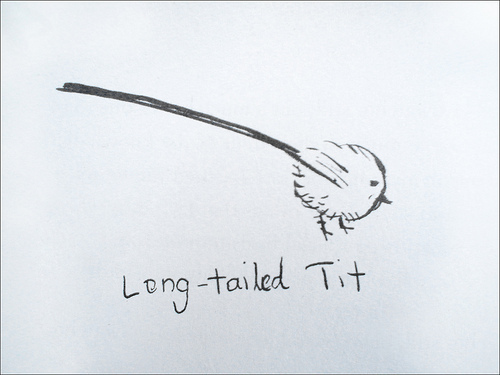
I shall end with one of the lovely pen and ink drawings that prefix each chaper. Like the rest of this book it is simple, yet full of character and charm....
Every so often a book comes along into my life and it's as if that book was meant for me to read precisely at that moment. I read many books, the majority of which I enjoy -- but they are books I would have enjoyed regardless of when I read them. A special book is one that finds its way to you exactly when you need it, and that is the ultimate pleasure in reading. How to Be a (Bad) Birdwatcher is that book for me. Around the late winter of this year, I became interested in birdwatching and bird photography. I went through a great deal of many changes this year, including a break-up, moving, and working on a new project where I constantly feel insecure. Being able to photograph birds on the weekends or the evenings has brought me much delight and calm to my life, even though I'm a complete novice who sometimes doesn't even know who she is photographing in the park. But it's difficult to articulate exactly why I'm in love with being a birdwatcher now. However, I think this book gets at the heart of why birdwatching is so pleasurable and meaningful. Sprinkled in with some light science about birds are anecdotes about his life - his relationship with his father, for example. So it's not just a book about birds and birding, but a bit of life lessons as well. He writes with charm and sincerity and knowledge. It was exactly what I needed to read right now, to feel okay with being bad at birding and to feel understood by the author. I think it's my favorite book I read this year.
I was on vacation and pulled this book off of the owners' shelf. I have never, ever read a book in this context. I generally come to a vacation laden with thousands of pages of fiction begging for my attention. But Simon Barnes's charming How to be a (BAD) Birdwatcher hooked me and kept me enthralled. The books was full of beautiful imagery, heartwarming anecdotes, and practical tips--all about birds.
Let me give you a sample of his poetic thoughts about birds:
"And flight attracts our eyes, lifts our hearts with joy and envy. Flight, to us earthbound creatures, is a form of magic. . .And so we look to birds for a very deep-seated kind of joy. . . but merely by existing--by flying before us--they add to the daily joys of existence. Emily Dickinson called hope "a thing with feathers." Birds are about hope."
"Birds are not only a delight; they are a cause, a battle, a purpose, a meaning--and no trivial one either. But before the meaning comes the joy. Marriage, for many, is what gives life its meaning. And in marriage, before the meaning comes the joy. You don't find the meaningfulness of marriage without first falling in love. I want every reader who likes birds--who, as it were, fancies birds--to move on. Stop ogling them from afar and make your big move. Stop admiring the birds; start falling in love with them."
And this practical tip, never to be gleaned from any field guide I have ever read:
"As you get to watch birds more, you will get to learn about the places they like. Alas, you can't rely on birds entirely for their good taste: rubbish tips, as we have seen, are a favorite. So are sewage farms and nuclear power stations. It's true: the water used for cooling is released out at sea; this comes out a fair bit warmer than the surrounding sea, and so naturally fish like it. Equally naturally, the fish eaters like it. Nuclear power stations are great places for seeing seabirds."
I have many opinions about nuclear power plants. They have never involved how wildlife flock to them. What a golden nugget for the casual birdwatcher!
In short, this book is a celebration of a bird watcher's life. I am all in.
Simon Barnes makes a great case for all of us becoming (bad) birdwatchers.
Why? Birds are everywhere, birds come in a great variety, and birds are amazing.
I think we can all agree on that.
Barnes encourages us to learn a little about birds around us to start. This is exactly what we have done here at my house during the pandemic. We have big windows that look out onto our bird feeder and bird bath. We have spent a lot of time looking at the birds as they stop for seeds and water. We've learned to identify a dozen sorts of birds, and we have had great pleasure in watching them and photographing them.
If you are like me, you would love reading this little book.
What a canny little book. A perfectly simple introduction to what has always seemed like an intimidating activity that requires prior knowledge. But it’s true: truly anyone can be a bird watcher. You just have to look at a bird, and enjoy it! Yet it has made me want to spend more time actively learning and noticing them. I love the idea that to properly meet something is to call it by its name, to show that you recognise and respect it. I’m gonna continue to say hello to every robin that talks to me.
...I came in from a hard January frost and a feeble winter sun. The sun didn't do much for me, but it stirred the soul of a dunnock. A dunnock is perhaps the drabbest bird in Britain the LBJ of all LBJs, a dunnish, brownish, smallish, skulking little thing that is about as common as another of his common names - hedge sparrow - might suggest. And he, ignoring the cold, was filled with a sudden excitement about the coming of the warmer weather. In that iron frost, he felt the tug of spring; and he sang his heart out as a result. It's not a great song, compared with that nightingale on Walberswick marshes. It's not a special bird, in terms of peak experiences; I'd come in telling everybody about my hobby, but I wouldn't take up anybody's time with a dunnock moment.
But there he was against the cold blue sky, every feather picked out by the low winter sun as he sang his song of spring and gave it absolutely everything. It was a song that made the whole day better. A common bird; a rare moment.
Barnes, or Simon as I feel I could call him, is sitting over my shoulder. “Watch,” he tells me. He lends me his binoculars, helps me figure out what that bird is doing, shares an anecdote from his years of birdwatching, and shows me why birds are so amazing and important.
And, a lovely bonus, I discover that I am not quite as entranced as he is. But with his guidance, I can be a bad plant-watcher, a bad weather-watcher, a bad bug-watcher. All that’s needed, he says, is “the habit of looking.”
Delightful and useful. Gets a 5 from me for charm and personality.
As a birdwatcher since about the age of 6, this book really struck a chord with me, at times I laughed out loud. At times I had tears in my eyes. At times I thought my Dad had written this book himself! My Dad was my teacher, he was and is a bad birdwatcher and he’s taught me how to be exactly that - a bad birdwatcher! Thanks Dad for all the hours, all the excitement of seeing an unrare and a rare bird! And for all the love & all the delights.
This book cracked me up and was really informative. I am a (bad) birdwatcher and love doing it! I truly enjoyed this as much as I love watching my backyard birds!
I love everything about watching birds and there aren't many things in life which give me more joy than birding. I picked this book up from a book sale hoping it's a light read, and it completely reinforced my belief system (yes birdwatching is the only belief system I am left with). I mean it's more like preaching to converted in my case, but I absolutely love it. There are some snippets from the book which stayed with me because I pretty much think exactly the same.
1. I never look for birds, but I am always looking at them. Not for reasons of science, or in hopes of a fabulous rarity, or to make careful behavioral observations. Just because looking at birds is one of life's greatest pleasures. Looking at birds is a key; it opens doors, and if you choose to go through them, you find you enjoy life more and understand life better.
2. Some of the very best field observers- very good birdwatchers indeed- never chase rarities. They are "local patch" people. Their satisfaction is their connection on a place, where they observe the comings and goings of the birds, day by day, season by season, year by year. Many of them will observe and identify the occasional rarities and do so with immense glee, but it is bread-and-butter daily observation that enthrals.
3. Some of the very best birdwatchers are more interested in common birds than rare ones. In fact, the notion of common birds and rare birds begins to look like nothing more than a kind of snobbery. There is no hierarchy of birds that takes the birdwatcher on from lowest of the low to the highest of high.
4. My favorite line from the book - Birdwatching isn't something you do; it is something you are.
And I can go on and on because there are so many. But yes, if you love birds then just pick it up and if you don't then also pick it up. The birdwatching world has space for all and as the book says- there is no such thing as bad birdwatcher. Let this little bird manifesto convince you of the quiet joy, the democratic beauty, and the boundless wonder that comes with simply noticing the birds around you.
I was attracted to this book because I myself am a bad birdwatcher - meaning I've learnt to appreciate and take an active interest in birds (and other wildlife) but I don't really know what I'm doing! Also I knew Simon Barnes from his sports writing for The Times, which he does very well.
Well having read this it turns out I am already a pretty well-qualified bad birdwatcher so this book didn't have a huge amount to teach me. In fact, at times I felt Barnes made an art of stating the obvious - buy binoculars and a field guide, visit the right places at the right time, listen to birds, don't judge birds for attacking each other.
It was mostly an experience of 'preaching to the converted'. Barnes's target audience is presumably people who have yet to start birdwatching at all - I'm just not sure how many of those people would actually pick up this book.
The parts I enjoyed most were the more autobiographical parts, where Barnes explains how he himself got into birdwatching. His story of a week in Sri Lanka spent visiting nature reserves after missing a flight is a highlight, as are the passages about his relationship with his dad and how birdwatching helped them bond later in life.
Barnes's style is easy to read. Being a journalist he specialises in punchy, brief articles and I did feel that his chapters would have worked well as series of articles in a newspaper. But this being a book, he could have allowed himself to flesh out his anecdotes and narratives and allow the reader to get more engrossed.
A quick easy read but I wouldn't recommend this book.
I’m a bad birdwatcher. I have been for years, and it is great to see my experience in writing. I haven’t had the people to take me and guide me in the whole birdwatching activities. I have done this through books and birder magazines. And this has become one of those book. This book has become my Shirtless Tim.
The love the author has for birds is hearth warming. It is a guide to birdwatching but not just watching but enjoying. It’s a guide to how to be a bird listener and a bird lover, how to appreciate the little common birds and not to be intimidated by all the warblers( I certainly am and I have been avoiding them as well).
But like him, I can spend a day in an RSPB reserve and enjoy even the great crested grebes for hours and just watch their continuous disappearance under water to fish, the joy of all their colours! Was I intimidated by the two expert birders that were already leaving by the noon when I got there, with the massive expert quality bins and all their camouflage clothing-yes. But, I enjoyed my birds the same. I think this is what the author is trying to say in the end. It doesn’t matter the how, it only matters is that you do and that you continue doing it and that you find joy in it.
This was an enjoyable, light book aimed at someone just getting interested in birds, but also enjoyable for someone with a longer term interest. It was amusing and had a conservation message without being depressing, but I felt it could have been better with more detailed bird watching experiences that the author has had. I felt like he was trying not to be too specific to be able to appeal to beginners who don't know their birds and both a British and American audience and the book suffered a bit for it.
The most popular activity in Britain is going for a walk in the country, and it's about the best, too. The country being the park and the common and all the urban local spaces. And here's how you do it. You put one foot after another, and when you see a bird, you stop, and put your binoculars to your eyes and say: "What the bloody hell's that?"
Birdwatching is a latent passion of mine. One that's waiting under the surface, ready one day to come out when given the opportunity. At the moment, there isn't much opportunity, I live in the centre of the city and don't get to spend much time just existing in nature. Luckily, it turns out that this book was pretty much written for me.
Mostly the book goes through the authors life. He uses his experiences to illustrate the joy you can get out of observing what is there around you. He didn't grow up birdwatcher, but slowly became one over time as he discovered the fun of it. Reading this, it made me want to go on the same journey. Actually, I really hope I do.
The chapters in this book don't let you go, the writing style is funny and engaging. The author is a sports writer for the times and this is quite clear when reading it. He has a real ability to make not very much information stretch over many pages in the best way possible.
"Look out the window. See a bird. Enjoy it. Congratulations. You are a bad birdwatcher."
A wise woman once told me, "Anything worth doing is worth doing badly." As you might have guessed from the title of this book, birdwatching is one of those things that's worth doing badly. I'm still at the "bad birdwatcher" stage, but Simon Barnes has convinced me that that's okay. It's a very small book, only 220 pages, and can easily be read in one evening, but in those few pages the author opens our eyes and ears to the wonderful, miraculous world of birds, and convinces us that anyone, at any stage of experience and knowledge, can enjoy birdwatching. This is a book I will definitely be re-reading, and soon.
Birdwatching is something I have become increasingly interested in over the last few months. I've loved noticing local birds a bit more with my eyes and ears lately and this book really added to that joy. I feel like I learnt a lot but also realised that birdwatching doesn't have to be fancy or scientific all the time, it can just be! Very much enjoyed, loved the personal stories of birdwatching in different places too.
I am just now re-reading this wonderful little book that was given to me as a Christmas present some years ago. Barnes has a great sense of humor and his humanity shines through with every sentence. And he loves birds for various reasons, which he describes with heart and philosophical thoughtfulness.
Absolutely crucial read for anyone who is even slightly fascinated by nature and birds. Not a heady book of facts, but rather an account of how someone can stumble upon birding in their everyday life, just caught up in the awe of nature. Perfectly relatable and humorous. I rarely have the focus to read a book all the way through, but this one kept me riveted!
An autobiographical narrative sown with explanations about what makes bird watching enjoyable and motivational passages for beginners. Not impressed, particularly the way he talked about women.
A book that basically tells you that you should look at birds sometimes, because sometimes they do weird stuff. Also, you can play a game where whenever you see a bird, you keep track of it and thereby "collect" it, kind of like real-life Pokemon Snap. You won't learn much of anything useful concerning the hobby in question, but that's kind of its charm. The author doesn't pretend that he knows a great deal about his subject, just kind of puts in a kind, goofy word for the pleasures of bird world observation. Upon reading the book, you'll definitely feel an urge, however brief, to go buy a pair of binoculars and traipse around town with a notebook squinting at indistinct shapes on telephone wires and looking like an idiot, but it'll probably pass.
Originally I was thinking 3 stars, but I wonder if I was giving it extra points just for being a book about birds. I'm not sure who the audience is for this book - beginning birders? potential birders? It's a coming-of-birding story, including a somewhat interesting father-son history - interesting in that it feels unique. Although he uses his own term "bad birdwatcher" repeatedly, I still am unsure what that really means. Occasionally funny (although if "bad birdwatcher" is supposed be a joke, I don't get it). Very English but still accessible for North American birders/readers. It is a short book - it also has that in its favor.
There actually is advice in this small, chatty how-to book. First of all, look. Look at birds. Look around you. Go outside. Pay attention. Get a birdfeeder. Get a pair of binoculars. Cheap ones are OK. Get a bird book. Find out where the birds are, and go there. Learn to identify birds by their calls. You can do this by listening to recordings.
The author includes examples of his own experiences watching birds in his travels all over the world, and some of the friends and mentors who have helped him and shared with him, particularly his father.
He explains what he means by being a bad birdwatcher. He means to not worry about being the snobby sort of birdwatcher who knows every thing about every bird, and who has a long life list, and delights in identifying the rarest species. Barnes calls this sort of birdwatcher “twitchers.” He doesn’t want his readers to worry about impressing anyone, or being good enough. Barnes wants his readers to be filled with wonder, whatever their skill level.
And that is the greatest thing I have taken away from this book. Simon Barnes goes into unapologetic raptures about how wonderful birds are, and how having birds around you enriches your life. When was the last time you heard someone love something so openly? It reminded me of something I had heard before, and the closest I could come was this quote from Mister Rogers:
“The thing I remember best about successful people I’ve met all through the years is their obvious delight in what they’re doing and it seems to have very little to do with worldly success. They just love what they’re doing, and they love it in front of others.” Simon Barnes loves birds, and he loves them in front of you, and me, and everyone who reads this book.
Here are some examples:
“Every field guide that was ever printed is not merely a book of helpful hints on how to tell one bird from another. It is also a hymn to biodiversity: a song of praise for the fact that such a wonderful variety of creatures exists and has its being in our country, on our continent, on our planet.”
“Just listen and say wow. […] The more you know, the more you wow.”
“Birds are not only a delight; they are a cause, a battle, a purpose, a meaning—and no trivial one either. […] But before the meaning comes the joy. […] I want every reader who likes birds—who, as it were, fancies birds—to move on. […] Stop admiring birds; start falling in love with them.”
“It [the Jamaica Bay Wildlife Refuge] is not beautiful, at least not in any terribly obvious way, but there are birds there, and if that doesn’t make a place beautiful I don’t know what does.”
“There are wonders to be seen everywhere in the world, and you can find them in your city, in your suburb, wherever you happen to be. Birds can light up your life just a little, wherever you happen to be.”
“The more you look, the more you see. Every passing minute is richer, more rewarding. The more birds you see, the more birds you see.”
“And that, I think, is the principal aim of this book: to encourage everyone who picks it up to look about, all the time, every day.”
“Birds indicate life in its richness and its diversity, and without places where birds are, we would have a deeply impoverished planet Without such places we are cut off from what makes us part of nature, and therefore we are cut off from what makes us truly alive.”
As you see, the man is smitten. He is besotted. And you can be too. You can be basking in beauty, richness, and wonder. I am convinced.
I have been a birder, or birdwatcher, for over 30 years, and actually teach birding to beginners. This book is not really about the mechanics and process of birdwatching. It is more about the reason to watch birds. In the electronically bloated, information saturated world we live in today, it may be hard to find a few minutes, or mornings, to take some time to watch birds, to revel in their beauty, and marvel at their abilities. Simon Barnes knows better and he does an excellent job of clearly stating the principles of a "bad birdwatcher", which work, incidentally, in the US or Britain. I have never thought of myself as a bad birdwatcher, but I found out I am. A bad birdwatcher is not a rabid life-lister, nor someone in it solely for the competition (although birding, as Simon mentions in the book, is really closer to sport than science), and they certainly are not someone who enjoys most being able to put a name on more birds that you on the drop of a hat. A bad birdwatcher is someone who experiences birds, regardless of their ability, joyfully in nature. The book could be used by someone to begin birding and it provides all the best reasons to do that and a lot of how to get started. I think it is a more valuable resource for those less likely to read it. Every advanced birder should read this book to remind themselves, if they have forgotten, why watching birds is so rewarding and so important. Birding allows you to experience nature like you are an insider in the play of life. Barnes, being a sportswriter by training, uses the analogy that a birder knows the players, can predict the moves, and wonders at the strategy being employed. Maybe more importantly, one of Barnes' main points is that advanced birders should be teachers, giving back to others the joy they received from their mentors. Birds are diverse and populous, providing me, with every walk in the woods, or grass, or sagebrush, a chance to connect with, think about, and experience the joy of wild nature. Thank you Simon Barnes for putting in print what we should all keep in mind as we watch the birds.
Charming, right? That's the word. A little overused but it fits this book exactly.
The only thing at all wearying is his overuse of the catch phrase 'bad birdwatcher', but of course he had to, in order to give the book its name and distinguish it from all other books about birdwatching. Not that I've seen so many, but I did read one once.
This book was mostly just memories and funny stories, but there are some useful words of advice. Especially regarding dippers. I've never seen one but it's on my must-see life list.
Mostly, they like fast-flowing streams with plenty of rocks, because they are odd little birds, like big fat wrens, except they have the unnerving habit of flying straight into waterfalls. And if you go to the right sort of stream, you are almost certain to see a dipper, and if you walk along it for a way, you will see several. [...] Find your stream, and you have found your dipper.
I used to wonder why I never saw a nightjar. Field guides tend not to overcommit themselves, for the very good reason that birds often turn up in unlikely places. Any open country, you can read, is good enough for the nightjar. True; but you are highly unlikely to see them unless you go to the right sort of open country, the sort of open country that nightjars like very much indeed.
I guess I knew these things before, but I appreciate the memory jog. (Jab? Jag?) And appreciate the book, too--good job!
How to be a (bad) birdwatcher was a fun read for me as a fellow birder. The book was a good reminder to just enjoy birds as they go about their routine tasks and enjoy the ordinary bird moments that can become very special moments. Birding can be a way to bond with others and strengthen family and friendship bonds forever. I enjoyed seeing how Simon’s relationship with his dad improved through many birding encounters and eventually passed on to his son. Now I want to go to England and see some of the tits in action at his feeder. The book inspires one to practice citizen science at home or any other location as you go about your everyday tasks and to look up and marvel even if it is only a crow that flew over. I don’t have to race off to see a rare bird who may die tomorrow after being blown off course into another part of the world. I enjoyed Simon’s frequent literary references at the beginning of each chapter from a wide variety of sources that tie into the birds he is describing or the moment of bird exploration. Birding as Simon points out can be done everywhere and anywhere including when I am in Lowe’s watching house sparrows move around in the garden section or hear a veery thrush while watching a drive-in movie! Celebrate and enjoy even the brief encounters with our avian friends that brighten and beautify our often drab world with their everyday activities as they move through the seasons of their often brief lives.
I enjoyed this book even though I have a natural aversion to the genre. It’s not a work of non fiction or scholarship , it’s a jaunty chatty informal look at being a bird watcher .
Simon Barnes used to irritate and amuse me in equal measure when he was a writer at the Times, his profile photo with beard etched into my mind as a member of the mini celebrity journo set. I’m sounding chippy.
This book does the same - amuse and irritate , however the overall effect I find as I put the book down, is surprisingly a strongly positive one , for I am a new bird lover, and this book has given me some good tips and enhanced my love of the subject .
The tips - use binoculars because they bring the birds closer . Everyone begins not knowing anything about birds and makes mistakes identifying them. Knowing the name of a bird brings the birds closer to you. Spend time , hours watching birds - it will bring its own joy and is the way to learn. Keep doing this and the world of birds and knowledge about them will come to you.
So yes despite his - to me - slightly over familiar annoying writing style - this book is a good bridge to better understanding and enjoyment of the subject - bird watching .
To quote the title of Chapter 17, I read this book just at "The Right Time." I read Barnes' witty, self-deprecating book about the joys--and perils--of bird watching shortly after I returned from a luncheon with a very accomplished group of birders--and me--to celebrate the completion of the Fort Worth Audubon Society's Big Year. Because life got in the way last year I came in next-to-last at 80 birds, and the winner scored 224! None of these folks were what Barnes calls "twitchers," but very dedicated--and friendly--bird enthusiasts. Nevertheless, I returned from the luncheon quite discouraged about ever coming close to their level, but Barnes' book really spurred me to keep going. Someday I may even be able to distinguish among what Barnes calls LBJs (little brown jobs), a real source of frustration for me. Thanks, Simon for a great read and for encouraging me to continue to really look at the world around me and be in the moment, two of the reasons I have grown to love this hobby.