Sheriff Spencer Arrowood keeps the peace in his small Tennessee town most of the time. Every once in a while, though, something goes wrong. When 1960s folksinger Peggy Muryan moves to town seeking solitude and a career comeback, and she receives a postcard with a threatening message, her idyll is shattered. Then a local girl who looks like Peggy vanishes without a trace. Although she was once famous, Peggy has no fondness for the old times. Those days are best left forgotten for Spencer Arrowood, too. But sometimes the past can't rest, and those who try to forget it are doomed to relive it....
Sharyn McCrumb, an award-winning Southern writer, is best known for her Appalachian “Ballad” novels, including the New York Times best sellers The Ballad of Tom Dooley, The Ballad of Frankie Silver, and The Songcatcher. Ghost Riders, which won the Wilma Dykeman Award for Literature from the East Tennessee Historical Society and the national Audie Award for Best Recorded Books. The Unquiet Grave, a well-researched novel about West Virginia's Greenbrier Ghost, will be published in September by Atria, a division of Simon &Schuster. Sharyn McCrumb, named a Virginia Woman of History by the Library of Virginia and a Woman of the Arts by the national Daughters of the American Revolution, was awarded the Mary Hobson Prize for Arts & Letters in 2014. Her books have been named New York Times and Los Angeles Times Notable Books. In addition to presenting programs at universities, libraries, and other organizations throughout the US, Sharyn McCrumb has taught a writers workshop in Paris, and served as writer-in-residence at King University in Tennessee, and at the Chautauqua Institute in western New York.
I loved this reading experience that transported me to another time and place very different from my own. It was so good that I would even pedal a few extra minutes on my exercise bike to finish the chapter! The context of my favorite quote is a mother who desires to update her kitchen to suit herself now she finds herself alone. She lost her eldest son to the Vietnam War and is a widow with one son remaining: "This was the home of his childhood, and while he wouldn't want to live here anymore, the fact that the house existed unchanged made him feel safe in the world, because here it was 1959, just the way he remembered it. She was used to providing this museum of comfort for the last surviving man of her family; it was part of her job as a diplomat."
This is the first in the 'ballad' series of Appalachian novels by Sharyn McCrumb. I like this series so much, and I love that her recurring characters are more than just window-dressing, but are not the main focus of the books. This novel seems to take place in 1986, and it feels a bit dated, not only due to the lack of technology (no cell phones or computers, not even a fax machine in this tiny town) but also due to the interest in and latent advocacy for Vietnam veterans. Not to downplay the issues, but it seems a faraway time when that was the biggest military issue weighing collectively on society. Not too hard to figure this one out, but still pretty compelling to read and with a bit of something unexpected at the end.
Well, smack my a** and call me a mystery reader! I ordered up the second one the next day. Paid cash money for it, too. I guess these are so old they are being lost to attrition in the library system, and not replaced. I'm not sure who I am anymore, but I really enjoyed this book. Me and Sheriff Spencer were inseparable for a few days while things got heated in our little Tennessee town. True to the promises of the lusty librarian Nancy Pearl and others, this author creates an excellent sense of place. I loved the lyrical title, and love the whole idea of a ballad series for Appalachia. I read an exceptionally ugly copy, but once I got over it, the dime store nature of it almost added to the experience.
The beginning of the Ballad series and man, is ever good. Most of the ballad books can be read as stand alones, but if you haven't started yet, begin here. McCrumb has not done anything this good lately though.
McCrumb does a good job of describing scenery & setting and of capturing snapshots of southern Appalachia and its idiosyncratic characters. Rather than using dialect and accent to give her characters a distinctly Southern voice, however, she uses omniscient narration to reveal their rural, socially stratified, and geographically-defined thoughts and attitudes about their lives, environment, and neighbors. But if you subscribe to professor Jerry Leath Mills' (late of UNC-Chapel Hill) "Dead Mule" theory of Southern fiction, then this isn't Southern fiction. I happen to think that Southern fiction encompasses a lot more than just works that feature a dead mule or three.
There are some interesting and fairly well-developed characters here, especially Sheriff Spencer Arrowood, his chief deputy, Joe LeDonne, and dispatcher Martha Ayers, and to a somewhat lesser extent victim Peggy Muryan, but the rest are little more than stock characters. Despite the dearth of dead mules, this is assuredly Southern. It features plenty of the grotesque and the gothic, and it's set in the very well-described (though fictional) East Tennessee mountain town of Hamelin. I like the conceit of Sheriff Arrowood having his own personal soundtrack of traditional folk ballads, which helps set this series apart from other formula-fiction mystery series.
As for the central mystery, it is by far the weakest part of the novel. The killer and his or her motives are evident very early on, and the two red herrings are so transparent as to be more like pale pink herrings. Still, there's a lot here to build on, and I'll be reading further in this series to see how much it improves as it matures.
I'm a bit conflicted about this book because while I really liked the writing style, I thought the storyline was just okay. One issue, of course, is that the book was written in the 90s and so a lot of the references are dated. The mystery wasn't particularly compelling...in fact, for me, it was pretty obvious who did it. There was a lot of setup before getting to any meat. I'm hoping that her future books are a bit more intense because again her writing style is really good.
A very slow moving story, though the writing is good. However, I did not connect with any of the characters which made it difficult to be pulled fully into the story. An okay book, but I probably won't be reading any more in the series.
A mystery set in Appalachia. The plot has some good twists but I like the glimpse of a different time and the characters reflecting on life. It’s you familiar cop trope with the divorced guy but the author makes the characters her own.
I think highly of Sharyn McCrumb, partially because she writes about thinks I love in a voice I understand. This mystery novel is psychologically excruciating and funny at the same time, hallmarks of that dark voice she uses. Enter small town Sheriff Spencer Arrowood, a man trying to live with ghost of his older brother, the high-school football star killed in Vietnam. Spencer drives around town accompanied by his own mental jukebox, which gives him insight into emotions he was trained never to articulate. He's divorced, and has bad feelings about Jenny, who appears to have been a hand-me-down girlfriend from Cal, although I wondered about midway through the book if Cal hadn't singled out Spencer's crush on Jennie for his attentions just because Cal could. Cal comes off as that sort of fellow in Spencer's recollections, but then he seems to think he's the only one who saw Cal clearly. It's hard to be the younger brother, especially when the older one dies before he can reveal his real potential or lack thereof. I loved it when you enter Mrs. Arrowood's mind and you find that she keeps her home a museum for her surviving son, and knows that Spencer is worth two of Cal, even though she can't get past her grief for her first born son. No one wants to speak ill of the dead, so Spencer seems to be stuck with his issues, the issues of many of those who did not go to the Killing Fields. Enter the folk singer, Peggy Muryan, the voice of the peaceniks, a celebrity in the little Tennessee town. The locals want to court her, but are too frightened of her supposed wealth and her somewhat stale fame. Spencer explains that she can break the ice by donating to the local church drive, after he's called in to register a complaint against her dog, Blondeen, who pooped in a neighbor's flowerbed. She does, and it sets the stage for threatening postcards, Blondeen's death and a host of animal and human deaths. I won't spoil the mystery aspect of it, because the real gist of the novel is the cost of a culture of violence on its survivors. Pretty Peggy-O ends on a note of moral ambivalence-what do we think of Peggy at the end of the novel? Spencer is pretty clearly a due process sort of fellow, but Peggy is more of the point and shoot variety, calculating the costs. The characters are both haunted people. Spencer has Cal, and Peggy has Travis, her original singing partner and boyfriend. His letters inform the reader of his time in Vietnam, and how cruelly he felt the loss of Peggy, removed not only by his service to his country, but also to her rising status as a singer. We also meet other Vietnam vets, the damaged deputy, the isolated man in a shack on the outskirts of everything. And the evil past stares back at a youth in the local high school who determines to penetrate the darkness of the prior generation. Pretty serious themes for a mystery, which is why I so appreciate McCrumb.
A great introduction to one of my favorite character-driven mystery series. Even though I’d read this before and knew who the culprit was, I thoroughly enjoyed re-visiting the folks and sheriff’s department regulars in the mountain community of Hamelin, Tennessee. What I’d forgotten was how well this gives recognition to Vietnam veterans and the challenges they faced even years after returning home. 3 1/2 stars
Intriguing start to the Ballad series. I appreciate the inner dialogue the characters have regarding aging as their 20-year high school reunion approaches and memories of the Vietnam War persist.
I've read several McCrumb books, but not in any kind of order. So I'm starting at the beginning of the Ballad series, because I just love the Nora Bonesteel character and want to know everything about her. Sheriff Arrowood is another great character, and so is Joe LaDonne...well, I guess they are all great characters. :-)
This one is fairly light reading, but there are some deeper moments involving Vietnam vets and the struggle to adjust after coming home. There is lots of Appalachian background and culture, which is always enjoyable to me because I'm from the southern Appalachians. Just a good, entertaining mystery.
This series has promise. Setting, lovely. Characters, yet to be fully developed. Mystery, too easy -- I knew who was doing the deeds as soon as the person stepped on stage. Story of the divorced, lonely, sheriff. He's got a boring job in a tiny Appalachian town. Then a stranger comes to town and is threatened by a mad-man.
Wonderful writing, sense of place, and characters: I will come back to this series just to visit them again. Unlike other readers, I didn't spot the murderer, and the motive still seems far-fetched...but so much related to America's misbegotten war in Vietnam did and still does.
Why did I think I would enjoy this book? The 1990s were a low point for mysteries, I think. They don't hold up.
Instead of bothering with setting up the mystery plot McCrumb spends her time making sure the reader knows that she knows whatever the theme du livre is. Sure, I enjoyed the chitchat about Ian and Sylvia and their breakup but damn it, I also wanted the mystery to get started.
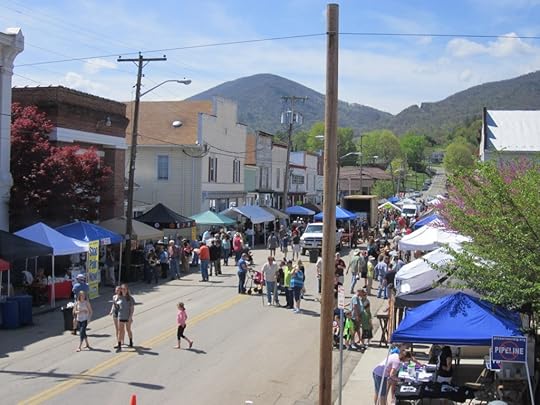
I'm about halfway through the Mitford series by Jan Karon, and I was looking for other books set in small southern towns to help me pace myself and not rush through the last few books. I had somehow never heard of Sharyn McCrumb before, although I probably should have. You see, as I was Googling, I discovered Sharyn McCrumb's Ballad novels set in the fictional town of Hamelin, TN. I also discovered that, though Hamelin is in Tennessee, McCrumb based the town on a real-life place, New Castle, VA, my own little hometown.
A murder mystery? Set in my hometown? How could I refuse?
The book is set in 1986, and I had a good bit of nostalgia connecting the houses, streets and landmarks in Hamelin to the places I knew growing up.
However, though the setting and the kinds of people in the book seemed familiar, this was definitely a seedy, David Lynchian version of the town I knew. No problem with that per se. After all, it is a murder mystery. However, some things just felt off. There was a good bit of strong language in the book, which seemed out of place here. There was one out-of-nowhere moment when . It was only two sentences and quickly over, but it felt pretty squicky and didn't endear me to the protagonist at all. The ending of the story was also pretty disappointing.
As I was reading I also felt like there was something missing. I didn't immediately realize what it was, but by the end it became clear. In a small, rural town in Appalachia, church is a huge part of life. Growing up, I remember a disproportionate number of churches for a county of less than 5,000 people. The majority of people were church people, whether earnest or hypocrites, and church attendance was mostly expected. However, in this book, with a cross section of all different kinds and ages of people, there was not one preacher, and no one ever mentioned going to church. Kind of a weird oversight if you're trying to recreate small town life. Jan Karon nails this dynamic a lot better.
Will I read another book in the Ballad series? Probably not any time soon. I've seen some reviews that say this first one was the worst and that they get better from here, but for now, I think I'll go back and spend some more time in Mitford.
This kept me on the edge of my seat. I tried to put it down so I could finish up around the house; but I had to give in to the book because I had to find out what happened to Peggy.
Challenges: Mid-Year Mystery Madness/Subgenre September (genre fusion, backlist); Reading Goal Posts - TBR Jar 2021. A genre-fusion literary mystery, part epistolary historical/part suspense thriller and police procedural. Couched in the haunting Appalachian ballads of 'Little Margaret' and 'Fennario', McCrumb slams the door wide open on how the Vietnam War was still viewed at the end of the 80s by the generation who lived through it. Characters are gritty, even for this small town of Appalachian Tennessee where no one had seen such violence toward animals and a young girl homeside. At the same time, the past was being relived through a twenty-year high school reunion. Without resorting to anything supernatural or paranormal, this book is truly haunting as only real life can sometimes be. Some of the best writing out there. Listen to the ballads 'Little Margaret' and 'Fennario' before beginning the novel; will foreshadow the story without spoiling it.
Spencer Arrowood and the other colorful characters of his small Southern town are featured in this puzzling mystery. Spencer's 20th high school reunion is coming up and he investigates the threats to a famous 60's folksinger while dealing with conflicting emotions about his ex-wife Jenny and dead Vietnam-era brother, Cal. The Vietnam War is a tie-in to another subplot also. The text alternates between current-day events and those of the Vietnam War through letters sent to Peggy, from her former boyfriend, missing-in-action. But is he still alive?
Outstanding start to an excellent series. McCrumb's Ballad series takes place in the mountains of eastern Tennessee; recurring characters include the local sheriff (good policeman, carrying a complex load of personal baggage), a Vietnam veteran deputy (ditto), and elderly mountain woman with a long memory and unusual abilities.
This series ranges back and forth in time, sometimes combining contemporary mysteries with historical fact. Heart-stopping ending -- Not to be missed.
I love all of the "ballad" mysteries. Learned about this author in 1998 when I was working in the mountains of Virginia, where she is a local hero of sorts, since she's from that area. She tells a great story, and there is a cast of characters you get to know. Some of the books tell the story from a previous characters perspective - new story, new voice, but familiar setting. Very well done, and a nice insight into appalacian culture.
As far as the detective work goes, there pretty much was none. There were no real suspects. There was no inching closer to finding out who the killer was (as far as the sheriff’s department goes - you as the reader are finding out snippets of information along the way). I mostly found this book supremely creepy and disturbing. I probably won’t read the rest of the series.
While I didn't find this a terribly strong novel, I was intrigued by the setting and the characters, and think I can see how and where McCrumb will grow (as this is one of her earliest novels) - I will definitely continue the series.
Sharyn McCrumb's If Ever I Return, Pretty Peggy-O (1990) is set in the small Appalachian town of Hamelin, Tennessee where Spencer Arrowood is the Sheriff who keeps the peace. It's not a difficult job most of the time--an occasional run-away or teenage boy with excess energy stepping out of line; a few drunk and disorderlies...that's pretty much it. Then Peggy Muryan purchases the old Dandridge home. The moderately popular folksinger from the '60s is looking for a quiet place to compose new songs and set the stage for a comeback.
But the peace and quiet doesn't last long. Peggy begins receiving postcards with lyrics from various folksongs which she had once made famous. As Sheriff Arrowood points out to her, the lyrics as printed are scarcely threatening--but Peggy knows the lines that come next and the haunting, ominous nature of the lines not written are worse than those which appear. Then Peggy's dog is killed and marked with an insignia of some sort--butchered in a commando-style that has indications of a link to Vietnam. The dog's death is followed by a sheep--also left with clues referring to Vietnam.
Things really get serious when a high school girl goes missing and winds up murdered--for Rosemary Winstead bears a striking resemblance to Peggy Muryan at the height of her career. LeDonne, Spencer's Vietnam vet deputy, doubts the Vietnam connection because the clues left behind in each case are too scattered. They point towards several different military units. Peggy, meanwhile, keeps getting those cards, and they seem to implicate her former singing partner, Travis Perdue--except es that Travis was a Vietnam casualty, an MIA. Is it possible he returned to the States after all? Why would he kill nice, young Rosemary? Who else had a motive?
[Possible spoiler ahead!] I find the ending deeply disturbing and unsatisfying. Which, honestly, is what I believe McCrumb wants. Many of her characters are disturbed--whether they are haunted by a past that never was quite like they remember it or a past that changed them forever or if they are caught up in their interest in a past that was never theirs. Portraying the psychological dilemmas of the various characters is probably McCrumb's strongest gift in her writing. It certainly isn't in the crime plotting itself. I found the motive fairly unbelievable--quite probably because the killer's psychology is the least examined. The character appears regularly, so the fair-play side of me can't holler "No Fair! X isn't even a real suspect." But I can't say that I'm believing in X as the villain. It also doesn't help that Arrowood doesn't really figure anything out and does very little in the investigative line. We find out who the killer is because s/he appears in Peggy's house and spills out a confession in a burst of bragging. Otherwise, I just don't see this crime being solved.
The setting is grand and the Appalachian background well-done. Most of the characters are well-rounded, interesting, and believable. One just wishes the villain were included in "most." A decent mystery with an intriguing set-up and lead-up to the final chapters. If the promise had been fulfilled, I would have given it a higher rating--as it is...★★★
First posted on my blog My Reader's Block. Please request permission before reposting. Thanks.
I admire Sharyn McCrumb as a writer and as a person helping people see the South and Appalachian people in particular. She’s a good story teller. I enjoy reading her stories and come away a little better informed than I was.
This was evidently her first ballad novel and it was a good first one. The impact of war on this part of the country is rich with potential - Vietnam war…
Too many characters for her to go deep with them. It’s true she didn’t go very deep with many other of the characters, but it worked. We do get to know more about Spencer and Peggy, but even there I needed more. Without having a spoiler, some things are revealed about both of these characters that beg for some kind of follow up or resolution.
But overall, an enjoyable read - most importantly, a read that made me want to read more by the author.
One thing I really was impressed with was her ability to express the impact the war had had on so many people - each in their own way. And did it with empathy for all.
One thing I never figured out was the storyline around the classmate and her mother. Why was that in this book?
“In my novels I want there to be truth, and an enrichment of the reader’s understanding of the mountains and their people. I have been known to warn folks not to read my books with their brains in neutral. Dickens: ‘Never be induced to suppose that I write merely to amuse or without an object.’ I have a mission.” from author’s note
“He supposed that all his moods were set to music while he was young, and neither songs nor emotions had troubled him much since.”
“None of our mothers did. They just stayed home and heard reports of the outside world from their husbands and their children.” (did mothers then “have a life”?)
“…wondering as always what dogs meant by that earnest, alert expression they have — as if waiting for you to tell them something really important.”
“Falling for a Lost-Cause Man was a young woman’s luxury…”
“That’s why her students called the German people stupid every time she taught about the rise of Hitler in twentieth-century history. It can’t happen to us, they were saying.”
“His folksy speech usually did work on people in shock. He called it his ‘Andy Griffith,’ rap, and he was very good at it.”
“A guy in my group explained it to me. It starts off real low to the ground, level with the path. That’s for the early years, when we first got involved over there, sending in advisors. They’re just one or two names there. Then the ground slopes down, so that the path descends and the wall is made taller. That’s our progression into the war. Finally – – in the mid 60s – – the wall towers way over your head – – like we were in over our head in the war – – and there are thousands of names before you. Gradually, as we started, pulling out in the early 70s, the path slopes up again, on the wall tapers off.” Vietnam Memorial in DC