Jump to ratings and reviews
Rate this book

Slavoj Žižek: A Critical Introduction

Rate this book
'When I read Ian Parker's manuscript, I experienced an underlying solidarity: despite obvious differences, we share the same basic political concerns and visions. And this makes his critical remarks always pertinent!' Slavoj Zizek 'This is not simply the best critical introduction to Zizek - in a much more radical sense, this is the only critical introduction to Zizek. Parker's study is much more than an important contribution to the ongoing debate: it redefines its very terms.' Yannis Stavrakakis, author of 'Lacan and the Political' 'A sharp, clear and radical analysis.' Christian Ingo Lenz Dunker, Professor of Psychoanalytic Theory and Lacanian Psychoanalyst, Sao Paulo, Brazil. Since the publication of his first book in English in 1989, Slavoj Zizek has quickly become one of the most widely read and contentious intellectuals alive today. With dazzling wit and tremendous creativity he has produced innovative and challenging explorations of Lacan, Hegel and Marx, and used his insights to exhilarating effect in analyses of popular culture. While Zizek is always engaging, he is also elusive and even contradictory. It can be very hard to finally determine where he stands on a particular issue. Is Zizek Marxist or Post-Marxist? How seriously should we take his recent turn to Christianity? Slavoj Zizek: A Critical Introduction shows the reader a clear path through the twists and turns of Zizek's writings. Ian Parker takes Zizek's treatment of Hegel, Lacan and Marx in turn and outlines and assesses Zizek's interpretation and extension of these thinkers' theories. While Parker is never hastily dismissive of Zizek's innovations, he remains critical throughout, aware that the energy of Zizek's writing can be bewitching and beguiling as well as engaging and profound.

171 pages, Paperback

First published March 20, 2004

6 people are currently reading
135 people want to read

About the author

Ian Parker

107 books35 followers
Ian Parker is a British psychologist who has been a principal exponent of three quite diverse critical traditions inside the discipline. His writing has provided compass points for researchers searching for alternatives to ‘mainstream’ psychology in the English-speaking world (that is, mainstream psychology that is based on laboratory-experimental studies that reduce behavior to individual mental processes).

The three critical traditions Parker has promoted are ‘discursive analysis’, ‘Marxist psychology’ and ‘psychoanalysis’. Each of these traditions is adapted by him to encourage an attention to ideology and power, and this modification has given rise to fierce debates, not only from mainstream psychologists but also from other ‘critical psychologists’. Parker moves in his writing from one focus to another, and it seems as if he is not content with any particular tradition of research, using each of the different critical traditions to throw the others into question.

Ratings & Reviews

What do you think?
Rate this book

Friends & Following

Create a free account to discover what your friends think of this book!

Community Reviews

5 stars
14 (24%)
4 stars
16 (28%)
3 stars
17 (29%)
2 stars
9 (15%)
1 star
1 (1%)
Displaying 1 - 8 of 8 reviews
Profile Image for Owlseyes .
1,805 reviews306 followers
June 19, 2023


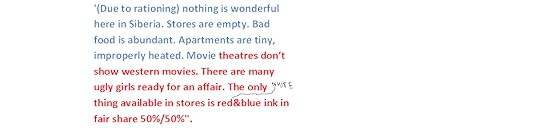
In the Introduction, Ian Parker, as a way to portray the typical Slovenian philosopher, quotes an ex-German Democratic Republic joke, Žižek usually tells the audiences.

"A German worker gets a job in Siberia. Aware how all mail will be read by censors he tells his friends 'Let's establish a code. If a letter you will get from me is written in ordinary blue ink it is true. If is it written in red ink it is false'. After a month his friends get the first letter from Siberia written in blue ink where they are able to read 'Everything is wonderful here in Siberia. Stores are full. Food is abundant. Apartments are large, properly heated. Movie theatres show western movies. There are many beautiful girls ready for an affair. The only thing unavailable in stores is red ink".

Yes, what TRUTH can you possibly extract from the previous joke?!

Let's just suppose his fellows had received this letter:

(press on the text for a better reading)

Ian Parker is quite adamant on telling us Žižek is not a Marxist. Do you believe him? (or both?).


"Slovenia has, however, a reputation disproportionately large for its size when it comes to the world of ideas. This state of affairs is due to the work of Slavoj Zizek, a fifty-four-year-old Lacanian-Marxist philosopher from Ljubljana, the capital of Slovenia. Zizek, who has been translated into more than twenty languages, has written books on subjects as wide-ranging as Hitchcock, Lenin, opera, and the terrorist attacks of September 11th. In the fifteen years since he started publishing in English, Zizek has established himself as a thinker whose views are worth paying attention to - if not always taking seriously, since always to take Slavoj Zizek seriously would be to make a category mistake.
...
"You probably saw the movie 'Minority Report' in which people are arrested before they commit the crime," he said. "Why does this sound familiar? This is the new model for international relations."
The NYer, How a philosopher from Slovenia became an international star; by Rebecca Mead

"Lenin's legacy, to be reinvented today, is the politics of truth"
Slavoj Žižek


Žižek is the Yugoslav-born (to communist parents) intellectual who started by studying and getting a degree in Sociology and Philosophy, however, the then-authorities looked at his academic work as “ideologically unsuited”. He then got into German translation work.

The philosopher experienced the life in Yugoslavia, and, most relevant, the disintegration of the self-managed socialist nation/brotherhood. Slovenia was the first nation to become independent. Žižek knew what dissent was. Later on, after meeting with French intellectuals (especially with the work of Jacques Lacan), he would become the president of the Society of Theoretical Psychoanalysis.

In our days he’s a communist* with conviction, but also an atheist who thinks churches should be turned into “grain silos and palaces of culture”. No doubts, he’s the Lacanian soldier, a sort of “apostle” of the “ANTAGONISM” …of the Left.

Recently I have watched the debate between Žižek and the British novelist and polemicist Will Self. The latter insisted many times on requesting the philosopher’s plan of action; yet, Zizek gave no plan, albeit he conceded with the Self’s expression “violence is on the table”. In that debate, Žižek said he was not for Grexit, nor for Chavez, though he admired Evo Morales’ vice in Bolivia, for his “rationality”. In the US, he endorsed Bernie Sanders. Will Self, was especially critical on Lacan whose sole great contribution was to lengthen psychoanalysis sessions…to get "more money".

Truly, (for me) Žižek the “idealist”, on October the 2nd, 2011, has participated in Australia in a conference named “Let us be realistic and demand the impossible: communism”. You figure.

The present book is good in showing the biographical trajectory of the Yugoslavian writer, and clarifying his positions in regards to being an “Hegelian” and a “Lacanian”. Maybe due to a certain sense of admiration, Ian Parker lets it escape: the contradictory aspects of Žižek . Parker though, circumvents it easily, by suggesting the “apparently willful contradictions” are integral part of the philosopher’s work. Still, some (true) communists are very critical on Žižek.

The last part of the book is dedicated to the cultural approach of the Slovenian writer. And here I see some good insights when you read Žižek on films, and ideology. …and commodities such as Kinder chocolates, or coffee from Starbucks.

You may laugh a lot from his jokes.

*"complicated communist" as some say.


P.S. Back to our previous joke, it seems that the above German "friends" got this message during the perestroika and glasnost times:
(press on text for better reading)


UPDATE

Zizek cannot stop dreaming about a communist society. Maybe the Coronavirus will help. Even "the reinvention of communism".

https://www.rt.com/op-ed/481831-coron...

Maybe not.

UPDATE

I reckon I've been very critical on Zizek. This article on The Guardian, however, raises good, timely questions, I must recognize. Especially this one: "A question like “Did US intelligence-sharing with Ukraine cross a line?” makes us obliterate the basic fact: it was Russia itself which crossed the line, by attacking Ukraine." Zizek is scoring, let's give in. Just for a while.
in: https://www.theguardian.com/commentis...

UPDATE

On Matrix Resurrections

https://www.spectator.co.uk/article/a...

UPDATE
(apropos ChatGPT)
https://www.sublationmag.com/post/cha...

UPDATE

https://m.hani.co.kr/arti/english_edi...

UPDATE

https://www.sublationmag.com/post/a-p...
Profile Image for Ramzey.
104 reviews
March 22, 2023
Excellent book deconstructing Slavoj Sizek philosophical views which is really hard to get a grasp on.

This booked helped me get a much clearer picture of him, he is a sophist and fake intellectual Marxist and a wolf in a sheep clothing.


Sizek is a right Heglian masquerading as a left Heglian.
The right Heglian is apparent in the split between individual particularity for which bourgeois individualism and a strong sense of tradition to secure order.

He uses Lacan as a kind of grid to read all political phenomen.
Sizeks discourse is schizophrenic split between a highly sophisticated Lacanian analysis and an Insufficent deconstructed Marxism. Zizeks thought is not organised around a truly politcal reflection but is , rather pscychoanalytic discourse which draws it examples from the politico-ideological field and becomes more problematic when the psychoanalytic act is used a s model for political change.


When we turn to Marx and Marxist politics there is a further significant asymmetry. Zizek is working with an understanding of the political domain that takes Marxism as a conceptual matrix for theorizing class struggle, independently of any particular empirical analysis of the ownership of the means of production. In this respect he does indeed follow the post-structuralist shift of attention from the economy to the cultural domain a domain that he treats as if it were a kind of signifying superstructure without any determinate signified or referent. Even the economy is then evoked as a point of the real in and against as the constitutive limit of the superstructure. This also means that some Hegelian work has already been done on the Material that Marxism concerns itself with. such that the appearance of things can be treated as itself the essence, rather than shadow theater for another realm behind it which can be scientifically disclosed to the experts.

Zizek already departs from a Lacanian view of the psychoanalytic act in the clinic when he insists that in the sphere of politics there is some kind of suspension of the symbolic, that an act will take place outside the symbolic and thus change the symbolic coordinates. He now goes further to claim that not only can the symbolic be transformed by an act, but that the real can be touched and transformed: the true act is precisely as Lacan puts it that which changes the real itself. This deliberate elision of claims for the act as something that can change the symbolic coordinates and claims that it can change the real presumably because it restructures the role of antagonism in the constitution of the social is Zizeks's way of resserting Marxist notions of class conflict against fascism foreclosure of the political in the service of Capital.


With respect to the motif of anti-humanism we also find in Zizek a motif of the finding of wealth in poverty that reads more like a sermon than a call to revolutionary socialism: In love I am also nothing, but as it were nothing humbly aware of itself, a nothing paradoxically made rich through the very awareness of it's lack. This is miles away from Marx own call in his critque of Hegels philosophy of right for the abolition of religion as the illusory happiness of the people s that man will think act and fashion his reality like a man who has discarded his illusions and regained his senses so, that he will move around himself as his own true sun. With respect the influence of Hegel, Marx tackles antisemitism on the Jewish question but fortunately in a such a way to license a reading of his call for the abolition of Jewish religion along with abolition of all religion as itself antisemitic. Marx argument is that emancipation of Jewishness as such is also, for the Jew Necessarily emancipation from the position allotted to the Jew by Capitalism, and marx here is elaborating an analysis of structural anti-semitism under capitalism that does prefigure some of Zizeks own comments on the figure of the Jew conspires and manipulates the things behind the scenes is a comforting and paranoiac explanation for the crisis of capitalism. however there is a rapid slippage in Zizeks account of the fantasy of the Jew to an analysis of the jewish religion as such, and here the problem piles up. Zizeks analysis picks up Hegel's framing of the historical sequence by which Christianity succeeds Judaism, a sequence that does also appear in Marx writing. After noting that the way to make religious opposition dissapear is to abolish religion. Marx argues that the Jew and the Christian should recognize their respective religion as nothing more than different stages in the development of the human spirit, as snake-skins cast off by history, and man as the snake which wore them, and they will no longer be in religious opposition, but in purley critical and scientific human relationship. what marx is aiming at here is a time when that the historical sequence will be unimportant, but what zizek always aims at is the sequence itsel as the key to unlocking how it might be possible for the individual subject to move from law to love, from Judaism to Christianity. What sizek actually takes from Marx, then is not an analysis of political economy, still less ownership of the means of production(which Zizek sees as historically redundant= but some abstract notion of historical development social and indiviudal that repeates anti-semetic imagery.
Profile Image for Steven R. Kraaijeveld.
562 reviews1,923 followers
February 8, 2012
I personally would call this an analysis of Žižek and his work, rather than an explicit introduction to it as such. Primarily because the concepts that are tackled do not get defined and explained at an elementary level for the neophyte. That is to say, if you do not have a basic knowledge of especially Hegel and Marx, you may be reaching for your encyclopedia or searching the internet to supplement and follow the text.

Having said that, this is an excellent guide to Žižek's thought; Parker is both critical (as the title suggests) of Žižek but at the same time shows a tender kind of solidarity with him. The book has a clear logic to it: first Žižek's background in Slovenia, then his reading of Hegel, followed by Lacan and then Marx. The final chapter (on the cultural aspect of his work) is the most engaging in my opinion, and finally gives body to some of the criticisms of Žižek's approach that had already been alluded to in previous chapters. This final chapter also speculates as to 'what Žižek is doing' - why the peculiar combination of theories (Hegel-Lacan-Marx) interspersed sporadically in his often erratic text? It is definitely worth the read if only to find out what Parker's take on these questions is.
22 reviews2 followers
June 15, 2020
So you're a terminally online millenial/zoomer who wants to be cool and bandy around Zizek like you see all those elite whitepilled chads you see. But there's one problem: you're kinda dumb and haven't read any of the works that Zizek is working off of.

Fear not, Springer is here for you, as ever. I read this years ago before my true deep dive into the Western Canon and dear god am I glad I did as opposed to reading The Sublime Object of Ideology or whatever. Like it or not, Zizek is a titanic influence on contemporary discourse and like all "great thinkers" must be treated within the historical context of their arising. Zizek himself would agree with this statement.

Parker does an admirable job of demystifying and contextualizing Zizek iconoclastic writings. When dealing with a writer who is intentional obtuse as a methodology, I think Parker did as good of a job as is possible in explicating what's going on behind the slavic mutter. This writing opened up the ground of the western canon for me in a way nothing had previously, it allowed me first access into the fractal of Western Phil.

I'm only rating it three stars because it shouldn't have to exist.
Profile Image for Dave.
1 review
March 11, 2022
much more critical than it is an introduction - an interesting analysis if you already understand most of the concepts taken into consideration
Profile Image for Michael.
20 reviews6 followers
May 5, 2007
A first-rate introduction to the work of Zizek, acknowledging the real scope of his influences. The chapter breakdown helps any new student to Zizek's ideas, and offers good detail and insights for the reader more familiar with Zizek's work. The final section, which addresses Zizek's critics, is a little narrow in scope in that it only looks at those who accept Zizek's terms of debate ('taking Zizek at his word'), but Parker doesn't hesitate to disagree forcefully and sometimes even fundamentally from Zizek's thinking.
Displaying 1 - 8 of 8 reviews

Can't find what you're looking for?

Get help and learn more about the design.