What do you think?
Rate this book


368 pages, Kindle Edition
Published October 17, 2023
What makes a person the same person over time? Is it our consciousness, the what-it’s-like to be us? Is consciousness like a light that’s either on or off?--------------------------------------
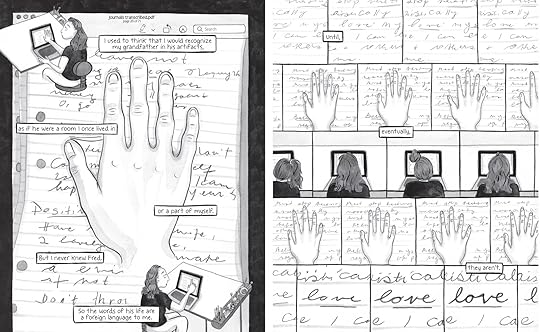
What remains of a person once they’ve died? It depends on what we choose to keep.Amy Kurzweil is a long-time cartoonist for The New Yorker. If the name sounds a bit familiar, but you aren’t a reader of that magazine, it may be because her father is Ray Kurzweil. He is a genius of wide renown. He invented a way for computers to process text in almost any font, a major advance in making optical character recognition (OCR) a useful, and ubiquitous tool. He also developed early electronic instruments. As a teenager he wrote software that wrote music in the style of classical greats. No gray cells left behind there. He happened to be very interested in Artificial Intelligence (AI). It helps to have a specific project in mind when trying to develop new applications and ideas. Ray had one. His father, Fred, had died when he was a young man. Ray wanted to make an AI father, a Fred ChatBot, or Fredbot, to regain at least some of the time he had never had with his dad.
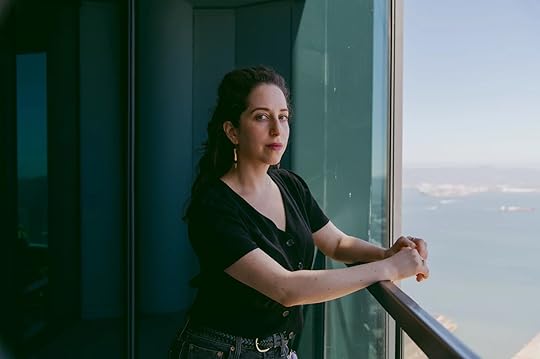
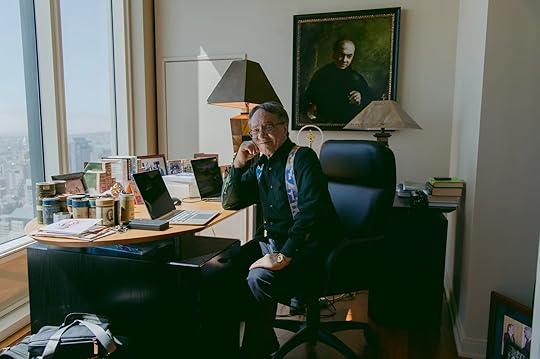
I always understood my father’s desire to resurrect his father’s identity as being connected to two different kinds of trauma. One is the loss of his father at a young age in a common but tragic scenario, with heart disease. The other trauma is this loss of a whole culture. Jewish life in Vienna was incredibly vibrant. Literally overnight it was lost. The suddenness of that loss was profound, and it took me a while to appreciate that. My great-aunt Dorit, who died this past year at 98, said they were following all the arbitrary protocols of the Nazis to save all this documentation. Saving documentation is an inheritance in my family that is a response to that traumatic circumstance. - from the PW interviewKurzweil looks at three generations of creativity, (Fritz was a top-tier musician. His wife, Hannah, was an artist. Ray was also a musician, but mostly a tech genius. Amy is a cartoonist and a writer.) using Ray’s Fredbot project as the central pillar around which to organize an ongoing discussion of concepts. In doing so, she offers up not merely the work of the project, but her personal experiences, showing clear commonalities between herself and her never-met grandfather. This makes for a very satisfying read. Are the similarities across generations, this stream of creativity, the impact not just of DNA, but of lived experience? Nature or nurture, maybe the realization of potential brought to flower by the influence of environment whether external (living in a place that values what one has to offer) or internal (families nurturing favored traits)?
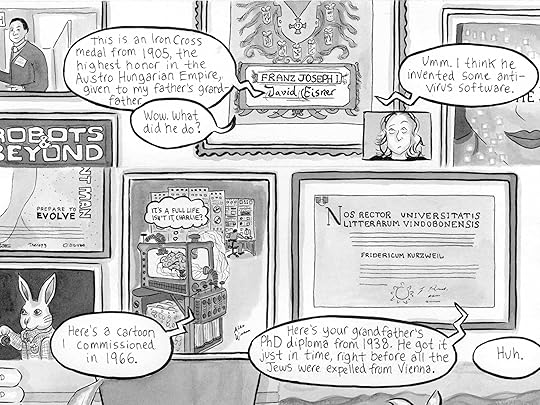
I used to wonder if I could wake up into a different self. For all I knew, it could have happened every morning. A new self would have a new set of memories.Review posted - 01/12/23


AMY KURZWEIL is a New Yorker cartoonist and the author of Flying Couch: A Graphic Memoir. She was a 2021 Berlin Prize Fellow with the American Academy in Berlin, a 2019 Shearing Fellow with the Black Mountain Institute, and has received fellowships from MacDowell, Djerassi, and elsewhere.Interviews
She has been nominated for a Reuben Award and an Ignatz Award for “Technofeelia,” her four part series with The Believer Magazine. Her writing, comics, and cartoons have also been published in The Verge, The New York Times Book Review, Longreads, Literary Hub, WIREDand many other places. Kurzweil has taught widely for over a decade. See her website (amykurzweil.com) to take a class with her.
A work of art begins by opening to us the inner life of its creator; it ends by revealing us to ourselves.