"This gracefully written history of twentieth-century gravity research" brings to life the discoveries and developments that confirmed the theory of relativity (Publishers Weekly, starred review).
Albert Einstein did nothing of note on May 29, 1919, yet that is when he became immortal. On that day, astronomer Arthur Eddington and his team observed a solar eclipse and found something extraordinary: gravity bends light, just as Einstein predicted. The finding confirmed the theory of general relativity, fundamentally changing our understanding of space and time. A century later, the Event Horizon Telescope examined the space surrounding Sagittarius A*, the supermassive black hole at the center of the Milky Way, to determine whether Einstein was right on the details.
In Gravity's Century, award-winning science writer Ron Cowen brings to life the incredible scientific journey between these two events and sheds light on their groundbreaking implications. From the development of radio telescopes to the discovery of black holes and quasars, and the still-unresolved place of gravity in quantum theory, Cowen breaks down the physics in clear and approachable language. Gravity's Century vividly demonstrates how the quest to understand gravity is really the quest to comprehend the universe.
This was such a wonderful surprise of a text in that it deals with some of the most interesting topics in modern physics, is written in a wonderfully readable style in a very efficiently slim volume, yet comes from an author I had never heard of.
The topic of gravity is both plain and endlessly complicated in that most of our day-to-day notions of this are still beholden to Newtonian theory, which certainly functions at our human macro level, yet the advances made by Einstein in this area are still wildly misunderstood or simply ignored by most as they pertain to action on a cosmological scale. The explanatory power of his incredible early 20th century work on the subject is proved so conclusively with each passing decade, producing ever more incredible feats of technological machinery with which to test his hypotheses.
This volume takes you from Einstein's writings in 1905 through the present and discusses how his notions of gravity as a subject of both general relativity and quantum mechanics have played out among great figures of the 20th and 21st centuries, and just how close we are to perhaps uniting these concepts in a single coherent theory. What makes for even more interesting reading are the episodes of genuine observation, both sonic and visual, of the more obscure elements of this theory. The current workings of both LIGO and the EHT are discussed towards the close of the book and deserve wide readership.
Some people were alerted to this work in the popular article in several periodicals detailing our observation of gravitational waves for the very first time. Ron Cowen explains just how that was achieved and also just how significant that is not merely as a product of verifying the work of such a singular genius but also for furthering our understanding of the cosmos. Study of this specific area, including direct observation of neutron star and black-hole collisions, is still in its infancy yet it remains the most fascinating area of study in physics today, standing on the shoulders of the giant of the field.
Lots of interesting info, some of which I hadn't heard before and much I had. Good analogies for science-is-magic fools like myself who don't have the underlying mathematical chops to actually understand the information, though this book went deeper into that realm than others I've read.
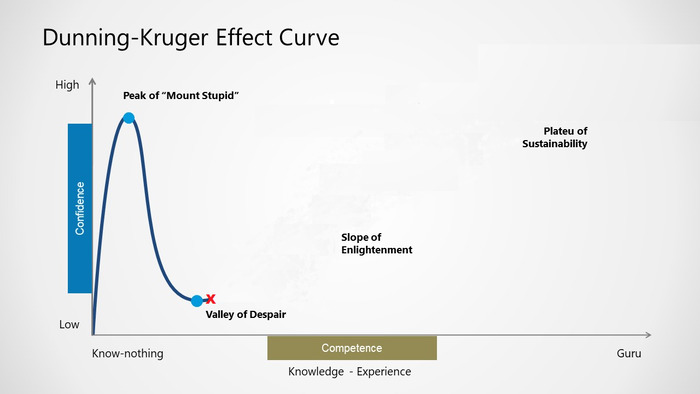
This pretty much illustrates where I land on the Dunning-Kruger effect when it comes to math-heavy sciency things, though I'm still entertained enough to keep trying:
Very accessible book that is an overview of the scientific understanding of gravity, starting with the theories and observations of Galileo and Newton. The bulk of the book is an explanation of Albert Einstein’s general theory of relativity or the geometric theory of gravitation, that gravity can be understand by how mass curves spacetime.
The author goes into the history of the understanding of gravity prior to Einstein’s 1915 general theory of relativity, the history of the development and reception of the theory, and the century since then of scientific exploration in confirming Einstein’s theory and its implications.
The author focused in particular on two scientific studies that bookend this century of gravity. The first bookend is on May 29, 1919, when British astronomers Arthur Stanley Eddington and Frank Watson Dyson did an observational test of general relativity, hoping to confirm Einstein. They set up an experiment to test if the star light visible near the Sun during a total solar eclipse was deflected by the gravity of the Sun, as Einstein predicted it would be. This experiment, detailed in the book, involved two expeditions, one to Principe in West Africa and another to Sobral, a town in Brazil.
The other bookend is how the Event Horizon Telescope, not a single telescope but rather a large array of radio telescopes around the world, combining data from very-long-baseline interferometry stations to produce in 2019 the first direct image of a black hole, in essence the author discussing how we went from seeing in 1919 if gravity deflected light at all to in 2019 watching how light was deflected by distant black holes.
Along the way, despite a few equations, the book is a very accessible introduction to the science of gravity, brilliantly discussing how space is curved by mass, the effects the curvature of spacetime have on light, and such concepts as gravitational lensing, the geodetic effect (and how this was experimentally confirmed), frame dragging, the equivalence principle, a good bit on the science of neutron stars, a lot on the science behind black holes (including a brief discussion of the movie _Interstellar_ depiction of a black hole), theories about a holographic universe, and the science of gravitational waves, including discussions of the LIGO and Virgo interferometers to detect gravitational waves, predicted by general relativity.
I really appreciated the excellent discussions linking in my mind things that I had never thought about before, that I had for instance heard of gravitational lensing and how light cannot escape a black hole, but I never imagined for some reason the linkages between these two phenomenon.
It wasn’t dry at all and a few parts were actually mildly funny. I didn’t think the segments on the personal lives of Einstein and of Eddington were too much (which were quite interesting), as well as the brief discussion of Karl Schwarzschild, another important physicist attached to general relativity, with both of the latter two had lives negatively impacted by World War I. I also liked the discussion of some of the mathematicians that were influential on Einstein, most particularly and for me memorably Carl Friedrich Gauss, whose mathematical work was fundamental to development of the theory of relativity.
I recommend reading _Black Hole Blues and Other Songs From Outer Space_ by Levin Janna for more on LIGO and gravitational waves. I also recommend _ Einstein's Shadow: A Black Hole, a Band of Astronomers, and the Quest to See the Unseeable_ by Seth Fletcher for more on the Event Horizon Telescope and the first ever direct image of a black hole.
"Gravity's Century" is a lot better than its title. Full of scientific information and explanations, it discusses many more things in intelligent detail than only gravity.
I listened to it on audiobook but I think this is one where having the information written for me would’ve helped me make more sense of it. But I still got something out of it.
Another one of those books that has a huge amount of content. For my own purposes I like to try and summarise but it’s pretty difficult with the range of material in this book. However, I’ve made an attempt with the following extracts to capture the main themes. In place of Newton’s idea that a massive body pulls objects toward it because it exerts a gravitational force, the general theory says that a massive body distorts or dimples space-time so that objects fall toward it, Gravity equals curvature. ...And because Einstein’s famous formula, E = mc2, says that mass and energy are two different forms of the same entity, both can generate curvature. With one notable exception, Newton’s law of gravitation works beautifully in the relatively weak field of the solar system. But it fails to describe the motion of stars zipping around a black hole or another extremely dense, massive body. ,,,,For example, although the orbits of all the planets precess, it’s only Mercury’s whose deviation from Newtonian gravity is large enough to be easily detected.
With the General Theory, knowing he was in over his head, Einstein turned to his college classmate Marcel Grossmann with a plea for help. Grossmann, who had become a mathematics professor specializing in geometry at their alma mater, was happy to oblige. While Einstein skipped classes (especially mathematics) that didn’t interest him and developed a reputation as a rebel who resisted instruction and alienated his teachers, Grossmann was organized, well liked, and studious. His carefully annotated notebooks on class lectures proved a lifeline for Einstein, keeping him on the path to graduation.
Knowing all too well his own [Farkas Bolyai’s] exhaustion in trying to prove the theorem, he warned his son that the study would rob him of health, peace of mind, and happiness. “I know this way to the very end,” he wrote his son in 1820. “I have traversed this bottomless night, which extinguished all light and joy in my life. I entreat you, leave the science of parallels alone.… Learn from my example.” When Bolyai contacted Gauss [about his hyperbolic geometry] the venerable mathematician refused to praise him, asserting that he himself had found, though never published, a similar geometry years earlier. Indeed, Gauss often did not publish work he deemed controversial. He would not publicly go against the prevailing thinking Both Bolyai and Lobachevsky died without knowing their work would have a lasting impact. A discouraged Bolyai became a recluse, leaving behind 20,000 pages of mathematical manuscripts at his death at age fifty-seven in 1860. A few years later, Lobachevsky also died in obscurity, nearly blind and unable to walk.
He [Gauss] also demonstrated that a single number, the Gaussian curvature, could fully describe the curvature of a surface, such as that of a cylinder or sphere. For his doctoral thesis, supervised by Gauss and completed in 1851, Riemann showed that a set of exotic numbers, those with a component proportional to the imaginary number square root of − 1, could be expressed as a curved surface. Riemann finally delivered his talk, “On the Hypotheses That Lie at the Foundation of Geometry,” on June 10, 1854. Gauss may have been the only one in the audience to fully comprehend the implications of Riemann’s talk, but experts have since hailed the lecture as one of the most farsighted in the history of mathematics. Riemann was only twenty-seven.
Because a curved surface can vary in a complicated way, Grossmann had to teach Einstein about tensors, mathematical objects that keep track of more than one variable at a time. In particular, Grossmann introduced Einstein to the Riemann tensor, which directly measures the curvature of space.
In October 1914, ninety-three German scientists signed a proclamation giving their unqualified support to the German military. Einstein refused to sign the “Manifesto of the Ninety-Three” and instead was one of just four scientists to endorse a proclamation protesting Germany’s aggression.
He was not the only one working to revise his theory, Sommerfeld wrote. Hilbert also believed the “Entwurf” work was flawed and was formulating his own version. In one of the most remarkable discoveries of the twentieth century, he finally unveiled the right solution to describe the inviolable link between space-time and gravity / matter-energy. Einstein’s compact equation takes up but a single line: Rμν − 1/ 2R gμν = 8πGN/ c4 Tμν .........It has revealed that the universe is expanding, that spinning objects drag space-time along with them the way the blades of a blender drag pancake batter, and that gravity acts as a zoom lens to reveal some of the first galaxies born in the universe, nearly 14 billion years ago. So we can symbolically write the equation in a much simpler form, suggests astrophysicist and author Jean-Pierre Luminet: G = T Here, G stands for the geometry of space-time and T stands for matter. Geometry equals matter. That’s what it boils down to. The boldface indicates that G and T are not mere numbers. They are tensors, because they keep track of more than one direction or variable. Moreover, in general relativity, each tensor has ten independent components, so the single formula represents ten equations.
Einstein suggested gravity as a force that acts across space with the idea that gravity is space. Specifically, he said, space and time, instead of being stiff and unchanging, are as jiggly as Jell-O. A massive body warps or curves this wobbly space-time much the way a heavy sleeper sags a mattress.
According to the Cambridge Daily News, the chair of the committee, a Major S. G. Howard, “suggested that Prof. Eddington’s ability be better employed in active prosecution of the war if placed at the disposal of the Government.” In reply, Eddington stood and declared, “I am a conscientious objector.” During the darkest days of World War I, with the German army shelling Paris, Eddington and his team of British astronomers got the official go-ahead to test a strange new theory proposed by a German-born scientist who published his work behind enemy lines. Not only that, but if Einstein was right, it would topple Newton,
But during the analysis, it was decided to exclude all the flawed Sobral images, rather than just giving them lower statistical weight. Historians have accused Eddington of doing so in an attempt to force a solution that would prove Einstein right.
Eddington meant that although he believed the observations confirmed the light bending predicted by Einstein, the study did not prove Einstein’s claimed source for the bending—the curvature of space-time.
Einstein was not the first to suggest that light is bent by gravity. Newton himself raised the possibility. At the end of his 1704 treatise, Opticks, the sixty-one-year-old scientist asked a series of questions that he felt he did not have time to investigate but hoped others might. Query number one read: “Do not Bodies act upon Light at a distance, and by their action bend its Rays; and is not this action … strongest at the least distance?”
In 1783, the English astronomer and clergyman John Michell took Newton’s notion of light bending to an extreme and calculated that some objects have such strong gravity that no light could escape—a black hole, in modern parlance.
Like today’s accusations of fake news, the fake charges against Einstein went viral. They spilled over to the United States when Arvid Reuterdahl, the dean of the engineering school at the College of St. Thomas in Minnesota, repeated Lenard’s claims. His criticisms were published in detail in the Minneapolis Tribune. Ultimately, the furor died down when experiment after experiment confirmed the light bending predicted by Einstein.
For once, Einstein bowed to the observational data gathered by astronomers. He hated to tinker with his perfect, mathematically elegant theory. But to save the universe in his theory from collapsing or expanding, he inserted a fudge factor: a constant that was denoted by the Greek letter lambda (λ) and would come to be called the cosmological constant.
Alexander Friemann [Russian], in 1922, found that, depending on the numerical value of Einstein’s cosmological constant, a static universe was just one of several possible scenarios allowed by Einstein’s theory. The universe could also expand, contract, or oscillate between contraction and expansion. In 1929, Hubble confirmed Lemaître’s work, using observational data to formally demonstrate the linear relationship between speed (redshift) and distance. The speed at which galaxies were receding from Earth was proportional to their distance. Those that resided twice as far from Earth were speeding away twice as fast, those that were four times more distant were fleeing with four times the speed, and so on.
At that point, Peebles made what might have seemed an outlandish suggestion. He proposed that most of the matter in the universe was invisible and interacted only through its gravity. Since it did not interact with light, this invisible material, or dark matter, would generate smaller lumps in the CMB than ordinary matter; that would explain why no one had yet seen evidence of it. By the 1970s, Zwicky’s crazy idea didn’t seem so crazy.
But Rubin found that the stars at the outer edge rotated just as rapidly. She concluded that the galaxies had to lie inside a halo of dark matter—and that there had to be ten times as much of it as there was visible material. .....And in 1992, NASA’s Cosmic Background Explorer satellite finally found evidence of the tiny hot and cold spots in the CMB that one would expect if dark matter ruled the universe. ....Observations of the size of the hot and cold spots in the CMB had revealed that the universe was flat on a large scale—that is, the angles of a triangle would always add up to 180 degrees and parallel lines would never meet.
But measurements of the actual amount of mass in the universe—both visible matter and dark matter—had come up drastically short. There simply wasn’t enough matter of any type to keep the universe flat. Where was the missing stuff? ......After some soul-searching, astronomers and cosmologists had to accept the notion that gravity had a flip side. Some kind of invisible, mysterious energy fills the universe, turning gravity’s pull into a cosmic push. ....Cosmologists call this mysterious force dark energy. But it could just as easily be called the cosmological constant. ......If dark energy does have a constant density, spread evenly throughout space, then it would indeed resemble the cosmological constant, that feature that Albert Einstein inserted into his theory of gravitation in 1917. ......After Einstein conceded that the universe was indeed expanding, he disowned the constant, reportedly calling it his greatest blunder. But he may have been right after all.
The equation Einstein presented to the Prussian Academy of Sciences on November 25, 1915, was elegant, but it symbolized ten coupled, nonlinear equations. Each equation dealt with all four dimensions (three of space and one of time). Einstein himself had only found approximate solutions to his suite of equations.
Chandrasekhar found that for a white dwarf greater than about 1.4 times the mass of the Sun (corresponding to a star that began its life at least 8 times heavier than the Sun), electron pressure would be no match for gravity. The star would continue to collapse until its radius was no bigger than the size of a city, about 10 kilometers. Gravity would squeeze nuclei so tightly that electrons and protons would fuse to form neutrons.
black holes. The objects remained a mathematical curiosity until the early 1960s, when astronomers discovered quasars, compact objects whose blazing light was believed to be fueled by monster black holes.
Observations suggest that a giant black hole lurks at the core of every large galaxy, where it governs the galaxy’s formation and growth.
The Gaia satellite, launched in 2013 by the European Space Agency, is poised to record the positions of billions of stars to an even higher degree of accuracy—about 20 millionths of an arcsecond—and is expected to see the effect of light bending by the Sun in every single one of its measurements.
But the most spectacular aspect of light bending emerged from a calculation Einstein did in 1912, three years before he completed the general theory of relativity. He showed that the most powerful magnifying lenses aren’t on Earth but in the sky. Einstein described the properties of a gravitational lens........Astronomers observed the first gravitational lens, a double image of a distant quasar, in 1979. Six years later, another team found four images of a different quasar, arranged in a cloverleaf pattern. In the years since, astronomers have found about 1,000 examples of gravitational lenses that produce multiple images of a celestial body.
Dark matter, the mysterious material now believed to outnumber the amount of visible matter in the cosmos by nine to one, can’t be seen. But this ghostly material betrays its presence through its gravity—how much it bends light from a distant body. ....Dark energy and dark matter, the primary sources of gravity, are essentially in a tug-of-war: dark matter pulls material together, while dark energy tries to pry it apart. The amount of clumping in the universe is the direct result of that epic battle.
Quantum theory describes the material universe in terms of probabilities and uncertainties, while relativity assumes that space and time can be well defined down to the tiniest levels. ......The clash between relativity and quantum theory hints that something is deeply wrong at the heart of physics. That’s exciting because it suggests there may be something brand-new, waiting to be discovered. A breakdown of relativity could even reveal that a previously unknown force is at play in the universe.
But measurements of the pair’s motion [a white dwarf and a pulsar] reveal that despite differences in their mass and composition, the neutron star and the white dwarf fall at the same rate, to within 0.16 thousandths of a percent of each other. The finding confirms the equivalence principle in the extremely strong gravitational environment of a neutron star, where the full theory of general relativity is required.
The other fundamental forces in nature—the electromagnetic force between electrically charged particles and the strong and weak nuclear forces that affect particles inside the atomic nucleus—all have a successful quantum theory. But even Einstein, who spent years trying to unify gravity and quantum theory, failed to do so.
But in [2010] Van Raamsdonk, had entered a shorter version of his paper [about marrying the General theory of relativity with quantum mechanics] in the Gravity Research Foundation’s annual essay contest, a prestigious competition Not only did Van Raamsdonk win first prize, but the award came with a delicious irony: guaranteed publication in one of the journals that had rejected him. General Relativity and Gravitation printed the shorter essay in June 2010. .....Einstein’s theory of gravity predicts that space-time is as malleable as Jell-O but does not dabble in quantum uncertainties. An electron may go through two slits at once, but relativity allows for no corresponding splitting of the electron’s gravitational field. ....But Van Raamsdonk and a cadre of other scientists approached the problem from the other direction: they started with the statistical nature of quantum theory. What they found, to their surprise, is that they could stop right there. Quantum theory, their calculations revealed, already encodes the essence of geometry, and by extension Einstein’s space-time theory of gravity. ......More precisely, Van Raamsdonk and his colleagues propose that space-time as we know it—smooth, connected, continuous—emerges from the very quality of quantum mechanics that Einstein believed would ultimately discredit the theory. That property, known as quantum entanglement, is one of the weirdest concepts in physics. ....It states that the measurement of one subatomic particle instantaneously determines the state of a partner particle—even if the two reside on opposite sides of the Milky Way. For Van Raamsdonk, the hologram idea was similar to a three-dimensional video game operated by a two-dimensional memory chip. All the three-dimensional information could be read off the two-dimensional chip. The chip and the video game each provide a complete description of the action.
But scientists found that the amount of entropy stored within a black hole is revealed not by its volume but by its surface area—in particular, the area of its event horizon, the spherical boundary inside which particles remain forever gravitationally trapped. The larger the event horizon, or area, of a black hole, the larger its entropy. ...... In this view, the area of an event horizon isn’t merely proportional to a black hole’s entropy; it is the entropy.
Specifically, Maldacena calculated a mathematical equivalence—what physicists call a duality—between a quantum field theory that resides on the surface, or “boundary,” of the universe and does not contain gravity, and a quantum field theory that describes the volume of the universe, or “bulk,” and does include gravity. .....In the absence of entanglement, space time consists of little chunks but Brian Swingle’s view is that entanglement knits the chunks together into smooth space time......It was the ultimate plot twist, Van Raamsdonk thought. Scientists had labored for years trying to figure out how to incorporate quantum mechanics into the study of space-time and gravity. Yet all along, quantum mechanics had contained the ingredients from which emerged space-time—and, by extension, Einstein’s geometric theory of gravity. [The idea remains a conjecture]
Maldacena and Susskind conjectured that anytime two subatomic particles are entangles, they may be connected by a tiny quantum version of a wormhole.....So if entanglement gives birth to wormholes, it may give birth to Einstein’s geometric theory of gravity as well. .....Knowing the connection between entanglement and space-time lends insight but still does not provide a complete theory of quantum gravity. ....The goal is to understand quantum gravity by reformulating interesting gravitational questions in the language of field theory, which physicists understand well. But it isn’t always clear how to do the translation.
I've run out of space for my review but certainly worth five stars from me.
I do not read much non fiction except when it overlaps with my keenness for real science based science fiction. I just love the reality based section of the genre and feel that it feeds an imagination that demands believability written into the core of any plot. My own writing reflects this and so I require an education and sustenance to inform and allow me to weave science into my stories with books exactly like Ron Cowen's Gravity's Century. Ron's writing is brilliant in explaining the science behind the strides in Physics and Astronomy since Einstein developed his Theory of Relativity in such a way that I can grasp and understand. Even I, only armed with Physics 'A' Level sat far too many years ago, get it and the history lesson is marvellous. The lengths that scientists went to in order to prove Einstein's theory and how they solved the missing bits of their understanding ending with how to create a telescope the size of Earth in order to image a black hole. Okay yes I realise that they didn't actually record an image of a black hole but rather the accretion disk spinning around it but the point being is that if you ever think that science fiction is a little staggering to believe then you need to start looking at real science. Some of the sections covered I already knew about from other readings e.g. LIGO's proof of the existence gravity waves, but this book explains everything so well and puts it all into context with the other breakthroughs in Physics in such a great way peppering the narrative with personal events to keep it from being too dry. I will say that this book while pitched just right for my brain does require a lot more concentration than normal to stay on topic and grasp the consequences of this compelling book. Despite which, never before has that level of concentration been so well rewarded.
Gravity’s Century: From Einstein’s Eclipse to Images of Black Holes by Rob Cowen
“Gravity’s Century” provides a historical account of gravity. Award-winning science writer Rob Cowen takes the reader on a journey of discovery in which general relativity plays a prominent role. This interesting 180-page book includes the following eight chapters: 1. Genesis, 2. From Turmoil to Triumph, 3. Eddington on a Mission, 4. Expanding the Universe, 5. Black Holes and Testing General Relativity, 6. Quantum Gravity, 7. Hearing Black Holes, and 8. Imaging Black Holes.
Positives: 1. Accessible and well-written book. 2. The fascinating topic of general relativity and black holes. 3. At only 180 pages and with optional deeper dive sections this book is accessible and brief. Cowen keeps math to the minimum while complimenting the narrative with plenty of visual material. 4. Easy to follow format and provides deeper dive sections for readers wanting a more depth. 5. Capture the sense of awe of scientific discovery. 6. Interesting account of Einstein’s life that molded him into the scientist that he became. 7. Defines and explains key terms throughout the book. “Gravity is an equal-opportunity interaction—it affects all objects in the same way, regardless of their mass, size, shape, electric charge, or other properties.” 8. The characteristics of gravity. “But in 1911, Einstein realized that the Sun’s gravitational field should be strong enough to noticeably bend passing starlight. The effect could in theory be observed during a solar eclipse, when the Sun’s brilliant disk is dimmed. His prediction was validated by observations during the solar eclipse of 1919. It became the most celebrated confirmation of Einstein’s theory.” 9. Key concepts the resonated with me. “In this never-ending cosmic dance, as the theoretical physicist John Archibald Wheeler would later put it, mass tells space-time how to curve, space-time tells matter how to move.” 10. An excellent deeper dive section that explains the meaning of Einstein’s equation. “It has revealed that the universe is expanding, that spinning objects drag space-time along with them the way the blades of a blender drag pancake batter, and that gravity acts as a zoom lens to reveal some of the first galaxies born in the universe, nearly 14 billion years ago.” 11. Fascinating factoids. “Because of the amazing cosmic coincidence that the Moon is 1 / 400th the size of the Sun yet is 400 times closer, the Moon blots out the entire Sun, creating a total solar eclipse.” 12. The scientific experiments that confirmed Einstein’s theory of general relativity. Eddington concluded: “After a careful study of the plates I am prepared to say there can be no doubt that they confirm Einstein’s prediction. A very definite result has been obtained that light is deflected in accordance with Einstein’s law of gravitation.” 13. Solving the expanding universe issue. “In 1927, the French priest and physicist Georges Lemaître independently found a solution for an expanding universe using Einstein’s theory. Because he had access to telescope observations that Friedmann did not, Lemaître went further than his predecessor had. Lemaître asserted that a galaxy’s light is stretched in frequency by the expansion of space itself. The longer the light’s journey, the more the universe had expanded and the greater the light’s redshift, he predicted.” 14. Looks at the discovery that confirmed the Big Bang. “Ultimately, the researchers had to conclude that a faint microwave hiss bathed the entire sky. They didn’t realize they had discovered the cosmic microwave background (CMB)—the Big Bang’s leftover heat, the ancient radiation that first streamed freely into space when the cosmos was about 380,000 years old.” 15. Examines black holes. “Combining quantum theory with Einstein’s theory of gravity, Oppenheimer and Volkoff calculated that if the initial mass of a star was sufficiently large, its neutron-star core would be too heavy to resist gravity and it would undergo a further, catastrophic collapse. (Recent studies indicate that any neutron star greater than 2.16 times the Sun’s mass will succumb to gravity.) In a follow-up paper by Oppenheimer and his student Hartland Snyder, they described what would happen: “The star thus tends to close itself off from any communication with a distant observer; only its gravitational field persists.” A black hole is born.” 16. Dark matter and dark energy. “Dark energy and dark matter, the primary sources of gravity, are essentially in a tug-of-war: dark matter pulls material together, while dark energy tries to pry it apart.” 17. Discover one of the weirdest concepts in physics. I won’t spoil it. 18. The elusive quantum gravity. “The other fundamental forces in nature—the electromagnetic force between electrically charged particles and the strong and weak nuclear forces that affect particles inside the atomic nucleus—all have a successful quantum theory. But even Einstein, who spent years trying to unify gravity and quantum theory, failed to do so.” 19. Hearing black holes. “Although astronomers have long suspected that neutron star mergers could form a black hole, until now they had lacked strong evidence. The chirp that LIGO and Virgo heard from the August 17 event could indeed have been the birth cry of a black hole.” 20. A look at how to image black holes.
Negatives: 1. No formal bibliography. 2. No notes or links.
In summary, Rob Cowen does a wonderful job of taking the reader through the key events leading to the discovery of general relativity and the ramifications it has on our understanding of the universe. It’s written for the average layperson but also provides deeper dive sections for those wanting more. I recommend it.
Further recommendations: “Black Holes” by Brian Cox and Jeff Forshaw, “General Relativity” by Leonard Susskind, “Gravity” by Nicholas Mee, “Reality is Not What It Seems: The Journey to Quantum Gravity” by Carlo Rovelli, “The God Equation” by Mivhio Kaku, “The Irresistible Attraction to Gravity” by Luciano Rezzolla, “The Edge of Knowledge” by Lawrence M. Krauss, “Einstein” by Walter Isaacson, “Black Holes & Time Warps” by Kip S. Thorne, “The Grand Design” and “A Brief History of Time”by Stephen Hawking, “Death by Black Hole” and “Welcome to the Universe” by Neil DeGrasse Tyson”.
This is a narrative telling of some of the amazing developments in physics and astronomy over the past hundred years. Cowen begins with Einstein and relativity, and the confirmation of his theories based on observations during a solar eclipse in 1919. The tale continues through new understandings of the universe's expansion to deeper understandings of quantum phenomena and the emergence of "quantum gravity" and "dark energy" as forces at play in the universe. The culmination is the investigation of black holes and the amazing discoveries about the event horizon and quantum entanglement. There was definitely some science that went above my head, but Cowen does a great job of keeping the explanations clear and letting the story drive the narrative. This book will definitely stretch your mind and build your appreciation for the wonders of the universe.
Overall, I would highly recommend reading this for anyone interested in the history of science and the fascinating world of gravitational research.
"Gravity's Century" is a very engaging and informative book that explores the history of gravity research, from its early beginnings to its modern-day applications. Cowen's writing style is accessible and well-paced, making the book enjoyable for both casual readers and those with a scientific background. The author does an excellent job of balancing historical context with technical details, providing an excellent overview of the many discoveries and breakthroughs in our understanding of gravity over the past century.
Great narrator for the audiobook (free on Audible).
A short book that details a number of experiments that have been conducted to test Einstein's Theory of Relativity. From the very first experiments of Newton that were duplicated on the moon and then on satellites. The book ends just prior tot he imaging of the supermassive black hole in Messier 87 by the Event Horizon Telescope in 2019. This was the predecessor to the photo of the event horizon of the supermassive black hole in the Milky Way, Sagittarius A*.
Written by a non-physicist, this book was more of a history of the experiments conducted rather than the physics behind them, but a worthwhile read although an update with the photos of Sag A* and an explanation of what we see would be a nice update to the book since 2019.
Well-done update to what I learned years ago in school. What I liked particuarly was how Cowen pointed out many instances where even Einstein was wrong and changed his mind. Cowen also does a great job of higlighting how important experimental objective evidence was for the acceptance of the theories of Einstein and others. The theories make predictions (hypotheses) that can be tested. The testing happens in the real world and can be replicated but is often difficult to do.
These are crucial things for people to understand about science. Science is not a sort of religion or a sort of politics. Science doesn't have a holy book or infallible prophets. Science is not a popularity contest.
This popular-level history of the last 100ish years in gravitational research was fascinating. The author used many helpful illustrations to explain the complex physical concepts and peppered interesting biographical narratives throughout to keep the book from becoming a math-heavy data-dump. Cowen did an admirable job presenting the mathematics involved in simplified form, requiring only that his readers have a good grasp of high-school math. Unfortunately, that's expecting a bit too much from me, so I did spend a bit of my time with my eyes glazed over, smiling, nodding, and hoping for an illustration.
It was okay. The book was a little hard to follow at times because of unfamiliar concepts or equations. (Then again, I was listening to it at 1.5x while doing yard work. Listening to this was probably not the best option.) The book gave a very high-level overview of the history and of the theory, but it did so in a way that seemed peculiar to me. For instance, it kept giving formulae (which were awkward to hear but not see); but intuitive descriptions of results felt lacking. I also had a hard time keeping track of the timeline since there was some jumping back in forth throughout the book. I did appreciate hearing some of the thought experiments (such as Einstein's space elevator); and the history can be interesting at times, too.
Gravity's century by Ron Cowen is a short read that covers the most important experiments that confirmed the Einstien's General Theory of Relativity.
While Einstein's theory has withstood numerous tests over the years, Cowen traces its validation from the first solar eclipse observation in 1919, which confirmed the bending of light by the Sun’s gravitational pull.
He concludes the book with the historic 2019 image of a black hole captured by the Event Horizon Telescope.
I always enjoy revisiting Einstein's theory through different authors, and this book is among the more fascinating ones.
Picked this one up on a whim and now I realise I must allocate time to read up on natural sciences. This stuff is fascinating and it works to shape your worldview, just in a very different way from, say, social sciences or humanism.
The book itself is very engagingly written and it manages well in making the concepts intuitively understandable. The way they are explained through the discovery processes helps to situate them and key the reader into the reasoning behind them. The book also spends a lot of time going through the different proofs validating Einstein’s theories.
I'd absolutely recommend if you have a science/engineering background and want to revisit discoveries in physics over the last century. If you're a beginner, it could be a little dry or you might lose some of the plot. But if you're interested, nothing a little Wikipedia search won't help you understand/remember! (might write a more detailed summary later)
A very uneven book. The first parts, on Einstein and Relativity, weren't very gripping for someone like me who's read several books already on the history of the theories. Then, the section on "Expanding the universe" suddenly threw a bunch of concepts and new terms at us without explaining them very well. And finally, the last part which detailed some of the actual experimental methods used to try to detect gravity waves and black holes was interesting.
I needed something to listen to and I picked this because it came up as included Audible and was short. I'll admit that there were several points where the math and science left me in the dust. I found parts interesting. One thing that stood out to me was how much of the facts of the universe that we hear are based on theories, and some of those theories can and have been a lot more rigorously tested than others.
Handy refresher to the field and a good run down of the state of research. Good for em to dip my toes into again having forgotten half my degree. That said, possibly more useful to the casual reader. I think I would have benefited from having read this on paper or as an ebook, rather than an audiobook, as for the equations in here I do prefer to see them.
Ever since Einstein... Gravity's Century is an accessible and compact overview of the theory of general relativity and the century of research that has been testing his ideas since. See my full review https://inquisitivebiologist.com/2019...
The author explains what, for me, is a very complex and hard to understand theme. However, even using physical equations and expressions, he makes it understandable for a non-astronomer reader. The book is as simple as possible, considering the topic, and almost never boring. Recommended for all of those who are curious about it.
A wonderfully written book with splendid simplicity and highlighting some of the cutting-edge research results in physics of this time. Very rarely I find books which have such power of explaining complex concepts so elegantly. Being in physics academia I feel the author has done a great work through this book with such a nice title.
This is a reasonably nontechnical explanation of some very deep thinking about gravity. There are eight chapters, starting with Einstein's theory that gravity is the result of mass bending the space-time continuum. Then Eddington's proof that the sun does indeed bend light and on to black holes, quantum entanglement, gravity waves, and imaging a black hole.
Overall, it's a good summary of science of gravity and black holes. Three star rating because it was a bit hard to follow as an audio book - maybe I would give it a bit higher rating if I had read it in paperback format.
Couple of cagey intros aside, this makes broadly accessible a field not exactly known for its simplicity. Cowen's structure can be a little messy but he strings the narrative of scientific discovery together with a genuine sense of awe and wonder.
I loved it! It’s not the best, but my issues are not terribly big. It doesn’t go as deep as I would like, but it also is a bit too in-depth to be beginner level. That’s a hard place to be with these types of books. However the book is short enough to make it work!
I am fascinated with physics, and I love history. I find I am not enamoured with the marriage of the two. This book also gets into the details of how the discoveries were made, which I don't find very interesting, either.