Jump to ratings and reviews
Rate this book

Christie Malry's Own Double-Entry

Rate this book
Christie Malry is a simple man. His job in a bank puts him next to, but not in possession of, money. As a clerk he learns the principles of Double-Entry Bookkeeping and adapts them in his own dramatic fashion to settle his personal account with society.

Under the column headed 'Aggravation' for offences received from society (unpleasantness of Bank Manager; general diminution of life caused by advertising), debit Christie; under 'Recompense' for offences given back to society (general removal of items of stationery; Pork Pie Purveyors Ltd. bomb hoax), credit Christie. All accounts are to be settled in full, and they are - in the most alarming way.

B.S. Johnson was one of Britain's most original writers and Christie Malry's Own Double-Entry is his funniest book.

187 pages, Paperback

First published January 1, 1973

28 people are currently reading
2848 people want to read

About the author

B.S. Johnson

40 books129 followers
B. S. Johnson (Bryan Stanley Johnson) was an English experimental novelist, poet, literary critic and film-maker.

Johnson was born into a working class family, was evacuated from London during World War II and left school at sixteen to work variously as an accounting clerk, bank junior and clerk at Standard Oil Company. However, he taught himself Latin in the evenings, attended a year's pre-university course at Birkbeck College, and with this preparation, managed to pass the university exam for King's College London.

After he graduated with a 2:2, Johnson wrote a series of increasingly experimental and often acutely personal novels. Travelling People (1963) and Albert Angelo (1964) were relatively conventional (though the latter became famous for the cut-through pages to enable the reader to skip forward), but The Unfortunates (1969) was published in a box with no binding (readers could assemble the book any way they liked) and House Mother Normal (1971) was written in purely chronological order such that the various characters' thoughts and experiences would cross each other and become intertwined, not just page by page, but sentence by sentence. Johnson also made numerous experimental films, published poetry, and wrote reviews, short stories and plays.

A critically acclaimed film adaptation of the last of the novels published while he was alive, Christie Malry's Own Double-Entry (1973) was released in 2000.

At the age of 40, increasingly depressed by his failure to succeed commercially, and beset by family problems, Johnson committed suicide. Johnson was largely unknown to the wider reading public at the time of his death, but has a growing cult following. Jonathan Coe's 2004 biography Like a Fiery Elephant (winner of the 2005 Samuel Johnson prize) has already led to a renewal of interest in Johnson's work.

Ratings & Reviews

What do you think?
Rate this book

Friends & Following

Create a free account to discover what your friends think of this book!

Community Reviews

5 stars
654 (33%)
4 stars
786 (40%)
3 stars
402 (20%)
2 stars
89 (4%)
1 star
16 (<1%)
Displaying 1 - 30 of 237 reviews
Profile Image for Vit Babenco.
1,781 reviews5,776 followers
March 2, 2020
Christie Malry’s Own Double-Entry is a unique balance sheet of a single human being’s existence…
Christie Malry is young but he knows that money gives power so to be closer to the great amounts of money he starts working in the bank.
Christie had expected to have to work hard, and to find the work both uncongenial and menial, at first. What he did not expect was the atmosphere in which he was expected to work, and which was created by his fellow-employees or colleagues as they were in the habit of calling one another. This atmosphere was acrid with frustration, boredom and jealousy, black with acrimony, pettiness and bureaucracy.

And all the money just pass him by… So to be yet closer to money he decides to become an accountant…
We fondly believe that there is going to be a reckoning, a day upon which all injustices are evened out, when what we have done will beyond doubt be seen to be right, when the light of our justification blazes forth upon the world. But we are wrong: learn, then, that there is not going to be any day of reckoning, except possibly by accident.

And Christie Malry makes up his mind to strike back…
Debit and Credit are two things that every bookkeeper knows for sure… Therefore Christie Malry turns his life into a general ledger – all grievances inflicted on him by the world he enters on the side of debit and all his acts of revenge he enters on the side of credit trying to keep balance…
God gives this couple, known as Adam and Eve, something called free will, which means they can act as they like. If they act as God does not like, however, they will get thumped. It is not by any means clear what God does or does not like.

So much for freedom and cognizance of the world… In the end God turns out to be the only cosmic accountant.
Profile Image for Guille.
1,004 reviews3,272 followers
January 20, 2022

“Hoy la novela únicamente debería proponerse ser divertida, brutal y corta"
Eso nos dice el autor a través de uno de sus personajes y, en efecto, este es un libro divertido en ocasiones y brutal en otras, incluso divertido y brutal a la vez; es un libro donde se aúnan la brevedad del relato y la sencillez de su lectura; un libro diferente en su forma; un libro donde los personajes son conscientes de vivir en una novela y que incluso charlan con el narrador, mientras que este no pierde ocasión de provocar al lector, de incitarle (las apariencias de los personajes se dejan totalmente abiertas a nuestras preferencias, incluso escenas tan apetecibles como los encuentros sexuales son expresamente confinados a la mucha o poca imaginación del quizás decepcionado indolente lector) y hasta de comunicarle sus disquisiciones acerca de la escritura de esta novela en particular como referente de la novela en general.
Abstenerse, por tanto, aquellos lectores que necesiten meterse en la historia o identificarse con algún personaje para poder disfrutar de su lectura... yo tampoco he disfrutado mucho, por otra parte.
Profile Image for Kris.
175 reviews1,620 followers
September 4, 2012
I am joining my voice to the chorus of friends who love this book. I read it yesterday, when I was not in the best of moods. Johnson's writing helped to lift that haze. (Many thanks to Mark for recommending and lending the book to me. I have now ordered my own copy - you're correct that I want it for my collection.)

As mentioned in other reviews, this is an experimental novel that combines wicked doses of dark humor with many different, and hilarious, nods to the fact that this is a novel. The narrator interjects himself regularly into the text, commenting on the conventions of novel writing as he implements, or bends, those rules. The characters talk to each other on occasion about their being in a novel - there's a wonderful sense of a grown-up version of
The Monster at the End of this Book, as I kept imagining the characters talking to each other, making plans to meet in a later chapter, and generally carrying on their existence within the confines of the novel's pages. And, in a memorable instance, the narrator and the protagonist, Christie Malry, talk to each other about the novel's progression and upcoming conclusion.

The premise of the novel is simple - Christie, a young accountant who is dissatisfied with his life, but wants to work in proximity to money, takes a series of jobs for which he learns double-entry accounting. He soon strikes upon the novel idea of developing his own double-entry system, in which he engages in increasingly grandiose acts of revenge to gain credits against the debits that society owes to him, from small disappointments to large-scale frustration over the workings of society and politics in 20th-century England. Johnson's execution of this premise is hilarious and inventively done. Strongly recommended, especially if you are having a bad day - just make sure you don't adopt Christie's brilliant idea yourself. It could have disastrous results.
Profile Image for Ian "Marvin" Graye.
948 reviews2,782 followers
December 7, 2017
A Novel Epigram

The author, B.S. Johnson:

"The novel should now try simply to be Funny, Brutalist, and Short."

"It does not seem to me possible to take this novel much further. I’m sorry."

Ain’t that the truth.

The Zany Prankster

This novel is Funny, Brutalist, and Short. (Only a little longer than this review actually.)

It takes a simple person, an industrious pilgrim, Christie Malry, and it tells you the truth about him, his place in the world and his progress through it.

Unlike most people, he doesn't necessarily like what he sees, so he does something about it, albeit with his author’s hands or the hands his author supplied him.

He is a prankster, a hoaxster, a subversive, a revolutionary, an urban guerilla, who despises the pious mouthings and hypocrisy of society and religion.

He establishes a personal ledger, containing debits and credits, representing injustices and offences (balanced by appropriate compensation), so he can call society and religion to account.

Notwithstanding the advice of his mother (a sceptic, if not an agnostic or atheist), the expectation is that the ledger will be consulted on the day of reckoning, and justice will be done. Though in the meantime, just in case, Christie does his own reconciliation or reckoning, and takes justice into his own author-supplied hands.

In a way, the novel becomes a piece of metafiction that enables the author, via his character, to rage against the machine.

However, for all the Biblical and Accounting framework, the novel is one of the most humorous and affectionate novels I have ever read.

It is the product of a genius, a metaphorical bomb-maker with a deceptively simple, but explosive message that baffles and mucks about with the establishment, while amusing us zany hipsters.

It is a tragedy that the author did not live to see its publication or to add to his legacy.

It is our duty to ensure that people who care learn of its existence, read it, laugh, love and think.

A Weighty and Inelegant Piece of Dialectic

This is what Christie’s mother has to say about the day of reckoning:

"We fondly believe that there is going to be a reckoning, a day upon which all injustices are evened out...but we are wrong…we shall die untidily…in a mess, most things unresolved, unreckoned, reflecting that it is all chaos.

"Even if we understand that all is chaos, the understanding itself represents a denial of chaos, and must therefore be an illusion."


To the extent that this is a caution against tolerating injustice in the hope of heavenly justice and redemption, it is the equivalent of the existentialist messages (for they are different) of Camus and Sartre, only it’s delivered in an almost offhand, wry, humorous way.

Love

Sexual love sustains Christie during his pilgrimage.

He started life as an idealistic boy who was very fond of his cat and was not afraid to tell his mother:

"I do love pussy."

At age 28, he meets the love of his life, and the two of them are perfectly happy (“well, this is fiction, is it not?")

Guys, has anyone ever said this to you:

"I don’t know why I love you so much…but I do, mystery man."

Has your girlfriend ever said to her mother in front of you:

"We must go now, Old Mum, Sunday’s the only day we have for a really long fuck."

And is this not true love:

"The Shrike loved Christie. Then Christie loved the Shrike. Then they both loved each other, on the carpet in front of her gas fire."


Good Name for a Band

DOOM DOOM and the Sugarboilers


Words I Hadn’t Encountered Before

Aleatoric
Brachyureate
Campaniform
Cryptorchid
Eirenicon
Exeleutherostomise
Fastigium
Helminthoid
Incunabula
Macaronic
Malicho
Nacreous
Retripotent
Sphacelated
Sufflamination
Trituration
Ungraith
Vermiferous
Vermifuge


Upon the Etymology of "Christie Malry"

DJ Ian:

Christie, I’d like to ask you about your names. First name: Christie, surname: Malry.

Christie Malry:

My parents gave them to me.

DJ Ian:

Your parents?

Christie Malry:

Yes, both of them, separately. Well, B.S. Johnson really. The author. He gave my first name to my mother, and she gave it to me. He gave my surname to my father, and he gave it to me.

DJ Ian:

OK, I was really thinking about the metaphorical significance of your first and last names.

Christie Malry:

What could be more significant than that they are my names?

DJ Ian:

Well, Christie might be derived from "Christ". And "Malry" might be derived from "mal", the French word for evil or bad or wrong. So your name might literally represent a war between good and evil? A heavenly dialectic between God and Devilry? Outside the institution of the Church. Diabolical as it might sound.

Christie Malry:

Don’t be ridiculous.

DJ Ian:

I don’t know why my producer exhumed you.

Christie Malry:

I am the body. I am the resurrection.

DJ Ian:

What?

Christie Malry:

I overcome evil with good.

DJ Ian:

Don’t be ridiculous. You’re mucking us about.

Christie Malry:

Is this interview finished? Can I go back to being dead now?


SOUNDTRACK

Stone Roses - "I am the Resurrection"

http://www.youtube.com/watch?v=qyrrTK...

REM - "So. Central Rain" (1st TV performance on 10-06-83)(from the album "Reckoning")

http://www.youtube.com/watch?v=HGiNVZ...


My Father

This novel reminded me of my father.

B.S. Johnson was born on 5 February, 1933, the same year as my father was born.

My father was an accountant in a bank. He wasn’t happy unless the ledgers balanced at the end of the day. A penny out was not good enough. Everybody stayed behind, until debit and credit matched. Only then could he go to the pub.

My father had a sense of humour, which I inherited. So did one of my brothers.

My father died when he was 55 and I was 30, 15 years after B.S. Johnson, so he didn’t get to laugh at all of my jokes. Only the early funny ones. Both of them.

Thanks, Dad. I did enjoy making you laugh for a few short years.
Profile Image for Berengaria.
956 reviews193 followers
August 20, 2024
2 stars

short review for busy readers:
This is a very strange book, and I say that as someone who greatly adores experimental, metafiction, new weird and just about any and all fictional gimmickry. It's not as funny as it claims to be, nor is it as original as it claims to be. Some see this as the author's suicide note and yes, that would make sense.

in detail:
This book is like a mix of the 1970s, tits-and-arse "Benny Hill Show" style Brit comedy, a bit of Kafka's "The Metamorphosis" and a bit of Sterne's The Life and Opinions of Tristram Shandy, Gentleman.

Our protag, Christie Malry, is a type of Gregor Samsa, except he doesn't turn into an insect, but rather a bomb-threat hoaxer and eventually a bomber/mass murderer. Like Lawrence Sterne with his Shandy, the author, BS Johnson, is rather at a loss with what to do about Christie and keeps apologising for his "not being very bright" as Christie gets worse and more indiscriminate.

Once our simpleton Malry learns about the accounting wonder that is double-entry bookkeeping in his tender years, he uses it as his life guide. For everything done TO HIM, he must do something TO SOMEONE ELSE. Debt and Credit.

Malry doesn't care who he does things to in revenge, as long as he doesn't get caught. Sometimes they are the actual people who annoy him (his direct superior) and sometimes just society at large (bombing the local tax office for daring to claim any of his earnings, 3 dead). And sometimes he just does stuff for fun, like calling in bomb hoaxes on the business next door so he can watch the circus that ensues from his window.

That could all be funny, but it somehow isn't. It's got a morose, embittered, personally insulted quality to it that mostly kills of any giggles.

Unless you happen to find the suicidal hilarious.

No, what this should-have-been-a-short-story novel is, is the overly-long and meandering story of a young psychopath trying to get back at a world he thinks has done him so so so wrong, told in a slightly off-beat kind of way.

Can't say it was all that enjoyable.
Profile Image for Paul Bryant.
2,408 reviews12.6k followers
June 7, 2013


This was a really difficult book to read. Because it was quite short, the strong glue the printers used meant that it wouldn’t open fully unless I was going to break the spine, which I was loath to do as it’s a brand new copy (unusually for me - I prefer second hand paperbacks, and if there’s marginalia in them so much the better, it’s like stalking the intimate moments of a previous reader. I believe I am not alone in this secret pleasure). So I was forever peering down a waterfall of text disappearing into the dubious central spinal crevice or up the spout of right hand type emerging from the same depths. I doubt this was the effect B S Johnson had in mind. But being the metafiction poster boy he was, he may have appreciated it.

BSJ finished this novel in March 1972 – the bulk of it was written in 30 days - and committed suicide by cutting his wrists in the bath in November 1973, so this was his last published novel before his life and mind began to unravel, and you can see if you peer beneath the facetiousness, smirks and self-congratulation which pepper the surface of this novel that a story about a youth who embarks on a private war against established society during which over 20,000 people die, who we would now call a terrorist, indicates surely a form of wish-fulfilment fantasy revenge is going on here, and that BSJ was by no means the happy and contented boho avantist. Not even slightly. This is a slender black comedy which writhes in anguish.

Actually, the metafictional stuff was mild and consisted of the author making asides about the fact that we’re reading a novel –

”Christie,” I warned him, “it does not seem to me possible to take this novel much further. I’m sorry.”

I’m not sure why BSJ thought this kind of thing was worth doing when Tristram Shandy had done it all and more in the 1760s, not to mention Tom Jones, in which Fielding muses directly to the reader in between chapters about what he should do with his characters, and tries to figure out what the reader would most like to see happen to them – that’s pretty meta if you ask me. And umpteen other examples between the 18th century and 1972.

The effect this has is to make the novel not a novel but a diagram of a novel (the plot is a sketch, the characters are thin to the point of emaciation), into which the author wanders and offers comments. And the comments are despairing. I got the feeling that he thought the novel was the only thing worth writing, because it’s a big statement, but he didn’t have any faith in either it or himself to make any statement worth getting out of bed for. There’s an emptiness here, a series of gestures, a sense of complete futility. The end of the novel is a shrug – hey, what the heck. Emoticon with wavy live mouth.

Given all of that I was surprised to find out there was a movie of this novel

http://www.imdb.com/title/tt0213561/

Here’s a song about BSJ

http://www.youtube.com/watch?v=Bexd18...


This novel gets the Goodreads Big Love.There are various
great reviews of it,which I recommend. I did not fall in love, as you see. I think I like BS Johnson more than I like his novels, judging from the two I’ve read and the delightful film he made Fat Man on a Beach (which now seems to been been removed from youtube, grrr.) But don’t let me stop you. He’s definitely worth your time.


Profile Image for Vesna.
239 reviews169 followers
March 8, 2023
By all accounts, B. S. Johnson was the principal figure in the ’60s-’70s wave of British experimental fiction and it is said that Christie Malry's Own Double-Entry, his penultimate work, is his most accessible novel. I didn’t have any difficulties reading it, the ‘experimentation’ is mild by comparison to other novels I’ve equally enjoyed but probably because the experimental fiction has evolved and branched out in many directions since Johnson’s pioneering times.

The eponymous Christie is a young bank clerk without qualifications who starts to tally his life with the double-entry bookkeeping principle that debits (hurts inflicted on him) need to be balanced out with credits (to himself, by avenging the hurt). It starts out with small chagrins that are recompensed with silly innocuous ‘subversive’ acts but the debits get massive rapidly and Christie’s retaliatory methods get more grandiose and serious . At times the balance scoring can get tedious but, after all, that’s in the nature of bookkeeping.

It would have been just a good black comedy that mixes humor and brutality had it not been for Johnson’s creative ways with the novel form. The writer/narrator and his characters engage in brief exchanges (“Christie,” I warned him, “it does not seem to me possible to take this novel much further. I’m sorry.”) and there is a long poignant one between the narrator (Johnson) and the novel’s hero at the end, the writer/narrator addresses the reader (often humorously such as You must be curious about Christie’s father. So am I. and then says absolutely nothing about his father), the characters recognize that they are the characters in the novel (like when the mother of Christie’s girlfriend gets excited: “Aaaaer, it was worth it, all those years of sacrifice, just to get my daughter placed in a respectable novel like this, you know. It’s my crowning achievement.”), subverting the conventional literary separation between the writer, reader, and characters. Brilliantly done. The conventionality is further broken with his typographic playfulness, unexpected blank spaces, Christie’s score sheets of debits and credits reappearing at intervals…

It’s “Funny, Brutalist, and Short”, exactly as the character Christie reminds his writer/narrator what this novel should be.

The debits of his life must have been overwhelming for Johnson as, a year after finishing this novel, he committed suicide at the age of 40. One only hopes that the new crop of enthusiastic readers of his works, whom I am delighted to join, add to his credits wherever he is now.
Profile Image for MJ Nicholls.
2,274 reviews4,848 followers
August 24, 2010
This touching and despairing and hilarious and beautiful book demands to be read NOW. B.S. Johnson was painfully aware of the artifice of the novel, fed-up of conventional narrative styles and the failings of the novel as an art form. In a sense he was an anti-novelist, his utterly contrary approach making him one of the most original novelists of his generation.

This book, for those morbid enquirers, can be read as Johnson's suicide note. Despite its cynical, dismissive view of humanity it is also a playful and peerless work of genius. An essential entry in the devoted postmodernist's canon.
223 reviews189 followers
January 17, 2012
Extremely clever rendition of a bored accounts clerk who decides to square it with fate with his very own double entry ‘reckoning’ by going ‘postal worker’ : debit Christie Malry, credit the body count. The ratio seems to work out roughly to several hundred corpses for every time his boss shouts at him. Which is not to say that he’s got double entry right here: what I’ve retained from accountancy 101 makes me cringe at this blatant misuse of credit and debit (done deliberately I believe, as Johnson worked in accounts for six years. He must have had SOME inkling). Debit does not mean take away from, reduce, diminish or anything remotely like that. It simply means a sum is entered on the LEFT hand side of the equation. Nothing more. Similarly credit. Its not an increase, just a right hand sum. Not to mention, if your boss shouts and you decide to debit, you can’t credit by shouting back. Thats not double entry, because its the same variable in two different events in the space time continuum. . It would have to work a little like this:
Boss shouts
Dr Assets (you now have a shout, which you didn’t before you were shouted at)
Cr Liabilities. Name it anything, like I’m gonna get you sucka’. (You owe the boss a shout back)

Now, when you’re ready to shout back, (or kill 300 people or whatever)

Cr Assets (you’ve just shouted back and depleted your stored shout)
Dr Liabilities (or the sucka account) (you no longer owe a shout. Accounts are square).

Phew. I AM getting anally retentive, but what do you expect, this is double entry not double entendre.

Did I mention this is an experimental novel? Beautifully rendered. And no, its not about accounting.
Profile Image for küb.
194 reviews17 followers
August 6, 2024
Kendine ait bir Çift Kayıt Sistemi kuran Christie’nin çok eğlenceli kendiyle hesaplaşıp kâra geçme çabası.
Genç yaşta paranın öneminin farkında varan ve paraya yakın olmak için muhasebecilik yapmaya başlamasıyla hikaye başlıyor. Ve tabii işverenleri, meslektaşları, hayalleri, etikler, siyasi gerçeklerle farkettiği atmosferle hüsrana uğramasıyla son bulacakken hayır karşılık vermeye başlıyor. Borç ve Alacak. Kendisine yöneltilen, yönettiği şeyler borçları olurken, yapmayı planladığı öç alma girişimleri alacakları oluyor. Sistem çarklarında insanın önemsizliğinin intikamı çok küçük gözüken şeylerle alınıyor. Anlatılanı ayrı anlatımı ayrı sevdim. Kafamın doluluğundan çoğu kitaba elimin gitmediği şu üç günden sonra yormayacak, kolay ama zevkli kurgusu olan, akıcı güzel bir roman oldu. Kısacası tam aradığım kitap oldu. Deneysel metinler okumayı seviyorsanız kaçırmayın derim. Ben şair ve edebiyat eleştirmeni olan yazarımızın diğer kitaplarını okumak için sabırsızlanıyorum.
Profile Image for Mala.
158 reviews197 followers
August 3, 2016

3.5 stars.

There are some fantastic top community reviews of this book so why should I work hard? Perhaps I should debit them for depriving me of the opportunity...

There are two ways of approaching this book:

A) Siding with the underdog—don't we just love it? Down with the system, burn everything down, out with the old—our spleen gets a vicarious outlet identifying with Christie Malry. But who is this deluded malcontent? And does he have any alternative plans once the system is really down? At what point anarchy descends into terrorism?
And what are Christie's credentials? — he goes for an accounting job in a bank without having any qualifications for it, because, as a "simple man", he just wants to be where the money is. Yeah, right. Over the course of the narrative, we learn, that he has a destructive brain & a talent for subterfuge & manipulation, which, come to think of it, would've given him a great shot at a political career!

B) Being on the side of Authority— so uncool huh? But before people demand greater privileges, perhaps they should show greater merit/deservedness?
"ask not what your country can do for you, ask what you can do for your country," an attitude like that can also change a moribund system.
Still, it's true that in a class dominated society, upward mobility is available to few & society's malcontents stew in frustration, chafing at real & imagined slights. So, do not push the little man— even a rat will give a fight when cornered. Superheroes, put on their costumes, hide behind the facade, channel their frustration, & dole out justice— what's an ordinary bloke to do?
He makes double entries.
In short, the seemingly easy choices are not really easy ones & in that ambiguity & unease lies this book's appeal. That, and B. S. Johnson's refreshing humour.

Johnson's meta techniques take far more from Brecht's anti-illusionist theatre/distancing techniques than from any other source, and if you are already familiar with Brecht's theory, then Johnson's meta trickery won't exactly sweep you off your feet. When the artifice is revealed at every step then here's the issue—if as readers we don't get to believe in the reality of Malry's world; how are we to believe in his struggles: a small man subverting a system that doesn't give him a fair chance?
If the meta element reduces the fictional elements to cardboard proportions—it's not a 3D world; it also makes Malry's discontent petty & ridiculous.

Maybe that was the intent—that we play it for laughs, a kind of mirthless laugh. That, in the end, nothing we do has any meaning; because comedy masks tragedy in real life.

********************************
Plenty of white pages here & as far as 'experimental' writing goes, surprisingly easy!
But no, to be fair, the GR intro describes this as B. S. Johnson's most accessible book.
Hmm, I need to mull over this.
21/9/15
Profile Image for Nate D.
1,653 reviews1,251 followers
November 28, 2011
I've hit upon a lucky string of pretty excellent books lately, and this is another.

Detailing the life of a petty clerk who begins to tally his accounts with society -- debits incurred by an assortment of modern inconveniences, frustrations, and injustices against his credits, beginning with minor vandalisms and quickly escalating -- this reads like a kind of darker Calvino, seemingly light-handed amusing post-modernism eliding into something much more cynical. As others have observed, this was his Johnson's last novel before killing himself, the same year as his compatriot Ann Quin disappeared into the ocean, incidentally, which really gives the bitter buffoonery a stark context.
Profile Image for Jim Elkins.
361 reviews454 followers
Read
August 31, 2024
Using Outrageously Rare Words; The Difficulty of Writing Apostrophes to the Reader; The Brilliance of Johnson's Double-Entry ledger sheets; and a PS. on How to Critique Double-Entry Bookkeeping

Three issues. The second is the important one.

1. Sudden rare words
Johnson plays with preposterously rare words: "sphacelated" (gangrenous), “exeleutherostomise” (“to speak out freely, especially in an inappropriate moment”), “trituration,” “cryptorchid” (“failure of one or both testes to descend into the scrotum”), “eirenicon” (p. 42), "nucifrage," "ventripotent," etc. etc.

He got this habit from early Beckett, possibly with a dose of Mencken, Carroll, etc. In the early Beckett novels ordinary description riddled with wildly obscure words, with the same effect: it produces an idea of the author as a person who knows far more, and presumably far better, than the characters he's presenting, but declines to fill the gap between the main narrative and the untethered erudition. Declines, in other words, to tell us how he got from the sorts of events or the kind of person he wants to tell us about to the place from which he can now speak.

I find this not so much pompous, grandiloquent, or even coy, as it is distracting. What exactly happens between Christie's lowly life and the multilingual, Oxford-don-level writing that is intermittently revealed in those words?

2. Handling metafictional humor
The first hint of metanarrative is on the opening page. (By that term I mean specifically apostrophes to the reader, not the wider apparatus of self-reflective fiction.) Here is the opening sentence, which is also the opening paragraph:

“Christie Malry was a simple person.”

There then follows a paragraph describing a stupid decision he makes. The third paragraph is again one sentence:

“I did tell you Christie was a simple person.”

The novel is punctuated by first-person asides, novelist to reader, in which Johnson tells us he doesn’t need to continue on such-and-such a point, or doesn’t think we want him to, or can’t be bothered. It's the same repertoire as Tristram Shandy, in that it relies for its humor on variation.

It's funny a number of times, but it's especially vulnerable to repetition. Each interruption has to be voiced differently, intrude in a new way. One of Christie's failed plots sounds unlikely, and the author wriggles out of it this way:

“And he had contrived a way of throwing these switches by remote control, so to speak, in an unusual way which I am not going to bother to invent on this occasion.” (p. 101)

This one's funny because he then goes on and describes it anyway. The end of entertainment for me was on p. 106, where the narrative is interrupted with this apostrophe:

"'Where,' you must be screaming, 'did Christie find this gelignite? I can't obtain gelignite. Not that I want to, of course.'"

That last qualification is awkward, since I haven't been told what my thoughts are, and this doesn't seem surprising (as a reaction anyone might have). On the next page there's this:

"I am told one has to put incidents like that in; for the suspense, you know."

That's too familiar, too easy. Unless I'm surprised into laughing or smiling, metafiction is powerless to amuse me more than the narrative. It's a tremendously difficult strategy to pursue, as Sterne shows. I think of this labile sense of the reader as a danger, and a limit, for metafictional reference. We're not told much about ourselves, so familiarity is first a surprise and then a guess that is always a bit off. The optimal strategy might be to choose just a few moments to address the reader, and make sure they do not resemble one another or add to a coherent sense of who the author thinks we are, or thinks we ought to imagine ourselves to be.

3. The double-entry
This one's less important.

Around 2011, when I first wrote these notes, I was distracted by the sudden change from Christie's tiny infractions to his terrorism and murders, especially on p. 119 when we learn Christie only values people by the chemical components of their bodies. But that's been remarked on many times in the many reviews.

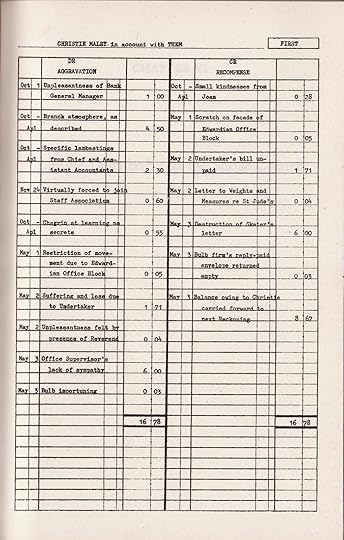
Now I only want to note that the double-entry spreadsheets themselves hold up very well. They are intended to be read, and they are infrequent enough so that reading them jogs the memory of some events and creates anticipation for others. They are one of the most successful legible graphics in fiction.

4. PS.
In 2013 I noted someone with the username knig posted a review on January 17, 2012 here on Goodreads, taking Johnson to task for not getting double-entry right:

"…what I’ve retained from Accountancy 101 makes me cringe at this blatant misuse of credit and debit. (Done deliberately I believe, as Johnson worked in accounts for six years. He must have had SOME inkling.) Debit does not mean take away from, reduce, diminish or anything remotely like that. It simply means a sum is entered on the left hand side of the equation. Nothing more. Similarly credit. It’s not an increase, just a right hand sum. Not to mention, if your boss shouts and you decide to debit, you can’t credit by shouting back. That’s not double entry, because its the same variable in two different events in the space time continuum. It would have to work a little like this:
"Boss shouts
"DR [standard bookkeeping for "debit"] Assets (you now have a shout, which you didn’t before you were shouted at).
"CR Liabilities. Name it anything, like “I’m gonna get you sucka.” (You owe the boss a shout back.)
"Now, when you’re ready to shout back (or kill 300 people or whatever):
"Cr Assets (you’ve just shouted back and depleted your stored shout).
"Dr Liabilities (or the sucka account). (You no longer owe a shout. Accounts are square.)"

This is itself funny, because of how knig misunderstands the purpose of the spreadsheets—Johnson uses them to mean "take away from" and so forth, so they're a parody—but then proposes how to make them even more accurate (as any good terrorist might desire).

Revised August 2024
Profile Image for Mark.
180 reviews84 followers
May 28, 2011
The best book I have ever read, period. Part V For Vendetta, part Fight Club, part Monty Python, part PoMo comedy/revenge anti-novel that's barely long enough to be called a novel at all (appropriately enough). The characters live and breathe, despite Johnson's repeated reminders that this is indeed a work of fiction.

The Fourth Wall hath been breached and we the readers are all the better for it.
Profile Image for Paul Fulcher.
Author 2 books1,952 followers
May 18, 2019
Christie Malry was a simple man.

It did not take him long to realise that he had not been born into money; that he would therefore have to acquire it as best he could; that there were unpleasant (and to him unacceptable) penalties for acquiring it by those methods considered to be criminal by society; that there were other methods not (somewhat arbitrarily) considered criminal by society; and that the course most likely to benefit him would be to place himself next to the money, or at least to those who were making it. He therefore decided that he should become a bank employee.

I did tell you Christie was a simple person.
...
What Christie thought, however (and how privileged we are to be able to know it) was that he would consider himself to be a failure if he had to depend on a bank pension at sixty


The last novel of the avant-garde British writer BS Johnson, published shortly before his death by suicide aged just 40 in 1973. Johnson was a forceful advocate of innovation in literature, and against reversion to the conventional 19th century style novel, and while Christie Malry's Own Double-Entry is perhaps his most accessible novel, it is certainly far from conventional, as well as a lot of fun.

Despite starting his career with aspirations of financial success, Malry soon get bogged down in Reggie-Perrin like frustrations about the injustices of life (the atmosphere was acrid with frustration, boredom and jealousy, black with acrimony, pettiness and bureaucracy), and invents his own form of double-entry bookkeeping with debits for the petty aggravations in life, and credits as he gets his own back on the world with, initially, relatively petty retaliations.

description

Johnson has a lot of fun with language - e.g this 'dictionary battle' between Malry's superior and an angry customer (the dispute a result of Malry's mischief making):

Skater's assertive roar when he was told that no letter had arrived could be heard several more desks away; his proposal was that (if he were there) he would defenestrate Wagner . Christie's Section Head was riled at this, and, forgetting he was putting the company's reputation in jeopardy, he suggested that were Skater to come within a hundred yards of him he would (before he could carry out his threat) be subjected to a rapid process of trituration. Skater responded with a distinctly unfair (for it was accurate) divination, from Wagner's telephone, of the Section Head's helminthoid resemblances. Wagner snapped back with the only word he could think of at the time, cryptorchid , though as he had never had the necessary opportunity of observing, let alone carrying out a count, Christie felt that his superior had compromised his integrity at this point. And with sounds of gulping incapacitation at both ends of the line the conversation lapsed without any sign of an eirenicon.

(see this review for further examples of the vocabulary - and explanations)

The novel is also Tristram-Shandyesque with frequent metafictional interjections by BS Johnson himself, and frequent acknowledgements of the artificial nature of fiction. He complains that readers tend to skip physical descriptions of characters and form their own view, so simply tells us:

What writer can compete with the reader's imagination!

Christie is therefore an average shape, height, weight, build, and colour. Make him what you will: probably in the image of yourself. You are allowed complete freedom in the matter of warts and moles; as long as he has at least one of either.


But as his frustrations with life grow - he values 'socialism not given a chance' at £311,398 - so does the seriousness of the actions he needs to take to redress the balance. When one of Malry's schemes requires a machine to be operated remotely, the narrator simply tells us this is done in an unusual way which I am not going to bother to invent.

I described B.S. Johnson in a previous review as 'in literary terms he was very consciously influenced by Beckett, who was also an admirer of Johnson, and in looks and persona rather closer to Tony Hancock' and there is always pathos in his humour, here marked by a sad rather than glorious end to Malry's scheming and the novel itself.

Highly recommended.
Profile Image for Ed.
Author 1 book444 followers
February 16, 2018
This is a short, darkly humorous novel about evening the score and getting back at society. It’s clever, funny, and very well put together. I enjoyed the postmodern metafictional elements, which felt refreshing and did not take themselves too seriously. Despite his troubled state of mind, clearly the author was having fun with this one.
Profile Image for Graham  Power .
118 reviews31 followers
August 3, 2024
The novelist B. S. Johnson was deeply distrustful of the imagination, taking the Platonic view that ‘telling stories is telling lies’. And Johnson thought that telling lies was morally wrong. All very well for philosophers, but a position bound to make life a bit tricky for a novelist, you would have thought. He was part of a loose group of experimental 1960s British writers which also included Ann Quinn, Eva Figes, Christine Brooke-Rose and Alan Burns. Except that Johnson was emphatic his novels were not experimental, explaining that although he made experiments, his published books were fully achieved work (well, many people do seem to regard the term ‘experimental novel’ as a euphemism for failure). Although passionate about the form and its possibilities, he didn’t have much time for most contemporary novels and his literary heroes were idiosyncratic ones: Sterne, Joyce, Beckett and Flann O’Brien. Despite his ethical distaste for stories he had a rare gift for telling them, as this brutally funny shaggy dog story demonstrates.

Christy Malry is a young working class man who works in a confectionery factory as an accounts clerk and decides to take night classes to train as an accountant. He learns double-entry bookkeeping with its golden rule-: ‘Every debit must have its credit’. Highly impressed, Christie decides to base his life on this principle and devises his own system of moral double-entry bookkeeping: whenever society commits an offence against him he will take proportionate action to balance the books. Initially, this involves little more than a bit of petty pilfering and harmless insubordination to right wrongs perpetrated against him by managers in the factory. As he becomes more aware of the sheer injustice of society, however, his attempts to balance the books lead him inexorably towards much more serious, darker and deadly actions.

Christie Malry, like most of Johnson’s novels, draws on his own experience. He worked as an accounts clerk in a bakery in the fifties and, like Christie, was from a working class background in Hammersmith. It’s also evocative of Britain in the early seventies - a time of political and industrial conflict and terrorist bombs - with Christie as a one-man Angry Brigade. Rather like Candide, it combines a bleak vision with an insouciant and high-spirited narrative tone. Johnson paints with broad comic brushstrokes and is very, very funny. He subverts his own narrative, throwing formalistic spanners into the works with gleeful abandon. He addresses the reader directly and indulges in undisguised political polemic. The characters are fully aware that they are fictional and, at one point, Christie and Johnson have a conversation about the novel Christie is in and The Novel in general. He reproduces some pages from Christie’s account books which convey his steadily increasing fury (debit column: ‘Socialism not given a chance, 40,734’).

Johnson litters his text with ridiculous and ridiculously abstruse words: exeleutherostomise, incunabula, trituration, ventripotent, sufflamination, vermifuge. Anthony Burgess, who admired Johnson’s novels, used to do much the same thing. With Burgess it always seemed like a deadly earnest and vaguely unpleasant attempt to overwhelm the reader with his erudition, but with Johnson, perhaps because his approach is more extreme and he uses even longer long words than Burgess did, the effect is of a wilfully perverse joke that he is playing with (not on) the reader.

Johnson’s theories about the novel were dogmatic and simplistic. His practice, however, was more complex. In this novel he does indeed tell a story and creates vivid characters. His constant exposure of the fictive nature of his own creation somehow has the paradoxical effect of making it seem more real and thrillingly alive than most naturalistic fiction. It crackles with energy and is compulsively readable and entertaining. Behind its playful surface this book is powered by strong emotions of anger and despair and, in addition to being hilarious, it’s also strangely moving. At about 20,000 words Christie Malry has more ideas and invention in it than many novels twice its length: black comedy, social satire, an unconventional thriller, formal innovation and erotic romance (how could I have forgotten to mention Christie’s girlfriend, the Shrike?).

All this and a highly unusual use of shaving foam.
Profile Image for Greg.
1,128 reviews2,147 followers
April 9, 2008
B.S. Johnson is someone I had never read before, but had been on my radar to read for quite sometime. I think at some point I read that DFW really liked him, and then a few years ago Jonathan Coe wrote a very interesting looking biography on him. I don't know what took me so long to finally try to read him, his books that are still in print aren't too big, this one is only about two hundred pages, and a lot of those pages are filled with lots of white space. Yes his books are kind of expensive, I've yet to come across one in my used book scouring, and the new copies of the three books in print are a bit more expensive than the normal book, as they are print on demand copies. The real reason I think I avoided him was that he is English, and considered an experimental, or avant garde writer. I've read a few British avant garde writers before and none of them turned out to be pleasant experiences.
B.S. Johnson turned out to be an exception to the rule that British and experimental literature don't mix. Instead of being the obtuse and near-impossible to find a hole in the text to get inside and figure out exactly what the author is even attempting to do, Johnson made it quite easy to at least get engaged in the book. His writing was more akin to early John Barth or DFW than to someone like Ann Quinn, and his sense of humor moved in what could now be classified as standard meta-fiction antics.
The book is about a man of no particular importance who realizes that the world as it relates to him is out of balance. Being a book-keeper, he understands the importance of keeping balanced books and with this knowledge sets out to even the debits and credits in his life. As I said the book is at turns quite humorous, and Johnson gets humor from both his post-modern playing with the text, and from the well regarded tradition of British humor (a genre the British are vastly superior in general to their American couterparts). The book in the end is an absurd look at modern day life, in an almost Monty Python sort of way.
Good stuff.
Profile Image for Jeff Jackson.
Author 4 books527 followers
September 9, 2021
Metafictional follies worthy of Flann O'Brien. Seriously funny.
4.5 stars
Profile Image for Adam Dalva.
Author 8 books2,158 followers
October 18, 2014
A totally wonderful lean volume of metafiction. Not for everyone, but I've never read a book that relishes its bookiness more, that is more pleasantly self-aware. I hadn't heard of Johnson before reading this (frankly, I don't even remember why I have this one), and I will be going back to the well shortly. Who else gives you paragraphs like:

"Headlam paused to provide a paragraph break for resting the reader's eye in what might otherwise have been a daunting mass of type"

What's special about this is that despite it's EXCESSIVE darkness, it also reminds me most of something like The Phantom Tollbooth, only if The Phantom Tollbooth had vacuum cleaner sex and excessive murder (it is worth saying that the book is violent in a slapsticky way). Intriguingly, it also serves as something of a Charlie and the Chocolate Factory companion piece. And it reminds me of Monsieur Verdoux too.

Read this.
Profile Image for W.D. Clarke.
Author 3 books350 followers
July 2, 2022
A riot. I laughed, I cried. I literally fell into cliché. I lie, but the truth is in here somewhere, and I will say this: a spoonful of the ol' sugar-sugar helps the meta-sin stay down (typed as if with gentle effect, as he's a reader's kind of writer all along), but seriously how can you not love this (only seemingly) unserious unliterary Guy Fawkes of a guy?
Profile Image for Richard.
Author 1 book57 followers
November 20, 2021
Bryan Stanley Johnson himself disliked the term ‘experimental’ which is often used to describe his novels, but how else do you describe them? One is printed with holes in a couple of its pages, through which readers catch glimpses—like premonitions—of what’s about to happen next. Another is written in twenty-seven sections, twenty-five of which can be shuffled and read in any order, allowing you to reread a different book each time. Christie Malry’s Own Double-Entry, the last to be published during Johnson’s lifetime, is among the least experimental though.
    It draws on his own experiences as a young man not long out of school, in Hammersmith, west London, during the 1950s. Christie, eighteen years old and working as a junior invoice clerk for a company making sweets and cakes, discovers something which will transform his life: double-entry bookkeeping. A lightbulb goes on over his head: every Debit must have its Credit, not just in accounting but in life itself—a balancing and setting straight of things, a righting of wrongs. Wrongs done to Christie by the world that is. Justice, in other words. And revenge. His balancing of life’s books starts off with some relatively trivial entries: annoying junkmail on the doormat at home (Debit) is balanced by posting the wretched stuff back (Credit); the overbearing rudeness of his work supervisor (Debit) is balanced by sabotaging the firm’s incoming mail (Credit). Every so often he draws up a proper balance sheet, and five of these are included in the book. Things quickly escalate though—and the first time Christie kills people, his justification is that he’s Crediting himself for the way society treats people like him: ‘If they fight dirty (and they do), so shall I; if they are so callous about human life, then so shall I be (though I could not possibly kill as many as they do).’ The question, of course, is how will it all end—will there be a final settling up of Christie’s account?
    Several things about the author himself became plain—how much he liked women for instance. I don’t mean sex, he clearly just found women particularly likeable as people: Christie’s mother is beautifully described; and most striking of all is his girlfriend, nicknamed The Shrike (she’s a bird who works in a butcher’s). There’s anger in this book too and, although I liked it a lot, at times did find myself wondering about the author’s state of mind while writing it. Often depressed by the lack of recognition for his work, he committed suicide (his career as an author cut short at the age of just forty) only months after Double-Entry was published.
Profile Image for Lee.
381 reviews7 followers
December 24, 2020
It's one thing to break the fictional 'fourth-wall', another to facilitate our enjoyment of the process (rather than have us wearily think, 'Here we go, they've gone all meta,') and another still for the impudence of having done so make no difference to how much we care about plot developments, nor derail our appreciation of a text. In fact, Johnson regularly disparages plot and narrative convention, at one point admitting he 'can't really be bothered' to explain how Christie manages to set up a makeshift system which he hopes will sabotage the confectionary plant at which he's tentatively employed; this derision is all part of the manifesto - Johnson wants you to revel in language, in iconoclasm, in the suspension of the suspension of disbelief, in the implicit mirth of demolishing his own novel (and brazenly putting it back together again), and producing something else altogether, still somehow a novel of sorts but also much more. Yes, it's dated, and you'll perhaps need to forgive a little some of its slightly malodourous excesses, but even these serve to cement its position as perfectly deserving cult classic, truly unlike anything else (although there's a little of Stern, Beckett and O'Brien in here, if you need some kind of helpful comparison).


'Later, Christie argued with himself. This was not common for him, as he was essentially one and in accord. It was the first time he was aware that he had been more responsible than anyone else for a loss of human life.

Christie argued with himself. Who would win in the end ? Should he have had this argument before the Little Vermifuge, and not after ? It went like this. I have no right to kill people. No one has, according to all the arguments. Yet people are killed. There are even licensed killers of people, of several kinds.

Despite the overwhelming concurrence with the canon regarding the absolute sanctity of human life, in fact society saw that human life was in fact a very inexpensive, plentiful and easily-disposable asset. Of all things, human life was the easiest to replace. A machine would be difficult, costly : but the man who drove or worked or manipulated it could be replaced at very short notice by any one of millions of other men, all equally capable after a little training, all equally replaceable. Women were even cheaper. Human life is cheap, dirt cheap, according to this society, judged by the way it acts, the only true test, saw Christie, despite its pious mouthings. What it does in practice is not what it says it does. It does not care for human life : it shortens that life by the nature of the work it demands, it poisons that life in pursuit of mere profit, it organises wars from which it is certain mass killing will result . . . but you know the ways in which we are all diminished : I should not need to rehearse them further.

So Christie was easily able to become one again. If they fight dirty (and they do), so shall I, he thought ; if they are so callous about human life, then so shall I be (though I could not possibly kill as many as they do). Those who disagree are missing the point ; it needs to be said, thought Christie. Of course the death of those near to one is distressing : of course the death of a mother makes one think she was indispensable. But if she really was indispensable, then you yourself die. Otherwise she was not indispensable. And in any case, society does not, they do not share any concern for your mother, what she meant to you. It could not be society if it did.

Christie could go on.'

'Meanwhile, they were both perfectly happy. Well, this is fiction, is it not ? Isn’t it ?'
Profile Image for Mayk Can Şişman.
354 reviews221 followers
March 4, 2024
aşırı hızlı okunan, akıcı ama tam olarak beklentimi karşılamayan bir metin oldu. ekonomi mezunu biri olarak ‘alacak feat. verecek’ davası gibi komik ve keyifli bir konuya sahip olması ve özellikle de başları yüz güldürse de sonlara doğru ‘gerekli çorba’ kısmına giden yolda ilgim epey dağıldı ve sonlarına doğru bir an önce bitmesini dileyerek kapattım kapağı. halbuki ben yazardan çok daha yaratıcısını beklerdim. ama kötü değil tabii, yalnızca benim beklentimin altında kaldı bir çıt.
Profile Image for Neil.
1,007 reviews757 followers
October 4, 2019
Recently, I have read several books that have referenced, in one way or another, the works of B S Johnson. I decided I should do something about the fact that I haven’t read any of his books. My introduction to B S Johnson has come via the generosity of my GR friend Paul who has so far passed two of Johnson’s books to me. So, let’s start by thanking Paul.

This novel was Johnson’s final work, published shortly before his death by suicide in 1973. The book opens with an introduction by John Lanchester. Lanchester notes that Johnson believed that the story-telling function of the novel had been superseded by other media and that the novel’s job was to concentrate on the depiction of interior states. Johnson was an advocate of innovation in literature and both the books of his that I have read have unconventional elements (Albert Angelo famously has cuts through some of the pages that allow the reader to see ahead into the developing story). Christie Malry’s Own Double-Entry is very playful and, therefore, very entertaining to read. It is fully aware that it is a book, characters die when they have played their part because they are no longer needed by the novel, characters reference other events by page number, the author addresses both the reader and the protagonist, key statistics in the book are plucked out of the air based on the book’s word count.

Christie Malry becomes aggravated by the apparent injustices of life and decides to apply the principles of double-entry accounting to his life by keeping a record of the “debits” life throws at him and seeking to balance those with credits as he exacts his revenge. Initially, his reprisals are of a minor, petty nature but they gradually escalate. At several points in the book we are presented with a balance sheet which records the various debits and credits of the preceding section (and therefore serve as a helpful reminder of the plot points) and highlight Malry’s perception of the growing debt that life owes him - the balance carried forward grows rapidly!

Meanwhile, B S Johnson has a lot of fun playing with language. The book contains a lot of words that you can choose to skip over or to look up - I doubt many people will be aware of all the obscure words used in the text.

This is a short book easily read in one sitting. The edition I read is only 180 pages long and about 70 of those pages are either empty or have just a chapter title. And a few other pages are a sheet of accounting. It moves along at a rapid pace often skipping things with the excuse that it is only a short novel so there isn’t time for detailed explanations. Malry’s actions become gradually more dramatic until all is brought to a sudden halt.

Worth reading to see an author working 45-50 years ago to explore the possibilities of the novel.
Profile Image for Doug.
2,544 reviews912 followers
April 24, 2019
Although sadly, the title does NOT refer to the world's most agile (and kinkiest) porn actor, it DOES have its own mordant charms. The novel instead chronicles the exploits of a young accountant whose 'Great Idea' is to make the world pay for every slight he feels has unjustifiably come his way, in order to maintain an equitable balance sheet. As in all Johnson's work, this seeks to extend the boundaries of what a novel is and can be, here introducing a lot of metafictional episodes, including the author commenting upon his own achievements. There is also, note well, a very interesting film adaptation, which only loosely follows the outlines of the narrative, alas.
Profile Image for Jonathan.
1,009 reviews1,229 followers
April 4, 2013
Loved it - perhaps some of the meta-textual play feels a little dated now, but the wit and narrative force more than makes up for it.
Profile Image for Troy Alexander.
275 reviews61 followers
September 26, 2022
Published in 1973, this is a linguistically and stylistically playful and very self-aware novel that I probably would have enjoyed writing about when studying postmodernism in my English degree. Now however – although it is relatively entertaining and funny – the metafiction aspect of it feels dated and heavy-handed.
Profile Image for Carmen.
623 reviews21 followers
January 8, 2013
Really really really liked this one.

Totally preposterous but totally brilliant, in a Vonnegut sort of way. Johnson is totally aware of the tropes of novel writing and twists them, pokes fun at them, and yet he uses them while he pokes fun.

Sure, it is dark! It's dark in that there's a complete disregard for human life. But the author is actually making a point at how our society undervalues humanity. And once Christie Malry (The King Evilmaker/anti-Christ if you read his name that way) gets out of hand- mocking religion, mocking life- he is dealt with via deus ex machina. And the irony is wholly intentional. It's one of the smartest things I've read in a while yet it is presented as totally absurdity.

Oh, and the vocab is great. Johnson knows language and uses words well. The fast read of short paragraphs can be deceptively simple though his vocab is stellar.
Displaying 1 - 30 of 237 reviews

Can't find what you're looking for?

Get help and learn more about the design.