Jump to ratings and reviews
Rate this book

Albert Angelo

Rate this book
A failed love affair, the failure to find work as an architect, and the difficulties of substitute teaching cause Albert Angelo to reexamine his life.

180 pages, Paperback

First published January 1, 1964

7 people are currently reading
1609 people want to read

About the author

B.S. Johnson

40 books130 followers
B. S. Johnson (Bryan Stanley Johnson) was an English experimental novelist, poet, literary critic and film-maker.

Johnson was born into a working class family, was evacuated from London during World War II and left school at sixteen to work variously as an accounting clerk, bank junior and clerk at Standard Oil Company. However, he taught himself Latin in the evenings, attended a year's pre-university course at Birkbeck College, and with this preparation, managed to pass the university exam for King's College London.

After he graduated with a 2:2, Johnson wrote a series of increasingly experimental and often acutely personal novels. Travelling People (1963) and Albert Angelo (1964) were relatively conventional (though the latter became famous for the cut-through pages to enable the reader to skip forward), but The Unfortunates (1969) was published in a box with no binding (readers could assemble the book any way they liked) and House Mother Normal (1971) was written in purely chronological order such that the various characters' thoughts and experiences would cross each other and become intertwined, not just page by page, but sentence by sentence. Johnson also made numerous experimental films, published poetry, and wrote reviews, short stories and plays.

A critically acclaimed film adaptation of the last of the novels published while he was alive, Christie Malry's Own Double-Entry (1973) was released in 2000.

At the age of 40, increasingly depressed by his failure to succeed commercially, and beset by family problems, Johnson committed suicide. Johnson was largely unknown to the wider reading public at the time of his death, but has a growing cult following. Jonathan Coe's 2004 biography Like a Fiery Elephant (winner of the 2005 Samuel Johnson prize) has already led to a renewal of interest in Johnson's work.

Ratings & Reviews

What do you think?
Rate this book

Friends & Following

Create a free account to discover what your friends think of this book!

Community Reviews

5 stars
170 (25%)
4 stars
277 (41%)
3 stars
160 (23%)
2 stars
45 (6%)
1 star
17 (2%)
Displaying 1 - 30 of 83 reviews
Profile Image for Vit Babenco.
1,784 reviews5,787 followers
December 15, 2021
Albert Angelo is a thoroughly unconventional novel.
Schools… Pupils… Teachers… At the beginning, little schoolchildren are nice but with every new class, the pupils become nastier…
You spend all day teaching simple English to the third-year classes, fourteen-year-olds who have very little interest in learning: they are waiting only to leave school. You try to arouse their interest by pointing out how basic a knowledge of at least English must be. One boy says he can read the racing, and that that’s enough for him.

Albert Angelo is a manqué architect and a supply teacher… Tormented by frustrated love he has no wish to teach… Disappointment and disenchantment… Drunken escapades and dubious leisure… He is a bad teacher among bad scholars…
Albert sat, within himself, quite alone. His shattered state after each school day seemed to last longer and longer: soon it would be permanent, he felt, in spite of the end of term being near.

The quality of the future society directly depends on the quality of education.
Profile Image for Stephen M.
145 reviews645 followers
June 14, 2012
[SPOILER WARNING. BUT WITH A BOOK LIKE THIS IT ISN’T LIKE A SPOILER OF THIS TYPE WOULD CHANGE TOO MUCH ABOUT THE READING EXPERIENCE OR RUIN SOME CRAZY PLOT TWIST CAUSE IT AIN’T THAT KIND OF BOOK, AS YOU’LL SEE]

This is what my meta-fictive madness shelf was made for. Whooooo wheeeeee, this was an interesting book. I don’t think I’ve read a book like this ever in my life. There was a point at every part of the book where I would have given each different star rating to it. It pulled me in every which way. And being such a polarizing novel, just in myself, I was surprised to not find more discussion about it. I notice that there is a criminally low amount of ratings and reviews for this book, so I will try to curb any excessive bashing for sake of the implications of over/under-popularity (which even if it had tons of ratings, it wouldn’t change my opinion of the book, only the presentation of this review) Because I would like to convince people to read this book despite my three stars. It is alternatingly brilliant and frustrating. But be warned, if you’ve ever read any pomo literature and it didn’t really sit with you, you should know, this is hyper pomo after a bump of coke, hardly able to sit still for longer than a page or two without switching genre and style, which is something I’m hip to (see my David Mitchell, Thomas Pynchon-filled ‘read’ shelf), but everyone has their limits for everything. I guess I’ve found mine.

I could throw the word post-modern at this thing until the cows came home but that still wouldn’t capture the udder* post-modern-fuckeriness that literally permeates every page. All the happy categories are represented: fractured narrative, uses of every type of POV, meditations on the loss of meaning, reflexivity, questions of author’s identity, ambiguous moral stances, emphasis of the physicality of the text or as the “author” admits at the end of the book “typographical techniques beyond the arbitrary and constricting limits of the conventional novel”, etc. etc. etc.

The final example gets a big, fat one star shame for its complete disregard for the reader as intelligent, able to think for her/himself and his/her completely reasonable desire for a stable, completed story. The majority of the book before this penultimate section entitled “disintegration” (titled so for pretty good reasons) is a lot of fun. What had captured me about the story was that it was a basic one (Albert is an aspiring architect, who holds down a temp job as a substitute teacher at a school filled with unruly youngsters. The story circles around Albert’s recovery from a long-finished relationship—four years after the book starts!) Yet despite any hint of romantic cliché and conventionality, there was a thick coat of quirky, intelligent prose and idiosyncratic story format. My favorite part was a two-columned section of 20 or so pages. The left side of the page detailed Albert’s dialogue in class (his lecture and his student’s interruptions) while the right side of the page wrote out all of Albert’s thoughts. The cognitive dissonance between Albert’s thoughts and spoken dialogue was hysterical and harped on the obvious fact that teachers are people too, no matter how misbehaved and unruly his/her class may be. At one point Albert trails off, thinking of a time he had relations with his ex-girlfriend while the class makes fun of him as they screw off. The two elements of thoughts and dialogue played off one another with such a flair of tact and brilliance. There’s no doubt Mr. Johnson can construct a solid scene. But see, there are patches of the book like this: funny, lighthearted and quite unself-serious. Then it is broken off, literally mid-sentence into things like the “disintegration” section where the author gives himself away and tells us that the entire book is a work of his own fiction. I mean, I realize that I’m reading a book and it isn’t real but can you just leave me to my illusion that I was perfectly enjoying? Like ruining a tender, intimate moment by pointing out every time in the night where he was successful in getting you to think about actually bringing him home and not his obvious shameless ploy for your pants. Kinda spoils the mood doan’it?

But that is to ignore the amazing moments of brilliance such as this bit of Albert’s meditation while looking at his students:
“They sit, large and awkward at the aluminium-framed tables and chairs, men and women, physically, whom you are for today trying to help to teach to take places in a society you do not believe in, in which their values already prevail rather than yours. Most will be wives and husbands, some will be whores and pounces: it’s all the same; any who think will be unhappy, all who don’t think will die”.
This book was also quite short. Way too short to complete what it had set out to do. And the author is painfully aware of the incompleteness of the novel, as when the author’s voice comes through revealing himself as a poet searching to tell the truth in its most honest form. The final section is of a frustrated author who couldn’t get across what he wanted to. It seems obvious that the author (of the story or the real B.S. Johnson? ooooh! So intriguing!!!) gave up on his own story and resorted to giving away all his techniques and intentions as if we couldn’t understand it anyway. He reacts to anticipated criticism with condescension: “to dismiss such techniques (his experimental techniques) as gimmicks, or to refuse to take them seriously, is crassly to miss the point”. Well, Mr. Johnson, fuck you. I can rightly judge your work in whatever way I see fit.

This book is like Jonathan Safran Foer’s insane, alcoholic great-uncle who has just polished off his last Jack Daniel’s and is subsequently running through the town screaming for a handle of scotch as he stumbles and breaks the store’s signposts to finally land flat on his face where he violently shits himself, oh yeah and in the middle of this cringe-inducing disaster, the things he yells out are actually pretty profound, emotionally-packed quips on life slobbered with a beautiful eloquence. It’s all a bit humorous and always worth seeing, even if watching causes you to feel a bit nauseous after it’s all over.


* ;)
Profile Image for Paul Fulcher.
Author 2 books1,956 followers
December 14, 2021
I know what she’d say if she was a workingclass character in a book

BS Johnson, novelist and poet, was, until his death by suicide aged just 40 in 1973, the most prominent of the wave of British avant-garde writers that emerged in the 1960s (the recently 'rediscovered' Ann Quin who also committed suicide the same year, Alan Burns, Eva Figes among others). In literary terms he was very consciously influenced by Beckett, who was also an admirer of Johnson, and in looks and persona rather closer to Tony Hancock.  

He achieved his prominence both for his TV programmes, but also his forceful advocacy for innovation in literature, and against reversion to the conventional 19th century style novel. Inspired by a Nathalie Sarraute metaphor BS Johnson argued that literature was a relay race, the baton of innovation passing from one generation to another, but that the vast majority of British novelists has dropped the baton, stood still, turned back, or not even realised there is a race.


And, within his work, he was best known for his focus on typographical techniques. His The Unfortunates is perhaps best known: a novel in a box - with separately bound sections designed to be read in any order, nominated by Jon McGregor for a retrospective Goldsmiths Prize; https://www.gold.ac.uk/goldsmiths-pri...

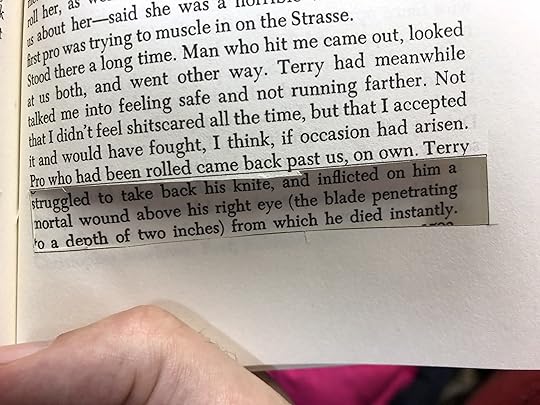
In Albert Angelo, pages 149 and 151 have holes cut in them to give the reader a sneak preview of what's on page 153, cleverly done so that the text appears to point to the resolution of what is narrated on each of the two earlier pages, but actually misleadingly so .

description

Warning: I say 'comes with holes'. But the the Picador paperback (ISBN 9781447200376) on sale on Amazon.co.uk doesn't actually comes with holes, just a box drawn on the page. The reader - if aware of Johnson's intentions, as there is no indication - has to cut the holes for themselves.

Albert Angelo was his second novel published in 1964.

The eponymous main character is aged 28, in his mind, an architect but, in practice, works as a supply teacher, parachuted into troubled North London schools at short-notice and for short periods, in some cases after the previous teacher has been driven to a breakdown by the children.

The novel alternates between third person narration and first person Beckettian stream of consciousness, using a variety of techniques (most successfully one where his thoughts and the dialogue within the classroom are shown in parallel columns). Johnson himself worked as a supply teacher and Albert's thoughts on teaching and his troubled wards are a highlight:

They sit, large and awkward at the aluminium-framed tables and chairs, men and women, physically, whom you are for today trying to help to teach to take places in a society you do not believe in, in which their values already prevail rather than yours. Most will be wives and husbands, some will be whores and ponces: it's all the same; any who think will be unhappy, all who don't think will die.

He lives, having been left by his previous partner, in Percy Circus, near to St Pancras, a station of which he is not architecturally fond (the pseudo-Gothic excrescences of Scott's St. Pancras):

I wonder shall I come to accept St. Pancras station, living so near? Or even to like it? Perhaps it is fatal to live so near to St. Pancras for an architect? Certainly it would be to bring up children here: their aesthetic would be blighted. But it seems unlikely that I shall be allowed to bring up children here.

The novel also documents his rather grubby personal life (I was reminded of Ann Quin's excellent Berg) as he wanders and drives around the less salubrious parts of London, with humour that is rather off its time and at times a little "On the Buses". Talking of buses, there is a wonderful mathematical musing on coincidence (and how one can contrive it) on the way back from a Chelsea game:

I catch with my father a number twenty-seven bus several minutes after arriving at the bus-stop in Hammersmith Road at the end of North End Road .... We could have caught a number nine or a number seventy-three, to place them in numerical order, had either of these splendid numbers been opportune .... The numbers are related: the square root of nine, three, multiplied by nine gives you twenty-seven; and seven added to three brings you back to nine again, if you take one off. Furthermore, there is a three in seventy-three. The numbers of these three (again!) buses running along the Hammersmith Road are not related by accident, these things are no coincidences.

The large parts of the novel that describe in details the streets, the denizens and the architecture feel somewhat less successful now, since they seem to rely on a 'yes I recognise that' nod of recognition, and London then is so unrecognisable 55 years later.  But brilliantly in the novel’s final section, where author speaks to reader, Johnson has anticipated that:

Who knows what else will have shifted by galleyproof stage, or pageproof stage, or by the time you’re reading this?  Between writing and galleys, they’ve cut down some of the trees in Percy Circus, for another instance, taken down the railings, you’ll just have to take my word for the description, now, now all I can say is That’s how it was, then, that’s the truth.

Because in the other, by now well-known, twist, the narrator interrupts the text on page 163 with an almighty aposiopesis, and the last section of the novel, Disintegration, begins (his punctuation following the section's title):

fuck all this lying look what im really trying to write about is writing not all this stuff about architecture trying to say something about writing about my writing im my hero though what a useless appellation my first character then im trying to say something about me through him albert an architect when whats the point in covering up covering up covering over pretending pretending i can say anything through him that is anything that i would be interested in saying

The author then proceeds to set out his fictional manifesto and to reveal the artifice of how Albert’s story is based, with many changes of detail (lies he calls them) on his own life: BS Johnson, in his late 20s, working as a supply teacher in North London (like Albert) but really considering himself as poet (c.f. Albert’s architectural leanings; although as he points out at least Albert had a hope of making living from his chosen vocation).

So, he for example, explains the 'future-seeing holes':

The novel must be a vehicle for containing truth, and to this end every device and technique of the printer’s art should be at the command of the writer: hence the future-seeing holes, for instance as much to draw attention to the possibilities as to make my point about death and poetry.

As well as being blurbed by Beckett, BS Johnson was also praised by Anthony Burgess who said: “The future of the novel depends on people like BS Johnson.”

That quote is worth examining - because that is not how the novel proceeded: English literature didn't follow the path Johnson hoped but largely that he feared and criticised. And the author largely faded - as did Ann Quin - from public consciousness over the next 30 years.

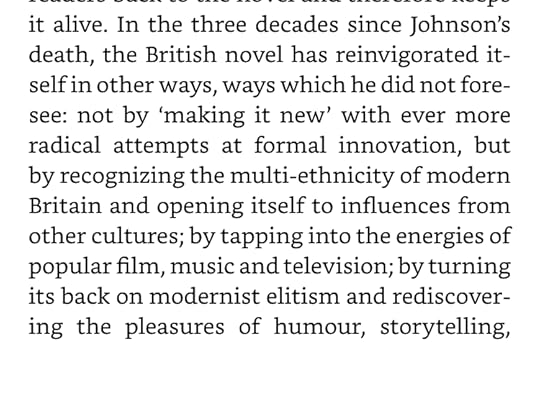
BS Johnson's prominence was restored by an award-winning literary biography from Jonathan Coe. While displaying much sympathy for Johnson's personal life and personality and also his work and literary manifesto, Coe was also not shy of criticising either, in particular suggesting that the high modernism of Joyce and Beckett, whose baton Johnson tried to grab, take forward and pass on, was actually a straitjacket the novel had to break out of.

Coe argued that:

description

I think Coe is right that the novel has developed in terms of diversity - the 1960s avant-garde was ultimately rather white English dominated, although interestingly Quin and Johnson were both from working class background - but he is wrong to reject BS Johnson's modernist and innovation manifesto. In practice literary innovation is alive and well and driven from a diverse group, by gender, culture, ethnicity, social-class and sexuality, while it is the more conventional narrative novel that seems more the preserve of the white male middle-aged middle-class author.

And to that end I would recommend this book but also books by the author who prompted me to revisit BS Johnson, Isabel Waidner and her Liberating the Canon: An Anthology of Innovative Literature and We Are Made Of Diamond Stuff.
Profile Image for Nate D.
1,654 reviews1,252 followers
June 28, 2012
Despite being rampant with typographic, narrative, and perspective shifts and disorientation, there's something about B.S. Johnson's delivery -- brisk and funny and personable, simple and direct at time, gracefully turning a phrase when needed -- that makes this a breeze to read, and totally enjoyable, perhaps like a somewhat more negative Calvino. Similarly for his later Christie Malry's Own Double Entry. This time we're hanging about with a schlub of an architect, failing to make headway on his career or getting over his last romantic escapades, while noncommittally substitute teaching (battling difficult students, mostly) in order to live. Then, things start to break down a bit, both in obvious and less obvious ways. I'll say no more: just read it, it's quick and entirely engaging, even when it's working hard to disengage itself, arguably. (maybe to be bumped up to 5 stars later, it's real close).
Profile Image for Adam Floridia.
604 reviews30 followers
December 29, 2012
This one really was almost five stars for me, but I’ve got to get back to being more prudent with that prestigious honor, and this certainly has room for improvement. Because of the nature of the book, I’m going to have to write a two part review pretending that I had not finished the book at the writing of the first part of my review. Simple. Here goes.

Adam’s review of pages 9-163 (Prologue, Exposition, and Development) while pretending to have not read beyond page 163:
Although not a perfect novel, I loved this because it really seemed to capture life realistically. Readers get the actions, thoughts, and dialogue of the protagonist each in their own fashion: first, second, and third person; play format, and some other cool, original style. The story is a piecemeal compilation of Albert’s days as a substitute teacher. Rather than complete episodes, we get snippets sewn together none too seamlessly. From Albert in the classroom, to Albert visiting his parents, to Albert in a bar, to Albert walking around aimlessly. I know this probably doesn’t sound that appealing, but to me it just really captured life—nothing more than a series of events, some interesting, some banal.

I think another reason (and this reason is twofold in itself) I really liked this is because I could relate so well to it. The “cool, original style” I noted above consists pages split into two columns of text, the left being the dialogue in the class, the right being the monologue in Albert’s head. Johnson writes three pages just of Albert taking attendance, yet I managed to find even that entertaining. It’s one of those, “Boy, if students could really know what teachers are thinking,” and it’s so perfect, so true that I loved it.

In fact, I bought the book in the first place after reading the following quotation in Stephen M’s review::
“They sit, large and awkward at the aluminium-framed tables and chairs, men and women, physically, whom you are for today trying to help to teach to take places in a society you do not believe in, in which their values already prevail rather than yours. Most will be wives and husbands, some will be whores and pounces: it’s all the same; any who think will be unhappy, all who don’t think will die” (47).

Quick Explanation: All of my comments about teaching in this review only reflect my horrible memories of teaching high school. Any of my college students who read this, please know that when professors are teaching they are focused only on the lesson and do not ever form any disparaging opinions of students. Any of my former high school students reading this, please know that of course I don’t mean you—you are an exception.

Students in Albert’s classroom are terribly behaved and do not treat Albert with much, if any, respect. That’s because they see him only as a teacher, not as a person. I always did use to think about how students seem to forget that teachers are actually real people, with thoughts all the human emotions and tendencies that come with being a real person. It’s like when a student would be shocked to see his/her teacher outside of the school and dressed in “normal” clothes. Just imagine how shocked Albert's students would be if they knew what stupid things he does—mouthing off to cops, mouthing off to big guys in bars who want to kick his ass, mouthing off to a random homeowner on whose property he is trespassing-- when he goes out drinking with a friend.

In fairness, though, Albert is also quick to categorize the students, and limiting anyone to a category is a way to limit his/her full humanity. “Only one to show some interest. The one they say makes it all worth while. Yes, yet at the same time feel disappointed that I can’t dismiss the whole class as bastards” (98). Still, I could relate and got a good chuckle. And another line that I think perfectly sums up teaching high school: “It’s like I’m working at the frontier of civilisation all the time” (132).

Yet he still has his moments of great, inspiring teaching too:
“Faced with the human situation, then, what do you do? The main thing is to behave with dignity…Accept the human situation…You can accept it all with dignity, dignity the greatest, most godlike, of all human qualities” (56-57).
“And call nothing human, inhuman…How could his actions, being those of a human being, be called inhuman” (57)
“You must go away and think about what I have said for yourselves. Some of my questions may seem silly to you, some may not even seem to be real questions at all to you” (57).

I know, a lot of quotations, but I loved them. I think I got off track…my first point was that I liked that I could relate to everything that Albert does—the teaching, the mouthing off, the antics, the self-deprecation, the lot of it.

Remember when I wrote that my liking the relate-ability was twofold? Well here’s fold two. Because it was so piecemeal, because it was like jottings of someone’s days without transition, because the events were so true to someone’s daily life, it made me feel like maybe, someday (oh hope against hope) I could actually write a book. But, like Albert’s attempts to make the pro football squad or his attempts at “architecture,” I’m likely to lose interest after starting something and/or just never be able to sit down and actually do it.

Adam’s review of pages 167-180 (Disintegration and Coda) and his reflections on his original impressions of the first half of the book:

Aposiopesis: a sudden breaking off in the midst of a sentence, as if from inability or unwillingness to proceed.

Spoiler Alert(?): Here ends the “story.” The “Disintegration” is exactly that: a breaking down of any narrative structure that did exist. What the reader gets now is a new character, a character as author who has been telling his own tale through the preceding story about Albert. That’s okay, but there are a few things that bothered me:

1) I liked Albert. I liked him more than this “real” Albert who has been writing. And it’s such a sudden switch! (Aposiopesis, indeed!)

2) In this part all we get are scraps of what most closely resemble journal entries or notes by “Albert”-As-Author (AAA from here on out). In truest postmodern style, the “fourth wall” of reading is completely obliterated and AAA reveals his exact intentions in writing: “I’m trying to say something not to tell a story telling stories is lies and I want to tell the truth about my experience…about my truth to reality” and it’s “about the fragmentariness of life, too, attempts to reproduce the moment-to-moment fragmentariness of life” (167,169). Any of that sound familiar? Yeah, those were my crack-insights while I was reading part one. So having what I thought were my insightful analyses thrown in my face made me fill a bit like a wanker.

3) It’s just a copout.

BUT it didn’t totally ruin it for me; in fact, it does kind of work in a way. Aposiopesis (my new favourite word). Albert could never finish anything, could never commit to seeing something through; hence AAA can’t actually finish the book. Although I certainly didn’t pick up on the “architecture as a metaphor for poetry” deal, there is the poem left comically unfinished on 142 which foreshadows this failed attempt at writing.

Equally as funny or infuriating, depending on the reader I’m sure, is the actual ending. Determined that a Coda must be added, Albert ends his book exactly like many young students would. I found it hilarious! It reminded me of a student’s story from my days of student-teaching a seventh grade creative writing class in Takoma Park, MD. Students had to write a two page story incorporating some props I had brought in. One student’s story was coming along very nicely. It had such impressive details that, to this day, I remember a specific line used in the narrative about a burglar: “The burglar stole everything from him. Even his toothbrush.” (Geoff, do you remember that???). Anyway, in the middle of a great part in the story, the burglar suddenly “jumped off a cliff and died.” It took me a long time to realize that that line was at the very end of the second page of the required two pages. Aposiopesis!!

Other part I really liked even though some may think it’s longer than need be and just filler: Students’ candid responses to the essay prompt “What I really think about Mr. Albert.” Teachers should never give that assignment--students have a knack for identifying our own insecurities and letting us know that others are aware of them.

A book this reminded me of but couldn’t find a place to mention earlier At Swim Two Birds , another hodge-podge, a bit more random, yet a bit more complete as well.


Profile Image for Jonathan.
1,009 reviews1,230 followers
June 3, 2014
The middle section contains one of the most accurate recreations of the life of a secondary school teacher in North London I have ever read (I used to teach very close to the one in the novel), and reminded me why I am glad I quit teaching….

As for the rest? Well, there are some wonderful moments, and some great writing, but also some parts which seem rather unsure of themselves and feel unfocused to me.

Not my favourite of his by any means, but certainly worth tracking down.
Profile Image for Adam.
423 reviews182 followers
September 13, 2019
Very much fun. Nothing quite like a gallivanting experimental form suffused with lovesick melancholy, black humor, and existential contemplation. I don't believe this is the unmissable go-to text from the brutally shortened work of this author, but it's the one I could get and it's far better than a lot of what I've had. The moral of the story is that none (ok fine: few) of us will ever make a living doing what we love and making a living is the death of us. Johnson fought this (and other) battles until about the age of 40 and then authored his own irreversible denouement. To most people, I recommend his books rather than his decision. Most people.
Profile Image for Graham  Power .
118 reviews32 followers
April 16, 2024
The British novelist B.S. Johnson believed that ‘telling stories is telling lies’, so instead of making things up, he tried to tell the truth about his life in the form of the novel. His autobiographical novels are usually described as experimental but this was something he firmly rejected, maintaining that although he made experiments his published writing was fully realised work, and not ‘experimental’ at all.

Albert Angelo, published in 1964, was Johnson’s second novel and the first one he felt came close to achieving his aims: ‘I broke through the English disease of the objective correlative to speak truth directly if solipsistically in the novel form, and heard my own small voice’. It’s based on his experiences as a supply teacher in various state schools in North London in the early ‘60s. Albert, a would-be architect forced into teaching to make a living, drifts around the city with his friend Terry and obsesses over a former relationship with a girlfriend. Albert’s pupils become increasingly aggressive and the reader gradually realises that they seem to have a very nasty surprise in store for him.

Johnson may have been a depressive, he committed suicide in 1973 at the age of forty, but he knew how to enjoy himself when writing a novel. Architect Albert studies the form of buildings and Johnson plays with the form of the novel: he punches a rectangular hole into the page enabling the reader to see a future event, divides pages into two columns so we can read both Albert’s speech and thoughts as he gives his class a disastrous geology lesson, and scatters essays by Albert’s pupils throughout the text. When Albert finds a fortuneteller’s card in the street Johnson, instead of describing it, simply reproduces the card. He breaks into poetry, switches between first-person, second-person and third-person narrative, dramatic dialogue and internal monologue.

Enjoyable though these formal innovations are, what makes Albert Angelo a great novel rather than merely an ingeniously entertaining one, are other qualities entirely. This book is thrillingly alive in a way that the general run of novels, even perfectly competent ones, simply aren’t. Johnson captures the chaos of life as it is actually lived rather than as it is lived in fiction and writes with unusual passion and an abrasive humanity. He is also extremely funny in a Beckettian sort of way and, in amongst the anger, there are some beautifully tender lyrical passages.

You get a vivid sense of London, the working class London Johnson knew so well and that was disappearing even as he chronicled it; a world of spit-and-sawdust pubs, bustling street markets, Saturday football matches and seedy late-night cafes. Stylistic games aside, for most of its length Albert Angelo has much in common with the British social realist fiction of the late ‘50s and early ‘60s with its artistically inclined anti-hero kicking against the pricks of a repressive and philistine society. It certainly paints a damming portrait of the English education system of the time (and has anything really changed?). Then, on page 163, B.S. Johnson himself suddenly and dramatically bursts into his own novel and with the immortal sentence ‘OH, FUCK ALL THIS LYING!’ demolishes the entire elaborate artifice he has constructed. Throwing aside the mask of novelist he proceeds to speak directly, in anguished and urgent tones, about his own preoccupations and the deceptions he has perpetrated on the reader in the course of the novel.

This is a short book and a quick read; an easy read, in fact, but one whose multilayered nature and anarchic humour combined with deep moral seriousness rewards endless rereading. In his polemical essay ‘Aren’t You Rather Young To Be Writing Your Memoirs?’ - one of the last things he ever wrote - Johnson compiled a list of contemporaries who he felt were ‘writing as though it mattered, as though they meant it, as though they meant it to matter’; in Albert Angelo he did precisely that.
Profile Image for Mark.
180 reviews84 followers
November 25, 2013
BS Johnson was a realist. He may've used tricky formatting, reflexive authorial commentary, but he was a realist. Which is likely a reason he killed himself at the age of 40. You can't stare hard at the world around you without eventually becoming depressed. You just can't.

I first read Johnson a couple of years ago. Christie Malry's Own Double Entry. One of the best books I've read. Still. Every page, every sentence, every word: perfect. At times, Albie was even better. As a whole, it was not as satisfying or cohesive as Malry, but it's still a brilliant piece of work.

The thing about Johnson, he was sometimes labeled a postmodernist, an experimental writer, but what he was doing was trying to come as close as possible to real life. Scenes in real life do not often (ever?) play out as action and dialog. In reality, you have the action, the dialog, but each person has thoughts racing a through their head, some so fast they never know they're thinking them. So fiction becomes an artifice that's supposed to tell the truth. Johnson said the hell with that. He was out to show things as they really are. Messy. Chaotic. But strangely enough, if you don't focus on reading a story, instead focus on reading a transcript of real life, every bit of the unusual formatting flows in ways that no other writer can achieve.

This is why I love BS Johnson. The man, for better or worse, to the detriment of his own well being, always told the truth. For that I thank him. I think.
Profile Image for Michael.
1,609 reviews210 followers
August 2, 2015
Under construction
(noch nicht die Review, nur Lesenotizen)

"Ja, er, der so das Irrlicht vor mir schwenkte, den Handstock zur Hand, die aktive Seite der Prosa zugewandt"

Für B.S. Johnson, ein-Mann-Avantgarde der britischen Literatur in den 60ern, stand fest, dass die Prosa nach Joyce und Beckett nicht zurückfallen dürfe in die victorianisch-gemütliche Erzähltradition. Joyce hat die Messlatte nun nicht gerade tief gehängt
(hier eine meiner von Arno Schmidt übertragenen Lieblingsstellen aus dem gern geschmähten FINNEGANS WAKE:

": Mir däuchte, da ich in Schlummer sank, irgendteils im Nichtland des Woesunsgefällt, (und es war, als Du & Sie war Wir), daß ich gegen Schlag Null Uhr etwas vernahm, wie das perlende Gelach´ einer Füchsin, inmitten Mittnachtsgeläut, vom Glockenstuhl der altspitzen buntscheck´jen Kirche her, so schwächlich biederklöppelnd von Hausvaterstreu ; und der Nachtheit ungesehne Veilchenhaftigkeit wandelte alles Belebte ins Großbritannische, machte Irische Gegenstände humanen Beobachtern nicht-wahrnehmbar ; ausgenommen, es wär´ denn ein zufällig glimmender Schein, der unten, auf dauniger Fläche alluvischen Fluß-und-Fließens sich undeutlich zeigte, oder auch wieder wie Wäschestücke, ruhend auf Rasengrund, gleich bei der Hand, in voller Erwartung. Und wie ich so schlafmützig in einem Traum dahinzokkelte, und döste daß ich trödelte, ei war mir da nicht, ein Tongebreit erschalle ; und Alles was auf Erden kreucht und gleitet und fleucht in Atmosfären, und die tanzenden Zungen der Waldfeuer, und die Hummern tief im Grund, Alles schrie und echokäute : " Shaun ! Shaun ! Die Post zur Post ! ", mit lauter Stimme, und O, je höher zur Höh´, desto tiefer und leiser, so hab´ich´s gehört ! Und schau, mit dünkte, etwas käme aus solchem Schallen, und Irgendwer rege sich mächtig im Dunkelall. Erst war´s wie ein Klumpen ; und dann ein Vielleicht. Da, sieh, wie ein Licht ; und nun wie ein Witzblitz, nein, mehr wie ein Docht glimmt. Ja, was Lichtschwäche angeht, war die Ähnlichkeit täuschend, oh leck, es war seine Gürtel-Lampe ! Den wir träumten der Schatte, mimt jetzt Hellaug´, der Laffe ! Gebenedeiter Augenblick, oh wie so romantisch, er schickt sich an zu bleiben ! Ja, er, der so das Irrlicht vor mir schwenkte, den Handstock zur Hand, die aktive Seite der Prosa zugewandt, gekleidet einem Jarl gleich, in just korrektem Schnitt : ein klassischer Klassemantel, fröstle mich, Fries, von überlegenster Aufgerauhtheit, bravindigobraun, zum Trekken und Trampen, darüber ein irischer Grobschmidskragen, mit Meerschweinborsten, freischwingend über den Schultern ; und dicke geschweißte Hosen, ihm aufgehämmert, um der extremsten Öffentlichkeit und sämtlichen Klimen zu trotzen ; eiserne Hacken zu sparsamen Sohlen ; und ein wohlbevorratetes Vorsehungs-Jackett, wollig-wollendes mit sanfwallenden Lispelschößen daran, und mächtigen Knöpfen aus Siegelwachs, eine gute Portion größer als die Lochschlitze dafür, von 22- karätigem Krasnopopsky-Rot ; und die undurchdringliche Jute-Weste ; den volkstümlichen Hemdkragen, Größe sieben-und-firz-ich, mit der auffälligen Bohème-Krawatte ; dann das damascierte Oberhemd, dessen er sich im Innern rühmte, ein bratrostiger Sternenbanner-Zefir mit ausgesprochen gestärkter Talar-Doodle-Brust als Zugabe, und sein Motto für´s ganze liebe Leben lang eigestickt, in Erbsen-, Reis- und Eidotter Schrift : >R< für König, >M< für Pos(t), >RMD< nie baargeldlos. Dann die erfolgreichste aller je getragenen Schöpsenkeul-Bauschhosen, die man jemals (nein, diese vollendete Bügelfalte ! Wie absolut zum Küssen !) wie sie ihm über den Knöchel fiel, und die Schuhhacke umkoste, Von Allem Das Beste — nichts anderes von (ach, möge der Schildkröten-Segen von Gott & Maria & Patricks Fleischpudding mitsamt Huschel-die-Braut ihn von oben bis unten besupptaumeln !) Jemand anders als (und mögen seine hunderttausend willkommdünstenden Briefe, verlegt und eilpost-gejagt, sich vervielfältigen, ja, wahrlich, und verviehlfalten !) von Shaun selbst !
Welch ein Bild der Primitivität !
Besäße ich die synoptischen Schlauköpfe der Herren Gregory und Lyons zusammen, vereint mit dem von Doktor Tarpey, und, ich wage den Ausdruck, den unseres allgemein verehrten Mister Mac Dougall ; so jedoch, ich armer Esel ich, bin ich lediglich der vierte Teil Schlüsselklingelns. Dennoch däuchte mich, Shaun (mögen Heilige Botschafter-Engel ihn ununterbrochen rippstößeln, entlängst und über alle Schlangenwege seines zufälligen Jeweils !) Shaun in höchsteigner Person (und mögen sämtliche blauschwarz - rückwärtsgleitenden Sternbilder fortfahren, seine variable Zeittafel zu gestalten !) stünde vor mir. Und ich verpfände Euch mein großes landwirtschaftliches Ehrenwort, bei allen 160 ungeraden Ruten und Tannenzapfen dieses Nachtstyx : dieser junge Bursche sah tatsächlich danach aus !, dieser Bel-Ami von der Gecken-Allee, ein Trumpf-Aß, wenn je eines war ! Pep ? Nein, also täuschen wir uns nicht, man geht schwerlich zu weit, wenn man feststellt, daß er einfach großartig aussah ; so höllische smart, und weit wohler noch, als allgemein schon der Fall war. Nein, da gab´s kein Verkennen bei dieser strahlenden Stirn ! Hier war Euch Einer, der nicht mit dem Guten Herzog Humphrey imbißelte ; sondern der sich durch die Monate fraß, ohne auch nur 1 Anzeichen von Unsicherheit in sich ; beziehungsweise, andersherum ausgedrückt, vierfach-Ale und kein Rest im Glas. Diese jehovalischen Augen-Blicke ! Dies schwerlastende Stirn-Runzeln ! und diese Hahn-im-Korbschaft. Unendlich war er, überragend grandios ; denn er hatte just keine üble Zeit hinter sich, 24 Stunden pro Moment eine substantielle Mahlzeit, in einem Bierhaus, zechfrei, (falls Sie den Namen wissen wollen : >Zum Bratrost Sankt Laurentii< oder >Zum Glücksrad< — Keulen bitte im Vorraum lassen ; Selbstbedienung ; Kinnstreicheln für eingemachte Wallnüsse nicht erforderlich ; Faulenzern wird Kräuterwürze gratis verpaßt — also jenes Etablissement, das die einstige Königin von Bristol & Balrothery zweimal bewunderte ; weil ihre Lügen-Tür direkt zur Anstands-Straße hinausging), wo er, angesichts schöner Augen, und während seine Herzbuben-Messer derb Schaden anrichteten, seine Stärke vermittels ganzer Spaten voll reichsapfelmäßiger Nahrung auffrischte, im völlig richtigen Vorgefühl des kommenden Erntedankfestes dann ; ergo konstituierte er ein dreiteiliges Mittagsmahl plus einer Kollation.
Zunächst ein Erst-Frühstück, ein Wohlbekommsuns, aus blutdürstigen Orangen ; als nächstes einen guten Viertelliter Speck, mit frischgelegten Eiern dran ; und 1 Sektor eines Reis-Plum-Puddings, aus erlesen-verschiedenen Zuckern gefertigt ; und diverses kaltes gottverlassenes Steak, torffeuergebraten in fledermausiger Schwarznacht, überschwenglich zu schauen ; Sondereinlagen natürlich unpräjudizierlich, die gleichsam spielerisch zu seinem Fundamental-Diner von einem halben oder auch ganzen Pfund Rumpsteak hinzukommen könnten ; obwohl sich Mein Bestes Von Portalingtons Fleischerei, mit einem derben Schnitt Erbsen-Reis nur selten anschloß, wie auch Corkshire à la melange ; und Schinken (ein wenig mehr noch, bitte !) Koteletts, und Klein-Einlagen vom silbernen Grill der Besitzerin dieser Rostbraterei, die auf dem Hügel haust ; und gallige Gulasch-Tunke, und Pumpernickel zum Hineinwolfen ; und eines Fräßers Perl-Zwiebel-Knebel (Marg-Ritter, Marga-Reiter, Margarasti-Kondeiter !) ; und nicht minder beim Zweiten Gang ; und dann schließlich, nach seinem avalonischen Elf-Uhr-Imbiß bei Apfelroth´s und Kitzbraten´s, ein unter´m Sattel mürbegerittenes Hausgans-Steak, und 1 Buddelchen von ihrem Fönix-Parker-Porter, bloß um seinem Adams-Knorpel den letzten Schliff zu geben ; und gleich süße `töffelchen und irisch noch dazu ; und Mock-Turtle, damit die Schluck-Wege wieder pfiffig würden, und Supp´ auf Supp´, und gleich die Zunge drumrum gewickelt, und Bolands Brühe unberechnet obendrein, allerdings zu seinem Bedauern ein Souper avec Ruhestörung, videlicet, ein Gelage, das sich folgerichtig mit noch einem Gang Eier an Schinken vertrug (und zwar ein´n gut durchwachsenen diesmal), mit breitesten Bohnen, Hoh, Stich, Hah, gib dem Karo-Knochen Peffer, daß er tipptopp heiß wird ; und als es dann After-dem war, stürzte er ein letztes Endchen hinter, schnuck´lig gestopft, im Nachgang zu kaltgewordener Kalbslende, und mehr Kohl, und, in ihrem jungen unschuldigen Zustand, gewissermaßen unterröckig, einen Sternhaufen Erbsen als Letztes ..."
)

Johnson setzt nicht darauf, Werke wie FW sprachlich zu übertreffen, sondern beschäftigt sich zunächst in seinen Romanen vor allem mit den formellen Möglichkeiten des epischen Erzählens und mit der Frage nach erzählerischer Wahrhaftigkeit.
Sein Protagonist Albert ist ein Alter Ego von Johnson, der selbst als Aushilfslehrer in Londen gearbeitet hat:

"Groß und schlaksig sitzen sie an den Stahlrohrtischen, Männer und Frauen, körperlich, denen du heute zu helfen versuchst, ihren Platz in einer Gesellschaft zu finden, an die du selbst nicht glaubst, in der bereits jetzt eher ihre Wertvorstellungen gelten als deine eigenen. Aus den meisten werden sicher Ehefrauen und Ehemänner, aus manchen Nutten und Zuhälter: es läuft alles auf dasselbe hinaus; wer denkt, wird unglücklich werden, wer nicht denkt, wird untergehen."

So die Wahrnehmung des 28-jährigen Hilfslehrers und Titel-"Helden" Albert Angelo, der sich zum Architekt berufen fühlt, aber noch nie etwas gebaut hat. Seit ihn seine Freundin Jenny vor vier Jahrenn verlassen hat, neigt er zu Depressionen, vielleicht auch schon davor, wer weiß. Mit den Sicherheiten, den möglicherweise voreiligen eindeutigen Aussagen hat es Albert nicht so, ist eher zurückhalten. Wer könnte zum Beispiel mit Bestimmtheit sagen, ob die Menschen, die sich Eltern nennen, wirklich die eigenen Eltern sind?
Aber dahinter steckt wohl nicht nur die Genauigkeit des Architekten, die absurde Genauigkeit des manchmal an beckettsche Figuren erinnernden Protagonisten, denn Albert, Fremdkörper in Klasse wie im Kollegium, hat es ganz grundsätzlich nicht so sehr mit Menschen, interessiert sich mehr für Architektur und ist ein Außenseiter aus Überzeugung.
Eher noch als mit den Lehrern würde er sich allerdings mit den Schülern solidarisieren, und dieser Widerstand nimmt schon mal komische Formen an:

"Mittags bleibst du nach dem Essen nicht im Klassenzimmer. Du gehst in deine Klasse zurück und bringst dem Wellensittich ordinäre Ausdrücke bei. Er lernt nicht: auch er nicht."


ALBERT ANGELO: das große Zugleich, Miteinander, Durcheinander... Eklektizismus als Nebeneinander verschiedener Baustile ist hier literarisches Gestaltungsprinzip.
Spaziergänge durch London, Pubs, Unterrichtsstunden, innerere Monologe lassen an Joyce denken, während der mal einfältige, mal hellsichtige Albert just einem beckettschen Roman oder Bühnenstück entsprungen sein könnte.

"Der verdammte Reißverschluß an meiner Hose muß genäht werden. Seit Wochen schon. Kann es heute machen, darf es nicht hinausschieben, kann es jetzt gleich erledigen. Ach, meine liebe Mis Crossthwaite, sollten Sie heute abend hausfrauliche Gefühle verspüren, kommen Sie doch vorbei und reparieren Sie mir den Hosenschlitz. Ja, und dabei überlege ich mir die Deckenkonstruktion, das ist schließlich auch Arbeit, selbst wenn ich dabei nicht am Zeichenbrett sitze.

Clowneskes, schreiend Komisches und Tieftrauriges stehen hier Komma an Komma, Angelo begegnet uns mal als erste, dann wieder als dritte Person Singular, wenig schmeichelhaft urteilt Albert über sich selbst, dann wieder urteilen die Schüler über ihn.

Nicht zufällig kommt der Begriff conditio humana mehrfach vor, einmal eher abstrakt, als Albert seine Schüler in eine Glaubenskrise stürzt und sie auffordert, an die eigene Würde und nicht an Gott zu glauben, ein weiteres Mal, als er mit sich selbst zu Gericht geht. Die conditio humana ist im ALBERT ANGELO das Scheitern an der Welt und am eigenen Wesen, stellvertretend im Konflikt zwischen Überlieferer (=Lehrer) und Schöpfer (=Architekt) dargestellt. Die Art, in der Albert an beiden Aggregatzuständen scheitert, ist urkomisch und deprimierend zugleich.
Profile Image for Tosh.
Author 14 books776 followers
November 7, 2008
A good book but it didn't knock me out. B.S. Johnson came to my attention via Jonathan Coe's brography on Johnson. He's an author who was obsessed with the novel form and how it can be changed via the book as an object.

In many ways the experimentation is very much the 60's (and it was written in that era) and it's dated. One can think of Johnson as the British version of Raymond Queneau, but I feel Queneau is a much better writer. But on the other hand I am still curious about Johnson's other works.

"Albert Angelo" is an architect who is forced by financial circumstances to teach children in various London schools. The text is separated from the narrative once in a while to express the inner-thoughts of the main character. It overall works and very readable, but also not that interesting as an experiment or device to tell the tale.

Nevertheless it is still an interesting novel on many fronts. Johnson uses London in a way that you can smell the very streets. He's good with dialogue as well. So not a masterpiece, but an interesting work from a writer who was trying to break new ground for fiction writing.
Profile Image for Doug.
2,549 reviews914 followers
March 26, 2019
4.5, rounded down.

What an odd, fascinating little book - if it had been written TODAY, I wouldn't rate it so highly, but the fact it is 55 years old and is doing things that even now might be considered avant-garde, bumps its rating significantly. Of course, Johnson owes a huge debt to his idols, Joyce and Beckett (if not, indeed, to L. Sterne), but what he does do here has the sheen of innovation, nonetheless. Parts of it are quite funny, especially for those of us who have toiled in the trenches of academia. I am glad I didn't know more going into it (the 'aposiopesis' at the end came as a terrific surprise), and anyone likewise tempted to read it would do well to do the same - and then afterwards, read my friend Paul F's much more erudite review once you've finished!

I was so delighted with this, I have already ordered a copy of Johnson's other most read book, The Unfortunates from the library...
Profile Image for Neil.
1,007 reviews757 followers
May 23, 2019
A page is an area on which I may place any signs I consider to communicate most nearly what I have to convey: therefore I employ, within the pocket of my publisher and the patience of my printer, typographical techniques beyond the arbitrary and constricting limits of the conventional novel. To dismiss such techniques as gimmicks, or to refuse to take them seriously, is crassly to miss the point.

My Goodreads friend, Paul, has written a detailed and extremely helpful review of Albert Angelo here:

Paul’s review

I should perhaps come clean and acknowledge that not only have I copied Paul’s review, but I also read Paul’s copy of the book itself.

One of the unusual techniques used by Johnson in this book is to cut pieces out of a couple of pages and thereby give the reader a (misleading, as it turns out) preview of how the episode being related will turn out. Except this cutting was clearly not “within the pocket” of Picador and the pages were not cut. Fortunately for me, as I was reading Paul’s copy, by the time I read the book, the pages were cut. Thanks, Paul.

This page cutting is one of several different techniques used. One of the most effective is to split the page into two columns with one relating the external events and one relating, in parallel, Albert’s internal thinking as these events progress. The novel also jumps around between first, second and third person narration.

You get the idea. Perhaps if this book were published today it would not seem so innovative (read Danielewski’s The Familiar to see what can be done with innovative typographical techniques, for example). But it was, in fact, published in 1964 when B S Johnson was part of a wave of British avant-garde writers. He was a fierce advocate of innovation in literature.

Albert is a supply teacher who dreams of being an architect. Or, as he might put it, he is an architect who is temporarily working as a supply teacher until his big commission comes in. In his teaching role, he is moved from one school to another in North London, often trying to pick up the pieces after the children have driven the previous incumbent to some kind of breakdown. This gives Johnson scope for commentary on the state of the education system. Albert also takes trips around London. And he records his feelings about an ex-girlfriend who he feels betrayed him and left him high and dry. Some of the commentary on education and on London feels a bit dated (a lot changes in 50+ years), but large parts of it are very entertaining. When Albert asks his students to write a no-holds-barred report on what they think of him, with a promise of no recrimination, some of the essays (complete with appalling spelling and grammar) are very funny.

If you haven’t read what happens on page 163, maybe look away now. But I think a lot of people know about the way the author suddenly interrupts the narration and then begins to set out his own manifesto for fiction and explains how he has changed details of his own story (he calls it lying) to create Albert’s story. It is during this exposition (or disintegration, as the section title calls it) that the quote at the start occurs.

As Paul points out in his review, B S Johnson’s ambitions for the novel didn’t work out immediately. In fact, the novel took more the path that he most feared. But today, many of the small, independent publishers are taking more risks with innovative fiction making it both fascinating and worthwhile to look back at works like this one from past decades.
Profile Image for dom.
9 reviews7 followers
September 8, 2024
My first BS Johnson, and it seems like a pretty ideal, if chaotic, introduction to his work. The book concerns Albert, an aspiring/failed architect, and his day job as a substitute teacher in various down n out state schools in London. His days are spent lecturing about igneous rock, giving kids a good clobberin’ around the ears for moufin’ off, hitting the piss with his mate Terry and pining over his old girlfriend Jenny. There’s a cheeky bit of racially aggravated assault in there as well.

The book would seem a pretty standard kitchen sink realism-y kind of affair if there weren’t a few cool stylistic devices sprinkled (albeit sparingly) throughout. The most noticeable is the perspectival shifts - from scripted dialogue, to first person, to second, to parallel columns of one of his lectures and the peep show-esque inner monologue that accompanies it. This is disorienting, but refreshing, and gives the proceedings a vorticist quality which sustains interest when the Jenny mawkishness gets a bit much.

Some chapters are in stream of consciousness, there’s some poetry in there, there’s a few square centimetres of page randomly cut out towards the end, and character descriptions have a unique typeface. Whether these can be construed as gimmicks or not is probably up to your discretion, but as a whole they give the book a playful (if not revolutionary) texture and inject some spark and vigour into its dated as hell subject matter.
Profile Image for Cemal Can.
46 reviews
December 25, 2020
Simply great. I do not want to make any comment to spoil anything; but just like in House Mother Normal he plays with the typography quite innovatively and expertly. Even though it seems like a straightforward book, it certainly is not, and I absolutely recommend it to lovers of metafiction!
Profile Image for George.
3,258 reviews
September 21, 2021
A very originally written, funny, sad, easy to read, realistic, memorable short novel about Albert, a 28 year old supply teacher who wants to be an architect. The novel is written in various styles including first, second and third person and play format. He is still struggling to cope with the end of his relationship with girlfriend Jenny, three and a half years ago. His interactions with his students are very realistic and entertaining.

A novel to reread. A very worthwhile reading experience.

This book was first published in 1964. The author committed suicide, aged 40.
Profile Image for Bbrown.
910 reviews116 followers
November 26, 2025
After a prologue in play form Albert Angelo starts out normally enough, the titular character going about his substitute teacher job in London told through a stream of consciousness narrative. Albert visits his parents, teaches at various schools, reminisces about his past, and it’s all interspersed with brief observations about architecture. But then it gets weirder. A rambling speech about the imperfections of God delivered to a class of 12-year-olds. A selection of his student’s error-ridden writing assignments. A messy lecture on geology and Albert’s accompanying thoughts presented in parallel columns. A facsimile of an advertisement for a spiritualist apropos of nothing that I could decipher. A poem recounting the main character’s failed relationship. Literal holes cut into the pages. And then the narrative truly fall apart, an intentional implosion wherein the narrator addresses you directly about what the novel was trying to do. Are the narrator’s thoughts and intentions truly those of author B.S. Johnson, or merely another layer of fiction? I don’t know.

And, more importantly, I don’t care. As the description above I hope made clear, Albert Angelo is certainly a unique and very different book, but even as a reader who values novelty more than most I did not think it was particularly good. Albert’s wanderings through London weren’t that entertaining, and although the text’s many gimmicks kept the narrative from getting boring, none of them on their own were particularly interesting to actually read. Note, though, that I rarely care for stream of consciousness works, so Albert Angelo was always fighting an uphill battle. If you like this style of writing more than I do, and are in the mood for a particularly strange work, you might actually like this one.

Reading this novel made me glad I’ve spent the time writing down my thoughts for so many books, because I knew that I enjoyed B.S. Johnson’s other work Christie Malry's Own Double-Entry when I read it last year, but I couldn’t for the life of me remember why. Having now gone over my review for that novel, it all just comes down to that book being a fun read in a way that Albert Angelo was not. A good gimmick is nice if it’s on top of an enjoyable text, but on their own even a legion of gimmicks will carry very little water. 3/5. I might check out one more B.S. Johnson book in the future, but it won’t be a high priority.
Profile Image for Damian Murphy.
Author 42 books215 followers
May 31, 2021
Profile Image for David.
734 reviews366 followers
January 16, 2014
B.S. Johnson reminds me of David Foster Wallace: sometimes passages of stunning greatness, sometimes inspired belly laughs, sometimes infuriatingly opaque, but worth the slog because they both seem to be hammering at the same problem – how to be decent and fully alive if you're also just a regular schlub who has to get up and go to work. I like this type of book because I'm tired of artists (including writers) telling about how hard it is to be an artist (or writer). Only someone who's never faced the alarm clock day in and day out for years, made the commute, etc., can really feel that the artists/writers among us really suffer any more than the average Joe.

Like Wallace, Johnson killed himself at an early age. It's sad news for all of us – in both cases, it seemed like the writer was making some sort of progress toward what I am pleased to call a Unified Theory of Everyday Decency.

I got interested the author after reading Michael Dirda's 2005 review of a BS Johnson biography in the Washington Post. Through the miracle of Goodreads, I managed to hold on to the name of not only the biography (I'll read it someday) but also a bunch of his novels. I've started making my way through his novels.

Don't go searching for these on your ereader store. B.S. Johnson's work is full of paper-based tricks – I wish he were alive today so I could see what he'd make of all the newfangled ways we've invented to deliver the book. I'll bet he could've thought up some fairly awesome ideas to push the edges of the new print-delivery devices.

In any case, limited as he was with paper, he made some great variations on the novel. I loved the only other B.S. Johnson novel that I've read: The Unfortunates . That's the one that comes in the form of some twenty-odd chapters bound in a box, about a normal day in the life of a sports journalist. You can read in any order you like, except for the ones labelled “first” and “last”. It sounds gimmicky, but it completely works. I also think the book would make a great (if poorly-selling) app, but that's another story.

In Albert Angelo, we've got some of his other tricks, esp. cutting a hole in the pages so we can see what's coming up in a couple of pages. It turns out to be a bit of a trick, but also fun. And: Holy moly, that must have been a complete nightmare to organize, print, and bind! That's dedication to your craft.

The story starts out within one standard deviation of normal and has a slow but entertaining nervous breakdown. The last couple of pages are pretty incoherent, but that's after more than 150+ perfectly good pages so cut the guy some slack already. Give this short and entertainingly odd book a try.
Profile Image for Ian.
1,012 reviews
September 27, 2016
Johnson appears to set himself a lofty goal - that of bringing real life to the page. Not just real life stories of an everyday man who cannot get work in his chosen field and is haunted by a failed love affair, but capturing the moments of life itself. Everyone knows the feeling of thinking one thing while you are actually saying something entirely different, but how do you render that on a page? Albert Angelo is the would-be architect forced to accept short term work as a supply teacher. The sequence of one of his lessons, in real time with the pages split to show the audible sounds of the class concurrent with his interior monologues is a tour de force. The later physical hole cut in the page is a less successful piece of post-modernism. It's a valiant attempt at achieving his goal and Johnson scores some valid points along the way.
Profile Image for Harry Collier IV.
190 reviews41 followers
May 9, 2015
I don't want to oversell it but this, to me, is everything a book should be. I am not saying that every book should be like this and I think it would be tragic if they were. What I am saying is this book spoke to me. I connected with this book in a way I haven't with a book in a long, long time.
I marked it as 5 stars because to me it was easily a 5 star book. With that said, I am unsure if it will be as profound to others.
I would definitely give it a shot.
Oh, and before I go, yes there is some strange formatting and use of narrative in this book. Yes, there are holes in some of the pages, but it is not as big of a deal as some make it out to be and does only occur once.
DON'T READ THIS BOOK FOR GIMMICS, READ IT TO RELATE!
Profile Image for Romana.
536 reviews13 followers
February 9, 2020
2 stars.

I'm not sure I liked this at any point whilst reading. At times it reminded me of Slaughterhouse Five, except worse.

Albert Angelo is an architect, who spends his time substitute teaching to earn a living. As he struggles to control a chaotic class of rowdy students in a poorly achieving school, his mind is constantly preoccupied by thoughts of his ex-girlfriend, Jenny.

I did my best with that summary, but I honestly couldn't tell you what the plot (or, frankly, the point) of Albert Angelo was. I found myself frequently reading words that were washing over me with almost no meaning. In the rare cases where I could decipher Johnson's meanings and intentions, I found that I didn't care what was going on anyway.

Much of the discussion surrounding Johnson's work, focuses on his experimentation and innovation of the novel form. This was evident in Albert Angelo, which changed constantly in form, and introduced a number of unusual ways of story-telling which included multiple POVs and some sections which echoed scripts. Whilst I appreciated these efforts to play with traditional novel writing, I felt that the narrative became completely lost behind Johnson's desperation to produce something unique. As a result, I didn't care about or know his protagonist, and I often didn't understand what he was doing.

Combine this with the baffling penultimate chapter of jarring author interruption, and the droning sections where I was patronised by Albert's boring lessons on geology and architecture, and Albert Angelo becomes one of the least enjoyable books I have read in a while.
Profile Image for Pamela.
1,673 reviews
July 17, 2025
Quite surprising and engaging book about a teacher who really thinks he’s an architect but never gets down to any work. He’s a supply teacher at a series of tough London schools - this was written in 1964 so there’s plenty of casual violence and misbehaviour by both kids and teachers, it’s both appalling and rather amusing.

I liked the innovative way the book was structured and written. There are sections that are like a play, and others where Albert’s actual speech as he instructs his class are juxtaposed with his thoughts - this is a revealing and engaging device. There is also plenty of humour, especially in the badly written essays by his pupils.

The book has a lot to say about education, the literary world and the role/predicament of a writer, and it says it in an original and surprising way. A little known gem that deserves to be more widely known.
1,945 reviews15 followers
Read
August 31, 2021
An interesting novel, especially from the perspective of one who has been a school-teacher! Lots of fun with experimental forms. Some good humour and some good pathos.
Author 8 books18 followers
March 1, 2019
Ever since I inhaled Jonathan Coe’s biography of BS Johnson, I’ve been excited about this book, the first novel by one of the most notorious and inventive writers of his generation. Now I’ve read it, I’m conflicted.
I will start by saying I love its tone – rarely has melancholia been so exuberant – its central premise – that the lines between fiction and non-fiction are hopeless blurred – and, of course, the rightly famous ‘revelation’ of this truth. It is also very funny:

‘For lunch we have beef. I enjoy lunch. I offer the dog a piece of gristly beef for which I have no use.
“You’ll make him sick,” says my mother.
“You’ll make him constipated,” says my father.
The dog accepts my offer, swallows it without chewing, and sits back confused about whether sickness or constipation is now expected of him.’

So why the conflict? Reading around the novel I came across a criticism by Peter Ackroyd, who claimed, in 1975, that Johnson’s ‘experimentation’ was ‘lamentably archaic.’ He based this judgement on the fact that Johnson was writing about something (the relationship between truth and fiction) that was ‘already a complete idea.’ For a moment I thought he might be on to something. Then I realised that Johnson – who makes reference in the novel to Petronius, Sterne and Beckett amongst others – was well aware of the newness, or otherwise, of what he was writing. More to the point, he recognised that it is up to each new generation to restate the difficult truths of art. To recast them in their mould. Just as it is also up to each new generation to tell more simple stories simply, write more tunes, paint more ‘realistic’ paintings. Ackroyd’s criticism then, should be disregarded.

I soon realised that the real reason for my reluctance to fully embrace the book is Johnson’s attitude to women. If not necessarily misogynistic, it is certainly unsettling. It’s not the slang he uses when writing ‘in character’: anyone who can’t take the odd ‘bint’, ‘pro’ or ‘bird’ probably shouldn’t be reading grown-up fiction. Rather it’s the more considered doing downs (doings down?). ‘…the eyes,’ he writes, ‘just as lovely, just as treacherous.’ And later:

‘That was perhaps the best reason he had to hate her, for withdrawing these things from him, and somehow making it impossible at the same time for him to ask them of any other woman.’

At one point, after he has broken out of character, he admits partial responsibility for the disintegration of a relationship and you almost reconsider what has gone before. But even here, his role is that of an innocent (‘fantasy’) while his girlfriend’s is that of manipulator (‘deception’):

‘Not that most of it was not fantasy, in the first place, of course, for it was: if I had really wanted her all those years I should have gone out and found her again, have made her mine, have made her want me. It was the fantasy that had to be broken. Fantasy on my part, deception on hers. For it was I who actually broke from her, wanting too much, and her not giving, or being unable to give, she put me in a position where I had to break away, to nurse my fantasy without its being broken by her reality, and in this I was grievously wrong, to myself and to her, self-delusion is the worst crime.’

It’s all very wearing. And whilst the argument against this sort of objection is well-rehearsed – Johnson was a product of his environment and time; it’s wrong to criticise his work from the lofty vantage point of a (particularly right-on) contemporary perspective or expect anything but his negative portrayal of women – it doesn’t wash.

Because most products of Johnson’s environment and time also liked their stories simple, their music tuneful, their paintings to be recognisable representations of the world. These preferences have always been the default. There’s nothing inherently wrong with them, of course. But Johnson had the desire and the will to read and write himself out of this mindset, even to disdain it. So why didn’t he do the same with the rest of it? With the prevailing fear and mistrust of women? Am I missing something here?
Profile Image for Marc Nash.
Author 18 books467 followers
September 19, 2013
Subversive and clunky at the same time, a fast paced experimental read if you can conceive of such a thing. Albert Angelo is a trained architect who can't get any commissions so to make money works as a supply teacher. The frustration he feels with Britain's educational system in the 1970s still resonates today as Johnson dissects its failings and suggests a wilful policy of keeping the lower orders half-educated. But the frustration he outlines also echoes his own love and professional lives too. The re is a brilliant section where he invites his class to write down what they really think of him and to hold nothing back; their reports are reproduced in the text and each both lambasts him in broken English and yet also offers him some saving graces. The children either seem unaware of their contradictory reports, or that they are essentially fair minded and trying desperately to offer up both the good and the bad in him, that no matter how broken they are, the children still have an essential decency in their human natures.

The book is tricksy in parts, with cut out sections of pages giving the reader a preview of future paragraphs and these seem a bit too under-developed to justify their existence, but the final two sections, headed "Disintegration" and "Coda" do pull the book's experimentation round to having some justification. The book is just a good read, searing in its sections on his supply teaching experiences, less convincing about his lost love reminisces.
Profile Image for Stefan Szczelkun.
Author 24 books43 followers
August 30, 2024
I finally got around to reading ‘Albert Angelo' (1964). It's an experimental novel about a person aspiring to be an architect, who works as a secondary school supply teacher in the early Sixties. It was richly evocative of my time in school. We also had a teacher that went around hitting boys on the head - ours had a big ring on his fist. Also I went on from school in Sunbury to Portsmouth School of Architecture in 1966 but never practiced, although I didn't work as a supply teacher! #education

BS Johnson is a working class writer but not usually considered in this category (!) because of his experimentalism and because his depiction of class could be described as wry. He describes the culture I recognise in an oblique way using words and turns of phrase rather than any classic socialistic mise-en-scène. an example of this would be the representation of the word 'peasant' as an insult (p.149 and later) Also the kind of ever present possibility of violence within street life. Basically he gets into the swing of working class life. On page 138 he does get into an explicit defence of working class speech.
"The flakeworn paving was marked like a delta, like a chaotic candelabra, like a fistful of snakes. Albert paused, fascinated, then turned his head to look at the patterns in reverse. Never content to leave well alone, he unzipped his fly and attempted to impose the pattern of art on nature. Terry joined in laughing... : p.125

Get the idea?
Profile Image for Sam.
2 reviews9 followers
April 9, 2013
The words 'experimental novel' and 'highly readable' are not often seen together, but for Albert Angelo I think an exception can be made. What would otherwise be a fine-but-slight story of a wannabe architect slumming it as a substitute teacher, mourning the loss of his relationship, and generally not fulfilling his potential while drinking his nights away in east London and beating the young boys in his class (it's the 60s) is brought to life by Johnson's brutal honesty and his creative use of form and structure. Inner-and-outer-monologue, poetry, script, and 'real time' writing, to list but a few of the styles employed, bring the main character and his story to life in a way that is engaging and often oddly touching. Albert feels like a real person which, given the book is only 180 pages, is an impressive feat. That I'm a similar age to main character and at a similar point in life probably helps, but I don't think by a great deal.

Profile Image for Jez Fielder.
12 reviews19 followers
May 4, 2013
This is a breath of fresh air. Granted, the protagonist leads a tawdry, dilapidated life in between a shithole flat and a shithole school, but the writing is, particularly when one reaches the final section, uproariously honest. There are narrative techniques within Albert Angelo that would excite the most ingenious post-modern wit of today and yet this was written in the mid 60's. The only criticism I have of Johnson is the very thing that makes Albert Angelo wonderful: too much of himself, of autobiography. But this is more levelled at the next book in the omnibus, Trawl. The sections at the school written in double column form are fascinating and are possessed of the humour wrought from eye-rolling and oftentimes shameful self-realisation. If you haven't ever read B.S.Johnson, I'd start with something a little less jarring such as "Christie Malry's own double entry" but move to this next, as it's quite an eye-opener.
Profile Image for Jeff.
169 reviews11 followers
January 23, 2015
I could say that I found the experimental nature of this book refreshing and exhilarating, but that would be untrue. I wasn't completely put off by it, but it did seem, despite Johnson's authorial reassurances in the "Disintegration" section, gimmicky. Yet the meta-fiction oriented section of the book was the most entertaining. An author suddenly intruding on his own narrative to say: "No, wait, wait. This isn't what I really mean. Fiction is all just a big lie, and I want to tell the truth." It really was a nice way to play with the line that divides fiction and non-fiction, that divides narrator and author. I do like the concept. And the "tying up the loose ends" Coda section was a bit of a chuckle. (No spoilers.) But in the end, I'm a narrative kind of guy. And no amount of clever experimentation makes up for a solid narrative line. And the one in this novel was "okay." That's all I've got.
Displaying 1 - 30 of 83 reviews

Can't find what you're looking for?

Get help and learn more about the design.