Creating a piece of artwork that might be mistaken for a photograph is the goal of many aspiring artists. With this 32-page guide, even beginners can learn methods for painting with amazing realism and accuracy. Accomplished artist Daniel Tennant explains the basics of using gouache and airbrushing and provides in-depth information on essential techniques such as gradating, using stencils, and creating a metallic effect. He also offers instruction on common elements of traditional still lifes, guiding readers from applying the initial layer of color through adding texture to detailing with shadows and highlights. The book also features several inspiring projects, each broken down into numerous, digestible steps so artists can easily follow along.
Realism Is Not a Mood Why Daniel K. Tennant’s Little Painting Manual Refuses the Romance of Genius By Demetris Papadimitropoulos | June 10th, 2026
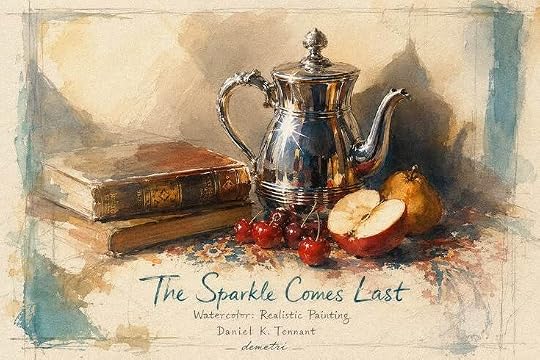
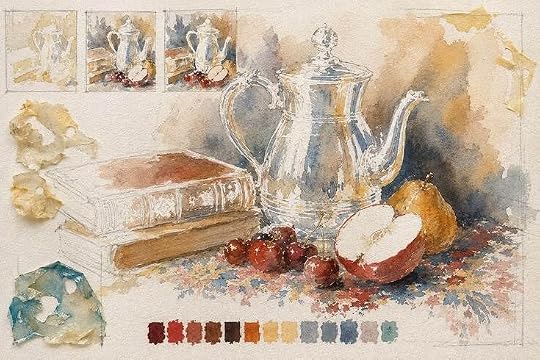
“The Sparkle Comes Last” – A nearly finished watercolor plate for Daniel K. Tennant’s “Watercolor: Realistic Painting,” where silver, fruit, old books, cloth, pencil scaffolding, and one earned white glint turn the book’s practical lesson into an image of patience, doubt, and finish.
Daniel K. Tennant’s “Watercolor: Realistic Painting” has no patience for the halo around realism. Its favorite trick is to pull the shine off the trick. Silver, cherries, satin, old books, snow, apples, lantern glass, patterned rugs – all the little tyrannies of realist painting arrive here not as marvels to be worshiped but as stages of value, edge, support, and light. Tennant’s answer to the aspiring painter’s anxious “How did anyone do that?” is modest, severe, and faintly comic in its faith in unglamorous materials: buy tools that will not betray the hand, make the drawing, preserve the drawing, control the support, manage the darks, then earn the light. Realism, in this compact guide, is not a mood. It is an order of operations.
Even the title sends the reader slightly sideways, usefully so. “Watercolor: Realistic Painting” belongs to a watercolor instructional series, but its governing medium is gouache, the opaque watercolor that lets Tennant work dark to light, recover buried forms, and place a white spark exactly where the eye expects one. This is not watercolor as bloom, wash, vapor, or happy accident. It is watercolor in a tool belt: firm supports, clean edges, obedient opacity, airbrush mist, stencil film, and final glints of permanent white. Readers arriving for looseness may feel they have wandered into a very polite machine shop. Readers arriving for method will find the lights already on.
Much of Tennant’s intelligence is there before the first grand object appears. He opens with materials and tools: gouache, brushes, illustration board, palette, thinners, water, maulstick, easel, lighting. The list may look like housekeeping, but it is more severe than that. A convincing painting is not made by a gifted eye alone. It is made by a body in a studio, under a particular light, with a particular brush, on a surface that either permits detail or quietly betrays the mark. Tennant knows how often beginners mistake their own frustration for a lack of talent when the saboteur is cheaper, meaner, and sitting on the table: flimsy paper, dirty rinse water, bad light, tired brushes, fugitive color.
Equally revealing is the chapter on drawing, where Tennant says he does not begin painting until he knows what he intends to do with each square inch of the surface. That sentence is the whole guide in miniature, though he would probably prefer it transferred with tracing paper. The grid system, projection, tracing, and careful preservation of the original drawing are not introduced with apology. The painter is not made to blush for aids. Accuracy is not treated as a moral test, and the book wastes no time on the old superstition that a device cancels the hand. For Tennant, the question is not whether a method looks romantic. The question is whether it lets the painter go on working.
Tennant’s prose has the dryness of a clean brush: directive, caption-minded, and useful by design. It is less a voice to savor than a hand on the wrist before the brush goes wrong. Sentences tend to be short to medium length, arranged in the rhythm of instruction: define the tool, explain its purpose, warn against misuse, proceed. The diction is studio-specific – HB pencil, hot-pressed board, zinc white, ivory black, ox gall, stencil film, PSI, gum arabic – and the nouns do most of the labor. There is almost no decorative weather. At times this makes the book verbally bald. At its best, the language has the same virtue as the method: it leaves the painter with fewer excuses and a clearer next move.
Rarely does Tennant write a sentence one would underline for beauty. One marks him because the next painting may otherwise go sideways. The captions, especially, have the blunt grace of someone standing beside an easel and rescuing you before you make the mistake he has already made five hundred times. Paint this first. Mask that. Restore the drawing. Do not overdo the spatter. Add the highlights last. The voice is calm because the process is not. Beneath the clean instructional surface lies a real knowledge of panic, and the prose’s restraint is part of its mercy.
Its structure is stronger than its sentences. “Watercolor: Realistic Painting” begins with working conditions, moves to techniques, then proceeds to applications. Materials lead to drawing; drawing leads to darks and lights; gouache leads to airbrush; airbrush leads to stenciling; stenciling leads to forms, textures, shadows, highlights, planning, and finally six demonstrations. The order is not housekeeping; it is the argument. Tennant does not hand the reader the full glittering still life first. Spectacle without grammar would only intimidate. He teaches the brush before the book spine, the sphere before the apple, the stencil before the polished teapot, the shadow before the room.
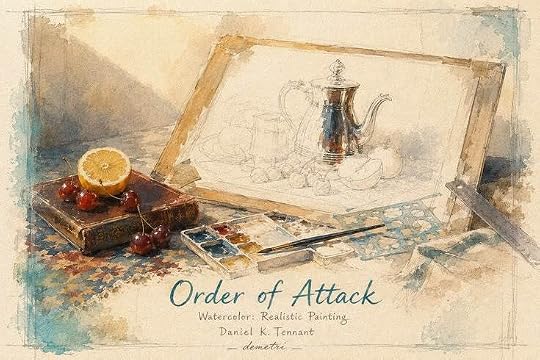
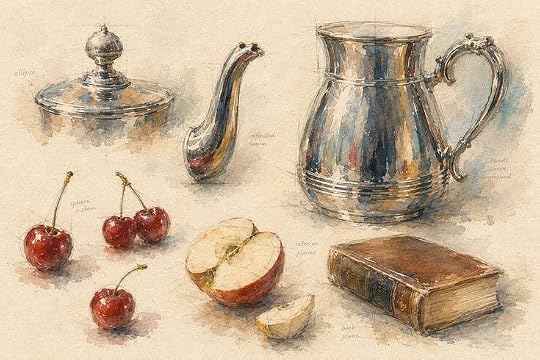
“Order of Attack” – A watercolor process plate for “Watercolor: Realistic Painting” by Daniel K. Tennant, arranging board, brush, stencil, graphite, fruit, book, and silver vessel into the quiet grammar of method before illusion begins.
Planning is the temperament that follows from that structure. The demonstrations make this visible. “August Afternoon” applies the method to an outdoor figure and landscape; “Still Life with Lantern” gathers fruit, books, shadow, rug, and glass; “Still Life with Satin Pillow” adds ornament and reflective abundance; “Last Light” moves into winter atmosphere; “Still Life with Blue Cloth” turns stenciling into orchestration; “Heirlooms with Cherries” gathers the lessons into an ornate final arrangement of books, lemons, cherries, silver, rug, reflections, and white sparks. The sequence is accretive rather than dramatic. Nothing happens, except competence, which is not nothing.
Airbrush work gives the guide one of its particular signatures. Tennant’s airbrush is not a novelty act but a way of extending the painter’s reach: soft shadow, gradual blend, fog, spatter, hard edge, soft edge. The exercises – parallel lines, dots, Xs, curlicues, metallic squares, graduated color – may look unglamorous, but they reveal the book’s workshop intelligence. Before the reader is asked to make something beautiful, the hand must learn distance, pressure, repeatability. This is where the guide’s view of art becomes most usefully unromantic. Beauty is downstream from drills.
Perhaps the most clarifying pages are the ones where adjectives stop being adjectives. Metal is not “shiny” in the abstract. It is black, then gray, then lighter gray, then reflected color, then a clean white point. Old books are not “old” because the painter feels literary about them. They are dark underpainting, stippled texture, worn edges, scuffed highlights, and controlled shadow. Fruit becomes volume, mask, reflected light, cast shadow, and skin. Satin becomes directional value. Snow, wisely, is not simply white. Tennant is best when he teaches the reader to translate description into stages.
Against this, the cost appears exactly where the discipline works. “Watercolor: Realistic Painting” is enclosed in the place where it succeeds. Tennant’s world prizes order, preparation, surface, and finish. That gives the book clarity, but it also limits the air around it. The guide leaves looseness outside the studio door, along with accident, art history, and most of the unruly reasons people make pictures in the first place. It treats likeness as a solvable problem, which is invigorating when one is holding a brush and less satisfying when one wants a roomier argument about art.
Despite the enclosure, Tennant’s lack of embarrassment about aids gives the book a small but real nerve. He embraces photographs, grids, transfers, projection, stencils, and airbrushes without flinching. Some painters will find that liberating. Others may find it too engineered, as if painting has become cabinetry with highlights. But Tennant’s frankness is preferable to a haze of unaided genius. The book does not cheapen craft by admitting tools. It clarifies craft by showing how many decisions remain after the tool has done its small part.
Its useful relatives are not wash-heavy watercolor reveries but practical seeing manuals: “How to Draw What You See” by Rudy De Reyna, with its reduce-and-build logic, and “Color and Light” by James Gurney, with its broader sense of light, color, and surface as systems. Tennant has neither De Reyna’s classic drawing-first scope nor Gurney’s conceptual reach. He is smaller, brisker, more workshop-bound. His contribution is not amplitude. It is compression with a screwdriver.
Measured at the workbench, the book’s sturdier achievement is demystifying the work without discouraging the worker. It makes lifelike painting feel teachable without making it feel easy. Tennant does not promise that labor can be bypassed. He promises that labor can be ordered. His most revealing aside comes in “Thoughts on Painting,” where he admits to the discouraging middle of a painting, the stage at which one may want to throw the whole thing away. That confession gives the manual its human pressure point. The finished glimmer rests on a moment of private disgust.
In that ugly middle, the book’s emotional pattern briefly shows itself: intimidation gives way to sequence, sequence gives way to frustration, frustration gives way to continuing anyway. Tennant does not stop to cultivate the feeling; he names the discouragement and gets back to the board. Still, the pattern is recognizable to anyone who has tried to make something exact. A painting often fails before it finishes. The book’s hidden consolation is that failure may simply be a middle stage with bad lighting.
The repeated chain – transfer, mask, underpaint, shadow, restore, highlight – steadies the reader and eventually starts to show its seams. Repetition is partly the point. Instruction requires return; skill becomes skill by coming back. But in a book this compressed, recurrence can harden into predictability. You may admire the sequence while wishing it would occasionally surprise itself. The demonstrations reinforce the system more often than they complicate it.
Readers who keep one eye on the board and one hand near the water bucket are the likeliest audience. For a beginner or intermediate painter who wants a compact, material-minded introduction to realist gouache technique, there is much here to use. For someone seeking literary pleasure, expressive looseness, contemporary art debate, or a philosophy of looking, the walls may feel close. The book is not hostile to imagination, but it imagines imagination as something that works best after the drawing has been properly transferred.
Our present flood of frictionless images gives Tennant’s patience an unintended glint. He is not writing about automated image-making, nor should he be drafted into a manifesto he did not sign. Still, the book’s devotion to hand-skill, sequence, and material consequence now feels stubborn in the right way. It says that an image can be reverse-engineered, yes, but not without a person making decisions in time: thinning paint, cleaning water, cutting stencils, watching a shadow, and refusing to quit before the surface turns.
Put at its proper size, “Watercolor: Realistic Painting” deserves a favorable but bounded verdict: 74/100, which translates to 3/5 stars. That is not a punishment. It is a recognition of size and ambition. This is a coherent, useful, sometimes quietly wise guide, not a major work of art writing. Its excellence is practical and structural rather than literary, emotional, or philosophically deep. It gives the reader an order of attack, not a world-encompassing vision – though the order of attack contains more vision than it first admits.
One charm of the book is that its ambitions remain refreshingly local. It wants the apple round, the satin directional, the snow less toothpaste, the old book handled, the teapot bright without becoming chrome pudding. There is wit in that practicality, though Tennant does not perform it. The comedy belongs to the gap between the grandeur of illusion and the homely means required to produce it: tape, water, paper towel, stencil film, patience.
Underneath its topic, the real subject keeps showing up in the advice. Keep the final drawing. Step back. Use a mirror. Do not throw the painting away too early. Work out the composition first. These instructions sound simple until one recognizes that they are also emotional safeguards. Tennant’s realism is not just a way of depicting surfaces. It is a way of surviving the period when the surface offers no encouragement.
Like the best workshop books, “Watercolor: Realistic Painting” is more useful in the hand than away from the easel. Read straight through, it can feel spare, repetitive, and overly sure of one way of proceeding. Used beside a painting, its virtues grow. The reader can return to a page on gouache consistency, stencil control, cast shadow, or white highlights and find, not revelation, but the next reasonable move. That is a small, durable excellence. Not every book needs to open a door. Some earn their keep by labeling the hinges.
On its final pages, the guide culminates in “Heirlooms with Cherries,” an apt last exercise because the objects are old, reflective, patterned, edible, worn, and bright – a tournament of surfaces. The painting gathers the whole argument into one crowded tabletop: plan the drawing, build the rug, age the books, round the fruit, darken the silver, return the light. The end does not revise the method so much as confirm it. For Tennant, the climax of realism is not revelation. It is finish.
Still, that finish has its own small radiance. A highlight placed at the end is not decoration; it is proof that everything before it has held. The clean white glint on a cherry or teapot carries the history of the drawing, the board, the underpainting, the stencil, the shadow, the resisted impulse to quit. “Watercolor: Realistic Painting” may not be a deep book, but it understands something deep about making: the sparkle comes last because the sparkle has to be earned.
[image error] Compositional Thumbnail Sheet – Small graphite-and-wash studies test the triangular relation of teapot, books, fruit, cloth, and border before the final image settles into its quiet order of attack.
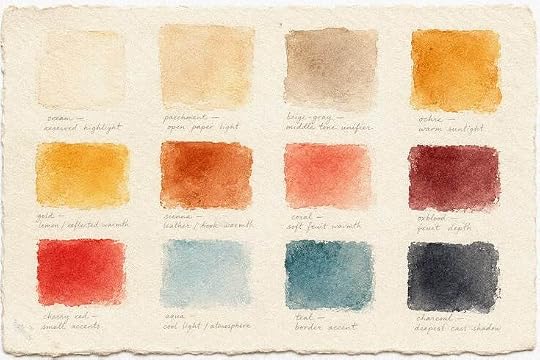
Color Swatch Sheet – The cover-derived palette becomes a working vocabulary here: teal, parchment, oxblood, ochre, cherry red, blue-gray, cream, and charcoal laid out before they are asked to become light.
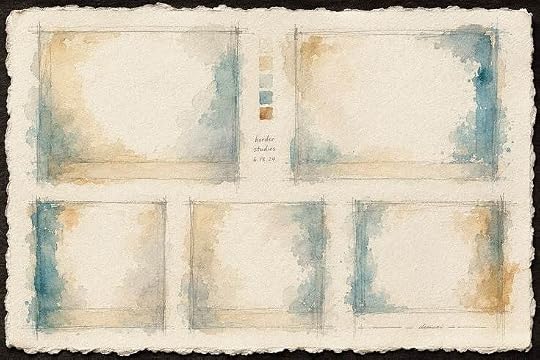
Watercolor Border Study – A cream-paper margin, softened teal side accent, incomplete wash edge, and lower signature line shape the image as a literary plate rather than a simple still life.
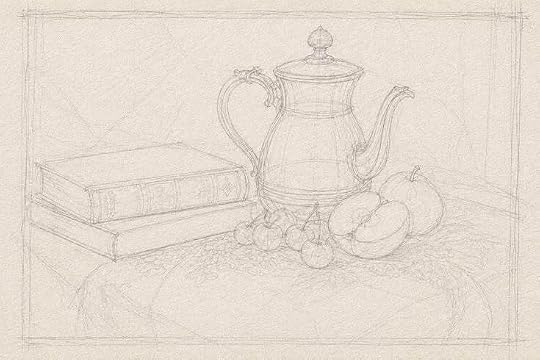
Faint Pencil Underdrawing – Teapot ellipses, fruit contours, book blocks, table edges, and border guides remain visible as the image’s first intelligence, before color begins to persuade.
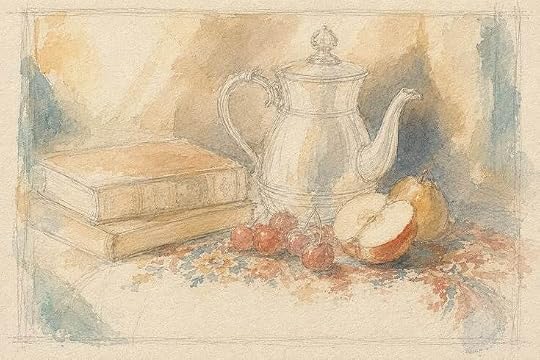
Pencil-Plus-First-Wash Stage – The first washes establish the slant of light, the table shadow, the teal border, and the warm fruit tones, letting atmosphere enter before detail.
Masking / Reserved-Highlight Study – Protected edges and reserved whites show how the eventual sparkle is planned in advance, not discovered by accident at the end.
Object Anatomy Study: Silver, Fruit, Book, Ellipses – Separate studies of the teapot lid, spout, cherry spheres, cut fruit geometry, book perspective, and reflected bands reveal realism as structure beneath shine.
All watercolor illustrations by Demetris Papadimitropoulos. Watercolors are done on 140lb vellum and then scanned into the computer using an Epson scanner. From there, they are finalized in Procreate. All art and opinions are my own.
First of all, this should be called Gouache: Realistic Painting because that's what it talks about. Yes, gouache is a type of watercolor, but every single artist I know refers to watercolor as one thing and gouache as another. But I like both mediums, so that didn't stop me from reading.
The rest of the book, however, is just as messy as the title. The lessons don't flow in a natural order. We learn how to paint fruit and silver and Persian rugs, all with highlights and shadows. Then, one of the last chapters is about highlights and shadows. Shouldn't we have learned about those concepts before actually painting them? Speaking of which, I don't think this book knows who its audience is. Most of the first chapters assume you understand color theory and have basic/intermediate skills. If that's the case, why even have a chapter explaining what highlights and shadows are? Those are some of the first things we learn in art classes.
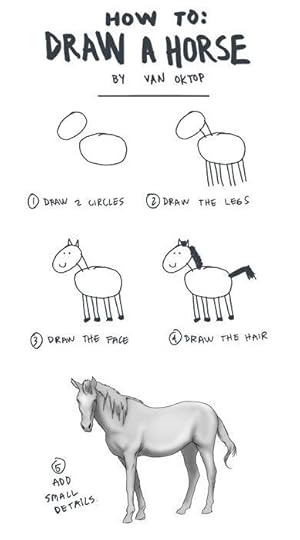
My biggest annoyance with this book is that it doesn't actually teach you anything substantial. It mostly gives you tutorials. For example, there's a chapter called "Painting Different Textures." It gives us a few techniques, but rather than showing us how to use those creatively in any painting we want to create, we're walked through the painting process of specific objects. The fruit, silver, and rug I mentioned earlier are some of those objects. That would actually be somewhat understandable if they were explained well, which they're not. Those tutorials remind me of this meme:
The reason I didn't give it one star is because I did learn one technique that I hadn't thought about before, so this wasn't a complete waste of time.