Handfasting and Wedding Rituals has everything you need to plan the perfect Pagan wedding. You'll find advice and examples to help you with basic wedding planning, writing vows, and ritual construction, along with practical tips and great ideas about everything from low-cost wedding favors to candle and bonfire safety.
Handfasting and Wedding Rituals also includes sixteen full rites honoring a wide variety of Pagan traditions. Rituals in their full form can be used exactly as printed or modified to fit your needs. Each rite is categorized as level one, two, or three depending on their level of overt Pagan content and degree of participation expected from your guests.
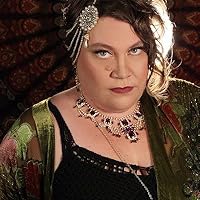
A female-to-male transgendered activist and shaman, Raven Kaldera is a pagan priest, intersex transgender activist, parent, astrologer, musician and homesteader. Kaldera is also the author of "Hermaphrodeities: The Transgender Spirituality Workbook" from XLibris Press. The founder and leader of the Pagan Kingdom of Asphodel and the Asphodel Pagan Choir, Kaldera has been a neo-pagan since the age of 14, when he was converted by a "fam-trad" teen on a date. Since then, he's been through half a dozen traditions, including Gardnerian, Dianic, granola paganism, Umbanda, Heithnir, and the Peasant Tradition. He is currently happily married to artist and eco-experimentalist Bella Kaldera, with whom he co-founded the Institute for Heritage Skills.
I guess I expected more from this book. I wanted a book that would help me plan the entire handfasting/wedding. Unfortunately, this book is only helpful if you are trying to come up with the wording for that actual ceremony. Since we have an officiant that has preformed numerous handfastings, this is something that I wasn't as interested in. I would have liked more information about ideas for decorations, invitations, lore, etc. There is so much more to planning a wedding than just the wording of the ceremony. I expected this to be a much more comprehensive resource.
A phenomenal and amazing book, a MUST HAVE for anyone planning a handfasting, thinking about a handfasting, or looking to learn more about a handfasting. It is excellent and I can't recommend it highly enough.
I loved this book is because it is so diverse. There is an entire chapter on interfaith weddings, which includes pagan weddings with Christian (Catholic and Prodestant), Jewish, Muslim, Hindu, and Buddhist traditions. There is also an entire chapter specifically on handfastings with two men, two women, multiple partners, and transgender/genderqueer spouses. It shares templates for rituals and vows that include more common wiccan elements like calling quarters, but also celtic, norse, grecian, warrors, thelemic, tarot, astrological, runes, heathen, Faery, goth, theatrical plays and scripts, and ideas for incorporating children. It is extremely comprehensive. There is appendices of astrological signs, flowers, and a dictionary of common symbols. There is also a chapter on handparting and resources for clergy.
In addition to being full of good information, I also loved this book because the writing style was so open and encouraging. The authors inspire you to put together a ceremony that above all works for you. The entire book takes into account that people have differing levels of comfort between their religions and their families. The authors encourage the reader to reflect when they create the ritual and to focus on the things that are really important - love and commitment. This book supports you to make your handfasting great, which was really reassuring in a sea of people who all seem to want your wedding to be what they think it should be. I highly recommend.
I checked this book out from the library after doing a search for Llewellyn books in the collection. I skimmed through a lot of this book, but read in detail certain parts that looked interesting to me. I think it may be very helpful in planning the ceremonial aspects of my future wedding! Definitely worth the read if you are stumped as to what to say. I wish it had more of what they call "level 1" stuff - things to say if you want to keep the pagan-y aspects toned down for the family attending, but still there for the bride and groom. I found it neat that they had ideas for people in different relationships other than just the traditional heterosexual though. Also, there was a sweet little handfasting for teens that seemed very appropriate for the year-and-a-day type handfasting, which was worded to show it's seriousness in intention of commitment but also to make it obvious that it was equally about being responsible and NOT a legal marriage. Pretty neat stuff!
I think that this book would be an excellent addition to any Pagan group's library and especially important for any Pagan clergyperson who performs, or would like to perform, weddings; it has a great breadth and depth of material. As a barely-practicing Pagan getting married to an atheist, not involved in any Pagan group, large chunks of this book had no relevance to me. However, I did find several useful ideas (especially for the vows), so it was worth the price.
As with so much of Raven's work, it is wide-ranging, and able to be helpful to many. He covers several bases yet, keeps it a general book that is a great starting place to having a non-traditional wedding with a Pagan (of many stripes) hand-fasting, including inter-faith marriages.
From his own experience, he includes ceremonies for multiple gender expressions, and multiple relationship structures, using his poetic talents, there are plethora of variations of vows, a mixture of ceremony suggestions, and items one might want to include including his own vows. There are those modeled on tarot, runes, and astrology which I thought was a very creative way to present one's vows There are examples to include other family members in the ritual, as well as a hand-parting, if such a time is needed. I appreciate that he includes some deities associated to marriage that one may which to invoke during the surface. The appendix has symbols, flower meanings, and how to use astrology to help determine compatibility, and timing. Suggested Reading permits a great place to continue.
This book is great for planning a pagan wedding! While there are not as many details for the “wedding” party (picking catering, choosing a florist, dress shopping, invites, and so on), there are a lot of details that are still applicable. Of course the main purpose of this book is the wedding ceremony/vows. I was surprised to see a variety of relationships represented as well as various faiths. We ended up using the rune blessing ritual for ourselves (slightly altered) in a private ritual after our wedding. It was a great resource for planning our pagan wedding!
Earlier this year I reviewed A Romantic Guide to Handfasting by Anna Franklin. While I enjoyed the book and plan to even use a couple ideas from the book, I generally found it to be lacking the meat and depth that I was looking for when planning our wedding. The only other major book on pagan wedding rites and handfasting that I could find was Welcoming Hera's Blessing - Handfasting and Wedding Rituals by Raven Kaldera & Tannin Schwartzstein.
This book wins my heart for a few reasons. First, there are so many wonderful rite examples! The authors really showcase the diversity of the weddings they preformed and their community. Everything from young couples, polyamorous couples, interfaith couples (there is a whole chapter devoted to these!), traditional Pagans, to eclectic Pagans are covered. Even if, somehow, you don't see a rite devoted to the type of couple or handfasting you are having, you are bound to find ideas from the many different full rituals given here.
Second, the authors balance the needs of writing explanation of symbols, history, and the "whys" of the rituals with the meat of example rituals extraordinarily well. Never did I find myself wanting more explanation or getting board of the example rituals given. This balance made for a very cohesive read.
I'm planning on keeping this one on my bookshelf for a while, in hopes that I get to help someone else plan a really awesome wedding!
I didn’t read this cover to cover, as it is a book of ritual planning. However, we used it to put together our wedding ceremony, and it is full of wonderfully-written words. I hopped around the book and found what worked.
I really wanted to enjoy this book, and I did in the beginning, but I got very tired of the author contradicting themselves with statements they had no sources of with very little research done on them. From blatantly stating that white dresses are Judeo-Christian in nature (they aren’t, some quick research will tell you that it was an elitist color and very hard to keep clean as only the most upper class of the upper class in any culture even possessed it), to just unsourced tales and traditions that can easily be found in many historical books. This strikes me as both a lack of caring for history and a lack of understanding traditions today. Why bother making a book about rituals and traditions without understanding what came before you?
I know that the premise of the book is to make up traditions so that a more non-religious sect can enjoy the ceremonies, it even goes out of his way to include different forms of gods and rituals and ways to include audience members who may not be so inclined, but it does it so haphazardly with no focus on one particular thing. For example the book is dedicated to Hera, but there’s no devoted part to Greek mythos rituals, or culture, just a handful of their gods.
I did enjoy the index, it felt very witchcraft-ian to me. But unfortunately the sources section is nonexistent and instead has a “suggested reading” and “index of words used”.
I question the validity of the authors as well, because the book has blurbs on their history and past, as well as ways of to get in contact with them (and to send them $10 for a reply?!) but when I did a quick search I found mixed results and that many of the places (I assume where they used to work) back when this was published in 2002, are no longer around.
Perhaps I was just mislead, the entire summary of the book describes pagan weddings. But it felt more bohemian, new age, witchcraft rather than old gods, feast food, and such. Juggling too much with lose words and feelings, it just wasn’t what I expected. That being said it does seem to have something for everybody, of every religion, ethnicity, sexuality, and belief.
Its a book to maybe spice up your wedding rather than an actual how-to, I wouldn’t take all the advice word for word, I mean have fun with your ceremonies; don’t worry about not picking the most perfect kind of flower based on the month or something. You can get married in a courthouse and then have a massive intricate ceremony with no real officiant, just go crazy and do what you want, it’s your special day after all.
If you are planning your own handfasting or facilitating one, this book is very in-depth. The author does a great job at covering all the basics and includes a wealth of information from wording and vows to incense making to decorations. For partners who are of dual faith or same faith, gay or straight, this book is awesome!
I recommend this book over all others on the market in regards to planning pagan weddings and handfastings.
Kaldera covers all things that need consideration. The planning, the place, the guests.........comfort levels of your guests and participants.
Best of all Kaldera takes a very gender neutral approach. Kaldera addresses and acknowledges GLBT individuals (being one himself), and considerations that need to be taken into account regarding a GLBT ceremony.
Kaldera also addresses the topic of interfaith weddings.
There really is not another pagan handfasting book on the market that is as thorough and well written and thought out as this one is.
I purchased this book because, at the time, I was preparing for my wedding and wanted to incoporate some special themes into it. Reading through it gave me a myriad of ideas and it all honored things that were special to me. When the time comes, it will only add to the beauty that any good wedding should have, mine included.
As an ordained rabbi, it's important for me to be able to write my own ceremonies for the people that I marry. This book helped me prepare a lovely ceremony for a dear friend's wedding in March. I highly recommend it to anyone that is getting married or anyone that wants to renew their vows in a more spiritually unique way.
I definitely got some good ideas from this book. It covers some really difficult topics, including having a pagan wedding without offending your conservative Christian relatives, which is really useful. I also like that it covers a variety of pagan paths. Too often I find that pagan books are 95% Wiccan, and if you're not Wiccan, the book isn't terribly relevant to you. But this book had elements of many different traditions, so I think it could provide inspiration to any pagan planning a handfasting ritual.
This book was terrific! It covered a wide variety of ideas, options, traditions and techniques for constructing a Wedding or Handfasting ceremony for just about any situation and any couple. This was probably the greatest resource I had when my husband and I created our own public wedding ceremony. A must have for any pagan bride, groom or clergyperson!
If you want to start performing handfastings/weddings, this book is a good place to start. There's a lot of information and guidelines to help guide you through designing the perfect wedding ceremony for each couple. There are even complete ceremonies included.
A fine and detailed source for alternative commitments, including many variations on "mixed" marriages (pagan/catholic, pagan/jewish, pagan/atheist…) , a rainbow of gender combos, and weddings involving three or more spice (that's plural for spouse, right?).
There are lots of great ideas in here! There are even suggestions for polyamorous ceremonies. My favorite part was that the various suggestions were rated levels 1-3 for how pagan they were. My one issue was that the writing seems to be aimed more at officiants than happy couples.
Helpful for creating a ceremony from scratch... I feel much more prepared to write our ceremony script and vows. The LGBTQ chapters, divorce, an theatrical chapters were interesting but not useful for me.
This is my go-to book when planning a wedding, even if the people getting married are not Pagan. It offers some lovely ceremonies for a variety of situations. The ring exchange ceremony is a staple of my officiant offerings. If you buy one book on doing handfastings, this should be it.
Not only does this book go incredibly in-depth, but it also shows the beauty of different types of weddings and sub-communities of pagan life. From rites, crafts, to even party-goer gifts, this book has everything and more anyone could ever need for a beautiful handfasting.