

What do you think?

The Seeds of Time
For the ten short stories collected here, John Wyndham turns his imagination to, among other subjects, body-snatching, time-travel and mind-travel, and the the tricky business of interplanetary colonization.
222 pages, Mass Market Paperback
First published January 1, 1956
About the author
John Wyndham
364 books2,078 followersJohn Wyndham Parkes Lucas Beynon Harris was the son of a barrister. After trying a number of careers, including farming, law, commercial art and advertising, he started writing short stories in 1925. After serving in the civil Service and the Army during the war, he went back to writing. Adopting the name John Wyndham, he started writing a form of science fiction that he called 'logical fantasy'. As well as The Day of the Triffids, he wrote The Kraken Wakes, The Chrysalids, The Midwich Cuckoos (filmed as Village of the Damned) and The Seeds of Time.
Ratings & Reviews
Friends & Following
Create a free account to discover what your friends think of this book!
Community Reviews
Displaying 1 - 30 of 221 reviews

November 23, 2009
Totally new review after November 2020 reread, replacing 2012 review.
Short stories explicitly outside the traditional sci-fi “adventure narrative” associated with cliff-hangers and “galactic gangsters”. If Wyndham makes you think of spooky children (see my reviews of Midwich Cuckoos and Chocky) and The Day of the Triffids, prepare for something different. There is plenty of variety here, and some great ideas from the 1940s and early 1950s, but more fiction than science, and several of them have a humorous slant.
Ask yourself
What I look for in sci-fi is interesting ideas (language, character development, and even plot are secondary). Wyndham delivers.
1. How much of your uniqueness is in your mind? If transferred to another entity, would you still be you?
2. What are the ethics of harming a version of yourself?
3. Does (assumed) low intelligence ever justify secondary treatment, especially if the individual is not human?
4. Would you want to know what happens on alternative timelines, if certain key decisions went another way? Which decisions would they be?
5. Would you prefer a long, painless, but fairly dull and idle life to what you currently have?
6. If you could travel to the recent past to see your forebears, what would you expect or want to gain by it?
7. Would you dare travel to the future?
8. How far can “self-defence” be stretched as justification for killing someone?
9. If you travel time in your craft, you need to be sure you have fuel for the return trip, but what are the possible consequences if it stays behind?
10. If human life is an accident, maybe our species’ survival is too?
Recurring themes
Colonialism and slavery
“We must remember it’s their world.”
There are serious, satirical, and outright comic examples of travelling to another place or time, sometimes with the intention of settling there. Wyndham is clearly against the historical human pattern of dominating and enslaving or obliterating those already there and was perhaps a multiculturalist before the word was coined:
“A culture must grow to live.”
Gender roles
There are characters with misogynistic attitudes typical of the time (and worse), but there’s invariably someone to challenge them: sometimes women by what they do and say, but there are also men who stand up for women’s rights and freedom.
Power of the press
Wyndham was prescient about how the media create “celebrities” and spin stories, but he also has savvy people using the hunger for headlines to their own advantage. See also Midwich Cuckoos and Chocky.
Narrative framing and exposition
Wyndham often (not just here) relies rather heavily on a character writing a report, diary, or letters as a handy way to explain things.
Seeds
The title may be inspired by a line from Macbeth:
“If you can look into the seeds of time, and say which grain will grow and which will not, speak then unto me.”
Several stories mention seeds metaphorically (including survival themes) and literally, but the one titled Wild Flower doesn’t.
“We have to think of ourselves as the seed of the future and every grain of that seed is precious.”
Image: Seeds of time (Source.)
Reviews of individual stories (no spoilers)
Chronoclasm, 4*
“Do you believe in predestination?”
A time-travel rom-com which, despite the foreword, has a spot of adventure and peril. The title refers to the sort of anomaly that can arise if users of history-machines do anything more than observe. The risks of killing one’s grandfather or becoming one’s own progenitrix are mentioned. This is The Butterfly Effect, an idea generally credited to Bradbuy’s Sound of Thunder from 1952 (see my review HERE), the year before this story was first published.
“One has to be so careful; the results of the least action are incalculable… Let one seed fall out of place, and who can say what may come of it?”
Time to Rest, 4*
“Bert disliked the silence which brooded over desert and water like a symptom of mortification.”
A charming pastoral tale where Bert travels the Martian canals on an improvised boat, living a tinker's life, befriending some of the “utterly unmechanical” Martian families he regularly visits, and noting the scenery and plants.
“One exists by barter. One lives by giving - and taking.”
It becomes more existential as we learn how long Bert has been doing this and why. Is Bert still an Earthman, and if not, what is he - what can he be?
“Existence now was not life to be lived; it was a token of protest against the ways of fate.”
Meteor, 4*
“We need long courage, not brief bravery.”
This was written pre-war, but lightly edited afterwards. It’s definitely an adventure, but there are no “galactic gangsters”. The basic plot is obvious from the off, but it’s an interesting example of how an insular perspective (life, experience, body) skews objectivity and ability to interpret unfamiliar situations.

Image: Think outside the box (Source.)
Survival, 4*
This seems like a cliché, but it predates most of the sci-fi it brings to mind. It contrasts some very misogynistic characters with a woman who is unafraid to make and defend her choices. As it’s a survival story, she’s not the only one with difficult decisions about priorities. The punchline is humorous horror.
Pawley's Peepholes, 5*
This is the story I remember most vividly and fondly from my first reading of this collection in my teens, when I was newly dabbling in sci-fi. It is a comic slant on time travel, commercialism, the media, and privacy.
Opposite Number, 4*
“Every ‘instant’ an atom of time splits. The two halves continue upon different paths.”
This story about parallel universes has an original ending that made me question the veracity of everything before it.
Pillar to Post, 4*
“I had acquired an understanding of the language… but the concepts that were behind it did not necessarily follow.”
Dark humour and ethical quandaries. Like Meteor, it’s about disorientation when one cannot even begin to understand one's circumstances, but Terry is fully aware of his ignorance, and the plot and dilemmas are more complex. It also posits that government paternalism removing the need to adapt could cause the slow demise of humanity.
Terry lost his legs in an explosion and then something of his mind from constant use of strong painkillers. One day he wakes to find himself, with legs, in a futuristic place that is not as utopian as it first seems. Near-immortality has a price, and two people attempt to outwit each other to survive at all.
Dumb Martian, 4*
“There’s a natural dumbness about Marts… They kind of non-register… Kind of like a half-robot, and dumb at that; certainly no fun.”
A strong anti-racist, anti-slavery, pro-education, feminist story, with a battle of wits towards the end that makes it more fun than my preachy-sounding description.
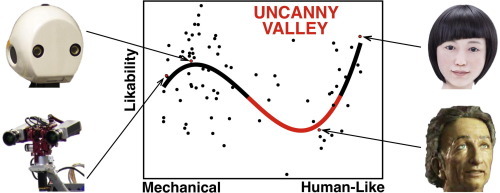
Image: Graphic from "Navigating a social world with robot partners: A quantitative cartography of the Uncanny Valley" by Maya B Mathur and David B Reichling (Source.)
Compassion Circuit, 4*
“You couldn’t go on thinking of it as ‘it’ any more.”
A very short exploration of the relationship between humans, domestic AI robots, and the differences between them. Light horror.
Wild Flower, 2*
“Science was the enemy of the world that lived and breathed.”
A twee story, unlike the others. Felicity Fray is a teacher who loves nature in a way that reminds me of Wodehouse’s Madeleine Bassett who thinks “the stars are God's daisy-chain”, but without the charm or clever plots.
More
If you enjoy these, you'll also enjoy his collection, Consider Her Ways and Others. See my review HERE.
Short stories explicitly outside the traditional sci-fi “adventure narrative” associated with cliff-hangers and “galactic gangsters”. If Wyndham makes you think of spooky children (see my reviews of Midwich Cuckoos and Chocky) and The Day of the Triffids, prepare for something different. There is plenty of variety here, and some great ideas from the 1940s and early 1950s, but more fiction than science, and several of them have a humorous slant.
Ask yourself
What I look for in sci-fi is interesting ideas (language, character development, and even plot are secondary). Wyndham delivers.
1. How much of your uniqueness is in your mind? If transferred to another entity, would you still be you?
2. What are the ethics of harming a version of yourself?
3. Does (assumed) low intelligence ever justify secondary treatment, especially if the individual is not human?
4. Would you want to know what happens on alternative timelines, if certain key decisions went another way? Which decisions would they be?
5. Would you prefer a long, painless, but fairly dull and idle life to what you currently have?
6. If you could travel to the recent past to see your forebears, what would you expect or want to gain by it?
7. Would you dare travel to the future?
8. How far can “self-defence” be stretched as justification for killing someone?
9. If you travel time in your craft, you need to be sure you have fuel for the return trip, but what are the possible consequences if it stays behind?
10. If human life is an accident, maybe our species’ survival is too?
Recurring themes
Colonialism and slavery
“We must remember it’s their world.”
There are serious, satirical, and outright comic examples of travelling to another place or time, sometimes with the intention of settling there. Wyndham is clearly against the historical human pattern of dominating and enslaving or obliterating those already there and was perhaps a multiculturalist before the word was coined:
“A culture must grow to live.”
Gender roles
There are characters with misogynistic attitudes typical of the time (and worse), but there’s invariably someone to challenge them: sometimes women by what they do and say, but there are also men who stand up for women’s rights and freedom.
Power of the press
Wyndham was prescient about how the media create “celebrities” and spin stories, but he also has savvy people using the hunger for headlines to their own advantage. See also Midwich Cuckoos and Chocky.
Narrative framing and exposition
Wyndham often (not just here) relies rather heavily on a character writing a report, diary, or letters as a handy way to explain things.
Seeds
The title may be inspired by a line from Macbeth:
“If you can look into the seeds of time, and say which grain will grow and which will not, speak then unto me.”
Several stories mention seeds metaphorically (including survival themes) and literally, but the one titled Wild Flower doesn’t.
“We have to think of ourselves as the seed of the future and every grain of that seed is precious.”
Image: Seeds of time (Source.)
Reviews of individual stories (no spoilers)
Chronoclasm, 4*
“Do you believe in predestination?”
A time-travel rom-com which, despite the foreword, has a spot of adventure and peril. The title refers to the sort of anomaly that can arise if users of history-machines do anything more than observe. The risks of killing one’s grandfather or becoming one’s own progenitrix are mentioned. This is The Butterfly Effect, an idea generally credited to Bradbuy’s Sound of Thunder from 1952 (see my review HERE), the year before this story was first published.
“One has to be so careful; the results of the least action are incalculable… Let one seed fall out of place, and who can say what may come of it?”
Time to Rest, 4*
“Bert disliked the silence which brooded over desert and water like a symptom of mortification.”
A charming pastoral tale where Bert travels the Martian canals on an improvised boat, living a tinker's life, befriending some of the “utterly unmechanical” Martian families he regularly visits, and noting the scenery and plants.
“One exists by barter. One lives by giving - and taking.”
It becomes more existential as we learn how long Bert has been doing this and why. Is Bert still an Earthman, and if not, what is he - what can he be?
“Existence now was not life to be lived; it was a token of protest against the ways of fate.”
Meteor, 4*
“We need long courage, not brief bravery.”
This was written pre-war, but lightly edited afterwards. It’s definitely an adventure, but there are no “galactic gangsters”. The basic plot is obvious from the off, but it’s an interesting example of how an insular perspective (life, experience, body) skews objectivity and ability to interpret unfamiliar situations.
Image: Think outside the box (Source.)
Survival, 4*
This seems like a cliché, but it predates most of the sci-fi it brings to mind. It contrasts some very misogynistic characters with a woman who is unafraid to make and defend her choices. As it’s a survival story, she’s not the only one with difficult decisions about priorities. The punchline is humorous horror.
Pawley's Peepholes, 5*
This is the story I remember most vividly and fondly from my first reading of this collection in my teens, when I was newly dabbling in sci-fi. It is a comic slant on time travel, commercialism, the media, and privacy.
Opposite Number, 4*
“Every ‘instant’ an atom of time splits. The two halves continue upon different paths.”
This story about parallel universes has an original ending that made me question the veracity of everything before it.
Pillar to Post, 4*
“I had acquired an understanding of the language… but the concepts that were behind it did not necessarily follow.”
Dark humour and ethical quandaries. Like Meteor, it’s about disorientation when one cannot even begin to understand one's circumstances, but Terry is fully aware of his ignorance, and the plot and dilemmas are more complex. It also posits that government paternalism removing the need to adapt could cause the slow demise of humanity.
Terry lost his legs in an explosion and then something of his mind from constant use of strong painkillers. One day he wakes to find himself, with legs, in a futuristic place that is not as utopian as it first seems. Near-immortality has a price, and two people attempt to outwit each other to survive at all.
Dumb Martian, 4*
“There’s a natural dumbness about Marts… They kind of non-register… Kind of like a half-robot, and dumb at that; certainly no fun.”
A strong anti-racist, anti-slavery, pro-education, feminist story, with a battle of wits towards the end that makes it more fun than my preachy-sounding description.
Image: Graphic from "Navigating a social world with robot partners: A quantitative cartography of the Uncanny Valley" by Maya B Mathur and David B Reichling (Source.)
Compassion Circuit, 4*
“You couldn’t go on thinking of it as ‘it’ any more.”
A very short exploration of the relationship between humans, domestic AI robots, and the differences between them. Light horror.
Wild Flower, 2*
“Science was the enemy of the world that lived and breathed.”
A twee story, unlike the others. Felicity Fray is a teacher who loves nature in a way that reminds me of Wodehouse’s Madeleine Bassett who thinks “the stars are God's daisy-chain”, but without the charm or clever plots.
More
If you enjoy these, you'll also enjoy his collection, Consider Her Ways and Others. See my review HERE.

November 28, 2019
John Wyndham writes of these stories as
"The intention of Chronoclasm, in the comedy-romantic, was to entertain the general reader and break away from the science-fiction enthusiast. Pawley’s Peepholes is satirical farce. Opposite Number attempts, with perhaps qualified success, the light presentation of a somewhat complicated idea. For Dumb Martian and Survival I tried to use the pattern of the English short-story in its heyday. Compassion Circuit is the short horror-story. A neo-Gothick trifle, could one say? And finally there is Wild Flower where one has encouraged science-fiction to try the form of the modern short-story.

The stories are;
Chronoclasm
Time to Rest
Meteor
Survival
Pawley’s Peepholes
Opposite Number
Pillar to Post
Dumb Martian
Compassion-Circuit
Wild Flower

John Wyndham wrote the novels The Day of the Triffids, The Kraken Wakes, The Chrysalids,The Midwich Cuckoos (filmed as Village of the Damned), Trouble with Lichen, The Outward Urge, Consider Her Ways and Others, Web and Chocky.
This collection contains good examples of his famous works.
Enjoy!
"The intention of Chronoclasm, in the comedy-romantic, was to entertain the general reader and break away from the science-fiction enthusiast. Pawley’s Peepholes is satirical farce. Opposite Number attempts, with perhaps qualified success, the light presentation of a somewhat complicated idea. For Dumb Martian and Survival I tried to use the pattern of the English short-story in its heyday. Compassion Circuit is the short horror-story. A neo-Gothick trifle, could one say? And finally there is Wild Flower where one has encouraged science-fiction to try the form of the modern short-story.
The stories are;
Chronoclasm
Time to Rest
Meteor
Survival
Pawley’s Peepholes
Opposite Number
Pillar to Post
Dumb Martian
Compassion-Circuit
Wild Flower
John Wyndham wrote the novels The Day of the Triffids, The Kraken Wakes, The Chrysalids,The Midwich Cuckoos (filmed as Village of the Damned), Trouble with Lichen, The Outward Urge, Consider Her Ways and Others, Web and Chocky.
This collection contains good examples of his famous works.
Enjoy!

December 31, 2016
There are some great sci-fi stories here, worthy of a five star rating.

December 1, 2022
First published in 1956 this book brings together a collection of ten short stories that features comedy, horror, romance and even occasionally social commentary. There's no real common theme, however three of the stories are based on Mars and time travel also features heavily as does a warning for men not to under-estimate women especially the quiet ones. Each story is individual rather than being part of a whole.
Normally I'm not a great fan of short stories, I usually find that whilst some are good others are less so, but here I found the standard was generally high. Wyndham is a great storyteller and the variety in this book allows him to show off his versatility. It is hard to pick a favourite but if I were pushed to do so I would probably plump for 'Pawley's Peepholes' in which the people of the future visit the present and treat it like a theme park, turning up in the most unexpected and unwanted places. A comedy with a satirical edge. In contrast I felt that 'Opposite Number' was probably the most dated and the final story 'Wild Flowers' probably the weakest.
This is a great introduction to Wyndham's writing for anyone who hasn't read his more well-known novels and as such I would highly recommend it.
Normally I'm not a great fan of short stories, I usually find that whilst some are good others are less so, but here I found the standard was generally high. Wyndham is a great storyteller and the variety in this book allows him to show off his versatility. It is hard to pick a favourite but if I were pushed to do so I would probably plump for 'Pawley's Peepholes' in which the people of the future visit the present and treat it like a theme park, turning up in the most unexpected and unwanted places. A comedy with a satirical edge. In contrast I felt that 'Opposite Number' was probably the most dated and the final story 'Wild Flowers' probably the weakest.
This is a great introduction to Wyndham's writing for anyone who hasn't read his more well-known novels and as such I would highly recommend it.

June 11, 2015
#13 in my Top 20 Books I Read in 2015: https://www.youtube.com/watch?v=zIWkw...
I thought Wyndham was an awesome novelist, but he seriously might be even better with short stories. The worst ones are kinda boring, but the best ones are really stellar: blood-chilling space horror, thought-provoking social commentary, and lots of Lovecrafty last lines that drive the mind-blowing last nail in the coffin of my not being sure of giving this thing a 5.
It's 50s sci-fi and if you don't know what that means, it means women tend to behave like good wives (watch for instance It!, The Terror from Beyond Space!, where the two women on the spaceship cook and serve meals while the men sit on their asses), but try and laught at that, come on. Dope collection!
I thought Wyndham was an awesome novelist, but he seriously might be even better with short stories. The worst ones are kinda boring, but the best ones are really stellar: blood-chilling space horror, thought-provoking social commentary, and lots of Lovecrafty last lines that drive the mind-blowing last nail in the coffin of my not being sure of giving this thing a 5.
It's 50s sci-fi and if you don't know what that means, it means women tend to behave like good wives (watch for instance It!, The Terror from Beyond Space!, where the two women on the spaceship cook and serve meals while the men sit on their asses), but try and laught at that, come on. Dope collection!

August 15, 2008
I'm tempted to say that John Wyndham's short stories are better than his novels. The ten in this collection range from average to awesome. You've got robots, time travel, space travel, and Martians, all written in Wyndham's accessible British style. A couple of them could easily have been made into Twilight Zone episodes. Seeds of Time won't make you forget Day of the Triffids or Midwich Cuckoos but it's definitely worth a read.

March 8, 2014
Sci-fi as it used to be...
Though always categorised as sci-fi, John Wyndham was probably one of the least science-based writers of the genre. There are very few gadgets in his stories and even when technology is being used – in order to time-travel for example – he doesn’t usually bother to give any kind of made-up science to explain the working; he simply expects his reader to accept it as possible and real. His stories might take the reader towards the fantasy side of sci-fi on occasion, but at heart they’re about humanity and Wyndham’s contemporary society even if they may be set on Mars in some distant future.
This collection, originally published in 1956, brings together ten stories, ranging from comedy to horror, with touches of romance and occasionally social commentary built in. There’s no real common theme – this is a collection where each story is individual rather than being part of a greater whole. But most of the stories are more than strong enough to stand alone and even the weaker ones are well worth reading. Wyndham is a great storyteller and the variety in this book allows him to show off his impressive versatility.
The stories are:-
Chronoclasm – a story that addresses the paradoxes inherent in time travel and throws in a nice little romantic comedy along the way.
Time to Rest – the tale of a human stranded on Mars after the destruction of Earth, and how his perceptions of the indigenous Martians gradually change as he struggles to accept his situation.
Meteor – a threatened species sends explorers out into space to find a new home, and the planet they find is Earth. Comedy and tragedy all rolled into one – a beautifully imaginative story, this one.
Survival – when a systems failure leaves a spacecraft drifting in space, the passengers and crew must find a way to eke out their food supplies till help arrives. There’s only one woman aboard and she is desperate to find a way to ensure her unborn child survives. Gruesome, horrific and yet kinda fun too…
Pawley's Peepholes – the people of the future find a way to visit the present and treat it like a peepshow, popping up in the most unexpected and unwelcome places. How will the people of the present respond? A comedy with a satirical edge.
Opposite Number – now we move into the realm of parallel universes, though Wyndham’s reasoning for their existence is...er…somewhat unique! This is Wyndham at his most romantic, and more than any other I found this story felt very dated. Still enjoyable though.
Pillar to Post – time travel again, but this time by body swapping with people from the past. But what if the person you’ve swapped with doesn’t want to swap back? Imaginative and with a lot of humour, but this story also takes a rather grim look at the horrific injuries some soldiers were left with after the Second World War.
Dumb Martian – our nasty narrator buys a Martian woman to take with him on his solitary five-year posting to an uninhabited moon orbiting Jupiter. Fooled by the shape of her face into thinking Lellie is stupid, the narrator is soon to discover he has under-estimated her. This is a thinly disguised attack on racism, but despite the fairly overt message, it’s still a good story.
Compassion Circuit – a future when robots have been designed to take care of all our needs, including health-care. But what happens when the robot decides that it knows what’s best for us – without asking our permission? A theme that has recurred many times in sci-fi over the last half-century, and handled with a lovely touch of horror here.
Wild Flower – a strange little story foreshadowing the whole nature/technology debate that is still going on today. Not the most successful of the stories in terms of entertainment but still interesting.
It’s hard to pick favourites when the overall standard is so high, but I particularly like Meteor, Survival and Pillar to Post. But there’s so much variety in the stories that each reader would probably end up with a completely different top three. Great as an addition for anyone who’s read Wyndham’s major novels, and would be equally great as an introduction to his writing for anyone who hasn’t. Highly recommended.
www.fictionfanblog.wordpress.com
Though always categorised as sci-fi, John Wyndham was probably one of the least science-based writers of the genre. There are very few gadgets in his stories and even when technology is being used – in order to time-travel for example – he doesn’t usually bother to give any kind of made-up science to explain the working; he simply expects his reader to accept it as possible and real. His stories might take the reader towards the fantasy side of sci-fi on occasion, but at heart they’re about humanity and Wyndham’s contemporary society even if they may be set on Mars in some distant future.
This collection, originally published in 1956, brings together ten stories, ranging from comedy to horror, with touches of romance and occasionally social commentary built in. There’s no real common theme – this is a collection where each story is individual rather than being part of a greater whole. But most of the stories are more than strong enough to stand alone and even the weaker ones are well worth reading. Wyndham is a great storyteller and the variety in this book allows him to show off his impressive versatility.
The stories are:-
Chronoclasm – a story that addresses the paradoxes inherent in time travel and throws in a nice little romantic comedy along the way.
Time to Rest – the tale of a human stranded on Mars after the destruction of Earth, and how his perceptions of the indigenous Martians gradually change as he struggles to accept his situation.
Meteor – a threatened species sends explorers out into space to find a new home, and the planet they find is Earth. Comedy and tragedy all rolled into one – a beautifully imaginative story, this one.
Survival – when a systems failure leaves a spacecraft drifting in space, the passengers and crew must find a way to eke out their food supplies till help arrives. There’s only one woman aboard and she is desperate to find a way to ensure her unborn child survives. Gruesome, horrific and yet kinda fun too…
Pawley's Peepholes – the people of the future find a way to visit the present and treat it like a peepshow, popping up in the most unexpected and unwelcome places. How will the people of the present respond? A comedy with a satirical edge.
Opposite Number – now we move into the realm of parallel universes, though Wyndham’s reasoning for their existence is...er…somewhat unique! This is Wyndham at his most romantic, and more than any other I found this story felt very dated. Still enjoyable though.
Pillar to Post – time travel again, but this time by body swapping with people from the past. But what if the person you’ve swapped with doesn’t want to swap back? Imaginative and with a lot of humour, but this story also takes a rather grim look at the horrific injuries some soldiers were left with after the Second World War.
Dumb Martian – our nasty narrator buys a Martian woman to take with him on his solitary five-year posting to an uninhabited moon orbiting Jupiter. Fooled by the shape of her face into thinking Lellie is stupid, the narrator is soon to discover he has under-estimated her. This is a thinly disguised attack on racism, but despite the fairly overt message, it’s still a good story.
Compassion Circuit – a future when robots have been designed to take care of all our needs, including health-care. But what happens when the robot decides that it knows what’s best for us – without asking our permission? A theme that has recurred many times in sci-fi over the last half-century, and handled with a lovely touch of horror here.
Wild Flower – a strange little story foreshadowing the whole nature/technology debate that is still going on today. Not the most successful of the stories in terms of entertainment but still interesting.
It’s hard to pick favourites when the overall standard is so high, but I particularly like Meteor, Survival and Pillar to Post. But there’s so much variety in the stories that each reader would probably end up with a completely different top three. Great as an addition for anyone who’s read Wyndham’s major novels, and would be equally great as an introduction to his writing for anyone who hasn’t. Highly recommended.
www.fictionfanblog.wordpress.com

August 29, 2011
Pretty classic sorts of SF stories here: not space opera, but messing around with the idea of time travel and parallel universes, that sort of thing. None of them are all that surprising, but some of them are quite clever anyway. John Wyndham's writing is very easy to read, I've found -- you sit down for five minutes and find you've read for over an hour and your gate's just being announced over the loudspeakers.
It's easy going, and surprisingly rewarding -- and the stories here aren't quite so much all of a piece with his novels -- they don't share all the same themes as The Kraken Wakes, Day of the Triffids and the Chrysalids. Less apocalypse, more space travel. Of course, they're quite all of a piece ish with each other, by virtue of that. Still.
It's easy going, and surprisingly rewarding -- and the stories here aren't quite so much all of a piece with his novels -- they don't share all the same themes as The Kraken Wakes, Day of the Triffids and the Chrysalids. Less apocalypse, more space travel. Of course, they're quite all of a piece ish with each other, by virtue of that. Still.

April 19, 2021
This is the third short story collection I've read of Wydham's and my favorite of the bunch. Published in 1956, The Seeds of Time is comprised of entirely science fiction stories and there isn't a bad one in the bunch. As I've said over and over, Wyndham is a great story teller and I think his short stories stand up against those of any other author. The ten stories in this collection were written between 1949 and 1955. It is hard to pick a favorite of the bunch.
The lineup:
"Chronoclasm: a time travel love story with a light-hearted tone.
"Time to Rest": the somber tale of an Earthman stranded on Mars with Martians after the destruction of the Earth.
"Meteor": envoys from a dying planet land on Earth and find it to be different than expected.
"Survival": a young couple along with other passengers on their way to Mars find themselves in a horrific situation after something goes wrong with the ship.
"Pawley's Peepholes": future people find a way look back in time and peep in on a small town, much to the townsfolks chagrin. The funniest tale of the bunch.
"Opposite Number": a couple from a parallel universe visit themselves in our universe, and shenanigans ensue. Another light hearted tale, with a twist ending.
"Pillar to Post": a future scientists' experiment results in a legless man from the present to be teleported in to a healthy body far in to the future. Understandably, the man from our time does not want to return.
"Dumb Martian": an Earthman and his Martian wife take a temporary job isolated on a moon of Jupiter. Themes are equality and (interplanetary) racism. Great story.
"Compassion Circuit": a well-to-do couple spend extra pounds on new top-of-the-line lifelike home robot who takes helpfulness to an extreme.
"Wild Flower": a melancholy tale about a school teacher and an unusual flower.
Despite being over 65 years old these stories still feel fresh and it's pretty clear that some of the ideas in them influenced authors and screenwriters who came along after Wyndham. Highly recommended for any fans of short stories or classic science fiction.
The lineup:
"Chronoclasm: a time travel love story with a light-hearted tone.
"Time to Rest": the somber tale of an Earthman stranded on Mars with Martians after the destruction of the Earth.
"Meteor": envoys from a dying planet land on Earth and find it to be different than expected.
"Survival": a young couple along with other passengers on their way to Mars find themselves in a horrific situation after something goes wrong with the ship.
"Pawley's Peepholes": future people find a way look back in time and peep in on a small town, much to the townsfolks chagrin. The funniest tale of the bunch.
"Opposite Number": a couple from a parallel universe visit themselves in our universe, and shenanigans ensue. Another light hearted tale, with a twist ending.
"Pillar to Post": a future scientists' experiment results in a legless man from the present to be teleported in to a healthy body far in to the future. Understandably, the man from our time does not want to return.
"Dumb Martian": an Earthman and his Martian wife take a temporary job isolated on a moon of Jupiter. Themes are equality and (interplanetary) racism. Great story.
"Compassion Circuit": a well-to-do couple spend extra pounds on new top-of-the-line lifelike home robot who takes helpfulness to an extreme.
"Wild Flower": a melancholy tale about a school teacher and an unusual flower.
Despite being over 65 years old these stories still feel fresh and it's pretty clear that some of the ideas in them influenced authors and screenwriters who came along after Wyndham. Highly recommended for any fans of short stories or classic science fiction.

April 17, 2012
In my youth I liked John Wyndham's science fiction stories, and when I picked this one off a dusty shelf to catalogue it on GoodReads, I decided to re-read it before putting it back. The seeds of time is a collection of short stories, and I had forgotten some of them, and had only vague memories of the rest, so it was almost like reading them for the first time. And I enjoyed them just as much as when I first read them some 40-50 years ago.
And that made me wonder.
When I was in my teens and twenties I read quite a lot of science fiction, both short stories and full-length novels. Now I hardly read any. On the rare occasions that I browse the science-fiction shelves of book shops I usually don't come away with anything. On the even rarer occasions when I have bought recently-published science-fiction, I've usually been bored, and abandoned the book.
Have I changed, or has the genre changed?
At first I thought that I had lost my youthful taste for science-fiction, and that it was probably something one grew out of, but re-reading these stories by John Wyndham showed me that that isn't the case. So the genre must have changed, or everything that can be said has already been said and the new stuff is just boring repetition. Or else, most likely, popular culture has moved on and left me behind. What a drag it is getting old, as the Rolling Stones (anyone remember them?) used to sing.
And that made me wonder.
When I was in my teens and twenties I read quite a lot of science fiction, both short stories and full-length novels. Now I hardly read any. On the rare occasions that I browse the science-fiction shelves of book shops I usually don't come away with anything. On the even rarer occasions when I have bought recently-published science-fiction, I've usually been bored, and abandoned the book.
Have I changed, or has the genre changed?
At first I thought that I had lost my youthful taste for science-fiction, and that it was probably something one grew out of, but re-reading these stories by John Wyndham showed me that that isn't the case. So the genre must have changed, or everything that can be said has already been said and the new stuff is just boring repetition. Or else, most likely, popular culture has moved on and left me behind. What a drag it is getting old, as the Rolling Stones (anyone remember them?) used to sing.

October 13, 2021
I picked this up at random because I didn't recognise the title as a known John Wyndham novel; I recognised the first story pretty much as soon as I started reading, but went on to finish rereading the rest of the book. With the exception of "Survival", which gave me nightmares when I originally read it and which I couldn't face revisiting.
I'm not all that keen on short stories generally, though science fiction lends itself well to the form, and I still prefer Wyndham as a novelist. Some of the characters here are very similar to the protagonists of his full-length books in their internal voice and outlook (the protagonist of 'Peepholes' reminds me of those in The Kraken Wakes and The Day of the Triffids, for instance), and it's a bit like watching a familiar actor do a cameo; in some of them you wouldn't necessarily recognise the prose as coming from the same writer. I'm afraid my personal favourites, quite irrespective of literary merit, are those stories with reasonably optimistic endings (except for "Wild Flower", which appears to be set up as a Triffids-type story with a dangerous plant escaping from a top-secret plane crash and an oblivious narrator, but which we are apparently intended in the end simply to take at face value; there is no anticipated twist).
A very mixed bag of stories here, all of which the author characterises as having been written in an experimental mood to try to push the pulp-fiction monsters & ray guns expectations of the era, with the sole 'alien invasion' story dating back originally to the 1930s (later revised for publication to insert postwar references). I'm not sure I'd pick this book as a sampler to introduce a new reader to Wyndham's work, but some of these stories have definitely stayed with me for decades... as have some which are not to be found in this volume, but must be in one of his other collections. He undoubtedly does have a knack for getting under your skin.
I'm not all that keen on short stories generally, though science fiction lends itself well to the form, and I still prefer Wyndham as a novelist. Some of the characters here are very similar to the protagonists of his full-length books in their internal voice and outlook (the protagonist of 'Peepholes' reminds me of those in The Kraken Wakes and The Day of the Triffids, for instance), and it's a bit like watching a familiar actor do a cameo; in some of them you wouldn't necessarily recognise the prose as coming from the same writer. I'm afraid my personal favourites, quite irrespective of literary merit, are those stories with reasonably optimistic endings (except for "Wild Flower", which appears to be set up as a Triffids-type story with a dangerous plant escaping from a top-secret plane crash and an oblivious narrator, but which we are apparently intended in the end simply to take at face value; there is no anticipated twist).
A very mixed bag of stories here, all of which the author characterises as having been written in an experimental mood to try to push the pulp-fiction monsters & ray guns expectations of the era, with the sole 'alien invasion' story dating back originally to the 1930s (later revised for publication to insert postwar references). I'm not sure I'd pick this book as a sampler to introduce a new reader to Wyndham's work, but some of these stories have definitely stayed with me for decades... as have some which are not to be found in this volume, but must be in one of his other collections. He undoubtedly does have a knack for getting under your skin.

Read
October 2, 2013This is a short story collection that is, I dare say, much less famous than Wyndham's novels. It is, however, worth hunting down if you like those novels. As is often the case with short story collections, The Seeds of Time shows greater range than all of the author's novels together (although Wyndham was just one of several pseudonyms used by this author and I haven't read any of the others).
THIS REVIEW HAS BEEN CURTAILED IN PROTEST AT GOODREADS' CENSORSHIP POLICY
See the complete review here:
http://arbieroo.booklikes.com/post/92...
THIS REVIEW HAS BEEN CURTAILED IN PROTEST AT GOODREADS' CENSORSHIP POLICY
See the complete review here:
http://arbieroo.booklikes.com/post/92...

April 11, 2012
I will never tire of reading Wyndham. His writing is witty, original and thought provoking. The themes and ideas he explores are still relevant today. This book is no exception. With 10 short stories, all of the above come quickly and relentlessly. There were no huge twists or surprises in the stories, it is easy to see where they are leading, but it is the details and atmosphere that kept me reading. Such a good book.

September 6, 2015
This small collection of John Wyndham's short stories was published in 1956. I can't find any info about where and when they were first published, but the style seems post-war 1940s and 1950s to me. That was a period during which concepts came to be emphasized over adventure in US science fiction, and judging from these stories the same was true in the UK. There is nothing really radical or innovative about the concepts Wyndham explores here, but I found his writing style relaxed and descriptive. Overall, I enjoyed reading this very much and would rank it among the best examples of that era. I've not read John Wyndham before, and will be watching for his novels now.

September 1, 2007
Whereas Wyndham may now be best remembered for his novel Day of the Triffids clearly his strenghth as a story teller lay in the short story rather than the novel. These stories, the longest of which is thirty pages, each of which starts on the notion of "what if..." are delightfully entertaining, thrilling or disturbing depending on the tone of the particular story.
CHRONOCLASM: It's the story of a man faced with sudden knowledge of the immediate and distant future and his willing participation (for good and bad) to see the future play out as it has been described to him. Though the threat of a temporal paradox is presented, the story ends up playing out as if paradoxes cannot come into being leaving the reader to ponder if man really has as much free will as he thinks he does.
TIME TO REST:
This is one of three stories themed around Mars. Here the Martians are native humanoids, tall, graceful and cultured. The main character is an expatriot Earthman living the sort of life one of Hemingway's characters would have lived if he had written science fiction. It's really just a lovely mood piece.
METEOR:
Meteor plays on the notions of perception and assumption as it follows the disasterous attempt of a slow ship to colonize a far away world.
SURVIVAL:
Survival is the closest these stories get to pure horror. It has all of the classic themes of man's inhumanity to man and monster within that is released when one's existence is threatened. It is the second story that features Mars but here Mars is an unattainable goal.
PAWLEY'S PEEPHOLES:
This story is another time travel piece but is much more lighthearted than Chronoclasm. What would happen if people from the future decided to turn the past into one giant theme park? How would the citizens of the past react?
OPPOSITE NUMBER
Here's another take on time travel. This story works around the idea of different futures arising from different outcomes to decisions. Can true love sort things out when fates goes horribly pear shaped?
PILLAR TO POST
Wyndham's writing here reminded me most of H.G. Wells's social comentary science fiction, espcially that of The Time Machine. Here a man gets a brief chance to live in the future when he is mistakenly transmitted into a distant future. Although the future society is no Eutopia it is better than his life in the past. How hard will he fight to keep his future life and do they really want him in the future?
DUMB MARTIAN
If the woman in this story weren't a Martian (and I think she was a human but of a multi-generation Martian lineage), the story would just be a cautionary tale against domestic abuse.
COMPASSION CIRCUIT
There are a couple classic Twilight Zone episodes that are similar to this story of man and machine and man becoming machine. It's not particularly unique or clever but still chilling.
WILD FLOWER
The last story of the group is by far the weakest. The book ends on a whimper. Just sing Where Have All the Flowers Gone and leave it at that.
CHRONOCLASM: It's the story of a man faced with sudden knowledge of the immediate and distant future and his willing participation (for good and bad) to see the future play out as it has been described to him. Though the threat of a temporal paradox is presented, the story ends up playing out as if paradoxes cannot come into being leaving the reader to ponder if man really has as much free will as he thinks he does.
TIME TO REST:
This is one of three stories themed around Mars. Here the Martians are native humanoids, tall, graceful and cultured. The main character is an expatriot Earthman living the sort of life one of Hemingway's characters would have lived if he had written science fiction. It's really just a lovely mood piece.
METEOR:
Meteor plays on the notions of perception and assumption as it follows the disasterous attempt of a slow ship to colonize a far away world.
SURVIVAL:
Survival is the closest these stories get to pure horror. It has all of the classic themes of man's inhumanity to man and monster within that is released when one's existence is threatened. It is the second story that features Mars but here Mars is an unattainable goal.
PAWLEY'S PEEPHOLES:
This story is another time travel piece but is much more lighthearted than Chronoclasm. What would happen if people from the future decided to turn the past into one giant theme park? How would the citizens of the past react?
OPPOSITE NUMBER
Here's another take on time travel. This story works around the idea of different futures arising from different outcomes to decisions. Can true love sort things out when fates goes horribly pear shaped?
PILLAR TO POST
Wyndham's writing here reminded me most of H.G. Wells's social comentary science fiction, espcially that of The Time Machine. Here a man gets a brief chance to live in the future when he is mistakenly transmitted into a distant future. Although the future society is no Eutopia it is better than his life in the past. How hard will he fight to keep his future life and do they really want him in the future?
DUMB MARTIAN
If the woman in this story weren't a Martian (and I think she was a human but of a multi-generation Martian lineage), the story would just be a cautionary tale against domestic abuse.
COMPASSION CIRCUIT
There are a couple classic Twilight Zone episodes that are similar to this story of man and machine and man becoming machine. It's not particularly unique or clever but still chilling.
WILD FLOWER
The last story of the group is by far the weakest. The book ends on a whimper. Just sing Where Have All the Flowers Gone and leave it at that.

March 2, 2017
(Cecilia Flores: About 30 years ago I read a great story about a girl who travels from future to meet her grand grand grand father. She receives a letter from him when she is 18 years old (or something like that) and in this letter he declare his love to her, so she travels to the past to meet him. I think I remember that he is the narrator of the story, and it begins when he sees her in the street. He think that she has 2 things different from people around her: her shoes and her hair (and both details are explained after by her).
The story is beautiful, like "when you care, when you love" by Theodore Sturgeon, I really would like to find the name of the author or the story if you can help me.
Cecilia Flores: found it! I asked in this group : "https://www.goodreads.com/group/show/..." and it's a short story by John Wyndham that is included in "The Seeds of Time")
Flores is right; it's a great story. In fact, all of these are worth reading. Really neat speculations about how fantastic events can affect humans and humanity... like all the best of SF should be.
I've read it twice now and am parting with it reluctantly as I cull my shelves. Btw, I did finish several days ago, but have been trying to come up with actual review type comments... but can't, so here ya go... that's all.
The story is beautiful, like "when you care, when you love" by Theodore Sturgeon, I really would like to find the name of the author or the story if you can help me.
Cecilia Flores: found it! I asked in this group : "https://www.goodreads.com/group/show/..." and it's a short story by John Wyndham that is included in "The Seeds of Time")
Flores is right; it's a great story. In fact, all of these are worth reading. Really neat speculations about how fantastic events can affect humans and humanity... like all the best of SF should be.
I've read it twice now and am parting with it reluctantly as I cull my shelves. Btw, I did finish several days ago, but have been trying to come up with actual review type comments... but can't, so here ya go... that's all.
February 3, 2021
I enjoyed Wyndham's Day of the Triffids immensely, finding his wry sense of humor quite fitting (and refreshing!) with his mid-20th century tales to astonish. These shorter tales exude more of the same dry wit and an excellent foreword by the author lays out his reasoning for his quirky approach to science fiction.
None of the short stories here are wanting, all are fine, entertaining, and blackly funny.
"Chronoclasm" Time borders become porous and man falls for future descendant in a wacky tale of temporal, McFly-like pseudo-incest.
"Time to Rest" Earth colonist hobo wanders the deserts of Mars fixing things for the locals.
"Meteor" Differences in scale cause complications for would-be alien colonists on Earth.
"Survival" Sexism versus female endurance on a doomed space mission.
"Pawley's Peepholes" Tourists from the future annoy the denizens of a small English town who decide to strike back.
"Opposite Number" Parallel universes crossing over complicate a young man's love life.
"Pillar to Post" An amputee gets body swapped with an explorer from a future and decides he likes having legs.
"Dumb Martian" On a remote asteroid, an abusive misogynist gets his comeuppance from his supposedly idiotic Martian wife.
"Compassion Circuit" Robots built to care for us decide we don't work very well as organics.
None of the short stories here are wanting, all are fine, entertaining, and blackly funny.
"Chronoclasm" Time borders become porous and man falls for future descendant in a wacky tale of temporal, McFly-like pseudo-incest.
"Time to Rest" Earth colonist hobo wanders the deserts of Mars fixing things for the locals.
"Meteor" Differences in scale cause complications for would-be alien colonists on Earth.
"Survival" Sexism versus female endurance on a doomed space mission.
"Pawley's Peepholes" Tourists from the future annoy the denizens of a small English town who decide to strike back.
"Opposite Number" Parallel universes crossing over complicate a young man's love life.
"Pillar to Post" An amputee gets body swapped with an explorer from a future and decides he likes having legs.
"Dumb Martian" On a remote asteroid, an abusive misogynist gets his comeuppance from his supposedly idiotic Martian wife.
"Compassion Circuit" Robots built to care for us decide we don't work very well as organics.

September 5, 2019
I wish I liked this more, because I like how Wyndham brings a certain kind of gentleness to sci-fi.
Sadly, in this collection the gentleness flips towards boredom a few too many times. There are quite a few interesting ideas here, which then get suffocated with some real stuffy, fuddy-duddy writing.
Chronoclasm - 1 star
Time To Rest - 3.5 stars
Meteor - 3 stars
Survival - 3 stars
Pawley’s Peepholes - 3.5 stars
Opposite Number - 2 stars
Pillar To Post - 4 stars
Dumb Martian - 3.5 stars
Compassion-Circuit - 2.5 stars
Wild Flower - 2 stars
Sadly, in this collection the gentleness flips towards boredom a few too many times. There are quite a few interesting ideas here, which then get suffocated with some real stuffy, fuddy-duddy writing.
Chronoclasm - 1 star
Time To Rest - 3.5 stars
Meteor - 3 stars
Survival - 3 stars
Pawley’s Peepholes - 3.5 stars
Opposite Number - 2 stars
Pillar To Post - 4 stars
Dumb Martian - 3.5 stars
Compassion-Circuit - 2.5 stars
Wild Flower - 2 stars

November 4, 2019
After reading all of Wyndham's novel—which sometimes I feel the stories are a little bit repetitive though still great, it's fascinating how he executed various ideas amazingly on his short stories. He played with time travel, parallel universe, alien and interplanetary life, mind and consciousness transfer. He played with the "what if" question with such an unexpected possibility. And even though it was written in the 50s, it's still intriguing--and nice punch.
Hostile alien with an unexpected size—it's really shocking and amusing (Meteor), annoying “ghosts” from the future treated the present days as a tourist attraction (Pawley's Peephole), and the only woman on a spaceship have to fight to stay alive—so dark (Survival) are my favorites.
I must say I love The Seeds of Time more, even more than some of his novels. Highly recommended.
Hostile alien with an unexpected size—it's really shocking and amusing (Meteor), annoying “ghosts” from the future treated the present days as a tourist attraction (Pawley's Peephole), and the only woman on a spaceship have to fight to stay alive—so dark (Survival) are my favorites.
I must say I love The Seeds of Time more, even more than some of his novels. Highly recommended.

April 14, 2021
Grammatical alterations 7 June 2025
The great joy of John Wyndham’s work is his continuing interest for contemporary readers. This is due to the strength of his imaginative ideas and the ability to suggest rather than explaining, letting the reader’s knowledge and imagination complete the picture. Wyndham anchors his stories in the lives of ordinary people going about their working lives and he quite good at strong female roles.
The ten stories were originally published in science fiction magazines then issued as a paperback in 1956, following the early success of the novels The Day of the Triffids, The Kraken Wakes and The Chrysalids.
There are some time travel tales, stories about the painfulness of adjusting to life in a far off place, when someone is away so long it might not be worthwhile returning home, intergalactic visitors and the perils of giving birth in space.
Sometimes technical and conceptual descriptions in Wyndham’s stories are shown to be wrong with passing time, but these are minor misses which do not detract greatly from the scenarios he establishes. So many of his stories are about age old concerns or issues which need not have an intergalactic setting or take place in the future.
Two entries illustrate this point while serving to emphasise the quality of the collection: The Dumb Martian, about treating someone with respect and Compassion Circuit, a tale about a household robot and artificial elements surgically introduced to flesh. These conceptions could have been essayed on Earth, but they are sharper and more dramatic set on Mars and in the future respectively.
The Dumb Martian,
Companion Circuit
The great joy of John Wyndham’s work is his continuing interest for contemporary readers. This is due to the strength of his imaginative ideas and the ability to suggest rather than explaining, letting the reader’s knowledge and imagination complete the picture. Wyndham anchors his stories in the lives of ordinary people going about their working lives and he quite good at strong female roles.
The ten stories were originally published in science fiction magazines then issued as a paperback in 1956, following the early success of the novels The Day of the Triffids, The Kraken Wakes and The Chrysalids.
There are some time travel tales, stories about the painfulness of adjusting to life in a far off place, when someone is away so long it might not be worthwhile returning home, intergalactic visitors and the perils of giving birth in space.
Sometimes technical and conceptual descriptions in Wyndham’s stories are shown to be wrong with passing time, but these are minor misses which do not detract greatly from the scenarios he establishes. So many of his stories are about age old concerns or issues which need not have an intergalactic setting or take place in the future.
Two entries illustrate this point while serving to emphasise the quality of the collection: The Dumb Martian, about treating someone with respect and Compassion Circuit, a tale about a household robot and artificial elements surgically introduced to flesh. These conceptions could have been essayed on Earth, but they are sharper and more dramatic set on Mars and in the future respectively.
The Dumb Martian,
Companion Circuit

June 30, 2025
As a fan of the Wyndham novels I've read ('The Day of the Triffids', 'The Chrysalids', 'The Midwich Cuckoos', 'Chocky'), I'm going to guess that this volume of short stories might be best appreciated by readers who are already fans of the novels.
I don't mean to say that those readers will put these stories on the same level of quality - but those familiar with the author will no doubt admire what can be recognized as Wyndham's spirit. And, from time to time, his humor.
That said, it appears that - in spite of their entertainment value (which they generally have) - these stories would benefit from aging better. Their details re: time travel, life on Mars, body transference, parallel lives, aliens, robots, etc., can read as quaint, though not trivial.
I'll admit I prefer the novels, where the ideas within have more room to breathe and longer legs as ideas. Some authors are better in the longer form and, for me, Wyndham is likely one of those.
Some of these stories are more straightforward - and less fussy or academic (oh, my widdle bwain at times!) - than others.
Of the ten tales, my favorites are the anti-misogyny / feminist-leaning 'Survival' and 'Dumb Martian'; each rather cinematic (and certainly tense / creepy) in the telling. But I would hesitate in calling any of these stories 'weak'.
'Meteor' intriguingly reinvents 'alien invasion' in a surprisingly sympathetic light.
'Pawley's Peepholes' has a 'circus sideshow' aspect, in which humans seem to be tormented for fun. Something in the tone here (and occasionally elsewhere) reminded me of Philip K. Dick.
'Pillar to Post' contains a cogent argument re: how Earth's civilization died:
I don't mean to say that those readers will put these stories on the same level of quality - but those familiar with the author will no doubt admire what can be recognized as Wyndham's spirit. And, from time to time, his humor.
That said, it appears that - in spite of their entertainment value (which they generally have) - these stories would benefit from aging better. Their details re: time travel, life on Mars, body transference, parallel lives, aliens, robots, etc., can read as quaint, though not trivial.
I'll admit I prefer the novels, where the ideas within have more room to breathe and longer legs as ideas. Some authors are better in the longer form and, for me, Wyndham is likely one of those.
Some of these stories are more straightforward - and less fussy or academic (oh, my widdle bwain at times!) - than others.
Of the ten tales, my favorites are the anti-misogyny / feminist-leaning 'Survival' and 'Dumb Martian'; each rather cinematic (and certainly tense / creepy) in the telling. But I would hesitate in calling any of these stories 'weak'.
'Meteor' intriguingly reinvents 'alien invasion' in a surprisingly sympathetic light.
'Pawley's Peepholes' has a 'circus sideshow' aspect, in which humans seem to be tormented for fun. Something in the tone here (and occasionally elsewhere) reminded me of Philip K. Dick.
'Pillar to Post' contains a cogent argument re: how Earth's civilization died:
"It died of Government--paternalism. The passion for order is a manifestation of the deep desire for security. The desire is natural--but the attainment is fatal. There was the means to produce a static world, and a static world was achieved. When the need for a new adaptation arose it found itself enmeshed in order. Unable to adapt, it inertly died of discouragement--it had happened to many primitive peoples before. ... (Y)ou neglected your philosophers--to your own ruin."The penultimate story - 'Compassion Circuit' - seems the most readily accessible. It 'fleshes out' the AI experience, as a 'housemaid' explains:
"We are stronger. We don't have to have frequent sleep to recuperate. We don't have to carry an unreliable chemical factory inside us. We don't have to grow old and deteriorate. Human beings are so clumsy and fragile... ... (Y)ou have all kinds of words like pain, and suffering, and unhappiness, and they don't seem to us to be useful things to have. I feel sorry that you must have these things and be so uncertain and so fragile."The stories are at their best when they suddenly jump out with gem-moments. But, overall, my feeling for them was one of nostalgia brought on by old-style sci-fi.

October 21, 2017
I read the Penguin Classics version of this collection, which has apparently undergone several incarnations with different iterations of the table of contents. I’m not sure who decided on the order of stories in this collection. I would have never set the brutally grim “Survival” between the much lighter fare of “Meteor” and “Pawley’s Peepholes”. Some of the other shifts from whimsy to unblinking brutality cause the reader whiplash over the course of the collection.
“Survival” is a brutal story that I was not expecting. Precision machined deconstruction of humanity. “Dumb Martian” is also a brutal little piece of revenge, and much like “Survival” gives us another woman who will not be cowed. “Wild Flower” is poetic and melancholy.
Most of the remainder of the collection is much lighter fare. “Opposite Number” could be just a puff piece of time traveler’s dilemma, but the sting at the end elevates this to great fun. “Meteor” is a nice and tiny first contact story, filled with humans who don’t quite understand. “Pawley's Peepholes” is a charming story about the vulgarity of tourist capitalism. There’s some bitingly wry writing in this one. “It was Jimmy Lindlen who works, if that isn’t too strong a word for it, in the office next to mine who drew my attention to them in the first place. Jimmy collects facts. His definition of a fact is anything that gets printed in a newspaper – poor fellow.” And to make sure a pin was stuck in the theme, “What we do with the product of genius is first of all ram it down to the lowest common denominator and then multiply it by the vulgarest possible fraction.”
“Survival” is a brutal story that I was not expecting. Precision machined deconstruction of humanity. “Dumb Martian” is also a brutal little piece of revenge, and much like “Survival” gives us another woman who will not be cowed. “Wild Flower” is poetic and melancholy.
Most of the remainder of the collection is much lighter fare. “Opposite Number” could be just a puff piece of time traveler’s dilemma, but the sting at the end elevates this to great fun. “Meteor” is a nice and tiny first contact story, filled with humans who don’t quite understand. “Pawley's Peepholes” is a charming story about the vulgarity of tourist capitalism. There’s some bitingly wry writing in this one. “It was Jimmy Lindlen who works, if that isn’t too strong a word for it, in the office next to mine who drew my attention to them in the first place. Jimmy collects facts. His definition of a fact is anything that gets printed in a newspaper – poor fellow.” And to make sure a pin was stuck in the theme, “What we do with the product of genius is first of all ram it down to the lowest common denominator and then multiply it by the vulgarest possible fraction.”

February 24, 2011
This is the first time I've read any of Wyndham's short stories and my overall take on it is I can see why he is remembered more for his novels.
There are some quite good stories in here. I particularly liked "Opposite Number", Wyndhams attempt to grapple with the complex subject of parallel universes, and "Dumb Martian" that is quite unusually written from the point of view of the antagonist.
To his credit, the author attempts to explode some ridiculously dated views of women in many of these stories. Views so ridiculous that one would not even bother sending them up nowadays. Then again, in other stories that didn't focus on feminist themes, his own intrinsic prejudices about women linger not far below the surface.
Some of the stories just come across as quite dated and obvious the the modern reader, valuable as little more than historical curiosities but none of them are terrible and probably worth a read, especially to Wyndham fans.
There are some quite good stories in here. I particularly liked "Opposite Number", Wyndhams attempt to grapple with the complex subject of parallel universes, and "Dumb Martian" that is quite unusually written from the point of view of the antagonist.
To his credit, the author attempts to explode some ridiculously dated views of women in many of these stories. Views so ridiculous that one would not even bother sending them up nowadays. Then again, in other stories that didn't focus on feminist themes, his own intrinsic prejudices about women linger not far below the surface.
Some of the stories just come across as quite dated and obvious the the modern reader, valuable as little more than historical curiosities but none of them are terrible and probably worth a read, especially to Wyndham fans.

November 13, 2011
Short stories aren't usually my favourite genre as I find in most books I've read, that they are hit and miss at the best of times. However, on the whole, I must say that I enjoyed every story in this collection by John Wyndham. Not only can he write an excellent story, like in The Day of the Triffids, The Chrysalids and others, he has also displayed the knack of telling as interesting a story when using the short story format. The stories are mixed nicely; there is humour, drama and down right creepiness in some. They range from space travel, time travel, mind transference to robot stories. Every one was interesting, to the point, well-written and enjoyable to read. Highly recommend The Seeds of Time to anybody.

November 26, 2022
I’m very happy to be able to say that I enjoyed this one, because I’ve picked up a few Wyndham books in a row that haven’t really hit the mark for me. I’m not sure what it is about this one that I enjoyed so much, but I think it has a lot to do with the fact that it was a short story collection.
Wyndham is one of those writers where their work is often all about the ideas that it contains. I think that’s why he’s so suited to short stories, because they give him the best playground for developing and trying those ideas out. With a full novel, it can feel like a little bit too much, while he can just go in and play around and then get back out before it gets too boring.
It also helps that there are a bunch of great ideas for Wyndham to play around with here, and his writing is also at its best, too. The result is a fantastic little short story collection that was a joy to read, and I’m super glad that I was able to pick it up. It’s also reaffirmed my love of Wyndham.
Wyndham is one of those writers where their work is often all about the ideas that it contains. I think that’s why he’s so suited to short stories, because they give him the best playground for developing and trying those ideas out. With a full novel, it can feel like a little bit too much, while he can just go in and play around and then get back out before it gets too boring.
It also helps that there are a bunch of great ideas for Wyndham to play around with here, and his writing is also at its best, too. The result is a fantastic little short story collection that was a joy to read, and I’m super glad that I was able to pick it up. It’s also reaffirmed my love of Wyndham.

April 14, 2026
As John Wyndham wrote in his Foreword, The Seeds of Time is a compilation of different types of short stories: "adventure-narrative", "somewhat pastoral", "satirical farce", "English short story in its heyday", "horror-story", "modern short-story", etc. Overall there are ten stories (five short stories, five novelettes) from 1941 to 1955. Such a wide selection of styles may not be to everyone's liking.
I, however, enjoyed most of these stories a lot, and the "somewhat pastoral" and immensily beautiful Time to Rest is a masterpiece. Compassion Circuit, "a neo-Gothick trifle", was another stand-out. "Survival" was pleasingly creepy too, and Meteor was entertaining early 1940s pulp scifi. The depiction of racism and misogyny in Dumb Martian was effective, but if I want to read about those I could just open the newspaper. And I'm clearly not a modernist, because the last story, Wild Flower, was my least favourite.
Despite the somewhat varying appeal of the stories, to me The Seeds of Time once again shows that Wyndham was really a great writer, and that he is among my all-time favourites.
4.25/5
I, however, enjoyed most of these stories a lot, and the "somewhat pastoral" and immensily beautiful Time to Rest is a masterpiece. Compassion Circuit, "a neo-Gothick trifle", was another stand-out. "Survival" was pleasingly creepy too, and Meteor was entertaining early 1940s pulp scifi. The depiction of racism and misogyny in Dumb Martian was effective, but if I want to read about those I could just open the newspaper. And I'm clearly not a modernist, because the last story, Wild Flower, was my least favourite.
Despite the somewhat varying appeal of the stories, to me The Seeds of Time once again shows that Wyndham was really a great writer, and that he is among my all-time favourites.
4.25/5

February 11, 2023
Like most short story collections, some really good, and some just okay.
May 9, 2023
It's been years since I picked up an SF anthology or read Wyndham (Day of the Triffids when I was a teenager). Absolutely loved this - full of strong hooks and subtle world-building; I got sucked in by every story except the very last one.
Standouts:
-Survival: terrifying in its spare approach to unspooling a conventional thriller scenario (a disabled spacecraft is running out of food and on the edge of social collapse - then they find out the one female passenger is pregnant)
-Pawley's Peepholes: hilarious and prophetic in its vision of tech-influenced tourism, in this case via a kind of cinema/time travel conceit
-Opposite Number: My fave of the bunch, though he goofs the ending slightly. A fascinating look at multiverse/time-travel problems of the heart.
-Pillar to Post: Other fave - a physically disabled war veteran has his consciousness transferred via body swap to a future society as part of an experiment by said future scientist, then decides he doesn't want to leave. Funny and sad in equal measure.
-Dumb Martian: An abusive and wicked man buys himself a largely inarticulate Martian slave-woman to keep him company on a deep-space asteroid assignment, then finds the tables turned once she begins reading. A pretty searing social commentary.
Standouts:
-Survival: terrifying in its spare approach to unspooling a conventional thriller scenario (a disabled spacecraft is running out of food and on the edge of social collapse - then they find out the one female passenger is pregnant)
-Pawley's Peepholes: hilarious and prophetic in its vision of tech-influenced tourism, in this case via a kind of cinema/time travel conceit
-Opposite Number: My fave of the bunch, though he goofs the ending slightly. A fascinating look at multiverse/time-travel problems of the heart.
-Pillar to Post: Other fave - a physically disabled war veteran has his consciousness transferred via body swap to a future society as part of an experiment by said future scientist, then decides he doesn't want to leave. Funny and sad in equal measure.
-Dumb Martian: An abusive and wicked man buys himself a largely inarticulate Martian slave-woman to keep him company on a deep-space asteroid assignment, then finds the tables turned once she begins reading. A pretty searing social commentary.
May 4, 2026
Shots to the head! These stories are by turns delightful, fascinating, and beautiful, and they come packaged so intensely into their short lengths that they sweep you up entirely. The worlds Wyndham summons all crystallise so elegantly about their central emotional structure; those emotions could have found expression in any genre, but what it is is science fiction at its glowing, kaleidoscopic best. While a few of these stories are merely compelling and intensely interesting, some of them are incredibly potent; stomach-churning or faith-restoring, delightfully whimsical or suddenly heartbreaking. The best is saved for last.

August 13, 2026
I’m not sure which part was more disturbing—how Earth men treated Martians or how Earth men treat women.
Displaying 1 - 30 of 221 reviews