Jump to ratings and reviews
Rate this book

Pandora's Seed: The Unforeseen Cost of Civilization

Rate this book
Ten thousand years ago, our species made a radical shift in its way of We became farmers rather than hunter-gatherers. Although this decision propelled us into the modern world, renowned geneticist and anthropologist Spencer Wells demonstrates that such a dramatic change in lifestyle had a downside that we’re only now beginning to recognize. Growing grain crops ultimately made humans more sedentary and unhealthy and made the planet more crowded. The expanding population and the need to apportion limited resources created hierarchies and inequalities. Freedom of movement was replaced by a pressure to work that is the forebear of the anxiety millions feel today. Spencer Wells offers a hopeful prescription for altering a life to which we were always ill-suited. Pandora’s Seed is an eye-opening book for anyone fascinated by the past and concerned about the future.

256 pages, Kindle Edition

First published January 1, 2010

101 people are currently reading
1748 people want to read

About the author

Spencer Wells

45 books52 followers
Spencer Wells is a geneticist, anthropologist, author, entrepreneur, adjunct professor at the University of Texas at Austin, and an Explorer-in-Residence at the National Geographic Society.

Ratings & Reviews

What do you think?
Rate this book

Friends & Following

Create a free account to discover what your friends think of this book!

Community Reviews

5 stars
271 (23%)
4 stars
454 (39%)
3 stars
321 (27%)
2 stars
87 (7%)
1 star
15 (1%)
Displaying 1 - 30 of 157 reviews
Profile Image for Will Byrnes.
1,372 reviews121k followers
January 12, 2023
In a 2006 interview with Conservation Biology, geneticist, National Geographic Explorer-in-Residence, and head of NatGeo’s Genographic Project, Spencer Wells said that in various ways people today
are mismatched with the culture we’ve created in the last 10,000 years. And where are we going in the future?
When asked what he meant by “mismatched,” Wells replied
I mean things like the obesity epidemic, increasing diabetes, children on Ritalin, high levels of suicide and depression — ever-increasing levels of those in the developed world, certainly. Our biology is clearly mismatched with some of the aspects of culture, the way we live today. How did this society arise? If it’s so bad for us in so many ways, why do we have it? And going into the future, what are we going to change about ourselves in the society? It’s amazing to think that we are the first species in the history of evolution that has evolved to the point where it can change its own biology. We have the tools of genetic engineering now. We can craft our own evolutionary fate. Where are we going to go? That’s a big responsibility, and I would argue that to understand where we need to be going in the future, we need to look to the past and understand where we come from.
Between eleven and twelve thousand years ago, a group of sedentary, grain-gathering people in the Fertile Crescent, stressed by declining resources, figured out that they could feed themselves by cultivating crops. Once that happened, human organization changed from hunting and gathering to farming. Like a stone dropped into a pond the repercussions of that change have spread from then to now, affecting not only how we organize ourselves, what we believe in, our health, our freedom of movement, our mental states, but our very DNA. In Pandora’s Seed Wells looks at the environmental conditions that allowed the sowing of this new way of living and offers his analysis of both the long-term social and genetic impacts of the shift. He looks as well at how recent and potential actions might ripple outward from today. It is fascinating stuff.
description
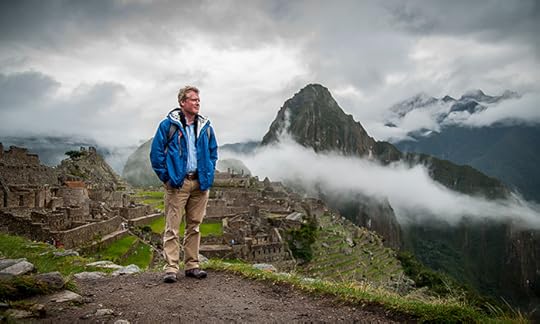
Spencer Wells - image from the University of Texas at Austin

Before people could drop out of the eat-what-you-can-find-or-catch rat race, (Survivor: Crescent?) certain conditions had to exist. The end of an Ice Age made a major difference, increasing the number of places where edible flora, like wheat, grew. So one need not go far to gather the good stuff. Populations expanded in numbers and geographical breadth. But Mother Nature played an early version of Mommie Dearest. In an event with significant implications for the present, the retreating ice, ironically, allowed the release of a huge quantity of fresh water into the oceans. Since fresh water is lighter than salt water, it floats atop it, sealing off the warmth that ocean currents had circulated throughout much of the world, thus creating a mini ice age around 12,700 years ago. One effect this had was to make much of the land considerably drier. Crops that had merrily sprouted in much of the temperate world, rice, barley, and wheat, for example, retreated to more agreeable places that still had water. That usually meant uphill into high mountain valleys. No fun for lowland dwellers, who then had to travel farther than was sustainable to gather their food.

We see the similar things today, as plants and critters that thrive on cool temperatures are retreating to higher elevations and latitudes, or perishing. Aspens, for example, are currently under assault by insects that used to find the aspens’ mountainous locales too chilly. Never previously having had to cope with these insects, the trees developed no defenses against them. Now that global temperatures are climbing, the hungry bugs are comfortable in places that used to be inhospitable. Result? Lower elevation aspens are endangered.

People of the Neolithic Period had to adapt or perish, as well. Communities had been established and had grown, before this new Big Chill, locating based on access to easily retrievable food sources. Adapting meant recognizing that one did not necessarily have to follow the favored flora; one could grow food plants in fixed locations as long as the local conditions were reasonable. Thus the seed of the Neolithic Revolution was planted. But from this change many side-effects sprouted.
As humans expanded their population size, they were forced to move from the original centers of domestication, mountain valleys, out onto the plains, since the small land area near easily accessible water supplies could not sustain an unlimited number of people. This necessitated the development of a system for transporting water and irrigating fields. Constructing irrigation canals requires that large groups of people work together toward creating a common, shared piece of real estate. This meant they had to develop some way of administering the work itself, as well as the maintenance of the completed canals and the access to the water—suddenly a scarce resource. And this meant they needed something else that had never existed before in human history: a formal government, with specialized bureaucrats, and most important, authority. Otherwise, why listen to someone telling you what to do?

Because of a growing population that was increasingly urban, as well as the growth in trade between Neolithic cities, the need to oversee complex public works projects drove the development of ever more complex forms of government. (p 56)
Wells goes on to detail how the growing size of communities led to the creation of greater social stratification and the creation of a military. Religion changed as well.
The world’s hunter-gatherers are traditionally animist, and their belief in a multitude of spirits and gods mirrors their reliance on a complex variety of natural resources. Agriculturalists, with their relatively simple food supply and their view of nature as something that needs to be controlled as rather than cooperated with, were sociologically predisposed to create religions with fewer, more powerful gods—and gods in their own image at that. (p 55)
But social changes were not the only new thing on the block. DNA was doing the twist inside homo sap too. It makes sense, for example, that a hunter-gatherer would have a body that hangs on to available calories, given the sometimes uncertain nature of the food supply, but when one shifts to an agricultural world, in which supply is often abundant, that ability can become a liability, translating into diseases like diabetes. A few examples. We have receptors on our tongues that are attuned to appreciate sweet food and reject bitter. But a sweet tooth becomes a liability when one is not attempting to distinguish between fruit that is edible and rotten. The diet of hunter-gatherers helped keep teeth clean. With the shift to farming, tooth decay increased. Wells also cites a decline in longevity when hunter-gatherers became farmers. Bodies selected for one type of existence did not necessarily fare well at the other. For example, lactose intolerance was a non-issue for the hunter-gatherer, but it became a significant disadvantage for survival in an agricultural world. The lactose-tolerant were better suited to survive in a world that was domesticating animals, so those genes spread.

What happens if you are forced to remain in one place instead of wandering to new territories when local resources fade? Dashing through the woods, a hunter-gatherer needed to be acutely sensitive to sound and motion, lest one fall prey to human competitors or large critters with a hankering for two-footed steak. But the sensitivity that kept us alive ten thousand years ago became a liability. Our bodies simply cannot cope with all the stimulation, noise, numbers of people that were inherent in growing agricultural and urban environments. Wells cites studies showing that people can realistically relate personally only to a maximum of 150 people. In hunter-gatherer societies, a group could split if it grew too large, but this was not an option for Neolithic farming communities. One result, in Wells’ view, was a growth in mental illness. In addition, the stress of all this excess stimulation compromises our immune systems, making us more vulnerable to a wide range of diseases, acute and chronic.

What might be the long-term implications of activities of the present age? How will gene therapy ripple out to the humans of the future? How will our mining of natural resources, biological as well as chemical, affect the future us? Whereas hindsight can be twenty-twenty (well, it is often not even that, as there are typically competing theories explaining past events) foresight is a bit like wandering around at night in the country wearing shades. Which is to say that I found some contemporary analysis and some of the projections Wells offers sometimes less compelling than his look backward.

Wells offers a fascinating discussion on major revolutions in where we get our food. The establishment of agriculturalism in the Neolithic was the last basic change. Domestication of aquatic food sources only began on large scale in the last 100 years. Fishing has remained pretty much a pre-industrial enterprise. Mega-fishing has almost destroyed native stock, so we need aquaculture if we are to satisfy growing demand for fish-based protein. Will the impact of fish farming match the dramatic changes wrought by the institution of plant farming and the domestication of animals for food? Who knows? But it is an interesting question.

He notes a correspondence between income and obesity, but never mentions that the food that is a primary culprit in this contemporary trend, corn, is heavily subsidized by the government, whereas foods that are healthier receive minimal, if any support. Thus, it is much less affordable to consume the right foods if doing so means not being able to pay the rent. While bodies that were selected for the Paleolithic, in large measure, would probably still have issues with obesity and disease in the contemporary world, those public health concerns certainly would not be nearly so significant if our public policies and corporate marketers did not encourage our craving for sweet.

Wells decries the use of gene therapy, and more extremely, the use of genetic tools to select traits in our babies, as harbingers of grave unseen dangers in the centuries ahead. Gene therapy may keep alive some who might otherwise perish, thus altering the future gene pool, but unless that group and their descendants become dominant, we should, as a species, retain our genetic diversity.

Re contemporary religious extremism he writes:
Unlike previous movements that have advocated violent solutions to social problems, however, such as the PLO or the IRA, with their territorial desires, today’s violent fundamentalist movements claim to be doing God’s will, giving them a sense of higher purpose success means not simply achieving proximal goals such as political autonomy, for instance, but changing the world order in the name of God. Crazy though it may appear from the outside it is not insanity that drives terrorism in the fundamentalist world; rather, it is the God-given certainty that what one is doing is morally just. (p 201)
And what madman does not cloak his desires under the banner of religion? I thought Wells was out of his depth here. Many contemporary Islamic extremists seek to establish the Caliphate, which would certainly entail extinguishing many Middle Eastern states. If that is not territorial I do not know what is. In the USA, fundamentalists of the Christian persuasion have been seeking real estate since landing here in the 15th century. Seeking to incorporate religiosity into our secular political institutions is nothing, if not territorial. Israeli fundamentalists have made a clear translation of their religious beliefs into territorial demands.

The strength of Pandora’s Seed is in tracking the ancient change to the present. There are plenty of social critics and futurists about and there are many places one can go to get views on what lies ahead. While it certainly makes sense for Wells to use what he has discussed as a basis for making projections, there does not seem to be anything in that effort that is unique. His prescriptions for coping with our impending crises struck me as bromitic and lacking the analytical heft of his look at our genetic and social inheritance. Basically he encourages humanity to learn to live with less. He is probably correct in the overall, but a more pointed menu of suggestions would have been welcome.

Definitely read the book for its considerable strength, mapping how the shift to an agricultural way of life created the people and institutions of today. That work is utterly fascinating. You may certainly find his other analyses and projections intriguing, but I thought they were bits of chaff to his bushels of analytical wheat.

Review first posted in 2010

==============================EXTRA STUFF

7/27/13 - GR friend Jan Rice passed along a fascinating article from the December 19, 2011 New Yorker Magazine, THE SANCTUARY: The world’s oldest temple and the dawn of civilization, by Elif Batuman. It takes the view that religion came before settlements rather than the other way around.
Profile Image for Terence.
1,314 reviews469 followers
July 16, 2011
Spencer Wells argues in Pandora’s Seed that there are two critical events in humanity’s (relatively) recent past that have pushed us onto the path leading to modern civilization. Two cusps that have led to the marvels we enjoy today, as well as the horrors (which explains the book’s subtitle: “The Unforeseen Cost of Civilization”). The first took place 70-80,000 years ago when Mount Toba in Sumatra erupted, throwing millions of tons of ash into the atmosphere that caused a catastrophic climate shift. Archaic humans, who had been around for c. 100,000 years at the time and had expanded as far as the Middle East, were reduced to less than 10,000 individuals in Africa. This population bottleneck exerted enormous selective pressure that resulted in modern humans, men and women like ourselves both physically and mentally. The qualities selected for in those fraught generations after Toba were so successful, modern humans had spread to nearly every continent and into nearly every environment by 10,000 years ago, when the second event occurred – the Agricultural (or Neolithic) Revolution.

Ten thousands years ago (give or take a few millennia – these dates are approximate) the world was in a warming trend and glaciers around the planet were melting. In the Middle East, the climate was bountiful and its human population was large for a hunting-gathering culture. In fact, for several thousand years, these tribes had been opportunistically harvesting grains and fruits, and semi-sedentary and sedentary villages developed in many areas. This Garden of Eden, however, was not fated to last. In North America, the Laurentian glacier melted, unleashing a catastrophic flood that washed down over the Great Plains and the Northeast and into the Atlantic. The influx of cold water shut down the Gulf Stream that kept (and today keeps) Northern Europe’s climate warm and temperate. The Middle East became drier and colder, and food resources scarcer. In previous eons, humans would have adjusted: Populations would fall, tribes would split up, numbers would eventually stabilize at a sustainable level. But populations were too large and too far removed from their hunting-gathering roots to easily return to their ancestors’ way of life. But they had been harvesting those grains for generations – modifying consciously or unconsciously many plant species – and it was a small step from that to deliberately planting fields that could ensure a more reliable food source. What came about was “civilization” – a culture of scarcity that gave rise to hierarchies, organized war, classes, specialization, as well as organized religion, philosophy, writing, technical progress, etc.

A few weeks ago, I finished Derrick Jensen’s Endgame: Volume 1: The Problem of Civilization and Endgame: Volume 2: Resistance. Anyone familiar with Jensen’s work (or who’ve read my review) will know that he believes humans made a serious mistake when they turned from the lifestyle they had enjoyed and to which they were adapted for tens of millennia to one that forced them into a never-ending spiral of expansion, exploitation and violence, and for which their bodies and minds were ill-equipped to handle. Civilization will inevitably fall, and soon despite any stopgap measures we try to sustain things. For Jensen, humans will be infinitely better off in the long run the sooner we abandon modern life.

Wells would agree that civilization has led to many unforeseen, unfortunate consequences. He would also agree that current civilization is unsustainable. And he would agree that physically and mentally, humans are not well suited to modern life. Wells is not a Luddite; however, he doesn’t believe we should return to a pre-modern lifestyle. Nor does he think civilization is irredeemable as Jensen does. In his view, while civilization has brought us to the dire straights the world finds itself in today, it also has brought us miracles of medicine and technology and holds the potential to develop the answers that will resolve our myriad crises.

Assuming enough people recognize the problems and act appropriately.

An assumption that makes this book unwarrantedly optimistic (IMO). Wells identifies the problem with the assumption in Chapter 2 where he defines and discusses what he calls “transgenerational power,” the capacity to affect future generations by our contemporary actions. And the mother of all acts was the development of agriculture. Humans have been scrambling to keep up with the problems caused by solutions reached to immediate dilemmas (like food scarcity in 10,000 BC) ever since.

Pandora’s Seed is a short book and a weakness is that it loses focus, particularly at the end. As long as Wells stays in the past, he makes a good case for the largely unintended effects of moving from a hunting-gathering existence (for which 2 million years of evolution had adapted us) to an agricultural one (for which we’ve made some adjustments but not nearly enough to make us comfortable in our self-imposed environments).When Wells moves to the present and contemporary responses to our maladaptations, he writes in vague, feel-good language about the exciting options ahead of us or equally vague bromides about what we must do, as in his concluding paragraph:

“(A)t the present critical point in human history, where we have the tools to begin to solve some of the problems set in motion by the Neolithic Revolution, saving ourselves will mean accepting human nature, not suppressing it. It will mean reassessing our cultural emphasis on expansion, acquisition, and perfectibility. It will mean learning from peoples that retain a link back to the way we lived for virtually our entire evolutionary history. And it might allow us to stick around for the next two million years.” (p. 210)


Two other examples from the book illustrate his odd disconnect between sunny optimism and the logical conclusions of his argument. In “Growing a New Culture” (Chapter 2), Wells starts off discussing the growing aquaculture industry in Norway, which seeks to replenish the fish stocks that have been destroyed in the wild by egregious overfishing. The “poster boy” of his brief digression is a farm in Stavenger that raises salmon. It relies on an elaborate and expensive technology that herds salmon and fools them into thinking restricted pens are their natural habitats. We’re doing this here and elsewhere, as Wells notes, because the natural, sustainable supply of cod, tuna, and other fishes is running out in the face of humans and their need for food. As a final irony – the Norwegian “fishermen” are forced to supplement their farmed salmons’ diets with the artificial astaxanthin. This replicates the pink flesh so prized by consumers but which is naturally brought about by the salmons’ diet in the wild, and (if that weren’t enough) it’s derived from petroleum.

In “Heated Argument,” Wells begins the chapter discussing the situation of Tuvalu, a nation of nine coral atolls in the South Pacific. Because the seas are rising, Tuvalu will no longer exist by the end of the century. Because of civilization, Tuvalu’s economy has shifted from a reasonably sustainable one of subsistence agriculture to one of exportable crops and cash. The population relies on food imports, the waste products of industry are piling up, and tidal surges are making the ever-shrinking land too salty for agriculture. Yet, “I was beginning to get the impression that there were a fair number of people who hadn’t given up on Tuvalu” (p. 158).

This isn’t a bad book, by any means. Wells is a good writer and presents his case well, and if he had stuck to the evidence for our biological adaptations to the environment and the consequences of consciousness and the Neolithic Revolution, this would have been a very good book. But he loses focus and goes off on tangents that deserve books all on their own, or (worse) he brings up a relevant consequence of our “transgenerational power” but wanders off into vaguely optimistic opinions about how wonderful things will be once we put our minds to solving the problem.

I still recommend the book with a clear conscience. It brings together a lot of accumulated information about our past in one easy-to-read source, and I did learn a few interesting things, as in Chapter 4, “Demented,” where I learned about “sympatric speciation” (read the book to find out for yourselves). Or in “Fast Forward,” where I learned about the unintended (and revealing) consequences of our interference in the natural lifecycles of acacia trees.
Profile Image for Nikki.
1,756 reviews84 followers
September 3, 2016
This is definitely one of those books where you're reading and you have to stop yourself and ask WTF the main premise was again. He is seriously all over the place. And the writing? Irritating. His choice of wording is often questionable and irritated me as a reader. For instance, calling Dolly Parton buxom was somehow warranted? In a book supposedly about "the unforeseen cost of civilization" huh? I also thought it was a bad choice to have so many tangents and back and forth style of writing. He was already having some difficulty making his thesis clear, he really should have been more streamlined. He also seems to contradict his own statements at times. (Population an issue but IVF ok? And nuclear energy is living sustainably with the environment?) Overall I just really found him irritating and I do not recommend the audiobook at all, especially since he reads it himself. Oy.

Overall there really was not much here that is new, at least not if you read this type of non-fiction much. You really just get his grating take on it. Yay!
Profile Image for Stetson.
561 reviews348 followers
August 18, 2025
Spencer Wells’s Pandora's Seed evaluates the Neolithic revolution, also known as the human transition from foraging to farming ~10–12k years ago, from the perspective of biogeography and archaeogenetics. Wells, like Jared Diamond and Yuval Noah Harari, argues it was a mixed bargain for humans at the time. It enabled large, complex societies, but it also invited novel biological and social stresses for a species evolved for small, mobile bands. He explores these “unforeseen costs” across several domains, including demography, health, genetics, social structure, and the environment. Demographically, farming supercharged fertility and population growth (the “Neolithic Demographic Transition”), filling landscapes with many new sedentary communities. Despite the population growth, the average health of early farmers were worse than their hunter-gatherer neighbors. They often had worse skeletal/dental health and higher infectious disease burdens than foragers, which was a product of crowding and close contact with livestock. Evolutionarily, the emergence of civilization created new selection pressures (e.g., dairying and starch consumption), reshaping human genetic diversity atop an older “serial founder effect,” the legacy of the out-of-Africa expansion (~60-100kya). Additionally, modern chronic diseases (obesity, type 2 diabetes, some mental health disorders) are thought to reflect environments that our genomes and physiology weren’t optimized for (The book is more synthetic than data-heavy on this point.). Socially, agriculture super-charged inequality, leading to phenomena like Y chromosome star cluster, and created the material conditions for which scaled human catastrophes (famine) and violence (war) could occur. In parallel, the human activity worked toward ecological simplification given the need to make land fertile.

By the publication of this book (2010), many of these claims were becoming increasingly popular among intellectual elites and academia. In fact, similar claims about the transition to agriculture appeared in Guns, Germs, and Steel in the late 1990s and were probably in circulation before that. Wells' rhetorical position is cautionary, which is a position that is somewhat grating to me in works of popular science. It often can make them seem more polemical than they are.

Since the field of ancient DNA (aDNA) has really exploded since Wells' book, it is worth trying to return briefly to see how the science on these questions has evolved:

Ancient Population Dynamics Much More Complex

There has been a lot of elaboration and modification of the out-of-Africa thesis due to new evidence and a great deal has been learned recently about the ancient population history of Europe. We now know early European and Near Eastern prehistory was shaped by repeated pulses of migration and admixture, not just a single wave of “farmers replace foragers.” Europe, for example, draws ancestry from at least three broad sources: western hunter-gatherers (WHG), early Anatolian/Levantine farmers (EEF/ANF), and later Bronze Age steppe groups (Yamnaya-related). The last contribution was especially substantial. Further, in the Near East itself, aDNA shows multiple, genetically distinct early farming populations (Levant, Anatolia, Iran/Caucasus) and a “Basal Eurasian” component with unusually low Neanderthal ancestry. Rather than dismantling Wells' claim, this population-level dynamism and diversity arguable strengthens Wells’s argument that farming created new human ecologies. It is simply that there is a lot more complexity than the picture painted by Wells here let's on, but he was working with the data that existed at the time.

Neolithic Baby Boom is Real

On, the “Neolithic baby boom” Wells claims are still hold. Cemetery age profiles and other proxies do show an increase in juvenile proportions and overall growth with farming. The pattern is replicated across regions, though its timing and magnitude vary.


Health Cost of Agriculture Oversold but Health-Trade-offs were Real

The arguments about the health disadvantages of moving from foraging to farming holds, but there is was a reason that sedentary agricultural was accepted as a trade-off and some of those more diffuse population benefits can't be measured in any other way than the simple success of those lineages. The research cited by Wells in Pandora's Seed has been replicated with new integrated osteology + genomic data. Skeletal reviews long suggested declining oral health, more workload stress markers, and more infections with agriculture, and newer aDNA-linked studies go further. For instance, when you compare an individual’s genetically predicted height to their achieved stature from bones, early European farmers are shorter than expected, consistent with worse childhood health and nutrition, with partial rebound later in the Bronze/Iron Ages. This is exactly the sort of “mismatch cost” Wells foregrounded, now on firmer quantitative footing. However, the narrative concerning these data is sometimes used to make a misleading and somewhat Rousseaun argument about hunter-gatherer lifestyles.

Rapid selection under the new cultural ecologies: direct observation in ancient genomes

Wells' book anticipated strong, recent selection on diet- and immunity-related loci. Since 2010, new aDNA research has confirmed some of those sweeps for lactase persistence (LP), starch digestion, and immunity. Dairying appears millennia before LP became common; selection intensified surprisingly late (after ~2500–3000 BCE), and was likely amplified by famine/infection contexts where milk drinking conferred survival advantages. The aDNA data revised the old “dairying immediately to LP” story and exemplified the importance of culture–gene feedback. AMY1 (amylase - the enzyme that digests starch) copy-number variation correlates with starch-rich diets across species and human groups, supporting Wells’s dietary-selection framing, though the trait’s evolutionary timing and pleiotropic effects are still being refined. Additionally, genome-wide scans in ancient West Eurasians have detected shifts at many immune and metabolic loci across Neolithic→Bronze/Iron transitions, consistent with crowding, zoonoses, new diets, and mobility (Notably a recent pre-print from David Reich's lab).


Pathogens & “civilization diseases”: from a plausible narrative to genomes of the culprits

Wells argues that settlement and domestication intensified pathogen exchange (ofc true). Now, aDNA from teeth and sediments documents ancient Yersinia pestis lineages in the Late Neolithic/Bronze Age, charting the emergence of flea-borne transmission and repeated waves across Eurasia—evidence that large, connected populations did become pathogen theaters.

On the chronic-disease/microbiome front, industrialization is associated with reduced gut microbial diversity and altered ecological dynamics relative to foragers such as the Hadza. These findings don’t prove mismatch-type causation for specific modern diseases, but they support the broader mismatch template. The frame is theoretically very compelling even if we haven't yet proven all the particular in every disease state, though I think the case for obesity is a slam dunk.

The bottom-line is that Pandora’s Seed got the big picture right but does so in more qualitative and less rigorous way than can be found in alternative works. I'd strongly recommend, Who We Are and How We Got Here and the work of Wells' protégé Razib Khan. So yes, agriculture and the societies it enabled created new selective regimes, new pathogens, and new social risks that still echo in our genomes and health today. This book is very dated simply because of the bounty of new evidence that followed in its wake. Reality turned out to be even more dynamic: multiple origins of farming, repeated migrations and population turnovers, late and context-dependent selection on diet and immunity, and striking heterogeneity in health outcomes through time. For this reason, it is hard to recommend it heartily today.
Profile Image for Loskotka.
42 reviews9 followers
August 2, 2019
Чудова книга, яка охопила таке широке коло проблем минулого і сучасності, що лишається лише дивуватися, як це все вмістилося у такий малий обсяг! Обов'язково перечитаю її знову згодом.
39 reviews7 followers
April 8, 2015
This is one of the most disappointing books I've ever read. The version I read has the subtitle "Why the Hunter-Gatherer Holds the Key to Our Survival", though it seems that only lesson Wells has taken from H-G cultures is that adaptation is good and necessary. But this lesson could be learned from pretty much any culture, and even from other non-human creatures. The first bit of the book had a few interesting tidbits, but the analysis was incredibly shallow. Nearly every paragraph for a bit had something in it that I could critique. Towards the end I got a bit more angry when Wells began advocating nuclear power (of course with no acknowledgement of the fact that nobody has figured out what to do with nuclear waste) and genetic engineering. Did Wells get these ideas from hunter-gatherers? These two technologies are the pinnacle (thus far) of short-sighted civilized idiocy. There are so many books out there with better analyses than this one it would take forever to list them all, but a short list would include Against the Grain: How Agriculture Has Hijacked Civilization for a better analysis of agriculture, The Party's Over: Oil, War and the Fate of Industrial Societies for information on how much "alternative" energies won't replace oil, Coming Home to the Pleistocene for a much more in depth analysis of how civilization effects us, anything by John Zerzan and Endgame, Vol. 1: The Problem of Civilization for more analysis on how civilization is destroying the planet and what to do about it.
23 reviews5 followers
August 6, 2014
I really enjoyed this book. Especially the center chapters where he was discussing the social issues that came from the development civilization. In the chapter "Demented", his brief treatment of mental illness was one of the most compelling from an evolutionary perspective that I have read, in that it stripped the need to find a "point" or a "benefit" to issues like depression and anxiety, which others writing from that standpoint attempt to find. His chapters on the future I thought did not quite reach the level of the rest of the book, which is why I rated it four rather than five stars.
Profile Image for Richard Reese.
Author 3 books199 followers
March 23, 2015
Spencer Wells is a geneticist who gathers DNA samples from around the world and uses them to analyze evolutionary history. Mutations occur from time to time, and they provide landmarks in our genetic history. Following a mutation, the new characteristic is passed along to future generations. A region where the new characteristic is found in unusual density is marked as its place of origin. Wells can also distinguish old mutations from recent ones, based on how common they are. So, each mutation is marked with a time stamp and a place stamp. Using these markers, and your DNA, Wells can go to a world map and plot the meandering journey of your ancestors’ migration out of Africa.

Genetic historians perceive the journey of humankind in a unique manner. Based on gene markers, they have theorized that humans nearly went extinct around 70,000 to 75,000 years ago, dwindling down to 2,000 to 10,000 individuals. This corresponds with the huge eruption of Mount Toba in Sumatra, which spewed massive amounts of dust into the atmosphere. Global temperatures dropped from 9° to 27° F, and the weather stayed cool for 1,000 years.

The ancestors of Neanderthals moved to Europe about 500,000 years ago, and they overspecialized for life in temperate forests. Our ancestors migrated out of Africa 60,000 years ago, and arrived in Europe 35,000 years ago. A few thousand years later, the Neanderthals were gone. Europe was in an ice age 35,000 years ago, and the forests had changed to grasslands and tundra. Neanderthals were not well suited for hunting on open ground. The humans had better weapons, better hunting skills, and travelled in larger groups.

Our tool-making skills increased significantly around 60,000 years ago, and we may have been pushed out of Africa by population pressure. The arrival of the cave painting era, 40,000 to 50,000 years ago, provides clear evidence that we had acquired abstract thought. This era of big changes has been called the Great Leap Forward. Recent evidence suggests that this era of advance may have started as early as 70,000 years ago.

Moving out of Africa presented us with a radically different survival game, and this encouraged us to be innovative and adaptable. So did the wild mood swings of the climate. Wells, who sees the world through gene-colored glasses, suspects that abstract thinking was the offspring of one or more genetic mutations. Once we had acquired this dangerous juju, we were able to jump onto the high-speed train of cultural evolution. Sadly, we have yet to be blessed with mutations that provide the powers of foresight or wisdom.

So, for 60,000 years we’ve been stuck in a vicious cycle of out-of-control innovation, and this madness kicked on turbo thrusters about 10,000 years ago, with the Neolithic Revolution — the dawn of farming and civilization. We entered into a long era of unusually warm and stable weather, which opened the floodgates to many new possibilities, and many new mistakes.

At this point, the feces hit the fan, in impressive quantities. Everything that had worked pretty well for tens of thousands of years got blown out of the water. The quality of our diet plummeted. Our teeth began rotting from a grain-based diet. Our enslaved animals generously shared their disease pathogens with us, shooting us off into an era of catastrophic pandemic disease. Growing population led to growing empires and growing warfare. We got shorter, sicker, and died younger. We lost our ancient freedom and became “a group of worker bees with looming deadlines to meet.”

Well’s book, Pandora’s Seed — The Unforeseen Cost of Civilization, does not present us with a miraculous epic of progress. Agriculture totally changed our relationship with nature, and not for the better. We quit finding food, and started creating it. “Instead of being along for the ride, we climbed into the driver’s seat.” Our numbers exploded, but our quality of life declined.

Today, at the zenith of our tool-making juggernaut, we’re killing ourselves with a high-calorie crap diet, and an addiction to motorized transport. A wide variety of degenerative diseases, rare in earlier centuries, have become quite popular. We tend to be obese, and our rates of mental illness are rising sharply. The World Health Organization predicts that by 2020, mental illness will be the second most common cause of death and disability, following heart disease.

The book gets wobbly near the end, as it contemplates solutions. Wells clearly understands that our current way of life is a dysfunctional disaster, and he hopes that we can find a sustainable long-term solution, but his recommendations get dodgy. This is a normal problem with any book that attempts to sneak as much cool technology as possible into a “sustainable” tomorrow. Many have tried, none have succeeded.

“I’m not advocating a return to a hunter-gatherer lifestyle, of course….” Why not? At some point in our collapse, if we’re lucky, hunting may once again become a real possibility. He doesn’t reveal how we’ll be able to indefinitely continue agriculture as water supplies are rapidly being depleted, as erosion continues the process of converting cropland into wasteland, and as the end of the cheap energy bubble is leading us toward the end agriculture as we know it.

Writing in the months prior to the Fukushima disaster, Wells thought it was time for a second look at nuclear energy, “as nuclear waste disposal methods become increasingly sophisticated and power plants become safer and more efficient.” Better electric cars are coming out all the time. If we don’t develop new forms of energy, our only alternative would be radical change.

We are never more innovative than when we are up against the wall. Maybe we’ll come up with some cool ideas. The bottom line is that we need a new worldview, followed by a new lifestyle. We need to live far slower, and waste far less. Great!

Finally, Wells reveals his biggest fear, a nightmare future where fundamentalists try to take over the world. Both Christian and Muslim fundamentalists detest modern life, and want to return to the good old days, by any means necessary. Here on the west coast, Christian fundamentalism is far from putting a stranglehold on society. But Wells was born in Georgia, raised in Texas, and schooled at Harvard, so his paranoia is understandable.

Profile Image for Olena.
301 reviews5 followers
July 24, 2024
В цій книзі, як і в інших про еволюційну історію людства, підкреслюється важливість переходу від мисливства-збиральництва до рільництва. Тобто виникнення сільського господарства було знаковим для людини і це рішення породило той складний світ, в якому ми живемо зараз. Воно супроводжувалося стрімким зростанням чисельності людського населення. Цей перехід також повпливав і на ДНК, зумовивши добір багатьох потенційно позитивних змін.

Загалом книга описує всі біологічні та психологічні пристосування людства до життя в цьому світі, досліджує його історію як виду.

Зацікавило посилання на «PLoS” - “Public library of science” - престижну групу наукових журналів доступних в інтернеті.
Profile Image for Elaine.
312 reviews58 followers
July 15, 2011
As the title portends, Wells chronicles the troubles a Pandora unleashed on humankind when first she planted some of the grains she had gathered for food. This occurred long before humans gave up their ostensibly wonderful hunting and gathering societies to live permanently on their farms. So, for thousands of years, Homo sapiens grew small plots of grain and pounded into flour, depite their seasonal movements. During those years, apparently, nobody owned the land they grew wheat on. It was only 7,000 years ago that much of the population of Homo sapiens gave up hunting and gathering for full time farming in communities. Although Welles doesn't note it, animals had to be domesticated before agrarian settlements could be established. Humans alone can't handle large flocks of sheep, and domestication of the Auroch, an enormous and aggressive beast, couldn't have been domesticated into cows without canine herding.

The first cultivated wheat and grindstones for flour are dated to 23,000 years ago, but the first domesticated herbivores didn't appear until 7,000 years ago. Dogs were domesticated 14,000 or more years ago. There are good reasons to claim dogs attaehed themselves to humans and followed them as humans moved from one hunting camp to another, but this went in for 7000 years until humans became herders. Welles ignores the role of dogs, but I don't. Without dogs, humans wouldn't have achieved great cities or great wars. My blog address is:

http://dogsandwolves-smartoldlady.blo...

Welles claims farming brought about population explosions, diseases, crime, obesity and other dysfunctions of civilization. There was a big population increase when farming became a prime occupation. Hunting and gathering don't foster large populations. The diseases brought about by farming were caught from the animals humans domesticated, as well as by the fact that peopler were living in closer contact than in pre-farming days.

I presume that even hunter-gatherer tribes have some crime, although the studies of early people don't mention it, or I just haven't come across any that do. Undoubtedly, however, once humans owned flocks of sheep and goats as well as herds of cattle, crime increased. All you have to do to rob a farmer of his livestock is to open the gates and herd it to another spot. David Anthony in The Horse, The Wheel, and Language says that farmers and their sons had to patrol their holdings, making male children more valuable than females. This was reflected in the change from Goddess religions to those of strong Patriarchal gods about the time that the change to farming cultures was effected.

Without farming, technological advances wouldn't have occurred to the degree that they have. Welles does note that the building of cities wouldn't have happened without being preceded by agrarian life. From cities, of course, we get all manner of problems, including the incredible population growth of the last two centuries. Although Welles cites the evils that farming produced, he does not offer any alternative except for remaining hunters and gatherers. It seems to me that this ignores the marvelous things that civilizations have enabled, like modern medicine, Mozart, Rembrandt, Michaelangelo, and Blu ray movies to watch on our TV's. It's up to you to judge for yourself if you'd rather have done without the evils of civilization as well as its benefits. Apparently, we can't have civilization without its evils.

Wells writes well and cogently.
Profile Image for xDEAD ENDx.
251 reviews
December 29, 2016
Absolutely nothing new in here. It's chapter after chapter of today's headlining topics: health crises, global warming, cultural malaise, etc. This time, brought to you by your friendly geneticist and (amateur?) biological anthropologist who should probably brush up on the cultural anthropology (because referencing Lewis Morgan's social structures in a positive light, or like, as "correct," is sort of disgusting). There's a lot of moralizing throughout and it ends with the same trite liberal cliches about needing to "want less" and how we can use science and technology to solve our problems. *Yawn*
Profile Image for Donna.
4,553 reviews169 followers
June 5, 2015
This book was not what I thought it was but I enjoyed listening to his theories. It was definitely thought provoking. With books like this, I always feel cautious about the regurgitation of facts. Everyone seems to assimilate it differently and then they produce their own opinions. Whether I agreed with his bullet points or not, it was interesting to hear his spin on where we've been, where we are, and where we might be going as a civilization.
Profile Image for Amy the book-bat.
2,378 reviews
February 24, 2025
I think this would have been better for me if I would have had a print copy to look at while listening to the audio. It was very interesting. I did find myself getting a little confused at times because I only had the audio. Overall, it was fairly easy to understand all of the concepts. I feel like I learned a good amount about a topic I hadn't really considered much before. I think if I had more than just the audio, I might have rated the book higher.
Profile Image for Joseph.
108 reviews
March 20, 2011
The author expounds some interesting ideas about how even the earliest transition of humans (homo sapiens) from a hunter-gatherer culture to a fixed farming culture has put us at odds with our evolutionary genetics; a disconnect that has grown substantially since the industrial revolution. He presents a very compelling argument for this during first two thirds of the book when discussing how humans are not genetically engineered for the high carbohydrate diet and relatively sedentary life style the the transition to agricultural communities brought about. He is, in my opinion, on shakier ground when he postulates various physiological and social downsides of this transition later in the book as he makes largely unsupported assumptions about the well being of humans in the hunter-gather cultures and over states the cause-effect relationship between such ills in modern society. This is apparent when he repeatedly is forced to use such language as “the evidence is scant” or “the little data available is intriguing.”

The conclusions at the end of the book about how we could have a healthier and happier future are at odds. He acknowledges that to go back to anything like the hunter-gather culture would be impossible without a drastic decrease in the world population. However, most of the impending problems he sees for our future would disappear with such a drastic population decrease, and without any changes to our current highly developed civilization that does provide a much better life for us all.
Profile Image for Dweezil E..
72 reviews1 follower
March 7, 2017
Food for thought op de akkers van Pandora. Dit boek biedt veel stof tot nadenken. Het is een verzameling van wetenschappelijke feiten, speculatie en wilde ideeën. Spencer Wells laat zijn geest lekker breed uitwaaien, van welvaartsziekten tot terrorisme, maar daardoor vergeet hij soms een punt aan zijn betoog te breien. En dat is jammer want de man heeft wel degelijk iets te vertellen. Wells hoopt dat wij als mondiale soort kunnen voorbij zien aan de oppervlakkige verschillen die ons verdeeld houden. Op niveau van DNA zijn we immers identiek.

Voorts gaat Wells in zijn boek op zoek naar het moment waarop wij ons lot in eigen handen namen en aan landbouw gingen doen, en welke gevolgen dat had voor onze ontwikkeling. Die zijn immers niet minnetjes. Wells: "Elke belangrijke ziekte die in moderne menselijke populaties voorkomt, heeft haar wortels in de kloof tussen onze biologie en de wereld die we sinds de opkomst van de landbouw en de veeteelt hebben geschapen."

Uiteraard horen daar enkele speculaties bij over het lot van de mensheid. Hier pleit de auteur vooral voor nederigheid. Nu de klimaatverandering ons confronteert met nieuwe grenzen van het menselijke handelen, moeten we ons vooral beraden over wat voor soort toekomst we willen. "Weten wanneer je nee dient te zeggen is soms belangrijker dan het vinden van een nieuwe manier om ja te zeggen," aldus Wells.


Profile Image for Pat.
884 reviews
March 26, 2015
Actually a rather fast read, maybe just because the subject of ancient human origins interests me so much. The final chapters of the book are the ones that talk about the unforeseen costs of civilization, but the sections I enjoyed more were the earlier ones, giving more of a review of our ancient human prehistory, but that is just my bias. I guess his conclusion can be summed up thusly: "We need to want less: less commuting, smaller houses, more energy-efficient forms of transportation, food that is more cottage than industry."
Profile Image for Lazygorillas.
9 reviews3 followers
February 4, 2012
A definite "must read" for 2012, I found myself unable to put this book down until I finished it. The writing style is fluid and accessible, and the science and anthropology is conveyed in an easy-to-read format for the layperson. I had never really thought the profound impact that cultivating our own food had on our species, as opposed to hunting and foraging, and how it led to the establishment of government and specialization. An impressive work.
Profile Image for Данило Судин.
563 reviews392 followers
August 2, 2017
Як людська біологія впливає на сучасність та майбутнє людства? Як рішення, прийняті людством тисячоліття тому, можуть давати несподівані наслідки в теперішньому і призводити до катастроф у майбутньому? На ці питання дають відповіді Джаред Даймонд у своїй книзі "Зброя, мікроби і харч" та Спенсер Велз - у "Посівах Пандори". Запрошую до перегляду короткого огляду цих двох книг - https://youtu.be/P9pqD0yVxhY
Profile Image for Mlg.
1,260 reviews20 followers
July 17, 2010
Fascinating book about the ways in which humans evolved and the implications of that evolution and Wells' predictions for future evolution. Choosing to grow crops instead of staying hunter-gatherers had a downside that we are only now beginning to recognize. The chapters on tinkering with our genes are really interesting.
Profile Image for Sarah.
9 reviews2 followers
May 17, 2011
This book was all right, although what the book sets up as the turning point for humanity--the transition to agriculture 8,000 years ago, which set the stage for war, disease, overpopulation, and other malaises--wasn't really explained to my satisfaction. I wished the author would have spent more time exploring the reasons why that transition took place.
Profile Image for Paul.
2,230 reviews
August 3, 2016
Sort of a mixed bag this book. Part of it was looking at the DNA of very early human populations, and other parts considered climate change, oil and commodity prices and genetic disorders.

What he said was very good, but didn't hang together.
Profile Image for Brendan.
1,277 reviews53 followers
February 6, 2019
4

I have been following Simon Wells during 2018, and I finally convinced the library to purchase Pandora's Seed. I found the previous books to be very insightful, and I do agree that a lot of our current mental issues stem from the drastic changes we face in our day to day existence. Pandora's Seed attempts to put together an argument, that evolution is the root cause, but instead of finding compelling research and evidence, Wells gets caught up in his core investigation of the evolution of man. The book is good, but not the best of its subject, I would hope.

Simon Wells crafts a compelling argument, but he is unable to demonstrate the hunter and gatherer connection links to our anxiety, or mental health breakdown. The strength of some of his arguments are undone by chapters that don't add fuel to the fire, so to speak. A lot has changed since this books publication, but one thing has not and that's the checking your child's progress before they are born into the world. Parents can take solace that children with down syndrome, will be a thing of the past. That is a joke, before you get all offended and to be honest I don't care if you do, but the chance to eliminate a child born with vast mental disabilities and genetic disorders is not something you should point your nose up at.

The book covers a lot of ground and is interesting for the better part, but the core argument is lost in various chapters. Where the book succeeds is the idea of mental illness and our overweight being a side effect of farming, this is interesting stuff. In a world full of Capitalism and consumerism, it's not a stretch for people to feel lost and stressed. The USA and Japan are two of the largest corporate driven countries, and they have the highest suicide rates, this is no easy statistic to shake. People struggle to fit into a perfectly constructed society, that's a no-brainer, but to link it to something that occurred ten thousand years ago is no easy task. I feel Wells has something here, and it is something society should be looking at closely. People are being grinded to the ground by corporations, and to what end? Money is a fictional currency, that you and I believe has value. We slave each day for no real goal, just procreation and wealth. My favourite quote from Fight Club "You are only free once you have lost everything, to try anything". There is definitely a linkage here, and I feel we have lost what makes us human. To explore and expand our world, this is clearly space exploration and planet colonisation. At the moment we are trapped on this one planet, and we are exhausting all resources, it's a grim outlook.

Why the 4?

Simon Wells lacks the execution with this book. It saddens myself to say this, but it's the truth. I enjoy the work he has done, but this book while promising a lot, doesn't deliver on the central concept. The book is still interesting, and I feel people without previous knowledge of Wells research, might consider this a higher rating. Pandora's Seed succeeds in opening doors to questions, that require an answer, but what is the solution? Not even Wells has one here. Do we end capitalism? There are a lot of questions, but no true solution. Not even dumb, dumb Trump believes in Global Warming. These bigot CEO's wouldn't have an idea, but to reverse their power is not an easy feat. We all believe money is power, and when it all ends, our wealth is either passed on or lost. Imagine a world where you have the option to assist with a task of improving our species, wouldn't that give you substance and meaning? At the moment we slave for no true gain except the turning cog. It's bleak and when you think about it, nothing is going to change, no politician suffers from a guillotine any longer. The banks control your wealth and spending, what you have in the bank or that Tv you so desperately need. This book is a nice eye opener, but will it answer your dying questions? No. The book is a little dated now, but it has some interesting side notes and I recommend it for any novice looking into a DNA history.
Profile Image for Maureen Weiner.
213 reviews1 follower
June 3, 2021
Pandora's Seed: The Unforeseen Cost of Civilization
by Spencer Wells
My rating 4/5 stars

I have come to really enjoy reading about human evolution. I feel these studies really help me to understand myself, especially why I feel so alienated in this society.

I agree with Wells' conclusion that humans evolved to live in hunter-gatherer societies, but when we developed agriculture, we set in motion a world we were not prepared to live in. Wells outlines the theory that a small number of humans developed the capacity for abstract thought and when a volcanic eruption dramatically changed the climate ~70,000 years ago, humans were on the verge of extinction and only those humans with the capacity for abstract thought survived.

Our capacity for abstract thought allowed us to take over the world and, eventually, to control the world. As the Bible notes, we ate of the Tree of Knowledge and were exiled from the Garden of Eden. Our advanced intelligence allowed us to go from living with nature to controlling nature, but that same intelligence couldn't warn us of all the unforeseen consequences of doing so.

Personally, I believe the Bible illustrates this same idea in the story of Cain and Abel. Abel was a shepherd, which is closer in nature to a hunter-gatherer than a farmer, which is why God favors his sacrifice more than Cain's; Abel's sacrifice was more in line with our human nature. Cain, as a farmer, is on the path of humans who control nature, and, I believe, the Bible is warning of the inevitable greed, malice, and murder that come when humans stop living with nature and begin trying to control it.

The major unforeseen consequence of agriculture, as Wells outlines, are population explosion, disease, mental illness, technological advancement (specifically advancements that move too fast for human society to keep up with), and the search for meaning. Each of these issues impacts the others and compounds their effects.

Wells does not mention this specifically, but I believe it he would agree with the school of thought that believes all religions are a maladaptive coping mechanism borne of humans inadequate ability to adapt to these unforeseen consequences.

But, as Wells rightly indicates, we cannot go back to hunter-gatherer society. There are too many of us now. But, that doesn't mean we can't make changes that take into account our evolutionary nature. That is something I would like to see.
Profile Image for Chris.
793 reviews11 followers
June 3, 2022
I listened to the audio book and I wish I hadn't. This is another book that has been on my to read shelf for many years and I finally selected it and I wish I hadn't. I sped up the listening speed from 1.5 to 1.75 so that I could get through it faster.

What makes this book bad?

1. The author, Spencer Wells, narrates the book himself, a huge mistake and like most other books where the author narrates his/her own book I don't recommend this (with very few exceptions, Malcolm Gladwell and Jim Collins are only two that come to mind) and he is so soft spoken and lacks dynamic speaking ability.

2. The book is not memorable and was not as scientific as the title or the book cover led me to believe

3. There is only one memorable portion to the entire book and that was the story of the family in the UK that had another child to extract cord blood to save their older child who had a genetic defect. Note to Spencer: Please read Made to Stick by Chip and Dan Heath to learn how to tell stories that are memorable.

4. This book takes a turn into the political realm with discussion about climate change which is a result of civilization though I could have done without the political commentary

5. The coup de grâce for me was the history lesson about Christian fundamentalism/extremism and Radical/Jihadi Islam and it's as if Wells started writing a completely separate book at the end and these portions had no place in this book.

I cannot recommend this book.
Profile Image for David.
Author 3 books4 followers
May 10, 2025
Once there were fewer of us and we were hunters and gatherers. Back then renewable energy was about the only kind we had. Our lifestyle fit our biological design, But that changed about 10,000 years ago when we substituted animal husbandry and agriculture for hunting and gathering. When we started eating more cultivated grains our teeth rotted out more easily. But other changes occurred as well. Moving from place to place we owned little, but once we became sedentary farmers and created property, we became both greedier and more power hungry.

"With agriculture, as we have seen, came the power to create far larger problems than we could have even dreamed of as hunter-gatherers, and the driving force behind most of them was greed."

The last 10,000 years has changed human endeavor from one of cooperation to one of competition. Today we are numerous and technologically advanced, but we are also challenging the carrying capacity of our environment.
Profile Image for Holly McIntyre.
359 reviews8 followers
October 26, 2022
Well, it is certainly interesting and well-worth reading (or in my case, listening to). I’m just not totally convinced of its premise, namely, that all human ills, from diabetes to war, can be traced back to when humans stopped being hunter-gatherers, settled down, and became farmers. Agriculture is the new Original Sin. I’m no anthropologist, but somehow I doubt that the life of hunter-gatherers was free from envy, greed, or anger. I can agree with the conclusion, however, that if humans want to survive, want the planet to survive, we must learn to use, and to WANT less — less food, less stuff, less comfort, less of everything.
Profile Image for Kathy.
3,211 reviews26 followers
April 22, 2018
Interesting report on the consequences of mankind's change from hunter-gatherer to an agricultural society. While he talked about the long term effects on our mental health, physical health and mortality, climate and the recent growth of religious/cultural extremism, the thing I most took away was the idea of transgenerational power. Basically, decisions made in the present may not have consequences for many generations later. Scary thought with how rapidly technology is allowing us to make radical change.

Good read for those interested in social science, anthropology and human history.
108 reviews1 follower
November 17, 2021
For the type of topic being covered, this book is already a bit old, but what is being said is still equally valid. It poses the thesis that many of the problems we are facing are essentially the result of our transition from hunter/gatherer to agriculture, a thesis that was since repeated by Harari in his best-selling book "Sapiens". Problems analyzed in the book include the obesity pandemic and the climate crisis, which are both still mostly relevant today. The book is easy and pleasant to read.
Profile Image for Nilesh Bahir.
36 reviews
June 9, 2017
Deep philosophical discussion that delves into all things that have been reason for our existence and are also threat to our existence.
The book covers so many topics, microbes, virus, human evolution, genetics, genome sequencing, #Gattaca, ice age, global warming, role of art in human evolution, obesity epidemic of the Americas, terrorism and technology..

I think this book sums it all in an effective and concise way for any level of reader.
Displaying 1 - 30 of 157 reviews

Can't find what you're looking for?

Get help and learn more about the design.