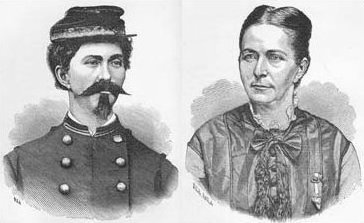
“Albert Cashier” served three years in the Union Army and passed successfully as a man until 1911 when the aging veteran was revealed to be a woman named Jennie Hodgers. Frances Clayton kept fighting even after her husband was gunned down in front of her at the Battle of Murfreesboro. And more than one soldier astonished “his” comrades-in-arms by giving birth in camp.
This lively and authoritative book opens a hitherto neglected chapter of Civil War history, telling the stories of hundreds of women who adopted male disguise and fought as soldiers. It explores their reasons for enlisting; their experiences in combat, and the way they were seen by their fellow soldiers and the American public. Impeccably researched and narrated with verve and wit, They Fought Like Demons is a major addition to our understanding of the Civil War era.
Neither the Union nor the Confederate Army in the Civil War authorized women to enlist or welcomed women combatants. Indeed, they were actively discouraged from the traditionally male preserve of combat. Yet a small number of women had the drive to assume male disguise and to enlist and fight. This book helps tell their story.
The authors of "They Fought Like Demons" DeAnne Blanton, a military archivist, and Lauren Cook, of Fayetteville State University spent more than a decade in researching primary sources to recreate the role of women as Civil War combatants. Their book tells us something about roughly 250 women soldiers, who fought either for the Union or the Confederacy.
The book spends a great deal of space on the motivations that caused women to disguise their sex and enlist. It finds that patriotism and devotion to their respective cause was the chief motive, as it was with men; but also finds that in many cases women enlisted to be with a male loved one, whether husband, lover, father, or brother. This latter motivation seemed important in the accounts and it seems to me different from the motivation of most male combatants.
The book gives good detail on women soldiers and, in the process, of Civil War military life. It describes how many women managed to avoid detection (of course, many were unsuccessful in so doing, particularly if they were wounded), the strength with which they fought, how they were regarded by their peers, both when they were assumed to be men and following the discovery that they were women, how women were treated as prisoners of war, in hospitals, and the extent of female casualties in the war. The book discusses the lives of some of the women after their career as soldiers -- one of the most interesting aspects of the book -- and it recounts some of the literature that was published about women soldiers during the Civil War era. There was more of this than I had supposed.
At the most basic level, Blanton and Cook make a convincing case that women fought in the war and contributed as soldiers on both sides. Women soldiers fought and sustained casualties at every major Civil War battle. I am a student of the Battle of Gettysburg and learned that a Confederate woman soldier died in Pickett's charge and that there were five women soldiers who were known to have fought at Gettysburg. There were also women prisoners at the notorious facility at Andersonville.
The organization of the book makes it difficult to follow the activities of most of the women in detail. This difficulty is also the result of the nature of the historical records. But two or three of the female combatants left memoirs or other records which perhaps could have been highlighted more effectively in this account.
It is worth remembering that there were about 2,750,000 combatants in the Civil War, 2 million for the Union, 750,000 for the Confederacy. Blanton and Cook document about 250 women soldiers and accept the general estimate of about 400 women soldiers serving in the War. This is statistically a very small amount. (One percent of 2.75 million is 27,500)It is also, of course, a tiny fractional percentage of the available pool of women. Thus, one should be hesitant about drawing broad global conclusions from this evidence. Blanton and Cook generally use their data wisely and circumspectly.
The Civil War remains the pivotal experience in our Nation's history. In many respects, it remains a shared American experience. Thus, it is good to have inclusive histories and to remember the role played by women in combat. Blanton and Cook show that during Civil War times, it was known that there were small numbers of determined women in the ranks. This book does a service by recreating this part of our national experience.
This one kills me...the research is amazing and impeccably done. And honestly the information is so fragmentary I don't know how you can get a fluid story going. That being said, it just becomes a series of facts thrown at you and supposedly sealed together by larger themes. I appreciate the information but almost would have preferred chapters to approach each woman independently rather than lumping them together under themes.
I've seen a few Civil War reenactments over the years, I've gone to several battlefields and forts in different states and I've toured homes still bearing the marks of the war - bullet holes in the doorways, Minié balls lodged in trees. I've heard the stories of soldiers' gallantry, young boys who lied about their ages so they could aim their weapon at the other side, families torn apart by the politics that didn't quite have so much to do with slavery as it is taught in schools. I've watched Gettysburg and Glory a freaking lot.
The extent of the information I've heard about women in the war was their relief work. They were nurses. They cared for the wounded. They waved goodbye from their doorways as their fathers, husbands, brothers, cousins, lovers, and sons went off to war, and they occasionally opened their doors to help the infirm, or they would go to the nearest camp and lend a hand. But many women served a different purpose - and no, it wasn't prostitution.
There were women who dressed as men, lied about their gender, and fought in the Civil War. They killed people. Some of them went to war pregnant, hid the pregnancy the entire time, and may have been found out only when they were found giving birth. I consider myself a pretty tough cookie when I want or need to be, but that's just above and beyond. Ouch, comes to mind, as does "No way in hell" and "WTF!".
So there's this virtually unknown bit of American history, a terribly interesting story about the hows, whys and whatfors behind a woman's decision to go to war, and yet this book made it all seem like a routine study session. Names, dates and ranks were rattled off very militarily, the paragraphs were brief at times, segue ways left so much to be desired.
I felt there was a wealth of information here and I was eager to eat it all up. Instead I felt like I was being lectured and there would be a pop quiz at the end. My interest waned. I did manage to create a list of other interesting books from the bibliography at the end, but I wish the text itself had given me more. History doesn't have to be so dry, especially a part of history that was viewed by so many as to be downright scandalous. This is a fascinating topic, but evidently I'm just going to have to go elsewhere to get my information.
Also, I shake my fist at you, educators! No one talks about Loreta Velazquez when they teach about the Civil War. No one talks about how Loreta disguised herself as a male and called herself Harry T. Buford, who eventually became a lieutenant before she was discovered. This never came up in any of my trillions of women's studies classes! What's up, world? This is why everyone is so freaking dumb. Then again, some people think the war is still being fought.
Very interesting, but I'd have liked it better if each woman's story had been kept together. The same names kept appearing in different chapters, but because the information was separated in that way, it wasn't easy trying to keep a clear picture of what was happening to each of them. The authors' point could have been made with more impact if it had been presented in a more readable style.
Anyone interested in thorough research done on women soldiers during the American Civil War? Look no further. This is an amazing and highly interesting thesis. It's definitely one of a kind.
The subject of women warriors throughout history is often overlooked by present-day scholars; at best, it is acknowledged with a nod to Joan of Ark, and, if one studies the American War for Independence, Molly Pitcher. The topic of female soldiers in the American Civil War, which is often termed the last "old-fashioned war," is notable not only because the conflict occurred more than half a century before women's suffrage in the U.S., but also because we have documented proof of women's service in the ranks--something that both Federal and Confederate armies forbade. In the majority of known cases, women, upon the discovery of their true gender, were sent home. Although some obeyed, others merely bided their time and waited for opportunities to attach themselves to other units. Authors Blanton and Cook catalogue all the known ways and means that women used to disguise their gender--including convenient cicumstances, such as the fact that "medical" examinations of soldiers rarely involved the removal of clothing.
The take-home message is that women, despite the rules and social conventions of their time, joined the ranks of both armies and fought during the war. Although the total number of volunteers will never be known, the authors claim that their research turned up about 250 names. Clearly, a subject like this deserves more scrutiny, despite the general urge among scholars to downplay or to dismiss instances of women soldiers in the Civil War. Parts of this book are compelling, especially sections devoted to the few individuals whose stories survived. Unfortunately, the majority of women are reduced to names only, as nothing of their fates or post-war lives are known. However, the authors make the mistake of listing all these names throughout the book, no doubt for the sake of accuracy, and to preserve the scant existing records and the headcount their research uncovered. On the one hand, it's brutally difficult for writers to sustain a narrative when the only known facts are limited to mere names and unit numbers. From the reader's pov, however, the overall effect is choppy and disorganized, which doesn't do justice to the amount of research that went into this book, or to the women who, though lost to history, served in the conflict. Under the circumstances, I think the authors did the best they could, but one wonders whether a shorter book, or a series of essays, would have been a better choice.
This book, on the other hand, somehow made a fascinating topic utterly boring. It was not good story-telling. The first two chapters (the only two I could stomach before I gave up) simply listed things. For example, the 2nd chapter was about women's motivations for joining the army. The entire chapter was "So-and-so, under the name of something-or-other followed her husband into war; in Virginia, someone else, under a-masculine-pseudonym, followed her fiance into battle; sometimes women would follow fathers or brothers, such as in the case of whats-her-name, under the male name of Private something-untrue." Over and over and over- just listing women's names, their fake names, and that they followed some man to the front. That's just regurgitating facts without properly organizing or presenting it.
I found myself learning nothing in the first 50 pages that wasn't already obvious, other than about 400 women are known to have served in either the southern or northern armies (of course, the book does not mention that this is 400 out of 3 million soldiers- so about 0.01% of the army. I was disappointed in how very small this number was). The introduction tells us that very little is known about the women who joined the ranks- which is clear from the data presented in the 2 chapters I read. They really scraped the bottom of the barrel, noting every little fact and detail they were able to uncover without much flow to the narrative.
This is a topic I am really interested to know more about, but I'll be looking for other authors to give me the story. I would not recommend this book.
This is an essential volume in the story of women soldiers in the Civil War. The authors take a great first step in uncovering the story in a well researched way giving the soldiers their due.
20 years later more work could stand to be done through the lens of sexual identity and gender studies which the authors almost go out of their way to avoid or minimize.
Lastly, the writing was at times a bit dreary and the organization was sometimes confusing (I would have put the second to last chapter first).
Fascinating to read how many women dressed as men to fight in the civil war. On both sides!
The authors did tremendous research to discover the motives of these women, as well as how society viewed them and whether that differed depending on where they were from, plus so much more. And all of it without a whiff of an agenda! No attempt to rewrite history, but rather to understand it.
The authors obviously did some extensive research in putting this book together, and I learned quite a lot about how women managed to pass as men during the civil war and have even greater respect for women who had the courage to don the uniform and fight. However, there were some weaknesses and some missing information.
I would have wished for a different method of organization or indexing. It was as though each chapter was an independent entity, with no crossover or acknowledgment of information in other chapters. Women were referenced by both their female names and male identities each time (when known) which became tedious, and the few people that were in every chapter were reintroduced every time with new snippets of information included that would have been good to know earlier in the book. I think a more clear picture would have emerged with a chapter or appendix dedicated to each of a few key people, but I can understand why this wasn't done given the information available and length constraints.
I know a lot of details are unavailable, but the authors didn't explore the implications of some of the women dressing as men before and after the conflict unless it was in the context of freedom and fair wages; there had to have been other reasons, right?
Very little reference was made to the downsides of a women being discovered among men in the service or in a POW camp. There was an awful lot of "rah! rah! all the men were so impressed with the women!" and not much speculation or reference to the downsides (i.e. assaults or negative reactions).
Scholarly written text organized by themes. Must be the most comprehensive book on this topic ever written. The authors' research was exhaustive. It would be interesting to see if any contemporary letters on this subject not already known to exist are brought to light as a result of this book. I like that it focused on the women soldiers, as opposed to nurses and others, and appreciated especially the discussion of motivation. I think that we need look no further than today's modern military enrollment in response to 9/11 to see that women experience the same patriotic zeal that men do. I have a friend who is very proud of her service in the Marine Corps; she has no doubts that women could do just as well as men on the field of battle. While in the middle of reading this book I was actually at an event with a Civil War encampment. Spoke with one of the reenactors about the subject and he was delighted to demonstrate the roominess of the standard Union jacket and was very interested about the subject. I have never seen any female Civil War reenactors depicting soldiers, but there surely must be some out there.
This book provides an amazing account of the collective female participation in the Civil War, including insight into the conditions of enlistment that enabled women to cross-dress successfully and earn better wages than the 19th century would allow. My only complaint (and this happened often enough for me to rate it with four stars instead of five) is that the transitions between topics are monotonous and weakened by repetitive language. For example, so-and-so "wasn't the only" such-and-such who did such-and-such. I was ready to burn the book by the end of all these lame transitions that were, in fact, completely unnecessary. The value of the collection of material from journals, memoirs, newspaper articles, and letters however curbed my frustration.
The content of this book was great -- the execution, at best, was very poor. The authors could've taken a page out of David McCullough's guide to writing history: Make it at least vaguely interesting instead of a arduous listing of facts.
Those of us who are either currently serving in the military or are recent veterans of the US Armed Forces (I fall in the latter category) are quite accustomed to seeing female colleagues in the military--for any of us who've served in the post-Vietnam area, female troops are nothing out of the ordinary (with the exception of certain Combat Arms career fields such as the Infantry). And in this day and age of thorough physical examinations at the MEPS (Military Entrance Processing Station) as well as personnel background investigations, one could hardly imagine a woman attempt to disguise herself as a man in order to enlist in today's military.
The authors of this book, however, give us an eye-opening reminder on how starkly different things were in the US military--and American society as whole--back in those Victorian times 150+ years ago. In the process, Ms. Blanton and Ms. Cook provide an eminently readable book with valuable insights into a facet of the Civil War that's either been under-reported or, even worse, inaccurately in most Civil War scholarship since the end of the First World War, i.e. the notion that "women who masqueraded as men and enlisted in the armies were crazy, sexually loose, lesbians, or all of the above." (p. 193) The authors give a more accurate and balanced accounting of Civil War female soldiers, positive and negative alike. While there were certainly some proverbial bad apples (as there are in every bunch), Blanton & Cook ague convincingly that the overwhelming majority of women soldiers, Yankee and Rebel alike, who served in America's bloodiest conflict, did so with honor and bravery. Not only did they willingly and ably take on the toughest and most dangerous jobs in the Armies, from infantry to artillery to cavalry, as well as the dreary, drudgery-laden jobs like picket duty, they earned the respect of their male colleagues, and for the most part retained the respect of those male comrades even after their gender was discovered (unlike the aforementioned post-WWI scholars who weren't actually there serving alongside the women soldiers).
There is a little bit of overlap and repetition (for example, multiple citations of the allegations of insanity and suspicious character against Mollie Bean of the 47th North Carolina Infantry) in Chapters 5-7 ("The Prisoner of War Experience," "Women Soldiers as Casualties of War," and "Women Soldiers Discovered in the Ranks," respectively), but even these repeated facts and references serve a useful purpose within the context of the individual chapter topics and do nothing to detract from the overall excellence of the book.
I picked this up for a research project in high school and found it intriguing, well-written, and wonderfully in-depth. Women warriors are vastly underrepresented in historical study but Blanton and her co-author have made an excellent contribution to the canon. They use a wide variety of primary sources as their foundation, but what really makes the book is the way the authors write.
Rather than just dry, basic facts like so many other history texts, the authors instead tell a story. Even if you aren't a big history or Civil War buff, I think you can find some intrigue in this book. Overall, I loved this book and reread it frequently.
I am not generally hugely into military history, but I enjoyed this book. I could see it being a great starting point for further research on the subject, because most of what it does is list names and events and dates. Not much of a narrative, not many opinions about the war or it's reasons itself. Where the record is lacking, the book is honest. For example, almost very few former slave female slaves come up, but not for lack of trying. It gave me enough of a taste to want to know the full stories of near every woman mentioned, and left me knowing that there were many many more near entirely forgotten
I’ve previously learned about American women (i.e., Deborah Sampson) who disguised themselves as men to fight in the American Revolution. As much as a Civil War aficionado I claim to be, I don't recall ever hearing of similar women fighting in the Civil War. “They Fought Like Demons” was my attempt to correct that ignorance. The book does its best to illustrate that yes in fact there were plenty of recorded (and probable unrecorded) instances of women fighting in the Civil War, disguised or otherwise. The author’s do their best (many of the Confederate records of these women for instance were destroyed and men otherwise tried to bury these women’s stories) to capture the stories of these women who defied social norms to fight alongside their family and loved ones or just because they thought it was the right thing to do.
There is plenty of useful information in They Fought Like Demons and I did finish the book getting some understanding of the known and unknown women that did fight in the war. It’s just that while there were some neat stories (even though she’s a Confederate, Loreta Velazquez’s wartime and controversial post war life would make for a good movie) and plenty to learn (like post war challenges, the contrast of Victorian era men romanticizing women soldiers vs early 1900s men trying to squash/dismiss these women’s service) the book isn't the easiest to read. The authors do a good job devoting each chapter to a particular theme but beyond that the way the chapter proceeds to repetitively just list a number of names and what they did got really tedious after all, particularly when some of these themes/stories came up *again* in later chapters like examples of women’s identities being discovered. There are a few stand out examples of individual women’s tales that stand out and are generally interesting and the final few chapters do get more engaging. But They Fought Like Demons just felt like a slog to read which is unfortunate considering how interesting the subject matter otherwise is.
“They Fought Like Demons” did do what I was hoping it would do, namely educate me about a group of women participating in one of the bloodiest conflicts in American histories and their experiences doing so. I just was a bit letdown with its presentation.
The authors were faced with scant data, for women who disguised as men in order to volunteer were not likely to leave many written traces. This scarcity shows in chapters that read as lists of sorted notecards. For example in the chapter about motive, the motive of patriotism is named followed by listing of citations that show the motive. Similarly following a partner and seeking adventure. Another evidence of scarce data is the frequency with which a female soldier is unnamed or where the authors have to say that nothing is known about the women's lives after the reported incident. Though reading through lists is not very interesting, it is historically significant.
Where there is more data, the book reads more as one would expect, interesting vignettes. These chapters include women taken as prisoners of war, women who died serving, and women's lives after the war. Especially interesting is the chapter about the changing attitudes of historians and reporters toward the women from the highly romanticized version to presenting them as whores and insane or lesbians to presenting them all as lesbians. Each version is challenged as it is presented.
Extremely interesting, extremely thorough. Amazing to see just how many women served in the Civil War--and how venerated they were then compared to how little is spoken of them now. Definitely a must-read for anyone studying women soldiers and/or the Civil War.
Before I heard of this book, I hadn't realized there was any official record of women soldiers throughout history. This went a long way toward filling in my knowledge about the phenomenon during the American Civil War. The book even explains why it fell out of general knowledge. Altogether, though, it's more of a starting-off point than a comprehensive look.
They Fought Like Demons covers several aspects of women soldiers: the why, the how, the discovery, and what their male counterparts, the press, and the general public thought of them. The book takes great pains to debunk several notions about female soldiers. They weren't sexual deviants or lesbians; only one woman was found to be prostituting herself, and a lot of them went to join a husband, lover, or brother. Confederate women were able to serve more openly, because the Confederacy was in greater need of soldiers and spies, and most who joined a loved one left after the loved one died or was discharged. Treatment of an injury was the greatest cause of discovery, but many women who were discovered re-enlisted in another regiment. Most of the men who served with disguised women spoke highly of their service, and were surprised to learn their secret.
If the above seems scattershot, that's because the book is told in a scattershot way. Rather than telling any one woman's story (that of Albert D.J. Cashiers is most comprehensive, but still scattered throughout), it's a series of premises, backed up by the evidence presented by one of perhaps a dozen women soldiers. Because each woman went by at least two aliases (her own and her male pseudonym, and sometimes what the press called her or another name she switched to, or simply "unknown"), it was hard to keep track of everyone.
According to They Fought Like Demons, there were, provably, 240 women who disguised themselves as men in order to serve in America's bloodiest conflict. That's hardly a large number, but it's not a small representation, either. These women were known to the press and the Civil War veterans, and yet they vanished out of the historical record once there was no one alive to tell their tale. The book suggests this is due to a backlash to women's suffrage and the rise of feminism.
Mostly, reading this book made me want to write a fictionalized account. It's been done before in a fantasy setting (Terry Pratchett, Monstrous Regiment), but I suddenly want to bring it alive in a way that makes it impossible to deny. If another writer beats me to it, I'll happily read that, instead.
Considering how spotty my Civil War history is, that story will have to wait a long while before it's written.
One of the main things that I have discovered in all this reading about the Civil War is that women were primary actors in both the conflict and the lead-up to it. Female participation in the Civil War, for good and for bad, was erased by successive waves of societal prejudices. First they got wrapped up with the Lost Cause after publication of Loreta Velazquez's memoirs, and then, as women started to win the right to vote in the early 20th century, society became threatened, stratified itself, and invented a dogmatic reservation of frontline combat for men exclusively. In fact, frontline combat was the only occupation legally barred to women at the close of the 20th century. Part of making this happened involved instilling the myth that women were inherently peaceful, which meant erasing the history of women soldiers.
This joins racism and Marxism as the great trifecta of why our society refuses to discuss the Civil War.
So this is a good book, it is a short book, it is about something important that is going to become even more important to scholars in the future, and I would recommend it. This is a worthy book even to people who are not particularly interested in the historical era.
I think that the authors massively underestimate number of women in the ranks on both sides. I would estimate the real number of soldiers serving to be at least 4% on both sides, and probably much closer to 10% on the Confederate side. The major difference between the Union and Confederate sides in this were that the Confederates had women serving openly, whereas almost all the women serving on the Union side were doing so in male clothing. "In citizen's dress," as one of the female soldiers called it.
I don't think the American Civil War or slave society can be understood without greater consideration of female influence and female agency during the time. One of the main reasons that the story of slavery and the Civil War never makes sense to people is that they're only hearing part of it. The story of American slavery is not only the story of plantation slavery. Slavery was not only a thing that men did to other men in cotton fields. The real story of slavery was domestic slavery. The real slavery happened in the home.
They Fought Like Demons: Women Soldiers in the Civil War is a fascinating account of the women who cut their hair, pulled on pants, and marched off to fight in the Civil War. I had some vague notion that women had done this, but I had never given it much thought before reading I Shall Be Near You earlier this year. The protagonist of that book, Rosetta Wakefield, is partially based on a real woman, 21-year-old Sarah Rosetta Wakeman, who was remarkable not only for what she did, but the fact that so many of her letters home survived, providing a unique window into the life of women soldiers.
Using Wakeman's correspondence, as well as letters from other women soldiers and from male soldiers that mention women soldiers, as well as newspaper articles and contemporary accounts - including two published autobiographical texts (those of Sarah Emma Edmonds and Loreta Janeta Velazquez), De Anne Blanton and Lauren M. Cook create a well-rounded profile of the women who fought from their motivations (love, money, patriotism) to their experiences in the field (blood, death, burial duty, prison camp, and - for a lucky few - childbirth) to their lives after the war (generally hard work, a healthy dose of awe and respect from those around them, and the occasional fight with the government for a veteran's pension).
In many ways, They Fought Like Demons reminds me of Debs at War: it is broader than it is deep, delving into the stories of individuals, but carefully keeping the reader focused on the bigger picture. Yet, the women could not be more different. While the latter looks at the favored daughters of the English aristocracy, the former is a portrait of hardscrabble women unconcerned with society's judgment who plunge headlong not into the war effort, but into the war itself.
I read the first half of this book last May - I had to take it back to the library before our vacation.... then kind of forgot about it. I finally checked it out again this past week & finished it up.
Blanton & Cook focus on the women who disguised themselves as men in order to enlist in the Union and Confederate armies during the American Civil War (as opposed to those in support roles - nursing, supplies/laundry, etc). Their best estimate of the total number of women who served is about 400, but the scarcity of primary source material limits the discussion to a few dozen who wrote memoirs, letters or otherwise had their service documented. Many of the women served anonymously, either dying on the battlefield or of disease, or simply returning to civilian life once the war was over.
The writing style was a bit dry & academic, as well as repetitive, due to the aforementioned lack of resources. However, it still was an intriguing look into the culture of the mid-1800's & how the women who were discovered were then perceived, both by fellow soldiers and by the public at large. There were a few soldiers who continued living as men for years after the war, only being found out once they retired to the poor house or had to be put under medical care. The Resources section is well-developed, with a bibliography, notes and index.
Recommended to those with an interest in women’s studies and/or Civil War enthusiasts.
This book has such potential but to me it suffers from two major flaws. First, it reads way too much like a parade of facts with little synthesis. Second, the extent to which the authors seem unwilling to accept the intersection of this topic with LGBT history is downright galling. They even go so far as to ask on p. 201 (while explaining away how all of these people were cisgender women and none of them could possibly have been lesbian or bi) "Why would a lesbian join the Army, where she would be surrounded by men?" Well, perhaps we might ask U.S. Army Major General Tammy Smith for her reasons, or ask any number of other lesbian/bi women now serving openly in the US Armed Forces. I suspect that those of these "distaff soldiers" who were lesbian or bi would have similar reasons.
And apparently, not once did it occur to either author that perhaps, just perhaps, some of the people they wrote about here were trans men?
Surely we can do better than to refer to Albert D.J. Cashier as "she."
I started this after my interest was piqued by I Shall Be Near to You. I wanted to find out more about the women who disguised themselves as men and went to war. Whilst They Fought Like Demons is meticulously researched, it's quite a dry read, and not what I was looking for. I'm more interested in the human stories behind these women, rather than a catalogue of facts and figures. However, with so little known about many of the women referred to in this book, I'm not sure how it could be anything other than what it is.
Very interesting topic. Unfortunately, the authors don't have much material in terms of primary or secondary sources to work with, so they resort to much duplication when referencing the same women soldiers in the various contexts (motivations, evading detection, jobs performed as army members, feats of bravery, etc) that they discuss. The writing sometimes has a choppy feel, especially when authors list various women soldiers to highlight a particular point. This breaks their narrative. Perhaps a different organization would have made the narrative smoother. The authors seem to follow somewhat the outline of McPherson's, "Why They Fought," which recounts the reasons Union and Confederate male soldiers gave for their participation in the US Civil War, but with less source material to work with, this model falls short. On a side note, the authors have a glaring mistake regarding the Battle of Malvern Hill: it was the Union that repulsed Lee's army, not the other way around, as the authors inaccurately state.
This definitely reads more like an academic paper than a book, but that's okay. The authors managed to cram in an amazing amount of facts and research into a fairly small amount of space. A lot of it was fascinating, though there were sometimes SO MANY facts that it got a little hard to follow or in a few spots a bit repetitive. The only thing I found a little bit questionable was the authors' adamant denial that any of these women (even the ones who lived as men both before and after the war) were lesbians. While I see their point, which is that women had so few options at the time that some might choose to continue to live as men because they preferred a more independant lifestyle, I think it's a bit silly to think that none of them would be what today would be referred to as "transgendered". In all, it's an excellent piece of research on an overlooked area of history.