

What do you think?
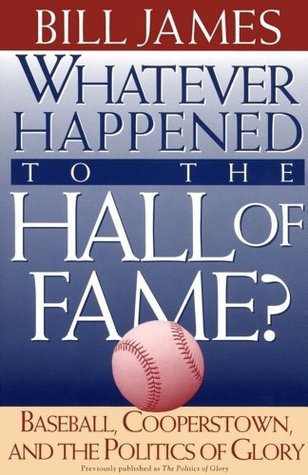
Whatever Happened to the Hall of Fame
Arguing about the merits of players is the baseball fan's second favorite pastime and every year the Hall of Fame elections spark heated controversy. In a book that's sure to thrill--and infuriate--countless fans, Bill James takes a hard look at the Hall, probing its history, its politics and, most of all, its decisions.
466 pages, Kindle Edition
First published May 2, 1994
About the author
Bill James
173 books206 followersGeorge William “Bill” James (born October 5, 1949, in Holton, Kansas) is a baseball writer, historian, and statistician whose work has been widely influential. Since 1977, James has written more than two dozen books devoted to baseball history and statistics. His approach, which he termed sabermetrics in reference to the Society for American Baseball Research (SABR), scientifically analyzes and studies baseball, often through the use of statistical data, in an attempt to determine why teams win and lose. His Baseball Abstract books in the 1980s are the modern predecessor to websites using sabermetrics such as Baseball Prospectus and Baseball Primer (now Baseball Think Factory).
In 2006, Time named him in the Time 100 as one of the most influential people in the world. He is currently a Senior Advisor on Baseball Operations for the Boston Red Sox. In 2010, Bill James was inducted into the Irish American Baseball Hall of Fame.
http://en.wikipedia.org/wiki/Bill_James
In 2006, Time named him in the Time 100 as one of the most influential people in the world. He is currently a Senior Advisor on Baseball Operations for the Boston Red Sox. In 2010, Bill James was inducted into the Irish American Baseball Hall of Fame.
http://en.wikipedia.org/wiki/Bill_James
Ratings & Reviews
Friends & Following
Create a free account to discover what your friends think of this book!
Community Reviews
Displaying 1 - 30 of 50 reviews

May 4, 2013
Not James' liveliest book, it is still as persuasive and as painstakingly researched as anything James writes.
His forte is less statistics than the ability to put statistics into context. So the next time you hear somebody advocate for a bum like, say, Jack Morris, who has a couple of gaudy stats but no legitimate claim to the Hall of Fame, you can be prepared to discuss the matter intelligently.
Or you can skip the background reading and just say, "Oh yeah, sez you," a whole bunch.
His forte is less statistics than the ability to put statistics into context. So the next time you hear somebody advocate for a bum like, say, Jack Morris, who has a couple of gaudy stats but no legitimate claim to the Hall of Fame, you can be prepared to discuss the matter intelligently.
Or you can skip the background reading and just say, "Oh yeah, sez you," a whole bunch.
July 5, 2010
I read this during my brief interest in sabermetrics. Bill James is the king of this hobby. He makes convincing cases for his arguments, although I did not agree with all of them.
James argued convincingly against the Veterans Committee, which is the old boys club of the Hall. This is how favored players who are not qualified get in through the back door.
A fun and interesting read. If you need barstool arguing fodder, give it a read.
James argued convincingly against the Veterans Committee, which is the old boys club of the Hall. This is how favored players who are not qualified get in through the back door.
A fun and interesting read. If you need barstool arguing fodder, give it a read.

January 26, 2018
Being a baseball fanatic I absolutely loved this book. It is well worth checking out.

December 27, 2020
Enjoyable, if outdated, look at the inconsistencies inherent in the Baseball Hall of Fame's selection policies. James wrote this, I think, primarily to argue against the induction of Phil Rizzuto. He also makes many excellent points about others who hadn't yet been inducted (many of whom have been since) and many who are already in, but don't deserve to be. Since it was written in 1994, much of it was before the advent of many advanced statistical metrics which have since become commonplace such as WAR, OPS+, ERA+, FIP, etc. It also pays inordinate attention to conventional fielding metrics, pitcher wins, and RBIs. James writes well, reasons better, and argues brilliantly.
October 26, 2020
It's a dated book, as some of the player references assume you're reading this book in the 90s and not thirty years later, but 'Whatever Happened to the Hall of Fame?' is a very informative book about how players were elected since the beginning. I really enjoyed hearing about how deserving, questionable, and undeserving players got in as well as the various arguments for those who were on the cusp at the time. There are a few chapters that get a bit bogged down that I only skimmed through (his new idea for election qualifications, the lengthy Drysdale argument), but I appreciated what he was trying to do. In the end, this was a great book to really sink into and I found myself appreciating a lot of lesser known (to me) hall of famers as well as those deserving to be.

Read
April 11, 2008Since republished under the title Whatever Happened to the Hall of Fame?, pioneering stats guru Bill James will show you that "Hall of Fame caliber" is largely a myth, and that while Phil Rizzuto, Richie Ashburn, and the entire double-play combo of Tinker, Evers, and Chance (and just about everybody elected by the Veterans Committee) probably don't belong in the Hall, Ted Simmons and Ron Santo probably do.
Great, enlightening fun for baseball geeks. Believe it or not, books like this and Moneyball are great, real-world ways to bone up on logic, since James' analysis is about cutting through foggy baseball cliches and tropes to find the truth.
Great, enlightening fun for baseball geeks. Believe it or not, books like this and Moneyball are great, real-world ways to bone up on logic, since James' analysis is about cutting through foggy baseball cliches and tropes to find the truth.

February 11, 2012
Bill James is in fine form here, wondering about things like why Don Drysdale was a slam-dunk Hall of Famer and Milt Pappas wasn't. Was Phil Rizutto worthy? Did Frankie Frisch and friends steamroll old New York Giants into the Hall with debatable credentials? Like anything involved with Baseball Hall of Fame voting, people will argue vehemently forever (see Jack Morris in 2012). James can rankle with some of his observations but I still find him an entertaining writer. Many of his followers are inflexible doctrinaires when it comes to the new stats, at least James can write well.

August 23, 2011
Book discusses the history of the Baseball Hall of Fame. It discussed the issues and politics of getting seleceted or not selected. The author uses individual players to apply his statistical and qualatative analysis of players. Phil Rizzuto is used extensively throughout the book. Others used Don Drysdale, Glenn Davis and Tinker, etc.

December 29, 2011
A fairly interesting book about baseball's hall of fame. James's writing style is easy and conversational, but it gets bogged down talking about archane issues of the Hall's past. James focuses on two players - Phil Rizzuto and Don Drysdale - and disects their Hall of Fame credentials ad nauseam. For someone who has read his Baseball abstracts and other works, this is a mild disappointment.

August 11, 2012
His best work, IMHO. His explanation of the process by which players make the HOF (as opposed to who deserves it) is eye opening. It was a revelation to discover that the sports writers almost NEVER enshrine some one undeserving... but the "old timers committee" (or it's equivalent) does so frequently.
January 18, 2024
Really enjoyed parts of it, but also found myself skimming/skipping some chapters. I think my buddy might like this book (at least the parts I read).
November 1, 2025
I love Bill James and the way his mind works and how he asks questions that challenge preconceived notions. He does not argue that if one reaches a certain statistical level that they should get voted into the Hall of Fame, rather he tries to understand why certain people do not get voted into the Hall of Fame despite having similar careers as those already in the Hall of Fame.
In doing so, he also discusses why certain players did not win an MVP during a year when they won the triple crown in batting for example. Sports still has a lot of subjectivity despite an endless amount of data.
This book has helped me understand what goes into decision making, and the tagging of certain people with “Oh they are really good!” despite no solid evidence to prove this. I see this type of unconscious bias in the workplace to municipal politics.
He also was the first to touch on environmental factors that help explain results with mathematical explanations of “If all things were equal would person X be better than person Y in terms of expected results.
This is still a baseball book and can get dry in parts…but in other ways it can be quite entertaining in describing the personalities of people associated with the creation of MLB Hall of Fame. Not just a museum…!
In doing so, he also discusses why certain players did not win an MVP during a year when they won the triple crown in batting for example. Sports still has a lot of subjectivity despite an endless amount of data.
This book has helped me understand what goes into decision making, and the tagging of certain people with “Oh they are really good!” despite no solid evidence to prove this. I see this type of unconscious bias in the workplace to municipal politics.
He also was the first to touch on environmental factors that help explain results with mathematical explanations of “If all things were equal would person X be better than person Y in terms of expected results.
This is still a baseball book and can get dry in parts…but in other ways it can be quite entertaining in describing the personalities of people associated with the creation of MLB Hall of Fame. Not just a museum…!

June 12, 2021
Sabermetrician Bill James scores again with a unique book that blends statistics, analysis and essays to evaluate one of the great though erratic hallmarks of professional baseball, that being the Hall of Fame. In “Whatever Happened to the Hall of Fame? Baseball, Cooperstown, and the Politics of Glory”, James takes a deep look at the foundation of the Hall and highlights its inductees, up until the 1995 election cycle. For the numerous questionable players which have been elected, a good statistical analysis is given, as well as to the method of election - which tends to be the result of the “very old white men” that sit on the Veterans Committee. Though I would have appreciated more commentary on every borderline and undeserving Hall of Famer, Bill James succeeds in using statistics and relatable rationales to convince his readership of what a Hall of Fame baseball player looks like, and which deserving players are and are not in Cooperstown.
Read
March 1, 2020Picked this up on a whim at a used book sale and am damn glad I only paid a dollar. It's obviously out of date (James bites down HARD on "Pete Rose got a raw deal!" just a few years before Pete admitted to everything), but also, James, for all his rep as a SABREmetrician...offers a lot of oddly subjective criteria. There's also a big focus on players before, say, the Cobb/Ruth era, and that's just something I struggle to care about (maybe that's my failing).
On the other hand, I did enjoy the chapters on the history of Cooperstown and the Hall.
On the other hand, I did enjoy the chapters on the history of Cooperstown and the Hall.
April 19, 2020
Bill James is a national treasure. This book is really dense (witness how long it took me to get through it) and more than 20 years out of date, but absolutely fascinating. It helps that James is a good writer. The analysis of players against each other and against objective standards is impressively detailed and interesting. He spares no love for the Veterans Committee, and his view has only been borne out with their increased influence in the past 25+ years. This book will keep you interested and help you make the case for your own personal pet HOFer.

July 6, 2019
This book is quite outdated, but still has a lot of good discussion and ideas in it.

August 25, 2026
Great book about the Baseball Hall of Fame and the everchanging "selection process" If you love baseball, this book is a must read.

August 8, 2012
Whatever happened to the Hall of Fame? According to Bill James, not much. Essentially, the Hall of Fame is the same as it ever was--a foggy, undefined collection of players, many whom deserve recognition, and many whom coasted in due to politics, cronyism, or the simple fact that they outlived their better contemporaries (I'm lookin' at you, Rizzuto!)
Bill James always comes off as a bit of a pedantic dick, but it works here, as he truly knows what he's talking about, and he has the knowledge to back up what he's saying with facts instead of opinion.
The book itself tries (and largely succeeds) to define what makes a true "hall of famer." There are a number of different statistics and methods used by James, who essentially argues that all must be taken into account when determining whether someone is worthy of the honor.
Bill James' methods are so good, in fact, that at one point he predicts HOF elections (BBWAA choices, not Veterans Committee choices) for the next 25 years (from '95 through '19), and his predictions are frighteningly good: Of the 50 men he predicts, 26 have already been elected. One incorrect guess is Pete Rose (James incorrectly guessed that Rose would be reinstated and admitted--something that didn't happen.) He also predicted that players such as Roger Clemens and Barry Bonds would be admitted--obviously in question now, given what we know of their "enhancements" (though not impossible). The other players he predicted would be in that are not are Steve Garvey, Al Oliver, Dave Parker, Jim Kaat, Ted Simmons, Dale Murphy, Jack Morris, Lee Smith, Tim Raines, Joe Carter, Brett Butler, David Cone, Alan Trammell, Lou Whitaker, Jack McDowell, Fred McGriff, Don Mattingly, Dwight Gooden, Ruben Sierra, Ken Griffey, Jeff Bagwell, and Juan Gonzalez. At least one of those players--Griffey--is a sure thing when he becomes eligible in 2016. Many of the others (Jeff Bagwell, Tim Raines, Alan Trammell, Fred McGriff, Lee Smith) have been garnering votes, but not enough to be enshrined (although Bagwell and Raines appear to be possibilities). Some others (including Trammell, Mattingly, and Jack Morris) will likely come in as Veterans Committee selections.
As far as his correct predictions, sure he had a couple of years incorrect. He predicted Don Sutton would be elected in '96, but that didn't happen until '98. He said Yount would be elected in 2000, but that honor occurred in '99. He predicted Dawson would be elected in 2001 an Sandberg would be elected in 2010, but the Hawk wasn't in until 2010, and the Ryno came in much earlier, in '05. Some people James assumed would have a longer playing career--he must have assumed Kirby Puckett would not have retired until about 2003, as he predicted Kirby's induction occurring in '08. Or course, Kirby only played one more year after the publication of James' book.
Still, that's some pretty impressive guess work.
(It's interesting to see who was elected that was not predicted by James. That list includes only Tony Perez (in 2000), Bruce Sutter (in 2006), Bert Blyleven (in 2011), Barry Larkin (in 2012), Tom Glavine (in 2014), Craig Biggeio, Randy Johnson, Pedro Martinez, and John Smoltz (all in 2015). Mostly pitchers, which is interesting.)
Although hundreds of players are discussed at length, the book uses primarily two when examining hall of fame worthiness--Don Drysdale and Phil Rizzuto--both "bubble" candidates who eventually found their way into Cooperstown.
But did they deserve the honor? I must say, James is a very persuasive pedantic dick. After reading the book, my determination (along with James's) is that in no way is Don Drysdale a worthy candidate. Rizzuto--maybe it's arguable, but he is very, very low on the qualifications.
So persuasive is James, in fact, that I have personally re-evaluated my beliefs regarding whether Pete Rose and Joe Jackson belong in Cooperstown. No way in hell, I now think.
Of course, my favorite part of the book--likely the favorite part for all Cubs fans--is James' assertion that if he were running the HOF, his FIRST act would be to enshrine Ron Santo.
Bill James always comes off as a bit of a pedantic dick, but it works here, as he truly knows what he's talking about, and he has the knowledge to back up what he's saying with facts instead of opinion.
The book itself tries (and largely succeeds) to define what makes a true "hall of famer." There are a number of different statistics and methods used by James, who essentially argues that all must be taken into account when determining whether someone is worthy of the honor.
Bill James' methods are so good, in fact, that at one point he predicts HOF elections (BBWAA choices, not Veterans Committee choices) for the next 25 years (from '95 through '19), and his predictions are frighteningly good: Of the 50 men he predicts, 26 have already been elected. One incorrect guess is Pete Rose (James incorrectly guessed that Rose would be reinstated and admitted--something that didn't happen.) He also predicted that players such as Roger Clemens and Barry Bonds would be admitted--obviously in question now, given what we know of their "enhancements" (though not impossible). The other players he predicted would be in that are not are Steve Garvey, Al Oliver, Dave Parker, Jim Kaat, Ted Simmons, Dale Murphy, Jack Morris, Lee Smith, Tim Raines, Joe Carter, Brett Butler, David Cone, Alan Trammell, Lou Whitaker, Jack McDowell, Fred McGriff, Don Mattingly, Dwight Gooden, Ruben Sierra, Ken Griffey, Jeff Bagwell, and Juan Gonzalez. At least one of those players--Griffey--is a sure thing when he becomes eligible in 2016. Many of the others (Jeff Bagwell, Tim Raines, Alan Trammell, Fred McGriff, Lee Smith) have been garnering votes, but not enough to be enshrined (although Bagwell and Raines appear to be possibilities). Some others (including Trammell, Mattingly, and Jack Morris) will likely come in as Veterans Committee selections.
As far as his correct predictions, sure he had a couple of years incorrect. He predicted Don Sutton would be elected in '96, but that didn't happen until '98. He said Yount would be elected in 2000, but that honor occurred in '99. He predicted Dawson would be elected in 2001 an Sandberg would be elected in 2010, but the Hawk wasn't in until 2010, and the Ryno came in much earlier, in '05. Some people James assumed would have a longer playing career--he must have assumed Kirby Puckett would not have retired until about 2003, as he predicted Kirby's induction occurring in '08. Or course, Kirby only played one more year after the publication of James' book.
Still, that's some pretty impressive guess work.
(It's interesting to see who was elected that was not predicted by James. That list includes only Tony Perez (in 2000), Bruce Sutter (in 2006), Bert Blyleven (in 2011), Barry Larkin (in 2012), Tom Glavine (in 2014), Craig Biggeio, Randy Johnson, Pedro Martinez, and John Smoltz (all in 2015). Mostly pitchers, which is interesting.)
Although hundreds of players are discussed at length, the book uses primarily two when examining hall of fame worthiness--Don Drysdale and Phil Rizzuto--both "bubble" candidates who eventually found their way into Cooperstown.
But did they deserve the honor? I must say, James is a very persuasive pedantic dick. After reading the book, my determination (along with James's) is that in no way is Don Drysdale a worthy candidate. Rizzuto--maybe it's arguable, but he is very, very low on the qualifications.
So persuasive is James, in fact, that I have personally re-evaluated my beliefs regarding whether Pete Rose and Joe Jackson belong in Cooperstown. No way in hell, I now think.
Of course, my favorite part of the book--likely the favorite part for all Cubs fans--is James' assertion that if he were running the HOF, his FIRST act would be to enshrine Ron Santo.
August 17, 2014
This deviation from my usual reading turned out to be a lot of fun. I probably should've read it twenty years ago, when I was still really invested in baseball. But I'm still really fascinated by canon formation, so there was a lot to love here.
The book could probably use an update, particularly in the institutional history area. (Those were maybe my favorite chapters. All the stuff about the earliest baseball historians and statisticians was fascinating, and James' dissection of the checkered history of the voting process was enlightening and informative.) With the giant influx of Negro Leaguers back in 2006, various changes to the rules involving the selection of veterans (or old-timers, or whatever they're calling them this week), and the BBWAA's apparent decision to hold off on recognizing non-pitchers from the steroid era, there's been a lot of controversy and deviations from the norm with HOF voting in the past two decades. Some coverage of all of this in an updated edition would be worthwhile.
But what's here is great, and any baseball fan should check this out.
The book could probably use an update, particularly in the institutional history area. (Those were maybe my favorite chapters. All the stuff about the earliest baseball historians and statisticians was fascinating, and James' dissection of the checkered history of the voting process was enlightening and informative.) With the giant influx of Negro Leaguers back in 2006, various changes to the rules involving the selection of veterans (or old-timers, or whatever they're calling them this week), and the BBWAA's apparent decision to hold off on recognizing non-pitchers from the steroid era, there's been a lot of controversy and deviations from the norm with HOF voting in the past two decades. Some coverage of all of this in an updated edition would be worthwhile.
But what's here is great, and any baseball fan should check this out.

January 1, 2024
Baseball fans love to argue about who is a Hall of Famer and who isn't. About 30 years ago Bill James wrote this book which is basically that. He centered his book around pitcher Don Drysdale and shortstop Phil Rizzuto. If they belong then why aren't others in there. But it's more than comparing players. James delves into the history of the HOF and who runs it. He also explains why he believes certain players already in shouldn't be and the probable reasons they are in. James also comes up with a different way to elect players to the HOF that includes fans, current and former players, executives, et. al. Since the book came out, voting procedures have changed somewhat with the addition of several committees that meet on a staggered basis to elect players no longer on the ballot. One committee will meet one year, another the next and so forth. The arguments and stats can be a bit mind numbing but James's arguments are solid and he offers solutions.
July 18, 2011
An interesting analysis of the Baseball Hall of Fame and how it works (or doesn't work, in many cases). There's some terrific historical pieces here on how the institution functions and came to be in its present form. Some of the material is a bit dated now, but most of it is very strong, combining strong data analysis with a sense for how the game is played in a readable and pleasing format that makes it more compelling.
Bill James is at the top of the SABR-metrician pantheon, and there's a good reason for it. He can crunch the numbers, but can also write about them in an accessible and compelling way. Baseball writers should take note.
Bill James is at the top of the SABR-metrician pantheon, and there's a good reason for it. He can crunch the numbers, but can also write about them in an accessible and compelling way. Baseball writers should take note.
December 31, 2013
This is a good book that is marred by the fact that it has changed the way we view baseball history in a deletrious matter. It looks at Hall of Fame cases for various players using traditional stats (Had this book come out more recently, James might have used more advanced stat) and qualititative measures like the Keltner List. I think of the Keltner List as a guide, not something to be slavishly followed, but it is a good way to look at a players career.
Unfortunately, since this book has come out, our first thought about a historical baseball player is "Worthy HOFer or no?" Still, this is a good book. James is a helluva writer.
Unfortunately, since this book has come out, our first thought about a historical baseball player is "Worthy HOFer or no?" Still, this is a good book. James is a helluva writer.
Read
April 4, 2015I first read this book twenty years ago. Just as entertaining a read today. James, a clever statistician, analyses the history of the baseball Hall of Fame how this peculiar institution and its voting patterns have developed and what should be done to correct them. None of which, it must be said, have been adopted. He challenges a number of players who have been voted in and answers questions about many who are frequently brought up as worthy of induction. His statistical comparison of players is fascinating. Clearly this is a book for the truly obsessed. Many of the chapters read as discrete essays and so there is some repetition.

March 2, 2012
A good intro to James' sabermetric thoughts as they impact the Hall of Fame.
Though he says early on that this is NOT a book about who should be in or out, it's clear that he thought Phil Rizzuto (written before his induction shouldn't be in), Dick Allen shouldn't be in, and Don Drysdale should be out, among others.
And, was Sandy Koufax's late career brilliance in part not only leaving Ebbetts Field, but then leaving the L.A. Coliseum and its short left field for spacious Dodger Stadium and it's ultra-high mound?
Agree or disagree, James will make you think, if you are prepared to do so.
Though he says early on that this is NOT a book about who should be in or out, it's clear that he thought Phil Rizzuto (written before his induction shouldn't be in), Dick Allen shouldn't be in, and Don Drysdale should be out, among others.
And, was Sandy Koufax's late career brilliance in part not only leaving Ebbetts Field, but then leaving the L.A. Coliseum and its short left field for spacious Dodger Stadium and it's ultra-high mound?
Agree or disagree, James will make you think, if you are prepared to do so.
March 29, 2014
The Politics of Glory is a discussion about the Baseball Hall of Fame---why some players are in, why others are out, how the voting system is flawed and how it can be fixed. Author Bill James is adept at expressing his views clearly and supporting them with evidence. If you love statistics, baseball and the Hall of Fame, you will love this book. It jumps around from topic to topic without much structure or direction, but it is a stat-lover's dream. Much enjoyed the read and will reference it again.

July 15, 2016
Was really disappointed with this book, so much so I stopped on chapter 9. As a lover of ALL things Baseball I thought this would be a good read, but it's just Bill James nagging about how the Hall of Fame is corrupt and doesn't take into consideration all of his requirements. He's better off just making a magazine with all the comparable stats than turning it into a book. Did not enjoy this at all.

July 24, 2021
3.49 stars.
1994 look at the Baseball Hall of Fame, how elections work, and the controversy surrounding inductions. I gave my copy away . . . wish I had it because it contains James's predictions of what current (1994) players probably would have Hall of Fame credentials. Alas, this was the steroid era, so many of those guys are tainted. I specifically remember he predicted Ruben Sierra would make it. You can check that one out!
1994 look at the Baseball Hall of Fame, how elections work, and the controversy surrounding inductions. I gave my copy away . . . wish I had it because it contains James's predictions of what current (1994) players probably would have Hall of Fame credentials. Alas, this was the steroid era, so many of those guys are tainted. I specifically remember he predicted Ruben Sierra would make it. You can check that one out!

November 25, 2007
I really hope that the Hall of Fame has increased the level of librarianship it employs since 1994. I was more worried about that after reading this than the dubious election practices.
Also, if you're trying to calculate your own HoF monitors and whatnot based on the formulas in this book, the guy at baseball-reference.com already did and they're posted on relevant player pages.
Also, if you're trying to calculate your own HoF monitors and whatnot based on the formulas in this book, the guy at baseball-reference.com already did and they're posted on relevant player pages.

September 15, 2008
Do you ever wonder why Babe Ruth, the most popular player of all time, only garnered 95% of the Hall of Fame vote (instead of 100%)? Or why a hitter as poor as Rabbit Maranville is in the Hall? Bill James walks us through a history of the Hall of Fame and its voting processes, while also presenting unique James-ian ways of quantifying just what a baseball Hall of Famer is supposed to be.
June 12, 2009
Si quieres un completo analisis del Salon de la Fama del Beisbol, este es tu libro. Bill James nos da su opinion de quienes estan y de quienes deberian estar en este Olympo del Beisbol. Un libro muy analitico del Salon. Excelente.
Displaying 1 - 30 of 50 reviews