In the brightly decadent nightscape of New Orleans, strange figures stalk the fringes of existence, demanding sacrifice and blood. In backwoods Georgia, flesh stirs among the unknown graveyards. And in the human swamp of Calcutta, the souls of the dead walk among the living... Poppy Z. Brite is back to haunt us with twelve new tales of bizarre and seductive terror.
From America's fastest rising horror star—author of Drawing Blood and Lost Souls—Swamp Foetus is a trip to the black heart of longing... to the darkest regions of desire...
Poppy Z. Brite (born Melissa Ann Brite, now going by Billy Martin) is an American author born in New Orleans, Louisiana.
Born a biological female, Brite has written and talked much about his gender dysphoria/gender identity issues. He self-identifies almost completely as a homosexual male rather than female, and as of 2011 has started taking testosterone injections. His male name is Billy Martin.
He lived in Chapel Hill, North Carolina and Athens, Georgia prior to returning to New Orleans in 1993. He loves UNC basketball and is a sometime season ticket holder for the NBA, but he saves his greatest affection for his hometown football team, the New Orleans Saints.
Brite and husband Chris DeBarr, a chef, run a de facto cat rescue and have, at any given time, between fifteen and twenty cats. Photos of the various felines are available on the "Cats" page of Brite's website. They have been known to have a few dogs and perhaps a snake as well in the menagerie. They are no longer together.
During Hurricane Katrina in 2005, Brite at first opted to stay at home, but he eventually abandoned New Orleans and his cats and relocated 80 miles away to his mother's home in Mississippi. He used his blog to update his fans regarding the situation, including the unknown status of his house and many of his pets, and in October 2005 became one of the first 70,000 New Orleanians to begin repopulating the city.
In the following months, Brite has been an outspoken and sometimes harsh critic of those who are leaving New Orleans for good. He was quoted in the New York Times and elsewhere as saying, in reference to those considering leaving, "If you’re ever lucky enough to belong somewhere, if a place takes you in and you take it into yourself, you don't desert it just because it can kill you. There are things more valuable than life."
Really brilliant horror stories. The kind you get jealous of. They tread the lines between horrors, they're subtle and rich and tactile. They're never ever predictable or stale. Of particular interest is "His Lips Will Taste of Wormwood," which uses Lovecraft's "The Hound" blueprints and constructs a startingly good yarn with. Exciting prose, sensuality, good macabre notes for us death-centric types. I'd never read Brite/Martin before but I've got other paperbacks coming and look forward with interest to see how he developed his mark on the horror world.
I rescued this book at the Calgary Horror Con because I couldn't stand to see it sitting there like an orphaned puppy, waiting for someone to pick it up. This kind of puppy, however, is for very special owners. It drinks human blood and shifts in and out of reality like a shadow in a strobe light.
For those who have not been exposed to Poppy's work, this is an excellent primer for what is to come. And, honestly, if you haven't read at least something by Poppy Z. Brite,your horror education is sorely lacking and your image of what horror was in the 1990s is a warped thing at best, missing so many chromosomes it's unable to survive on its own.
The book includes the story "Calcutta, Lord of Nerves", which, for my money, is one of the best zombie stories ever written. A collection of stories beautiful in their celebration of the dark.
Možda Popi [Popica od milošte] nije autorka široko razbokorene imaginacije, što jamačno ne mora mnogo da znači, kao što uostalom ni ne znači. Možda sam i sâm očekivao nešto još drastičnije i raskalašnije, a dobio tek po koji zavrtanj više bizarno-hororičnog na južnjački gotik. Malo li je i to!
Preče mi ipak bude to što Popi onaj opsesivni gotovo tinejdž-buntovni stav "ti-i-ja-spram-sveta-dok-ne-sagorimo"* po većini priča uspeva da protegne i servira tako da se unapred primi. Spreda il' otpozadi, na kolenima il' ležećki, kako kome drago. Stav je uzet svim čulima (olfaktornim, gustatornim i taktilnim, osobito) kao prirodna, sobom prihvatljiva datost. Otprilike kao kad Sofronije, igrajući se žmurke, mora da prihvati to što ga je sin Nebojša iskopao na mestu gde se nije sakrio. Po sistemu: nije mi jasno kako, ali ti je uspelo. [Dobro de, malčice preterujem!]
*Odakle li mi "Propovednik" u glavi? Mislim na strip, naravno.
A ne gasnu samo srodne a izgubljene duše po gradovima, već izumiru čitavi kvartovi i gradovi - ko brže, ko sporije - pa mi preče opet i to što Brajtova uspeva da vekovečni zapah umiranja izmesti iz Venecije s kojom je srođen. Da se razumemo, nema ovde Venecije nigde, više je po sredi čitalački utisak u srodnosti po propadanju. Izmamljujući, dakle, mijazmu drugde - najčešće u Nju Orleans kao sasvim podesan topografski korelativ - Popi pooštrava zapah smeđe sladunjavim notama, čineći ga autohtonim.
[Utoliko bi pijačno-mijazmični uvod Ognjanovićevog "Naživo" mogao biti pritajeni omaž prozi Popi Z. Brajt. Naravno, ukoliko nije puka senzibilitetsko-koincidentna analogija. A kad sam već u digresiji: kod Dejana gotik ima implikacije južnjačkog, samo se radi o jugu jedne druge geografije. Moglo bi se, štaviše, govoriti i o kvir komponenti u vezi s njegovim junakom, imajući u vidu šire značenje termina dato u pogovoru "Ukusa pelina".]
Zbirka kratkih priča pod imenom Ukus Pelina od Popi Z. Brajt, ostavila je snažan utisak na mene, i zbog toga sam joj dao ocenu 5. Većina ovih priča mi se urezala u sećanje i mislim da će me pratiti tokom celog života.
Što se tiče samih priča, najviše mi se svidela - Kalkuta, Gospodar nerava, jedna od boljih ako ne i najbolja zombi priča koju sam pročitao do sada. Čoveče jebena zombi apokalipsa je, ali to nekako u ovoj priči nije ni važno, sve se odigrava sporo, nihilistički, kao da je sve to neki san, san koji sanja neko drugi, i polako, neprimetno, svi počinjemo da sanjamo taj isti san, koji postaje naša realnost. U priči Stariji, pustio sam jednu kapljicu suze, izuzetno teška priča. U priči Andjeli, govori se o čudnim (najblaže rečeno) blizancima. Priča iz Džordžije, je prica o izgubljenim tinejdžerima sa nihilističkim pogledom na svet. Šesti čuvar, je potresna priča o zabranjenoj ljubavi. Opcionalna muzika za glas i klavir - Dečko peva, ubija. Njegova usta imaće ukus pelina - Gorka, ali sočna i stravstvena priča. Pitka kao pelinkovac ;) Ostale priče su mi se takodje dopale, ali su mi ostavile nešto blaži utisak od ovih gore pomenutih.
4.5 Kakva šteta što mi ovo nije dopalo ruku 15ak godina unazad. Mini gotičarka ja bi ishajpovala ovo do statusa kulta i izludela sve oko sebe. Ni matora ja nije ostala ravnodušna na ovu kakofoniju queer vampira, groteski i macabre estetike. Iako na momente repetativna tematika, čitanje je bilo osveženje nakon suve Džejmsove viktorijanske proze.
In Poppy Z. Brite's first stories, collected here in WORMWOOD (pub’d in hardcover as Swamp Foetus), there is no real sense of good or evil, just the aesthete's pose of worldliness and boredom. She was concerned not with morality but with sensuality and brought a sort of fin de siecle decadence to the genre just as its paperback popularity seemed to be fizzling out. This approach was something horror mostly lacked in the era, concerned as it was with middle American families, or children and teenagers.
A teenager herself when her stories were being published in The Horror Show magazine in the mid 1980s, Brite's characters were the misfit kids, part of subcultural movements that I was familiar with and sympathetic to—punk and goth and whatever the mixture of the two beget. They hung out in filthy, ill-lit clubs, wore black rags and had messy hair and crashed in abandoned houses and churches, sleeping on stained mattresses and consorting intimately with a variety of partners, smoking clove cigarettes and drinking cheap rotgut liquor, usually all in a New Orleans of perfume and rot. Certainly to an audience used to the familiar comforts of Koontz, King, or Saul this wasn't going to go over well at all.
But stories like “His Mouth Will Taste of Wormwood” (an ingenious update of Lovecraft’s “The Hound”), “The Sixth Sentinel,” and “Calcutta, Lord of Nerves” are some of the finest of their era. Nothing else like this book, it is a must-have collection!
Every once in a while you stumble across an artist who is in the wrong time… Poppy is one of those authors, and artist who seems as if she was born too late to be happy. From reading her stories you can envision her walking with the likes of Lovecraft and Poe. I assume they would discuss language, the beauty of the written word and the terrors of their hearts. Brite has a style that harkens back to the 1800’s when flowing language and beauty could be found in even the darkest of tales. This collection of short stories is dark, gothic, beautiful, flowing, engaging and sad. Though she is labeled as horror, I wouldn’t quite put her in that category, at least in this book. True there are vampires, murderers, and the undead… but they are never frightening… Brite looks at them all as a beautiful and necessary addition to a dark and morose world.
Although her writing is beautiful, and her stories thrilling to read, this book will not be for everyone. Her characters are sexually ambiguous, often leaning closer to the homosexual side, and although she never becomes overly graphic, I don’t know that I would advise my husband read this. Also her characters tend to be very thin, fine boned almost androgynous males with questionable morals, and a penchant for eye shadow and lace. The closest mainstream author I can think of to compare her with would be Anne Rice with a darker view of the world.
Personally, I really enjoyed reading these stories, I loved her use of language, her sense of atmosphere and the brooding nature of her characters. The theme that seems to run through the book is one of both love and death, though the love is darker and more horrifying and the death is beautiful and erotic. If you read this book be sure to read the introduction by Dan Simmons, one of my favorite authors. It is both hysterically funny, and also does a good job of setting your mind in the right mood to proceed into the stories.
on the verge of being really good but held back by its sneering myopic depictions of city life and strange contempt for the down and out. there are some weird racial dynamics that the author thinks he’s clear of (one story is literally titled ‘xenophobia’) in a typical gen x manner that i have grown to find less tolerable as i get older. when we’re in the south things are much better. all the more irritating for its often inspired prose and frequent emotional heft. few real scares to be had here. maybe i’m especially hard on him because i see a lot of my own tendencies reflected in his approach. i don’t know.
This was my first Poppy Z. Brite read. There were some excellent stories here, my favorites being Calcutta, Lord of Nerves and The Sixth Sentinel. Great collection, and I'm glad I finally gave this author a read.
Great collection of short stories. Very atmospheric. Creepy. Well-written and engaging. Several were phenomenal. Several more were well above average. Several were very good. And I don’t really recall any being poor, which made this collection a definite good read.
Poppy Z. Brite (Now living as Billy Martin) was one of the authors in the much-touted Dell Abyss Line. The following elements characterize his writing: 90s nihilistic angst, graphic sexuality and violence, quirky and damaged characters, and the haunting presence of his native New Orleans. I can say that I enjoy his writing style; it is artful in its descriptions while still finding a way to move the story forward. There might be some disappointing tales in this collection, but the ones that work are absolute masterpieces. (see "His Mouth Will Taste of Wormwood," "The Sixth Sentinel," "Calcutta, Lord of Nerves," "The Elder," and "The Ash of Memory, The Dust of Desire")
Not bad for a first collection!
1. Angels
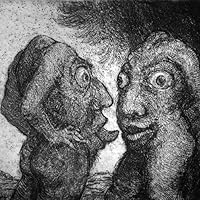
Ghost and Steve are looking for someone to fix their car. They eventually come across a house and a possible troubleshooter. Their prolonged stay, however, means that they have to deal with the twins, two deformed brothers with a penchant for biting people. Ghost knows they want something, but can he offer that, and what is the prize for such generosity?
For the appetizer, Brite presents this tale of empathy and shared pain. Brite posits that sometimes monsters are created by primal needs that can't be understood and therefore remain unfulfilled. (Ghost, in the story, is the bridge to that need) Is this successful? Maybe not as a creepy horror story but one where horror elements accentuate a fact of life. And that ending is poignant and bleak.
2. A Georgia Story
While driving to Georgia, Unnamed Narrator (#1) reminisces about his tragic and sordid past as part of a subversive New Orleans band. They spent their days hiding in a church and their nights playing music in "decaying little clubs with runes and cryptic names spray-painted on the walls." Unfortunately, Gene, their lead singer, is prone to irrational behavior and eventually does a permanent act that breaks the band apart. Back to the present, UN(#1) stops by a carnival show for a quick ice cream fix, and he discovers the newest addition to the freak show, somebody he might know.
This story is depressing and includes a gruesome twist. There might be little concerning supernatural occurrences, but this story still haunts with its message: being different won't save you from the scorn of your fellow man. It might not be as memorable as the other tales, but it is compelling.
Unnamed Narrator (#2) and his friend/occasional lover Louis are looking for the ultimate thrill. Jaded by the pleasures of sex, music, and drink, they eventually turn to a more morbid hobby: grave robbing. Their latest conquest is a trinket from a voodoo sorcerer's. Later, their enjoyment is complete as they attract the attention of a thin and dark-haired boy. And he has a more than passing interest in the amulet they stole.
An absolute masterpiece. Brite recreates Lovecraft's "The Hound" in his own New Orleans, giving the old story vibrant and dangerous life. The narration captures the decadence and danger of the underworld culture of New Orleans, depicted as a place where all the weird and disaffected act out their rabid fantasies. I also love the inclusion of voodoo elements; it feels right and appropriate considering the lack of (for me) credible real-life mythology in the original Lovecraft tale. This tale is truly immortal.
A surprise attack on a deserted alleyway gives our unnamed character a unique trait: his voice is capable of bringing out profound emotions from the listener. Those who hear his voice are overcome with strange emotions, bringing out hidden feelings and (mostly negative) reactions. He joins a band when he grows up, and he sees for himself the effects of his voice: deaths, suicides, etc. But what can he do to stop this?
The end should not be a surprise to anyone. This story is your standard music/signal-drives-people-bonkers, albeit with an unspecified reason behind the phenomenon. At least the writing moves forward, and we get a few moments of unease and fear.
Unnamed Narrator (#3) and his xenophobic friend Robert are touring New Orleans' (?) Chinatown for a night of unplanned revelry. After stopping for some Ice Cream in a sweet shop, they are made an offer by a man who was listening to their ramblings: watch over his funeral parlor for the night while he goes drinking with his other undertaker friend. Robert and UN(#3) agree in exchange for a bottle of Cognac. The dead body they look after turns out to be a woman, and Robert is particularly curious about a racist sexual tidbit he heard once. What surprise is in store for our drunk "protagonists"?
This story is fun, freaky, and unpredictable. The strength of this tale is you don't have any idea where Brite is heading to: is it a ghost tale, or is it-like its source anthology indicates- a blood-soaked affair? I think it is neither, as this story has elements of both while not fully committing to either subgenre. The ending nevertheless delivers on the promise of delivering weird imagery. And you even get a valuable lesson in cultural sensitivity.
Jean is in love with stripper Rosalie Smith. The catch is Jean is a 200-year old ghost haunting the grounds of New Orleans. Jean, because of their special friendship, wants to free her from her unsavory and degrading lifestyle. He plans on making her dig his riches in a bayou somewhere. But Rosalie has an unnatural fear of graves and of digging them out. Curious, Jean visits her mind and learns of her disturbing and tragic past; he also learns of the disgusting event that cemented that fear in her heart.
This story is one of Brite's most famous tales, and there is a good reason for that: it is one of the best horror short stories of the 90s. Once again, we are back in the phantasmagoric side of New Orleans, a place Brite depicts as filled with death-obsessed youth and the literal ghosts of its past. The progression of the tale from a goth romance to a lurid and gruesome southern gothic/horror tale is well-done and commendable; who had the aptitude and vision to combine these two but Brite?
Andrew and Lucian are lifelong friends (lovers?) who are inseparable: they play music, hang out, and complement each other's weirdness. But now they both can't get rid of a nasty smell, a foul odor that doesn't seem to have a source. It can't be the preserved skeleton of the landlady's child. By morning both of them (or maybe just one) will know the answer.
Just like 'Optional Music", this tale feels predictable and is a bit underwhelming. Perhaps it is successful when viewed as a "mood piece," evoking the unbearable sadness one goes through when someone is "missing" from your life. At least the story doesn't overstay its welcome.
8. Footsteps in the Water
Dru Frixton is a gifted human being: he can move objects and manipulate matter at will. As he grows older, his power grows, too. He is also more aware of the brutality he can inflict on other living beings. Enter Nineveh, still mourning the death/drowning of his twin brother Dylan. Nineveh believes that Dru can bring Dylan back to life. Dru agrees, but can he face the consequences of his actions?
This story has a shocking end, but it still feels like it needed more "oomph." But the writing is compelling and, again, it doesn't overstay its welcome, so no harm!
Steve and Ghost (same characters from "Angels" and Brite's "Lost Souls") have a scheduled performance in New York's East Village. The problem is in going there, as they encounter a series of increasingly bizarre and dangerous groups of people on their way. From violent hobos to peddlers selling human heads, Steve and Ghost meet and greet the best New York has to offer. All of this to play some tunes!
I initially decried the inclusion of this story in the BEST NEW HORROR anthology because I felt this was more of a surreal and Lynchian journey to wherever rather than something to rattle the bones. But after a re-read, I realized that the cumulative effect of all the encounters and experiences must have been one of horror for the main characters. This story made me think of all the journeys we take in unknown urban environments; if one element (say muggers) had you anxious during your travel, how much more three or four after that?
"Calcutta, you will say. What a place to have been when the dead began to walk.
And I reply what better place to be? What better place than a city where five million people look as if they are already dead - might as well be dead - and another five million wish they were?"
An Indian-American man (Unnamed Narrator #4) returns to his birthplace of Calcutta, which is slowly turning into a hellhole of the living dead. But as our UN(#4) is keen to tell us, there seems to be little to no difference at all, as the squalor and misery of Calcutta are at par with the zombie epidemic. But can there be far worse things not seen yet?
This story is a gruesome, shocking, and unforgettable account of a man, his city, and their connection with Death. The Calcutta descriptions remind me of Simmons's "Song of Kali," but with the added juxtaposition to the zombie apocalypse at hand. Compelling writing and vivid and visceral descriptions of carnage writing elevate this zombie piece to horror-heaven. Again, who has the imagination to combine the real-life squalor of Calcutta with a zombie apocalypse that would make Romero proud? Only Brite.
Paul and Jen's are celebrating their new life with their baby, Bobby. This bliss seems short-lived as problems arise: Jen is suddenly disinterested in the baby, and Paul is left to care for Bobby alone. But this is just the start of the hell to come.
This story grows more disturbing as the pages turn. Brite, when he wants to disturb, is unstoppable as he is merciless; he shows the gradual progression of events from blissful to hellish. And that ending will tear you apart.
Jonny, a head chef for an elite restaurant, is so in love with his girlfriend Leah; he is even willing to accompany her to get an abortion borne out of her affair with Jonny's best friend (!) Cleve. Once they get the address (ominously named Payne street), they traverse the run-down neighborhood filled with dirty and empty buildings. Amidst all the miserable background, Jonny loses sight of Leah. He looks for her and eventually discovers the location of the supposed clinic amidst all the urban decay. But what is waiting for both of them?
A great combination of a sexually-charged love story with a unique and frightening idea: what if something was feeding off our universal hopelessness (and other negative emotions) to survive? To tell more would spoil the tale, but I recommend a "double-bill" read: Gary A. Braunbeck's "Union Dues" from Borderlands 4.
Popi mi je otkriće ne godine nego života. Sjajne ideje sprovedene u delo kako treba; kliše tematike poput priča o duhovima, vampirima ili zombijima pretvara u pravo osveženje i čitaocima otvara nove dimenzije kroz nesvakidašnje opise likova, mesta i radnji. Kroz par priča se provlače homoseksualnost i biseksualnost ali nenametljivo i nimalo forsirano i savršeno pašu atmosferi. Negde sam pročitala da je dark comedy jedan od žanrova kojima pripada i to se oseti kroz priču o dva momka koji drogirani proveravaju kako ženi koja leži na stolu u mrtvačnici izgleda međunožje. Da ne spojlujem previše, ovo je samo jedna od mnogih opičenih priča na koje ćete naleteti u ovoj zbirci; kažem opičenih jer nema boljeg opisa, zapravo nijedan nije dovoljno dobar. I za kraj moram da dodam da su u veliki deo priča utisnute godine bunta, samopronalaženja, ljubavi prema određenim vrstama muzike i raznoraznim supstancama. U par navrata sam imala osećaj kao da čitam dnevnik pisca i da su likovi i događaji služili kao ukrasni papir za misli i lična iskustva.
This entire review has been hidden because of spoilers.
Some of these stories I really enjoyed and some of them were just ok and some of just didn't do anything for me. On the other hand, I found the prologue by Dan Simmons highly entertaining. Dan Simmons showed that he was arrogant old kook, and I'm exceptionally curious as to why he has/had such a boner for Poppy Z. Brite...
I really enjoyed this book, which has it's own unique feel to it, which I liked. I also found the characters Steve and Ghost interesting and thought at the time I'd like to hear more from them, as it turns out they are from Lost Souls, which I have not read as yet, so I will have to track it down.
This was a great collection of short horror stories for my book club's Halloween edition. I had never read Brite's works before, but I think if I ever had the chance, I would read more from him.
That being said, I think there were highs and lows here; with some being gross and thrilling but others seemingly losing the point and just being boring? So that's why I can't rate this higher than a 3, mainly just because a few stories lost my interest.
I loved the items to do with Ghost and Steve, as well as The Georgia Story. Apparently this is Brite's early work, so I know it can only improve by how well done the descriptions are. Really disgusting stuff!
Usually when I rate a short story collection five stars it's an average. It can't be possible to hit the mark with every single story. There are always stories that I'm lukewarm to, stories that while interesting just don't appeal to me. They are outweighed by the especially great stories, and so I give the entire collection a five star rating.
With Wormwood it isn't an average. Every single story in this collection is worthy of a five star rating.
I've always been interested in this feeling of decay that some stories invoke in me. A feeling of the story itself rotting away before my eyes, the only remnants the memory of reading it in my head. Brite's stories bring this feeling to the forefront of my mind. Not only does his work describe a physical and moral rot, but also something I would describe as a cosmic rot. A sense that the world is breaking down and we are all forced to live in the ruins. His stories have an infinite kind of sorrow to them. These feelings have come to me before, in short spurts, but never full force like they have when reading this collection.
I will treasure this book. I will keep it forever and return to it, trying to really figure out the washed out terror it instills in me. I love it.
Well to be honest, I have read all of the Poppy Z Brite Gothic horror novels and short stories. The Forward states that this is one of her first pieces of work..or something to that effect.
Ms Brite is one of my favorite writers - there are no boundaries with this woman, however I found these stories a little too cliche with the whole skinny, pale, thin, goth thing. It feels like she just started out when she wrote these stories and because I have read everything else by Poppy, it fell a little short for me. The stories lacked emotion but included incredible descriptions of the taste and smell of Calcutta zombies, death, suicide, lust etc etc
I would urge those who are disappointed with this book to buy her novels. I'm still searching for a Horror Novelist like her and haven't managed to find one.
If you still haven't ready any PZB, what are you waiting for? It's raw sex, ultra violence, painful loneliness and an exquisite array of sights sounds and odours all wrapped into one.
This collection of their earliest short stories is above and beyond a lot of the stuff you read today from ANY author. PZB is the master. This is likely the last book I read for 2021 and I can't think of a better way to top the year! PURE FIRE.
This was a tricky one to rate, as it earned another star in the last hour. I'll try and be as honest as possible here.
First off, clearly, Brite can write the hell out of anything. I feel a shot of reader's adrenaline when something's a bit more nuanced than the mainstream, not in content/plot, but delivery. Barker had it. I love that thrill when it hits, and recall in the last 10 years feeling it with writers such as Matthew Tait and Autumn Christian (both of whom I cannot recommend enough).
Here's the honest bit, and this is just my personal experience. I'm coming to Brite very late in the game. I was frequently recommended Brite in my 20s, but I felt that her work wouldn't be my thing. Why? Because of the people recommending her. Brite felt very 'faux goth' at the time (around 2000 when nu metal peaked in popularity). Reading Brite was like a more extreme piercing, or a larger tattoo. Rice was for your trendy goth, Brite was only appreciated by the real deal. Apparently. Of course, no one could tell me what made Brite special, only that you simply had to read it. To me, it felt like a fashion accessory. Of course, once times moved on, people generally stopped recommending Brite. Okay, history lesson over.
I wish I had challenged my own dismissive ideals and given her a go. I think I would have had more of that special feeling when these stories were fresh and contemporary. While I can see why work of this nature attracted the fashionably alternative boundary pushers late in the last century, there's significantly more at play here.
So I started this collection, written between the mid-80s to early 90s. Initially, I was going to rate this with three stars. I've been in this situation before, in that while the author has phenomenal skill, its the book itself that is its weakness. How? Well...the sum is not greater than its parts. Hear me out.
Firstly, as I say, this is an older collection. In all the years between, we may read the same plots to the point they're now tropes, but back then, they were genuinely remarkable. With this book, and especially perhaps the introduction over-hyping, I didn't find anything too challenging or unsettling. Splatterpunk was thrown around, and I feel that the meaning of the team has changed over the 30 years represented here. Additionally, we generally would not have been reading about characters with varying sexualities and desires when these stories were released, not in the main stream, so I feel that this is another factor that made Brite stand out from the pack. Again, not such a controversial topic now. Without igniting any kind of political debate, if I read about a male character in a same sex relationship wherein they do the usual loving relationship things: holding hands, kissing, sleeping together, vacuuming out the car on a Sunday...its just people going about their lives. Back in the late 80s, this aspect may have raised a few eyebrows with readers not exposed to what was considered an 'alternative lifestyle'. Therefore, while this shows change in society but is to the detriment of the book, some of the stories lose a little of their...challenge?
Secondly, while I have nothing against pale, sensitive, darkly thoughtful, artistic young male musicians in bohemian sexual lifestyles with each other...grouping several stories that feature these characters types became tedious very quickly. With the start of each story, I had a mental bingo card of character traits and was disappointed as they rolled out one by one. This is further exacerbated with each story being quiet in its horror, with our now somewhat cookie cut characters experiencing some slight supernatural or personal tragedy. All the stories tended to blur together. Around the halfway mark, a story features a pair of musicians for the second time, and I didn't realise straight away. I even wondered if these two had been the same two characters in the other stories, but no.
The book earned a further star with the last two stories that knock it out of the park. Perhaps it was because Brite mixed it up with the characters, or that they're a bit more down to earth and thus relatable. I really connected with the thoughts around loss, the contemplation of choices made, the regrets, the intrusive images. Wonderful. The heart-breaking penultimate story, The Elder, sits nicely in my top five short stories. Ever.
The fact I wrote all this shows that there's more going on than usual, and I applaud a book that makes you think about, well, what you think about it!
a really impressive introduction to Poppy Z Brite-some stories here have become instant favorites for me namely “A Georgia Story” “His Mouth Will Taste of Wormwood” and “The Sixth Sentinel”-while unfortunately a few others do fall a bit short, i think the strengths really outweigh the weaker works here, and I can’t wait to dig into another one of his books soon
This is some of Brite’s earliest writing, and that’s true in good ways and bad. It’s overly descriptive for my taste, and can’t convey the emotion you know he’s reaching for in some spots, but it’s lively and lovely and loaded.
I think I prefer his writing in long form, where he gets all the scene setting and character foundation out of his system with enough time for us to get a lot of plot. With short stories, they’re nearly finished by the time we’ve established the setting and characters with purple prose.
So this may be my least favorite of the 3 books of his I’ve read, even though I ranked Lost Souls lower at the time of reviewing—I’m fonder of it from a distance.
My ranking of the Wormwood stories:
"His Mouth Will Taste of Wormwood" B+. Perverse, erotic. Good fiction.
"Calcutta, Lord of Nerves" B+. Quite an evocative and tragic setting, even if the plot’s not much.
"The Ash of Memory, the Dust of Desire" B. Takes a while to get to the point, but it’s scary when it does.
"The Elder" B. Sort of cheap and lifetime-y, but I liked it.
"A Georgia Story" B-. A sad second act twist.
"Optional Music for Voice and Piano" B-. Refreshingly easy to read, though it staled for me over time.
"Missing" B-. Super uneventful, but I didn’t hate it.
"How to Get Ahead in New York" B-. Doesn’t have much of an ending, and boasts a pretty tasteless depiction on homeless people.
"Footprints in the Water" B-. Feels a little superhero-y (derogatory).
"Angels" C. A very underwhelming opener to the collection.
"The Sixth Sentinel" D. So boring, couldn’t pay attention to what was happening.
A note on the intro by Dan Simmons: "A Prolegomena to Any Future Metaphysics of Poppy" — Simmons has quite the rollicking voice, with fun backstory to share, but, wow, is he annoying and problematic.
Honestly, I don’t know how to rate short story collections and I fear I never will.
This was our October book club pick and definitely out of my comfort zone. I’ve never really been one for horror, but as I’ve got older, I feel I can handle it better.
I think what I liked most about this was the author’s prose because it was excellent. I think the best and only word I can use is ‘visceral’. It was pretty easy to read, but I found I could only do one or two stories at a time, because although they’re short, they were often intense and required a hot minute to chew on. Some of them have stayed with me, despite the disgracefully long time it’s taken for me to finish the book, and I think that’s a marker of good fiction. Others, however, have sort of faded into a haze somewhere in my brain. But I think that’s is often characteristic of collections like this: you’re going to have some bangers, you’re also going to have some that just don’t hit.
I think, for me, this was an equally fun and horrifying time, and I’m happy to step out of my comfort zone to see what else is in the world. I’d recommend this to anyone who likes horror that can set your teeth on edge and make your gut churn.