Margaret "Peggy" Hodges was an American writer of books for children.
She was born Sarah Margaret Moore in Indianapolis, Indiana to Arthur Carlisle and Annie Marie Moore. She enrolled at Tudor Hall, a college preparatory school for girls. A 1932 graduate of Vassar College, she arrived in Pittsburgh, Pennsylvania with her husband Fletcher Hodges Jr. when in 1937 he became curator at the Stephen Foster Memorial. She trained as a librarian at Carnegie Institute of Technology, now Carnegie Mellon University, under Elizabeth Nesbitt, and she volunteered as a storyteller at the Carnegie Library of Pittsburgh. Beginning in 1958 with One Little Drum, she wrote and published more than 40 books.
Her 1985 book Saint George and the Dragon, illustrated by Trina Schart Hyman, won the Caldecott Medal of the American Library Association.
She was a professor of library science at the University of Pittsburgh, where she retired in 1976.
Hodges died of heart disease on December 13, 2005 at her home in Oakmont, Pennsylvania. She suffered from Parkinson's disease.
She wrote her stories on a notepad or a typewriter. "I need good ideas, and they don't come out of machines," she once said.
There was once a young acolyte who was a apprentice at a temple, but his teacher priests where not happy with him. Everywhere, at every moment, he just couldn't stop himself drawing cats!
This was nice! Amusing, with some quotable moments, and on the whole fairly enjoyable, for meager four pages at least. With a boy and a priest, it reminded me a lot to the short story I just have recently written lol.
It should be free domain but can't find it in Gutenberg. Bummer!
----------------------------------------------- PERSONAL NOTE: [1890] [4p] [Fantasy] [Not Recommendable] -----------------------------------------------
Había una vez un joven acólito que era aprendiz en un templo, pero sus sacerdotes maestros no estaban contentos con él. En todas partes, a cada momento ¡no podía dejar de dibujar gatos!
¡Esto estuvo bien! Entretenido, con algunos momentos citables y, en general, bastante divertido, al menos para apenas cuatro páginas. Con un niño y un sacerdote, me recordó mucho al cuento corto que acabo de escribir recientemente jajaja.
Debería ser dominio público pero no puedo encontrarlo en Gutenberg. ¡Bajón!
----------------------------------------------- NOTA PERSONAL: [1890] [4p] [Fantasía] [No Recomendable] -----------------------------------------------
Weird and a bit spooky story. For me, a little too detached and cold. I'm not that familiar with Japanese culture, but the story was interesting enough.
Now, I will admit that I had actually read the popular Japanese folktale, “The Boy Who Drew Cats” before; my first exposure being to the Rabbit Ears’ version of the folktale which was narrated by William Hurt. Well, imagine my surprise and delight when I discovered that there was another version of the classic Japanese folktale that was written by Margaret Hodges along with illustrations by Ari Sogabe that was just as memorable as Rabbit Ears’ version of The Boy Who Drew Cats!
The story starts off with a poor farmer and his wife having difficulty feeding their children. While the rest of the children can work efficiently on the farm, their youngest son was not strong and efficient in working on the farm, even though he was extremely clever. So, the parents decided to send the youngest son to a priest so he can prepare for priesthood. Unfortunately, the boy loved to draw cats, but it would always get him into trouble with the priest until one day, the priest told the boy to get out and gave him a small warning before he left:
“Avoid large places at night; keep to small.”
Disappointed, the boy wandered around town until he came to an abandoned temple that was rumored to contain a large goblin that terrorized the people of the village.
Will the boy survive the goblin’s wrath and what importance will the priest’s words have on the boy?
I have always enjoyed the story of “The Boy Who Drew Cats” and this version of the classic Japanese folktale does not disappoint me! I loved the way that Margaret Hodges retold this story as the story was full of horror that set me on the edge of my seat! I actually sympathized with the young boy in this story as his own family had to send him to a priest since they could not feed all of their children and then, the boy gets kicked out of the priest’s home since his ability to draw cats had gotten him into trouble. I was actually rooting for the boy throughout the story as I wanted him to get his happily ever after, after going through so much turmoil in his life. I also enjoyed the little author’s note at the end of the book by Margaret Hodges as she describes about where she got the inspiration to write this story and where this story originated from. Ari Sogabe’s artwork was truly gorgeous in this story and some of my favorite images were of the trees and the landscape of Japan as they look truly colorful and realistic and it really brought out the beauty of this story!
Parents should know that this story has some scary moments, including the young boy’s encounter with the goblin and that might scare young children who do not like reading about monsters. However, I will say that this version is not as graphic as the Rabbit Ears’ version, so parents might have an easier time helping their children deal with the dark nature of this story since the violence is extremely low key in this version.
Overall, “The Boy Who Drew Cats” is a fantastic story for children who enjoy reading horror stories and Japanese folktales. I would recommend this book to children ages six and up since the dark themes of this story might scare younger children.
This is a spooky, but entertaining story about a young Japanese boy who survives a night in a haunted temple. His artwork both gets him in trouble and saves him. The story is fun to read aloud and the illustrations are fantastic.
I thought it was fascinating that the story is based on the artist Sesshu Toyo, who lived in the fifteenth century. We really enjoyed reading this book together.
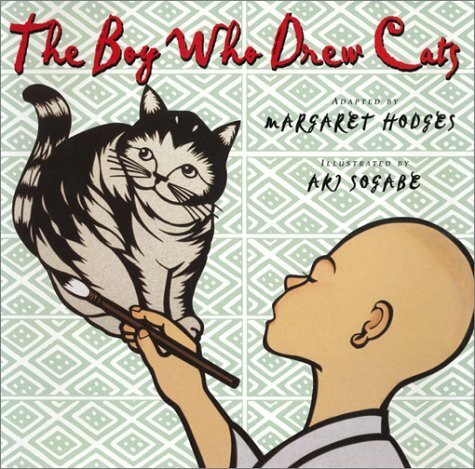
Margaret Hodges adapts and Aki Sogabe illustrates the story of 15th-century artist Sesshu Toyo from Lafcadio Hearn's Japanese Fairy Tales.
Sesshu Toyo's drawings were so realistic that they were said to come to life. This story tells of his childhood, when he was constantly in trouble for drawing on surfaces that he shouldn't have. Afraid of being punished, he hid in a temple that had been taken over by demons. When the demons came to eat him as he slept, his drawings of cats came to life and slew them.
I learned about this Japanese folktale from the book Wild Things by Clay Carmichael. This is a story about a Japanese boy who is the youngest boy in his large family. Because he isn’t physically built for farm work like the rest of his family, his parents decide to have him apprentice to the town’s priest so that he might become a priest one day.
However, the boy has an odd desire to draw cats all of the time. When he’s at the temple, he draws cats everywhere—enough to make the priest tell him that he would be better off as an artist—so he gets sent away. Before the boy leaves, the priest tells him to remember to not sleep in big spaces—to only sleep in small spaces. The boy doesn’t understand, but doesn’t ask the priest to clarify.
Rather than go home and shame his family, the boy decides to go to the temple in the next town. When he arrives, it appears as though no one is there. While waiting for someone to arrive so that he could ask to be apprenticed to one of them, he finds some ink and draws cats all over. When it gets late and the boy grows tired, he remembers the priest’s words and decides to sleep in a small cabinet.
During the night, the boy wakes to the awful sounds of screaming and fighting. Terrified, he stays still in his cabinet and doesn’t even peek through the crack until daytime. When finally does, he sees the dead and mutilated body of some sort of huge goblin. The boy wonders who could have killed this evil being until he looks around and sees that all of the mouths of the cats he had drawn are red with blood.
He then understood the priest’s advice…and was able to grow up to be a famous artist!
Just to be clear, Margaret Hodges has done the adaption from the Lafcadio Hearn retelling. The fairytale has been retold by many, but in English most refer back to Hearn. The collaboration between story telling and illustration seems to inspire many. The illustrations by Aki sogabe are colorful, large, and well suited to a shared reading.
This legend, or more likely fairytale, is based on the 15th century Japanese artist Sesshu Toyo. His ink drawings were said to be so realistic they would spring to life. Lafcadio Hearn was the son of a Greek mother and Irish father, who fell in Love with the culture of Ancient Japan. He wrote and taught in Japan and won fame with his retellings of tales and legends learned from his Japanese wife and friends.
From shapeshifters to demonic corpse eaters, supernatural cats have roamed for centuries in the country’s folklore. I discovered this when I went to look for Toyo and discovered lots of cats - but not so many dogs? If you want art depicting cats, evidently this is the culture into. It is after all the home to Hello Kitty. Is it not?
I discovered the tale in Celeste Ng's book Our Missing Hearts where it is central to the mystery and connection to her missing son. I learned more about when I started reading Kwaidan, by Lafcadio Hearn when I went out looking for more of his retellings. Turns out there are many covers (like in a cover of a good song) - which is also a play on words. Ng's book would have meant more to me if I'd read this little picture book first. Who knows it may have disrupted the pacing of her mystery.
It's an interesting tale as it's actually full of quite a few fearful things - but also, mythically and realistically what children go through growing up; leaving the family, being less than others, being in the world alone, find a safe place to be, being frightened by the unknown -- Of course what makes the tale delightful is the outcome. Mainly the child gets to do what he wants to do, what he's good at, he learns to protect himself, heed guidance, and see evil overcome, removing fear. Perhaps this was the world of Sesshu Toyo - but just as easily any child with an artistic temperament - or any child.
And how does this happen? How are the demons overpowered? Well you can see the red on all nose, whiskers, mouths of the black and white illustrations of cats.
This book was imaginative and creative. Diversity was present, allowing children to be introduced to a culture they may not be familiar with. Other lessons are present as well, such as following your heart. The pages include paragraphs and the story line unfolds neatly. More literary devices could be implemented to make the vocabulary more fun. The story is a young boy who lives in a village. He loves to draw cats. His parents want him to become a priest, so he goes to visit one. He decides to take another path. He ends up in big trouble, where his drawing of cats ultimately save him. This book is good for keeping a child's attention and showing them to follow their dreams no matter how crazy they seem.
A long, long time ago, in a small country-village in Japan, there lived a poor farmer and his wife, who were very good people.
The author Lafcadio Hearn lived in Japan and collected (and translated) traditional Japanese folk tales. In this one, the youngest son was not a good farm worker, so was sent off to become a priest. But all he wanted to do was draw cats. That was his talent, and his passion.
When the priest has had enough he sends the boy away, with these mysterious words of advice: "Avoid large places at night — keep to small!"
This is a story based off of a legend of the artist, Sesshu Toyo, who drew ink drawings that were so realistic they'd "spring to life." It tells about a young boy who was to become a Japanese priest but he loved art, and would later become an artist. The author retold this story based off of a legend by Lafcadio Hearn, who learned it from his Japanese wife.
This was my son’s first foray into Japanese folklore. A clever, budding artist with impulse control gets to be a hero when he accidentally kills a goblin.
My two year old relished the scary bits with the goblin, although I found it rather creepy. “The cats mouths were red and wet with blood.”
Wasn’t really anything I liked about this book. I suppose educational value in the legend of the famous fifteenth century Japanese artist, Sesshu Toyo. Illustrations were ok, but story wasn’t one I’d care to reread. Disobedient little boy, scary monster, no valuable lessons, no entertaining storyline that you want to revisit… not the kind of book I look to add to my library.
Apparently based on a Japanese folktale, the story of a boy who drew cats (somewhat compulsively!) that were so realistic they seemed to come to life - and in the story, maybe the drawings *did* come to life to save the boy from a monster . . .
I liked the story, and so did my son, but . . . surprise! It had quite a lot of blood in it towards the end. Definitely not recommended for sensitive children.
The Boy Who Drew Cats is adapted from Lafcadio Hearn’s Japanese Fairy Tales, the story was originally published as a pamphlet in Tokyo by Takejiro Hasegawa. It is based on a legend of Sesshu Toyo, a Japanese artist from the fifteenth-century.
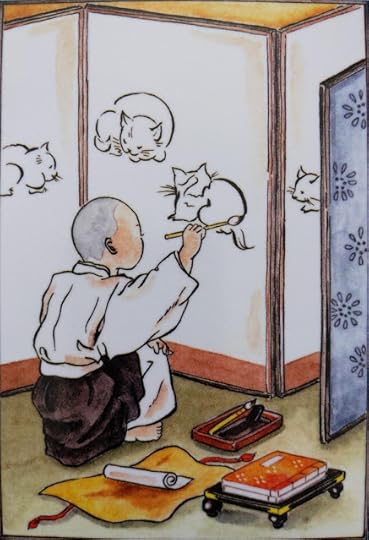
In a small country village in Japan, a young boy lives with his family of farmers. As all his siblings help out in their own roles at the farm, he is very clever but weaker and smaller than his brother and not likely to be fit for hard farm work. Brought to the village temple by his family, the boy begins his life and education for priesthood. Though clever and quick to learn all he was being taught, the boy developed a habit or drawing cats at any opportunity he had, all over everything.
Despite warnings, the boy continued drawing all over the temple and everything else, eventually leading to the priest to force him out of the temple, telling him he would never be a good priest but a good artist. The priest gives him one piece of advice, and the boy packs up and leaves the temple and village. After some travel, during one night something terrifying happens to which the boy is saved by the priest’s advice and his cat drawings.
The story is interesting, though very straightforward as many legends and folklore may be. The saving feature lies in the artwork which I enjoyed greatly; the backgrounds, details like the candle flame, and of course the abundance of cats on nearly every page.
The Boy who Drew Cats is about a clever but tiny little boy that had a passion for drawing cats. Due to his size his parents sent him to become a priest. Throughout the story, the clever little boy faces many challenges but by the end of the story his passion for drawing cats sizes not only himself but the city. I enjoyed the book and found it very entertaining. I could relate to the story because growing up I was not the most popular student but I stuck to what I enjoyed doing and it eventually played in my favor. I love that the book teaches students that it is okay to be yourself because children are so influential.
This book would serve as a great read aloud or independent read for students in 3rd through 5th grade. I could use this book in story time during a day when a child is having a rough time fitting in or doesn't understand why they "unusual" talents matter. This book would allow the students to understand that everyone has a purpose and matters. I could also use this book during a lesson plan where I am teaching my students about culture and diversity. The illustrations are vivid and accurate to the Japanese culture, as well as vocabulary ingrained throughout the story.
I randomly came across this book at the library and decided to read it before I left. The artwork was very nice, and I think it embodied the traditional Japanese style nicely without becoming inaccessible to children. The story, on the other hand, was intriguing, especially since I don't read stories based on old Japanese folk tales as much as I would like to; however, it left me kind of cold in the end. I know the intended audience is for children, but I felt like nothing was really explained. The boy just liked obsessively drawing cats on the wall and magical stuff just happened because... Japan? I don't know, I just like closure - cause and effect in my stories.
Still, I'm sure any non-adult would probably enjoy this with zero of the qualms I had. I would like to mention, like all old school stories, it had a little violent bit towards the end. Nothing shown in the artwork though. But, in closing: pretty good story, very nice art; just a little simplistic for me.
A good story to read when your Japanese culture storytime for ages 5-10 ends up being attended by junior highers instead!
This is a version of one of the first Japanese stories I ever read, from my parents' small book of Japanese Fairy Tales. When, as a little girl, I saw that book on their shelf, I thought to myself, "Fairy tales are for children! That must be a book for me!" I will never forget reading the story for the first time. It's pretty scary!
This version isn't too graphic as far as illustrations go, but it's still a bit of a spooky story!