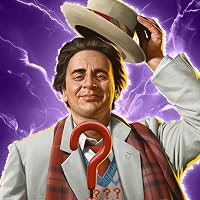
Following a spot of uncharacteristic intoxication, the Doctor wakes to discover that the Tardis has materialized in the service ducting of the Vipod Mor, a huge craft which is itself floating in deep space. Furthermore, the console has detected Time spillage: someone or something is tampering with Time. Featuring Colin Baker, Nicola Bryant and Valentine Dyall.
Eric Saward worked as a writer and later script editor for Doctor Who during the 1980s.
Saward had a particular fondness for the Cybermen. He wrote stories with good action throughout them and stories that connected the Doctor to important events in Earth's history.
He also wrote the short story Birth of a Renegade and the radio play Slipback.
He served as script editor from Time-Flight, the last episode of season 19, to the penultimate episode of season 23 (The Ultimate Foe episode 1). He resigned his position due to a disagreement with producer John Nathan-Turner over the storyline (and particularly the ending) of episode 2 of The Ultimate Foe. Afterwards, he gave a notably scathing interview to Starburst magazine over his falling out with Nathan-Turner, and he became vocal in his criticism of Colin Baker's appointment as the Sixth Doctor.
Target Books failed to secure an agreement that would have seen Saward's two Daleks serials novelised either by Saward himself or by others, with Saward only novelising both of his Dalek stories in 2019. The 1989 publication of Saward's adaptation of Attack of the Cybermen actually post-dated his falling out with the Doctor Who production team by several years. His favourite snack is a chocolate hobnob
The soundscape really does feel dated in this, and the story could be better. I guess this is what kept fans fed during the hiatus in 1985. Really puts into perspective how lucky we are to have Big Finish’s output.
http://nwhyte.livejournal.com/1339629.html[return][return]There is a minor character in this novel who is an unsuccessful author:[return][return]'When Horace's book was finally published, it was viciously attacked by the critics. This was sad, as no-one had been able to disprove anything he had written. It was even sadder that the critics, blinded by their own prejudice, could not see the energy, grace and skill that had gone into the book's construction. Even if, as they believed, every word was untrue, they chose to ignore the incredible flights of imagination necessary to argue such a theory. But worse still - as they were supposedly people of education and letters - they could not see or appreciate the pure, good writing which was on the page. Although the book sold well, it was bought for all the wrong reasons. People would memorise passages from it, then regurgitate them at drinks parties, laughing. like blocked drains as they did. It had become chic to mock Horace. Unable to cope with the ridicule, Horace retired into obscurity. Two years later he died of a broken heart.'[return][return]It's tempting to interpret this as Eric Saward justifying himself: a misunderstood and underappreciated genius, the quality of whose work will be apparent to the ages though not to the contemporary critic. Given everything else I know about Saward, actually, I am pretty convinced. Doctor Who - Slipback is a desperate attempt to channel Douglas Adams, even more desperate than the radio series on which it was based. Planets and people have comical names and bizarre characteristics; and threats to the universe are both gruesome and bathetic. I think this actually is a worse book than Saward's novelisation of The Twin Dilemma, though I'm not rereading it in order to form a more precise judgement. Certainly neither is interesting enough in their awfulness to be worth memorising and regurgitating at drinks parties. [return][return]Douglas Adams did it much better, not just because his prose style in general was vastly superior to Saward's but also because he had a coherent sense of world-building, both for his own fiction and for the Who stories he wrote; and his humour was self-deprecating rather than defensive.
(Note: I'm reviewing the original Audio Drama, not the novelization of said audio drama.) Slipback is an odd beast. Written by then-script editor Eric Saward, starring Colin Baker and Nicola Bryant as the Sixth Doctor and Peri respectively, and released as part of a kids radio program during the 'hiatus' between Seasons 22 and 23, this isn't that good. Made up of six ten minute episodes, the story sees the Doctor and Peri arrive on a spaceship where someone is experimenting with time. Colin and Nicola are fine, however, the story is just kinda boring with a captain who can create and release viruses when he's angry, a schitzophrenic ship's computer, an art thief and a revelation that the ship will cause the big bang. At the time, it was probably enjoyed as it was new Doctor Who when there wasn't any on TV. Now however, it just doesn't stand up to the superior story-telling that we get from Big Finish. It doesn't help that Saward isn't the best writer Who has ever had. It's not un-listenable, and as a historical curiousity it's interesting, but it's not worth re-listening to. Mercifully, it's short. So check it out for historical curiosity, but don't expect much out of it.
First broadcast in July to August 1985 - So this was produced in the hiatus between the two seasons starring Colin Baker, who reprises his role as The (Sixth) Doctor. And with Nicola Bryant appearing as Peri this really does feel like a “canon” story for Doctor Who. Unfortunately, that’s about all the good I saw about it. It certainly feels just like the episodes from that era and, as that is probably the era I find the least entertaining, it really doesn’t hold up for this particular narrative. This is 6-episodes long and around an hour in total length, so for 10-minute episode, this story really drags. So unfortunately, this story keeps all the faults of Doctor Who and loses all the charm.
I thought that was a brilliantly bizarre adventure. Having had to put down Saward's novelization of the Twin Dilemma half way through as I found it gruelling, I'm pleasantly surprised at this. I read people here calling Saward here a second rate Douglas Adams, and while there's obvious similarities to the train of thought style of writing and chimeric humour, Slipback is a more concise and digestible tale than that which was spun from the head of Adams. I enjoyed the supporting cast and found them memorable characters. However, Peri and the Doctor were written quite generically, I felt. Both personalities of the main characters felt swamped under the story. It was a great read though and I think it's an unsung gem in fandom.
Slipback is a boring, drawn out story, which is a feat at only 1 hour. The plot is an overlong drudge, that honestly could have been told in 20 minutes. There is no sense of actual characters, except for one 'person'. The quality of the recoding is good considering its age. Really, this is for completist only.
Read the Target novelisation of this, not much happens. Saward seems to have decided that to do Dr Who on radio 4 it has to be very similar to the Hitch Hiker's Guide to the Galaxy, unfortunately this doesn't really work with its thin plot and lack of interesting characters.
This had an element of Douglas Adams to it. Slightly surreal. However it's still a fun story with key Doctor Who motifs. Much lighter than many of the sixth Doctor's stories.
Between a 2 and a 3 for me. An enjoyable enough read, with some interesting ideas and themes in here (though looks to contradict Terminus), but something of a Doctor lite story really, as the first third of the books doesn't feature the Doctor or Peri at all, instead looking to expand on backstory for some of the characters and current state. Tries to evoke the Douglas Adams' style of humour, but not as successfully - yes some of it is somewhat amusing, but doesn't combine / interweave nicely like Adams generally achieved, or have it's own internal logic either really - with some of the backstory as such not really going anywhere either. Due to the backstory side of things, the one off characters are quite well fleshed out, and do make you care about what happens to them, but at times the violence gets somewhat gratuitous (continuing on from some of the Sixth Doctor's first season), which I didn't enjoy. Overall though, feels like it was quite padded out - that without all the backstory and fleshing out of character thoughts etc, there isn't actually that much of a story here, even if it does have a good twist at the end, but if more barebones like some Target books, likely could have been done in less than 50 pages. Still, an interesting read and not too bad :)
Slipback captures much of the Sixth Doctor zeitgeist but also attempts a Hitchhiker’s-style humour, which entirely fails to land. Valentine Dyall is given no interaction. The plot strands are barely developed (yet shamelessly rehashed). Hardly an advertisement for a programme on hiatus.
To go from Revelation of the Daleks - my second favourite Doctor Who episode of all time - to this absolute stinker is such a cataclysmic fall from grace for Eric Saward. This is literally the equivalent of being trapped in a corner against your will with the most painfully unfunny and awkward comedian in the entire world, yet has such a smug and self-deluded grandeur to think that he’s the modern-day equivalent to William Shakespeare and Albert Einstein combined. Saward may be a fit for gritty action blockbusters but when it comes to comedy he comes off as incredibly mean-spirited and patronising to the audience (and judging from his 2019 Dalek novelisations, his prose is just as condescending and shoddily-written), and what’s worse is that this is the most incompetently-plotted and written script ever written for Who; you’d think he had never actually constructed a story let alone be an editor for them! It’s only an hour long which is a saving grace but it’s still a deeply unpleasant hour.