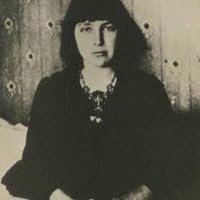
I am, beginning on Christmas, 2020, to read the complete poems, book by book, of the great Russian poet Anna Akhmatova, whom I knew as a poet when I was young but really delved into when I went to Russia in 1991 with a group of high school students for a kind of writing/cultural exchange. We took the train from Moscow to Leningrad for a couple days, visited many of the key tourist attractions, but one thing I did to prepare for this was to read the poetry of Akhmatova, paying particular attention to her war poetry, specifically her poetry of WWII, focused on the siege of Leningrad.
The trip included a visit to the Piskaryovskoye Memorial Cemetery and two or three Russian Orthodox Cathedrals, all of which was very memorable and moving for me., in part I suppose because we visited there on Easter. Of her poetry, Akhmatova said, “I never stopped writing poems. In them is the link with time, with the new life of my people. When I wrote them, I believed in the resounding rhythms reflected in the heroic history of my country.”
Evening is the first book the young Akhmatova published, in 1911, at the age of 22, but it was both critically and popularly received. The focus in these poems is love, though other subjects are included, of course, such as nature, but it is tempting to see the work as emerging out of her tempestuous, tumultuous relationship with her first husband, Nikolay Gumilyov. It’s a book about what she called “meetings,” by which she meant emotional encounters, and a range of emotions we associate with love. The critic Korney Chukovsky said that a couple generations of Russians grew up and fell in love to the accompaniment of her poetry.
“I’m carrying a bouquet of white gillyflowers.
In them there’s a secret, latent flame for the one
Who, taking the blossoms from my timid hands,
Will touch my warm palm.”
“The blood beats ever stronger
In a body wounded by desire.”
“First as a serpent, it’ll cast its spell
Next to your heart, curled up.
Then it’ll come as a dove as well,
Cooing for days nonstop.”
And of jealousy?
“I keep the candle burning in my window til dawn
And I don’t long for anyone
But I don’t want, don’t want, don’t want
To know how they kiss.”
“He loved three things in life:
Evensong, white peacocks
And old maps of America.
He hated it when children cried
He hated tea with raspberry jam
And women’s hysterics
. . . And I was his wife.”
The Complete Poems was translated by Judith Hemschemeyer, who devoted seventeen years of her life to the unenviable task of taking her rich lyrical Russian language and conveying it into the more prosaic English. But this is now the definitive Russian to English edition. I can't read the original (though I have two record albums of her reading her own work that were given to me as gifts when I was there that are priceless, amazing), but the poetry is terrific.
Of these early poems Akhmatova was to write: “These naïve poems by a frivolous girl for some reason were reprinted thirteen times [...] And they came out in several translations. The girl herself (as far as I recall) did not foresee such a fate for them and used to hide the issues of the journals in which they were first published under the sofa cushions."