Le soleil bleu s’était déjà perdu derrière les montagnes du couchant. Le soleil rouge penche aussi vers ce point, tombeau de toutes les lumières des cieux. Pour cette terre, pour ces lieux toujours ruisselants de clarté, c’était presque la nuit, mais la nuit douce, tropicale et chatoyante. Si vous levez les yeux au ciel, peut-être apercevrez-vous du côté de la constellation de Cassiopée, un étrange scintillement... la planète Star... Voici le premier véritable space opera , tombé dans l’oubli et redécouvert par Raymond Queneau, un livre total qui présente l’ensemble de l’univers starien : son système stellaire, sa faune et sa flore, ses satellites, son histoire ancienne et celle de ses civilisations, ravagées par une forme de peste et par des égorgeurs fanatiques. Grâce à l’invention de l’abare, un vaisseau spatial, et sous la conduite de Ramzuel, les Stariens quittent alors la planète mère pour ses satellites. De leur exploration naît la recolonisation de Star menée par les Néo-Stariens et le voyage d’un Tassulien (habitant de l’un des satellites de Star) dans la ville de Tasbar. Le tout est entrecoupé de pièces de la littérature starienne qui forment un ensemble poétique et théâtral extraterrestre inédit. L’histoire d’une planète sur laquelle brillent quatre soleils, de ses cinq satellites et de leurs habitants, de vaisseaux voyageant entre ces astres, de civilisations qui naissent, se développent, meurent, renaissent, fondant une fédération interplanétaire et créant une culture et une littérature extra-terrestres. Star ou ψ de Cassiopée est une œuvre étrange, poétique et protéiforme, un voyage onirique vers un monde lointain.
Charlemagne Ischir Defontenay, born in 1841 and died in 1856, was a French writer and surgeon. Bachelor in literature in 1839 and science in 1841, he became a doctor in Saint-Germain en Laye then in Les Andelys, and in Les Thilliers-en-Vexin.
A renowned surgeon, he is often considered one of the pioneers of plastic surgery. He wrote essays on this subject under the pseudonym "Dr Cid". He was also interested in tuberculosis.
It is a strange book which is worth to him to be known today, Star or Ψ of Cassiopée (1854), which observes the fauna and the flora of another planet, considered as one of the pioneer works of science fiction . It was rediscovered and admired in the twentieth century by Raymond Queneau.
I've seen this 1854 novel described as a 'forgotten classic' of French science-fiction. I think it may be more accurately described as an 'intriguing curiosity'.
The introduction consists of a series of poems describing how the narrator acquired a set of writings from a planet orbiting the star Psi Cassiopeia. What follows are ostensibly translations of those texts, which recount the history of the planet (whose name, curiously, is “Star”) and its people (called “Starrians”). Extensive attention is given to matters of art, culture, religion and literature. Examples of Starrian poetry are provided, including two complete one-act plays.
There aren't really characters in “Star” (cf. some of Olaf Stapledon's books). There is, however, a story arc that plays out in Starrian history involving a plague that gives rise to a self-genocide cult, the escape of a handful of Starrians to the planet's moons, and their descendants' eventual return to Star, to reclaim it and establish a utopian civilization devoted to art, humanistic religion, and everything beautiful, good, and true.
Or so it seems on the surface. There's a not-so-subltle subtext in the novel about a second species of intellligent beings who live on Star, a servant-race to the Starrians. The relationship between the two is supposedly like that of “horses to humans” and the servant race loves its status. Amazingly, this species ruled the planet for many generations following the Starrian departure, but upon the return of the Starrians, they recognized the superiority of their former masters, gave up rule, and resumed their servile status. Or at least, that's what the history of the ruling Starrians says about it...
Overall, I found this an enjoyable mixture of science fiction and fantasy, tragedy and satire, prose and poetry, and loved the heavy doses of 19th Romanticism, exoticism, symbolism, and aestheticism. (I can think of few-- if any-- other books that invite comparison, at one and the same time to Stapledon, Tolkien, Poe, Verlaine, and Gautier.)
Overall, I can't honest say that I think that “Star” is a great book-- or a must-read-- even for sci-fi fans. But it was quirky, offbeat, and definitely memorable.
Je peine encore à croire que ce space opera fut publié en 1854 pour être honnête!
Récit de l'évolution civilisationnel de plusieurs races sur une distante planète nommée Star, on lit le récit historique des premières civilisations de la planète, leurs évolutions, les guerres qui sont portées, l'apocalypse qui survient, la survivance de quelques êtres, la colonisation des satellites (tous avec leurs propres faunes, flores et particularités), etc.
Le tout dans des formes très différentes: on alterne entre le récit historique, les vers poétiques, les fragments, le récit d'explorateur, le théâtre! et il y a même une carte astrale!!!! Autant de genres littéraires divers qui commentent ou montrent la pluralité des possibles (technologiques, artistiques) des civilisations stariennes. Le récit est fascinant et date à peine lors de sa lecture à l'exception un peu du style et du langage (et lors de ce passage: "Ils sont semblables à nous mêmes... Ce sont bien là les mortels que nous connaissons. Là, comme partout, l'homme est l'homme ; la nature jusqu'alors n'a rien produit de plus parfait").
Il y en a pour tous les goûts: récits épiques, plusieurs races (dont une race d'immortel·les) avec leurs caractéristiques distinctes et des conflits et alliances entre-eux, des explorations spatiales (comme si le récit de Star n'était pas déjà suffisant!), des espèces avec des compositions genrées divers, des extraits de la production culturelle de Star, etc. Même si tel ou tel passage peut être un peu moins intéressant pour son lectorat (je dois avouer que la dernière pièce de théâtre m'a particulièrement ennuyé personnellement), on ne reste jamais très longtemps sur les mêmes thèmes, genres et lieux donc on ressort toujours très excité de découvrir de nouvelles choses.
Un roman qui devrait définitivement être lu par tous les fans de space opera et d'hybridité générique. Il y a tellement de choses à découvrir, à lire, à analyser. Si le portrait n'est toujours pas très clair du livre, imaginez Re: Colonised Planet 5, Shikasta en beaucoup plus excitant et convoquant plus de formes littéraires (et plus court!).
This translated French book basically gives us the history of the fictional alien world 'Star'. Amazingly, it was written in the mid-1700s, but feels like a contempary of Verne and Wells.
It's not really a novel, more of a history book of a fictional place, so it does get a bit dry when presenting its facts. Luckily, the facts are interesting enough and the author has created such a well thought out world that you are willing to forgive the occasional boring part. There is a geography of the planetary system and a history of its many races, as well as examples of plays and poetry of the world.
Some of the science is a bit iffy and you do wish historical persons were more fleshed out, but the 'Star' system is a fantastic setting and the various snippets of 'Starian' culture really draw you in.
Shame no one has every done a sequel or used this 'history book' to write a novel set on 'Star'.
Imagine a world bathed in the light of five suns, where shrubs fly like birds and nuts swing from trees like pendulums. In the nineteenth century the French surgeon Charlemagne Ischir Defontenay did just that. Using the conceit of a fictional collection of alien documents found in the Himalayas, Defontenay traces an intricate history of a distant solar system across millenia, through the rise of nations, the development of space-faring technology, first contact between exotic worlds and the final blossoming of a wonderful alien civilization. Readers will delight at the inclusion of examples from this foreign culture, such as play extracts, prose poems and even myths.
The 1854 French original was titled Star ou Psi de Cassiopee: Histoire Merveilleuse de l’un des Mondes de l’Espace. Google translates this to Star or Psi Cassiopee : a History of the Wonderful Worlds of Space. I read the 1975 Daw edition, which changed the title to STAR (Cassiopeia). A shout and a whisper of a title, but an understandable decision as the main planet of the book is referred to by its inhabitants as Star. I should also mention that the Daw edition was translated by P. J. Sokolowski, who did a great job from what I can see.
If I were pitching this to a sci-fi fan, I’d describe it as somewhere between Tolkien’s Silmarillion and Olaf Stapledon’s Last And First Men. Star is a verdant world that would be capable of assimilating a hobbit or two, and the Starian’s obsession with beauty is downright Elvish at times. They also fly through space in these spheres called abares, which Defontenay describes as being stocked with supplies like food and air, and encounter imaginatively bizarre humanoids. My favourite are the near-invulnerable inhabitants of the gloomy globe of Rudar, who fear only the lethal floating orbs they call death. The totally transparent world of Elier was another memorable moment. All this wonder, along with Star‘s long timescale, make the novel a worthy predecessor to Stapledon and to a lesser extent Tolkien.
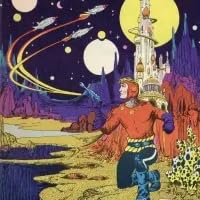
Star‘s biggest flaw is racism. You see this on the cover, the slim blonde woman being served by the blue slumping figure. This figure represents the repleus, the humanoid species enslaved by the Starians. Only Defontenay doesn’t use terms like enslave, he uses terms like domesticate. An extinction event gives the repleus an opportunity to build their own civilization, a culture described by the author only in the most insulting and animalistic of terms. Every time a repleu appears Star reads like Norman Spinrad’s The Iron Dream. I’m not entirely sure what France was doing in 1854, I’m guessing they had colonies in northern Africa and south east Asia, but no amount of historical context could make Defontenay’s glowing praise for the enslavement of an intelligent species palatable for the modern reader. As I see it, the only way in which Star‘s racism could be redeemed would be if a modern sequel contested that the fictional documents mentioned by Defontenay were written by the Starian version of the Ku Klux Klan. I’m not sure if it would be worth it.
I recommend Star if you like stories about told on a massive timescale renders individuals almost invisible and turns cultures into characters. If you like reading about cool things that can only happen in prose, this might be for you I’d also only recommend it if you’re willing to overlook a lot of racism.
A truly remarkable novel – this French retelling of the rise and fall of civilisations on planets surrounding a distant star is indeed the first space opera. Like most other pre-Vernean French SF, "Star" was quickly forgotten. Going wholly against the grain of the religiously conservative bourgeois realism of the era, Defontenay's sprawling epic raises Darwinian ideas five years before the publication of the Origins of Species, unashamedly deals with sexual customs and functions among species that are certainly not found in any copy of the Bible, decries the evils of religion and ultimately raises up Man as the divine spark of the universe. The story begins as the narrator comes across a box inside a meteor containing strange manuscripts from a distant world, which he proceeds to recount to the reader. This is the story of the civilisation around the star Psi in the Cassiopeia. Included are descriptions of the rise and fall of civilisations, the biology and geography of its planets, first-hand accounts of their inhabitants' life in sprawling alien cities, examples of poetry and even a full theatrical play, which the narrator dutifully presents in its entirety.
The novelty of this book in 1854 cannot be expressed enough: at a time when most sci-fi simply used the moon or Mars as a "utopian mirror image" of Paris or London, Defontenay paints worlds made up of translucent crystal, 9-foot tall, blue immortal humanoids, humans who are half plants, anti-gravity spaceships, interplanetary warfare, space romance and even gives the star system its own Homerian mythology. One cannot claim this to be "influential" on either Burroughs or Olaf Stapledon, whose epic future histories the novel mostly resembles, simply because it was completely forgotten until 1975, when it was dug out of oblivion by P J Sokolowsky and translated into English – at this point only two French copies of the novel were known to exist. The cover in the image is from the 1975 original English edition.
simultaneously incredibly ahead of its time as well as being very much a product of the era - on one hand, it almost reads like something from the 1950s. a multigenre work purposed to be a history of an alien civilization (with commentary), interleaved by several cultural artifacts of this civilization, including two one act dramas, a "historical poem in verse", as well as a great deal of poetry. in addition to the framing, lots of concepts are explored here that frequently come up in science fiction - explorations of exobiology, alien geography, multisolar star systems, interplanetary travel in a pressurized, spacecraft that runs on an antigravity drive, which all presented as scientific speculation, rather than trying to make a political point. and yet, on the other hand, the political overtones who do exist in the novel are a love letter to french colonial arrogance and scientific racism, portraying the starian people as beneficent colonizers who bring civilization to the rest of the system, though interestingly enough is quite anti-authoritarian, and the final form of the enlightened starian empire isnt too far away from the idea of "property is theft"
Publié en 1854, Star est un roman de SF, partiellement en vers. Ce qu'on y lit est la traduction française de documents extraterrestres trouvé par le narrateur.
Il n'y a pas vraiment d'intrigue ni de personnages. On y relate l'histoire d'un peuple qui est devenu une fédération galactique, sur des milliers d'années. On y voit leurs différentes institutions politiques et religieuses qui évoluent au fil des ans. Une version génocidaire du Déluge. Une race extraterrestre hermaphrodite, une autre qui fonctionne en matriarcat (je me demande s'il s'agit du premier texte de SF à explorer les questions de genre).
On y parle de la primauté de la raison. De l'importance de limité la propriété en tant que droit. De mettre un plafond au profit que peuvent faire les gens. De l'autonomie personnelle/corporelle comme fondement de la propriété.
Le texte est aussi parsemé de poèmes et d'une pièce de théâtre courte, qui sont des textes extraterrestres qui ont été retrouvé permis le reste.
"In Star ou Psi de Cassiopée: Histoire merveilleuse de l’un des mondes de l’espace [Star, or Psi of Cassiopeia: marvellous history of one of the worlds of space] (1854), by the splendidly named French writer Charlemagne Ischir Defontenay, a case is discovered in the Himalayas which contains a wealth of information about the alien inhabitants of the planet Psi, which orbits three different-coloured suns in the constellation of Cassiopeia. Defontenay includes details of the alien physiognomy and society and samples from their literature, and indeed tends to overwhelm his readers with his inventiveness, making Star a rather exhausting book." -Adam Roberts, The History of Science Fiction
Un Space Opera... 100 avant la naissance du genre. Un beau jour, un explorateur trouve sur l'Himalaya des écrits inconnus originaires de la constellation de Cassiopée. L'auteur va nous décrire L Histoire, la spiritualité et la société de la planète Star.
Ce fut une belle trouvaille. Surtout en sachant que le roman a été écrit en 1854.
My favourite book ive read so far this year i think. Such a splendid way to reveal a society’s nature, philosophy, government, genealogy etc etc through these sweet, disconnected yet overlapping stories. I would love to live in this book, set myself free.
Primitive and lacking personality, but about 100 years ahead of its time. Reads more like what would come to be called science fiction than anything else I've encountered until the mid 1900s.