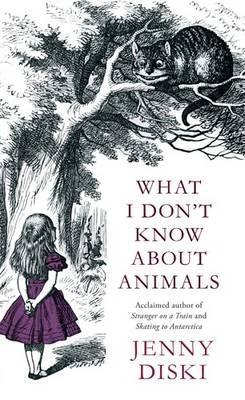
What does Jenny Diski know about animals? She's really not sure. There is, however, one thing of which she is our relationships with and attitudes to animals are really worth thinking about. In What I Don't Know About Animals, she shows why. She sets out to investigate what she does and doesn't know about animals. She remembers the stuffed cuddly creatures from her childhood; the animal books she read; the cartoons she watched; the strays she found; the animals who have lived and still live with her; the animals she has observed close up, and those she has feared. She examines human beings, too, and the way in which they have looked at, studied, treated and written about the non-human creatures with whom we share the planet. Subtle, intelligent and brilliantly observed, What I Don't Know About Animals is an engaging look at what it means to be human ? and what it means to be animal.
Jenny Diski was a British writer. Diski was a prolific writer of fiction and nonfiction articles, reviews and books. She was awarded the 2003 Thomas Cook Travel Book Award for Stranger on a Train: Daydreaming and Smoking around America With Interruptions.
2.5 stars. While this wasn't terrible it wasn't very interesting to be in the authors mind while she describes animals and what she doesn't know. It's rather a boring set or ramblings that doesn't highlight anything new thinking and I didn't like the process. Bit disappointed in this
I have read several of this author's books and always find them enjoyable and amusing. One learns more and more about her life, and although animals do feature in this book their presence is relevant.
Jacques Derrida was disturbed by the way his cat was apparently mesmerised by the sight of his naked body in the bathroom: the situation filled the philosopher with a sense of "an existence that refuses to be conceptualised". Jenny Diski, on the other hand, is convinced that it is simply that the cat wants to be let out: if a human closes a door, the cat will insist on being let through it.
Striking a cord with my own experience of living with my own cat, who likewise is totally transfixed, and almost disgusted by the sight of human nakedness, I was excited to read this book to discover what others thought of this phenomenon. Diski’s own experience comes from a cat called Bunty, who, just like my cat, refuses to let the human owner do any work- instead insists on meowing to be let in, and out, of doors for apparently no reason.
This book starts off fairly slowly – and it took my quite some time to try and decipher what the ‘point’ was, especially as Diski seems to speculate and never come to any conclusion. However, I was soon very much drawn into her style of writing and interested in her contradictory and confused musings on the nature of animals, and our relationships with them.
She starts by looking at her own childhood: a rescued baby bird, a family budgie, an endless supply of goldfish. Her recollections seem cold and matter-of-fact, "There was something quite alarming about him (budgie) flying free," she said, but when he flew out of a window, never to return, she found herself unmoved: "I may have cried, but I didn't really care."
Diski confronts our responsibilities to animals with a sense of conflict. She feels we should face honestly the ‘beingness’ of animals. The suffering we cause through abattoirs and battery farming is "a stupefying crime". She finds it hard to ride horses as she could not bring herself to be the master over any animals, however, she faces the fact that she cannot give up meat: in fact, the more militant and self righteous make her more obstinate about her cravings for flesh.
Diski brings together opinions and experiences by established scientists, wildlife experts and philosophers in her journey to discover more about our relationships with animals; and their relationships with us. She asks difficult questions – such as is it right for the scientist to cut the heads of baby chicks in order to maybe one day discover a cure for Alzheimers; who gives us the right to be lords over the ‘beasts’?
The questions she asks are hard hitting and unanswerable, but certainly worth pondering. Her book is a good read; funny and warm, and with a darker edge. It is also a hard-hitting moral argument which lets nobody off the hook, not even its author. She questions the way we anthropomorphosize animals; whether we are able to stop seeing animals without seeing them through our own experiences; and whether it is indeed ‘right’ to do it. This is an interesting question considering that women and men don’t even communicate with the same language, and we are the same species. How are we supposed to know what a different species is thinking?
Diski’s best writing though certainly comes when she observes her own cat, Bunty. This is where I know exactly where she is coming from. I disagree with her assertion that cats cannot have facial expressions (I know exactly when my cat is playful, angry or desperate for a wee – and that is in her eyes, not just the manic swish of a tail), but I know exactly what she means when she says that although we assume animals cannot speak, they simply might be speaking a different language.
“Sometimes when I look at her she stares at me so intently that I really do expect her to finally say what she has to say. Or she is saying it….and simply looks at me thinking, ‘How stupid is this human…It’s hopeless trying to communicate with it.’”
An interesting read... as other reviewers have noted, the utter lack of structure in this book would have sunk it, if it were in the hands of a less capable writer. Diski is very skilled, and so it remains a thought-provoking and wide-ranging reflection on humans' (or at least Diski's) relationship to animals.
But jeez, she really doesn't get it. -- and, as the title suggests, she knows. 300 pages, and she doesn't talk about caring once. The entire thing is about 'otherness,' which I admit is an inescapable part of relating to nonhumans (and humans too for that matter). But it can't be all there is. Her exchange of blank expressions with her cat and wondering if there's anything there becomes the paradigm for all animal encounters in this book, and while she goes to some very interesting places -- the ethics of meat; a nice critique of reductionist sociobiology and evolutionary psych; the politics of animal trainers -- she never comes close to really talking about being with animals. She never talks about caring, about love, about the feeling of putting oneself out for someone or something you care for. Her approach to ethics is really about her wondering if it's ultimately alright that we're using animals for our own benefit, and she ultimately refuses to answer this question, denying all the various possible answers as all too simple. That's well and good, but it leaves her firmly in her own solipsistic universe, staring blankly in to the blank face of her cat (horse, lamb, elephant, etc. etc.).
I liked a lot of this book as I was going through, but upon finishing it, I can't help thinking this is ultimately about the "me" generation's inability to think beyond themselves.
I think this book is way underrated. I loved it. Jenny Diski is an amazing writer and deserves more attention than I think she's receiving. The only part I didn't like was her pages of contemplating whether or not people should raise animals to eat because ultimately they suffer in the process. She kept offering up the vegan question which was kind of annoying. Humans are omnivores. Whether or not we should raise them is a different question but it's kind of too late to ask it. But all of the stuff about anthropomorphism I loved and her stories about the London Zoo. I thought she really contributed a lot to a real discussion about human relationship with non-human animals. Highly recommend it.
I picked this up in the discount bin of a bookstore in Amsterdam, and what a great gamble! But, just like the author, who didn't really know anything about animals before writing this book and still doesn't, we as readers also don't get a real conclusion. And that's unfortunate! It's a book with great stories, but it lacks structure.
What a fascinating book. It was slow going, partly because the writing is a bit stilted but mostly because I kept having to put it down to digest. It does contain some lamentable grammar. I can excuse the weirdly-meandering sentence fragments as a style choice, but published books should not have issues with noun/verb agreement. I hope an editor was fired, somewhere. It was worth it, though, slogging through all that. Very interesting stuff.
I bought this at a book fair a few years ago, because I thought it was an autobiography (which, FYI, it's not, at all). I read about three chapters a year ago,got bored, and then picked it up again last week, intending to start it again and actually finish it this time. That's not a good sign- I love to be gripped by novels, to be sucked in completely, to devour them in one go. But this isn't a novel, so it's unfair to ask the same of it. In fact, it's not even close to a novel, nor an autobiography- it's a non-fiction collection of essays about animals, and ourselves.
I found this exploration dense, but intriguing- as a vegetarian and animal-lover, I was probably the easiest and most agreeable consumer of this information, with one of the repeated themes in the book being of what we learn about ourselves through our treatment of animals. There were segments here I found more interesting than others. Once I settled down for what I learned would be a more educational than imaginative experience, I enjoyed best the animals-and-madness chapter, which runs us through zoo's, science labs, and a mental hospital- exploring living things that don't resemble us (such as internal parasites or spiders) and how they contribute to our neuroses. As such, this chapter is aptly name "Under Our Skin". Crazy cat ladies and hoarders are also discussed here, and this chapter contains some of the authors more generous confessions. I also liked the discussions into traditional and factory farming, as well as the conversations on vegetarianism and veganism, and how one can eat meat while still having animal companions.
Overall, I liked this book, but didn't love it- purely because I'm not a huge non-fiction reader (it reminds me too much of the endless, rambling university readings I was required to do for three years). If there's anything I went away with it's that the title is misleading- Jenny Diski certainly knows ALOT about animals.
Bunty the cat is looking at her. Why is he looking? What does he want? Jenny Diski doesn’t know. She will probably never know. But somehow, an idea of writing a book about what she doesn’t know about animals enters her mind. Maybe that reaction was just what Bunty wanted.
In What I Don't Know about Animals Jenny Diski is exploring the impossible relationship between humans and animals. Can we ever understand eachother without a common language? How is their perception of reality compared to ours? And how should we live to avoid restringing their rights as living beings?
It’s indeed a complicated relationship, at least for JD. She writes about all her experiences with animals as a “post-domesticated” human being, i.e. visits to the zoo, and a number of pet cats. As a part of the research for the book, she also exposes herself to uncomfortable situations which involve interactions between humans and animals. She takes riding lessons, visits a medical research laboratory where chickens are killed, visits a farm during the lambing period, and tries therapy to cure her fear of spiders.
JD is mostly known for her books about travelling. What I don’t know about animals is also a sort of unstructured travel book. Good and bad hands-on experiences are mixed with theoretical, philosophical, and moral discussions. The result is often uneven, as the reader is thrown between subjects of which both JD and the average reader have little or no knowledge about.
I always get a little impatient when reading books like this one. There are many questions, but very few answers. JD probably liked animals more than humans, just because she didn’t have to understand them or speak to them.
This is an odd book because while it's definitely written for people who enjoy thinking about animals -- I'd even venture to say people who like animals -- Diski's not really an animal lover at all. But her train of thought about the ways in which we relate to animals (or the way she does, at any rate) is interesting to follow. She works her way through a few big touchstones: childhood and the whole epistemology of Dr. Doolittle, zoos, and wildlife shows, through the adult considerations of man's dominion over the animal kingdom, animal testing, eating meat. It's more an exploration than manifesto, but seeing as it dovetails with my own interests I enjoyed trekking along with her.
I thought this book took a brilliant look into human connection with animals and anthropomorphism. It brought up concepts that I had never considered before. I am only left unsatisfied with her contemplation of veganism and the idea that veganism will not end suffering of animals raised for meat... I think there is much left to that conversation. Otherwise, a fantastic read! I especially loved her experiences on the goat farm.
Me gusta la escritura de Diski y su aproximación al ensayo. El libro tiene partes geniales, pero finalmente el tema central no es algo que me provoque demasiada reflexión y terminó volviéndoseme un poco repetitivo.
This was disappointing. There are many good, well-written, and thoughtful books on animals, animal rights, and human responsibilities to animals and the world we live in. This is not one of them. Diski seems to know already how she feels about the issues of animals in the late-capitalist, environmentally-at-risk world. She dismisses vegetarian and PETA animal rights arguments by imagining only the extreme adherence to their objectives. She offers examples of "conscientious" animal advocates who experiment on chicks in alzheimer search, or redesign abattoirs to be less stressful for those about to be slaughtered, though she never defines what is moral or conscientious. She alludes to it but eludes naming a benchmark by which we can judge our acts in such cases. She continually retreats to an intellectually defensible position where everything is relative. I felt like there was so much more that she overlooked, ignored, or avoided. Diski's exploration of these matters seems lazy. I did enjoy Diski's memoir "Skating To Antartica".
Beginning with the early rescue of a bird in Regent's Park, and an indifferent relationship to childhood pets she moves on to look at the way in which fictional animal characters are used to explain the ways of the human world to children. Adulthood brings a series of relationships with cats and the thorny question of how we talk to animals, or if we can. Jacques Derrida and Dr Dolittle are both enlisted to help. A fear of spiders reveals the lurking possibility of darker traumas; a visit to a sheep farm confronts us with innocent charm and lunch; whilst an attempt at horse-riding provokes the question, 'who's in charge ?'
Read by Lesley Manville
Abridged and Produced by Jill Waters A Waters Company production for BBC Radio 4.
This entire review has been hidden because of spoilers.
I started this book with good intentions. I've always enjoyed Jenny Diski's essays and reviews for the London Review of Books. She's an engaging writer with a very likeable authorial persona. However, this book is just too wide-ranging and she often wasn't able to present her subject matter in a way that interested me. Her subjects include the history of nature documentaries on the BBC, a brief history of the London Zoo after World War II, her experiences at a workshop intended cure sufferers of arachnophobia, and her volunteer as a data collector for a scientific team creating maps of elephant migratory paths in Kenya.
The bottom line for me was that this book was often excruciatingly detailed, and the details were usually about people and not about animals.
There were parts of this book I liked more than others. Namely the more personal parts - her writing about her relations to animals, in her childhood and adult life. Some of the more lengthy sections referencing other academic opinions dragged a bit, probably because I've encountered them before. But overall I really like Diski's tone - the way she invites you in, it feels like your having a conversation with an intelligent and witty woman.
A fascinating exploration of how animals interact with the human mind. Provocative and often moving. Further comments may be found at: Sects and Violence in the Ancient World.