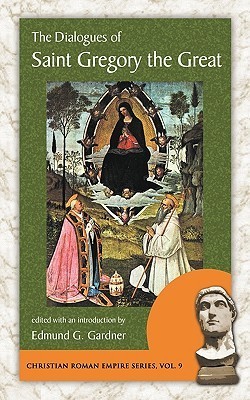
Having witnessed the endless string of disasters that shattered his beloved Italy in the late 6th century AD, Gregory the Great set down in the Dialogues a sequence of tales to help his contemporaries escape from their worldly troubles and contemplate eternal life. To modern readers, these tales of visions, miracles and extraordinary Christian virtue paint a vivid portrait of daily life amid the wreckage of once-prosperous Roman Italy. More importantly, the Dialogues offer a glimpse into the theology of one of the great minds of the Church during the time when Roman authority ebbed forever in the West and ecclesiastical authority emerged to fill the void.
From 590, Saint Gregory I the Great, known pope, increased authority, enforced rules of life for the clergy, and sponsored many notably important missionary expeditions of Saint Augustine of Canterbury in 596 to Britain.
Commonly vigilant Gregory guarded the doctrine of the Church. He founded numerous monasteries, including a school for the training of church musicians. He collected the melodies and plainsong, so associated and now Gregorian chants. In his time, he served as a monk, an abbot, and a leader of Italy. He also momentously influenced the Catholic Church through doctrine, organization, and discipline. People thought of his foremost skill in grammar, rhetoric, and dialectic in all Rome, Gregory of Tours tells us. Gregory sent as a patron of England. Gregory wrote Dialogues, one accomplishment, a book on the Lives of the Saints. Boniface VIII proclaimed him as a doctor of the church in 1295.
As part of my effort to read the writings of Popes who are saints in both the Orthodox and Roman Catholic churches, I decided to read this from St. Pope Gregory the Great.
It's not bad. It is a dialogue between Gregory and a subordinate, Peter, about men and women who persevered in their faith, resulting in miraculous outcomes.
If this had been a few chapters, that would have been fine. However, for every instance of a saint in tribulation resulting in a miracle, I found this harder and harder to digest. For the Christian journey for most of us is not one of miracles, but one of persisting in faith without any evidence of direct supernatural intervention, yet Christ being with us through these dark valleys of the soul.
I think that a text like this showing a miracle for nearly every test of faith is on that could cause many a Christian to stumble. If miracles were commonplace, they would not be miracles. If God parted the heavens every time, we Christians were in a tight pinch, we'd be more like storybook wizards, then like those who labor under the same physical laws and burdens that the rest of humanity bears with.
As I age and continue on my journey as an Orthodox Christian, I see things from a different perspective. Is raising the dead, or a miraculous healing, or lightning coming from above to smite a foe the greatest miracles? Maybe for some, but, to me, the greatest miracle is the Christian who remains faithful to Christ when all seems lost, yet makes it through it, trusting in God to the end --- despite no miracles, no supernatural phenomena --- and becomes stronger than before as a saint, his or her will increasingly in accord with God's.
So not a bad book. I did appreciate many of St. Gregory's observations on these stories of great men and women of God, but I think more from him on how to persevere on the virtuous path in the absence of miracles would have made this of more value to Christian readers.
Gregory just kept putting out bangers, the Dialogues is definitely his most engaging work, more so than the Pastoral Rule (which today is most useful to Clergy) as the work is primarily a collection of miracles that occurred in Italy just before or during Gregory’s life.
I appreciated St. Gregory stories of godly persons that served as examples for holy living. I don't believe that we can make any definitive statements about the afterlife and God's judgments, as they are "past finding out" (Romans 11). I would recommend these dialogues to anyone who inquired about the western Father's of the Church, as I believe they are more accessible than most patristic writing and that St. Gregory, is the cream of the crop, so to speak.
An amazing book written by one of the wisest man to walk on earth. The style (in dialogue form) is absolutely envolving and the life examples given all over the book are utterly inspiring. I wish i could know more books like this one.
Pope Gregory is one of the holiest and wisest men in history. His writings attest this. Get the book. You will see the world in a different way. The right way.
I enjoyed this reading, although it was a little difficult to get into and stay with it, as many works from this era are. Something that stuck out to me in his writings were his counsels to the bishops to be excellent examples for the people that they might see the good works and follow God. He describes that the various leaders should counsel in various ways according to the situations. I felt he was pointing the leaders toward looking at the person as a person and not as an object. He warned of vices passing themselves off as virtues. For instance, being stingy in the name of frugality; extravagant living in the name of liberality; laxity in the name of loving kindness (lack of strictness or care); sudden action in the name of promptness; and tardiness in the name of seriousness.
I don't know if I will read his works again, but I am glad I did study him and grateful for the change he brought about in England.
Just a little about his history: Gregory the Great lived after the fall of the Western Roman Empire (540-604 AD) and remained most of his life in Rome with a long stint in Constantinople. He acts as both a spiritual and political leader. As Rome was unstable due to many centuries of civil war and additionally being attacked by the Lombards, the people turned to the Church and her leaders for help, because she was stable. Gregory, thus became a political leader, negotiating with foreign invaders.
Additionally, Gregory the Great was known as the apostle of English Christianity. He made great efforts to send bishops to England to revive Christianity from the ever invading pagans (Saxons, Jutes and Angles). The most influential of those was Augustine of Canterbury, a monk, who preached the Gospel throughout England.