

What do you think?
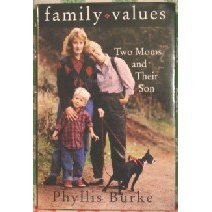
Family Values: Two Moms and Their Son
A lesbian recounts her fight to legally adopt and co-parent her lover's child, describing her journey into the worlds of adoption courts and the militant activist group, Queer Nation. 25,000 first printing. Tour.
233 pages, Hardcover
First published May 4, 1993
Ratings & Reviews
Friends & Following
Create a free account to discover what your friends think of this book!
Community Reviews
Displaying 1 - 3 of 3 reviews

November 18, 2016
I read this book soon after it came out in 1993 - found it on the new books shelf in the public library, thanks public librarians in my home town! - and I hadn't even come out to myself yet.
But it changed my life, because the author was so fierce and so committed to her family, and so willing to risk herself for her vision of what their life should be like.
It was, pardon the word, inspiring.
And behind all my eventual coming outs, and behind my moving away to Montreal, and behind the first time I hung up on my dad, and behind ever so many other decisions between then and now, sat her calm, loving, fierce, patient, and inexorable example. Saying that love was the most important family value, and that anything that got in the way of love, or damaged people or relationships, in the name of some higher good, was flat out wrong.
I wrote her a letter, after I read her book, and all the way from San Francisco she sent me back the most lovely and gracious note, on a card with a Matisse cut-out of a dancing woman on the front. I still have that card, 23 years later. I wish her all the best things in life, because her book was a tipping point on my way to being able to claim those best things for myself.
But it changed my life, because the author was so fierce and so committed to her family, and so willing to risk herself for her vision of what their life should be like.
It was, pardon the word, inspiring.
And behind all my eventual coming outs, and behind my moving away to Montreal, and behind the first time I hung up on my dad, and behind ever so many other decisions between then and now, sat her calm, loving, fierce, patient, and inexorable example. Saying that love was the most important family value, and that anything that got in the way of love, or damaged people or relationships, in the name of some higher good, was flat out wrong.
I wrote her a letter, after I read her book, and all the way from San Francisco she sent me back the most lovely and gracious note, on a card with a Matisse cut-out of a dancing woman on the front. I still have that card, 23 years later. I wish her all the best things in life, because her book was a tipping point on my way to being able to claim those best things for myself.

November 4, 2007
The story describes one women's experiences of San Francisco's lesbian and gay civil rights movement as she was undergoing the legal adoption proceeding's to try to adopt her partner's biological child, Jesse.
A part of me is mildly curious as to how Jesse has grown up. Jesse should be turning 18 this month. Has he discovered his passion in life? Is he thinking about college? Are the issues that were so important in his mothers' lives also important to him? Or does this feel so natural that he does not really think of them at all.
Another slightly morbid part of me wonders about his biological father who was a "yes donor" (meaning that he was willing to be contacted once Jesse was 18 years old). Does he ultimately feel the desire to contact him? The social worker who did the adoption process' home visit was so focused on his biological father, that I wonder.
I also have to wonder how he feels about this book now. There is an incredibly touching letter at the end of this book, written by Phyllis Burke to him. Not having anything to do with this process, I still got all teary at many points and am profoundly grateful of Phyllis' willingness to share their family's story.
A part of me is mildly curious as to how Jesse has grown up. Jesse should be turning 18 this month. Has he discovered his passion in life? Is he thinking about college? Are the issues that were so important in his mothers' lives also important to him? Or does this feel so natural that he does not really think of them at all.
Another slightly morbid part of me wonders about his biological father who was a "yes donor" (meaning that he was willing to be contacted once Jesse was 18 years old). Does he ultimately feel the desire to contact him? The social worker who did the adoption process' home visit was so focused on his biological father, that I wonder.
I also have to wonder how he feels about this book now. There is an incredibly touching letter at the end of this book, written by Phyllis Burke to him. Not having anything to do with this process, I still got all teary at many points and am profoundly grateful of Phyllis' willingness to share their family's story.

March 27, 2008
Had to read this book for a Social Inequality class. It was well written and gave much insight into the Gay Rights Movement in the early 90's. There were a few areas that I felt took the purpose off the intention of the book. The book is suppose to talk about the author's right to adopt her partner's son but it did not focus so much on the adoption as it did on what was happening in the gay community. Though it's 15+ years old now, it was still an interesting and informing read.
Displaying 1 - 3 of 3 reviews