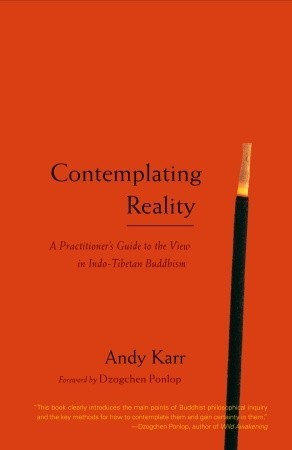
A clear, in-depth exploration of traditional Buddhist philosophy that unpacks difficult concepts through guided exercises that encourage experiential understanding
This book is for intermediate and advanced Buddhist practitioners who wish to deepen their understanding by joining practice with study of traditional ideas. It introduces the reader to contemplations that investigate a series of views of reality as they evolved in the Buddhist tradition. These views are explained in plain English, with contemporary metaphors and examples to bring out their meaning for modern Buddhists. Quotations from both historical and living meditation masters and scholars are presented as examples of key principles. Topics include
• Egolessness • Appearances and reality • Methods of investigation • Enlightenment • Tenets of different schools through the centuries • The root of compassion • The origin of thoughts
Guided exercises encourage the reader to trust in experiential understanding through deep contemplation of complex concepts. The book is structured as a guide for the reader’s journey.
For more information about this book, please visit www.contemplatingreality.org.
ANDY KARR is a teacher, author, and photographer who offers profound and penetrating insights into dharma and mind. He trained at the San Francisco Zen Center under Shunryu Suzuki Roshi, and under Chögyam Trungpa Rinpoche in Boulder, Colorado. Andy co-founded the first Shambhala Centre in France and taught regularly in Paris and other European dharma centers for ten years.
After Trungpa Rinpoche passed away in 1987, Andy and his family moved to Halifax, Nova Scotia. In 1993 he began studying Mahamudra, and the stages of view and meditation, with Khenpo Tsültrim Gyamtso Rinpoche. He later became a senior teacher in his sangha.
In the late 1990s, and early aughts, Andy studied contemplative photography with Michael Wood. This was an opportunity to bring together the Dharma Art teachings of Trungpa Rinpoche, the Mahamudra teachings of Khenpo Rinpoche, and Michael’s insights into photography as a contemplative practice.
Andy’s first book, Contemplating Reality, is a series of investigations into the nature of mind and the phenomenal world. Andy’s second book, written with Michael Wood, The Practice of Contemplative Photography: Seeing the World with Fresh Eyes, teaches the most essential photographic skill—clear seeing. His next book, Into the Mirror: A Buddhist Journey through Mind, Matter, and the Nature of Reality, shows how Mahayana teachings can meet modernity, without losing their profundity. The book is due out in the Spring of 2023.
Nowadays, Andy mainly teaches Mahayana view and meditation, and Mahamudra. To learn more about Andy’s work, go to www.andykarrauthor.com.
I read this book for a class held at my local Shambhala Center, and for that context I would give the book one more star. For those who might have to muddle along alone through these traditional (albeit simplified) arguments that "prove" and describe the empty quality of mind/phenomena, I think it might not be the source of merriment and inspiration that it was in the context of our class.
Actually, the question of audience is one of the problems with this book. It's subtitled "A Practitioner's Guide...," but probably most practitioners will look to the book this one is based on, Khenpo Tsultrim Gyamtso Rinpoche's Meditations on the Progressive Stages of Emptiness -- or one of the more scholarly treatments of the topic. Undecided about whether he's writing for practitioners, Karr's voice is simple almost to the point of cute, reminding me at times of A.A. Milne, so it would seem that he is writing for non- or beginning practitioners -- but then he asks the reader to take quite a lot on faith, which is not what I would do if I were presenting this body of logic-based teachings to non/beginning practitioners.
Too often, Karr suggests that if the reader doesn't understand an argument, or is becoming frustrated in her attempts to follow an argument, it's because the reader's tenacious ego is threatened by the notion of emptiness. Couldn't it just be because the argument is poorly presented, unconvincing, or even invalid? Western Buddhists, Karr included, seem afraid to critique traditional Buddhist logic. A valid and persuasive argument does not depend on one's realization -- we can respect our meditation tradition even while meeting these old arguments head on, on their own (logic-based) terms.
Also, Karr allows some comparison of the traditional Indian arguments about the nature of mind to relevant arguments made by historical and contemporary Western philosophers, but not in a very thorough way. I would have liked to have either stayed entirely within the tradition whence came these arguments, or to have had a deeper, more trustworthy comparison of Indian and European takes on the nature of mind. As it is, it seems that he "picks and chooses" to support the particular Buddhist view under consideration.
The strength of this book is Karr's discussion of contemplation practice and the verses he chose from classic works that support the arguments, verses which we are meant to contemplate. Personally, I do take it on faith that through such practice, anyone can realize the truths that the arguments supposedly demonstrate. The arguments themselves are simply not overwhelmingly convincing, so, to my mind, it is a good thing that the dharma does not depend on them.
I’ve been reading a bit on Buddhism to get a better sense of what it is and how it differs from Platonism [Neoplatonism], as I’ve seen a bit of work on Platonist-Buddhist scholarship that piqued my interest. This book was good insofar as the final sections before the conclusion really grounded it back in practice in a way that is familiar to any theurgist with a solid contemplative rhythm. The preceding chapters were interesting in that they clarified for me some things that a friend who had studied Buddhism before Platonism had kept telling me. Those chapters were, however, the source of frustration because terms that the author thought were very clear have different meanings in Platonism. I also found it strange the amount of word count/e-ink pixels taken to drive home the importance of the phenomenal world, but “comes to be and passes away, but never truly is” is drilled into most people who have done a deep co-read of the Timaeus. I imagine the same would be true if someone were coming from Yogic teachings &c.
The reason I am rating this two stars has nothing to do with the merit of the words (as a non-Buddhist, I’m an outsider), but I don’t want Goodreads to suggest more books like this to me.
Terrific! I don't know if this is a book I would approach as a first pass with Buddhist perspective; however, Karr succeeds in laying out some of the more complex pieces of Buddhism in a very clear and succinct text that is very helpful to novice practitioners. Great stuff!
good overview of the four tibetan buddhist schools. this tour is from the shentong mind-only view point (even if not the most profound school, still one of my favorites). the book is not incredibly detailed, but that makes it a great primer.
A fantastic read through and through. Both approachable and profound. I read Contemplating Reality in a dusty Ethiopian flee-bag hotel in 2006 and my world (or lack thereof) will never be the same. I can't recommend this book more highly.