Jump to ratings and reviews
Rate this book

Dark Passage

Rate this book
Darker and more obsessional than anything written by Hammett - Woody Haut

The mystery man of hardboiled fiction... poet of the losers... If Jack Kerouac had written crime novels, they might have sounded a bit like this. - Geoffrey O'Brien

No writer before or since has had such magnificent obsession with the shadows cast by the victim, the failure, the drop-out, the has-been... his world touches the stark and mysterious realism of Weegee's street snapshots. - Mike Wallington


Vince Parry, sentenced to life in San Quentin for the alleged murder of his wife, escapes in an attempt to prove his innocence by discovering just who framed him. Harboured by a woman he doesn't trust, a fugitive from justice in the depths of despair, Parry is forced to take a nightmarish gamble in an attempt to hide his identity from the Law...

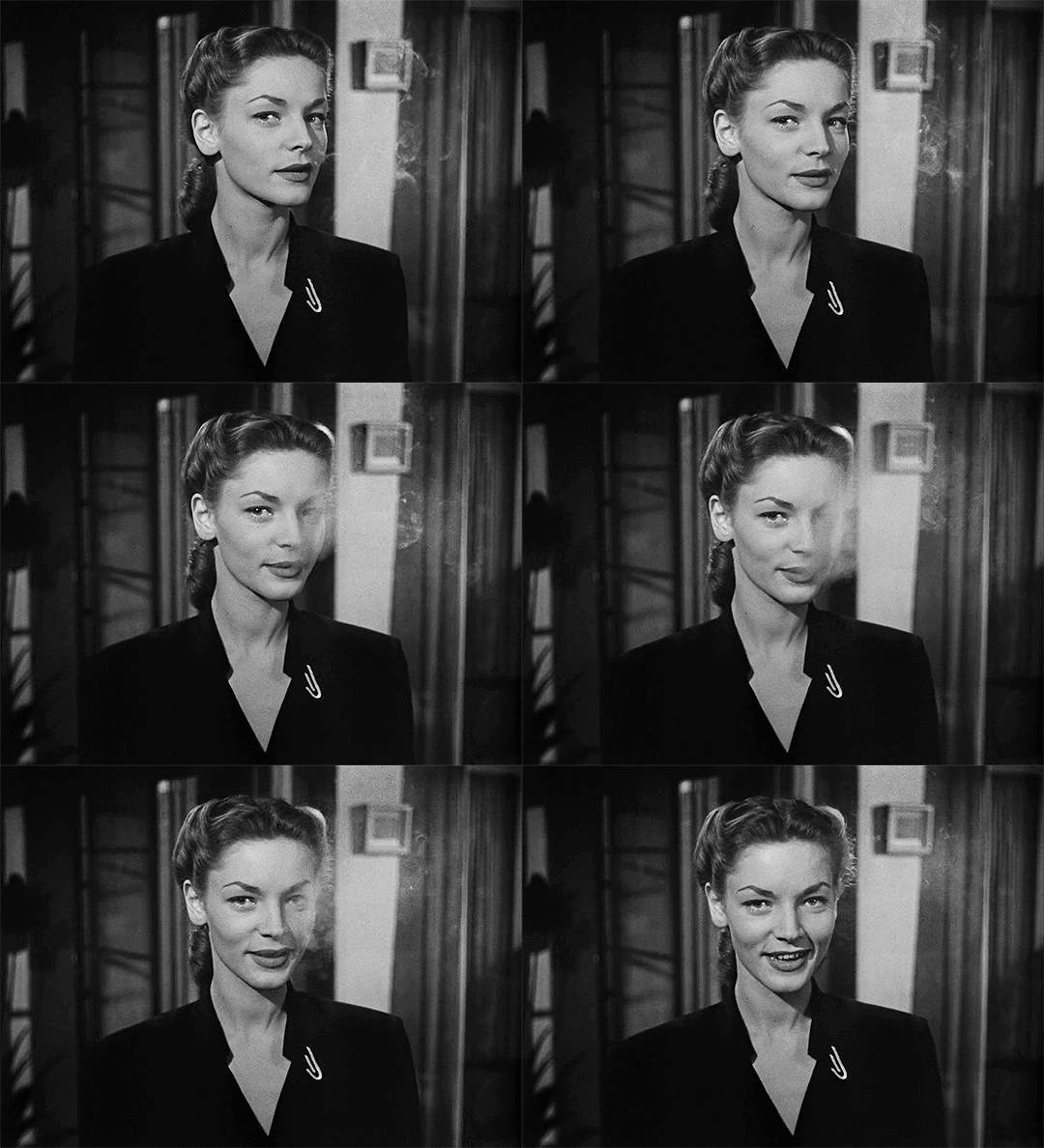
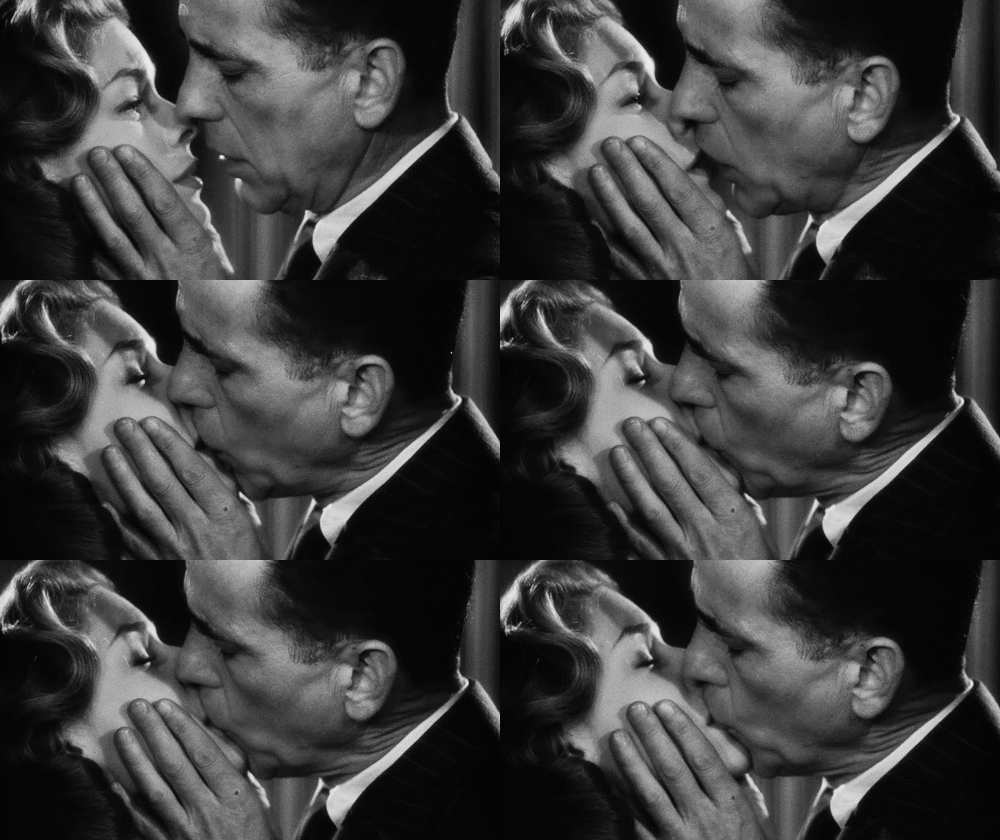
First published as a serial in the Saturday Evening Post, Dark Passage was filmed in 1947 by Delmer Daves. Starring Humphrey Bogart and Lauren Bacall - a classic of the noir genre.

With a new introduction by Geoffrey O'Brien

Cover shows a detail from the Dark Passage film poster.

244 pages, Paperback

First published January 1, 1946

30 people are currently reading
2381 people want to read

About the author

David Goodis

97 books319 followers
Born and bred in Philadelphia, David Goodis was an American noir fiction writer. He grew up in a liberal, Jewish household in which his early literary ambitions were encouraged. After a short and inconclusive spell at Indiana University, he returned to Philadelphia to take a degree in journalism, graduating in 1937.

Ratings & Reviews

What do you think?
Rate this book

Friends & Following

Create a free account to discover what your friends think of this book!

Community Reviews

5 stars
375 (27%)
4 stars
650 (47%)
3 stars
293 (21%)
2 stars
52 (3%)
1 star
11 (<1%)
Displaying 1 - 30 of 174 reviews
Profile Image for Jeffrey Keeten.
Author 5 books252k followers
October 15, 2019
“You know me. Guys like me come a dime a dozen. No fire. No backbone. Dead weight waiting to be pulled around and taken to places where we want to go but can't go alone. Because we're afraid to go alone. Because we're afraid to be alone. Because we can't face people and we can't talk to people. Because we don't know how. Because we can't handle life and don't know the first thing about taking a bite out of life. Because we're afraid and we don't know what we're afraid of and still we're afraid. Guys like me.”

 photo fabba9e9-36bb-477e-8f9a-c29f70211af7_zpscnsxphnz.png

It is hard to stack time for a murder that you did commit, but how about doing the time for one that you didn’t?

It is death on the LONG installment plan.

The days, the weeks, the months weigh heavy, like lead ingots are being tied to your soul. Every day that passes you feel a month older. You start to obsess about all that you had, all that you had planned, and all that you are missing out on that you haven’t even thought of yet. It is all enough to make a man get crazy...crazy enough to break out.

Vincent Parry did not kill his wife.

The trial was a sensation with the wild parties, the dark corner passions, and the unseemly adulteries making the headlines scream. Parry was made out to be a deadbeat, a draft dodger, and a man of loose morals. All of that he could beat back, but when Madge Rapf testified that his wife had whispered as she died that Parry had killed her...well...that sent him to San Quentin for the rest of his life.

Madge is complicated, a woman in an open marriage who made a real play for Parry after he’d staggered away from one of those knock down drag out fights with his wife. He’d played along, but soon realized that Madge wasn’t right for him. In fact, she wasn’t right for anyone. “He told himself she wasn’t really such a bad person, she was just a pest, she was sticky, there was something misplaced in her make-up, something that kept her from fading clear of people when they wanted to be in the clear.”

It turns out that she thought Parry was perfect for her. When he dropped her like a gunnysack full of rotten potatoes, she decided that he had to pay.

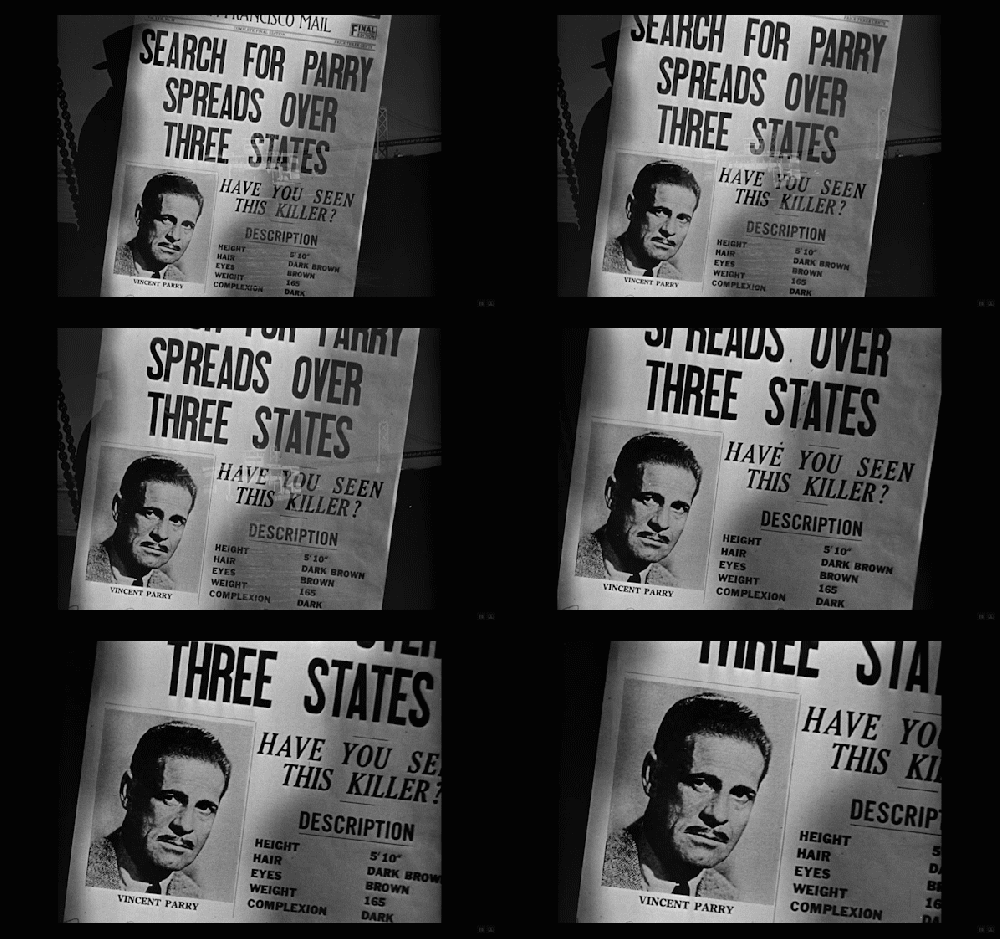
It was duck soup, escaping from prison. It was as if the prison wasn’t supposed to hold him. Escaping turned out to be the easy part. The manhunt that follows starts to make prison seem like the good old days. It feels like everyone is against him, not just the cops, but everyone who has ever picked up a newspaper with his picture emblazoned over the front fold.

Everyone that is except her.

”She came running up to him. The grey-violet blouse was supplemented by a dark grey-violet skirt. She was little. She was about five two and not more than a hundred. The blonde hair was very blonde but it wasn’t peroxide. And there was a minimum of paint. A trace of orange-ish lipstick that went nicely with genuine grey eyes. She was something just a bit deeper than pretty, although she couldn’t be called pretty.”

 photo 58f42be2-7cd3-4f25-8578-fce63c56fb18_zpsdfg2e1tq.png

When she learned he had escaped, Irene Janney came looking for him. She had followed the trial and had always thought he was innocent. She was willing to do whatever it took to make sure he got a fair shake. She hid him in her apartment. She even had stacks of his favorite musician Count Basie. ”He switched on the current and got the record under the needle. Texas Shuffle began to roll softly and it was lovely. It clicked with the fact that he had a cigarette in his mouth, watching the smoke go up, and the police didn’t know he was here.”

Bodies keep turning up, and Parry keeps finding himself in the frame. Who is the man in the Studebaker? Who is trying so hard to strap him in the electric chair? Why is Irene Janney trying to help him? Will a new face and a $1000 in his pocket put San Francisco behind him for good?

David Goodis keeps the pressure on the reader from the beginning to the end in this gem of noir. The tough talk, the cigarette smoke, and the man against the world aspects of this story reminded me of the best of James M. Cain.

”Without thinking of it, he reached in a coat pocket, took out a pack of cigarettes and a book of matches. He put a cigarette in his mouth as he looked at the body. Standing there and looking at the body he lit the cigarette.

He was puzzled.

He couldn’t understand why he felt no regret, why he felt no horror at the sight of this dead thing on the ground, this thing he had killed.”


Even just going into a shop for a book of matches or someone on a street corner looking at him with an odd expression on their face or an inquizzitive cabby asking too many questions all add to the suspense. The part that wraps the piano wire tighter around the reader’s own throat is the fear that Parry himself will finally come apart at the seams and give himself up.

 photo Bogart_zpsimdtpxhe.jpg

The 1947 film starring Humphrey Bogart and Lauren Bacall based on this book is good, but not one of their best. Now that I’ve read the book I’d like to watch the movie again. By reading the novel I might be able to see the movie with an enriched insight.

If you wish to see more of my most recent book and movie reviews, visithttp://www.jeffreykeeten.com
I also have a Facebook blogger page at:https://www.facebook.com/JeffreyKeeten
Profile Image for Bobby Underwood.
Author 143 books352 followers
August 22, 2017
David Goodis’s Dark Passage is most famous today because of the WB film starring Humphrey Bogart and Lauren Bacall. Goodis sold the rights to film it for $25,000 and secured for himself immortality by doing so. To those who read, however, and especially those who enjoy a good crime noir, Goodis’s name would be known and bandied about during discussions of the genre, regardless.

Anyone familiar with the very good film based on the book knows that for the first forty minutes or so of the movie, we are in Parry’s (Bogart’s) shoes during the prison break and the ensuing escape. We never see Parry’s face during this portion of the film. Goodis’s entire novel is the equivalent of that portion of the film, the reader placed into Parry’s head, “hearing” him panic, reason out things, fight his fear and paranoia, and finally, figure out who killed his unfaithful wife and framed him for the murder.

Tightly constructed and narratively claustrophobic, Dark Passage is a unique narrative that won’t appeal to everyone. It is more likely to appeal to fans of the genre, and fans of the greatest writer of suspense, Cornell Woolrich. Goodis here seems to be influenced by Woolrich’s work. Parry even has an entire conversation in his head with his only friend, who has just been murdered, which is very Woolrichian.

One can almost picture Agnes Morehead as the shrill and annoying Madge Rapf, and Bacall as the lovely and lonely Irene, whose motives for helping Parry hide out at the outset, and later so that his face can heal when he has it altered, are at first unclear. Those motives will be seem more ambiguous for anyone who hasn’t seen the 40s film, but that’s not many.

There is loneliness here, and not just Parry’s, and there is that feeling of the little guy fighting against fate which permeated Woolrich’s work during this period. While Goodis doesn’t quite reach the level of Woolrich noir, this is very good, and there are moments when he comes close. A tricky and ultimately dooming confrontation with a guy referred to as Studebaker for much of the book, and the color of a car, set in motion an exciting conclusion. It is here, at the end, when Goodis throws the reader a Deadline at Dawn type of lifeline that makes this a memorable read.

While the narrative style of nearly every thought in Parry’s head can become too overblown at times, at other times it’s marvelous, both cerebrally claustrophobic and entertainingly mesmerizing. This seminal noir novel will have you looking up Patavilca, Peru on your globe, and wondering…

Because Goodis seemed to be channeling Woolrich, but didn’t quite reach that lofty plateau, this is 4.5 stars for me. But it is such a terrific read, I’m rounding up. A unique novel (unless you’ve read Woolrich), and like Woolrich, not for everyone. Fans of 1940s and '50s noir/suspense, however, must have a go at it to sample the full spectrum of what the genre has to offer.
Profile Image for Sana.
316 reviews162 followers
August 23, 2024
گذرگاه تاریک اخیرا توسط نشر برج منتشر شده و کم و بیش شبیه کتاب شاهین مالت هست.
البته هردو فیلمشونو ساخته شده.
کتاب درباره‌ی مردی به نام وینست پاری که به جرم قتل همسرش محاکمه شده ولی او معتقده مرگ همسرش سانحه بوده و بی گناه هست.
بنظرم داستان خوبی داشت فقط یذره حوصله مو سر برد بااین حال تاآخر خوندم و پایان بندی قابل قبولی داشت. گذرگاه تاریک یک کتاب جنایی و پلیسی با چاشنی عاشقانه هست.
Profile Image for Algernon.
1,840 reviews1,164 followers
May 2, 2013
[9/10]
Another winner from David Goodis, one of the authors that contributed substantially to the success of the noir genre in the 1940's. More than a crime investigation, the novel is a study of an ordinary man trying to remain sane under immense psychological pressure. Vincent Parry is in prison for murdering his wife, a crime he is innocent of, although all the evidence is against him. After coming to blows with a prison guard he decides to escape, and the rest of the novel is about him trying to stay one step ahead of the police, even as a new murder is pinned on him. There is an angelic blonde trying to help him (Irene Janney), and a fiery tempered redhead trying to bring him down (Madge Rapf). They even have a great scene together, with Vincent a silent and slightly baffled witness of their fighting over him.

As with other novels from the period, it is quite short, yet it delivers one memorable scene after another, each with edge of the seat, white knuckled potential for violence, as even a taxi ride or buying a box of matches from the drugstore can pitch Vincent Parry over the edge. I know there's a movie adaptation with Humphrey Bogart and Lauren Bacall, but it didn't make much of a lasting impression. To me the style of the story is more like Hitchcock than anything else, with dream sequences and internal monologues inspired from the work of Carl Jung, with color coded mise-en-scene where orange and violet and yellow and dark gray reflect the mood or the personality of the characters, with the sustained tension and the ambiguity about the guilt of the main character (Vincent has a violent streak and black-out moments when he loses his temper).

It's hard to pick a favorite scene, but I would go for the flashbacks detailing Parry's failed marriage (the fire opal ring) and for the portrait of Fellsinger - Vincent Parry's close friend from his former job as an insurance clerk:

You know me. Guys like me come a dime a dozen. No fire. No backbone. Dead weight waiting to be pulled around and taken to places where we want to go but can't go alone. Because we're afraid to go alone. Because we're afraid to be alone. Because we can't face people and we can't talk to people. Because we don't know how. Because we can't handle life and don't know the first thing about taking a bite out of life. Because we're afraid and we don't know what we're afraid of and still we're afraid. Guys like me.

I still have a couple of questions left unanswered , but overall this was one of the top picks in the genre for me.
Profile Image for David.
764 reviews185 followers
July 5, 2025
It seems I've developed a desire to make regular returns to Goodis' work. There's just that... certain something... about his style of storytelling that I find uniquely compelling. His work has a distinct voice - and, even though the issue of 'excess' can sometimes rise up as a 'problem', Goodis always seems to find a way toward a reader's satisfaction. ~ at least this reader. 

The 1947 Bogart / Bacall film version of 'Dark Passage' is not among my favorite flicks. Now I know why. Not that the film is bad; it holds interest and it has a particularly delicious, scenery-chewing performance by Agnes Moorehead. Overall, it even follows the novel rather closely. But it somehow doesn't properly translate the angst and despair that Goodis put down on the page. 

A good deal of what's on the page is in the mind of the protagonist, Vincent Parry - a man at internal war with paranoia in a way that would be hard to pull off on-screen (esp. the minutely detailed, borderline-crazy way that Goodis has written it). ~ a man who, if given the half-a-chance he never seems to get, would likely be endearing.
"I'm not really fresh. Just sort of informal."
I came to a reading of this only after having read a number of Goodis' later novels. I had, in fact, skirted this earlier work precisely because I was familiar with the film (which I may have seen two or three times), so the book seemed less... urgent.

Well, 'B-o-o' to me! 

If you're a Goodis fan and you've skipped over this one, go back. It's not only one of his most accessible books (the bulk of the writing is simplicity itself) - but the larger part of its construction is ultimately revealed to hold more cunning than expected. 

And the sparks-fly dialogue is top-notch noir. Esp. the undeniable master-stroke of the 'conversation' with the dead guy.:
"Look at me. Look what happened to me. Isn't it awful?"
Alone, that whole jam-packed jolt of the suddenly surreal makes this novel worth the read!
Profile Image for Sharon Barrow Wilfong.
1,135 reviews3,969 followers
January 6, 2020
David Goodis is a recent discovery and a happy one at that. I had read Shoot the Piano Player in an anthology so I was encouraged to give more of his stories a try. This one, in my opinion, surpasses Shoot the Piano Player in story and character development, suspense, and looking into the dark corners of the human soul.

Vincent Parry is condemned to life in San Quentin for killing his wife. He claims he is innocent, but his wife's dying words were that he did it. The prosecuting lawyer persuades the jury more by slaughtering the man's character than providing concrete proof.

Through a series of fortunate events, Parry manages to escape from prison and, after several close calls goes into hiding. But if he didn't kill his wife, who did?

There are many characters in this book, many suspects, and every chapter ends with a close call, leading the reader to believe it's all over for Parry.

The characters are very interesting, each of them believable, but also representing a type of person:

The woman who believes in him and wants to help him.

The woman who is psychotically obsessed with him and wants to destroy everyone and everything she can't have.

The woman who held him in contempt, even up to her dying breath, accusing him of her murder.

The man who seems to want to help him, but actually has ulterior motives.

The men who are in power to turn him in, but show a compassionate side and a surprising amount of insight and accurate measuring up of a man's real character.

Then those that are caught in the cross fire of Parry's drama and end up dead or desperate.

Goodis, himself was a desperate man. His characters are outcasts, innocent people who are in the wrong place at the wrong time. Loners who must escape their misfortunes.

The best part is the writing. Parry thinks a lot and at a gun fire pace. We read his stream of consciousness throughout the book, since it is all from his point of view in limited third person.

Even though Goodis will never be ranked with Hemingway, I found his writing to be comparable and often surreal.

A movies was made of this novel, starring Humphrey Bogart and Lauren Bacall. I remember seeing it, but I don't remember how it ended. I guess I'll have to watch it again.

Goodis also wrote The Fugitive, which was made into a TV series and also a movie, starring Harrison Ford and Tommy Lee Jones.

Goodis was a kind of fugitive himself. He lived with his parents and schizophrenic brother and would haunt the seedy neighborhoods of Philadelphia. His last slumming escapade ended with him getting badly assaulted. He died shortly after. Maybe Goodis wrote himself into all of his stories.
Profile Image for Carla Remy.
1,062 reviews116 followers
May 12, 2023
02/2015

I loved this. Dark Passage is the most Cornell Woolrich like book I've encountered (which isn't by Woolrich). Darkness, night, surreal dreamlike sequences. I loved the ambiguity of this novel. The conversing (in his mind) with dead people parts were great, and the use of color. From 1946, this book was contemporary with Woolrich.
Profile Image for robin friedman.
1,947 reviews415 followers
December 14, 2022
An Early Goodis Novel

In 2012, the Library of America published a volume of five noir novels of David Goodis (1917 -- 1967) which has brought a wider readership to Goodis' work. The LOA collection opens with "Dark Passage", Goodis' second novel, serialized in the Saturday Evening Post and then published in book form in 1946. When Goodis wrote "Dark Passage" he was working in Hollywood. In 1947, "Dark Passage" became a movie starring Humphrey Bogart and Loren Bacall. The book was reissued in paperback, but the LOA volume may make this paperback obsolete. The book is worth discussing on its own.

The book is set in San Francisco during the years of WW II. The primary character is Vincent Parry, a young man who was ineligible for military service due to a medical condition. He works at a low-paid, dead-end job as a clerk in an investment firm. Parry has made an unhappy marriage. When his wife Gert dies, Parry is tried and convicted for her murder and sentenced to life imprisonment at San Quentin. The hapless Parry had claimed the death was an accident. Goodis sets the stage for what follows in the opening paragraph of his story:

"It was a tough break. Parry was innocent. On top of that he was a decent sort of guy who never bothered people and wanted to lead a quiet life. But there was too much on the other side and on his side of it there was practically nothing. The jury decided he was guilty. The judge handed him a life sentence and he was taken to San Quentin."

As the book develops, Parry escapes from San Quentin. He receives assistance from a mysterious woman, Irene Janney, and for a time from his only friend, a man named Fellsinger, who is himself murdered. Parry is accused of this murder and faces the threat of execution if caught. Parry undergoes a painful underground treatment to change his face. He also works to discover the killers of his wife and of Fellsinger.

The intricate plot and the details of Parry's sleuthing tend to slow down the book. The appeal of the book does not lie in its elements of a mystery. Rather, "Dark Passage" offers a portrayal of failed, lonely, and sad people who have not lost a sense of determination. The book portrays city life in crowds, lost individuals, lonely deserted dark streets, and boxed-in apartments.

Goodis writes in the short, clipped sentences of noir. As the novel progresses, the writing takes on a poetic character, with its repetitious, rhythmic incantations of phrases and long passages of description. Although the book includes a substantial amount of violence and external action, the focus is on the characters and their tormented inner lives. In many introspective scenes, through dialogue, Goodis offers insight into Irene, Fellsinger, several other characters, and primarily Parry himself. In a passage late in the book, Parry describes his life and his dreams, as he thinks he has discovered the murderers:

"And the pattern kept expanding, showing him the simple and ordinary happiness he had expected to find with Gert, the clean and decent happiness of the little guy who wasn't important and had no special urge to be important and wanted nothing more than a daily job to do and someone to open a door for him at night and give him a smile."

"Dark Passage" is a sad lyrical novel about lonely people. Goodis' subsequent works would be even darker.

Goodis' novel also had an interesting legal history. Late in his life, Goodis sued a television series, claiming that it appropriated themes and scenes from "Dark Passage." The initial court rulings were adverse, but an appeals court allowed Goodis to pursue his case. The case settled for a relatively small amount after the author's death.

"Dark Passage" is a poignant, introspective example of noir from a writer that I am enjoying getting to know and who is receiving deserved critical attention.

Robin Friedman
Profile Image for RJ - Slayer of Trolls.
990 reviews191 followers
November 4, 2023
Framed for murder - a set-up almost as old as the genre itself. Vincent Parry didn't kill his wife, but after busting out of prison he's less concerned with finding the murderer than with staying out of sight. Likewise, author Goodis - known for his post-WWII noir writings - is less interested in writing a whodunit and more interested in exploring the intense pressure and despair felt by a man on the run. Goodis uses long run-on sentences to show the stress and paranoia felt by Parry in even the most mundane settings. Buying matches in a corner store or riding in a car or taxi, we feel Parry begin to unravel when someone so much as looks in his direction. The plot itself is nothing terrific, as if Deus Ex Machina-brand plot device was applied liberally with an aerosol can, and the behavior of most of the people Parry meets is nothing short of implausible. But the story retains the pulpy fun from its serial origin in the Saturday Evening Post, with cliffhangers at the end of each chapter and a big reveal at the end (which will probably not surprise anyone). Although the story was adapted as a mostly forgettable Bogey and Bacall vehicle, you'll probably recognize the main plot points as the basis for the TV show The Fugitive, and the book's most lasting effect may be a landmark 1970 court decision in favor of Goodis' copyright.
Profile Image for Tim Orfanos.
353 reviews41 followers
December 29, 2019
Πρόκειται για μια ιδιαίτερη περίπτωση αστυνομικού μυθιστορήματος: εκδόθηκε το 1946, και, αμέσως, ένα χρόνο μετά, μεταφέρθηκε στο κινηματογράφο με πρωταγωνιστές το δίδυμο Μπόγκαρτ-Μπακόλ.

Αυτό το αναφέρω, γιατί, συμπτωματικά, διαθέτει σεναριακή δομή, η οποία λειτουργεί αμφίσημα δηλ. καί σαν ατού και σαν μειονέκτημα. Το ατού της δομής είναι ότι το 1ο μέρος, το οποίο έχει πιο γρήγορο ρυθμό, έντονη πλοκή και ξετυλίγει τα πάθη και τη σκοτεινή πλευρά των χαρακτήρων, ενώ δημιουργεί στον αναγνώστη έντονο σασπένς μέσα από εικόνες σχεδόν κινηματογραφικές.

Τα μειονέκτηματα, κυρίως, από τη μέση του βιβλίου και μετά είναι: ο τρόπος που έχουν παρατεθεί κάποιοι διάλογοι, θυμίζοντας τις γραμμένες ατάκες που πρέπει να μάθουν οι πρωταγωνιστές πριν γυριστεί η σκηνή, οι κοφτές προτάσεις του συγγραφέα που εκβιάζουν τα γεγονότα, και οι περιττές επαναλήψεις στη περιγραφή των χώρων, όσο και των έντονων συναισθημάτων του πρωταγωνιστή.

Πέρα από τα παραπάνω στοιχεία, ο Goodis κάνει πολύ ενδιαφέρουσες αναφορές στο παγκόσμιο μεταπολεμικό τοπίο, όπως στις σκληρές συνθήκες διαβίωσης στη Κίνα όπου στέλνονται πακέτα 'Αλληλεγγύης' από τις Η.Π.Α. με παλιά ρούχα, στον ρατσισμό που αντιμετώπισαν οι Εβραίοι της Αμερικής, στην ραγδαία αύξηση των ενεχυροδανειστηρίων ως αποτέλεσμα της οικονομικής κρίσης μετά τον πόλεμο, στην τρέλλα του εύκολου πλουτισμού, και στη εξέλιξη της πλαστικής χειρουργικής, η οποία, την εποχή εκείνη, γινόταν, κυρίως, παράνομα.

Γενικά, υπάρχουν αρκετά διάσπαρτα 'hard-boiled' στοιχεία, ατμόσφαιρα φόβου, παιχνίδια γάτας με το ποντίκι, και δολοφονικά ερωτικά πάθη, τα οποία δίνουν αρκετό ενδιαφέρον σε αυτή την μυστηριώδη ιστορία καταδίωξης.

Συνολική Βαθμολογία: 3,5/5 ή 7/10.

Βαθμολογία λόγω πρωτότυπης πλοκής: 8,4/10.

Υ.Γ.: Υπάρχουν και αρκετά λάθη στην επιμέλεια που έγιναν, μάλλον, λόγω της γρήγορης εκτύπωσης του βιβλίου.
Profile Image for Nancy Oakes.
2,019 reviews917 followers
June 2, 2016
If you enjoy the darker side of fiction and very powerful and thought-provoking writing, this is definitely a no-miss.

Wrongly convicted of murdering his wife, Vince Parry tries to cut it in prison, but after a certain incident leaves him to face the fact that prison "was going was going to be a horrible life," he plans and executes a daring escape. It is at this juncture where the story really begins -- as fate intervenes in the form of young Irene Janney, who, for her own reasons, had followed Parry's trial and is now willing to go to great risk helping him out after his escape. What follows is some of the darkest noir ever written, where despite Parry's chance at a new life, the tough breaks continue to follow him.

While out on the streets of San Francisco, Parry wants very much to clear his name, and in his isolated and lonely life he has a sincere and desperate need to find someone in whom he can trust. But Parry's world is one where betrayal has become part and parcel of who he is, and Goodis brings this out so beautifully when he's inside of Parry's head, revealing the paranoia that threatens to consume him.

You can read more of my post here but the bottom line is that I loved this novel, and I think it is a masterful and solid piece of noir writing, a book where plot is definitely secondary to Goodis' skill as an author. If you're in it for plot alone, it's still good, but for me, it's way more about the writing and what's underneath the plot that resonates. Very, very highly recommended.
Profile Image for John.
Author 537 books183 followers
September 30, 2017
The 1947 movie Dark Passage, directed by Delmer Daves and starring Lauren Bacall and Humphrey Bogart, is one of my favorite films noirs; I'm not saying it's one of the best (although it's very good), but it's one that got under my skin the first time I saw it and continues to fascinate every time I rewatch it. So it came as something of a surprise the other day to realize I'd never read the source novel, even though its author, David Goodis, is one whose work I've always enjoyed.

Well, problem easily enough solved.

Vincent Parry, innocent of killing his wife but convicted anyway, escapes from San Quentin and is soon rescued by rich divorcee Irene Janney, who has been following the case and believes in his innocence. Although she's generous with him, giving him money and clothes, he keeps trying to break away from her, convinced his presence in her life will drag her down.

Then, through a chance encounter, he gets himself a face lift, and plans to spend the days before the bandages come off with his best friend. But someone murders the best friend, the cops assume it's him, and so it's back to hiding out with Irene. But it's not only the cops who are hunting him . . .

The screen adaptation stuck pretty closely to the plot and characterization of the novel, to the point that, as I was reading, I kept finding myself reliving some of the movie's scenes. Most times I'm irritated when that happens -- when my memories of a movie intrude upon my reading of a book -- but here it actually enhanced my enjoyment, I think probably because the movie really is so faithful. The only major difference is that the first half of the movie is told via subjective camera -- i.e., as through the protagonist's eyes -- because his face is already bandaged. In the book the plastic surgery happens later, and the period when he's bandaged is shorter and less pivotal to the plot.

Goodis's telling alternates between sharp, snappy dialogue and, all too often, gargantuan paragraphs of peripheral exposition that sometimes smack of undue padding. Even so, the text never falls short of highly readable. There's an air of almost magic realism about the proceedings, as if Goodis is aware that we know the events of the book could never really pan out as described but expects us to go along with him anyway; I think that's part of the reason I find the movie so fascinating, and it worked for me here with the novel as well.
Profile Image for Josh.
1,732 reviews174 followers
April 29, 2012
A prison break, a murder, an assault, an attempt at grand theft auto, an unfaithful husband, and bribing law enforcement - yet Goodis' protagonist, Vince Parry comes across as a soft hearted, overtly emotionally man who personifies the noir 'wrong-man' stereotype. After being convicted for the murder of his cheating significant other, Parry finds himself behind bars at San Quentin. Knowing he's innocent he masterminds an all too easy escape and subsequently finds himself at the mercy of a helping hand wanting nothing more than to heal his tarnished person.

Each core character's story interlopes with Parry the centre of the patchwork plot - a masterstroke of coincidence and tightly plotted linear focus. The Irene angle played out a little less believable yet presented enough surface reality to be plausible. The main event; the murder of Perry's cheating wife, Gert, leads to suspicion of everyone within the doomed couple's circle - notably Madge and Bob Rapf, a couple with a seemingly open relationship who both come under fire throughout proceedings. There's also a nice side bar which plays on Parry's paranoia following his escape - keep in mind the Studebaker while reading...

While entertaining enough throughout, Goodis employed an annoying element of estimation into almost anything that encompassed figures (distance travelled, time, money, etc.) - this had a tendency to be a distraction rather than an addition to the story. Other blips can be overlooked - notably some corny dialogue but then again this was written some time ago and rings true to the time and genre trappings.

Parry, prone to leak at the drop of a hat yet hardened enough to beat a man unconscious is an interested character made of two distinct halves - I'm not sure which takes prominence - the hard or heart? Goodis will question Parry's sanity and humility throughout, making 'Dark Passage' all the more true to the title. As noir/pulp as it gets - held together by the glue of intrigue and mystery while following a theme of the classic case of whodunit without the police procedural element. 3 stars.

This review is from 'Dark Passage' which appears in David Goodis: Five Noir Novels of the 1940s and 50s: http://www.goodreads.com/book/show/12...


Profile Image for Elizabeth (Alaska).
1,570 reviews554 followers
August 9, 2022
The Goodreads description is as brief and accurate as any I would want. It tells us only the beginning: that Vincent Parry was convicted of the murder of his wife and sentenced to life at San Quentin. He managed to escape prison and return to San Francisco.

The book is written in third person limited and we know what Parry is seeing and thinking at all times. One would not think reader sympathy would be with an escaped convict. There are reasons to believe he was wrongly convicted. For much of the novel I thought the style and cadence of the writing is much like the hard-boiled writers, though there is no detective in this. He got another good look at her. She was twenty-seven if she was a day. Give her a big break and call her twenty-six. He saw lines under her eyes that told him she didn’t get much sleep.

Goodis manages to create tension for the reader - even fear for Parry - through his writing. There were passages when Parry thought he was being pursued by the police and he was afraid and what would he do and could he escape through the window, where is the fire escape. My extended run-on sentence here is only a glimpse of what Goodis manages to do to have the reader feel how trapped Parry felt.

Not long after the serial publication of the novel, it was made into a film starring Humphrey Bogart and Lauren Bacall. I have not seen the film, but I can certainly see each of them in this - Bogart in particular. I want to thank my Goodreads friend, Denise, for leading me to David Goodis. This is superb noir and, for me, crosses over that 4-/5-star barrier.
Profile Image for Lee.
927 reviews37 followers
March 20, 2020
I stumbled onto Mr Goodis a few years back, searching noir/pulp writers. Says, he died in obscurity in 1967. Then I found out later he was one of the most admired American noir writers of the last century. I concur. This was like watching a B&W movie..oh, that was done in 1947 with Bogart & Bacall. Pretty good duo..... and #66 on IMDB top 100 noir films. More Goodis is in my future.
Profile Image for AB.
220 reviews5 followers
January 7, 2021
I went into this knowing what the story beats were going to be and as I read on, I confirmed my hunch. We meet Vincent Parry on the verge of escaping from San Quentin after being railroaded for the death of his wife and we follow him as he tries to put the past behind him and make it out of San Francisco (of course what would a noir novel be without constant blindsides). I thought to myself how this would be just like the Maltese Falcon novel. I could read Parry in Bogarts voice and Irene in Bacall’s. Even picture the action in black and white. What I read blew my expectations out of the water. The story was grey but there were violent flashes of violet, yellow, and orange. And Goodis’ Vincent Parry was no Bogart.

You can talk about the characters in this, all of whom I absolutely loved, but you need to start with Parry. Hes feverishly paranoid, indecisive, and prone to give up. The story would plod along calm and calculated until something would happen. Then Goodis would reveal Parry’s thoughts in a torrential flood of words that felt like a McCarthy run-on sentence on steroids. Here is Goodis revealing the panic Parry felt when he was sure he would be caught:

The mallet was banging now, banging hard on his skull. He got up from his bed and went over and picked up the ash tray and he was thinking that he would open the door for the detective and hide the ash tray behind his back and mange to get behind the detective and then hit him with the ash tray, hit him hard enough so he would go down, hard enough so he would stay down, but not too hard, because too hard would kill the detective and he didn’t want to kill the detective. He didn’t want to but he wanted to hit the detective hard enough to put him down… but not too hard, of course not too hard. But hard enough… He was going to bring it down too hard because he was so anxious to get away, because now he was at the point where he was more afraid of bringing it down too lightly than too hard. And now that he had it in his hand and his mind was made up to use it he could not put it down and he was going to do something now that he didn’t want to do, that he never expected he would do, and didn’t want to do it, and he pleaded with himself to not do it, and he knew he would always regret doing it, and he was sick, and he was tired, every part of him was so tired except his right arm and his right hand.

In other instances, Parry’s paranoia would be written as a nagging, creeping question breaking into his thoughts. He would plod along thinking about some potential future where large paragraphs of day dreaming would be broken up with short sentences, often ignored in Parry’s dreams, demanding answers for certain events.
In another shock for noir, Parry was not some hardboiled ex- something or other. He was decidedly normal, wanted nothing more than normalcy, and (in a first for me) would regularly break down and even cry. He was more than normal; he was a human reacting to his terrible situation:

“What’s the difference?” Parry said. He wasn’t talking to the driver. “The worst I can get is a week in solitary. And no privileges. And no chance of parole. But there wasn’t a chance anyway. They told me I was lucky I did get the chair. That’s something I’ve got to remember- I’m lucky. I didn’t get the chair. That’s something I’ve got to remember- I’m lucky. Ill always be lucky because I didn’t get the chair.” He looked up and saw the driver watching him. He said, “Go on- take me to the police station”

The other characters, from the major to the minor, practically leap off the page. I found it very enjoyable to read the dialogue. That really speaks to what Goodis did with this book. I found the writing well done for its genre. Sure its no Faulkner or Pynchon, but what Goodis did here with the human psyche: from doubt to paranoia and from loneliness to possession was something special. It was hard to put down, not only for the plot and style, but for the devious hooks that Goodis left at the end of each chapter. It just begged for the reader to continue. Is it the best noir that I’ve ever read? Its really close. It’s a good book and I’d really recommend it.
Profile Image for Amin Houshmand.
158 reviews56 followers
March 8, 2025

«گذرگاه تاریک» اثر دیوید گودیس یکی از آن رمان‌های نوآری است که حس خفقان و ناامیدی را در تک‌تک صفحاتش می‌توان لمس کرد. داستان درباره‌ی وینسنت پری است، مردی که به اشتباه محکوم شده و از زندان فرار می‌کند تا بی‌گناهی‌اش را ثابت کند. اما مثل هر قهرمان نوآر، فرار او نه آغاز آزادی، بلکه ورود به دنیایی پر از خیانت، سرنوشت محتوم و امیدهایی است که هر لحظه رنگ می‌بازند. هرچند فیلمی که از این رمان ساخته شد، با بازی همفری بوگارت و لورن باکال، بیشتر شناخته شده است، اما نسخه‌ی اصلی گودیس حال‌وهوایی بسیار تیره‌تر و تلخ‌تر دارد.

یکی از ویژگی‌های جالب کتاب، روایت خاص آن است. در بخش ابتدایی، داستان از زاویه دید پری روایت می‌شود، بدون اینکه تصویر واضحی از چهره‌اش داشته باشیم. این تکنیک، که در ارتباط با جراحی پلاستیک اوست، حس رازآلودی ایجاد می‌کند اما در عین حال، سرعت داستان را پایین می‌آورد و ممکن است برای برخی خوانندگان کمی خسته‌کننده باشد.

نثر گودیس ساده اما تأثیرگذار است. دنیایی را ترسیم می‌کند که در آن، شخصیت‌ها بازیچه‌ی دست تقدیر هستند و هر چه بیشتر تلاش کنند، بیشتر در دام سرنوشتشان گرفتار می‌شوند. برخلاف کارآگاهان خونسرد و باهوش چندلر و همت، قهرمانان گودیس معمولاً افرادی درمانده‌اند که نمی‌توانند از گذشته‌ی خود فرار کنند. پری هم از این قاعده مستثنی نیست؛ هرچند برای زنده ماندن می‌جنگد، اما سایه‌ی شکست همیشه بالای سرش سنگینی می‌کند.

یکی از نقاط ضعف داستان، وابستگی بیش از حد آن به تصادف و اتفاقات غیرمنتظره است. ب��خی از شخصیت‌ها درست در لحظه‌ای که نباید، سر راه پری قرار می‌گیرند و این تا حدی باورپذیری داستان را کاهش می‌دهد. رابطه‌ی عاشقانه‌ی کتاب هم کمی غیرطبیعی به نظر می‌رسد، اما به خوبی در خدمت مضمون اصلی داستان است: نجات، اگر هم وجود داشته باشد، همیشه موقتی و شکننده است.

«گذرگاه تاریک» یک نوآر تمام‌عیار و به‌شدت تلخ است که بیش از آنکه حس ماجراجویی بدهد، حس سرخوردگی و گریزناپذیری را در خواننده برمی‌انگیزد. شاید از نظر انسجام داستانی به پای بهترین‌های این ژانر نرسد، اما اگر به دنیای تاریک و تقدیرگرای گودیس علاقه دارید، بدون شک ارزش خواندن را دارد.
Profile Image for Pha.
31 reviews
May 15, 2025
2.5 ⭐️
اولین خلاصه‌ی کوتاهی که از این کتاب خیلی رندوم دیدم، به‌قدری چشمم رو گرفت که زود رفتم از نسخه‌ی صوتیش شروع کردم به گوش دادن. می‌تونم بگم تا یک‌سوم اول داستان خیلی برام جذاب بود. ولی هرچی می‌گذشت این جذابیت کمتر شد، تا حدی که اپیزودهای آخر رو با وقفه‌های یک هفته‌ای گوش می‌کردم. :))
داستان با یه موضوع واقعا جالب شروع می‌شه: مردی که به جرم قتل زنش توی زندانه. اما فرار می‌کنه تا بی‌گناهیش رو ثابت کنه و سر راهش یه زن ناشناس و مرموزی قرار می‌گیره که به طرز عجیبی طرف اونه.
اون زن مرموز داستان :)) واقعا پتانسیل پرداخت جالبی می‌تونست داشته باشه اما درنهایت به یه کاراکتر به‌شدت ناامیدکننده‌ محدود شد. هیچ‌وقت هویت مستقلی پیدا نکرد و انگار صرفا حضور داشت که داستان کاراکتر مرد پیش بره. رابطه‌ش با مرد داستان و در کل کارهاش هم... بیشتر عجیبه تا باورپذیر و قانع‌کننده. حتی ارتباطی که با هم داشتن هم ملموس نبود.
داستان از یک جا به بعد انگار دیگه پیش نمی‌ره و تو یه لوپ تکراری گیر میفته. پایان هم اون‌طوری نبود که وقتی شروعش کردم، انتظار داشتم. نه شوکه‌کننده‌ست، نه قانع‌کننده، نه حتی تلخ به‌شیوه‌ای تأثیرگذار. صرفا فقط همین‌جوری تموم شد.
خوندنش تجربه‌ی عجیبی بود در کل.
Profile Image for David.
208 reviews638 followers
July 26, 2018
miss me with all these "hot sticky summer days" in San Francisco. Has Goodis ever been here? All summer I'm wearing a fleece jacket.
Profile Image for Jim.
2,414 reviews798 followers
September 13, 2017
David Goodis is one of a handful of great noir writers who is unfortunately not read much today. In 2012, the Library of America released a volume of five of his crime novels, which I hope will cause a re-evaluation that he richly deserves.

Dark Passage was made into a Bogart and Bacall film even as it was being written as a novel. The Delmer Daves movie was good, but Goodis's book was better.

Vincent Parry is in jail for murdering his wife. He manages to escape and is helped by a young woman named Irene Janney who sympathizes with him and is able to supply him with some cash. He uses some of it to get a back street plastic surgery job to change his face. He returns to his friend Felsinger's apartment to find him stretched out on the floor in a pool of blood. Then, even with his new face, a crook named Arbogast is on to him. It seems that Parry can never quite get away to his dream getaway, the town of Pativilca (called Patavilca in the novel) in Peru.

Goodis's plot is intricate and requires close attention, but he repays the reader with a good story with some nice literary touches, including a dialogue with the body of his friend Felsinger which has to be seen to be believed.
Profile Image for Lady Tea.
1,784 reviews126 followers
January 17, 2023
Rating: 4.5 / 5

It's always a good thing when a film does a novel justice--or vice-versa. In this case, I'm happy to say that the book version of Dark Passage holds up with the 1947 film that it inspired, starring the famous Bogie and Bacall pairing! (aka one of my favourite film couples of all time!)

The novel starts out with Vincent Parry escaping from San Quentin. He's been sentenced to life for the murder of his wife but, as the very first sentences in the book tell us, he didn't do it.


This is not only key information for us as the readers to know, but it's also very clever for the author to make it the very first fact that we know about Parry. Because, after all, Parry is also painted as being two other things that many people would have considered very negative at the time: a draft dodger and an unfaithful husband. Only the unfaithful husband part is true of the three accusations against him, but the reader themselves can't get mad at that, since his wife cheated way more on him anyway.

So...yeah, we're instantly on his side, even while he escapes from prison and beats up the first man to pick him up hitchhiking.


He's luckily picked up by Irene Janney, who just happens across him and has in fact been in support of him right from the very beginning. She gets him past the cops and gets him all suited and ready to move on with his life.


Unfortunately, because the hunt for Parry is on and he's too recognizable, he really needs a new face, and so off to plastic surgery he goes.


Still though, his past follows him at every turn, and when another murder is committed, suddenly getting away isn't as simple as all that.

_____________________________________

Now, in terms of the novel, without giving anything away, the film follows it pretty well, with only a few slight changes. For one thing, the novel definitely dedicates more room to describing Parry's past, as well as his psychology and emotions, but this makes sense because there's more room for both of those in writing. It's full of richness and raw emotion, which is particularly convincing for when Parry's in a panic or feels betrayed or anything negative or paranoid.

At this times, the writing becomes almost eratic in parts, with a lot of repetition on different parts of sentences and some run-on sentences as well--a train of thought, in other words. These parts are a bit harder to get through, but I like that there's a point to them and that they make sense in conveying Parry's panic and fragile mental state at what is, after all, a tense situation. The fact that he's so vividly able to imagine scenarios using those "what ifs" is also interesting to sort through.

Overall, it's just a very well-written novel that translates very well to film. In fact, if I had to mention just one thing that it's lacking, I'd say that it's the chemistry between Parry and Irene. I mean, some of it's definitely there--after all, the film took the lines directly from the novel, and they work--but there just isn't as much of a romance there as it is represented on-screen.

HOWEVER

Keeping in mind that it's Bogart and Bacall who bring that chemistry to life through their very real romance and marriage, I'm going to say that it's more them that do justice to the roles rather than the roles themselves that are intended to be that intense.

But, for what it is, I definitely love it, and appreciated reading the inspiration behind what is, after all, one of my favourite films.

Profile Image for Redrighthand.
64 reviews24 followers
July 31, 2021
It's been a long time since I've quit a book halfway through, but Goodis' prose in this one was irritating. Some long, rambling passages and particularly grating word repetition brought to mind one of those Beatnik writers that my friends had encouraged teenaged-me to read, and which I disliked. The protagonist goes on for a bit bout how up he is on all those Modern freestylin' JAZZ records, while his cold & heartless murdered wife preferred classical (natch), so perhaps Goodis did have hipster inclinations.
Don't remember much of "Nightfall", the other Goodis novel I've read, but it looks like I rated it better-than-average, so maybe I'll give him another try after I've read all the Chandlers, MacDonalds, and Thompsons, and Woolriches.
Profile Image for Andy.
Author 18 books153 followers
December 25, 2008
David Goodis is a master of crime writing, but try to block the Humphrey Bogart noir movie classic while reading this. Can't do it, can you? Neither can I. Read it anyway.
Profile Image for Corey.
Author 85 books279 followers
August 30, 2012
David Goodisgoodisgoodisgood.
Profile Image for Lemar.
724 reviews74 followers
April 8, 2017
David Goodis is my current favorite Noir writer. Rather than try to review this book which succeeds so well due to its pervasive atmosphere, here are some examples form Dark Passage that made me stop and give the audible exhale wheeew,

"Weak greenish light from one of the upper floors came staggering down a narrow stairway". I had to put on some Tom Waits when I read that.

"the morning light came down and tried to glimmer on the Studebaker. There was no polish on the Studebaker and very little paint, therefore very little glimmer."

"Gerald would say that aside from all this, aside from all the filthy dealing involved, the stink of deceit and lies and the lousy taste of conniving and corruption, it was possible for a human being to live in this world and be honorable within himself. To be honorable within oneself, Gerald would say, was the only thing could give living a true importance, an actual nobility." - This is noir poetry. The sentiment, though arrived at from such a different mind set, reminded me of Herman Hesse.

"A little past six in the morning he stood under a shower and let the water run as cold as it cared to."
Profile Image for Tim Schneider.
622 reviews3 followers
January 4, 2024
This is my first time reading Goodis' noir about an innocent man convicted. I have, however, seen the movie two or three times (though not in a number of years) and that probably did color my reading of the book. There was just now way that I couldn't see Bogie, Bacall and Agnes Moorehead when I was reading the book. The film didn't deviate a huge amount from the book. I would say that Bogie's Vincent Parry is more assertive than the Parry in the book. The confrontation between Parry and Studebaker had to be changed to comply with the Hayes Code. But overall, the plot tracks.

This is a very solid literary noir...but Goodis was a master. A classic everyman noir, Parry is accused of murdering his wife and convicted on fairly weak evidence that included the testimony of Madge Rapf, with whom he was having a fling. Interestingly Parry's downfall begins before the book starts and rather than during the course of the novel.

This also interesting in that it's not set in Philadelphia like much of Goodis' oeuvre. But this was written while Goodis was still in Hollywood and riding fairly high as a screenwriter. I do think that Goodis' best work was done after he returned to Philadelphia after his screenwriting career floundered (and he possibly had a mental break). This is still a very solid literary noir and is well worth a read even if it's not quite up to the quality of Shoot the Piano Player, The Burglar or Street of No Return.
Profile Image for AC.
2,214 reviews
December 20, 2024
This is really good. And four stars is a bit stingy, but there are some imperfections.

This, of course, is the first of the series of Goodis’ mature work. One not only hears the echoes of Hemingway, but, even more clearly, the strong resonances of Cornell Woolrich. And he has gotten down perfectly that Noir style that derives from Expressionism. Consider this passage. Vincent is entering off an alleyway very late at night, at 3 AM in the morning, to climb up to the office where he will have the surgery performed in secret. The streets are dark. The building is dark. He reaches the door.

“The slip of paper came out of his pocket and he glanced at the address, pushed the paper back in his pocket and walked faster. In a few minutes he was there. He looked up along the windows of a dilapidated four-story building. The windows were dark, except for reflected light from dim street lamps that showed dirt on the glass. The alley bordering the building was very black and waiting for him. He walked down the alley.
The alley branched off to the right at the rear of the building. He went that way, came to the door. He touched the door. He touched the knob. He handled the knob, turned it. He opened the door. He went in and closed the door. Weak greenish light from one of the upper floors came staggering down a narrow stairway.”

That is perfection!
————————————————————
Profile Image for Francis.
610 reviews23 followers
February 2, 2021
So ....I think David Goodis is one of the more unappreciated figures of noir. His books capture that dark, lonely, person on their own, pitted against long odds and living in a world devoid of pity. Well ...their is that one true woman ...or maybe not?

Anyway, if you like that uncomfortable feeling you get from the world of noir ...I think you should read some Goodis and judge for yourself
41 reviews1 follower
August 6, 2019
I chose to read this book for the #classicfilmreading challenge on the Out of the Past blog. I've always read biographies for the summer reading challenges, so this was a fun change for me. Dark Passage is my favorite Bogie & Bacall film, so I knew this would be a fun one for me to read. I didn't know it was first a book by David Goodis until it was mentioned on Noir Alley on TCM one Sunday morning.
The beginning of the book is pretty much exactly like the film. I read the lines in Bogie and Bacall's voices, which was fun for me, because who doesn't love Lauren Bacall's deep, sultry voice? The story was written so well by Goodis, there wasn't much change to the screenplay. There's a few slight variances, but I can guess why they made the changes for the film. I want to say more, but don't want to give spoilers because everyone should read this noir and see the film and get the chance to enjoy the suspense- it's really one of my favorite noirs of all time. The fate of Madge in the book was a discussion on Twitter the last time I live-tweeted with the film, and the book gives a definite answer to the question of her intention.
I actually read this in a compilation of 5 Goodis noir novels, and I can't wait to read the rest. Another of his stories was made into a film, so I also need to catch that one sometime soon, too. Highly recommended quick read for anyone who has or hasn't yet seen the film!
Profile Image for Glenn.
Author 13 books118 followers
April 7, 2021
Goodis is Goodis. Hard-boiled, violent, implausible plot but you don't mind because the twists are so nasty. The Basie fandom of the lead character has me assembling a playlist. The Hemingway influence re commas and the Joycean influence re hallucinations and stream of consciousness work well in the larger scheme of things. This also might be Goodis' most optimistic book. It was made into a decent picture with Bogart and Bacall that was reasonably faithful to the book, although it jettisoned one of the more gnarly subplots. Clean break though, so it didn't register as a copout. Anyway.
Displaying 1 - 30 of 174 reviews

Can't find what you're looking for?

Get help and learn more about the design.