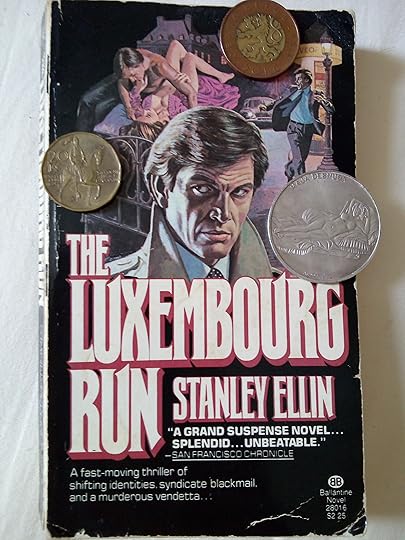
Stanley Bernard Ellin was a mystery writer of short stories and novels. He won the Edgar Allan Poe Award three times and the Grand Prix de Litterature Policiere once, and in 1981 he was awarded with the Mystery Writers of America's highest honor, the Grand Master Award.
For my UN challenge this title was given to me, because I could find no other Luxembourg mystery. I learned absolutely nothing about Luxembourg (except it's dirty). RUN is the operative word in this title. There was a RUN TO Luxembourg and then a RUN AWAY from Luxembourg. Still, having no other, this is my UN entry.
There is a lot of "other than English dialog", and the author does translate almost all of the time, and I was able to get the gist the other times, so I was not put off the book. BUT If you must understand every word and don't speak Dutch, French, Italian...keep a few translation dictionaries at your side!
I liked the brief glimpse of how to survive Europe with no money, something I am definitely not cut out for, but I believe a number of my contemporaries have done it. I’m apparently not cut out for the “newly rich” lifestyle either!
I would have liked this novel more, if it had described in depth how the crimes were committed. The premise was set within a financial realm of which I have little knowledge. I do think that how they got away with the goods, was ingenious.
Loyalties are strong here and as they say: Revenge is a dish best served cold.
A young man faces an attack of some kind from three other men, who do him great harm. Unbeknownst to them, he escapes, but he will never get over what they have done. By sheer good luck, he comes into great wealth. He sets out to get revenge, striking at them wherever they are most vulnerable, depriving them of fortune, of love, and perhaps of life itself.
That is the story of the famous novel, The Count of Monte Cristo. It is also the plot of The Luxembourg Run by Stanley Ellin. I have not seen this resemblance mentioned, but I suspect that it has not gone unremarked. Ellin was a very fine author in his own right, and I am sure that he intended the resemblance to be noted.
Ellin's protagonist and narrator is David Shaw, an American raised by his beautiful mother and his diplomat father in America and Europe, becoming "fluent in French and Dutch, competent in Spanish, Italian, and German, and [having] a fair smattering of what might be called kitchen Greek." His parents divorce and he is raised largely in a boarding school in France, and then goes on to college in America. His mother marries a "Greek gentleman who lived in Rome." His father marries a series of ever younger women. Something David does inadvertently helps expose his father to scandal. David drops out of college, moves to Paris, and takes on a new identity.
David becomes Jan van Zee, supposedly Dutch. To get proper identification papers, he must work with criminals, including a woman with whom he has a romantic liaison. When offered a position representing the criminals in America, he flees, taking up a new life and moving to Amsterdam. But he is tracked down by the crooks and offered a highly paid job in Europe, which he can carry out together with a woman with whom he is in love. Then everything goes wrong, and his life is totally changed once more.
Stanley Ellin was perhaps the best English language writer of short mystery stories of all time, and some of his novels were likewise excellent. Ellin won the Edgar Allan Poe Award three times and the Grand Prix de Littérature Policière once, and in 1981 he was awarded with the Mystery Writers of America's highest honor, the Grand Master Award. His first published story, "The Specialty of the House," is still widely regarded as one of the best fiction debuts in the mystery field, maybe the very best ever.
The Luxembourg Run is not a great book. The main character, David Shaw, is too perfect to be believable. He is the narrator, so it is possible that he simply chooses not to discuss any flaws he might have, but everything that is portrayed shows him as brave, brilliant, resilient, and absolutely irresistible to women.
But the book is a very impressive thriller, which is certainly a good enough reason to read it and enjoy it. And then pick up one of Ellin's collections of short stories and see a fine author at his scintillating best.
I enjoyed it most of the way through, an urbane, sophisticated thriller that follows the course of a somewhat aimless young American who absconds from his Ivy Leage university to live amongst the counter culture of Europe, being drawn into criminality that ends with a murderous double-cross and a thirst for vengeance - a Count Of Monet Cristo updating, in short. I was hooked and entertained until the childhood friend whose crush on him has persisted and shaped her life - it's okay she doesn't mind - turns up and while adoringly chiding him for his ruthless actions, still adores him - and then the climax turns on another woman having an enduring crush on him, and it was all a bit much, frankly of Strong Female Characters utterly besotten with a charismatic paragon, and I was skipping paragraphs and pages by then anyway, where before I'd enjoyed every sentence and change of scene and each new twist and coil of the plot and the ramping up of pace and tension.
Considerably stronger in its first third, as a disgraced diplomat's son flees to live hand-to-mouth amongst the European counter culture, than in its remainder, Ellin's normal home ground of the thriller, though that does little to disappoint. Ellin's prose - a mixture of Fleming's urbane detailing and cosmopolitan knowledge, King's facility with character and gritty reality - continues to be a delightful, easy read, and there's plenty of twists and turns along the way.
On the other hand, our protagonist seems a little too assured and capable, and there's a late romance that seems a little facile - and doomed for heartbreak or betrayal, so it's weird when that doesn't happen - as does the Get Out of Jail Free card played close to the end.
at ten, a silent and observant little boy already fluent in half dozen languages, was being dragged through the capitals of Europe by his diplomat father.at twenty, in the midst of the troubled 60s, he abruptly disappears from his Ivy League college-to be reborn as Jan van Zee. at thrirty, he is cruelly betrayed and left for dead by the syndicate-now he's out for revenge. he reverts back to his real identity and returns to America to claim his inheritance to execute a vengeance against three bosses. the climax is shocking
David Shaw left college & changed his name to Jan van Zee. He transported heroin for a man named Kees Barr who in exchange will get an illegal passport for Shaw. On one of his heroin runs, he is held-up, the heroin taken, & his car goes down a deep gorge & burns. The men who held him up believe he died. He didn't. He spends his time trying to find out who robbed him & is determined to see them dead. This was a difficult book for me to keep track of what was going on. Maybe you'd have better luck in reading it.
this excellent read seemingly like a modified The Count of Monte Cristo premise written in the author's inimitable style.
the best book I read so far on the 2-month long Prague vacation. I also privileged to see Karlovy Vary (Carlsbad), a spa resort town of 19th-century provenance now owned by Russian oligarchs in western Bohemia ... a setting for another novel, Vagabond, by Seymour Gerald.
Just barely interesting enough to see how the ploy plays out that i waited until the end, I found the lead character utterly tiresome ... unceasingly and inexplicably proficient at everything he sets his mind to, motivated to revenge for the murder of a woman who plainly existed in the storyline only to be murdered to provide his motivation, and invariably the object of desire of any woman he meets. The villains' comeuppance lacked the cleverness of a Ross Thomas novel, and for the most part seemed very rote. Not recommended.
My wife grew up in Luxembourg, and I have visited a few times. It has always seemed the perfect setting for a certain type of international caper book ...(Medieval settings, banking, hidden accounts, etc.) and yet there just is not much out there. When I came across this title I pounced, being drawn in both by the (presumed) setting and the author's reputation.
It turned out to be an international, cold-war era, crime/thriller type book of the "revenge" genre. The action moved all over Europe over a ten year time period, with one excursion into Luxembourg ... a "run" as it were.
I admit to liking it a lot. The plot was wonderfully complex and believable in a Hollywood action-movie kind of way, with numerous characters, hidden identities, and scammers galore. This was crammed into 272 pages ... complete with fully-sketched personalities. This was impressive, and also delightful. (Lots of great movie parts should anyone ever get the idea.)
If you have a couple of free afternoons and want to lose yourself in a 1950'-1970's jet-setting crime novel ... this could be just the ticket.
Needing to escape his father’s demand he become what his father wants him to become, and his grandfather’s support of this, David Shaw leaves for Europe, where he becomes a kind of leader to the hippies of the time; falls in love; discovers a way to make a lot of cash by smuggling drugs a few times a year, finds himself double crossed, left for dead, and his pregnant partner killed.
Discovering his grandfather has died leaving him a $10 million dollar fortune, Shaw seeks those that were responsible for his partner’s murder and force each to go through what he has endured.
This well constructed, complicated revenge novel, full of love, suspense, and well drawn characters has been given the Midas touch – a classic by a Mystery Writers Grand Master.